
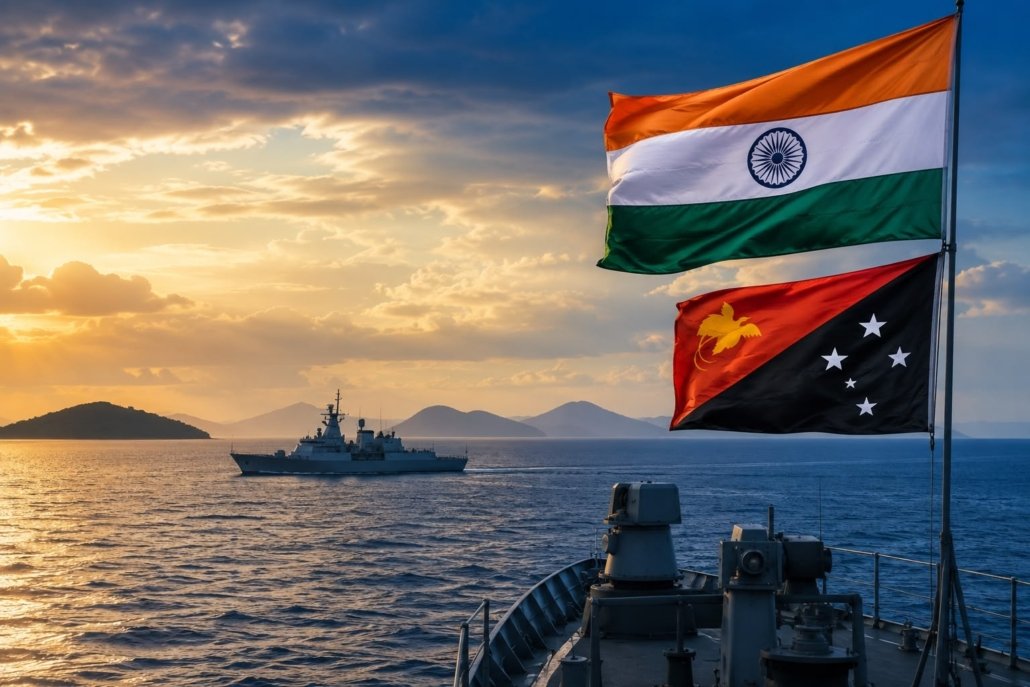
Strategic Overview
The Indo-Pacific has assumed very considerable strategic importance in global geopolitics, elevating the significance of every segment and sub-segment of this vast and predominantly (albeit not exclusively) maritime space. While global attention is currently riveted upon the western segment of the Indo-Pacific (that is, the Indian Ocean) and the sub-segment of West Asia, New Delhi needs to careful not to get blindsided by events in the Persian Gulf and must remain conscious of the sharply increasing geopolitical importance of the diagonally opposite segment, namely the South Pacific and, in particular, the island nations that are collectively referred-to as “Pacific Island Countries” (PICs). As the Wei Chi game moves of China play out in this south-eastern segment (the Pacific Ocean) of the Indo-Pacific, countries that have developed their strategic moves from derivatives of chess are likely to find that have prepared for the wrong game. China’s security pact with the Solomon Islands in 2022 signalled Beijing’s intent to establish a strategic foothold in the Pacific, triggering alarm across the Indo-Pacific and accelerating engagement by the United States (US), Australia, and Japan.[1] However, even beyond “China versus the Rest” considerations, the PICs command growing geopolitical attention owing to their position astride critical maritime routes, their vast Exclusive Economic Zones (EEZs), and the undersea cable networks traversing their waters — infrastructure that is vital to global trade, communications, and digital connectivity. Geopolitical uncertainty emanating from the US has begun to adversely impact the fundamental institutional architecture underpinning Indo-Pacific security. Consequently, if nothing else, the US-Israel–Iran conflict has reminded the world at large just how rapidly and unpredictably maritime security can unravel and that no single power — howsoever capable — can be relied upon as an unconditional guarantor of security.
India’s engagement with the Pacific has grown out of a broader strategic reorientation. India, which has long been criticised for a continental obsession wherein it remained preoccupied with its land frontiers at the expense of its maritime interests, has, of late, been reclaiming its oceanic identity. The “Look East” policy of 1991 and its evolution into the more assertive “Act East” policy of 2014, reflects a deliberate maritime reorientation and serves to highlight the enormous economic opportunities of the Indo-Pacific.[2] Contemporary New Delhi recognises that while multilateral mechanisms such as the Quad have expanded cooperation across the Indo-Pacific, bilateral partnerships are increasingly indispensable for translating broader strategic objectives into sustained local engagement. India’s economic interests reinforce this strategic logic. As a trade-dependent economy deeply integrated with global supply chains, India has a direct stake in secure and stable maritime pathways. The undersea cable networks threading through Pacific Island waters, as also the deep-sea mineral wealth within their EEZs, are not abstract assets — they are material interests that demand active engagement and protection.
India’s engagement with the PICs found institutional expression in the Forum for India–Pacific Islands Cooperation (FIPIC), conceptualised at the first FIPIC Summit held in Suva, Fiji, in 2014.[3] The forum links India with 14 Pacific Island nations — the Cook Islands, Fiji, Kiribati, Marshall Islands, Micronesia, Nauru, Niue, Palau, Papua New Guinea, Samoa, Solomon Islands, Tonga, Tuvalu, and Vanuatu — advancing cooperation across strategic, economic, and developmental spheres.[4] However, FIPIC is poorly marketed by New Delhi and, in any case, Indian capacities and capabilities are so thinly spread over the 14 constituent States of FIPIC that any initiative with limited funding gets dissipated and attenuated to the point of irrelevance. What New Delhi needs is an anchor for India’s strategy in the South Pacific — a focal point from where its endeavours can, over time, spread meaningfully across FIPIC in its entirety.
Against this backdrop, this paper avers that Papua New Guinea — the largest island State by territory and population, increasingly courted by multiple Indo-Pacific powers, and positioned at the confluence of the Pacific and Indian Ocean theatres —offers India precisely the sort of geopolitical focal point from which to expand its developmental efforts and with which India should establish a durable maritime partnership — one that is anchored in shared interests rather than being founded upon contingent geopolitical alignments. It accordingly examines the India–PNG maritime partnership, makes the case for its strategic importance, and concludes with the following five concrete recommendations:
- India should position itself as a “capability enhancement partner” rather than an “aid provider”—offering PNG interoperability with a democratic maritime power, access to India’s shipbuilding industry, and training through the Indian Naval Academy and Coast Guard, anchored by the Andaman and Nicobar Command.
- Maritime Situational/Domain Awareness (MSA/MDA) should become India’s signature contribution through a dedicated architecture of satellite-based monitoring, coastal surveillance, and real-time information sharing that strengthens PNG’s maritime sovereignty while enhancing India’s visibility across the Pacific.
- India must leverage its digital public infrastructure—including UPI, e-governance platforms, and telemedicine—as a soft-power tool, building institutional familiarity and people-to-people ties that endure beyond political cycles.
- PNG should be viewed not as an endpoint but as India’s gateway to the broader Pacific, enabling New Delhi to contribute to regional discussions on maritime governance, climate resilience, and undersea cable security as a co-architect of Pacific order.
- Rather than competing with China’s infrastructure spending, India should play the long game by remaining a consistent, reliable, and institutionally embedded partner, making sustained engagement its principal strategic advantage as debt fatigue and governance concerns surrounding Chinese projects continue to grow.
India and Papua New Guinea’s Interests in the Pacific Maritime Domain
The Pacific as a Strategic Theatre
The Pacific Ocean (better thought-of as the eastern segment of the Indo-Pacific) can no longer be an afterthought in New Delhi’s geopolitical thinking. The PICs collectively command EEZs totalling approximately 30 million square kilometres.[5] The undersea cables threading through their waters carry an estimated 95 per cent of international internet and financial data traffic.[6] And beneath the Pacific seabed lie significant deposits of polymetallic nodules, cobalt-rich crusts, and seafloor massive sulphides — resources central to the global energy transition.[7] Within this landscape, Papua New Guinea (PNG) occupies a position of particular significance — the largest Pacific Island State by territory, population, and resource endowment, sitting at the confluence of the Pacific and Indian Ocean strategic theatres.
India’s Strategic Interests
India’s engagement with the Pacific must be understood against the backdrop of a fundamental shift in strategic orientation. For decades, India’s attention was dominated by its land frontiers. The “Look East Policy” (1992), which evolved into the “Act East Policy” (2015), extended India’s strategic horizon eastward.[8] Simultaneously, the maritime policy of SAGAR (2015) — Security and Growth for All in the Region — articulated India’s maritime engagement as one premised on cooperation and shared prosperity. Its successor, the maritime policy of MAHASAGAR (2025) — Mutual and Holistic Advancement for Security and Growth Across Regions — announced by Prime Minister Modi in 2025,[9] deepened and expanded this considerably. Where SAGAR established the foundational principle of India’s foreign policy approach within the maritime domain, MAHASAGAR extended the ambition, explicitly positioning India as a preferred provider of holistic security across the Indo-Pacific, and signalling that New Delhi’s maritime interests could no longer be contained within its immediate neighbourhood but would increasingly encompass the Globa South as a whole.
India’s interests in the Pacific are strategic, economic, and diplomatic. With approximately 95 per cent of its trade by volume transported by sea, secure shipping lanes and resilient regional infrastructure are vital to its prosperity.[10] The region’s seabed mineral resources are also of growing strategic importance and India’s Deep Ocean Mission (2021) reflects its increasing investment in ocean science and deep-sea technologies, opening new avenues for cooperation with Pacific Island Countries (PICs). [11] Beyond the maritime domain, the fourteen PICs are also important partners in advancing India’s Global South agenda and support for UN Security Council reform.
India has been a dialogue partner of the Pacific Islands Forum (PIF)[12] since 2002, but it took another decade — through the launch of FIPIC in November of 2014 — for New Delhi’s engagement of the PICs to acquire the requisite sharpness of focus.
Papua New Guinea’s Strategic Interests
PNG’s strategic interests are shaped by its extraordinary resource endowment, its geographic exposure, and its determination to exercise genuine sovereignty amid intensifying great-power competition. Its LNG sector, mineral wealth, and productive fisheries, have all served to attract significant external interest. Its geographic position — along key maritime approaches to the Coral Sea, the Bismarck Sea, the Solomon Sea and the Torres Strait[13] — makes it a security priority for Australia and an emerging one for the United States, as reflected in their 2023 defence agreement.[14] For PNG, managing these external interests without compromising sovereignty is a central strategic challenge. PNG Prime Minister James Marape has been explicit about diversifying external partnerships — his warm reception of PM Modi at the third FIPIC Summit in Port Moresby (May 2023) reflected a strategic calculation that India offers PNG an alternative to over-dependence on any single power.[15]
Convergence of Interests
Both countries share a stake in a rules-based maritime order that protects freedom of navigation, upholds EEZ integrity, and resists coercive use of economic or military power. Both seek to diversify external partnerships as a hedge against strategic overdependence. India brings naval capability, technological expertise, and a development model free of debt conditionality; PNG brings strategic location, resource endowment, and institutional weight within the Pacific Islands Forum. India recognised PNG’s independence in 1975, established its High Commission in Port Moresby in 1996, and maintains people-to-people ties through the Indian diaspora.[16] These are modest but real foundations upon which a strategically substantive partnership can be built.
While India will continue to engage all fourteen Pacific Island Countries through FIPIC, the depth of bilateral engagement need not be uniform. PNG’s combination of maritime significance, economic potential, strategic geography, and regional influence makes it the strongest candidate to anchor India’s long-term maritime engagement in the Pacific.
Trade and Economic Engagement
India’s trade with PNG, while modest in absolute terms, is the most significant of any Pacific Island partner and holds considerable growth potential. According to data published by the Government of India, total India-PNG trade reached US$ 729.20 million in 2022-23, making PNG India’s leading trade partner among the PICs by a substantial margin.[17] Partial-year data for April 2023-January 2024 indicate a decline to US$ 432.60 million, largely driven by reduced Indian imports from PNG.[18]
PNG’s resource-dependent economy, limited industrial capacity, recurring foreign exchange shortages, and logistical bottlenecks constrain the volume and diversity of goods available for export, while geographic distance and the absence of direct shipping links raise transaction costs on both sides. Nevertheless, dyadic trade patterns reveal a marked structural asymmetry. India’s imports from PNG far exceed its exports, generating a trade deficit of US$ 317.82 million, primarily due to imports of liquefied natural gas (LNG), gold, and other minerals.[19]
There is a clear need for India to move beyond a minerals-import relationship toward genuine two-way economic engagement — in pharmaceuticals, ICT, agro-processing, renewable energy, and fisheries governance. Such diversification would align with FIPIC’s development priorities while giving the bilateral economic relationship the depth and resilience that trade in a single commodity category cannot provide.
Sources of Maritime Insecurity in the Pacific
Great-Power Competition and Strategic Encroachment
China’s security pact with the Solomon Islands in 2022 was a defining moment — the first time Beijing secured a strategic foothold in the Pacific proper.[20] China has since pursued debt-financed infrastructure across multiple PICs, with ten of the fourteen FIPIC member States now accepting the “One China Policy”.[21] Beijing’s Foreign Minister Wang Yi’s 2022 tour of eight Pacific nations signalled a systematic effort to embed China in the region’s political, security, and economic architecture.[22] The United States has responded with defence pacts (including with PNG in 2023) and the Indo-Pacific Economic Framework.[23] Australia’s Pacific Step-Up has attempted to reassert its traditional role.[24] The risk is that Pacific Island nations are reduced to instruments in a larger contest, undermining their sovereignty and agency.
Non-Traditional Maritime Threats
PNG’s EEZ of approximately 2.4 million square kilometres is one of the largest in the Pacific, yet remains severely under-monitored.[25] Illegal, unreported, and unregulated (IUU) fishing by foreign vessels — including those from China — is a persistent and economically damaging problem. Trafficking networks, too, exploit these under-monitored waters. Climate change is intensifying the frequency of extreme weather events, placing growing HADR demands on States with limited capacity. Undersea cable networks traversing Pacific waters are vulnerable to sabotage and accidental disruption — a concern that has grown as cable ownership has become an arena of strategic competition.[26]
India’s comparative advantage also lies in its record as a dependable first responder during humanitarian crises. Its assistance following the landslide in PNG’s Enga Province demonstrated its ability to provide timely humanitarian support beyond the Indian Ocean, reinforcing its image as a trusted security and development partner.[27] Such responses build confidence and complement India’s broader vision of being a preferred security partner across the Indo-Pacific.
Governance Gaps
PNG’s internal governance challenges — including frequent government transitions and law-and-order pressures — complicate the development of durable maritime institutions. The absence of a robust regional maritime security architecture means that threats are often addressed reactively and in isolation. These gaps create both a need and an opportunity for capable external partners willing to engage on terms that respect PNG’s sovereignty.
India and PNG’s Individual Contributions to Maritime Security
India’s Maritime Capacities and Capabilities
The Indian Navy has steadily reinforced its Indo-Pacific posture, with the Andaman and Nicobar Command (ANC) serving as India’s only tri-Service theatre command and its most Pacific-facing strategic asset.[28] The Indian Coast Guard maintains an active regional engagement model, and India’s Information Fusion Centre – Indian Ocean Region (IFC-IOR), established in 2018, has emerged as a principal hub for maritime information exchange with 76 linkages across 28 countries. India has deployed coastal surveillance radar networks with partners across the Indian Ocean littoral and has supplied patrol vessels and maritime enforcement equipment to multiple island states. The “Indian Technical and Economic Cooperation” (ITEC) programme complements these efforts by providing training, scholarships, and capacity-building opportunities for civilian officials and defence personnel from partner countries.[29]
Recent Indian Naval engagements in PNG signal its enhanced operational presence in the South Pacific. The August 2025 “India–Fiji Defence and Security Action Plan” — including plans to station a Defence Attaché in Suva, enhanced maritime surveillance training, and the establishment of a “Cyber Security Training Cell” — demonstrates India’s willingness to move beyond declaratory engagement toward operational presence.[30] This growing operational profile was further reinforced when the INS Kadmatt led the mobile fleet review during Papua New Guinea’s 50th Independence celebrations, underscoring India’s expanding naval diplomacy and visibility in the South Pacific.[31] India’s shipbuilding industry and its “Maritime Amrit Kaal Vision 2047” further position it as a credible provider of maritime assets to partner States.[32]
PNG’s Maritime Capabilities
PNG’s Defence Force Maritime Element has limited blue-water capacity relative to the scale of its maritime responsibilities. PNG engages with regional maritime governance through the Pacific Islands Forum (PIF) but lacks the resources to independently monitor and enforce its vast EEZ. Its engagement with Australia, the United States, and increasingly India, reflects an awareness that external partnerships are necessary to bridge this capacity gap. PNG’s strategic location is simultaneously its greatest asset and its most significant vulnerability — making it a prize for external powers and a potential flashpoint if governance gaps are not addressed.
The Strategic Gap
India has reach without Pacific presence; PNG has presence without adequate capability. This complementarity is the core logic of partnership. India’s offer must not be limited to the provision of contingency-driven aid — it must, instead, incorporate the transfer of proven maritime capability to a sovereign partner with strategic location and a compelling need. That framing is both more accurate and more durable than a donor-recipient model.
The Case for an Elevated India–PNG Maritime Partnership
From FIPIC to Bilateral Depth
There can be little doubt that FIPIC has provided a useful multilateral framework. However, multilateral platforms are, by their nature, constrained in the depth of engagement they can sustain across fourteen partner States simultaneously. The third FIPIC Summit in Port Moresby (May 2023) — the first held in PNG — was a significant moment: PM Modi’s 12-point Action Plan included the establishment of a “Regional Cybersecurity Hub” for PNG, sea ambulances, solar projects, and Sagar Amrut Scholarships.[33] Speaking at this summit, Prime Minister Modi emphasised the significance of the PICs by stating that these nations should not be perceived as “Small Island Developing States” but rather as “large ocean countries.”[34] This framing signals India’s strategic recognition of the region: despite their modest landmass, PICs control vast exclusive economic zones, hold key natural resources, and occupy critical maritime routes. For India, engagement with the Pacific is, therefore, less about size and more about strategic leverage and economic opportunity. PNG’s Prime Minister Marape, in turn, signalled that PNG wants a deeper relationship, not merely inclusion in a multilateral programme. A dedicated bilateral framework is clearly the logical next step.
India as a Credible Alternative
China’s model in the Pacific, involving infrastructure at a scale far larger than can be maintained or utilised by recipient States, its opaque financing, and its strategic conditionality, has generated growing debt distress and governance concerns across the PICs. India’s comparative advantage lies precisely in what China structurally cannot offer: democratic legitimacy, transparent partnerships, technology transfer without data dependency, and maritime capability built on decades of Indian Ocean experience. India is not seeking to match China’s spending — it is offering something different and, for many Pacific leaders, something that is far more trustworthy.
PNG as Gateway and Anchor
As the largest PIC and an active participant in Pacific regional institutions, PNG has diplomatic heft that smaller island States simply cannot match. A strong India–PNG partnership gives India credibility and visibility across the Pacific that no multilateral platform can provide in and of itself. PNG’s own interest in diversifying partnerships — demonstrated by its simultaneous engagement with Australia, the US, China, and India — makes it a willing anchor rather than a reluctant partner. India should read PNG’s 2023 defence pact with the United States not as a closed door but as confirmation that PNG is cultivating multiple relationships to preserve its strategic autonomy.[35] India’s task is to ensure it is among the partners PNG values most.
Policy Recommendations
The India–PNG partnership should be advanced as a mutually reinforcing maritime and developmental compact — one that strengthens PNG’s sovereignty and resilience while enhancing India’s strategic presence and maritime interests across the Pacific. The five major policy recommendations. which have already been mentioned in the “Strategic Overview” segment of this paper may be elaborated as follows:
- Lead with Capability Enhancement, Not Capacity Building.
India should position itself as a capability enhancement partner rather than a capacity builder. This means offering PNG what China structurally cannot: interoperability with a democratic maritime power, access to India’s indigenous shipbuilding industry for patrol and offshore support vessels, and training pipelines through the Indian Naval Academy and the Indian Coast Guard. Strategic port sites — particularly Port Moresby and Manus Island, the latter already of significant interest to the United States and Australia — offer opportunities for dual-use infrastructure development. This means that facilities built for commercial shipping, bunkering, and logistics can also support naval resupply, maintenance, and operational staging, extending India’s reach into the Pacific while directly serving PNG’s sovereign maritime needs. The Andaman and Nicobar Command (ANC) — India’s only tri-Service theatre command — should serve as the institutional anchor for this exchange. The framing must be explicitly peer-to-peer: two sovereign maritime nations building shared capability as allies, not as donor and recipient.
- Make Maritime Domain Awareness India’s Signature Contribution.
PNG’s EEZ is among the largest in the Pacific, yet one that remains significantly under-monitored, leaving it vulnerable to IUU fishing, trafficking, and encroachment by State and non-State actors. India should offer PNG a dedicated MSA/MDA architecture — combining satellite-based monitoring, coastal surveillance systems, and real-time information sharing — drawing on the systems India has already deployed across the Indian Ocean littoral through IFC-IOR. This is an area where India has genuine expertise, where China’s offering carries inherent trust deficits, and where the strategic dividend for India — visibility into Pacific waters — is direct and tangible. Beyond bilateral cooperation, India should also seek to institutionalise maritime information-sharing between the Indian and Pacific Oceans. This could include exploring cooperation between the IFC-IOR and the Pacific Fusion Centre through information-sharing arrangements, joint analytical exchanges, and opportunities for Pacific Island Countries, including Papua New Guinea, to engage more closely with IFC-IOR. Over time, India could encourage the placement of liaison officers from interested Pacific Island Countries at the IFC-IOR, strengthening maritime situational awareness (MSA) and information-sharing that would lead towards maritime domain awareness (MDA) and helping bridge the Indian and Pacific maritime security architectures.
- Use Technology and Digital Infrastructure as Soft Power.
India and PNG have already laid the foundations for digital cooperation through the MoU between India’s Ministry of Electronics and Information Technology (MeitY) and PNG’s Ministry of Information and Communications Technology (MICT).[36] India’s digital public infrastructure, such as UPI, e-governance platforms, and telemedicine, represents a genuinely differentiated offering in the Pacific. Unlike Chinese infrastructure, which typically creates hardware dependency and data vulnerability, India’s digital stack is open, interoperable, and replicable. Deploying these tools in PNG — particularly in remote coastal and island communities — would deepen India’s people-to-people presence, build institutional familiarity with Indian systems, and create durable ties that outlast any single government in Port Moresby.
- Position PNG as India’s Gateway into the Broader Pacific.
India should treat PNG not as an endpoint but as an entry point into the wider PIC network. A deepened India–PNG partnership — with PNG as a relatively large, stable, and strategically significant anchor — gives India credibility, visibility, and diplomatic reach across the Pacific that it currently lacks. India should work with PNG to shape regional conversations within the Pacific Islands Forum on maritime governance, climate resilience, and undersea cable security — areas where India has both interests and something substantive to offer. This positions India as a co-architect of Pacific order rather than an external power, seeking influence.
- Play the Long Game on China’s Debt Fatigue.
India should not attempt to match China’s infrastructure spending in PNG or the broader Pacific. Chinese projects in PNG and across the PICs have already generated significant debt distress, local resentment, and governance concerns. India’s strategic opportunity lies in being visibly present, consistently reliable, and institutionally embedded when that fatigue reaches a tipping point. This means sustained engagement — regular naval visits, consistent training exchanges, follow-through on commitments — over headline announcements. Reliability over time is India’s most powerful competitive advantage against China’s transactional model, and it costs far less.
Conclusion
The Pacific is no longer peripheral to India’s strategic calculus. The convergence of great-power competition, vulnerabilities in critical maritime infrastructure, and India’s growing dependence on secure maritime sea lanes underscores the need for a sustained Indian presence in the Pacific. In this evolving strategic landscape, Papua New Guinea stands out as India’s natural maritime partner—combining strategic geography, regional influence, and a shared interest in preserving a stable, rules-based maritime order. The India–PNG partnership is therefore not merely another bilateral relationship; it has the potential to serve as the anchor of India’s broader Pacific strategy.
India’s comparative advantage lies not in matching the financial resources of larger powers, but in offering credible maritime capabilities, trusted capacity enhancement, and a long-term commitment to partnership. By strengthening PNG’s ability to secure its maritime domain while deepening its own engagement in the Pacific, India can advance the strategic interests of both countries and contribute meaningfully to a more secure, resilient, and inclusive Indo-Pacific. For India, the question is no longer whether the Pacific matters, but how it chooses to engage it. In Papua New Guinea, it has an opportunity to establish a durable maritime partnership that will shape its Pacific presence for decades to come.
********
About the Author
Ms Kripa Anand is a Research Associate at the National Maritime Foundation (NMF). Her research encompasses maritime security issues, with special focus upon the manner in which India’s own maritime geostrategies are impacted by the maritime geostrategies of the island-States of Oceania in general and Australia and New Zealand in particular. She may be reached at ocn1.nmf@gmail.com.
Endnotes:
[1] Zongyuan Zoe Liu, “What the China-Solomon Islands Pact Means for the U.S. and South Pacific”, Council on Foreign Relations, 04 May 2022. https://www.cfr.org/articles/china-solomon-islands-security-pact-us-south-pacific.
[2] Abhyuday Saraswat, “India’s Island Outreach”, Indian Defence Review, May 2023. https://indiandefencereview.com/indias-island-outreach/.
[3] Government of India, Ministry of External Affairs, “About FIPIC”, Forum for India – Pacific Islands Cooperation (FIPIC). https://fipic.ficci.in/about.html.
[4] “About FIPIC”, Forum for India – Pacific Islands Cooperation (FIPIC), Ministry of External Affairs, Government of India.
[5] RD Gillett, “Foreword: Pacific Island Fisheries – Regional and Country Information”, 2002.
https://www.fao.org/4/ac682e/ac682e03.htm.
[6] Samuel Bashfield and Anthony Bergin, “Options for Safeguarding Undersea Critical Infrastructure: Australia and Indo-Pacific Submarine Cables”, Australian National University, 14 June 2022. https://nsc.anu.edu.au/content-centre/research/options-safeguarding-undersea-critical-infrastructure-australia-and-indo.
[7] “Cobalt-rich Crusts”, International Seabed Authority. https://isa.org.jm/wp-content/uploads/2022/06/eng9.pdf
[8] Abhyuday Saraswat, “India’s Island Outreach,” Indian Defence Review, May 2023. https://indiandefencereview.com/indias-island-outreach/.
[9] “2025 Edition of the Indo-Pacific Regional Dialogue (IPRD-2025), National Maritime Foundation. https://maritimeindia.org/indo-pacific-regional-dialogue-2025/.
[10] Government of India, Press Information Bureau (PIB) Backgrounder, “Maritime India: From Vision 2030 to Amrit Kaal 2047”, 26 Oct 2025. https://www.pib.gov.in/PressReleasePage.aspx?PRID=2182563®=48&lang=2.
[11] Government of India, Press Information Bureau (PIB), “Deep Ocean Mission: India’s Gateway to the Ocean”, 17 Aug 2025. https://www.pib.gov.in/PressNoteDetails.aspx?NoteId=155043&ModuleId=3®=48&lang=2.
[12] Government of India, Ministry of External Affairs, Media Centre, “Visit of Minister of State (External Affairs) to Kingdom of Tonga (August 27-29, 2024)”, 25 August 2024. https://www.mea.gov.in/press-releases?dtl/38226/.
[13] Australian Government, Department of Agriculture, Fisheries and Forestry, “Papua New Guinea – Australia Fisheries Cooperation”, 10 Oct 2021. https://www.agriculture.gov.au/agriculture-land/fisheries/international/cooperation/png.
[14] US Embassy to Papua New Guinea Media Note, “The United States and Papua New Guinea Sign New Defense Cooperation Agreement and Shiprider”, 22 May 2023. https://pg.usembassy.gov/the-united-states-and-papua-new-guinea-sign-new-defense-cooperation-agreement-and-shiprider/.
[15] Government of India, Ministry of External Affairs (MEA), “English translation of Prime Minister’s opening statement at the FIPIC III Summit”, 22 May 2023. https://www.mea.gov.in/outoging-visit-detail?36587/english_translation_of_prime_ministers_opening_statement_at_the_fipic_iii_summit.
[16] High Commission of India, Port Moresby, Papua New Guinea, “India-Papua New Guinea Bilateral Relations”, 22 June 2026. https://www.hcipom.gov.in/page/india-papua-new-guinea-bilateral-relations/.
[17] High Commission of India, Port Moresby, Papua New Guinea, “Fact Sheet on Papua New Guinea”, High Commission of India, Port Moresby, Papua New Guinea, 2022. https://www.hcipom.gov.in/page/fact-sheet-on-papua-new-guinea/
[18] High Commission of India, Port Moresby, Papua New Guinea, “Monthly Commercial Report on Papua New Guinea (PNG) & Solomon Islands (SIs)”, 01 June 2024. https://www.imcnet.org/storage/content_gallery/international_collaborations/Papua%20New%20Guinea%20&%20Solomon%20Islands-%20MCR%20April%202024.pdf.
[19] High Commission of India, Port Moresby, Papua New Guinea, “Fact Sheet on Papua New Guinea”, 2022.
[20] Joseph Hammond, “China’s Security Agreement with the Solomon Islands: Wider Implications for Geopolitics in the South Pacific”, Journal of Indo-Pacific Affairs (Maxwell Air Force Base, AL: US Department of Defense, December 2023). https://media.defense.gov/2023/Nov/14/2003340194/-1/-1/1/VIEW%20HAMMOND%20-%20JIPA.pdf.
[21] Inés Arco Escriche, “China in the South Pacific: geopolitical competition and local agency”, Barcelona Centre for International Affairs (CIDOB), Nov 2023. https://www.cidob.org/en/publications/china-south-pacific-geopolitical-competition-and-local-agency.
[22] Stephen Dziedzic, “Chinese Foreign Minister Wang Yi visiting multiple nations as Pacific push continues”, ABC News, 24 May 2022. https://www.abc.net.au/news/2022-05-25/chinese-foreign-minister-visit-pacific-countries/101096298.
[23] US Department of State, Office of the Spokesperson, “Deepening U.S. Partnership with Papua New Guinea”, 21 May 2023. https://2021-2025.state.gov/deepening-u-s-partnership-with-papua-new-guinea/.
[24] Scott Morrison, “The Pacific Step-up”. https://www.scottmorrison.com.au/morrison-government-achievements/pacific-step-up.
[25] Lowy Institute, Indo-Pacific Development Centre, “Papua New Guinea,” Pacific Aid Map, Lowy Institute. https://pacificaidmap.lowyinstitute.org/country/papua-new-guinea/.
[26] John Aitken, “Undersea Cables are Vulnerable to Sabotage – but this takes Skill and Specialist Equipment”, The Conversation, 07 July 2025. https://theconversation.com/undersea-cables-are-vulnerable-to-sabotage-but-this-takes-skill-and-specialist-equipment-259417.
[27] Government of India, Ministry of External Affairs, Media Releases, “India announces immediate relief assistance worth US$ 1 million to Papua New Guinea in the wake of devastating landslide”, 28 May 2024. https://www.mea.gov.in/press-releases?dtl/37826/India_announces_immediate_relief_assistance_worth_US_1_million_to_Papua_New_Guinea_in_the_wake_of_devastating_landslide.
[28] Indian Navy, “Basic Organisation”, Indian Navy Website. https://www.joinindiannavy.gov.in/en/about-us/basic-organisation.html.
[29] “Government of India, Ministry of External Affairs, “50 years of ITEC”, 2014. https://www.mea.gov.in/Uploads/PublicationDocs/24148_REVISED_50_yrs_of_ITEC_brochure.pdf.
[30] Government of India, Ministry of External Affairs Media Release, “India-Fiji Joint Statement: Partnership in the spirit of Veilomani Dosti”, 25 Aug 2025. https://www.mea.gov.in/bilateral-documents?dtl/40044/IndiaFiji_Joint_Statement_Partnership_in_the_spirit_of_Veilomani_Dosti_August_25_2025
[31] Government of India, Ministry of Defence, “INS Kadmatt Leads Mobile Fleet Review at Papua New Guinea’s 50th Independence Day”, Press Information Bureau, 06 Sep 2025, https://www.pib.gov.in/PressReleasePage.aspx?PRID=2164385®=48&lang=2.
[32] Government of India, Press Information Bureau (PIB) Backgrounder, “Maritime India: From Vision 2030 to Amrit Kaal 2047”, 26 Oct 2025.
[33] “At FIPIC III Summit, PM Modi Announces 12-step Action Plan to propel India’s partnership with Pacific Island Countries”, India News Network, May 2023.
[34] Dipanjan Roy Chaudhary, “Pacific Isle Nations Large Ocean Countries, Not Small States: PM Narendra Modi”, The Economic Times, May 2023. https://economictimes.indiatimes.com/news/india/pm-modi-reaffirms-support-for-capacity-building-efforts-in-pacific-island-nations/articleshow/100416277.cms?from=mdr.
[35] “The United States and Papua New Guinea Sign New Defense Cooperation Agreement and Shiprider”, US Embassy to Papua New Guinea, 22 May 2023.
[36] Government of India, Press Information Bureau (PIB) Backgrounder, “India’s Digital Public Infrastructure: Setting a global benchmark for population-scale DPI”, 06 Mar 2026. https://www.pib.gov.in/PressReleasePage.aspx?PRID=2235812®=3&lang=2.


Leave a Reply
Want to join the discussion?Feel free to contribute!