
With less than 6% of India’s overseas trade being carried on Indian-flagged or Indian-owned vessels till FY19, the reliance of Indian trade upon foreign-flagged vessels and its consequent vulnerability is well-known to the Government of India.[1] While in 2025, Shri Hardeep Singh Puri, the Minister of Petroleum and Natural Gas, has claimed that 20% of India’s energy cargo is carried on India-flagged and India-owned vessels, he nonetheless identifies this dependence upon foreign-flag shipping as a challenge to India’s energy security and her economic progress.[2] The approach that the Government of India has adopted involves incentivising flagging in India, enhancing ship manufacturing, and ship ownership to increase the pool of available Indian-flagged and Indian-owned vessels to carry Indian trade. In addition to the infusion of capital in the maritime sector through the launch of the “Maritime Development Fund” — with one of its key focus areas being the “augmentation of India’s tonnage capacity”[3] — specific initiatives include: (a) the Right of First Refusal to Indian-flagged vessels to match the lowest bid offered by foreign-flag vessels for the carriage of Central Government or Central Public Sector Enterprise cargo;[4] (b) a subsidy-scheme for Indian shipping companies participating in global tenders for importing crude oil, LPG, coal, and fertiliser cargo;[5] and (c) promoting ship leasing and financing through the “International Financial Services Centre” in India.[6] While these are certainly encouraging initiatives, the aim of this article is not to evaluate these policy initiatives. Rather, this article seeks to draw the attention of the Ministry of Ports, Shipping & Waterways; the Ministry of Defence; the Indian Navy, and the National Security Council Secretariat to the importance of creating the legal structures to transform ‘India’s tonnage capacity’ into a ‘strategic merchant fleet’. The focus of the article remains global legal frameworks for the establishment of such a strategic merchant fleet, particularly in Australia, China, France, the United States, and the United Kingdom as a “menu of policy options” that India may adopt.
The need for greater Indian-flagged or Indian-owned arises not only from commercial considerations but also from strategic ones.[7] While India’s imports and exports are adequately assured during peacetime through the commercial chartering of vessels from the global market, the disruption of maritime traffic during periods of conflict or those just preceding conflict may affect the availability of maritime services including the chartering of vessels. This was most recently demonstrated in the Strait of Hormuz closures. While in this instance it was the lack of insurance services that played a major role in the halt of maritime traffic — as opposed to hull availability — reliance on foreign maritime service providers made it more challenging for the Indian State to intervene. While the Government of India did act by establishing the “Bharat Maritime Insurance Pool” providing a sovereign guarantee to facilitate continuous maritime insurance coverage, it had to extend the scope of vessels to include “Indian-flagged or controlled vessels or vessels destined to or starting from India” as per the Ministry of Finance press release.[8] The need to include vessels destined to or starting from India was necessitated presumably by the lack of sufficient Indian-flagged or Indian-owned bottoms carrying crude oil or LNG from West Asia. While this move potentially exposes the sovereign to significant liability for the damage to a foreign hull (which is likely to be of a value significantly higher than the cargo itself), strategic considerations trump commercial considerations to ensure the movement of oil and gas.
However, this move solves the challenge of availability and pricing of insurance mechanisms which itself is contingent upon the owner and operator willing to undertake the voyage in the first place. If the shipowner or entity operating the ship does not wish to undertake a specific voyage out of safety (of hull and/or crew) or geopolitical considerations, the need for insurance would become secondary. Moreover, even if the Indian Navy chooses to escort the vessel, significant legal and diplomatic issues may arise with the escort of a foreign-flagged vessel especially if required to use force in defence of the foreign vessel’s navigational rights. This stems from the right of States in customary law and treaty law to take protective action vis-à-vis ships which have its national character.[9] While this legal position has been established, the determination of what State may confer national character upon a ship has long been contested in the jurisprudence of public international maritime law. While the right of the flag-State to extend such protection is well-recognised in law and State practice (the naval escort by the USA, UK, Soviet Union, and France of their vessels during the Tanker Wars), there has been established concurrent competence to protect by the State of nationality of the shipowner.[10] In the Oil Platforms case, the US sought to exercise the right of diplomatic protection against Iranian attacks on a foreign-flagged, American-owned vessel even though it was not the flag-State. The American claim, however, was supported by a declaration that the flag-States of these vessels had no objection to the US bringing these claims.[11] While the ICJ decided that the American claim was admissible it did not explicitly address this argument on the right to protection. An oft-quoted academic, Mr Rienow, has observed that “the right to protect ship property is an imperfect one, due to the special nature and qualities of ships’, given that the ship is a unit under the authority of the flag State. Hence, the beneficial owner’s State of nationality can only exercise the right of protection if it does not conflict with the flag State’s ‘perfect right”.[12] While diplomatic protection is relatively non-contentious, scholars have begun to argue that even the use of force may be justified on grounds of nationality of beneficial ownership as long as they remain within the bounds of the jus ad bellum principles of necessity and proportionality.[13] Therefore, while the Indian Navy may have the right to protect Indian-owned or controlled vessels, this right is subject to the approval or right of the Flag-State to exercise such protection. Moreover, it would spread the Indian Navy operationally very thin if it were to escort all vessels destined to or departing from India. Therefore, while these initiatives are predominantly framed with the objectives of conserving freight costs and preserving valuable forex reserves — which are indeed valuable objectives — the strategic dimension of ensuring transportation of supplies of “essential” or “critical’ imports during conflict and even in times of tension short of conflict, are equally strong in measure.
Indian-Tonnage vs Strategic Fleet. The idea of a strategic merchant fleet is one that undertakes commercial operations in the ordinary course of business but is available to the State to ‘requisition’ or under State direction for a specific period of time for the survival and continuity of a State during times of crisis. A strategic fleet is a subset of the nationally flagged, nationally owned, and nationally crewed fleet specifically identified and drawn from the latter by identifying the segments (sectors) and types of vessels that would be required to support strategic objectives.[14] Consequently, a strategic fleet needs to be determined by first identifying the critical needs and sectors that may need to be serviced during crisis or non-availability of reasonable commercial shipping, and then creating the structures to ensure the creation of that fleet and subsequently the mobilisation and protection of that fleet. Developing a strategy by identifying such requirements and analysing the current shortfall may also allow policymakers to gear policy benefits towards certain types of vessels of a particular capacity to be built in Indian shipyards or be Indian-owned and Indian-flagged. This exercise is not one that should be put off until India’s shipbuilding industry takes off and policy efforts to promote Indian-tonnage bear fruit. Rather, it is an exercise that must be taken simultaneously to calibrate our efforts towards also building a ‘strategic’ fleet in India. A strategic fleet can be organised around three main segments, each of which is discussed in the succeeding paragraphs.
Fleet Supporting the Armed Forces
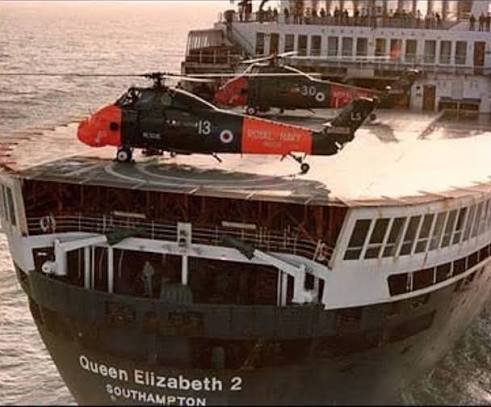
This segment supports the mobilisation of the defence forces and assists with any operational and logistics requirements through the movement of troops and material. It has always received focus in defence circles, and such fleets have played a crucial role in the defence efforts of a nation. The mobilisation of the merchant marine (known as “‘Ships taken up from Trade” or “STUFT”) by the British government in 1982 for the Falklands War to maintain an 8000-mile supply chain was an important measure.[15] The vessels were requisitioned under the “Requisitioning of Ships Order 1982” issued under the Royal prerogative through “Orders in Council”.[16] Compensation to those vessels were paid under the “Compensation (Defence) Act 1939”, section 4 of which provides for a sum which might be payable for the use of the vessel under a charter or contract of hire, including operational, maintenance, and any damage occurred during the requisition. The Requisition Order of 1982 “for the defence if the realm” was applicable to all “British ships” which terms was defined as those ships registered in the UK or any of her colonies or in which Her Majesty has jurisdiction in right of the government of the UK.[17] Interestingly, in the case of MV Stena Inspector, registration was changed from Sweden to United Kingdom before the vessel was requisitioned to comply with the Requisition Order of 1982. This transfer was made possible because in 1982, the vessel was transferred to Stena Caribbean Line Ltd, which was a company registered in London, UK.[18] Therefore, it would appear that the British ownership of the vessel played a role in the decision to re-register. However, it is unclear whether the motive was patriotism — which is unlikely as the company was a subsidiary to a larger Swedish Group — or was a condition for the subsequent outright purchase of the vessel and its commissioning as the RFA Diligence in the Royal Fleet Auxiliary. In instances of foreign flag vessels, the UK Government relied upon chartering these vessels for their use.[19] A government briefing note seems to suggest that “requisitioning” as opposed to “chartering” was preferred by shipping companies due to insurance implications involved in chartering.[20]
Additionally, the law may also be utilised to prepare for any such future requisition. Learning from the challenges faced by the Royal Navy in the Falklands War to retrofit and prepare the merchant vessels for military use, China, in the year 2015, approved regulatory standards entitled “Technical Standards for New Civilian Ships to Implement National Defence Requirements”, which established specifications and design requirements of five categories of vessels, namely, container carriers, roll-on/roll-off ships, multipurpose vessels, bulk carriers, and break bulk carriers, so as to make them capable of serving defence needs, if mobilised.[21] These technical standards apply to State-owned shipbuilders as well as to private ones. These have been supported by the 2017 “National Defence Transportation Law”, which mandates this sort of civil-military fusion. These measures support the requisition measures under the 2010 “National Defence Mobilisation” law for “public interest” and “national defence requirements”, thereby creating a lower threshold for such mobilisation.[22] The 2017 “National Defence Transportation Law” mandates that the government and military must develop a catalogue of projects in the design and construction of transport infrastructure that is required to implement national defence requirements, and also strengthens the mechanisms for the purchase of certain categories of civilian vehicles relevant to national defence transportation.[23] While these mechanisms have been put in place through legislation, Chinese scholars have identified that 62.5% by tonnage of the shipping capacity controlled by Chinese entities in 2015 was foreign-flagged, and that while requisition may be justified without any specific legal provision, registering them, getting them ready for mobilisation, and getting them trained properly would be a particular challenge.[24]
The US governance structure addresses this challenge by specifically adding two additional bases upon which a “requisition or purchase, or requisition or charter” may take place. As per Chapter 563 Title 46 US Code s56301, “during a national emergency declared by Presidential proclamation, or a period for which the President has proclaimed that the security of the national defense makes it advisable”, vessels owned by citizens of the United States and even vessels under construction in the United States are liable to be requisitioned. The threshold for the invocation of this provision, however, is quite high and requires either a presidential proclamation of national emergency or national security. The State, nonetheless, retains broad powers of requisition, and the legislation enables them to requisition foreign-flagged, US-owned vessels. This is recognised within American policy as those vessels under “Effective US Control”, collectively known as the “EUSC Fleet”. Thus, although US policy-makers recognise that many US shipowners register and flag their vessels (often through foreign subsidiaries) in open registries such as Liberia, Panama, Honduras, the Bahamas, and the Marshall Islands, these vessels are available for requisitioning.[25]
The US DoD recognises that while the law is broad enough to include US-owned vessels flagged outside these five States, they will not be considered part of the EUSC fleet, which requires that the nation of registry must be “…willing and able to bring the vessel under control of the United States in an emergency for such use as the United States may wish to make of the vessel”.[26] These arrangements do not need to exist through explicit legal processes. It is sufficient for an understanding to exist that when such requisition does take place, the flag-State will not object. Therefore, these States have tacitly or explicitly consented in advance to making the US-owned ships flying their flags available for requisition to “perfect” the US claim to these vessels. Another remnant of the Second World War but re-enacted in 2013 is “Title 50” s196, which empowers the State to even requisition foreign-owned vessels which are “lying idle in waters within the jurisdiction of the United States and …[are] necessary to the national defence”. A previous version of this provision was, indeed, utilised when Danish vessels in US ports were requisitioned to support the allied effort.
However, in the hierarchy of options, the US DoD resorts to requisitioning EUSC vessels only after it has chartered vessels from the US market on a voluntary basis and has requisitioned US flag vessels.[27] These voluntary systems have also been formalised through s708 of the “Defence Production Act” and the regulations of the “Federal Emergency Management Agency” (44 CFR Part 332), which approve the making of voluntary agreements to help provide for the defence of the United States by developing preparedness programs and expanding productive capacity and supply beyond levels needed to meet essential civilian demand.[28] The “Voluntary Intermodal Sealift Agreement” (VISA) programme has been launched on this legislative framework. It allows the “Maritime Administration” (MARAD) and the US Transport Command (USTRANSCOM) to enter into contractual arrangements with willing contractors to procure shipping services on pre-determined rates.[29] The programme is open to foreign participation (though they lie at the bottom of the priority list) and also permits the contractor to enter into a vessel sharing agreement with a foreign-flagged or foreign-owned vessel to substitute for the capacity contracted. It must be clarified that all these mechanisms exist in addition to the “US Maritime Sealift Command” which owns and operates its own fleet of vessels to support mobilisation efforts. All this, taken in aggregate, demonstrates the emphasis that the US has placed on the availability of vessels during crisis and the country’s consequent creation of mobilisation mechanisms that are well-founded to serve defence needs during times of crisis.
The Transport and Maritime Services Fleet
France and Australia are excellent examples of two nations that have, through legislation and/ or policy, sought to address the availability of vessels for ensuring supply chain continuity for ‘critical’ or ‘essential’ products. France anchored the concept of a strategic fleet with economic sovereignty and introduced it initially through the 2016 “Blue Economy” Act.[30] In 2024, however, these provisions were moved to the “Defence Code”, whose Article L1335-4 states that “Ships flying the French flag may be assigned to a fleet of a strategic nature to ensure in times of crisis the security of supplies of any kind, the necessary means of communication, services and maritime works and to supplement the means of the armed forces.”[31] Article D1335-6 elaborates that the “strategic fleet” is meant for strategic purposes and designed to preserve the integrity, safety, and continuity of industrial, energy, and food supplies; port services, public transport; submarine communication cables; oceanographic research; and offshore energy extraction work.[32] This is a category than is distinct from vessels needed in “times of crisis” to support transport, refuelling, and services work. Therefore, this strategic fleet does not necessarily limit itself to times of crisis but is operative even during times of peace. Moreover, recognising that these requirements would change over time, the list is ‘capability-based’ as opposed to being a fixed list of vessels that constitute the strategic fleet.
Interestingly, while French-flagged vessels will be a part of the strategic fleet, Article L1335-1 of the Defence Code requires “shipowners of French nationality to ensure maritime transport of national interest character”.[33] The obligation is general, does not specify the flag of the vessel, and does not relate to requisition of the vessels. This may be interpreted as an obligation on the French shipowner to ensure that all formalities (including any potential re-flagging) are met without explicitly specifying this to be the case. The definition of “maritime transport of national interest character” is to be determined by the Minister of Transport (L1335-2), and the terms of transport (operating rules, and nationality of crew), and the compensation regime are to be established through a contractual agreement (L-13335-3). Operationalising this has, however, been a challenge and recommendations for institutional harmonisation including between the Navy and the merchant marine have been repeatedly made.[34]
The Australian Government has adopted a slightly different approach , which was laid out in a “Strategic Task Force Report” commissioned by the Government of Australia.[35] The Report has identified that the government requires 12 “Australian-flagged and crewed vessels” which are privately owned and commercial in nature, with capability of requisition in times of national crisis or conflict. The Australian target is broader in its scope with the inclusion of ‘natural disaster’ as a ground on which such requisition can take place. The sectoral focus, however, is limited. It seeks to address primarily coastal shipping requirements of refined petroleum, containerised, and bulk cargo with just project cargo to be imported internationally. The report also states that “some components of the strategic freight needs identified are of such a scale as to be unviable to be moved by a prospective Australian strategic fleet. This includes the international movement of large volumes of crude oil and refined petroleum, and large volumes of imported cargo in containers. For these components, the Taskforce advises that other measures should be pursued to provide greater certainty that these trades could be sustained during significant disruption”.[36] Eventually, the report suggests a combination of legislative and contractual mechanisms for requisition, with emphasis on ensuring the right thresholds, terms, and compensation clauses.
Concluding Recommendations
While India is investing significantly in boosting Indian-owned, Indian-built, and India-flagged vessels, policy calibration needs to be undertaken to develop a strategic fleet to ensure both the transportation of essential cargo and support for defence needs.”. The use of plenary ordinance powers for requisition should be avoided. A clear legislative framework will ensure that ship owners are aware of the circumstances and terms upon which any requisition will take place. Ad hoc use of plenary powers is likely to negatively impact the objective of promoting Indian ownership and flagging. The legislative framework should place obligations on Indian ship-owners, with the re-flagging from foreign- to Indian flag being an act necessary to discharge that duty. Appropriate compensation, insurance, and crewing requirements are necessary for successful implementation. Closer cooperation between the Indian Navy, Indian shipyards, and the merchant marine, is imperative to ensure that retrofitting and design needs are met for defence needs when required. For essential cargo, the minimum required import quantity, the form of those imports, their shipping and port-handling requirements, and existing capacity need to be identified and mapped to ensure that any policy initiatives are effective. The legislative framework itself may provide for periodic reviews of such nature. The strategic fleet will be an important output and a conduit for the attainment of atmanirbharta as well as to realise the “Maritime Amrit Kaal Vision 2047”.
About the Author:
Mr Soham Agarwal, a Delhi-based lawyer, holds a Bachelor of Law (Honours) degree from the University of Nottingham, UK. He is currently an Associate Fellow with the Public International Maritime Law and Resilience Sustainability and Ocean Resources Cluster of the National Maritime Foundation, New Delhi. While he continues to address issues of relevance to the formulation and execution of public international maritime law (PIML) as in this particular paper, his research is increasingly focused upon issues relevant to resilience, sustainability, ocean resources (including those upon or below the seabed), and ocean governance. He may be contacted at law10.nmf@gmail.com
*********
Endnotes:
[1] Adm Karambir Singh (Retd) and Cdr Y Hemanth Kumar, “Navigating Economic Security through Shipbuilding”, National Maritime Foundation, 18 January 2024. https://maritimeindia.org/navigating-economic-security-through-shipbuilding/#_ftn1
Also see: Committee for Development of Avenues for Ship Acquisition, Financing and Leasing from GIFT IFSC in India, Ship Acquisition, Financing and Leasing (SAFAL), International Financial Services Centres Authority, 28 October 2021. https://www.ifsca.gov.in/Document/ReportandPublication/safal-report-final-2021-10-28-signed-live1212112021032138.pdf
[2] Ministry of Petroleum & Natural Gas, Government of India, “India’s Growth Linked to Energy and Maritime Strength: Shri Hardeep Singh Puri”, Press Information Bureau, 29 October 2025. https://www.pib.gov.in/PressReleasePage.aspx?PRID=2183703®=48&lang=2
[3] Ministry of Ports, Shipping and Waterways, Government of India. Maritime Development Fund (MDF) Guidelines. [n.d]. https://shipmin.gov.in/sites/default/files/MDF%20Guidelines.pdf
[4] Ministry of Ports, Shipping and Waterways (MoPSW), Government of India, Written Reply to Lok Sabha Unstarred Question No. 2062: Development of Indian Shipping, 18th Lok Sabha, 2nd Session, 02 August 2024 https://sansad.in/getFile/loksabhaquestions/annex/182/AU2062_TeLcfE.pdf?source=pqals
[5] MoPSW, Lok Sabha USQ No. 2062, 02 August 2024.
[6] IFSCA SAFAL Committee, Ship Acquisition, Financing and Leasing
[7] Anil Delvi, “Building an India Owner Merchant Fleet”, Gateway House, 26 December 2019. https://www.gatewayhouse.in/india-owned-merchant-fleet/
[8] Department of Financial Services, Ministry of Finance, Government of India, “DFS Launches ‘Bharat Maritime Insurance Pool’ of USD 1.5 billion, with a Sovereign Guarantee of USD 1.4 billion/₹12,980 Crores to Facilitate Continuous Maritime Insurance Coverages, in the Background of Current Middle East Tensions”, Press Information Bureau, 12 May 2026. https://www.pib.gov.in/PressReleasePage.aspx?PRID=2260413®=3&lang=1
[9] Myres S McDougal, “The Maintenance of Public Order at Sea and the Nationality of Ships”, American Journal of International Law 54 (1960): 25. https://openyls.law.yale.edu/server/api/core/bitstreams/866aa46f-3933-438a-823d-eba73a892e6b/content
[10] Eduardo Cavalcanti de Mello Filho, “Armed Attacks against Merchant Vessels: ‘Looking behind the Flag’ to Find the Victim State”, Journal of Conflict and Security Law 29, No 3 (December 2024): 281–309 https://academic.oup.com/jcsl/article/29/3/281/7815851
[11] Cavalcanti de Mello Filho, “Armed Attacks against Merchant Vessels,” 285.
[12] Cavalcanti de Mello Filho, “Armed Attacks against Merchant Vessels,” 285.
[13] Cavalcanti de Mello Filho, “Armed Attacks against Merchant Vessels,” 285.
[14] Yannick Chenevard, Mission gouvernementale relative à la réévaluation du dispositif de flotte stratégique [Government Mission on the Re-evaluation of the Strategic Fleet Framework], Mission gouvernementale, Gouvernement de la République française, 17 July 2023, https://www.vie-publique.fr/files/rapport/pdf/291229.pdf
[15] Midn 1/C Liam Nawara USN, “Lessons for a Wartime Navy: STUFT Vessels in the Falklands War”, Proceedings 150, No 3 US Naval Institute, (March 2024). https://www.usni.org/magazines/proceedings/2024/march/lessons-wartime-navy-stuft-vessels-falklands-war
[16] Elizabeth Chadwick, “Merchant Ship ‘Conversion’ in Warfare, the Falklands (Malvinas), and the Requisition of the QE2“, Journal of the History of International Law 12, No 1 (2010): 71–99 https://papers.ssrn.com/sol3/papers.cfm?abstract_id=2308354
[17] Ministry of Defence, United Kingdom, [Requisition Notice: SS Canberra], undated, c. 03 April 1982, UK National Archives, DEFE 13/1606, f.58, Margaret Thatcher Foundation Archive. https://archive.margaretthatcher.org/doc19/820403%20ND%20MOD%20bfg%20CANBERRA%20REQN%20DEFE13%201606%20f58.pdf
[18] Historical RFA, “RFA Diligence“, Historical RFA, first published 25 October 2008 https://historicalrfa.uk/rfa-diligence/
[19] Prime Minister Margaret Thatcher, Written Answer to House of Commons Question by Mr Woolmer, “Falklands Campaign (Ship Chartering)”, HC Deb, vol. 37, 14 February 1983. https://hansard.parliament.uk/commons/1983-02-14/debates/971abe7d-7c33-47bc-a3ab-549e3d0afa8c/FalklandsCampaign(ShipChartering)
[20] MoD UK, [Canberra Requisition Notice], DEFE 13/1606, f. 58.
[21] Zhao Lei, “New Rules Mean Ships Can Be Used by Military”, China Daily, 18 June 2015, 3 https://www.chinadaily.com.cn/china/2015-06/18/content_21036944.htm
[22] Devin Thorne, “China’s National Defense Mobilization System”, Testimony before the U.S.-China Economic and Security Review Commission, Hearing on China’s Preparations for Competition and Conflict, 13 June 2024, https://www.uscc.gov/sites/default/files/2024-06/Devin_Thorne_Testimony.pdf
[23] Thorne, “China’s National Defense Mobilization System
[24] Lonnie D Henley, China Maritime Report No. 21: Civilian Shipping and Maritime Militia: The Logistics Backbone of a Taiwan Invasion, China Maritime Studies Institute, U.S. Naval War College, 2022. https://digital-commons.usnwc.edu/cgi/viewcontent.cgi?article=1020&context=cmsi-maritime-reports
[25] Henry S Marcus et al, Increasing the Size of the Effective United States Control Fleet, Defense Technical Information Center, 2002 https://apps.dtic.mil/sti/citations/ADA409858?cs=0&hl=en-US&biw=1366&bih=599
[26] Marcus et al, Effective United States Control Fleet
[27] Marcus et al, Effective United States Control Fleet
[28] Maritime Administration, U.S. Department of Transportation, Voluntary Intermodal Sealift Agreement, 72 Fed. Reg. 62898, 07 November 2007, FR Doc. E7-21867. https://docs.regulations.justia.com/entries/2007-11-07/E7-21867.pdf
[29] MARAD, Voluntary Intermodal Sealift Agreement, 72 Fed. Reg. 62898.
[30] Chenevard, Review of the Strategic Fleet Framework
[31] Code de la défense [French Defence Code], Art. L1335-4 https://www.legifrance.gouv.fr/codes/article_lc/LEGIARTI000047917476 Note: Translations are not official and have been generated using web-based translation features. “une flotte à caractère stratégique permettant d’assurer en temps de crise la sécurité des approvisionnements de toute nature”
[32] Code de la défense [French Defence Code], Article D1335-6 https://www.legifrance.gouv.fr/codes/id/LEGISCTA000049906884/2024-08-01?__cf_chl_f_tk=_CDHbd4F_ecpJ0LvS4sl3FQhQCf6tGdEJuaNUxCIEM0-1782834742-1.0.1.1-6irqDbqXJ7yrlDgWzhNhUshEU0MVRMbleJn.lTMp1ok
[33] Code de la défense [French Defence Code], Article L1335-1 https://www.legifrance.gouv.fr/codes/section_lc/LEGITEXT000006071307/LEGISCTA000018095320/?__cf_chl_f_tk=ZjNMyAy_xkRWpokZjEWgLeFyehp1B1vYNHgOvJo2a.E-1782837760-1.0.1.1-zy8w85DjiVOTxQSbaxBemgnDBBn5wzxj11mI9H91kCw#LEGISCTA000047921729
[34] Chenevard, Review of the Strategic Fleet Framework
[35] Strategic Fleet Taskforce, Commonwealth of Australia, Strategic Fleet Taskforce Final Report, Department of Infrastructure, Transport, Regional Development, Communications and the Arts, November 2023 https://www.infrastructure.gov.au/sites/default/files/documents/strategic-fleet-taskforce-final-report.pdf
[36] Strategic Fleet Taskforce, Taskforce Final Report


Leave a Reply
Want to join the discussion?Feel free to contribute!