
NATIONAL MARITIME FOUNDATION × CDRI
Resilience is an infrastructure decision
NMF’s CDRI Fellowship projects examine how India’s critical maritime infrastructure can anticipate, withstand and recover from climate-related and natural hazards.
COALITION FOR DISASTER RESILIENT INFRASTRUCTURE
Research that strengthens the systems society depends upon
CDRI advances the development of resilient infrastructure through technical cooperation, knowledge creation, capacity development and international partnerships.
THE FELLOWSHIP
From locally grounded research to scalable resilience solutions
The CDRI Fellowship supports practitioners, academicians and community leaders working on disaster-resilient infrastructure.
Fellows receive research support, peer-learning opportunities and technical guidance to develop actionable responses to real-world infrastructure challenges.
Visit the official CDRI Fellowship ProgrammeSeed-grant fellowship period
Capacity, knowledge and partnership
Ports and digital connectivity
CDRI STRATEGIC PRIORITIES
A complete resilience ecosystem
BUILD CAPABILITY
Technical Support and Capacity-Building
Disaster response, recovery support, innovation, institutional assistance and community capacity.
CREATE KNOWLEDGE
Research and Knowledge Management
Collaborative research, flagship reports, global databases and evidence for infrastructure resilience.
EXPAND IMPACT
Advocacy and Partnerships
Global initiatives, knowledge networks, financing partnerships and dissemination of practical solutions.
NMF CDRI FELLOWSHIP PORTFOLIO
Two projects protecting different layers of India’s maritime infrastructure
CDRI FELLOWSHIP 2024–25
Resilient undersea cables for uninterrupted national connectivity
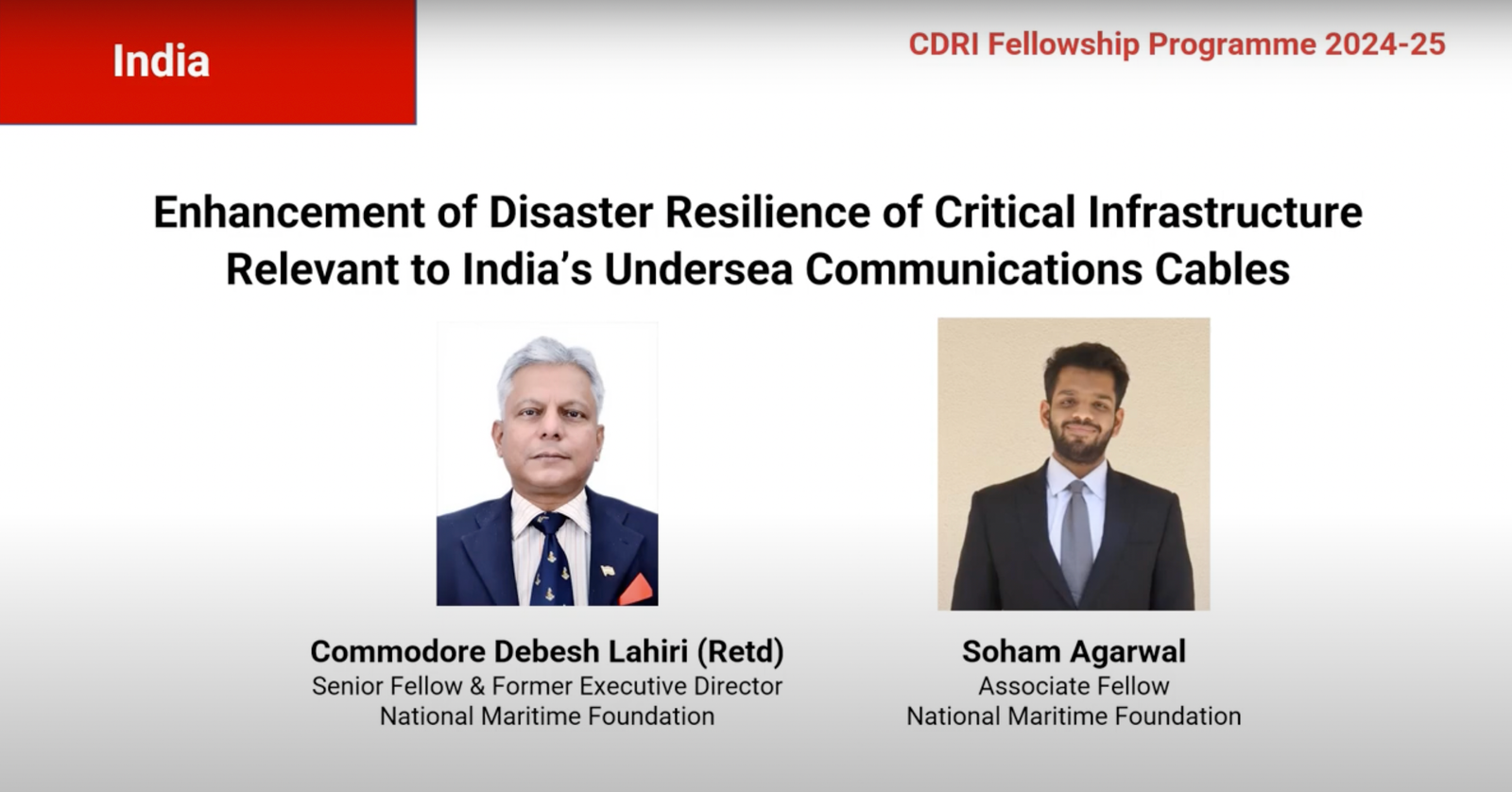
Enhancement of Disaster-Resilience of Critical Infrastructure Relevant to India’s Undersea Communications Cables
PROJECT ABSTRACT
Protecting the coastal infrastructure behind India’s digital lifelines
Undersea communication cables and associated infrastructure—including cable landing stations and beach manholes—are critical to national and international connectivity.
These facilities remain exposed to coastal flooding, cyclones, extreme rainfall and other natural hazards, while existing generic building standards do not adequately address their specialised resilience needs.
The project conducts contextualised disaster-risk assessments and develops a policy framework that integrates resilience into the design and construction of cable-landing infrastructure.
GEOGRAPHIC RESEARCH SCOPE
Four locations. Four distinct coastal-risk contexts.
Mumbai
High-density coastal infrastructure and major international cable connectivity.
Chennai
Cyclone-exposed east-coast infrastructure and a major digital-connectivity gateway.
Port Blair
Island connectivity with unique logistical, environmental and disaster-response constraints.
Digha
Coastal infrastructure exposed to severe weather, flooding and shoreline-related hazards.
PROJECT PATHWAY
From vulnerability to infrastructure standards
ASSESS
Disaster Threat Assessment
IDENTIFY
Standards and Protocol Gaps
DEVELOP
Customised Building Codes
EMBED
National Policy Framework

CDRI FELLOWSHIP 2021–22
Assessing Climate Change Risks-to and Resilience-of India’s Seaport Infrastructure and Operations
NMF’s first CDRI Fellowship project developed and tested a climate-risk assessment methodology for Indian ports through climatic data, field research and expert interviews.
Fellowship awarded
Project completed
Report released
RESEARCH PROBLEM
Climate adaptation must become a core element of port planning
India’s ports are expanding and modernising, yet coastal infrastructure faces intensifying risks from cyclonic storms, extreme rainfall, rising temperatures and sea-level rise.
The study moves beyond conventional disaster-response protocols by asking how individual ports can plan for changing long-term climate conditions.
CLIMATE-RISK MODEL
Climate and extreme-weather threats
Assets and operations in harm’s way
Sensitivity and adaptive capacity
FIELD RESEARCH
Port case studies across India’s western and eastern coasts
Jawaharlal Nehru Port Authority
Pilot assessment of climate hazards, critical assets and operational exposure.
Mumbai Port Authority
Examination of climate risk within a dense and historically significant port environment.
Paradip Port Authority
Assessment of risks within a cyclone-exposed east-coast operational environment.
RESEARCH OUTPUT
Climate-risk profiles for individual ports
The methodology combines climatic information, field-based assessment and port-level expert consultation to determine priority risks for assets and operations.
POLICY DIRECTION
Port-specific adaptation within a national framework
The report calls for dynamic adaptation strategies at individual ports supported by coordinated national policy for resilient maritime trade.