
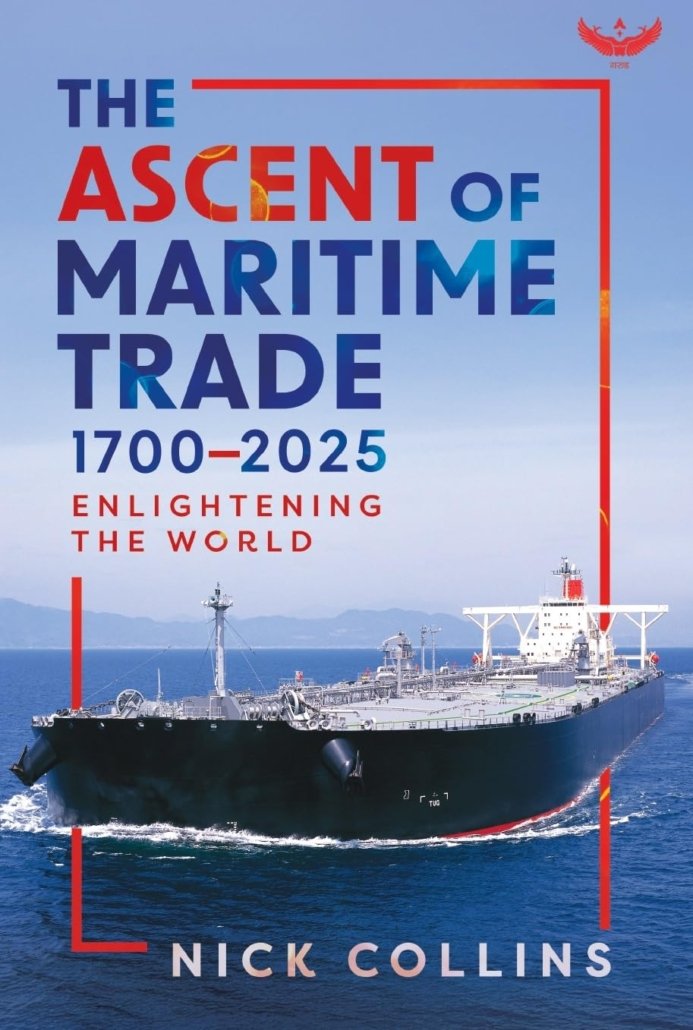
Nick Collins’s examination of maritime trade addresses several dimensions of the subject that have substantial relevance for Indian scholarship and public discourse, particularly at a time when the economic, political, and strategic significance of maritime activity is receiving renewed attention. He manages the considerable geographical scope, a three-century-long temporal span, and extensive factual details of the book, through a carefully structured division of the content into six parts, and further into 46 chapters.
A distinctive feature of Collins’s narrative is his ability to accommodate massive factual detail within relatively straightforward and succinct prose. At several points, facts are presented in rapid succession, with minimal narrative interruption, producing a dense but continuous accumulation of information. Conventional historical narratives often employ anecdotes and individual events as illustrative devices that support broader theories or arguments. Collins adopts a somewhat different approach. His narrative proceeds through what may be termed “micro-events”, each contributing to the larger instance, transformation, or historical phase that constitutes the focus of a particular chapter. While the book’s ‘Introduction’ provides a clear indication of the overarching theme and the sub-themes emerging from it, individual chapters remain solely oriented towards fulfilling their specific analytical function within the respective section. In other words, they contribute to the larger argument through the accumulation of detailed factual observations organised into a chronological and accessible narrative.
Collins essentially advances the proposition that maritime trade is inherently cosmopolitan, and therefore, necessitates an openness to diverse ideas, actors, and systems of exchange. In a manner that reflects this proposition, his analytical approach maintains a broad vantage point, allowing developments across different geographical regions and socio-political contexts to be examined within a common frame. The book traces maritime trade across Europe, Asia, and the Americas while bringing together ships, commodities, ports, labour, finance, political authority, and technological developments as mutually dependent components of a wider maritime network. This prevents maritime trade from being reduced to the movement of goods alone, and instead, situates it within the more dynamic systems that enabled its continuity and expansion.
The principal strength of this approach, however, also presents a challenge. The sustained narration and continual integration of factual material into the broader historical account can initially be demanding. The book is not necessarily intended to be read with the expectation of retaining its extensive factual detail in its entirety. The compression of events and developments occasionally comes at the expense of a deeper analytical engagement that some readers may crave, as individual instances are rarely examined at length. At his strongest, Collins employs quantitative evidence effectively to convey the scale and magnitude of maritime transformation. At certain points, however, statistical evidence accumulates more rapidly than it is analytically interpreted. Nevertheless, these details ultimately reinforce the broader argument. For researchers, this makes the book particularly valuable as a reference work for situating individual events within a wider historical chronology, and for facilitating comparative assessments of contemporaneous developments across different regions.
In examining maritime trade, Collins repeatedly brings two fundamental elements into dialogue— first, ships and their technological evolution, and second, the commodities transported through maritime networks. Commodities emerge as the central drivers underlying many of the aforementioned “micro-events” that constitute the narrative. Their value, scarcity, demand, and geographical distribution help explain why particular routes developed, and why certain maritime centres acquired greater significance than others. At the same time, ships are not presented merely as instruments through which trade takes place; Their evolution is closely tied to the changing scale, speed, reach, and economic viability of maritime exchange. Improvements in hull design, rigging, navigation, ship construction, and the use of iron fittings, alongside developments in navigational instruments, collectively reduced the cost and uncertainty associated with maritime transportation. Technological change thus appears not simply as an outcome of expanding trade, but as one of the conditions that continually reshaped the possibilities available to maritime economies.
The same systemic relationship extends beyond the ship itself. Collins demonstrates that maritime productivity was supported by developments in inland waterways, ports, banking, insurance, brokerage, shipbuilding, manufacturing, and other commercial services. Ports such as Bristol, Liverpool, Glasgow, and London emerge not simply as points of departure and arrival but as nodes within larger economic systems whose effectiveness depended upon connections with inland production and consumption centres. Maritime commerce consequently appears not merely as an activity that enriched existing cities, but as a force capable of reshaping their economic character.
This relationship between maritime orientation and economic development is one of Collins’s more significant contributions. Maritime trade is not treated as an isolated economic activity but is worked within the wider political economy that enabled, shaped, and sustained maritime exchange. The expansion of trade generated infrastructure, expertise, financial systems, and specialised economic functions, which in turn enhanced the capacity for further trade. Maritime economic power, therefore, emerges as the cumulative outcome of multiple interacting capabilities rather than shipping capacity alone.
The political consequences of commercial expansion are also particularly evident in Collins’s treatment of topics such as the Anglo-French rivalry or the East India Company. Competition between Britain and France extended across continents, demonstrating how maritime trade could evolve into political and military competition. The capture of ports and islands, the disruption of trading networks, and the control of commercially productive territories, all reveal the extent to which maritime commerce was intertwined with strategic objectives. The sea consequently becomes not merely a medium through which competition was conducted, but one of the principal spaces in which economic and political power was further contested.
For an Indian reader, the discussion on the East India Company is particularly eye-catching. Collins demonstrates how commercial privileges could progressively acquire political consequences — such as the Company’s involvement in Bengal, its relationship with the Nawab, and its subsequent acquisition of revenue-collecting authority. The transformation does not appear as a single decisive moment, but as a sequence of commercial, military, administrative, and financial developments that gradually altered the Company’s position within the Indian political economy. The episode also introduces an important tension between private commercial interests and public authority, particularly as the Company accumulated sufficient political and fiscal power to influence governance itself.
Collins’s cosmopolitan premise also raises a larger question, as to whether the openness associated with maritime exchange has necessarily translated into an equal distribution of its benefits. Maritime networks facilitated not only the movement of commodities and ideas, but also coercion, unequal commercial arrangements, labour exploitation, and imperial power. The book provides considerable material through which such tensions can be identified, even where the relationship between commercial expansion, humanitarian intervention, and imperial power may warrant deeper analytical interrogation.
This is perhaps where, from the viewpoint of a reader, the breadth of Collins’s writing, once again, becomes both its principal strength and its principal difficulty. He succeeds in placing a wide range of actors, regions, commodities, technological developments, and political events within a common historical frame, making the book particularly useful for comparative maritime history. Developments that might otherwise be studied within separate national or regional histories can be viewed alongside one another, allowing similarities, divergences, and temporal overlaps to become more visible. The very scale of this undertaking, however, necessarily limits the extent to which individual historical processes can be examined in depth.
Ultimately, the value of Collins’s work lies in the scale of the historical canvas it provides. The book does not seek to pause at every development and extract a fully developed theoretical argument from it. Instead, it builds an extensive factual and chronological foundation from which such arguments can subsequently be pursued. Its greatest utility for scholars of maritime affairs may therefore lie in encouraging the reader to regard maritime trade not as a specialised economic activity occurring alongside political history, but as one of the processes through which political economies, technological systems, social relations, and international connections have themselves been continually reshaped.
*******
About the Reviewer:
Ms Priyasha Dixit is a Research Associate at the National Maritime Foundation. Her area of focus is the enhancement of maritime consciousness in India— a theme that incorporates multiple issues of seminal importance including, inter alia, India’s maritime (seafaring) history (incorporating ancient Indian knowledge systems), the maritime history of the Indian Ocean, India’s maritime heritage and its underwater cultural heritage. The scope of her research is widening and now encompasses evaluations and analyses of maritime geopolitics within the Indo-Pacific. She may be contacted at indopac8@maritimeindia.org or indopac8.nmf@gmail.com.


Leave a Reply
Want to join the discussion?Feel free to contribute!