
The shipping industry is simultaneously one of the largest contributors to global greenhouse gas emissions and one of the most indispensable pillars of the global economy. Beyond its role in facilitating international trade, maritime capability has long been recognised as a fundamental determinant of national economic resilience, strategic influence and geopolitical power. Consequently, ensuring secure, affordable and sustainable marine fuel supplies is no longer merely an environmental consideration but a strategic national priority. India’s ambition of emerging as a leading maritime power, reflected in the Maritime India Vision (MIV) 2030[1] and subsequent policy initiatives,[2] reinforces the need for a coherent long-term maritime alternative fuel strategy. The challenge before India is therefore not whether a transition to alternative fuels should occur, but how that transition should be directed.
A number of technically viable alternative marine fuels have emerged over the past decade, with contemporary domestic and international research broadly converging on six principal candidates: green hydrogen, green ammonia, green methanol, biofuels, liquefied natural gas (LNG)[3] and, for limited applications, electric propulsion.[4] While each pathway presents distinct technological, operational and economic advantages, no single fuel simultaneously optimises every national objective. Ships represent long-lived and complex engineering assets and are supported by equally complex industrial supply chains, fuel-production systems and bunkering infrastructure. Consequently, uncertainty regarding the preferred fuel pathway translates directly into uncertainty in ship design, engine development, infrastructure investment, and private sector participation. Providing strategic clarity on fuel pathways is, therefore, an essential prerequisite for an effective transition.
The challenge confronting policymakers is, therefore, fundamentally strategic rather than technological. Different alternative fuels satisfy different national objectives, making fuel selection inseparable from the objectives of the policy itself. A maritime alternative fuel policy intended primarily to minimise lifecycle carbon emissions may favour a markedly different transition pathway from one intended to maximise national energy security by reducing dependence on imported fuels. Unless these objectives are explicitly prioritised, fuel selection risks becoming inconsistent with the broader strategic outcomes that the policy seeks to achieve.
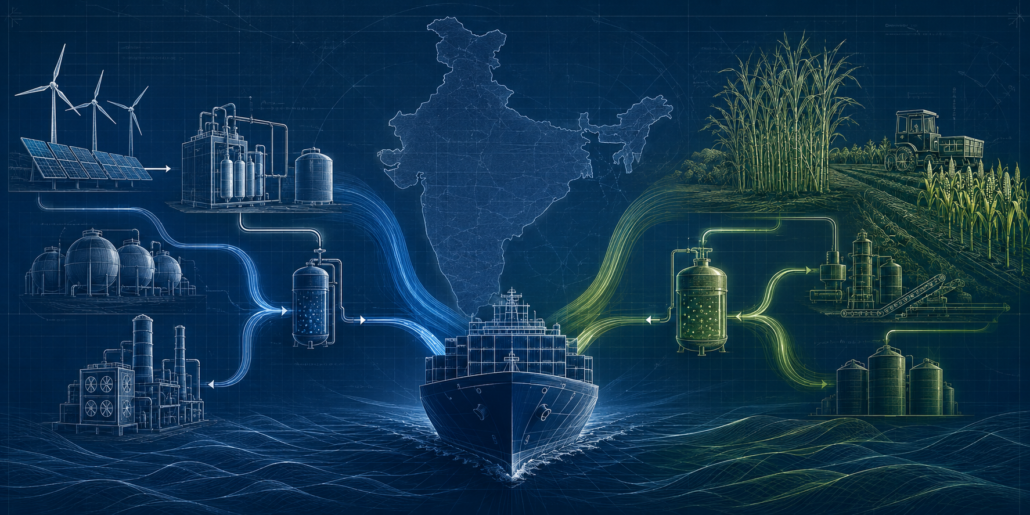
Against this backdrop, this paper develops a framework for evaluating India’s maritime alternative fuel policy through the lens of these twin national objectives. It argues that clarity regarding policy objectives must precede fuel selection and employs methanol and bioethanol as representative case studies to illustrate two fundamentally distinct production pathways — an industrial renewable energy system and an agricultural bio-based production system, respectively.
Throughout this paper, energy security is considered not only in terms of direct dependence on imported fuels but also through the concept of “Lifecycle Energy Independence” (LEI). LEI refers to the extent to which a fuel production pathway can operate without dependence on imported energy or energy-intensive material inputs over its “cradle-to-tank” lifecycle. While lifecycle carbon assessment evaluates environmental performance, LEI evaluates strategic autonomy. Together, these complementary metrics provide the analytical framework adopted throughout this study.
By examining these pathways against the twin objectives of carbon neutrality and energy security, the paper proposes strategic directions for India’s maritime alternative fuel policy and the transition pathway required to achieve them.
Maritime Alternative Fuels – Current Landscape
International and national decarbonisation strategies have broadly converged on a limited number of technically viable alternative maritime fuel pathways. These include hydrogen, ammonia, methanol, liquefied natural gas (LNG), and biogenic hydrocarbons such as ethanol. While electric propulsion continues to receive significant attention, current battery technologies remain suitable only for niche and short-range applications[5] and are yet to mature into a practical solution for mainstream commercial shipping.[6] Among the principal alternatives, hydrogen, ammonia, and methanol[7] are unique in that they can be synthesised directly using renewable electricity through “green” production pathways,[8] whereas ethanol remains fundamentally dependent upon biological feedstocks. Although LNG, under certain operating conditions, is capable of reducing emissions relative to conventional marine fuels, it remains a fossil fuel and is therefore widely regarded as a “transitional” rather than a long-term decarbonisation pathway.
Although each candidate presents distinct technological, operational and economic advantages, one of the most fundamental determinants of fuel suitability for maritime transport remains volumetric energy density[9] — that is, the amount of usable energy stored within a given fuel tank volume. For vessels of identical tank capacity, this directly determines the maximum voyage range between refuelling operations. Heavy Fuel Oil (HFO) and Light Fuel Oil (LFO) continue to outperform all alternative fuels in this regard.[10] Nevertheless, LNG, methanol, and higher hydrocarbons such as ethanol, all offer voyage ranges that remain operationally acceptable for a substantial proportion of commercial shipping applications. In contrast, hydrogen and ammonia possess considerably lower volumetric energy densities, resulting in substantially reduced operational ranges. Importantly, this limitation is not merely a consequence of current technological maturity but arises from fundamental thermodynamic constraints and, therefore, cannot be eliminated through engineering advances alone.
The practical implications of these physical constraints extend well beyond vessel design. Lower energy density necessitates either significantly larger onboard fuel storage or the establishment of reliable bunkering infrastructure at comparatively shorter intervals along shipping routes. Consequently, the successful deployment of hydrogen and ammonia depends upon the development of extensive “green shipping international corridors” capable of ensuring uninterrupted fuel availability throughout a vessel’s operational profile. From India’s perspective, the emerging bunkering infrastructure in Singapore represents an important strategic node for eastbound trade routes, particularly given Singapore’s ongoing investments in alternative fuel bunkering, including green ammonia and methanol.[11] However, westbound routes through the international shipping lanes (ISLs) via the Suez Canal would continue to require additional strategically located bunkering facilities for all alternative fuels except LNG, with hydrogen requiring the highest density of refuelling infrastructure.
Beyond infrastructure requirements, the deployment of hydrogen and ammonia introduces an additional dimension of implementation risk. Both fuels[12] possess hazardous[13] chemical properties that necessitate specialised storage, handling, transportation and emergency response systems throughout the fuel supply chain.[14] The same geopolitical uncertainties that motivate the transition towards alternative fuels also increase the strategic importance of resilient fuel supply networks. Consequently, widespread market adoption depends not only upon technological feasibility but also upon industry confidence in the safety, reliability and security of international fuel supply corridors.
Collectively, the physical limitations imposed by volumetric energy density, the infrastructure requirements associated with long-distance bunkering, the safety considerations surrounding hazardous fuels, and the implementation challenges unique to each production pathway, substantially narrow the range of practically deployable alternatives. While LNG remains an attractive transitional fuel[15] owing to its favourable operational characteristics, its continued reliance on fossil carbon limits its role in achieving long-term decarbonisation objectives.
Consequently, the principal long-term candidates for India’s maritime fuel transition increasingly converge towards green methanol and biogenic hydrocarbons such as ethanol.[16] At this stage, the challenge is no longer identifying fuels capable of powering ships; rather, it is determining what strategic objective India’s maritime alternative fuel policy is ultimately intended to achieve.
Policy Objectives: Carbon Neutrality and Energy Security
The suitability of any alternative maritime fuel cannot be evaluated independently of the strategic objective that the policy seeks to achieve. Consequently, the optimal transition pathway is not determined solely by technological capability but by the national objectives that the policy is intended to optimise. For India, the maritime alternative fuel transition is principally driven by two strategic objectives: (1) reducing lifecycle carbon emissions from the shipping sector and (2) enhancing national energy security through reduced dependence on imported energy. These objectives are neither antagonistic nor mutually exclusive. However, the relative emphasis placed upon each fundamentally influences the suitability of different alternative fuel pathways.
India’s commitments under the Paris Agreement and its broader climate change mitigation agenda underscore the importance of decarbonising the maritime sector. Equally, energy security has remained a longstanding strategic priority, reinforced by repeated geopolitical disruptions affecting global energy markets. The recent instability surrounding the Strait of Hormuz has once again demonstrated India’s continued vulnerability to external energy supply disruptions. Importantly, neither objective can be pursued in isolation. While energy security addresses the resilience and strategic autonomy of the nation, environmental protection and climate change mitigation form part of the constitutional responsibilities of the State towards present and future generations. Consequently, an effective maritime alternative fuel policy cannot disregard either objective but must instead determine the extent to which one assumes primacy where trade-offs arise.
These competing objectives reveal an important distinction between alternative fuel pathways. Certain fuels offer the potential for complete independence from imported material feedstock while requiring substantial investments in new production and bunkering infrastructure. Others can be deployed using comparatively mature technologies but remain dependent, either directly or indirectly, upon imported energy within their production systems. Consequently, the evaluation of alternative fuels cannot be restricted to vessel performance or operational feasibility alone; rather, it must consider the characteristics of the complete production pathway from “cradle to tank”.
In the present work, energy security is considered in a broader sense than the direct substitution of imported marine fuels. A fuel pathway is regarded as strategically independent only to the extent that its production system itself can operate without significant dependence upon imported energy or energy-intensive material inputs. This distinction becomes particularly important when comparing industrial fuel production systems with biologically derived alternatives, as the degree of import dependence is embedded within the entire production chain rather than solely within the final fuel.
The preceding section has established that the practical constraints of maritime operations substantially narrow the range of long-term fuel candidates. The remaining challenge is therefore no longer one of identifying technically viable fuels, but of determining which production pathway most effectively advances India’s strategic objectives. The succeeding paragraphs examine green methanol and bioethanol against the two policy objectives — carbon neutrality and energy security — to derive the strategic direction that India’s maritime alternative fuel policy should adopt.
Methanol and Ethanol – Juxtaposed against the Two Policy Objectives
The distinction between green methanol and bioethanol is not primarily a distinction between two fuels but between two fundamentally different production systems. Green methanol is an industrial energy system, in which renewable electricity is converted into a transportable liquid fuel using inorganic feedstock. Bioethanol, by contrast, is an agricultural production system that converts solar energy captured through biomass into liquid fuel via biological fermentation. Unlike methanol, no commercially scalable process presently exists to manufacture ethanol directly from inorganic feedstock using renewable electricity. Consequently, the ability of either fuel to satisfy India’s policy objectives is determined not by the combustion characteristics of the final fuel, but by the characteristics of its production system over the “cradle-to-tank” lifecycle.
In India, bioethanol production is presently dominated by first-generation feedstock,[17] principally sugarcane derivatives and maize starch, with rice grain-based feedstocks emerging as an increasingly important contributor. Green methanol, on the other hand, derives its carbon from carbon dioxide and its primary energy input from hydrogen. These fundamentally different production pathways form the basis for evaluating each fuel against the two strategic objectives identified earlier: reducing lifecycle carbon emissions and improving LEI.
Goal 1: Reducing Lifecycle Carbon Emissions
Green Methanol
Commercial methanol production has traditionally relied upon fossil-derived synthesis gas. However, the underlying chemistry is equally applicable when hydrogen is produced through renewable electricity and carbon is sourced from captured carbon dioxide. Under this configuration, the principal energy input is renewable electricity used to generate green hydrogen, while the carbon released during combustion can be reintroduced into subsequent production cycles through carbon capture. Green methanol therefore functions as a transportable chemical energy carrier, effectively storing renewable electricity in liquid form. The carbon emissions associated with such a system are consequently governed primarily by the carbon intensity of hydrogen production and carbon capture, rather than by the fuel molecule itself. As renewable electricity and green hydrogen production expand, green methanol offers a credible pathway towards a near carbon-neutral maritime fuel system.
Bioethanol
Unlike methanol, ethanol remains inseparable from agricultural production. Consequently, the lifecycle carbon intensity of bioethanol is fundamentally determined by the characteristics of the agricultural system producing the feedstock rather than by the fermentation process itself. Bioethanol feedstock is conventionally classified into four generations according to the source, with India’s present production dominated by first-generation feedstock, particularly sugarcane and maize.[18]
At commercial scales, sustained expansion of first-generation bioethanol production inevitably requires either increased agricultural intensity or an expansion of cultivated land. Both introduce additional lifecycle emissions, most notably through indirect “land-use change” (LUC), which may include the conversion of forests or other natural land to agricultural production.[19] Current lifecycle assessments indicate that once these emissions are incorporated, the carbon intensity of sugarcane-derived ethanol approaches that of conventional marine fuels, while maize-based ethanol may perform considerably worse. Although damaged rice grains[20] avoid much of the additional cultivation burden, they presently constitute only a limited proportion of total feedstock availability and are, therefore, unable to support large-scale maritime fuel demand.
Consequently, the challenge of producing genuinely low-carbon bioethanol is fundamentally a challenge of achieving low-carbon agriculture. Improvements in crop-production practices, fertiliser manufacture, irrigation, mechanisation, and land management, all become inseparable from the carbon performance of the fuel itself. In addition to energy requirements, large-scale expansion of first-generation bioethanol also introduces significant demands on land and water resources that must be considered within any long-term transition strategy.
Goal 2: Improving Lifecycle Energy Independence
India presently imports approximately 88 per cent of its crude oil requirements.[21] Within the maritime sector, the principal petroleum products comprise High Speed Diesel (HSD), Light Diesel Oil (LDO), Fuel Oil (FO) and Low Sulphur Heavy Stock (LSHS).[22] Using the relationship between crude oil imports and the proportion of these products consumed by shipping, the effective import dependence of the maritime fuel sector can be estimated, as summarised in Table 1.
| 2023 | 2024 | |||
| Fuel Type | % Share of Shipping | % of crude oil import | % Share of Shipping | % of crude oil import |
| HSD | 7.00% | 0.84% | 6.00% | 0.56% |
| FO/LSHS | 23.00% | 0.93% | 28.00% | 1.15% |
Although maritime fuels account for only a relatively small proportion of India’s total crude oil imports, this observation carries an important policy implication. While maritime fuel transition alone cannot substantially alter India’s overall energy import profile, the sector itself remains capable of achieving a high degree of strategic independence. The relevant policy question, therefore, shifts from reducing national crude oil imports to maximising the LEI of the maritime fuel production system.
From the perspective of LEI, the distinction between green methanol and bioethanol again reflects their underlying production systems. Green methanol can, in principle, be produced entirely from domestically available renewable electricity, water and captured carbon dioxide, allowing the complete production pathway to operate independently of imported fossil energy. Furthermore, India has already initiated substantial investments in the upstream infrastructure required for this transition through the “National Green Hydrogen Mission”. Pilot projects undertaken by organisations such as ONGC demonstrate the technical feasibility of integrating green hydrogen production with downstream synthetic fuel manufacture, thereby allowing green methanol to leverage an industrial ecosystem that is already under development.
The LEI of first-generation bioethanol, by contrast, is determined by the agricultural production system rather than the fuel itself. Although ethanol blending has contributed to reducing crude oil imports over the past decade, the cumulative reduction remains modest when viewed against India’s overall import dependence. More importantly, achieving genuinely high LEI would require the progressive decarbonisation and electrification of the entire agricultural production chain, including cultivation, irrigation, fertiliser manufacture, harvesting and processing. Unlike green methanol, whose principal challenge is the expansion of renewable industrial infrastructure, bioethanol requires the simultaneous transformation of a nationwide agricultural system before comparable levels of lifecycle energy independence can be realised.
The foregoing comparison reveals that the principal distinction between green methanol and bioethanol lies not in their combustion performance but in the complexity of the production systems required to achieve India’s strategic objectives. Green methanol primarily requires the transition of an industrial energy system centred upon renewable electricity and green hydrogen. Bioethanol requires the parallel transformation of an agricultural production system whose environmental performance and energy independence remain intrinsically linked to land use, crop production and rural supply chains. The scale, pace and complexity of these transitions differ substantially and, consequently, lead to markedly different policy pathways for India’s maritime fuel transition.
Strategic Transition Pathway
Although bioethanol presents greater complexities from both lifecycle carbon emissions and Lifecycle Energy Independence, it does possess an important operational advantage over green methanol. Owing to its volumetric energy density being approximately 50 per cent greater than that of methanol, ethanol-powered vessels are capable of substantially longer voyage ranges without refuelling, making the fuel operationally attractive for a wide range of maritime applications. Consequently, bioethanol should not be excluded from India’s long-term maritime fuel strategy.
However, maritime assets are characterised by exceptionally long investment and operational cycles. Shipowners, shipbuilders, and supporting industries, require policy certainty well before committing to alternative propulsion systems and fuel supply chains. Continued ambiguity regarding India’s preferred fuel pathway risks delaying investment or locking the industry into technologies that may prove inconsistent with the country’s long-term strategic objectives. The “Maritime India Vision 2030” and India’s broader maritime ambitions, therefore, require a clearly articulated transition pathway rather than an open-ended list of technically feasible alternatives.
The preceding analysis suggests that India’s maritime fuel strategy should adopt a staged transition approach. In the near term, policy should prioritise fuels capable of simultaneously advancing decarbonisation and Lifecycle Energy Independence while leveraging infrastructure that is already under development. Green methanol presently offers the strongest alignment with these objectives through its compatibility with renewable electricity, carbon capture technologies, and the ongoing development of a domestic green hydrogen ecosystem. At the same time, the policy should preserve flexibility for the future adoption of bioethanol as advances in agricultural practices, feedstock diversification, rural electrification and second-generation biofuel technologies progressively address the present limitations of its production system. Such an approach avoids prematurely committing the sector to a single long-term solution while providing sufficient certainty for industrial investment today.
Recommended Policy Roadmap for Maritime Alternative Fuel Transition
The principal barrier to the large-scale adoption of alternative maritime fuels is no longer solely technological feasibility but rather, investment uncertainty. Consequently, India’s maritime alternative fuel policy should first establish a clear strategic preference for the fuels that best advance the country’s long-term objectives and provide a stable regulatory framework for their adoption. Clear policy direction reduces uncertainty for shipowners, shipbuilders, fuel suppliers and financial institutions, thereby encouraging early investment in vessels and supporting infrastructure.
Secondly, India should accelerate the development of an integrated domestic green methanol ecosystem by extending the ongoing investments being made under the “National Green Hydrogen Mission”.[23] The production of green methanol utilises many of the same upstream technologies, particularly renewable hydrogen production, allowing existing investments and institutional capacities to support multiple sectors simultaneously. Such integration would strengthen both decarbonisation and national energy security while reducing duplication of infrastructure.
Thirdly, India should actively promote the development of strategic green shipping corridors and associated bunkering infrastructure aligned with its principal international shipping routes. While international initiatives have identified prospective green corridors, commercial deployment remains limited and no comprehensive alternative fuel corridor has yet emerged across the Indian Ocean. Given India’s geographical position along major international shipping lanes, early investment in strategically located bunkering infrastructure would strengthen both national competitiveness and regional influence within the emerging global alternative fuel network.
Finally, the transition must be supported through appropriate financial and commercial risk-sharing mechanisms. Early adopters inevitably face disproportionate technological and market uncertainty. Targeted incentives, concessional financing, demand commitments and other de-risking instruments will, therefore, be essential to encourage private investment during the initial phases of transition. At the same time, the policy should remain sufficiently adaptive to accommodate future technological developments and periodically reassess the relative merits of competing fuel pathways as renewable energy systems, carbon capture technologies and advanced biofuels mature.
Conclusion
India’s transition towards alternative maritime fuels is fundamentally a strategic policy question rather than merely a technological one. While considerable attention has been devoted to comparing the engineering characteristics of alternative fuels, considerably less emphasis has been placed on the production systems that underpin them. This study argues that the selection of maritime fuels should be guided by two complementary policy objectives: reducing lifecycle carbon emissions and improving Lifecycle Energy Independence (LEI). Evaluating fuels through these two lenses provides a more comprehensive basis for policy formulation than considering either objective in isolation.
The comparison between green methanol and bioethanol demonstrates that fuels possessing similar operational characteristics can require fundamentally different national transition pathways. Green methanol represents the transformation of an industrial energy system based upon renewable electricity, green hydrogen and carbon capture. Bioethanol, in contrast, represents the transformation of an agricultural production system whose performance is intrinsically linked to land use, crop production, and the progressive decarbonisation of agriculture. Consequently, the choice between these fuels extends beyond propulsion technology to broader questions of industrial policy, energy security and resource management.
Rather than identifying a universally superior maritime fuel, this paper proposes a framework through which alternative fuel pathways may be evaluated against India’s long-term strategic objectives. Such an approach enables policy to remain responsive to technological progress while providing the certainty required for present-day investment decisions. By aligning maritime fuel choices with both lifecycle carbon emissions and Lifecycle Energy Independence, India can develop a coherent transition pathway that simultaneously advances decarbonisation, strengthens energy security and supports the country’s ambition of emerging as a leading global maritime power.
********
About the Author
Mr Tariq Ahmad is a Research Associate at the National Maritime Foundation. His research focus is on port adaptation, disaster and climate change resilience, maritime spatial planning and blue economy. His background is in architecture and spatial planning (urban & regional). He may be contacted at rsor1.nmf@gmail.com.
Endnotes:
[1] Government of India, Ministry of Ports, Shipping and Waterways, Maritime India Vision 2030 (New Delhi: Ministry of Ports, Shipping and Waterways, December 2020). https://wwwcdn.imo.org/localresources/en/OurWork/Environment/Documents/Air%20pollution/Maritime%20India%20vision%202030.pdf
[2] Government of India, Ministry of Ports, Shipping and Waterways, “Maritime Amrit Kaal Vision 2047 (MAKV 2047)”, December 2023. https://shipmin.gov.in/sites/default/files/Maritime%20Amrit%20Kaal%20Vision%202047%20%28MAKV%202047%29_compressed.pdf
[3] International Maritime Organization GreenVoyage2050, “Alternative Marine Fuels: Regulatory Mapping”. https://greenvoyage2050.imo.org/alternative-marine-fuels-regulatory-mapping/
[4] International Maritime Organization, Resolution MEPC.377(80): 2023 IMO Strategy on Reduction of GHG Emissions from Ships, adopted 07 July 2023, Annex 15 to Report of the Marine Environment Protection Committee on Its Eightieth Session (MEPC 80/17/Add.1). https://wwwcdn.imo.org/localresources/en/OurWork/Environment/Documents/annex/MEPC%2080/Annex%2015.pdf
[5] Lukas Kistner, Astrid Bensmann, and Richard Hanke-Rauschenbach, “Potentials and Limitations of Battery-Electric Container Ship Propulsion Systems”, Energy Conversion and Management: X 21 (2024): 100507. https://doi.org/10.1016/j.ecmx.2023.100507
[6] Mærsk Mc-Kinney Møller Center for Zero Carbon Shipping, Understanding the Potential of Battery-Powered Vessels for Deep-Sea Shipping: A Pre-Feasibility Study (Copenhagen: Mærsk Mc-Kinney Møller Center for Zero Carbon Shipping, September 2024). https://www.zerocarbonshipping.com/files/battery-powered-vessels-pre-feasibility-study.pdf
[7] Cheng Cao, Bin Wen, Yanli Fang, Zhengmeng Hou, Qichen Wang, Tian Zhang, Liangchao Huang, Qianjun Chen, Liehui Zhang, Yulong Zhao, and Christian Truitt Lüddeke, “A Comprehensive Comparison of Green Ammonia and Green Methanol from a Full Chain: Production, Transportation, Storage and Utilization”, Carbon Neutral Systems 1 (2025): 8, https://doi.org/10.1007/s44438-025-00009-9
[8] Ministry of New and Renewable Energy, “Government Announces Standards of Green Ammonia and Green Methanol for India to Accelerate Trade of Green Hydrogen Derivatives”, 07 March 2026. https://www.pib.gov.in/PressReleasePage.aspx?PRID=2236255®=3&lang=1
[9] Anthony Foretich, George G Zaimes, Troy R Hawkins, and Emily Newes, “Challenges and Opportunities for Alternative Fuels in the Maritime Sector”, Maritime Transport Research 2 (2021): 100033, https://doi.org/10.1016/j.martra.2021.100033
[10] Foretich et al, “Challenges and Opportunities for Alternative Fuels in the Maritime Sector”, 100033.
[11] MarineLink Ports Directory, “Singapore Launches First Large-Scale Green Methanol Bunkering Facility”, 10 April 2026. https://ports.marinelink.com/ports/port/port-lavaca/news/singapore-launches-first-large-scale-green-methanol-bunkering-facility
[12] Praxair, “Hydrogen, Refrigerated Liquid: Safety Data Sheet P-4603”, 17 October 2016. https://www.nrc.gov/docs/ML1821/ML18214A861.pdf
[13] Reuters, “Ammonia Leak at Shanghai Refrigeration Plant Kills 15, Injures 26”, 31 August 2013. https://www.reuters.com/article/world/ammonia-leak-at-shanghai-refrigeration-plant-kills-15-injures-26-idUSBRE97U045/
[14] International Maritime Organization, “MSC.1/Circ.1687: Interim Guidelines for the Safety of Ships Using Ammonia as Fuel”, 26 February 2025. https://www.bimco.org/media/bxvcygg1/msc1-circ1687-interim-guidelines-for-the-safety-of-ships-using-ammonia-as-fuel-secretariat.pdf
[15] Indian Register of Shipping, “Future Fuel Strategy (FFS) For Maritime India”, 14 February 2025. http://dgma.gov.in/download/1759311377_68dcf611a7b6c_future-fuel-strategy-compressed.pdf
[16] P Das, YC Soodesh, P Upadhyay, and Hardikkumar A Valera, “Advanced Green Fuels for Maritime Application – Road Map for India (Part A)”, NCoEGPS, TERI, New Delhi, 2026
[17] Ministry of Petroleum and Natural Gas, “Green Hydrogen Certification Scheme of India (GHCI) Launched to Certify Green Hydrogen Production”, 01 October 2025. https://www.pib.gov.in/PressReleasePage.aspx?PRID=2292225®=3&lang=1
[18] Ministry of Petroleum and Natural Gas, “Green Hydrogen Certification Scheme of India (GHCI) Launched to Certify Green Hydrogen Production.”
[19] Pete Smith, Mercedes Bustamante, Harry Ahammad, Helen Clark, Hongmin Dong, Elsayed A Elsiddig, Helmut Haberl, Richard Harper, Joanne House, Mohamad Jafari, Omar Masera, Cheikh Mbow, N. H. Ravindranath, Charles W. Rice, Carlos Robledo Abad, Anna Romanovskaya, Frank Sperling, and Francesco N Tubiello, “Agriculture, Forestry and Other Land Use (AFOLU)”, in Climate Change 2014: Mitigation of Climate Change. Contribution of Working Group III to the Fifth Assessment Report of the Intergovernmental Panel on Climate Change, ed. Ottmar Edenhofer, Ramón Pichs-Madruga, Youba Sokona, Ellie Farahani, Susanne Kadner, Kristin Seyboth, Anna Adler, Ina Baum, Steffen Brunner, Patrick Eickemeier, Benjamin Kriemann, Jussi Savolainen, Steffen Schlömer, Christoph von Stechow, Timm Zwickel, and Jan C. Minx (Cambridge, United Kingdom and New York, NY: Cambridge University Press, 2014).
[20] Government of India, Ministry of Petroleum and Natural Gas, “Green Hydrogen Certification Scheme of India (GHCI) Launched to Certify Green Hydrogen Production.”
[21] Government of India, Ministry of Petroleum and Natural Gas, “India’s Growth Linked to Energy and Maritime Strength: Shri Hardeep Singh Puri”, 29 October 2025. https://www.pib.gov.in/PressReleasePage.aspx?PRID=2183703®=3&lang=2
[22] Government of India, Ministry of Petroleum and Natural Gas, Petroleum Planning & Analysis Cell (PPAC), Industry Consumption Report–POL & NG, December 2024 (New Delhi: December 2024). https://ppac.gov.in/download.php?file=menu%2F1737019430_ICR_December_2024_compressed.pdf
[23] Government of India, Ministry of New and Renewable Energy, National Green Hydrogen Mission (New Delhi, January 2023). https://cdnbbsr.s3waas.gov.in/s3716e1b8c6cd17b771da77391355749f3/uploads/2023/01/2023012338.pdf


Leave a Reply
Want to join the discussion?Feel free to contribute!