
Setting the Context
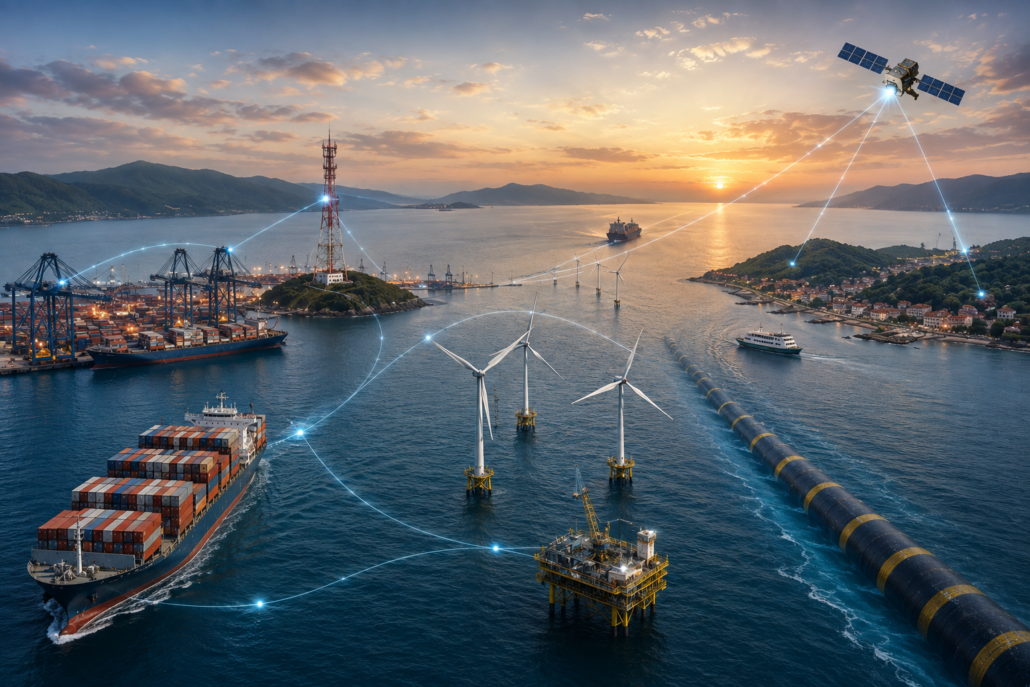
Maritime connectivity has emerged as an increasingly important component of national and regional economic and strategic policy. Yet, the growing prominence of the term has not been accompanied by a corresponding clarification of what maritime connectivity actually encompasses. In policy practice, the concept is frequently used in a relatively narrow sense, often becoming synonymous with maritime transport, port connectivity, shipping routes and the logistics systems that support them.[1] While these constitute important components of maritime connectivity, treating them (collectively) as the complete definition risks conflating one manifestation of connectivity with the broader system of relationships that the maritime domain sustains. It would be intuitively obvious that the maritime domain connects considerably more than merely ships, cargo, and passengers. It connects societies and communities, facilitates the movement of data and information, links energy-producing regions with consuming markets, and sustains ecological relationships that extend political boundaries. These connections certainly extend across political boundaries and while they may well be created through infrastructure, such as ports, shipping routes, submarine cables, pipelines and offshore installations, they may also emerge through institutional, economic and social relationships. Ecological connections are different: they are inherent to the marine environment and exist irrespective of political boundaries.
Maritime connectivity should, therefore, be understood not simply as the presence of physical links between maritime and terrestrial spaces, but as the interaction of nodes, networks, actors and flows within a shared maritime space. A port, for instance, can simultaneously function as a transport gateway, a logistics node, a digital interface, an energy hub, and a point of interaction with coastal communities and marine ecosystems. Its significance cannot, consequently, be determined only by cargo volumes or vessel calls.
Such a ‘systems’ approach[2] also distinguishes between connections that States construct and those that they facilitate or govern. A shipping route or port can be planned and developed; a submarine cable can be installed, an offshore energy facility can be constructed: but a fishery, an ocean current, a coral ecosystem, or the movement of marine species, cannot be created through infrastructure. These are different forms of connectivity and yet they operate within the same maritime space, often intersecting-with and influencing one another.
This distinction is not merely semantic. It has implications for how connectivity projects are conceived, assessed and governed. A port expansion may strengthen trade connectivity while simultaneously affecting fisheries, coastal communities, tourism, energy requirements and surrounding ecosystems. An offshore energy project may enhance energy connectivity while requiring changes to shipping routes and subsea infrastructure. Similarly, digital systems may increase the efficiency and resilience of physical maritime networks while creating new dependencies and vulnerabilities. A meaningful maritime connectivity strategy must, therefore, move beyond the infrastructure that is being connected and consider, instead, the wider network of relationships that the connection creates, enables, or affects.
This paper is a broad ‘conceptual’ examination of maritime connectivity. It does not seek to replace the conventional understanding centred on maritime transport. Rather, it seeks to situate maritime transport within a broader maritime system and examine the different forms of connectivity that operate within it. It subsequently considers what this broader conception implies for India’s approach to maritime connectivity and argues for a shift towards a more integrated, system-level policy framework.
Maritime Connectivity: Beyond Maritime Transport
Maritime connectivity has conventionally been understood through the movement of ships, cargo, and passengers. Ports provide the principal gateways, while shipping routes connect ports to other markets, and road, rail and inland-waterway networks extend these connections into the hinterland. This physical architecture remains fundamental. Indeed, there is no gainsaying the fact that maritime transport carries around 80 per cent of the volume of international trade in goods, underscoring its continuing importance to the functioning of the global economy.[3]
The problem arises when maritime transport becomes synonymous with maritime connectivity.
The two are closely related, but they are not interchangeable — one is a subset of the other. “Transport” describes a particular form of movement through maritime space. “Connectivity” is concerned, more broadly, with the relationships that maritime space enables between places, people, systems, and activities. The distinction becomes clearer when connectivity is viewed through relationships that maritime transport alone cannot capture. A submarine data cable connects economies through the movement of information; an offshore wind farm connects maritime space with terrestrial electricity systems; maritime heritage routes connect societies through shared history and cultural exchange; and migratory fish stocks create ecological and economic linkages across national jurisdictions. None of these connections depends primarily on the movement of cargo, yet each can have significant economic, social or strategic consequences.
Maritime connectivity cannot be defined solely by what moves through the sea. The broader understanding begins by asking six important questions:
- What is being connected?
- Through which medium?
- By which platforms or entities?
- What is flowing through these connections?
- Which policies facilitate them? And
- Which legal and normative frameworks govern them?[4]
A systems approach provides a means of examining this complexity without treating every form of maritime activity as a form of connectivity. These six questions provide a common analytical basis for examining the different forms of connection and their policy, legal and normative contexts. Taken together, these questions provide a framework through which apparently different forms of maritime connectivity can be examined without being treated as isolated sectors. They also demonstrate why maritime connectivity cannot be reduced to a single infrastructure or policy domain. The same maritime space may accommodate several networks simultaneously, while the same infrastructure may serve multiple forms of connectivity. On this basis, maritime connectivity can be examined through six interrelated dimensions as depicted in Figure 1:
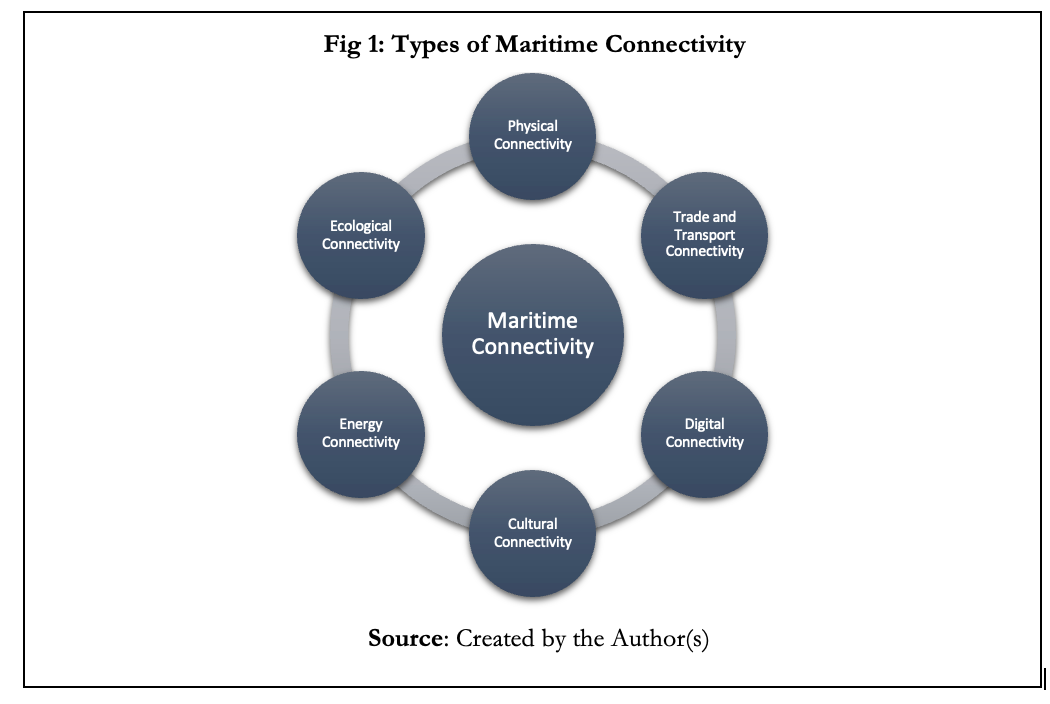
These dimensions should not, however, be viewed as six independent silos. Their analytical value lies precisely in the relationships between them. Physical infrastructure enables trade; trade increasingly depends upon digital networks; energy infrastructure relies upon maritime transport and subsea systems; cultural connectivity operates through passenger and knowledge networks; and all of these activities interact with ecological systems that transcend political boundaries.
The task, therefore, is not simply to identify the different things that the maritime domain connects. It is to understand how these connections coexist, interact and collectively constitute a wider maritime system. That provides the basis for examining the six dimensions individually before considering their interaction and the implications for India’s maritime policy.
Physical Connectivity
Physical connectivity constitutes the material foundation of maritime connectivity. It encompasses ships, ports, and maritime routes, together with the road, rail and inland-waterway networks that connect these maritime gateways to their hinterland. These networks determine the physical ability of people and goods to move between maritime and terrestrial spaces and remain central to India’s maritime connectivity ambitions.
Ports occupy a particularly important position within this architecture. Their connectivity is not determined simply by their physical capacity, but by their integration into wider maritime and terrestrial networks. Regular liner services, vessel calls, transhipment opportunities, and access to major shipping routes, determine the extent to which a port is connected to regional and global markets. Its landside connections are equally consequential. Railways, roads, inland waterways, freight corridors, and logistics facilities, all determine whether cargo arriving at a port can move efficiently towards production centres and markets. This makes multimodality intrinsic to physical maritime connectivity. A port may possess substantial handling capacity, but its effective connectivity is constrained if cargo encounters bottlenecks once it leaves the port.[5] Conversely, efficient hinterland connections can substantially expand the economic geography served by a maritime gateway. The relevant measure is, therefore, not infrastructure in isolation, but the continuity of movement across the network.
Physical connectivity also extends beyond cargo. Ferry services, passenger vessels, and cruise-ship networks, all serve to connect islands and coastal communities, supporting tourism, employment and access to essential services. In island and coastal regions, these connections can have a significance that cannot be captured through conventional measures of international trade.
A further consideration is” resilience”. Maritime connectivity is valuable only insofar as the networks through which it operates can continue functioning in the face of disruption.[6] The experience of contemporary disruptions around major maritime routes has adequately demonstrated how the closure or avoidance of a single segment can increase voyage distances, transport costs and pressure on alternative routes. UNCTAD has similarly highlighted geopolitical tensions, re-routing and disruptions as significant challenges for contemporary maritime transport.[7] The implication is that physical connectivity should not be assessed simply by the number of ports constructed, vessels deployed or transport links created. Its effectiveness depends upon the degree of integration, efficiency, and resilience of the network as a whole. Physical infrastructure provides the foundation, but connectivity emerges from the relationship between its different components.
This foundation, however, acquires economic significance only when it enables the movement of goods and services through wider production-, distribution-, and trade-networks. The next dimension, therefore, concerns not the infrastructure through which movement occurs, but the economic networks that determine what moves, where it moves, and how efficiently these movements are organised.
Trade and Transport Connectivity
Physical connectivity provides the infrastructure through which movement occurs; trade and transport connectivity determines how effectively that infrastructure is incorporated into wider economic networks. The distinction is important because the existence of a port or shipping route does not, by itself, establish meaningful economic connectivity. What matters is whether these physical links allow goods, services, and production networks to interact with markets efficiently and predictably.
Modern maritime trade operates through increasingly complex production and distribution systems. Components are frequently produced in one country, processed or assembled in another, and consumed in a third, with maritime transport connecting different stages of these value chains.[8] Ports, consequently, function not merely as points at which cargo changes modes, but as nodes through which regional and global economic networks are organised. This places logistics alongside infrastructure at the centre of trade connectivity. Customs procedures, documentation, warehousing, freight forwarding, insurance, financial services, and border management, each influence the time and cost associated with moving goods. The World Bank’s Logistics Performance Index reflects this broader conception by assessing infrastructure, international shipments, logistics competence, tracking and tracing, and timeliness as interconnected elements of logistics performance.[9]
The implication is that connectivity cannot be measured adequately through port capacity or cargo volumes alone. A modern port may possess substantial handling capacity but remain weakly connected to its potential markets if cargo clearance is inefficient, inland transport is unreliable, or logistics services are fragmented. Conversely, effective integration between maritime gateways and surrounding logistics networks can expand the economic hinterland served by a port without necessarily requiring a corresponding expansion of its physical footprint.
Trade connectivity is, therefore, also a question of predictability. Businesses participating in regional and global value chains require not simply access to maritime routes, but confidence that goods will move through those routes within reasonably predictable time and cost parameters. Disruptions to shipping routes, port operations or inland transport can consequently affect production and consumption well beyond the location at which the disruptions occur.
Recent disruptions to major maritime routes have illustrated this systemic character. Rerouting vessels around major chokepoints can increase voyage distances and transport costs, while congestion at alternative ports can transmit disruption further through supply chains. UNCTAD has identified such geopolitical and operational disruptions as important factors affecting contemporary maritime transport and supply-chain resilience.[10] Trade and transport connectivity thus shifts attention from whether places are physically linked to whether those links function as effective economic networks. This distinction is particularly relevant for India as it seeks to strengthen the relationship between its ports, domestic production centres and international markets.
Yet the organisation of these networks increasingly depends upon something that is neither cargo nor physical infrastructure. The movement of goods is accompanied by an equally important movement of information: vessel schedules, customs documentation, cargo data, tracking information, and operational instructions. As maritime trade networks become more complex, the ability to exchange and process this information increasingly determines the efficiency of the physical network itself. This brings digital connectivity into the maritime connectivity framework.
Digital Connectivity
If trade connectivity concerns the movements of goods through economic networks, digital connectivity concerns the information infrastructure that enables those movements to be coordinated. Maritime commerce increasingly depends upon the continuous exchange of information between ships, ports, customs authorities, logistics providers, and other participants in the supply chain. The physical movement of cargo is consequently accompanied by a parallel movement of data.
The most extensive manifestation of this infrastructure lies beneath the sea. Submarine telecommunication cables carry more than 99 per cent of international data traffic,[11] making the seabed an essential component of the global digital economy. Their significance illustrates why maritime connectivity cannot be assessed solely through visible infrastructure. Maritime space also accommodates critical infrastructure whose principal function is the movement of information rather than people or goods.
Digitalisation is simultaneously changing the operation of maritime transport itself. The International Maritime Organisation’s Maritime Single Window requirement, which became mandatory for all IMO member-States from 01 January 2024,[12] reflects this transition by requiring a single digital platform for the electronic exchange of information relating to a ship’s arrival, stay and departure in port.
The significance of digital connectivity, therefore, extends beyond administrative convenience. Interoperable information systems can improve visibility across maritime networks, allowing operators and authorities to monitor vessel movements, anticipate congestion, coordinate cargo flows, and respond more effectively to disruption.[13] Digital connectivity can, consequently, enhance the efficiency and resilience of the physical and trade networks considered above.
At the same time, greater digital dependence creates a different category of vulnerability. A maritime network can be disrupted without any physical damage to a port or vessel if the digital systems on which its operations depend are compromised. Submarine cables similarly represent critical infrastructure whose disruption can have consequences far beyond the immediate maritime area in which the cable is located. Digital connectivity, therefore, introduces questions of cybersecurity, redundancy, data governance, and the protection of infrastructure, into the broader connectivity agenda.
This also alters the meaning of a connected port. A port’s effective integration into maritime networks increasingly depends not only upon its ability to receive ships and handle cargo, but also upon its ability to exchange information with shipping lines, authorities, logistics providers and other ports through compatible digital systems.
Digital connectivity thus constitutes an enabling layer of maritime connectivity. Unlike physical transport infrastructure, it does not primarily connect places by moving people or goods between them. It connects the systems that coordinate those movements. Its importance lies precisely in this less visible function: increasingly, the efficiency of a physical maritime network depends upon the quality of the information network operating alongside it.
Yet maritime connectivity is not constituted only by infrastructure and flows of goods, data, and energy. Maritime routes have historically connected societies themselves, creating relationships that predate the modern infrastructure through which connectivity is now commonly understood. This brings a distinctly human dimension to the concept.
People-to-People and Cultural Connectivity
Maritime connectivity has historically been as much about the movements of people, ideas and cultures as it has been about the movement of commodities. Long before the emergence of modern ports and containerised shipping, maritime routes connected coastal societies through trade, migration, pilgrimage, knowledge exchange, and cultural interaction.[14] The sea was, therefore, not simply a physical space separating communities; it was also a medium through which relationships between them were established and sustained.
India’s Project MAUSAM provides an important contemporary expression of this understanding. Launched by the Ministry of Culture in 2014,[15] the project seeks to explore and revive historical maritime routes, coastal cultural landscapes, underwater cultural heritage, shipbuilding traditions, pilgrimage and historical exchanges,[16] illustrating a conception of maritime connectivity that extends beyond contemporary transport infrastructure.
This broader conception of connectivity also finds expression in India’s regional outlook. Speaking at the Shangri-La Dialogue in 2018, India’s Prime Minister, Mr Narendra Modi, observed that connectivity does more than enhance trade and prosperity: “It unites a region.” He further argued that connectivity initiatives could succeed only when infrastructure was accompanied by “bridges of trust”, and identified respect for sovereignty and territorial integrity, consultation, good governance, transparency, viability, and sustainability, as necessary principles for connectivity initiatives.[17]
The observation is significant for understanding cultural or people-to-people connectivity. Infrastructure can establish a physical link, but sustained connectivity ultimately depends upon relationships between the societies that use and govern those links. Academic collaboration, cultural institutions, maritime museums, heritage initiatives, passenger services, and tourism, can create repeated interaction between coastal communities and societies. Over time, such interaction can generate familiarity, institutional relationships and mutual confidence that cannot be produced through infrastructure alone.
Maritime tourism can create additional economic and social linkages. Unlike cargo connectivity, whose effectiveness can often be expressed through volumes and transit times, people-to-people connectivity produces outcomes that are less readily captured by conventional infrastructure indicators.
Cultural connectivity also demonstrates that maritime networks possess a historical depth that contemporary infrastructure alone cannot capture. Present-day shipping routes may be relatively recent, but many of the societies they connect have been linked by maritime exchange for centuries. Recognising these historical relationships can, therefore, provide a basis for contemporary cooperation in areas ranging from heritage preservation and research to tourism and education.
The significance of this dimension consequently lies beyond the movement of people itself. Connectivity can create relationships, and relationships can provide the social foundation upon which wider regional connectivity rests. This is particularly relevant to India’s conception of regional cooperation, where maritime connectivity is increasingly situated within a broader framework of economic, cultural and strategic engagement.
The maritime domain, however, connects societies not only through people and culture but also through the movement and production of energy. As the energy system undergoes structural change, the maritime space is becoming increasingly important not merely as a route for transporting energy, but as a space in which energy is produced, transmitted and integrated into wider networks.
Energy Connectivity
The maritime domain has long been integral to energy connectivity. Tankers, specialised terminals, pipelines and maritime routes connect energy-producing regions with consuming markets, moving energy as a significant component of global maritime trade. The importance of these connections is particularly evident during disruptions, when changes in maritime routes can affect the cost, availability and reliability of energy supplies.
The nature of maritime energy connectivity, however, is changing. The energy transition is expanding the role of the maritime domain from a medium for transporting energy to a space in which energy is produced, transmitted and integrated into wider energy systems. Offshore wind installations, subsea electricity cables, offshore production facilities and emerging low-carbon fuel infrastructure are creating new forms of connectivity that intersect with existing maritime networks.[18]
Offshore renewable energy illustrates this transition particularly clearly. The development of offshore wind requires more than the installation of turbines at sea. It depends upon specialised ports, installation and maintenance vessels, subsea cables and connections to onshore electricity grids.[19] Energy connectivity consequently intersects directly with physical and digital connectivity, while also creating new requirements for the allocation and management of maritime space.
India’s policy framework reflects this emerging significance. The Ministry of New and Renewable Energy’s (MNRE) offshore wind framework identifies the development of offshore wind resources within India’s Exclusive Economic Zone and has identified offshore wind areas along the coasts of Gujarat and Tamil Nadu.[20]
Subsea infrastructure adds another layer to this system. Electricity cables and pipelines can connect energy systems across considerable distances while traversing maritime spaces that may simultaneously be used for shipping, fishing and other activities. Their location and protection, therefore, have implications that extend beyond energy security to maritime safety, infrastructure resilience, and spatial planning.
This creates a particular relevance for ports. Ports that have traditionally functioned primarily as cargo gateways can increasingly serve as energy nodes, supporting conventional energy imports alongside emerging offshore renewable-energy supply chains and other maritime energy infrastructure.[21] The resulting connectivity is, consequently, not linear: energy infrastructure depends upon transport infrastructure, transport infrastructure increasingly depends upon energy systems, and both operate within a maritime space shared with other economic and ecological activities.
The expansion of maritime energy connectivity, therefore, reinforces the need to consider different forms of connectivity together. An offshore energy project cannot be planned solely as an energy intervention when its implementation may require new port capacity, specialised vessels, subsea connections and access to maritime space already used for navigation, fisheries or other activities. Energy connectivity thus demonstrates another characteristic of the broader maritime system: connections increasingly serve multiple functions and create dependencies across sectors. The challenge for policy is not to prevent these overlaps but rather, to anticipate and govern them so that the development of one form of connectivity does not undermine the functioning of another.
This becomes even more consequential when considering ecological connectivity. Unlike ports, cables or energy installations, ecological connections are not constructed to link one place to another. They are inherent characteristics of the marine environment itself and often extend across the same spaces in which maritime infrastructure and economic activities are being developed.
Ecological Connectivity
Ecological connectivity represents a fundamentally different form of maritime connection. Other forms of connectivity are deliberately created to connect particular places or systems. Marine ecosystems, by contrast, are interconnected irrespective of political boundaries or infrastructure. Fish move across jurisdictions, ocean currents transport nutrients and pollutants, and coral reefs, mangroves, and seagrass ecosystems, interact across spatial boundaries. The connections themselves are, therefore, not constructed; they are inherent to the functioning of the marine environment.
The distinction has important implications for how maritime connectivity is understood. Economic activity may be organised according to national jurisdictions, administrative boundaries, or individual projects, but ecological processes do not conform to these divisions. A change in one part of a marine ecosystem can consequently produce effects elsewhere, just as activities undertaken in one jurisdiction can affect ecological condition in another. Ecological connectivity is, therefore, closely connected to the sustainability of the wider maritime economy. Fisheries, aquaculture, tourism and coastal livelihoods depend upon functioning marine ecosystems on which that activity depends can consequently weaken the very economic and social networks it is intended to strengthen.
Climate change further intensifies these interdependencies. Changes in sea temperature, ocean conditions, and species distribution, can each affect fisheries, coastal communities, tourism, and maritime infrastructure, and simultaneously at that. The ecological dimension of connectivity, therefore, cannot be treated simply as an environmental consideration to be added after an infrastructure project has been designed. It forms part of the underlying system within which that infrastructure operates.
This makes ecological connectivity particularly relevant to marine spatial planning, fisheries management, pollution control, and environmental monitoring. These activities require cooperation across jurisdictions because the systems being managed extend beyond the boundaries of any single State. Marine spatial planning (MSP), in particular, provides a means of considering different maritime activities within their broader spatial and ecological context.[22] UNESCO’s Intergovernmental Oceanographic Commission identifies marine spatial planning as a public process for analysing and allocating the spatial and temporal distribution of human activities in marine areas to achieve ‘ecological’, ‘economic’, and ‘social’ objectives.[23]
The significance of ecological connectivity, therefore, lies in demonstrating that not all maritime connections are created by infrastructure or policy. Some are characteristics of the ocean itself. They constrain how infrastructure can be developed, influence the sustainability of economic activity and require forms of cooperation that extend beyond conventional sectoral governance.
This introduces an important qualification to the broader connectivity framework. Maritime connectivity is not simply a collection of networks that States can construct and expand. It is a system in which constructed networks operate within, and remain dependent upon, pre-existing natural systems. Understanding that relationship is essential to understanding the maritime system as a whole.
Towards an Integrated Maritime System
The six dimensions examined above should not be perceived in silos. Their significance lies in the relationships and dependencies between them. The maritime domain, therefore, is characterised by functional interdependence. A disruption in one network can affect others, while an intervention intended to strengthen one form of connectivity can generate positive consequences for another. This interdependence changes the policy question. The objective cannot simply be to maximise the number or capacity of individual connections. It must be to understand how individual connections contribute to the functioning of the wider maritime system.
This is where the distinction between infrastructure and systems becomes consequential. Infrastructure can be planned and developed within defined projects and institutional mandates. Systems are less readily contained within such boundaries because their functioning depends upon interactions between multiple infrastructures, actors and flows. A port authority may control a port, but it does not control the shipping network that serves it, the rail network that carries its cargo inland, the digital systems through which its operations are coordinated, the energy infrastructure on which it depends, or the ecological systems surrounding it.
The same applies at the regional level. Maritime routes, submarine cables, energy networks, fisheries, and cultural connections, frequently cross-national jurisdictions. Their effective functioning consequently depends upon coordination among States and institutions whose mandates may otherwise remain separate. This creates a fundamental governance challenge: the maritime space is integrated, while maritime governance remains largely sectoral.
Transport, telecommunications, energy, environment, fisheries, culture, and tourism, are generally administered through distinct institutional structures, each with its own objectives, regulations and planning processes. Such specialisation is necessary for effective administration, but it can also make it difficult to identify interactions between sectors before they generate conflict or inefficiency. An integrated conception of maritime connectivity does not require the creation of a single institution responsible for every maritime activity. Rather, it requires mechanisms through which the relationships between different forms of connectivity can be identified and considered during planning and decision-making.
This is particularly important for India. The country is simultaneously expanding port and logistics infrastructure, strengthening digital maritime systems, developing offshore energy potential, promoting maritime tourism and cultural linkages, and seeking greater economic and strategic integration across the Indian Ocean and the wider Indo-Pacific. These initiatives are individually significant, but their cumulative value will depend increasingly upon how effectively they are connected to one another.
The central policy challenge, therefore, is not a lack of maritime connections. It is the absence of a sufficiently integrated framework for understanding and governing the connections that India is creating.
The next question is, consequently, not what additional connections India should build in isolation, but what changes are required in the country’s policy and institutional architecture to ensure that its multiple maritime connections function as parts of a coherent system.
What India Needs to Change
India has already established much of the physical foundation required for stronger maritime connectivity. The SAGARMALA Programme — launched in 2015 — has sought to strengthen port-led development and port connectivity,[24] while dedicated transport corridors and logistics infrastructure have sought to improve the movement of goods between ports, production centres and markets. India’s wider connectivity initiatives have also increasingly linked maritime infrastructure with regional economic and strategic objectives.
The next requirement is, therefore, not simply to create additional infrastructure. It is to develop a policy architecture capable of seeing the connections between the infrastructure, networks and flows that India is already creating. Physical connectivity should and will remain the foundation, but it should no longer constitute the entirety of the policy conception of maritime connectivity.
This requires moving from sectoral programmes towards a framework in which major connectivity initiatives are considered for their wider interactions and consequences. The following measures could help make this transition.
- Make Maritime Connectivity an Explicit Cross-Government Policy Objective. Maritime connectivity must become a cross-government policy objective rather than continuing to remain distributed across separate sectoral programmes. A coordination mechanism involving the ministries and agencies responsible for ports and shipping, external affairs, commerce, railways, roads, telecommunications, energy, tourism, culture, environment, and maritime security, should periodically assess major connectivity initiatives through a common framework. India must seriously consider establishing an institutional mechanism modelled on the National Maritime Security Coordinator (NMSC), but with a substantially broader mandate. While the NMSC serves as a coordinating interface among India’s maritime security apparatus,[25] a proposed National Maritime Affairs Coordinator could perform a similar coordinating function across the wider maritime policy architecture. The office could serve as an institutional interface among ministries, departments and agencies dealing with all matters maritime. Its purpose would not be to absorb the mandates of existing institutions, but to ensure that policies and projects developed within individual sectors are considered in relation to their wider maritime implications. Such an arrangement would provide a single institutional locus for identifying overlaps, resolving inter-sectoral issues and maintaining a coherent national perspective on maritime connectivity. It could also periodically review major connectivity initiatives against the six pertinent questions framed earlier in this paper, thereby ensuring that connectivity is assessed as a system rather than as a collection of individual projects.
- Introduce a Maritime Connectivity Assessment Framework. India urgently needs to develop a common assessment framework. Major maritime connectivity projects could be assessed against these parameters before implementation. Such an assessment would allow policymakers to identify interdependencies, potential conflicts, and unintended consequences, at the planning stage rather than after infrastructure has been developed. This would also provide a common analytical basis for comparing projects whose immediate purposes may differ but whose interactions with maritime spaces may be significant.
- Develop a Nationally Integrated Marine Spatial Planning Framework. India must move beyond existing Marine Spatial Planning (MSP) pilots and State and Union Territory-level initiatives towards a nationally coordinated framework. MSP should not be limited to allocating maritime space between competing activities; it should also provide a mechanism for understanding how different forms of connectivity interact within that space. Common national principles and data standards should be established while allowing States and Union Territories to develop region-specific plans. MSP needs to also be integrated with cumulative environmental assessment so that new connectivity infrastructure is considered in relation to wider spatial and ecological consequences.
- Treat Digital Infrastructure as Core Maritime Infrastructure. Digital systems need to be accorded the same strategic consideration as physical transport infrastructure. Port-community systems, maritime single-windows, customs platforms, vessel-data systems, and logistics platforms, should all be interoperable rather than being developed as isolated systems. India must also explore greater digital interoperability with regional maritime partners, supported by common data standards, cybersecurity requirements and trusted information-sharing mechanisms. This would allow digital connectivity to function as an integrated layer of the wider maritime network rather than as a collection of independent platforms.
- Build a Dedicated Cultural Dimension into Maritime Connectivity. India must definitely expand the cultural dimension of maritime connectivity through Project MAUSAM, which already provides a foundation for the Indo-Pacific — especially the Indian Ocean segment as a shared historical and cultural space. Its next phase should be centred upon connecting maritime museums, universities, archaeological institutions, coastal communities, and tourism organisations, across the Indian Ocean and the wider Indo-Pacific, through joint research, exhibitions, student exchanges, maritime heritage circuits and collaborative underwater cultural heritage projects. Passenger shipping and maritime tourism could similarly be incorporated into regional connectivity planning wherever commercially and environmentally viable.
- Develop a Time-Bound Roadmap for Integrated Maritime Connectivity. India should draw upon the Roadmap Towards an Integrated and Competitive Maritime Transport (RICMT) adopted by ASEAN in November 2007,[26] which approaches maritime transport as a regional system and addressed infrastructure alongside maritime services, passenger and freight movement, regulatory cooperation, market integration, and institutional capacity. India should adapt this principle to its own requirements through a broader, time-bound roadmap covering physical, trade and transport, digital, cultural, energy and ecological connectivity. Each objective should identify the responsible institution, required policy or regulatory intervention, implementation timeline and measurable outcome.
- Shift from Project-Based to Network-Based Regional Connectivity. India should move beyond treating individual ports, corridors, and bilateral connectivity projects, as independent initiatives. Instead, each should be situated within the wider maritime networks to which it contributes. This would allow regional initiatives to be connected more systematically with trade facilitation, digital infrastructure, passenger movement, energy cooperation, disaster response, marine scientific research, and cultural exchange. The emphasis would, consequently, shift from the number of connections created to the quality and coherence of the maritime networks that those connections collectively constitute.
Conclusion
Maritime connectivity should be understood not as the accumulation of ports, routes, and infrastructure, but as the quality of the relationships that these connections create and sustain. The effectiveness of the “systems” approach, however, will depend not only on what India builds, but on the policy, legal and normative frameworks within which these connections operate. Policies determine priorities and coordination; laws provide the jurisdictional clarity, rights, responsibilities and predictability necessary for networks to function; and normative principles establish the standards of transparency, sustainability, sovereignty, trust and responsible conduct that shape how connectivity is pursued.
India’s objective should, therefore, not merely be to become more connected, but to develop a coherent, resilient and responsibly governed maritime connectivity system that converts its geographical position and maritime capabilities into sustained economic, strategic, social and environmental value.
*******
About the Authors
Vice Admiral Pradeep Chauhan, AVSM & Bar, VSM, IN (Retd), is the Director-General of the National Maritime Foundation (NMF), New Delhi, India. He is a prolific writer and a globally renowned strategic analyst who specialises in a wide range of maritime affairs and related issues. He may be contacted at directorgeneral.nmfindia@gmail.com.
Mr Suraj Palavalsa is a Research Associate at the National Maritime Foundation. He has a Bachelor’s degree in Sociology, History, Political Science, and Economics (Ancillary) from Banaras Hindu University (BHU), and earned his MA degree in International Relations (South Asian Studies) from Pondicherry University, Puducherry. His current research focuses on reviving India’s maritime consciousness, as also on ports and maritime connectivity, adopting an interdisciplinary approach to both areas. He can be reached at emc1@maritimeindia.org.
Endnotes:
[1] UNCTAD defines Maritime Connectivity as: “A country or port’s level of integration into global liner shipping networks. It is measured by how efficiently and frequently maritime transport links a nation to world trade routes.” Marco Fuggaza, Maritime Connectivity and Trade”, Policy Issues in International Trade and Commodities, Research Study No 70, UNCTAD, United Nations, 2015, https://unctad.org/system/files/official-document/itcdtab72_en.pdf.
[2] A systems approach examines a system as an interconnected whole, focusing on the relationships, interactions, and dependencies among its components and between the system and its wider environment, rather than analysing individual components in isolation. OECD, “Systems Approaches to Public
Sector Challenges: Working with Change”, OECD Publishing, 2017, 12-13. https://www.oecd.org/en/publications/systems-approaches-to-public-sector-challenges_9789264279865-en.html.
[3] Transport, Logistics and Trade Facilitation, “Review of Maritime Transport”, UN Trade and Development (UNCTAD), 2026, https://unctad.org/topic/transport-and-trade-logistics/review-of-maritime-transport.
[4] Vice Admiral Pradeep Chauhan, “Overview of India’s Maritime Geopolitics – Part 3”, Presentation, National Maritime Foundation, 25 February 2026.
[5] Aji Keway Bangura and Prasanna Kumara Rajapaksha, Factors Influencing the Mode Split from Port to Hinterland: A Comparative Study of European Ports, Gambia and Sri Lanka (master’s thesis, World Maritime University, 2023): 3, The Maritime Commons: Digital Repository of the World Maritime University, https://commons.wmu.se/cgi/viewcontent.cgi?article=3482&context=all_dissertations.
[6] Yafeng Qin, Jianke Guo, and Shasha Wu, “The Resilience Evolution and Dynamic Process Identification of the Global Shipping Network,” Transport Policy 174 (2025): 103851, https://www.sciencedirect.com/science/article/abs/pii/S0967070X25003944.
[7] United Nations Conference on Trade and Development (UNCTAD), “Unprecedented Shipping Disruptions Raise Risk to Global Trade, UNCTAD Warns”, 22 February 2024, https://unctad.org/news/unprecedented-shipping-disruptions-raise-risk-global-trade-unctad-warns.
[8] Jean-Paul Rodrigue, “Value Chains and Freight Transport Systems”, in The Geography of Transport Systems, 6th ed (New York: Routledge, 2024).
[9] “Maritime Indicators”, Logistics Performance Indicators 2.0, World Bank Group, 2026, https://lpi.worldbank.org/en/indicators/lpi-2-0.
[10] Zera Zheng, “Enhancing Supply Chain Resilience amid Rising Global Risks,” UNCTAD Transport and Trade Facilitation Newsletter, no. 104 (Fourth Quarter 2024), article 128, December 19, 2024, https://unctad.org/news/enhancing-supply-chain-resilience-amid-rising-global-risks.
[11] “Submarine cable resilience”, International Telecommunication Union, Apr 2026, https://www.itu.int/en/mediacentre/backgrounders/Pages/submarine-cable-resilience.aspx.
[12] The Editorial Team, “Maritime Single Window Becomes Mandatory from January 2024,” Safety4Sea, 21 Nov 2023, https://safety4sea.com/maritime-single-windows-becomes-mandatory-from-january-2024/.
[13] Divya Tejwani, “Navigating the Future: How AI, Big Data, and Autonomous Systems Are Reshaping Maritime Transport,” UNCTAD Transport and Trade Facilitation Newsletter, no 103 (Third Quarter 2024), article 125, 17 Oct 2024. https://unctad.org/news/navigating-future-how-ai-big-data-and-autonomous-systems-are-reshaping-maritime-transport.
[14] Nick Collins, How Maritime Trade and the Indian Subcontinent Shaped the World: Ice Age to Mid-Eighth Century (Yorkshire – Philadelphia: Pen & Sword Books Ltd, 2021).
[15] “Project Mausam”, Ministry of Culture, Government of India. https://www. indiaculture.gov.in/project-mausam.
[16] Project MAUSAM, “Themes to be explored”, Indira Gandhi National Centre for the Arts, Ministry of Culture, Government of India. https://ignca.gov.in/ project-mausam/themes-to-be-explored/.
[17] News Updates, “PM’s Keynote Address at Shangri La Dialogue”, PM India, Government of India, 01 Jun 2018, https://www.pmindia.gov.in/en/news_updates/pms-keynote-address-at-shangri-la-dialogue/?comment=disable.
[18] “Offshore Ocean Energy”, Blue Economy Forum, Research and Information Systems for Developing Countries (RIS), New Delhi, 2021, https://blueeconomyforum.ris.org.in/en/offshore-ocean-energy.
[19] Mahesh Ganguly, “How India seeks to translate its offshore wind potential into large-scale deployment”, The Indian Express, Updated on 12 Aug 2026, https://indianexpress.com/article/upsc-current-affairs/upsc-essentials/how-india-translates-offshore-wind-potential-into-large-scale-deployment-10828523/lite/.
[20] National Informatics Centre, “Offshore Wind”, Ministry of New and Renewable Energy, Government of India, last updated on 20 Dec 2024, https://mnre.gov.in/en/off-shore-wind/.
[21] Emmanuel Itodo Daniel, Augustine Makokha et al, “Digital Transitions of Critical Energy Infrastructure in Maritime Ports: A Scoping Review,” Journal of Marine Science and Engineering 13, no 7, 1264. https://www.mdpi.com/2077-1312/13/7/1264.
[22] Pushp Bajaj, “Mainstreaming Marine Spatial Planning in India’s Approach to Ocean Governance”, National Maritime Foundation, 06 Jan 2023, https://maritimeindia.org/mainstreaming-marine-spatial-planning-in-indias-approach-to-ocean-governance/.
[23] “Marine Spatial Planning”, UNESCO, last updated on 20 April 2023, https://www.ioc.unesco.org/en/marine-spatial-planning.
[24] “Sagarmala: Transforming India’s Maritime Landscape”, Press Information Bureau (PIB), Government of India, 11 Apr 2026, https://www.pib.gov.in/PressReleasePage.aspx?PRID=2251071®=3&lang=1.
[25] Captain Himadri Das, “Strengthening Maritime Security Governance in India”, National Maritime Foundation, 23 July 2022, https://maritimeindia.org/strengthening-maritime-security-governance-in-india-a-case-for-state-maritime-security-coordinators/.
[26] “2007 Roadmap Towards an Integrated and Competitive Maritime Transport in ASEAN”, Centre for International Law, National University of Singapore, 06 Jan 2020, https://cil.nus.edu.sg/databasecil/2007-roadmap-towards-an-integrated-and-competitive-maritime-transport-in-asean/2007-asean-maritime-transport-roadmap/.

 Credit: ChatGPT
Leave a Reply
Want to join the discussion?Feel free to contribute!