
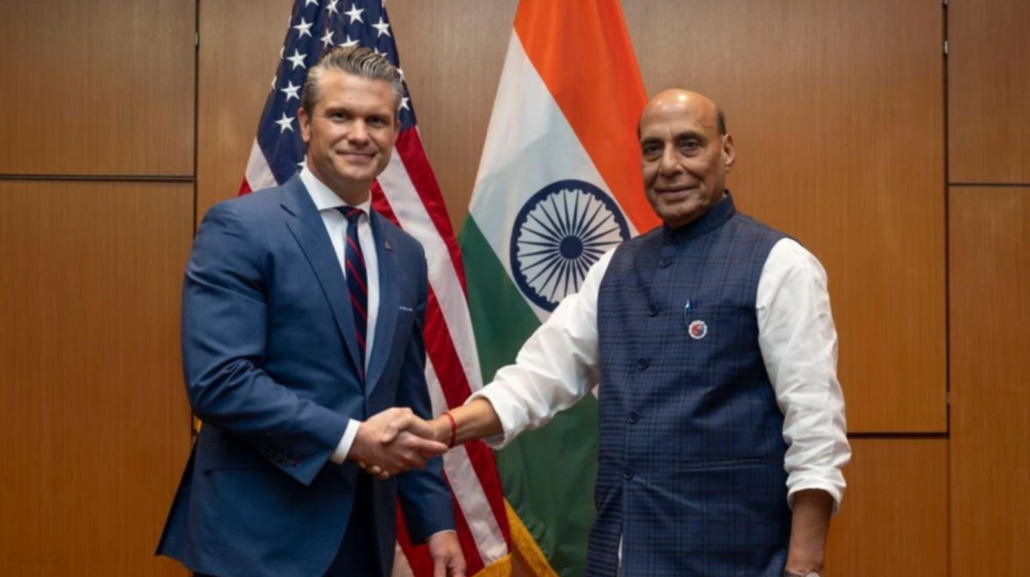
The economic and military growth of a nuclear-armed China and its implications for India’s security have caused India’s Prime Ministers from Vajpayee to Manmohan to Narendra Modi to invest substantially in strengthening the India-US relationship over the last three decades[1]. Their objectives have been to break out of technology isolation, modernise India’s military, accelerate domestic development and shape a multipolar Asia, with India as a pole. Their efforts have resulted in the transformation of Cold War estrangement to a mutually beneficial partnership.
The India-US thaw began with the visit of President Clinton to India in March 2000. Both sides agreed to be partners in peace, with a common interest in and a complementary responsibility for ensuring regional and international security[2]. Clinton’s successor, President George Bush, entered into a strategic partnership agreement with India[3], reversed decades of US non-proliferation policy through signing of the civil nuclear agreement[4], and approved the first ten-year framework agreement for India-US defence cooperation[5].
Addressing a joint session of India’s parliament in November 2010, Bush’s successor President Barack Obama voiced his firm belief that the relationship between the United States and India would be one of the defining partnerships of the 21st century[6]. He identified three areas in which the two could work together: preserving peace and security, promoting shared prosperity, and strengthening human rights and democratic governance. The ten-year framework for the US India defence relationship was revised and expanded in 2015, during his innings[7].
The first Trump Administration’s characterisation of China as using economic inducements and penalties, influence operations and implied military threats to undermine regional stability and limit US access to the region changed the prevailing US outlook towards China[8]. It ascribed a leadership role to India in South Asia and the Indian Ocean. The US National Defence Strategy of that time explicitly stated that China was leveraging military modernisation, influence operations and predatory economics to re-order the Indo-Pacific region to its advantage, seek Indo-Pacific hegemony and displace the US to achieve global pre-eminence in the future[9]. The US thus felt the need to strengthen India to act as a security provider in the Indian Ocean, the primary connector for East-West trade. India, on the other hand, felt the need to develop capability to deter Chinese adventurism in the Himalayas and in the Indian Ocean, albeit without confronting China in the Western Pacific.
The complementary needs provided the foundations for the strategic convergence that guided the India-US partnership: that of strengthening India and building an Asian balance. It is, therefore, ironic that the actions of the second Trump Administration have called into question the future of this strategic convergence.
This paper explores the evolution and prospects of the key pillar underlying the India-US strategic convergence and Comprehensive Global Strategic Partnership: bilateral defence and security cooperation. It reviews the political engagement between the countries since the first Trump administration, the foundational framework for bilateral defence cooperation, the military engagement, defence procurement and the industry engagement, before analysing current events and assessing the continued need for US-India defence cooperation.
Political Engagement
President Trump and Prime Minister Modi resolved to work together to promote stability across the Indo-Pacific, combat terrorist threats, increase economic engagement and strengthen energy linkages[10]. This was months the Da Nang APEC CEO Summit[11] brought the Indo-Pacific into the global strategic discourse as a replacement for the Asia-Pacific. The two leaders instituted a bilateral Foreign and Defence Ministerial 2+2 meeting, which was first held in September 2018[12]. Trump’s administration revived the Quad through a meeting of senior officials from the four partner countries at Manila in November 2017[13], transforming the grouping from a dormant concept into a formal diplomatic framework. His National Security Strategy of December 2017 gave the Indo-Pacific top billing amongst global theatres. It also stated, “We will deepen our strategic partnership with India and support its leadership role in Indian Ocean security and throughout the broader region”. It further spoke of insisting that Pakistan take decisive action against militant and terrorist groups operating from its soil. President Trump and Prime Minister Modi pledged to deepen defence and security cooperation, including maritime security cooperation. The US India relationship was upgraded to a Comprehensive Global Strategic Partnership when Trump visited India in February 2020[14].
Strategic convergence continued under the Biden administration. The first Quad Summit was convened virtually on March 12, 2021[15], and five summits followed. Participant nations committed to a free and open rules-based order, rooted in international law, to advance security and prosperity and counter threats in the Indo-Pacific and beyond. Biden’s National Security Strategy of October 2022 described China as the only competitor with both the intent to reshape the international order and the economic, diplomatic, military and technological power to do so, shifting the global playing field to its benefit[16]. The 2022 National Defense Strategy saw China’s coercive and aggressive endeavour to refashion the Indo-Pacific and the international system as the most comprehensive and serious challenge to US national security[17].
Biden and Modi met bilaterally four times, in September 2021, June 2023, September 2023 and September 2024. Two 2+2 dialogues were also held, in April 2022 and November 2023. Advancing the defence partnership remained a focal area in each of these engagements, apart from economic engagement, combatting terrorism, and Indo-Pacific security.
The initial stages of the second Trump administration maintained this focus. Prime Minister Modi was among the first world leaders to meet Trump for a bilateral summit in February 2025[18]. The India-US relationship, however, came under stress following Pakistan’s terror attack at Pahalgam in April 2025 and India’s response through Operation Sindoor. The US adopted a neutral stance and counselled restraint, abandoning the common rhetoric earlier administrations had adopted against cross-border terrorism. To add insult to injury, President Trump asserted he had mediated a ceasefire between India and Pakistan by threatening both leaders with deprivation of access to the US market.
India, in response, issued a public statement that it would never accept mediation, and that at no point was there any discussion on any US proposal in this regard[19]. Trump then played the Pakistan card, hosting Field Marshal Munir at the White House in June 2025, and again in September 2025, the second time with Pakistan’s Prime Minister. He also withheld assent for the India-US Free Trade Agreement, negotiations for which had been completed. He went further by imposing a 25% reciprocal tariff on India in early August 2025, and doubling this to 50% towards the end of the month. Anti US sentiment in India spiked. There has been no summit level meeting since February 2025, while the last 2+2 ministerial was held in November 2023.
The Foundations for India-US Defence Cooperation
The ground for India-US defence cooperation was laid through the four foundational agreements, which established the legal and operational framework facilitating deeper military-to-military engagement. The agreements fostered strategic, industrial and technology partnerships, advanced technology sharing and enabled logistic support between the US and its partners. India signed the General Security of Military Information Agreement (GSOMIA), a framework for sharing classified information, in May 2002[20]. The Industrial Security Annex to this, extending the framework to private industry, was signed during the second India – US 2+2 Ministerial Dialogue, in December 2019[21].
The Logistics Exchange Memorandum of Agreement (LEMOA), an India-specific agreement allowing the US and Indian militaries to access each other’s bases, land facilities, air bases, and ports for supplies, fuel, and repairs on a case-by-case basis was signed on 29 August 2016[22]. LEMOA did not create automatic obligations for assistance and did not authorise the establishment of permanent US military bases on Indian soil.
The Communications Compatibility and Security Arrangement (COMCASA), an India-specific variant of the Communications and Information Security Memorandum of Agreement (CISMOA), was signed during the inaugural 2+2 ministerial dialogue in September 2018[23]. The agreement allowed India to obtain specialised equipment for encrypted communications between the Indian and US militaries, including for intelligence-sharing, as well as with US origin platforms operated by India.
The last of the foundational agreements, the Basic Exchange and Cooperation Agreement (BECA), enabling exchange of high-quality geospatial intelligence, was signed in October 2020[24], in the aftermath of China’s surprise attack on Indian troops at Galwan.
India and the US also entered into the Security of Supply Arrangement during the visit of Raksha Mantri Shri Rajnath Singh to the US in August 2024[25]. The agreement allows both nations to access each other’s defense industrial bases for unexpected supply chain bottlenecks, such as crucial components for defense manufacturing. It is a reciprocal commitment to prioritise orders and acts as a stepping stone to Reciprocal Defence Procurement (RDP) Agreement, which still remains under negotiation.
The framework for defence cooperation constitutes the defining guideline under which cooperation between the two countries is carried out. Three frameworks, each valid for ten years, have been signed between the countries. The mutual guiding interests identified by the first, of 2005, were maintaining security and stability, defeating terrorism and violent religious extremism, preventing the spread of weapons of mass destruction (WMD) and protecting the free flow of commerce via land, air and sea lanes[26]. It envisaged bilateral engagement through the conduct of joint and combined exercises and exchanges, increased intelligence exchanges, and strategic level discussions between the US Department of Défense and India’s Ministry of Defence. It also envisaged collaboration in multinational operations, strengthening the capabilities of the militaries to promote security and defeat terrorism, expanding two-way defence trade (thus opening up procurement of defence equipment from the US by India), and strengthening the abilities of the military to respond quickly in disaster situations, among others. The Defence Policy Group (DPG) was established as the primary mechanism to guide the US-India strategic defence partnership.
A Joint Declaration on Defence Cooperation followed in 2013[27]. The US and India committed to place each other at the same level as their closest partners for defence technology transfer, trade, research, co-development and co-production for defence articles and services, including the most advanced and sophisticated technology. The US supported India’s full membership in the four international export control regimes (Australia Group, Missile Technology Control Regime, Nuclear Suppliers Group and Wassenaar Arrangement). The two sides committed to strengthen mutual understanding of their respective procurement systems and to address process-related difficulties in defence trade, technology transfer and collaboration.
The 2005 framework for defence cooperation was expanded and renewed in June 2015[28]. The guiding interests remained the same, as did the mechanisms for cooperation. Additions were enhanced training exchanges, and collaboration relating to missile defence. The Defence Technology and Trade Initiative (DTTI) had been established in 2012; a DTTI sub-group was created under the DPG to present progress to it.
The 2015 framework was replaced in October 2025 by a fresh framework. This, according to India’s press release, will usher in a new era and transform an already strong defence partnership[29]. India did not disclose the content of the framework agreement.
A US Fact Sheet from the Pentagon, however, provides more details[30]. Priorities added to the 2015 framework include safeguarding the Indo-Pacific, strengthening interoperability across all domains, supporting maritime security and maritime domain awareness, expanding collaboration with like-minded partners to address regional security challenges, including via the Quad, and bolstering defence industrial capacity, resilience and innovation through advanced defence technology cooperation. The 2025 framework envisages that the two armed forces strengthen their responses to regional threats and disasters, facilitate appropriate access for each other’s military forces, and expand logistics cooperation. It also envisages joint development and production of defence capabilities focusing on ISR, undersea domain awareness, air combat and support, air and space domain awareness, munitions and mobility[31]. It supports the development of India as a logistics and MRO hub for the region. As such, the framework sets out by far the most ambitious vision for defence cooperation between the two countries. It explicitly supersedes the 2023 US-India Roadmap for Defence Industrial Cooperation.
Military Engagement
Military engagement comprises high-level interaction, staff talks, interoperability and exercises, and training exchanges, among others. A strong and institutionalised engagement has been built up over the years across all four areas. This paper limits itself to engagement in operations and exercises, as representative of the whole.
India participates in an array of military exercises with the US, designed to build up its capability and prepare for multi-national operations. These exercises have continued despite the ups and downs in the overall India-US relationship. They include YUDH ABHYAS (21st edition held in Alaska in September 2025), VAJRA PRAHAR (16th edition held in Himachal Pradesh in February/March 2026), COPE INDIA (last edition hosted by India in November 2025), TARKASH (a joint counter-terrorism exercise last held in April 2024), SANGAM (an exercise between Indian Navy MARCOS and US Navy SEALs last held in November 2024), TIGER TRIUMPH (an amphibious HADR exercise last held in April 2025), SEA DRAGON (an ASW exercise for MRASW aircraft last held in March 2026), MALABAR (Naval exercise involving the Quad countries, last held in November 2025), RIMPAC (the world’s largest maritime exercise, last held in June-August 2024) and CUTLASS EXPRESS (intended to enhance maritime security and cooperation in the Western Indian Ocean, last held February 2026).
India announced its decision to join the Bahrain-based Combined Maritime Forces Task Force as an Associate Partner in April 2022[32]. It became a member of CTF 154, charged with leading multinational training in maritime awareness, maritime law, maritime interdiction, maritime rescue and assistance, and leadership development in the Middle East during the last quarter of 2023. India assumed command of CTF 154 in February 2026 and will lead the force for six months[33].
Defence Procurement
India is a major market for global arms manufacturers, including the US. According to SIPRI, India was the world’s second largest arms importer, after Ukraine, during the period 2021-2025[34]. This position will continue until India can sufficiently develop its own defence industry. At the same time, the US was by far the world’s largest arms exporter, with 42% of the global market.
In 2016, the US designated India as a Major Défense Partner (MDP). This was formalised in the US National Défense Authorisation Act of 2017. In 2018. India was elevated to Strategic Trade Authorisation Tier 1 (STA-1) status. The designations allowed India to receive licence free access to a wide range of military and dual-use technologies regulated by the Department of Commerce[35]. India is reported to have spent about $25 billion on procurement from the US since 2007. The figure may appear large, but is a small fraction of the over $370 billion that the top ten US defence companies generate annually. While alternatives to US producers are available in the global market, whether they meet India’s requirements and the companies concerned are willing to sell are separate questions.
An overview of India’s defence procurement from the US is contained in the succeeding paragraphs.
Indian Navy
- The Indian Navy (IN) began its American acquisitions with USS Trenton (INS Jalashwa) and six Sikorsky S-61 Seaking helicopters in 2007.
- In 2009, the IN ordered eight P-8I Long Range Maritime Reconnaissance and Anti-Submarine Warfare aircraft; these were delivered from 2013-2015. A second batch of four aircraft was ordered in 2016; these were delivered from 2020-2022. Approval for purchase of a third batch of six aircraft has been granted, and the order is expected to be placed in 2026.
- In 2020, the IN ordered 24 MH-60R Seahawk multirole helicopters; delivery of all 24 was completed by early 2026. A follow-on support deal for these helicopters was signed in November 2025.
- The IN has also ordered 15 MQ-9B Sea Guardian drones as part of an order for 31 (the balance are for the Army and Air Force), delivery of which is scheduled to begin in 2029. These will be supported by a Maintenance, Repair and Overhaul (MRO) facility in India, the first such facility outside the US.
- The US has provided India with LM 2500 gas turbines for INS Vikrant and the Project 17A frigates. Six additional turbines for the next generation missile corvettes are on order.
- India has procured 48 Mk 54 Lightweight torpedoes from the US, in 2011 and 2020. 53 more units are reported to be in the pipeline.
- India has also procured 12 air-launched and 12 submarine launched Harpoon Block II missiles in 2014 and 2016 respectively. 10 additional missiles were procured for P-8I aircraft in 2020.
- India has contracted to procure advanced ASW sonobuoys from the US; these will be manufactured by a unit set up by BDL at Visakhapatnam which is expected to commence delivery from 2027.
- The US State Department accorded approval for the sale to India of Sea Vision software for Maritime Domain Awareness in the Indian Ocean in May 2025. The status of delivery of this software is not known.
Indian Air Force
- The Indian Air Force placed an order for six C-130J Super Hercules aircraft in 2008; these were delivered by 2011. Another six aircraft were ordered in 2013 and were delivered by 2019.
- The IAF operates 11 C-17 Globemaster III aircraft, delivered between June 2013 and August 2019, which have become the backbone of its strategic transport capability.
- 15 Chinook-47F(I) heavy-lift helicopters, ordered as part of a 2015 deal, were delivered by 2020.
- The IAF ordered 22 AH-64E Apache attack helicopters in September 2015; deliveries were completed by March 2020.
- The Air Force has also received 245 Stinger air-to-air missiles as well as 1456 AGM-114 Hellfire anti-tanks missiles for these helicopters from the US.
Indian Army
- The US delivered 12 AN/TPQ-37 Firefinder counter-battery radars to the Indian Army from 2003-2007.
- A total of 145,400 SIG Sauer SIG716 G2 rifles have been procured since 2019.
- The Indian Army has inducted Polaris All-Terrain Vehicles for operation in the high-altitude regions of Ladakh and the Northeast.
- 145 M777 ultra-light howitzers for deployment in the Himalayas were ordered by the Indian Army in November 2016; these were delivered by 2023.
- Six Apache AH-64E attack helicopters were ordered by the Indian Army in 2020; delivery was completed in December 2025.
- 1300 M-982 Excalibur guided artillery shells have been ordered by India in 2019 and 2025.
- A contract for 100 Javelin Anti-Tank Guided Missiles is expected to be placed in 2026, with subsequent co-production in India.
HAL
- HAL obtained 10 F404-F2J3 engines to power the Tejas technology demonstrators and prototypes in the early 2000s.
- 65 F404-IN20 engines to power Tejas Mk 1 aircraft were ordered and were delivered between 2008 and 2016. In the absence of further orders, the production line became dormant thereafter.
- HA placed an order for 99 GE F404-IN20 engines to power Tejas Mk1A aircraft in August 2021, with GE agreeing to revive the production line. Delivery of these engines was to commence in October 2024, with two units being delivered per month thereafter. However, disruptions in the global supply chain and the logistic difficulties of restarting a dormant production line have resulted in delays. At the time of writing, only six engines have been delivered under the 2021 contract. HAL has invoked liquidated damages against GE Aerospace due to the delays in delivery.
- An additional order for 113 engines was placed in November 2025, with deliveries projected to begin in 2027 and complete by 2032.
- Meanwhile, negotiations for the GE F414 engine to power LCA Mk2 fighters are in the final stages. The deal is critical for the LCA Mk2 development programme. At the time of writing, technical negotiations were reported as completed[36]. Commercial negotiations are expected to follow, with the contract being signed by the end of the year.
The procurement relationship is not one-sided. The US is among the largest destinations for India’s defence exports, which totalled ₹38,424 crores (about $4.1 billion) in 2025-26[37]. It buys hi-tech components and sub-systems that integrate into global supply chains.
Industry Engagement
The Obama administration launched the Defence Technology and Trade Initiative (DTTI) in 2012, to enhance cooperation in technology and trade by overcoming impediments due to unique national bureaucratic structures, acquisition models and budget processes through dialogue. The initiative failed in its mandate of identifying joint projects for co-development and co-production, and has since been abandoned.
In May 2022, the India-US initiative on Critical and Emerging Technology (iCET) was announced when Prime Minister Modi met President Biden in Tokyo[38]. iCET effectively replaced the DTTI. Led by the National Security Advisers, it was intended to forge closer linkages between government, academia and industry of the two countries in areas such as AI, quantum computing, 5G/6G, biotech, space and semiconductors. It was officially launched when the two NSAs met in Washington DC in January 2023.
The NSAs also committed in 2022 to creating a new innovation bridge to connect defence startups on both sides. This resulted in the launch of INDUS-X (India-US Defence Acceleration Ecosystem) in June 2023[39]. INDUS-X has established a framework for technology transfer, joint innovation and investment in critical defence domains. It has facilitated industry collaboration, such as between General Atomics and Bharat Forge to manufacture MQ-9 components in India.
India and the US launched the India-US COMPACT (Catalysing Opportunities for Military Partnership, Accelerated Commerce and Technology) in February 2025[40]. Commitments pertaining to industry under it included conclusion of the Reciprocal Defence Procurement Agreement (still awaited), the TRUST initiative and launch of the ASIA alliance.
iCET evolved into TRUST (Transforming the Relationship Utilising Strategic Technology) during the Modi visit to the White House in February 2025[41]. Among its products is Shakti Fab, designated as India’s first national security semiconductor fab, a partnership between Bharat Semi, 3rdiTech and the US Space Force to produce infrared, gallium nitride and silicon carbide semiconductors for advanced military systems, secure telecommunications and green energy applications. Phase 1 production is expected to begin in 2027.
The Autonomous Systems Industry Alliance (ASIA) was launched in February 2025. The initiative seeks to co-develop and co-produce autonomous defence platforms for both nations and their partners. Four collaborations have been launched under ASIA. The first, a partnership between Anduril Industries and the Mahindra Group seeks to co-develop and co-produce advanced maritime systems and AI-enabled counter-Unmanned Aerial Systems (UAS). The second, between L3 Harris and Bharat Electronics (BEL), is for the development of active towed array sonar systems. Sagar Defence Engineering has signed a Memorandum of Understanding with Liquid Robotics (a Boeing company) to co-develop Autonomous Surface Vessels (ASVs) in India. Finally, Ultra Maritime and Bharat Dynamics Limited (BDL) have entered into an agreement to co-produce Multistatic Active (MSA) sonobuoys for Anti-Submarine Warfare (ASW). Other co-production opportunities under consideration are Sea Picket, an autonomous surveillance system using sonar acoustic arrays; Wave Glider, an unmanned surface vehicle; low frequency active towed sonars; large diameter autonomous unmanned vehicles; and Triton, autonomous vehicles for underwater and surface operations. Most initiatives are in the co-development or early production phase.
A number of US defence companies have invested in India. Boeing has invested in the Boeing India Engineering and Technology Centre in Bengaluru, its largest facility outside the US. Tata Advanced Systems, a joint venture with Boeing, manufactures fuselages for the AH-64 Apache helicopter and vertical fins for the 737 family. Tata Lockheed Martin Aerostructures Ltd in Hyderabad is the global single-source supplier for C-130J Super Hercules empennages. Lockheed Martin is also building an MRO hub for regional operators of the C-130 aircraft near Bengaluru; construction began in December 2025 and operations are projected to start in early 2027. Honeywell operates seven manufacturing facilities and five technology centres in India, for aerospace and automation systems. RTX Corporation has invested in an engineering development and test centre in Bengaluru and has signed an agreement with HAL to establish an MRO hub for Tejas aircraft at Lucknow. Northrop Grumman has partnered with BEL and Dynamatic Technologies to manufacture advanced defence electronics and aerostructures for F/A-18 aircraft. These investments have integrated India into global supply chains and played an important part in boosting defence exports to ₹38,424 crores in 2025-26. The target of ₹50,000 crores of exports by 2029 reflects confidence that this integration will gather further momentum.
L&T Shipyard Kattupalli has repaired the US Navy Military Sealift Command’s ships (USNS Charles Drew, USNS Mathew Perry, USNS Salvor). The US Navy has also signed Master Ship Repair Agreements with Cochin Shipyard and Mazagon Docks Shipbuilders Limited.
In sum, the industry engagement between India and the US has witnessed significant expansion, particularly over the last five years. The potential is large. Its fulfilment will depend on how the overall India-US relationship shapes up.
Recent Developments
India’s reaction to economic coercion by President Trump last year was on the same lines as its reaction to China’s military coercion in Galwan in 2020: a stiffening of the back and a refusal to submit to bullying activity, but without public recrimination. There was a severe dip in perceptions of the US amongst India’s public. Policy circles in the US too reacted adversely to President Trump’s actions. The backlash was apparently not anticipated by the administration.
Considerable effort has gone in thereafter to address the deterioration in the bilateral relationship. Arriving in New Delhi in January 2026, Ambassador Sergio Gor conveyed to the Prime Minister that the US wanted a trade deal with India. This resulted in the telephonic conversation between PM Modi and President Trump in February 2026, during which PM Modi spoke of taking the partnership to greater heights[42]. This was followed by formal announcement of an interim agreement regarding reciprocal and mutually beneficial trade[43]. The US Supreme Court ruling in February 2026 striking down President Trump’s ‘Liberation Day’ tariffs resulted in the US initiating Section 301 investigations, including into India, which could result in tariffs being imposed again. India is awaiting the results of this investigation, due in May 2026, before moving ahead with the trade deal.
Defence engagement between the two sides continued notwithstanding the hiatus in bilateral relations, indicating that both sides saw value in them. In October 2025, the two countries signed a fresh framework agreement on defence[44]. The US National Security Strategy of November 2025 prioritised rebalancing America’s economic relationship with China, while maintaining a strong deterrent posture in the Indo-Pacific. It stated, “We must continue to improve commercial (and other) relations with India to encourage New Delhi to contribute to Indo-Pacific security, including through continued quadrilateral cooperation with Australia, Japan and the United States[45].
US Deputy Secretary of State Christopher Landau visited India in March 2026 and explained the US position at the Raisina Dialogue[46]. He said that it was undeniable that this century would see the rise of India, that the Indian Ocean had become the centre of gravity internationally, and that it was in the US interest to partner with India. The caveat was that the US could not be expected to make the same mistakes with India that it had with China 20 years ago. Noting that there was cooperation in the US India defence relationship that would have been impossible some years ago, he identified preventing terrorism and ensuring freedom of the seas as shared interests.
Landau’s visit was followed by that of Under Secretary of War for Policy Elbridge Colby, to co-chair the meeting of the India-US Defence Policy Group. Speaking at a public engagement[47], Colby identified India’s role in ensuring stability in the Indo-Pacific as indispensable. He stated that the US sees India not merely as a key partner, but as an essential one in ensuring a long-term favourable balance of power in Asia. He drew parallels between the US policy of flexible realism and the need for greater realism in foreign policy espoused by Dr. S. Jaishankar in his book, ‘The India Way’. He saw the fact that the India-US relationship rests not on dusty formalities and unchallengeable shibboleths but on a hard-headed, clear-eyed recognition of overlapping interests as a key strength. He noted that both countries recognised the strategic centrality of military power for a stable balance in the region, and thus defence cooperation should enhance real capability. He saw the need for India to possess capabilities to defend its sovereignty and contribute to a favourable balance of power as a focal area for the US.
Assessing the US India Defence Partnership
The world is changing around us. The United Nations Security Council now appears an anachronism, with great powers themselves breaking the rules they had devised to maintain peace in the world. The US “Liberation Day” tariffs and its interventions in Venezuela and Iran mark the demise of the so-called rule-based order that guided international trade relations since World War II. A might is right era has dawned. It is in this new era that India faces the continued China thrust towards primacy in Asia, designed to relegate other countries to subordinate status. The bravery of India’s Armed Forces alone will not suffice to make up for deficiencies in strategic thinking or military technology, just as it did not in 1962. The need for priority action to strengthen India’s military capability remains, as does the strategic convergence that underpinned the India-US partnership.
The breakdown of trust in relations with the US merits consideration. Relations between great powers have historically been defined by interests and not by an abstruse belief in trust. Lord Palmerston’s well-known statement about only interests being permanent is as relevant today as when he uttered it in 1848[48]. There have been examples of cooperation, but these have been driven by shared threats, economic interdependence or mutual necessity rather than trust. The reality is that great powers perceive their relationships with other great powers in zero-sum terms. Since judging the long-term intentions of a competitor is well-nigh impossible, actions are often based on worst case scenarios.
On the other hand, as a third-world nation, India has placed great emphasis on trust. But trust not backed by adequate measures to safeguard against breakdown or betrayal, particularly in an anarchic era marked by flexible realism or multi-alignment, is a luxury that India can no longer afford. Diplomatic trust can no longer substitute for absence of deterrent military capability. India’s diplomacy will thus have to be based on hard-headed negotiation and greater foresight, putting in place the necessary safeguards.
India has derived considerable benefit from its partnership with the US. It has obtained access to high-end US military equipment and is gaining access to advanced miliary technology. It has diversified its dependence on Russian military equipment: Russian support in the event of a challenge from its “no limits” partner has become questionable. No other country can provide the range of capability that the US can. Reciprocal access agreements such as LEMOA and with other US allies have expanded India’s operational footprint in the Indian Ocean and the Indo-Pacific. Bilateral defence trade integrates Indian defence companies into global supply chains and creates jobs in the country.
There are, however, accompanying disadvantages. These include political friction due to the US penchant for weaponising dependency for coercive purposes, thus threatening India’s strategic autonomy; the US war in Iran and use of the Pakistan card, giving rise to strong anti-US sentiment in India; the US failure to modify the application of regulations like ITAR to India, leading to delays in projects; and US actions giving credence to the continued perception of the US as an unreliable partner.
Conclusion
Pique over US actions over the course of the last one year should not override the strategic reality that the US remains the most practicable option to strengthen India’s military capability in a timely manner. The core strategic interests continue to align. A transactional US doesn’t threaten India’s sovereignty or seek to subordinate India, unlike China. It only reinforces the correctness of India’s policy of ‘Atmanirbhar Bharat’. And as has been brought out above, the India-US defence partnership has begun to deliver on its objectives.
Recent events indicate that both sides remain interested in working with each other in strengthening India’s military capability. There is continued value in US arms sales, intelligence sharing, interoperability, technology transfers and defence industry engagement, so long as India can build in the necessary safeguards. India should thus continue investing in it, while at the same time exploring other options so as to retain strategic autonomy. This will require political and diplomatic dexterity from both sides to manage the partnership in a spirit of hard-headed realism, weighing costs against benefits, and always keeping in mind India’s goal of becoming a consequential power in the word.
*******
About the Author
Commodore Lalit Kapur (Retd) is a Senior Fellow for Maritime Strategy within the Delhi Policy Group (DPG), New Delhi. An experienced former naval officer, and an astute and insightful maritime analyst, the Commodore holds a Bachelor’s Degree in Science from Jawaharlal Nehru University as well as two Master’s Degrees (both with Distinction), one in Defence Studies from Madras University and the other in Management Studies from Osmania University. He also holds an M Phil degree from Mumbai University. He is an avid reader and a prolific writer, with his many interests including International Relations, human resource development, and military history. He may be reached at lalit@dpg.org.in
Endnotes
[1] The deteriorating security environment was responsible for India’s decision to go nuclear, as explained in Prime Minister Atal Bihari Vajpayee’s letter to US President Clinton. See “Nuclear Anxiety; Indian’s Letter to Clinton on the Nuclear Testing”, New York Times, May 13, 1998, https://www.nytimes.com/1998/05/13/world/nuclear-anxiety-indian-s-letter-to-clinton-on-the-nuclear-testing.html
[2] Joint Statement on United States-India Relations: A Vision for the 21st Century, March 21, 2000, https://www.presidency.ucsb.edu/documents/joint-statement-united-states-india-relations-vision-for-the-21st-century
[3] Statement on Next Steps in Strategic Partnership With India, January 12, 2004, https://www.govinfo.gov/content/pkg/WCPD-2004-01-19/pdf/WCPD-2004-01-19-Pg61-2.pdf
[4] US – India Civil Nuclear Cooperation Initiative, March 9, 2006, https://2001-2009.state.gov/r/pa/scp/2006/62904.htm
[5][5] New Framework for the US – India Defense Relationship, June 28, 2005, https://library.rumsfeld.com/doclib/sp/3211/2005-06-28%20New%20Framework%20for%20the%20US-India%20Defense%20Relationship.pdf
[6] Remarks by the President to the Joint Session of the Indian Parliament in New Delhi, India, November 08, 2010, https://obamawhitehouse.archives.gov/the-press-office/2010/11/08/remarks-president-joint-session-indian-parliament-new-delhi-india
[7] Framework for the US – India Defense Relationship, June 3, 2015, https://digital.library.unt.edu/ark:/67531/metadc949830/m2/1/high_res_d/2015-Defense-Framework.pdf
[8] National Security Strategy of the United States of America, December 2017,
[9] Summary of the 2018 National Défense Strategy of the United States of America: Sharpening the American Military’s Competitive Edge.
[10] Joint Statement – United States and India: Prosperity Through Partnership, June 27, 2017, https://www.mea.gov.in/bilateral-documents.htm?dtl/28560/United_States_and_India_Prosperity_Through_Partnership
[11] Remarks by President Trump at APEC CEO Summit, Da Nang, Vietnam, November 10, 2017, https://trumpwhitehouse.archives.gov/briefings-statements/remarks-president-trump-apec-ceo-summit-da-nang-vietnam/
[12] Joint Statement on the Inaugural India – US Inaugural 2+2 Dialogue, September 06, 2018, https://www.mea.gov.in/bilateral-documents.htm?dtl/30358/Joint_Statement_on_the_Inaugural_IndiaUS_2432_Ministerial_Dialogue
[13] Australia-India-Japan-US Consultations on the Indo-Pacific, November 12, 2017, https://2017-2021.state.gov/australia-india-japan-u-s-consultations-on-the-indo-pacific/
[14] Joint Statement: Vision and Principles for India-US Comprehensive Global Strategic Partnership, February 25, 2020, https://mea.gov.in/bilateral-documents.htm?dtl/32421/Joint+Statement+Vision+and+Principles+for+IndiaUS+Comprehensive+Global+Strategic+Partnership
[15] Quad Leaders Joint Statement ‘The Spirit of the Quad’, March 12, 2021, https://mea.gov.in/bilateral-documents.htm?dtl/33620/Quad_Leaders_Joint_Statement_The_Spirit_of_the_Quad
[16] National Security Strategy, October 2022, https://www.whitehouse.gov/wp-content/uploads/2022/10/Biden-Harris-Administrations-National-Security-Strategy-10.2022.pdf
[17] 2022 National Defense Strategy of the United States of America, https://media.defense.gov/2022/Oct/27/2003103845/-1/-1/1/2022-NATIONAL-DEFENSE-STRATEGY-NPR-MDR.PDF
[18] India – US Joint Statement during the visit of Prime Minister of India to the US, February 14, 2025, https://pib.gov.in/PressReleasePage.aspx?PRID=2103037
[19] English translation of Foreign Secretary’s statement on the telephone conversation between PM and US President (June 17, 2025), June 18, 2025, https://www.mea.gov.in/Speeches-Statements.htm?dtl/39692/English_Translation_of_Foreign_Secretarys_statement_on_the_telephone_conversation_between_PM_and_US_President_June_17_2025
[20] Joint Statement of the India-US Defence Policy Group, May 23, 2002, https://www.mea.gov.in/bilateral-documents.htm?dtl/7570/Joint_Statement_of_IndiaUS_Defense_Policy_Group
[21] Joint Statement on the Second India-US 2+2 Ministerial Dialogue, December 19, 2019, https://www.mea.gov.in/bilateral-documents.htm?dtl/32227/Joint+Statement+on+the+Second+IndiaUS+2432+Ministerial+Dialogue
[22] Indo-US Logistics Exchange Memorandum of Agreement, February 7, 2017, https://www.pib.gov.in/PressReleasePage.aspx?PRID=1482026®=3&lang=1
[23] Joint Statement on the Inaugural India-US 2+2 Ministerial Dialogue, September 06, 2018, https://www.mea.gov.in/bilateral-documents.htm?dtl/30358/Joint_Statement_on_the_Inaugural_IndiaUS_2432_Ministerial_Dialogue
[24] Raksha Mantri Shri Rajnath Singh holds bilateral delegation level meeting with his US counterpart Mark Esper; Both sides to sign agreement of BECA during the visit, October 26, 2020, https://www.pib.gov.in/PressReleasePage.aspx?PRID=1667651®=3&lang=2
[25] DOD, India Ministry of Defence Enter Into Security of Supply Arrangement, August 22, 2024, https://www.war.gov/News/Releases/Release/Article/3880791/dod-india-ministry-of-defence-enter-into-security-of-supply-arrangement/
[26] New Framework for the US-India Défense Relationship, June 28, 2005, https://library.rumsfeld.com/doclib/sp/3211/2005-06-28%20New%20Framework%20for%20the%20US-India%20Defense%20Relationship.pdf
[27] Joint Declaration on Defence Cooperation, June 03, 2013, https://www.mea.gov.in/Uploads/PublicationDocs/22265_Joint_Declaration_on_Defence_Cooperation.pdf
[28] Framework for the US-India Défense Relationship, September 27, 2015, https://digital.library.unt.edu/ark:/67531/metadc949830/m2/1/high_res_d/2015-Defense-Framework.pdf
[29] Raksha Mantri & US Secretary of War meet on the margins of 12th ADMM-Plus in Kuala Lumpur, Ink 10-year framework for US-India major defence partnership, October 31, 2025, https://www.pib.gov.in/PressReleasePage.aspx?PRID=2184622®=3&lang=2
[30] Fact Sheet: Framework for the US-India Major Défense Partnership, October 31, 2025, https://media.defense.gov/2025/Nov/13/2003820236/-1/-1/1/FACT-SHEET-FRAMEWORK-FOR-THE-US-INDIA-MAJOR-DEFENSE-PARTNERSHIP.PDF
[31] As also envisaged in the Roadmap for US India Défense Industrial Cooperation, June 5, 2023, https://media.defense.gov/2023/Jun/21/2003244834/-1/-1/0/ROADMAP-FOR-US-INDIA-DEFENSE-INDUSTRIAL-COOPERATION-FINAL.PDF
[32] Joint Statement of the Fourth India-US 2+2 Ministerial Dialogue, April 12, 2022, https://www.mea.gov.in/bilateral-documents.htm?dtl/35184/Joint+Statement+on+the+Fourth+IndiaUS
[33] India Assumes Command of Combined Maritime Forces’ Combined Task Force 154, February 11, 2026, https://combinedmaritimeforces.com/2026/02/11/india-assumes-command-of-combined-maritime-forces-combinedtask-force-154/
[34] Trends in International Arms Transfers, 2025, March 2026, https://www.sipri.org/sites/default/files/2026-03/fs_2603_at_2025.pdf
[35] US Security Cooperation with India, January 20, 2025, https://www.state.gov/u-s-security-cooperation-with-india
[36] “Big Boost to IAF: GE Aerospace, HAL seal technical pact on jet engines”, The Economic Times, April 13, 2026, https://economictimes.indiatimes.com/news/defence/big-boost-to-iaf-ge-aerospace-hal-seal-technical-pact-on-jet-engines/articleshow/130218096.cms?from=mdr
[37] Defence exports skyrocket to record Rs 38,424 crore in Financial Year 2025-26, a massive 62.66% increase over previous fiscal, April 2, 2026, https://www.pib.gov.in/PressReleasePage.aspx?PRID=2248124®=3&lang=1
[38] Prime Minister’s Meeting with President of the United States of America, May 24, 2022, https://www.pib.gov.in/PressReleseDetailm.aspx?PRID=1827885®=3&lang=2
[39] India US Defence Acceleration Ecosystem (INDUS X) launched in Washington DC, June 22, 2023, https://www.pib.gov.in/PressReleaseIframePage.aspx?PRID=1934311®=3&lang=2
[40] Ibid.
[41] India – US Joint Statement during the visit of Prime Minister of India to US, February 14, 2025, https://www.whitehouse.gov/briefings-statements/2025/02/united-states-india-joint-leaders-statement/
[42] Prime Minister Speaks to President Trump, February 02, 2026, https://www.pib.gov.in/PressReleseDetailm.aspx?PRID=2222399®=3&lang=1
[43] United States – India Joint Statement, February 6, 2026, https://www.whitehouse.gov/briefings-statements/2026/02/united-states-india-joint-statement/
[44] Raksha Mantri and US Secretary of War meet on the margins of 12th ADMM-Plus in Kuala Lumpur, ink framework for US-India major defence partnership, October 31, 2025, https://www.pib.gov.in/PressReleasePage.aspx?PRID=2184622®=3&lang=2
[45] National Security Strategy of the United States of America, November 2025, https://www.whitehouse.gov/wp-content/uploads/2025/12/2025-National-Security-Strategy.pdf
[46] Deputy Secretary of State Christopher Landau at the Raisina Dialogue, March 5, 2026, https://www.state.gov/releases/office-of-the-spokesperson/2026/03/deputy-secretary-of-state-christopher-landau-at-the-raisina-dialogue/
[47] Remarks by Under Secretary of War for Policy Elbridge Colby at the Ananta Centre in India, March 24, 2026, https://www.war.gov/News/Speeches/Speech/Article/4442027/remarks-by-under-secretary-of-war-for-policy-elbridge-colby-at-the-ananta-centr/
[48] The original quote reads, “We have no eternal allies, and we have not perpetual enemies. Our interests are eternal and perpetual, and those interests it is our duty to follow”.


Leave a Reply
Want to join the discussion?Feel free to contribute!