
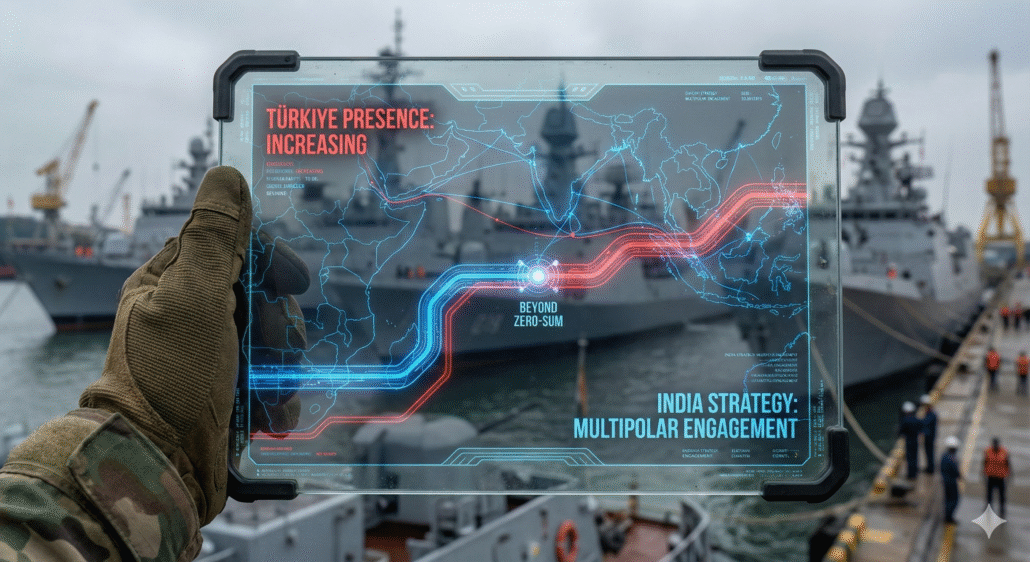
Türkiye’s expanding interest in the Indian Ocean—manifested through defence exports, naval diplomacy, and its growing partnership with Pakistan—has increasingly been interpreted in Indian strategic circles through a zero-sum lens. Yet this approach risks overestimating Türkiye’s structural capabilities while underestimating India’s ability to shape the regional environment. This article argues that India’s long-term maritime interests are better served through a strategy of regulated coexistence, wherein extra-regional powers are neither denied access nor permitted unconstrained operational space. As the principal resident power in the Indian Ocean, India possesses both the legitimacy and capacity to define normative boundaries for external engagement. A calibrated approach—neither confrontational nor permissive—allows India to signal its maritime primacy to realist audiences while simultaneously advancing a liberal, cooperative, and rules-based vision for the region. This perspective also shifts attention away from the ideological preferences or personal choices of individual Turkish leaders, and instead centres the structural, institutional, and long-term dynamics that should guide India’s maritime diplomacy. As part of a broader multi-article study examining how India’s evolving maritime geostrategies are impacted by those of Türkiye, this article explores the policy options available to New Delhi—options that extend beyond the conventional impulse to boycott, marginalise, or alienate Türkiye in the Indian Ocean.
Beyond Zero-Sum: Reframing Maritime Competition
In international relations, a zero-sum game refers to a situation where one actor’s gain is understood to come at the direct expense of another. This logic, drawn largely from realist thinking and classical game theory, has historically shaped interpretations of power, influence and access—especially in strategic spaces such as the Indian Ocean. Through this prism, any new maritime presence is viewed as encroachment, and any increase in capacity interpreted as a corresponding loss for others. However, such an approach increasingly fails to capture the complexity of contemporary maritime diplomacy.
The sea is not a finite territorial prize in the way land has traditionally been conceived. Geoffrey Till famously noted that the oceans function as spaces of movement, communication and connection, rather than zones of occupation.[1] This makes maritime power qualitatively different: it is measured less by exclusion and more by access, stability, and the ability to sustain flows of trade, energy, data and humanitarian assistance. In such an environment, multiple actors can operate simultaneously without necessarily cancelling one another out.
This does not deny the existence of strategic rivalry or defence alignments that may run counter to India’s interests. However, it does challenge the assumption that every Turkish initiative in the Indian Ocean must be read as an automatic strategic loss for India. A strictly zero-sum interpretation obscures important distinctions between hostile intent, transactional engagement and parallel ambition. For a maritime power pursuing an inclusive vision through maritime policies such as SAGAR and MAHASAGAR, the more effective approach lies in managing overlap, shaping norms and reinforcing regional leadership, rather than reacting through reflexive exclusion.
In this context, zero-sum thinking is not only analytically weak; it is strategically limiting. It narrows diplomatic space at a time when the Indian Ocean requires layered cooperation, calibrated competition and flexible alignment. Maritime diplomacy, by design, is an arena where coexistence is not just possible — it is often necessary.
Türkiye in the Western Indian Ocean: Friction, Fragility, and Manageable Ambitions
The Western Indian Ocean—stretching from the Horn of Africa to the Gulf of Aden and the Red Sea—is the principal region where Indian and Turkish interests intersect. For India, this is a vital energy corridor and a strategic extension of its maritime backyard. For Türkiye, it has become an arena for testing its middle-power aspirations, showcasing its development model, and strengthening ties with Muslim-majority partners. Understanding this space is central to evaluating both the scale and limits of Türkiye’s ambitions in the Indian Ocean.
Türkiye’s most substantive presence is in the Horn of Africa, particularly in Somalia, where Ankara has invested deeply since launching its “Opening to Africa” policy in 2005.[2] Its so-called “Ankara Consensus”—centred on human-centred development, infrastructure building, and rejection of Western-style conditional aid—has resonated strongly among regional elites.[3] In Somalia, Türkiye manages critical infrastructure, operates hospitals, and maintains the TURKSOM training base established in 2017, its largest overseas military facility.[4] The 2024 Defence and Economic Cooperation Framework Agreement, which commits Türkiye to rebuilding Somalia’s navy and protecting its EEZ, further consolidates this presence.[5]
- Stabilisation Role in Somalia: A Realist Asset for India, Not a liability. Türkiye’s engagement in Somalia is widely read in India as an extension of Ankara’s search for geopolitical leverage, ideological influence, and maritime reach. All of that may well be true—and yet, from a strictly functional Indian perspective, the more important question is not what motivates Türkiye, but what the outcome produces for the regional security environment. If Türkiye’s state-building project in Somalia results in a more coherent Somali security apparatus, then India gains—not loses. For New Delhi, the real destabiliser in the Western Indian Ocean is not Turkish power, but Somali State failure. If Ankara is willing to expend resources, political capital, and military deployments to stabilise one of the world’s most difficult theatres, it is effectively absorbing a cost-burden that India has carried for years. The Indian Navy’s experience makes this clear. During 2024 alone, the Indian Navy, acting as the default “first responder” in the Western Indian Ocean, deployed more than twenty ships and thousands of personnel, undertook constant escort and boarding operations, and conducted rescues across vast distances that lie far from India’s core maritime priorities.[6] Every day spent suppressing piracy off the Horn of Africa is a day not spent countering China’s expanding presence in the Eastern Indian Ocean—India’s actual strategic theatre. If a Turkish-trained Somali Navy eventually performs even a fraction of these “beat cop” duties, India benefits directly. A stable Somalia capable of policing its own coastlines reduces the operational burden on India and allows naval resources to be reallocated towards the China challenge, where India’s long-term maritime future will truly be shaped.
This logic also holds on land. The main threat to Indian and global shipping is not Turkish influence but Somali anarchy. Al-Shabaab’s ability to exploit ungoverned spaces sustains terrorism, trafficking networks, and piracy ecosystems.[7] Türkiye’s state-building efforts, regardless of their ideological packaging, are aimed precisely at restoring the territorial and institutional coherence that such groups rely on undermining.[8] The fact that most other external actors—Gulf States, Western powers, or African partners—have either failed or retreated from long-term stabilisation only underscores the reality that Türkiye is filling a vacuum that others have been unwilling or unable to address.[9] Geopolitics abhors a vacuum, and from India’s vantage point, Türkiye’s presence is preferable by far to the absence of any effective State authority.
There is also an underappreciated convergence of interest. Rivals often want similar outcomes, and in this case, India and Türkiye share the basic goal of secure sea lanes. Türkiye’s export routes to Africa depend on safe waters just as India’s energy supplies depend on stability across the Gulf of Aden. If Ankara’s geopolitical ambitions compel it to invest heavily in Somali capacity-building, India becomes a strategic beneficiary. Letting Türkiye “foot the bill” for stabilisation, while India focuses on securing the eastern half of its maritime backyard, is not a concession—it is a logical, interest-driven division of labour. In a realist reading, India does not need to endorse Türkiye’s broader ambitions to benefit from the stabilisation they might produce.
For India, then, the correct approach is not to fixate on Türkiye’s aspirations but to evaluate the net effect of its actions on the Indian Ocean security environment. If a more capable Somali State emerges, piracy declines, terrorist safe havens shrink, and the Western Indian Ocean becomes more governable, India gains strategic space where it needs it most. In this sense, India’s response should remain pragmatic: do not dismiss Türkiye’s geopolitical ambitions, but recognise that if Ankara is willing to undertake the stabilisation tasks others have failed at, New Delhi has every reason to exploit the strategic dividends.
- A Functional Alignment Masking Structural Distrust. The Red Sea and the Gulf of Aden illustrate most clearly the dual character of Türkiye’s maritime presence: tactically aligned with India’s interests yet strategically mistrusted in New Delhi. On the water, both navies are effectively engaged in the same mission—protecting shipping, deterring piracy, and navigating the instability generated by Houthi attacks. India’s independent deployments under Operation SANKALP and Türkiye’s long-standing participation in the Combined Maritime Forces (CMF) operate along parallel tracks, suppressing identical non-State threats without friction.[10] The hijacking of the Galaxy Leader—a vessel travelling from Türkiye to India—underscored the shared vulnerability both economies face when the maritime corridor becomes unstable.[11] In this functional sense, every additional capable navy in the region marginally reduces India’s immediate operational burden and helps maintain the flow of energy and trade. Yet this operational alignment stops at the tactical level. Strategically, New Delhi does not view Türkiye as a benign contributor to the regional security architecture. The mistrust is visible in India’s decision to reportedly exclude Türkiye from multilateral naval exercises such as MILAN—a clear diplomatic signal that Ankara is not considered a partner in shaping the Indo-Pacific security order.[12] The source of Indian concern is straightforward: Türkiye’s naval presence in the Western Indian Ocean amplifies Pakistan’s maritime horizon. With Ankara building Pakistan’s Babur Class corvettes, modernising its submarines, supplying drones, and sustaining long-term military training, any Turkish footprint in the Red Sea or near the Horn of Africa risks becoming an indirect operational asset for Islamabad.[13]
While political narratives in New Delhi often emphasise the Türkiye–Pakistan axis or Ankara’s selective alignment with China, these perceptions overstate the degree to which Türkiye’s actions undermine India’s maritime interests. Operational reality in the western Indian Ocean—especially during the Houthi crisis—demonstrates something far more complex and strategically manageable: Türkiye’s self-interested behaviour frequently produces outcomes that are not only non-zero-sum, but in several cases directly beneficial to India. Crucially, there is no evidence that Turkish deployments in the Red Sea or western IOR aim to constrain Indian shipping or challenge India’s maritime primacy. Türkiye’s actions are driven by its own economic vulnerabilities and desire to be seen as a responsible stakeholder—dynamics that incidentally support India’s broader vision for a stable, rules-conducive maritime order. This reality undermines the assumption that Ankara’s influence automatically dilutes India’s leverage. Rather, Türkiye’s pursuit of its own geopolitical interests can produce a stability dividend for India, particularly in regions where the burden of safeguarding sea lines of communication is extensive and increasingly costly.
- Symbolism Over Sustained Power. Türkiye’s engagements in the Indian Ocean—whether through naval port calls, defence exports, training missions, or its occasional participation in multilateral patrols—must also be understood alongside the structural limits of its maritime power projection. Despite the assertive rhetoric surrounding Mavi Vatan (Blue Homeland), Türkiye continues to face the classic tyranny of distance that constrains all mid-sized navies operating far from their home waters. While Ankara is visibly transitioning from a coastal defence posture to a more expeditionary orientation, its operational focus remains rooted in the Mediterranean, Aegean, and Black Sea.[14] These are theatres where the Turkish Navy must manage high-tempo commitments: the enduring rivalry with Greece, competition over energy exploration rights in the Eastern Mediterranean, the security implications of the Russia–Ukraine conflict, and protracted engagements in Libya and Syria.[15] This demanding neighbourhood absorbs the bulk of Türkiye’s naval bandwidth, leaving limited surplus capacity for sustained engagement in the Indian Ocean.
The much-publicised TCG Anadolu illustrates the gap between Türkiye’s maritime ambitions and its practical ability to operate at distance. Celebrated as a symbol of national technological prowess and naval modernisation, the ship does not, in its current form, possess the attributes of a platform for high-intensity sea-control operations.[16] Designed originally to host the F-35B, the ship lost its intended fixed-wing air element when Türkiye was removed from the F-35 programme.[17] Its re-conceptualisation as a drone-carrying platform is innovative but does not compensate for the absence of supersonic, carrier-capable fighters—assets essential for fleet air defence in contested environments.[18] Equally important, the Anadolu lacks the protective architecture required for long-distance deployments: Türkiye does not yet field a dedicated anti-air warfare destroyer (the TF-2000 class remains developmental), meaning any long-range task group would be highly vulnerable outside the protective envelope of land-based Turkish air power.[19] In practical terms, the vessel is an instrument of presence and political signalling, not a platform that meaningfully alters the maritime balance of power in the Indian Ocean.
Türkiye’s logistical limitations reinforce this structural reality. Blue-water operations require a robust fleet train—replenishment oilers, supply ships, heavy repair vessels, and ammunition resupply platforms—to sustain ships thousands of nautical miles from home.[20] While Türkiye possesses capable replenishment vessels, their number is limited, and they are already heavily tasked in the Mediterranean and Black Sea. Any attempt to maintain a persistent naval presence in the Indian Ocean would require diverting these assets away from Türkiye’s immediate security environment, a cost Ankara is unlikely to accept. Similarly, Türkiye’s overseas facilities—such as the Somali training base or its footprint in Qatar—carry political and symbolic value but do not constitute a logistical ecosystem capable of supporting sustained, high-intensity naval operations.[21] They lack the infrastructure for complex repairs, missile resupply, or deep maintenance. As a result, the Indian Ocean remains a theatre that Türkiye can enter episodically but cannot hold or shape through maritime power alone.
Taken together, Türkiye’s role in the Western Indian Ocean is best understood as a mix of meaningful diplomatic activism, selective operational engagement, and clear structural limitations. Its presence introduces friction at times, especially when intertwined with Pakistan, but also contributes to shared objectives such as anti-piracy, counter-terrorism, and maritime stability. Türkiye is not a structural challenger to India’s maritime primacy but a manageable, commercially driven middle power operating within a region too vast and too fragmented for any single external actor to dominate. For India, recognising these dynamics is essential to moving beyond zero-sum interpretations and toward a strategy of regulated coexistence—one that absorbs Türkiye’s presence where useful, limits it where necessary, and ultimately reinforces India’s long-term role as the principal architect of security and order in the Indian Ocean.
The Eastern Flank and ASEAN: Functional Convergence Beyond Rivalry
The Eastern flank offers perhaps the clearest evidence that Ankara’s maritime and defence footprint need not be viewed through a lens of strategic anxiety. Under its ‘Asia Anew’ initiative, Türkiye’s outreach to Southeast Asia is driven by a search for markets rather than a desire for geopolitical contestation, creating a commercial landscape where Indian and Turkish interests run in parallel rather than in collision. Ankara has successfully cultivated defence partnerships with key Muslim-majority ASEAN states, most notably Indonesia and Malaysia, yet these engagements focus on capability development and technology transfer rather than ideological alignment.[22] From New Delhi’s vantage point, Türkiye emerges in this theatre as a market competitor rather than a security threat, operating in a defence ecosystem vast enough to accommodate multiple players. India’s own strategic successes, such as the supply of BrahMos missiles to the Philippines[23], coexist with Turkish defence sales without operational conflict.[24] However, one must recognise that Türkiye’s defence industry has evolved into a primary instrument of its foreign policy largely out of economic necessity. With a domestic localisation rate now exceeding 80 per cent[25], the Turkish defence sector has effectively saturated its home market; the Turkish Armed Forces alone cannot absorb the sheer volume of platforms being produced. Consequently, the industry faces a stark ‘export-or-perish’ reality.[26] The record $7.2 billion in defence exports achieved in 2024 is not merely a diplomatic trophy but a critical inflow of foreign currency required to sustain the sector’s massive R&D overheads.[27]
Despite this commercial momentum, Türkiye’s ability to wield sustained strategic influence remains pragmatically constrained. Beyond chronic trade deficits and limited high-value non-defence exports, Ankara’s export-led model is hamstrung by a severe ‘engine bottleneck’.[28] While proficient in hull and airframe design, Türkiye remains heavily reliant on imported propulsion systems for its most prestigious platforms. The Altay main battle tank, for instance, still depends on South Korean power packs to replace restricted German technology, exposing a fragile supply chain susceptible to the very geopolitical friction Ankara seeks to escape.[29] This critical dependency on foreign subsystems—from engines to transmission units—means Türkiye cannot guarantee long-term support to its buyers without external approval, a vulnerability that limits its potential to replace established powers as a primary security guarantor.
The functional convergence evident in this theatre illustrates the principle that shared operational goals do not require political alignment. While Türkiye pursues prestige, markets, and currency, India’s maritime and strategic interests remain secure, provided New Delhi engages with a clear-eyed understanding of the distinction between capability, ambition, and intent. Understanding these specific industrial vulnerabilities offers India a unique strategic lever to navigate Türkiye’s footprint, but this complex interplay of supply chain geopolitics warrants a detailed examination in its own right and will be discussed elaborately in subsequent articles. By compartmentalising Türkiye’s activities and focusing on mutual functional outcomes—such as regional stability and the modernisation of partner militaries—India can effectively absorb Türkiye’s presence without adopting a zero-sum perspective.
Recommendations for India: Operationalising a Positive-Sum Approach with Türkiye
- De-hyphenate the Türkiye-Pakistan Relationship. India must engage Ankara on its own merits rather than through the lens of Pakistan. Viewing Türkiye solely as a proxy for Islamabad risks overstating strategic threats and undermining opportunities for constructive engagement. By treating Türkiye as a G20 economy, a Eurasian connectivity hub, and a middle power-seeking prestige, India can raise the cost of Ankara adopting anti-India positions while preserving New Delhi’s maritime primacy.
- Leverage Functional Convergence in the Western Indian Ocean. Operational realities, particularly anti-piracy, counter-terrorism, and maritime security in the Horn of Africa, Red Sea, and the Gulf of Aden, provide areas of pragmatic alignment. India should continue to capitalise upon Türkiye’s willingness to shoulder State-building and policing burdens (e.g., Somali Navy development) to reduce resource strains on the Indian Navy, while maintaining vigilance to ensure that these operations do not indirectly strengthen Pakistani naval capabilities.
- Expand Multilateral Platforms and Positive-Sum Mechanisms. India should actively use multilateral forums such as IORA to channel Türkiye’s energies into constructive and non-controversial sectors, including disaster risk management, trade facilitation, and maritime governance. Structured engagement on Non-Traditional Security (NTS) and the “blueing” of national and regional economies ensures that Türkiye contributes to regional stability without threatening India’s strategic interests.
- Integrate Economic Interdependence into Strategic Calculus. India should continue to strengthen bilateral trade and investment links with Türkiye, which have proven resilient despite political friction. Sectors such as construction, logistics, and manufacturing provide mutual benefits, stabilising the relationship and creating incentives for Ankara to maintain a cooperative posture.
- Capitalise on the Blue Economy and Non-Traditional Security Nexus. India and Türkiye have complementary capabilities in sustainable maritime industries, renewable energy, marine tourism, aquaculture, and maritime safety. Joint ventures, technology transfer, and shared capacity-building programmes can transform potential friction into positive-sum gains, aligning with India’s maritime policies of SAGAR and MAHASAGAR. Information-sharing mechanisms, particularly on white shipping and non-Sstate threats, offer low-risk avenues for collaboration.
- Maintain Strategic Vigilance While Encouraging Integration. India should continue to assert its naval dominance in the IOR and maintain surveillance of Turkish deployments to ensure that regional security is not compromised. This dual approach—engagement where possible, containment where necessary—allows India to harness benefits from Türkiye’s presence without ceding strategic control.
- Adopt a Long-Term, Structural Perspective. Engagement strategies should be informed by structural realities rather than episodic rhetoric. Türkiye’s limitations in logistics, expeditionary capacity, and sustained naval presence mean its maritime activities are largely symbolic and opportunistic. Recognising these constraints enables India to formulate policy that balances vigilance with collaboration, avoiding unnecessary zero-sum assumptions.
Conclusion
Türkiye’s emergence as an aspirational maritime actor in the Indian Ocean does not constitute a structural security challenge for India. While Türkiye’s defence partnership with Pakistan and selective alignment with China necessitate strategic caution, India’s best approach is neither confrontation nor exclusion. Rather, a strategy of regulated coexistence—anchored in India’s maritime primacy, institutional leadership, and diplomatic flexibility—allows India to shape Türkiye’s role in the IOR on terms favourable to Indian interests.
By avoiding zero-sum narratives and focusing on long-term regional norms, India can maintain its position as the principal architect of security, governance, and stability in the Indian Ocean, while ensuring that Türkiye’s activities remain within a framework conducive to India’s strategic vision.
*******
About the Author
Ms Aditi Thakur is a Research Associate at the National Maritime Foundation. She holds a Master’s degree in Political Science from Centre for Political Studies, Jawaharlal Nehru University, New Delhi. Her research primarily focuses upon the manner in which India’s own maritime geostrategies in the Indo-Pacific are impacted by those of Russia and Türkiye. She may be contacted at irms3.nmf@gmail.com.
Endnotes:
[1] Geoffrey Till, Seapower: A Guide for the 21st Century, 4th ed (London: Routledge, 2009), Chapter 2. https://doi.org/10.4324/9780203880487
[2] Mehmet Öztürk and Melih Duman, “A Founding Role in Türkiye’s Africa Policy: The Action Plan for Opening to Africa,” Insight Turkey 25, No 3 (Summer 2023): 223–240, accessed 30 November 2025. https://www.insightturkey.com/article/a-founding-role-in-turkiyes-africa-policy-the-action-plan-for-opening-to-africa
[3] Federico Donelli, “The Ankara Consensus: The Significance of Turkey’s Engagement in Sub-Saharan Africa,” Global Change, Peace & Security 30, No 1 (2018): 57–76, https://doi.org/10.1080/14781158.2018.1438384.
[4] Brendon J Cannon and Ash Rossiter, “Re-examining the ‘Base’: The Political and Security Dimensions of Turkey’s Military Presence in Somalia,” Insight Turkey 19, No 4 (Fall 2017): 171–73.
[5] Ragip Soylu, “Somalia Authorises Turkey to Defend Its Sea Waters in ‘Historic’ Deal,” Middle East Eye, 21 February 2024. https://www.middleeasteye.net/news/somalia-authorises-turkey-defend-its-sea-waters-deal
[6] Ministry of Defence, “Indian Navy’s Ongoing Maritime Security Operations (‘Op Sankalp’) 14 Dec 23 to 23 Mar 24,” Press Information Bureau, 23 March 2024. https://pib.gov.in/PressReleasePage.aspx?PRID=2016201
[7] United Nations Security Council, Report of the Panel of Experts on Somalia, S/2023/724 (New York: United Nations, 2023), 22–25. https://undocs.org/S/2023/724
[8] Özkan, Mehmet. “Turkey’s Involvement in Somalia: Assessment of a State-Building in Progress.” SETA Analysis, no. 157 (November 2014): 1–20. https://setav.org/en/assets/uploads/2016/05/20141118174857_turkey%E2%80%99s-involvement-in-somalia-assesment-of-a-state-building-in-progress-pdf.pdf
[9] Cannon and Rossiter, “Re-examining the ‘Base’.”
[10] Christian Bueger and Timothy Edmunds, “Coordinating and Deconflicting Naval Operations in the Western Indian Ocean,” RUSI Commentary, 9 February 2024. https://www.rusi.org/explore-our-research/publications/commentary/coordinating-and-deconflicting-naval-operations-western-indian-ocean
[11] Mohammed Ghobari, “Yemen’s Houthis Hijack Israel-Linked Ship in Red Sea, Take 25 Crew Hostage,” Reuters, 20 November 2023. https://www.reuters.com/world/middle-east/houthis-hijack-israel-linked-ship-red-sea-group-official-says-2023-11-19/
[12] Arun Dhital, “US, Russia To Join Indian Navy’s Mega Maritime Events In 2026; China, Pakistan, Turkey Not Invited,” Swarajya, 1 November 2025. https://swarajyamag.com/news-brief/us-russia-to-join-indian-navys-mega-maritime-events-in-2026-china-pakistan-turkey-not-invited-report
[13] Aditi Thakur, “The Türkiye–Pakistan Nexus: Strategic Implications for Maritime India,” National Maritime Foundation, 14 June 2025. https://maritimeindia.org/the-turkiye-pakistan-nexus-strategic-implications-for-maritime-india/
[14] Can Kasapoğlu, “Turkey’s Growing Military Expeditionary Posture,” Terrorism Monitor 18, No 10 (May 2020). https://jamestown.org/program/turkeys-growing-military-expeditionary-posture/
[15] Rich Outzen, “Turkey’s Syria and Libya Strategies Add Up to a Mediterranean Power Play,” Atlantic Council, 13 January 2025. https://www.atlanticcouncil.org/blogs/menasource/turkey-syria-libya-strategy-mediterranean-power-play/
[16] Thomas Newdick and Joseph Trevithick, “Turkey’s ‘Drone Carrier’ Amphibious Assault Ship Enters Service,” The War Zone, 10 April 2023 https://www.twz.com/turkeys-drone-carrier-amphibious-assault-ship-enters-service
[17] George Allison, “Turkey Now Has a ‘Carrier Without Jets’,” UK Defence Journal, 29 July 2019. https://ukdefencejournal.org.uk/turkey-now-has-a-carrier-without-jets/
[18] Fatih Yurtsever, “Unmanned Solutions for LHD TCG Anadolu Can’t Fill the F-35B Gap,” Turkish Minute, 20 August 2021. https://www.turkishminute.com/2021/08/20/lhd-tcg-anadolu-cant-fill-f-35b-gap/
[19] Burak Ege Bekdil, “The Operational — and Political — Benefits of Turkey’s New Warship,” Defense News, 3 May 2023. https://www.defensenews.com/naval/2023/05/03/the-operational-and-political-benefits-of-turkeys-new-warship/
[20] James R Holmes, “How to Build a Blue-Water Navy in Five Easy Steps,” The National Interest, 30 August 2020. https://nationalinterest.org/blog/reboot/how-build-blue-water-navy-five-easy-steps-167979
[21] Kasapoğlu, “Turkey’s Growing Military Expeditionary Posture.”
[22] “Türkiye’s Rising Role in Southeast Asian Defense: Indonesia and Malaysia,” Trends Research & Advisory, 24 August 2025. https://trendsresearch.org/insight/turkiyes-rising-role-in-southeast-asian-defense-indonesia-and-malaysia/
[23] Amid China Tensions, India Delivers Supersonic Cruise Missiles to Philippines,” VOA News, 23 April 2024. https://www.voanews.com/a/amid-china-tensions-india-delivers-supersonic-cruise-missiles-to-philippines-/7581242.html
[24] Gabriel Honrada, “Philippines Opts for Turkish over US Helicopters,” Asia Times, 11 March 2022. https://asiatimes.com/2022/03/philippines-opts-for-turkish-over-us-helicopters/
[25] “Türkiye Says Defense Exports to ‘Easily’ Exceed $8 Billion in 2025,” Daily Sabah, 25 July 2025. https://www.dailysabah.com/business/defense/turkiye-says-defense-exports-to-easily-exceed-8-billion-in-2025
[26] Jens Bastian, “Turkey: An Emerging Global Arms Exporter,” Stiftung Wissenschaft und Politik (SWP) Comment no 6/2024, 23 February 2024. https://www.swp-berlin.org/10.18449/2024C06/
[27] “Türkiye’s Defense Exports Hit Record $7.15B in 2024,” Daily Sabah, 3 January 2025. https://www.dailysabah.com/business/defense/turkiyes-defense-exports-snag-new-record-of-72b-in-2024
[28] “The KAAN ‘Trap’: Permission, Not Power,” EurAsian Times, 24 November 2025. https://www.eurasiantimes.com/the-kaan-trap-permission-not-power-the-real-story-of-turkeys-not-so-indigenous-fighter-aircraft/
[29] Ferhat Gurini, “Turkey’s Unpromising Defense Industry,” Carnegie Endowment for International Peace, 9 October 2020. https://carnegieendowment.org/sada/2020/10/turkeys-unpromising-defense-industry?lang=en; Burak Ege Bekdil, “BMC Moving Ahead on Altay Tank for Turkey Amid Supply Chain Questions,” Defense News, 31 October 2022. https://www.defensenews.com/global/2022/10/31/bmc-moving-ahead-on-altay-tank-for-turkey-amid-supply-chain-questions/


Leave a Reply
Want to join the discussion?Feel free to contribute!