
Keywords: INDIA’S SHIPBUILDING AMBITIONS, TÜRKIYE’S SHIPBUILDING INDUSTRY, COMMERCIAL SHIPBUILDING, NAVAL SHIPBUILDING, DEFENCE EXPORTS, MARITIME INDUSTRIAL POLICY, MILGEM PROGRAMME, GLOBAL SHIPBUILDING COMPETITION, GREEN SHIPPING, MARITIME STRATEGY
As India moves towards its shipbuilding goals—with an explicit ambition of entering the world’s top ten shipbuilding nations by 2030 and eventually the top five by 2047[1]—it becomes imperative to look beyond the country’s own aspirational targets and examine how others have already navigated this path. Ambition alone does not create shipbuilding power — sequencing, institutional design, industrial clustering, export ecosystems, and difficult strategic choices do. For a country seeking to transition from a maritime consumer to a maritime producer, learning from those already ahead on the curve is not optional—it is a strategic necessity. More importantly, India’s ambitions cannot be realised through declaratory targets alone. Moving towards the upper tier of global shipbuilding is not a leapfrog transition; it requires first outperforming the middle-tier shipbuilding States that already occupy the competitive space India seeks to enter.
One such case that warrants close and dispassionate study is Türkiye. Türkiye has developed a globally competitive presence in several specialised commercial and naval shipbuilding segments despite operating under significant structural and financial constraints. During the 2000s, Türkiye climbed rapidly in global shipbuilding before experiencing stagnation and structural correction after the 2008 global financial crisis. Yet even after this slowdown, it continues to retain competitiveness in specialised commercial shipbuilding, ship repair, niche vessel production, and naval exports.[2] India, by contrast, despite its far larger economy and maritime geography, continues to occupy a comparatively modest position in global commercial shipbuilding and export competitiveness.
At the same time, any comparison between India and Türkiye requires conceptual clarity regarding the distinction between commercial and naval shipbuilding.[3] Commercial shipbuilding creates industrial scale, export earnings, supplier ecosystems, and global market integration, while naval shipbuilding generates strategic capability and technological sophistication. Historically, the world’s leading shipbuilding nations built their maritime dominance primarily on commercial shipbuilding ecosystems, with naval capacity evolving alongside them. A country may possess advanced naval shipbuilding capabilities and yet remain commercially marginal in overall shipbuilding output; the United States, for instance, remains a global leader in naval construction but accounts for only around 0.04 per cent of global commercial shipbuilding output.[4]
This distinction is particularly important in the India–Türkiye comparison. India possesses greater strategic naval-industrial depth in several critical domains. It designs and constructs complex platforms such as aircraft carriers, nuclear-powered submarines, advanced destroyers, and long-range strategic missile systems — capabilities that Türkiye has not yet developed at comparable scale or technological maturity. However, shipbuilding competitiveness cannot be measured solely through high-end strategic platforms. It must also be assessed through industrial efficiency, export integration, production agility, commercial responsiveness, and the ability to sustain globally competitive maritime ecosystems.
It is in these latter dimensions that Türkiye presently performs more effectively than India in several segments. Turkish shipyards are deeply integrated into global maritime supply chains and have developed strong export-oriented capabilities in specialised commercial vessels, medium-sized naval platforms, repair and retrofitting services, and emerging green shipping sectors. Through programmes such as MILGEM (National Ship Project), Türkiye has also been more successful in converting naval shipbuilding into an export industry. India, despite possessing more sophisticated strategic naval capabilities, continues to face limitations in commercial shipbuilding competitiveness, naval exports, production timelines, financing ecosystems, and maritime industrial integration.
This, however, is not an argument that India should pursue shipbuilding primarily through a defence-export lens. The foundation of any major shipbuilding power ultimately rests on commercial scale and industrial depth rather than naval prestige alone. Yet if naval exports and defence-industrial partnerships can complement broader shipbuilding objectives by sustaining shipyard activity, generating technological spillovers, expanding supplier networks, and enhancing global market presence, they become strategically relevant rather than peripheral. The Turkish experience demonstrates how commercial and naval sectors, when linked effectively, can reinforce one another within a broader maritime ecosystem.
To study Türkiye, therefore, is not to overlook strained bilateral relations or diverging geopolitical positions. Nor is it to romanticise the Turkish model. Rather, it reflects a realist recognition that competitors operating within similar middle-power constraints often offer the most relevant lessons. Türkiye’s trajectory demonstrates not only how maritime industrial ecosystems can be built rapidly, but also how they can become vulnerable to overcapacity, external dependence, financing fragility, and macroeconomic instability. Understanding Türkiye’s strengths alongside its limitations helps clarify which strategic waters are worth navigating and which are best avoided, as learning from others’ successes is useful, but learning from their missteps is indispensable.
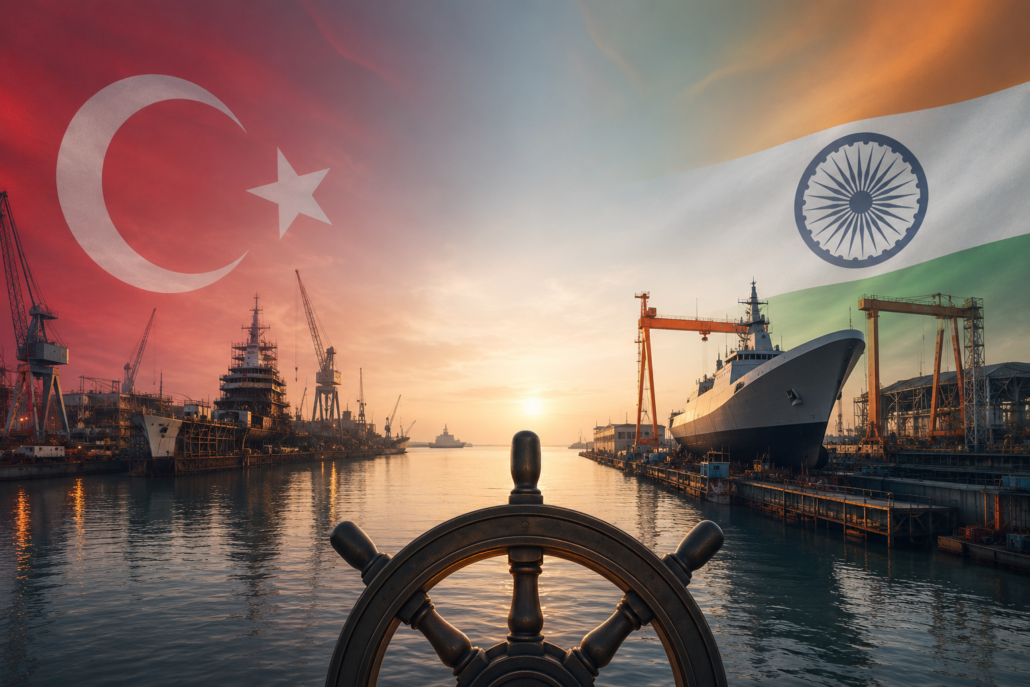
This article therefore examines the Turkish experience as a case study in building a competitive and export-oriented shipbuilding ecosystem under middle-power constraints. By mapping Türkiye’s trajectory against India’s evolving ambitions, it seeks to identify which lessons are transferable, which remain context-specific, and which are unsuitable for replication. In doing so, it argues that India’s shipbuilding transformation will benefit not from imitation, but from selective learning grounded in strategic realism.
Türkiye’s Shipbuilding Trajectory
Türkiye’s rise as a shipbuilding actor was neither accidental nor solely market driven. It emerged through the deliberate convergence of industrial clustering, State support, export orientation, and defence-sector coordination over nearly two decades. The significance of this trajectory lies not in Türkiye transforming into a global giant comparable to China, South Korea, or Japan, but in how a middle power operating under financial and structural constraints rapidly built a competitive and globally connected maritime ecosystem within a compressed timeframe. Through concentrated industrial zones, niche specialisation, naval-commercial linkages, and export-oriented production, Türkiye succeeded in positioning itself as a relevant middle-tier shipbuilding power despite lacking the scale advantages of the major Asian producers.
At the same time, the Turkish experience also reveals the vulnerabilities of rapid maritime expansion when growth outpaces financial resilience and long-term market sustainability. Its trajectory is therefore significant precisely because it combines both success and fragility within the same industrial story. For India, the relevance of Türkiye lies less in absolute comparisons of capability and more in understanding how industrial coordination, strategic adaptation, export competitiveness, and institutional support enabled relatively rapid maritime expansion — while also recognising the structural limitations, financial pressures, and external dependencies that later emerged within the same model.
What Went Right. A major foundation of Türkiye’s rise was the deliberate concentration of industrial infrastructure, shaped in part by the strategic anxieties that emerged after the 1974 Cyprus crisis and the subsequent US arms embargo, which exposed the risks of excessive external dependence in critical sectors.[5] The Turkish State increasingly recognised that maritime and defence industries could no longer remain fragmented or overly dependent on foreign suppliers if Ankara intended to pursue strategic autonomy. Within this broader environment, the Tuzla shipyard region, established as a designated industrial zone in the 1970s, gradually evolved into the core of Türkiye’s maritime industry and today accounts for nearly 90 per cent of the country’s ship production.[6]
Rather than allowing shipyards to emerge in isolation, the government encouraged concentrated industrial development around the Sea of Marmara region. Around Istanbul, particularly across Tuzla, Yalova/Altınova, and Kocaeli, Türkiye developed a dense network of shipyards, auxiliary industries, subcontractors, suppliers, repair facilities, and engineering services located within close proximity of one another.[7] More than one hundred shipyards and boatbuilding facilities eventually emerged across these clusters, including nearly forty yards in Tuzla alone.[8] Steel processing facilities, coatings industries, hydraulic systems manufacturers, electrical equipment suppliers, welding infrastructure, marine engineering services, and logistics chains, all became geographically concentrated. This reduced transaction costs, shortened production timelines, improved labour mobility, and created a self-reinforcing industrial ecosystem capable of responding quickly to international demand fluctuations.
This clustering strategy became especially important during Türkiye’s rapid expansion phase between 2005 and 2008. During these years, the Turkish Ministry of Transport actively supported shipyard expansion projects, licensing, infrastructure construction, and industrial capacity enhancement.[9] At the same time, the global shipping market was experiencing an unprecedented boom. World trade was expanding rapidly, freight rates were high, European shipping companies were placing large orders, and oil transportation demand remained strong prior to the global financial crisis.[10] Turkish shipyards capitalised on this environment by specialising heavily in relatively smaller oil and chemical tankers that could be delivered faster and more cheaply than many European competitors.[11]
Favourable domestic financing conditions also contributed significantly to this growth. Turkish banks provided relatively accessible credit to exporters, while macroeconomic stability in the early 2000s under the Justice and Development Party (AKP) encouraged industrial investment.[12] Turkish yards, unlike the heavily centralised State-dominated systems of East Asia, remained largely private-sector driven and commercially agile. They could rapidly adjust production schedules, negotiate directly with foreign clients, and respond faster to niche market opportunities.
The results were dramatic. Between 2005 and 2008, Turkish shipbuilding orders increased nearly tenfold, with Türkiye climbing from the 23rd position globally to eighth position within a few years, growing by roughly 360 per cent compared to a global average growth rate of around 89 per cent during the same period.[13] This surge followed an earlier phase of State-backed capacity expansion between 2002 and 2006, during which Türkiye’s global market share reportedly rose from around 0.9 per cent to 1.4 per cent, briefly placing it fifth globally behind China, South Korea, Japan, and Germany.[14] Employment in the sector expanded rapidly, rising from roughly 13,000 workers in 2003 to nearly 34,500 by 2008 before the global financial crisis triggered a sharp contraction.[15] Exports surged, and shipyards multiplied across coastal industrial zones, with Tuzla, Yalova, and Altinova emerging as the principal production clusters.
However, the most important aspect of Türkiye’s trajectory was not merely its initial growth, but its ability to adapt after a crisis. The 2008 global financial crisis severely damaged global shipping markets. International trade contracted sharply, oil prices declined, freight demand collapsed, and shipping companies across the world cancelled orders.[16] This hit Türkiye particularly hard because many Turkish yards were concentrated in tanker and dry cargo vessel production, sectors that experienced severe contraction after the collapse of global trade and shipping finance.[17]
Turkish shipbuilding took one of the heaviest blows among middle-tier maritime producers. Hundreds of orders were cancelled. Employment in Tuzla subsequently contracted sharply after the crisis. Several newly constructed yards in Yalova entered operation precisely when global demand was collapsing, leaving some facilities without sufficient orders even to complete a single vessel.[18] The rapid expansion that had initially fuelled growth suddenly produced overcapacity.
Yet instead of attempting to compete directly with China, South Korea, and Japan in mass commercial shipbuilding — a competition Türkiye could not realistically win due to scale limitations — Turkish shipyards adapted strategically. This transition became one of the defining strengths of the Turkish model. Rather than pursuing sheer tonnage, Turkish firms shifted towards specialised, flexible, and higher-value segments where smaller producers could remain competitive.
Turkish yards increasingly focused on tugboats, ferries, offshore support vessels, fishing vessels, mega-yachts, hybrid vessels, electric ships, retrofitting, repair services, and environmentally sustainable maritime technologies.[19] This pivot was driven not only by necessity but also by changing European demand patterns, particularly the growing emphasis on green shipping and specialised vessels tailored to specific operational requirements. Approximately 65 per cent of Türkiye’s shipbuilding production now reportedly consists of environmentally friendly or “green” vessels, while around 60 per cent of Turkish-built ships are exported primarily to European markets.[20] Türkiye today ranks among the world’s leading producers of tugboats and mega-yachts[21], ranks first in fishing vessel exports, and has become an important producer of ferries and specialised support vessels despite lacking the industrial scale of East Asian competitors.[22]
The development of Yalova reflected this strategic shift. Supported in part by cooperation with Norway’s DNV classification society — significant because Norway had become one of the major destinations for Turkish-built ships — new infrastructure increasingly focused on specialised production rather than mass commercial tonnage.[23] Turkish shipyards also expanded aggressively into ship repair, maintenance, and recycling. By 2023, Turkish shipyards reportedly handled nearly 41 million DWT of repair and maintenance activity, making Türkiye one of the leading repair hubs in the Mediterranean region.[24] The Aliağa recycling facilities similarly emerged as important components of Europe-linked green maritime supply chains, with Türkiye becoming the only country to host companies listed on the European Union’s Green Ship Recycling List — a credential that positioned it favourably as IMO environmental standards tightened globally.[25]
An equally significant dimension of Türkiye’s rise was the integration of naval shipbuilding with defence exports. The MILGEM programme became central to this transformation. Initiated formally in the mid-1990s after the Turkish Navy sought indigenous replacement platforms for ageing vessels, MILGEM was designed not simply as a procurement programme but as an industrial capability-building project. It aimed to establish domestic design expertise, strengthen indigenous suppliers, develop modular production capabilities, and gradually reduce foreign dependence.[26]
The long-term consequences of this strategy became increasingly visible over time. Domestic naval procurement created stable industrial demand, which in turn allowed Turkish companies to build technical expertise and eventually export naval platforms abroad. Turkish firms successfully transformed medium-sized warship production into a commercially viable export industry. Türkiye has now exported more than 130 military vessels to countries including Malaysia, Indonesia, Qatar, Pakistan, Turkmenistan, Egypt, and Georgia.[27] The attractiveness of Turkish exports lay not necessarily in technological superiority over larger naval powers, but in affordability, flexible co-production arrangements, integrated maintenance support, modular systems, and political willingness to transfer technology with relatively fewer restrictions than many Western suppliers.[28]
This export ecosystem was reinforced by institutional centralisation. The creation of ASELSAN in 1975 following the US embargo marked an early effort at defence industrial self-reliance, but institutional coordination accelerated substantially after the 2016 coup attempt and the 2017 reorganisation of the Presidency of Defence Industries (SSB) under the Turkish Presidency.[29] Centralised oversight enabled faster procurement decisions, closer political-industrial coordination, and stronger export promotion. Defence-industrial R&D expenditure rose dramatically from approximately US$49 million in 2002 to nearly US$1.7 billion by 2019, representing around 15 per cent of total industry turnover.[30] By 2022, Türkiye reportedly had more than 1,500 local defence firms participating across roughly 750 defence projects.[31]
This distinction matters because Türkiye’s shipbuilding success did not emerge solely from naval ambition or commercial production independently, but from the interaction between the two. Commercial shipbuilding created industrial flexibility and export orientation, while naval programmes generated technological capability and strategic depth. The Turkish model therefore illustrates how medium-scale naval production, commercial specialisation, and export ecosystems can reinforce one another even without the scale advantages enjoyed by major maritime powers.
What Went Wrong. Yet Türkiye’s trajectory is equally important for the lessons it offers in vulnerability and structural limitation. The Turkish experience demonstrates that rapid maritime industrial growth, if not supported by long-term financial resilience and sustainable demand structures, can generate significant fragilities.
One of the biggest weaknesses of Türkiye’s earlier expansion was excessive dependence on a relatively narrow commercial segment during the boom years. Prior to 2008, Turkish shipyards had become heavily concentrated in small and medium-sized tanker production, particularly chemical tankers serving European shipping markets.[32] This strategy worked effectively while global trade, energy demand, and shipping finance remained strong. However, it also created dangerous exposure to external shocks.
The 2008 global financial crisis fundamentally altered the international shipping environment. The collapse of major financial institutions triggered a worldwide credit crunch, global trade volumes contracted sharply, oil prices declined, and shipping companies across Europe and Asia suddenly faced severe liquidity pressures. Since shipbuilding is deeply dependent on long-term financing and advance orders, the crisis immediately translated into mass cancellations across the industry.[33] Turkish yards were especially vulnerable because many depended heavily on export orders financed through international credit networks.
As global demand collapsed, hundreds of Turkish shipbuilding contracts were reportedly cancelled or indefinitely delayed. Tuzla — previously the symbol of Turkish maritime growth — experienced severe contraction. By 2011, employment in Tuzla shipyards reportedly dropped by nearly 77 per cent.[34] Many yards survived only by shifting from new construction towards ship repair and maintenance work, which offered lower but more stable revenue streams during downturns. The crisis exposed how rapidly expanding industrial capacity without diversified demand structures could produce severe overcapacity once global conditions deteriorated.
The Yalova expansion reflected this problem particularly clearly. During the boom years, substantial investment flowed into new shipyard infrastructure because demand projections assumed continued global growth. However, by the time many of these facilities became operational, the global shipping market had already weakened dramatically. Some shipyards reportedly withdrew before delivering a single vessel.[35] Türkiye was therefore forced into a prolonged process of industrial adjustment, capacity rationalisation, and market repositioning.
A second major weakness emerged through financial vulnerability and macroeconomic instability. Shipbuilding is an exceptionally capital-intensive industry requiring long production cycles, stable financing conditions, predictable exchange rates, and affordable credit. Turkish shipbuilding increasingly struggled in these areas during the 2010s and early 2020s as domestic economic turbulence intensified.[36]
Inflation rose sharply, production costs increased, and the Turkish lira experienced repeated periods of depreciation and instability. Between mid-2021 and May 2023 alone, the lira reportedly lost nearly 60 per cent of its value against the dollar, while inflation climbed from 19.3 per cent in August 2021 to approximately 85.5 per cent by October 2022.[37] Since shipbuilding is heavily dependent upon imported inputs including steel, machinery, and marine equipment, the weakening lira translated directly into sharply rising production costs.[38] At the same time, banking regulations imposed restrictions on lira-denominated loans for exporters holding foreign-currency balances exceeding specified thresholds.[39] This forced many shipbuilders to rely increasingly on more expensive foreign-currency loans. In practical terms, Turkish firms often earned revenues in euros or dollars but paid rising domestic operating costs in an inflationary economy while also managing volatile debt burdens. This significantly weakened cost competitiveness over time.
The consequences became increasingly visible after 2020. Rising labour costs, energy prices, imported component costs, and financing pressures reduced margins across the sector. By early 2025, Turkish shipbuilding exports had reportedly plunged by nearly 40 per cent year-on-year in March alone, while industry representatives warned of a broader annual decline amid worsening financing conditions and competitiveness concerns.[40] Production costs increasingly approached European levels even as exchange-rate adjustments failed to keep pace with inflation.
Domestic macroeconomic instability also began affecting long-term industrial confidence. Several major Turkish maritime firms expanded operations abroad, including in Norway and the Netherlands, partly to access more stable financial systems, lower borrowing risks, and closer proximity to European customers.[41] This outward movement of industrial investment reflected concerns that domestic volatility was increasingly undermining long-term competitiveness.
It was within this context that the chairman of Türkiye’s Ship, Yacht and Services Exporters’ Association warned in 2025 that “If current trends continue, more Turkish shipbuilding companies could shift investments abroad.”[42] The statement reflected more than temporary commercial anxiety. It highlighted a deeper structural concern that Türkiye’s industrial agility and export orientation, while successful in creating growth, remained highly sensitive to domestic financial instability and external market fluctuations.
Türkiye’s experience also reveals the limits of niche success within the global maritime hierarchy. Despite becoming highly competitive in specialised segments, Türkiye commands less than one per cent of the global shipbuilding order book by tonnage — a ceiling acknowledged by Turkish industry leaders themselves.[43] China alone accounts for more than 60 per cent of global new ship orders[44], while China, South Korea, and Japan together dominate over 90 per cent of the global order book.[45]
Türkiye therefore succeeded in becoming globally relevant, but not globally dominant. Its rise demonstrates the possibilities available to middle-tier maritime States, but also the ceilings such States confront when competing against industrial giants. Even today, Turkish policymakers increasingly recognise that the future competitiveness of the sector may depend less on volume expansion and more on maintaining technological adaptability in specialised areas such as green shipping, hybrid propulsion, alternative fuels, repair ecosystems, and advanced support vessels. The sector’s current targets — including leadership in electric and hybrid vessel production by 2026 and alternative-fuel ships by 2030 — reflect both ambition and recognition that future survival depends on remaining ahead in specialised maritime niches rather than attempting to compete directly with East Asian mass-production systems.[46]
Lessons for India
For India, the Turkish experience offers neither a template for direct imitation nor a model to be rejected outright. Rather, it demonstrates how a middle power can rapidly construct a competitive maritime ecosystem through institutional coordination, export integration, industrial clustering, and strategic adaptation — while also revealing how financial fragility, overcapacity, and external dependence can gradually erode those gains. The most important lesson from Türkiye is therefore not any single policy instrument, but the discipline of sequencing. Türkiye built demand before capacity, created a domestic naval customer before pursuing exports, and shifted towards niche specialisation when scale competition became unsustainable. India’s challenge is to absorb the strengths of that trajectory while avoiding the structural vulnerabilities that later emerged.
- India requires an integrated maritime industrial coordination mechanism rather than fragmented policymaking. At present, India’s shipbuilding ecosystem remains divided across multiple institutions. The Ministry of Ports, Shipping and Waterways oversees commercial shipbuilding and repair policies, the Department of Defence Production manages naval shipyards and defence manufacturing, while the Ministry of External Affairs handles maritime diplomacy and export engagement under the evolving transition from SAGAR to the newer MAHASAGAR policy framework. Türkiye addressed similar coordination problems through the gradual consolidation of decision-making under institutions such as the Presidency of Defence Industries (SSB), particularly after its 2017 restructuring, which accelerated implementation and improved policy continuity. India does not require political centralisation on the Turkish model, but it does require a permanent inter-ministerial maritime coordination structure capable of synchronising industrial policy, naval procurement, export promotion, financing mechanisms, and technology development. Without such coordination, shipbuilding targets risk remaining declaratory rather than operational.
- India must prioritise demand creation before expanding shipbuilding capacity. Türkiye’s rapid growth during the 2000s was initially supported by a strong export order book, favourable financing conditions, and sustained European demand for smaller tankers and commercial vessels. However, the aggressive expansion of infrastructure in regions such as Yalova later created overcapacity once global shipping demand collapsed after 2008. India faces a similar risk if it focuses excessively on capacity announcements without securing long-term order pipelines. Although Indian shipyards maintain substantial order books — averaging 128 per cent of installed capacity over the last decade and reaching nearly 193 per cent in FY2023–24 — deliveries have remained disproportionately low at roughly 10 per cent of capacity, indicating that the principal constraint lies less in attracting orders than in execution efficiency and timely production.[47] Export orders already account for a significant share of Indian order books by DWT, further reinforcing the fact that the core challenge is delivery capability rather than demand generation alone. Rather than prioritising new infrastructure alone, India would benefit more from linking domestic demand directly to Indian yards through coordinated procurement policies involving Shipping Corporation of India, inland waterway authorities, port authorities, ferry operators, offshore-energy projects, and coastal shipping initiatives. India possesses a large domestic maritime market that Türkiye lacked at comparable scale; the challenge lies in converting that market into sustained industrial demand.
- India must formalise the naval-to-export pipeline instead of treating warship exports as isolated transactions. One of Türkiye’s most important achievements was the conversion of domestic naval programmes into export-oriented industrial platforms. The MILGEM programme created design capability, supplier ecosystems, and modular production experience before evolving into an export vehicle for medium-sized naval platforms. India already possesses significantly stronger naval-industrial capability in high-end platforms, yet its export ecosystem remains underdeveloped. Recent directives to MDL, GRSE, GSL, and HSL to expand export-oriented infrastructure represent an important step, but institutional follow-through remains limited.[48] India requires a dedicated naval export facilitation architecture combining diplomatic outreach, financing support, training packages, after-sales maintenance, and co-production arrangements. Export competitiveness today depends not only on building ships, but on sustaining long-term strategic partnerships around those platforms.
- India should pursue niche and green vessel segments simultaneously with broader scale ambitions. Unable to compete directly with East Asian shipbuilding giants in mass commercial production after the 2008 crisis, Turkish shipyards strategically shifted towards specialised segments such as tugboats, ferries, mega-yachts, fishing vessels, repair services, and environmentally friendly vessels. This adaptive pivot allowed Türkiye to remain globally competitive despite structural limitations in scale. India’s maritime policy discourse, however, continues to focus overwhelmingly on aggregate rankings and production targets. While scale remains important, India is unlikely to compete with China, South Korea, or Japan in large-volume commercial construction in the near term. Greater strategic value may instead lie in proactively building leadership in green coastal vessels, hybrid ferries, offshore renewable-energy support ships, dredgers, autonomous maritime systems, and low-emission harbour infrastructure. Unlike Türkiye, which pivoted reactively after crisis, India still has the opportunity to identify future-growth niches before market disruption forces adjustment.
- India must deepen domestic supply chains instead of equating assembly with indigenisation. Türkiye’s indigenisation success emerged gradually over decades and remained dependent for long periods on German and US technology transfers, particularly in propulsion, combat systems, and naval electronics. Even the earlier phases of Turkish naval construction relied heavily on imported subsystems despite domestic assembly. India faces a similar challenge. While indigenous content in Indian naval construction has improved substantially, dependence persists in propulsion systems, marine engines, specialised electronics, sensors, and critical sub-components.[49] Long-term competitiveness will depend not only on assembling ships domestically, but on developing a broader ecosystem of marine manufacturing, metallurgy, propulsion engineering, coatings, electronics, and underwater systems. Institutions such as DRDO’s maritime laboratories, private MSMEs, and heavy engineering industries must therefore become integrated into shipbuilding policy rather than functioning in parallel silos.
- India must convert SAGAR and MAHASAGAR diplomatic engagement into structured maritime-commercial partnerships. Türkiye successfully linked defence exports with diplomatic outreach, financing support, and long-term industrial engagement, particularly across West Asia, Africa, and Southeast Asia. India possesses a different and potentially stronger geopolitical advantage through its relatively non-coercive image and position as a reliable partner in the Indian Ocean. However, India’s maritime diplomacy has not yet been systematically connected to commercial shipbuilding outcomes, even as the recently announced maritime policy of MAHASAGAR seeks to expand the scope of India’s regional maritime engagement. Programmes such as the Shipbuilding Financial Assistance Scheme (SBFAS), the Shipbuilding Development Scheme (SbDS), and the Maritime Development Fund (MDF) — supported institutionally through the National Shipbuilding Mission (NSM) coordination mechanism — provide an emerging policy foundation, though the weak implementation of the earlier SBFAP framework demonstrated that financial allocations alone are insufficient without effective execution. These initiatives therefore need to be integrated with export financing, lines of credit, naval training programmes, and co-production arrangements for Indian Ocean partners. India’s comparative advantage lies not in creating dependency relationships, but in positioning maritime cooperation as capacity-building and long-term partnership.
Ultimately, Türkiye’s trajectory demonstrates that maritime industrialisation is not merely about building more ships. It is about constructing an integrated ecosystem where industrial policy, financing, exports, naval procurement, diplomacy, technological development, and supply chains reinforce one another over time. India possesses advantages in scale, geography, domestic demand, and naval capability that Türkiye never fully possessed. Yet the Turkish experience shows that these advantages alone are insufficient without institutional coordination, strategic sequencing, and long-term industrial discipline.
*******
About the Author
Ms Aditi Thakur is a Research Associate at the National Maritime Foundation. She holds a master’s degree in political science from Centre for Political Studies, Jawaharlal Nehru University, New Delhi. Her research primarily focuses upon the manner in which India’s own maritime geostrategies in the Indo-Pacific are impacted by those of Russia and Turkey. She may be contacted at irms3.nmf@gmail.com.
Endnotes:
[1] Government of India, Ministry of Ports, Shipping and Waterways, “Ministry of Ports, Shipping, and Waterways (MoPSW) Hosts Workshop on Revitalizing Indian Ship Building Industry,” Press Information Bureau, 04 July 2024. https://www.pib.gov.in/PressReleaseIframePage.aspx?PRID=2030843®=3&lang=2
[2] Organisation for Economic Co-operation and Development (OECD), Peer Review of the Turkish Shipbuilding Industry, Reviews of Shipbuilding Economies (Paris: OECD Publishing, 2021), 04 March 2021. https://www.oecd.org/en/publications/peer-review-of-the-turkish-shipbuilding-industry_43354abf-en.html
[3] John Birkler et al, Differences Between Military and Commercial Shipbuilding: Implications for the United Kingdom’s Ministry of Defence (Santa Monica, CA: RAND Corporation, 2005). https://www.rand.org/content/dam/rand/pubs/monographs/2005/RAND_MG236.pdf
[4] United Nations Conference on Trade and Development (UNCTAD), Review of Maritime Transport 2025: Staying the Course in Turbulent Waters, chap. 2, “World Shipping Fleet and Services” (Geneva: United Nations, 2025), 44. https://unctad.org/system/files/official-document/rmt2025ch2_en.pdf
[5] Demetrios Tsailas (ret Admiral), “Turkey’s Defence-Industrial Strategy and the Emerging Balance in the Eastern Mediterranean,” Research Institute for European and American Studies (RIEAS), 20 December 2025. https://www.rieas.gr/images/editorial/dtsailas62.pdf
[6] “Tuzla Shipyards Area,” Tuzla Shipyards, 19 February 2025. https://www.tuzlashipyards.com/en/blog/about-tuzla-shipyards-area
[7] Organisation for Economic Co-operation and Development (OECD), Peer Review of the Turkish Shipbuilding Industry, 2021.
[8] “Port: TUZLA,” Shipyards.gr, accessed 09 May 2026. https://www.shipyards.gr/shipyards/search-by/city?value=tuzla
[9] Eda Turan and Hülya Cengiz, “Turkish Shipbuilding Industry – Challenges and Potential,” professional paper, December 2015, UDC 629.5.081, ISSN 0007-215X, eISSN 1845-5859. https://www.researchgate.net/publication/295113985_Turkish_shipbuilding_industry_-_challenges_and_potential
[10] Hercules Haralambides and Helen Thanopoulou, “The Economic Crisis of 2008 and World Shipping: Unheeded Warnings,” January 2014. https://www.researchgate.net/publication/293823930_The_Economic_Crisis_of_2008_and_World_Shipping_Unheeded_Warnings
[11] Organisation for Economic Co-operation and Development (OECD), Peer Review of the Turkish Shipbuilding Industry, 2021.
[12] Erdal Tanas Karagöl, “The Turkish Economy During the Justice and Development Party Decade,” Insight Turkey 15, no 4 (2013): 115–129. https://www.insightturkey.com/articles/the-turkish-economy-during-the-justice-and-development-party-decade
[13] “Turkey – Shipbuilding,” GlobalSecurity.org, 20 August 2013. https://www.globalsecurity.org/military/world/europe/tu-shipbuilding.htm
[14] “Shipbuilding in Turkey Grows,” MarineLink, 25 October 2006. https://www.marinelink.com/news/shipbuilding-turkey-grows311708
[15] Organisation for Economic Co-operation and Development (OECD), Peer Review of the Turkish Shipbuilding Industry, 2021.
[16] Bhirugnath Meenaksi, “The Impacts of the Global Crisis 2008–2009 on Shipping Markets: A Review of Key Factors Guiding Investment Decisions in Ships” (master’s dissertation, World Maritime University, Malmö, Sweden, 2009). https://commons.wmu.se/cgi/viewcontent.cgi?params=/context/all_dissertations/article/1211/&path_info=SM_2009_MEENAKSI.pdf
[17] Organisation for Economic Co-operation and Development (OECD), Peer Review of the Turkish Shipbuilding Industry, 2021.
[18] Turan and Cengiz, “Turkish Shipbuilding Industry – Challenges and Potential.”
[19] Mehtap Özdemir, “Access to Technology and Retrofitting,” presentation at the Second IMO Symposium on Alternative Low- and Zero-Carbon Fuels for Shipping, International Maritime Organization, London, 21 October 2022. https://wwwcdn.imo.org/localresources/en/About/Events/Documents/IMO%20Symposium%20alternative%20fuels%202022/Block%203-6%20-%20Mehtap%20%C3%96zdemir%20-%20GISBIR.pdf
[20] “Green Ships Dominate Turkish Shipyards’ Production in 2023,” Daily Sabah, 20 August 2024. https://www.dailysabah.com/business/transportation/green-ships-dominate-turkish-shipyards-production-in-2023
[21] “Türkiye Rises to Second Place Globally in Mega Yacht Production,” Daily Sabah, 03 May 2026. https://www.dailysabah.com/business/economy/turkiye-rises-to-second-place-globally-in-mega-yacht-production
[22] “Turkey Emerges as Global Powerhouse in Fishing Vessel Production,” Fish Information & Services, 04 August 2025. https://seafood.media/fis/worldnews/worldnews.asp?monthyear=&day=4&id=135362&l=e&special=0&ndb=0
[23] Mitsui OSK Lines, “About the Maritime Industry in Turkey – Insights from Eight Years of Experience in Turkey,” MOL Service, 18 March 2025. https://www.mol-service.com/blog/the-turkish-shipping-industry-en and Turkish Ships and Yachts: From Turkey… to Norway (Istanbul: Ship, Yacht and Services Exporters’ Association [Gemi, Yat ve Hizmetleri İhracatçıları Birliği], nd). https://gyhib.org/files/downloads/Yayinlar/from_turkey_to_norway.pdf
[24] Eda Gedikoğlu, “Turkish Maritime Sector Accelerates Its Green and Digital Transformation with the 2053 Net Zero Target” [translated from Turkish], Sea Business, 22 October 2025. https://seabusinessworld.com/haber/roportajlar/turk-denizcilik-sektoru-2053-net-sifir-hedefiyle-yesil-ve-dijital-donusumunu-hizlandiriyor
[25] “List of Ship Recycling Facilities: First Renewals for Inclusion of Yards Located outside the EU,” European Commission, 06 December 2023. https://environment.ec.europa.eu/news/list-ship-recycling-facilities-first-renewals-inclusion-yards-located-outside-eu-2023-12-06_en
[26] Bob Nugent, “The MILGEM Programme: Turkish Naval Procurement and Exports,” European Security & Defence, 31 May 2023. https://euro-sd.com/2023/05/articles/31367/the-milgem-programme-turkish-naval-procurement-and-exports/
[27] “The Rise of Turkish Naval Industry,” Defense News, 21 September 2020. https://www.defensenews.com/native/turkish-defence-aerospace/2020/09/21/the-rise-of-turkish-naval-industry/
[28] Adit, “Turkey’s Booming Defence Exports,” defenceWeb (The Bulletin), 30 December 2025. https://defenceweb.co.za/industry/industry-industry/turkeys-booming-defence-exports/
[29] Sıtkı Egeli, Serhat Güvenç, Çağlar Kurç, and Arda Mevlütoğlu, From Client to Competitor: The Rise of Türkiye’s Defence Industry (London: International Institute for Strategic Studies, May 2024). https://www.iiss.org/globalassets/media-library—content–migration/files/research-papers/2024/05-new/iiss_from-client-to-competitor-the-rise-of-turkiyes-defence-industry_010520242.pdf
[30] “Turkey Begins New R&D Projects,” TurDef, 27 April 2021. https://turdef.com/article/turkey-begins-new-rd-projects
[31] Can Kasapoğlu, “Transforming from Arms Importer to Trendsetter: Assessing the Growth of Turkey’s Defense Industries,” Atlantic Council, 22 December 2022. https://www.atlanticcouncil.org/content-series/ac-turkey-defense-journal/transforming-from-arms-importer-to-trendsetter-assessing-the-growth-of-turkeys-defense-industries/
[32] Murat Sartas, Analysis of the Growth Dynamics in Turkish Commercial Shipbuilding Sector and Its Prospects (master’s thesis, Middle East Technical University, December 2010). https://etd.lib.metu.edu.tr/upload/12612767/index.pdf and Mehtap Özdemir, “GISBIR: Turkish Shipbuilders’ Association,” presentation, NEVA International Maritime Exhibition and Conference, nd. https://www.en.nevainter.com/upload/pdf/turkey/GISBIR.pdf
[33] Review of Maritime Transport 2009 (New York and Geneva: United Nations Conference on Trade and Development [UNCTAD], 2009). https://digitallibrary.un.org/record/675605?v=pdf
[34] Kenan Torlak, “We Are Losing Our Shipbuilding Industry” [translated from Turkish], DenizHaber, 08 January 2010. https://www.denizhaber.com/gemi-insa-sanayimizi-kaybediyoruz/20771
[35] Turan and Cengiz, “Turkish Shipbuilding Industry – Challenges and Potential.”
[36] “Turkey’s Shipbuilding Industry Struggles as Exports Decline Due to Rising Costs,” Turkish Minute, 16 January 2025. https://www.turkishminute.com/2025/01/16/turkeys-shipbuilding-industry-struggles-as-exports-decline-due-to-rising-costs2/
[37] “Will the Turkish Economy Benefit from the Authorities’ U-Turn towards Greater Orthodoxy?”, Coface, 02 July 2024. https://www.coface.com/news-economy-and-insights/will-the-turkish-economy-benefit-from-the-authorities-u-turn-towards-greater-orthodoxy
[38] Özgür Orhangazi, “The Falling Lira: Turkey’s State of Permanent Crisis,” Phenomenal World, 27 January 2024. https://www.phenomenalworld.org/analysis/the-falling-lira/
[39] “Turkey’s Shipbuilding Industry Struggles,” Turkish Minute.
[40] “Turkish Shipbuilding Exports Plunge 40 Pct in March amid Rising Costs, Financing Strain,” Turkish Minute, 07 April 2025. https://www.turkishminute.com/2025/04/07/turkish-shipbuilding-exports-plunge-40-pct-in-march-amid-rising-costs-financing-strain3/
[41] “Turkish Shipbuilding Output Declines Despite Global Order Boom,” The Maritime Executive, 08 April 2025. https://maritime-executive.com/article/turkish-shipbuilding-output-declines-despite-global-order-boom
[42] “Turkey’s Shipbuilding Sector Faces Steep Decline as Costs Rise and Orders Dry Up,” Turkish Minute, 10 July 2025. https://www.turkishminute.com/2025/07/10/turkeys-shipbuilding-sector-faces-steep-decline-as-costs-rise-and-orders-dry-up/
[43] “Turkey’s Shipbuilding Sector Faces Steep Decline,” Turkish Minute.
[44] MI News Network, “China Secures 62.42% of All New Ship Orders Globally, Per Latest Data,” Marine Insight, 17 March 2025. https://www.marineinsight.com/china-secures-62-42-of-all-new-ship-orders-globally-per-latest-data/
[45] “Global Shipbuilding Industry in 2025: Top 10 Leading Countries,” StatRanker, 25 May 2025. https://statranker.org/economy/global-shipbuilding-industry-in-2025-top-10-leading-countries/
[46] Gedikoğlu, “Turkish Maritime Sector Accelerates Its Green and Digital Transformation.”
[47] Captain (IN) RS Sawan and Junyali Gusain, “Enhancing India’s Shipbuilding Capacity: An Offshoring Strategy,” National Maritime Foundation, 24 April 2026. https://maritimeindia.org/enhancing-indias-shipbuilding-capacity-an-offshoring-strategy/
[48] “Indian MoD Directs Public Sector Shipyards to Ramp Up Capacity for Warship Exports amid Global Demand for Affordable Naval Platforms,” Indian Defence Research Wing (IDRW), 10 January 2026. https://idrw.org/indian-mod-directs-public-sector-shipyards-to-ramp-up-capacity-for-warship-exports-amid-global-demand-for-affordable-naval-platforms/
[49] Ashutosh Kashyap et al, “The Missing Heartbeat: Why Atmanirbharta in India’s Shipbuilding Requires Indigenous Marine Engines,” ORF Issue Brief no 824 (Observer Research Foundation), 11 August 2025. https://www.orfonline.org/research/the-missing-heartbeat-why-atmanirbharta-in-india-s-shipbuilding-requires-indigenous-marine-engines


Leave a Reply
Want to join the discussion?Feel free to contribute!