
Abstract
The commissioning of China’s first indigenous CATOBAR carrier, the Fujian (CV-18), at Sanya on 05 November 2025, marked a fundamental transformation in the People’s Liberation Army Navy’s (PLAN) blue-water capability.[1] When combined with the deepening of operational integration of the Liaoning and Shandong strike groups, and the accelerating construction of a fourth — reportedly nuclear-powered — carrier, the PLAN is moving from episodic signalling deployments toward a sustainable multi-carrier rotation capable of persistent presence across the First- and Second Island Chains, and potentially planning to extend further into the Indian Ocean Region (IOR). This article explores the operational, doctrinal, and infrastructural dimensions of that shift; benchmarks China’s trajectory against Taiwan’s asymmetric maritime posture along with India’s carrier and submarine programmes; and sets out policy responses centred on clarifying India’s carrier-modernisation pathway, prioritising nuclear attack submarines, and deepening layered Maritime Situational Awareness (MSA) across the IOR.
Military maritime power projection in the Indo-Pacific is transforming. For two decades, the PLAN’s carrier programme was treated by navies around the world as a curious but gradual development, rather than an operational threat. Based on the precedent of the Shandong and Liaoning cycles, naval analysts generally expect the interval between commissioning of a Chinese aircraft carrier and its full work-up to be a year or two.[2]
The Fujian class is unlike its predecessors whose “Short Take-Off but Arrested Recovery” (STOBAR) configuration constrained payload and sortie generation. Its “Electromagnetic Aircraft Launch System” (EMALS) removes the principal technical barrier that had separated PLAN carrier aviation from its US Navy counterpart — the ability to sustain a high “sortie-generation rate.” In the case of Carrier Battle Group or a Carrier Strike Group, it is “sortie-generation rate” — not hull count— that determines the tempo and endurance of maritime coercion, sea denial and, ultimately, deterrence.[3] This article, therefore, examines three factors— first, how the PLAN’s sortie generation is being operationalised; second, how China’s rivals are responding; and third, where India and its partners might retain realistic leverage.
From Liu Huaqing’s Blueprint to a Multi-Carrier Navy
The emergence of the Fujian reflects a calculated, long-term institutional undertaking rather than a discrete addition to the fleet. Admiral Liu Huaqing, PLAN Commander from 1982 to 1988, and later Vice Chairman of the Central Military Commission (CMC), is widely credited within Chinese naval historiography for shifting the PLAN’s doctrine from a coastal “near seas defence” posture towards “far seas protection”.[4] As historian Xiaobing Li argues in his 2026 biography of Liu, this shift was inspired less by Alfred Thayer Mahan and more by Soviet Admiral Sergey Gorshkov. The latter’s model emphasised balanced fleet design, missile-age technology, and centralized, party-led shipbuilding — a point underscored by Professor Andrew S Erickson in The China Quarterly (2026).[5] Liu’s insistence on organic carrier aviation, against an internal PLAN faction that favoured a submarine-only sea-denial posture, is the doctrinal ancestor of the Fujian.
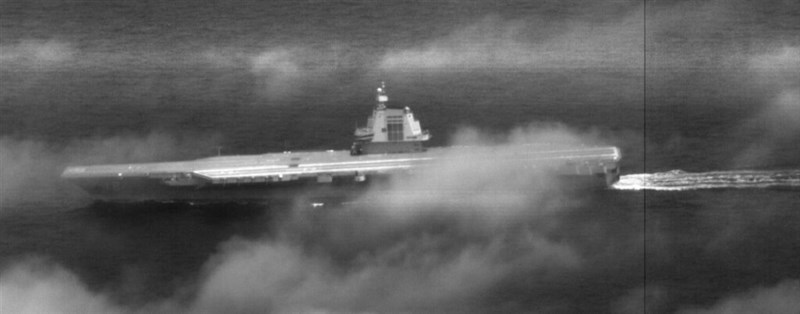
That lineage is now bearing operational fruit, metaphorically. Flight-deck trials during the Fujian’s ninth sea trial in September 2025 confirmed sustained CATOBAR cycles for the J-15T catapult-capable fighter, the J-35 stealth fighter, and the KJ-600 airborne early-warning aircraft.[6] The operational significance is threefold — first, CATOBAR permits heavier fuel and ordinance loads than STOBAR; second, organic, fixed-wing airborne early warning and control (AEW&C) closes the PLAN’s long-standing deficit in over-the-horizon targeting and command-and-control at sea; and lastly, higher sortie generation allows sustained rather than ‘split-wave’ air cover.[7] The Fujian’s 22-23 June 2026 transit of the Taiwan Strait, timed to follow the opening of Taiwan’s five-day “Immediate Combat Readiness Exercise”, and its subsequent return to Yulin Naval Base at Sanya, illustrate that the platform is already being used for coercive signalling ahead of a formal declaration of full operational capability.[8]
Table 1: Comparative Carrier Capability: PLAN and Indian Navy
| Platform | Launch system | Full-load displacement | Air wing / Operational notes |
| Liaoning (CV-16) / Shandong (CV-17) | STOBAR (ski-jump) | 60,000–70,000 t | J-15B/D; ski-jump launch constrains fuel and ordinance load and sortie-generation rate; no organic fixed-wing AEW&C |
| Fujian (CV-18) | CATOBAR (EMALS, three catapults) | 80,000–85,000 t | J-15T, J-35 (stealth), KJ-600 AEW&C; heavier payloads, faster deck cycles and continuous rather than ‘split-wave’ air cover |
| Type 004 (under construction, Dalian) | CATOBAR (EMALS, reportedly four catapults) | Est 110,000–120,000 t | Reported nuclear propulsion (twin reactors); expected air wing exceeding 100 aircraft; sea trials not expected before 2028–29 |
| INS Vikramaditya / INS Vikrant | STOBAR (ski-jump) | 45,000 t | MiG-29K; localised sea control; no organic fixed-wing AEW&C |
Source: Compiled by author from open sources.
Multi Carrier Doctrine and Force Concentration
The PLAN’s first dual-carrier formation exercise, in which the Liaoning and Shandong operated together in the South China Sea in October 2024, marked a doctrinal transition from localised single-carrier defence toward concentrated multi-carrier power projection.[9] The pattern has since deepened rather than remaining a one-off demonstration. On 10 June 2025, the two carriers operated simultaneously beyond the Second Island Chain for the first time, with Japan’s Ministry of Defense tracking them near Minamitorishima and Okinotorishima in the Philippine Sea;[10] a month later they conducted a first joint combined-arms opposing-force exercise, rehearsing reconnaissance, air defence and maritime assault scenarios against one another under simulated combat conditions.[11] Synchronised air wings of this kind allow near-continuous flight operations, dispersed vulnerability, and a strike volume capable of contesting Western carrier groups within the Second Island Chain.[12] With the Fujian entering the rotation, and the Shandong’s periodic dry-docking demonstrating an established maintenance cycle, the PLAN is structurally positioned to sustain persistent presence rather than episodic surges— the defining requirement for credible deterrence and coercion alike.
Layered Defence and the South China Sea Bastion
Within the South China Sea, the Fujian anchors a concentric defence architecture. Assessments by the US Naval War College’s “China Maritime Studies Institute” (CMSI) describe an inner zone for close-in weapons, a middle zone held by Type 052D/055 destroyers, and an outer zone extending to roughly 185-400 kilometres and dominated by carrier aviation.[13] This structure converts the South China Sea into a protected bastion for China’s ballistic-missile submarine fleet based at Yulin. The Fujian has also reportedly been fitted with a hard-kill anti-torpedo defence system — a lightweight torpedo-interceptor launcher intended to counter heavyweight torpedoes such as the US Navy’s Mk 48 — although its real-world interception performance has not been independently verified.[14] This reflects a Soviet-style defensive approach associated with Liu Huaqing: protect China’s nuclear submarines by keeping adversaries out of nearby waters, rather than trying to control the open ocean.[15]
Beyond the First Island Chain and Into the Indian Ocean
PLAN carrier task groups now routinely operate beyond 1,000 nautical miles into the Philippine Sea — well past the roughly 700-nautical-mile envelope that historically bound operations to land-based air cover.[16] EMALS-enabled continuous launch cycles directly challenge First Island Chain containment by sustaining the sortie rates required for persistent air cover over these distances. The same logic extends westward, that is, a CATOBAR strike group offers China a mobile command-and-control node capable of shielding sea lines of communication (SLOCs) from the Malacca Strait to the Arabian Sea. It is a capability gap the PLAN has historically lacked in an IOR long dominated by Indian and US naval power.[17]
Sustaining that reach also depends on shore infrastructure. The PLA’s Strategic Strong Point (SSP) at Djibouti was initially presented as a modest counter-piracy facility when it opened in 2017. Today, however, it features a deep-water pier of length roughly 330 metres and an accompanying 400-metre runway extension, sized to berth large surface combatants or a Type 901 replenishment oiler alongside escorts.[18] This affords the PLAN a plausible forward maintenance and replenishment node adjacent to the Bab-el-Mandeb chokepoint, which qualifies as the basic logistical precondition for any sustained IOR carrier presence. It remains, however, the PLAN’s only fully developed overseas SSP. Independent analysis of comparable facilities in Cambodia, Bangladesh and Pakistan suggests that a genuine capability of sustaining carrier operations at range is still some years from maturity, constrained above all by fuel-storage and munitions-support capacity rather than by pier length alone.
The Fourth Flat-Top: Type 004 and the Trajectory Beyond Fujian
The Fujian is not the PLAN’s terminal carrier design. Commercial satellite imagery, analysed by the Centre for Strategic and International Studies (CSIS) and a few independent open-source analysts, shows a fourth carrier — designated Type 004 — under rapid construction at the Dalian Shipyard since prefabricated hull blocks first appeared in early 2025.[19] By May 2026, the hull measured approximately 286 metres in length and 46 metres in beam, and imagery of internal compartments has led analysts, including the likes of former US Navy submariner Tom Shugart, to assess the vessel as “very likely nuclear-powered, with twin reactor compartments visible at a construction stage broadly comparable to the early build of the US carrier Enterprise”.[20] Estimates place its full-load displacement at 110,000–120,000 tonnes — larger than the US Navy’s Geral Ford Class — with four electromagnetic catapults, three aircraft elevators and an air wing exceeding 100 aircraft, roughly a third greater sortie capacity than the Fujian. Sea trials are not expected before 2028-29, though, with entry into service projected around 2030.[21]
It could be argued that the strategic significance of Type 004 lies less in any single capability than in what it confirms about intent and industrial capacity. China is not building a carrier fleet to match a fixed benchmark, but iterating rapidly toward a force — some open-source projections suggest as many as nine carriers by the mid-2030s — with sortie generation, endurance and reach comparable to the US Navy’s own.[22] For India and coalition planners, this compresses the window in which asymmetric and geographic advantages can offset the PLAN’s growing mass, rendering policy responses calibrated solely to the “Fujian risk” obsolete before Type 004 even completes sea trials.
The Coalition Response
China’s coalition rivals/competitors have not been static. Exercise BALIKATAN 2026 evolved from a bilateral drill into the largest multinational rehearsal in its history, with more than 17,000 personnel from the Philippines, the United States, Australia, Japan, Canada, France, and New Zealand, including forward deployment of the “Navy-Marine Expeditionary Ship Interdiction System” (NMESIS) to the Batanes Islands along the Luzon Strait.[23] Exercise VALIANT SHIELD 2026 similarly broadened from a largely unilateral US exercise into a joint-and-combined US-Japan-led framework, with Australian, Canadian and New Zealand participation — emphasising anti-submarine warfare, a trilateral submarine-hunting serial, and a live maritime-strike sinking exercise involving the George Washington Carrier Strike Group and Guam-based attack submarines.[24] In the East China Sea, Exercise RESOLUTE DRAGON 2026 deployments to the Ryukyu arc, including the first Japan Ground Self-Defense Force Osprey deployment to Miyakojima,[25] ran alongside continued Typhon and HIMARS deployments to Kanoya Air Base thereby extending a precision-strike screen along Japan’s Southwest Islands.[26] Routine US and allied freedom-of-navigation transits through the Taiwan Strait continue to assert access rights, though each now draws immediate shadowing by the PLA Eastern Theatre Command, illustrating a deterrence dynamic that is stable but increasingly contested rather than one-sided.
Comparative Assessment: China, Taiwan and India
China’s position rests on scale and doctrinal continuity, as is reflected in the lines of effort highlighted in earlier in this article — three operational carriers, a fourth under rapid construction, integrated shipyard capacity, and forward-logistics at Djibouti. Consequently, its principal vulnerabilities are less material than operational, for example, untested carrier aviation in high-intensity combat, dependence on vulnerable SLOCs through the Malacca Strait, or the risk that concentrated carrier assets become high-value targets for distributed anti-ship missile and submarine threats from a coalition adversary.
Taiwan relies on an asymmetric maritime defence — centred upon coastal missile batteries, mine warfare, and targeted readiness exercises —to counter regional threats. While constrained by limited organic power projection and diplomatic isolation, its strategic leverage lies in its critical control and operational knowledge of the Bashi Channel, offering substantial domain awareness value to coalition partners.India occupies a distinct position, operating a two-carrier fleet and an emerging SSN program. However, its force structure is currently split between securing near-term hull numbers via a repeat-Vikrant (IAC-II) and pursuing true qualitative parity with China’s Fujian through the larger, CATOBAR-equipped IAC-III. While India’s primary bottleneck remains the slow pace of indigenous shipbuilding relative to China’s rapid naval expansion, its main advantages are its dominant geographic position across vital Indian Ocean SLOCs and a strong, foundational growth-oriented relationship with the littoral States of the IOR (barring a few belligerent entities). Table 2 summarises a comparative capability-matrix incorporating carrier forces, a sub-surface posture, forward basing, and coalition depth:
Table 2. Comparative capability matrix: Carrier Force, Sub-Surface Posture, Forward Basing, and Coalition Depth
| Dimension | China (PLAN) | Taiwan | India |
| Carrier force | 3 operational (2 STOBAR, 1 CATOBAR); Type 004 (nuclear-powered, est. 110,000–120,000 t) under construction at Dalian | None; not pursued | 2 operational (STOBAR); repeat-Vikrant IAC-II awaiting Cabinet approval; larger CATOBAR/EMALS IAC-III still at design stage |
| Sub-surface focus | SSBN bastion at Yulin; expanding SSN fleet | Coastal mine warfare and missile-centric denial | Project-77 indigenous SSN programme approved (₹40,000 crore for first two boats) |
| Forward basing | Djibouti deep-water pier; Sanya/Yulin bastion; reported interest in additional access points | None required; home-waters defence | Andaman & Nicobar Command; limited overseas access |
| Coalition depth | Limited formal alliances; reliant on bilateral leverage | Informal, constrained by One-China policy | Quad, Foundational/Enabling Agreements (COMCASA, BECA, LEMOA, GSOMIA) and advanced exercises (MALABAR, RIMPAC, IPMSC, etc.) |
| Principal vulnerability | Untested combat aviation; SLOC dependence via Malacca Strait | Limited organic power projection; diplomatic isolation | Shipbuilding and carrier-aviation integration pace well behind PLAN’s rotation timeline |
Strategic Implications for the Indo-Pacific
- The shift from episodic to persistent multi-carrier presence normalises a level of PLAN presence that regional States will find progressively harder to characterise as escalatory, and it also lowers the threshold at which textbook coercive signalling, such as the Fujian’s Strait transit, becomes mere routine and stops being perceived as exceptional.
- Djibouti’s maturation as a genuine and sustainable node means that the IOR can no longer be treated as a peripheral theatre to the Western Pacific; it is becoming an integrated extension of PLAN force-planning, even if current fuel-storage and munitions-support capacity remains short of basic requirements for sustained carrier operations at range.
- The growing multinational character of the coalition response (Exercises such as BALIKATAN, VALIANT SHIELD, RESOLUTE DRAGON, RIMPAC, etc.) suggests that deterrence is shifting from bilateral hub-and-spoke arrangements towards a comprehensively networked coalition architecture. It is a structural change that also raises coordination costs and interoperability demands, which India, as a non-treaty partner, must navigate carefully.
- The emergence of the Type 004 means that any policy calibrated solely to matching the Fujian will understate the scale of the challenge. The relevant planning horizon for India and coalition partners is not the current three-carrier PLAN, but the multi-carrier, part-nuclear-powered fleet China is visibly building toward by the early-to-mid 2030s.
Policy Recommendations
- Carrier Modernisation
- Decouple procurement: Separate the IAC-II and IAC-III decisions and treat each as distinct operational requirement.
- Prioritise Qualitative Parity: While IAC-II adds near-term hull count, only the CATOBAR/EMALS-equipped IAC-III might counter China’s Fujian
- Urgent Action: Due to 10–12-year lead times, immediate design and partner approval is critical to avoid an irrecoverable operational lag compared to China’s Type 004 program
- Submarine Capabilities
- Resource Project-77 SSNs: Prioritise near-term funding for the ₹40,000 crore attack submarine program over further SSBN expansion.
- Focus on Sea Denial: Deploying agile SSNs provides superior tactical flexibility to counter forward-deployed enemy carrier strike groups in the IOR.
- Bilateral & Multilateral Operationalisation
- Leverage COMCASA & BECA: Establish real-time tactical data-sharing with the US to track PLAN assets from homeport departure.
- Upgrade Joint Exercises: Shift Exercise MALABAR and RIMPAC (including P-8I assets) toward high-end threats: anti-torpedo, ASCM defense, and multinational ASW screening against EMALS-equipped carriers in the IOR.
- Maritime Domain Awareness
- Expand IPMSC/IPMDA Networks: Avoid redundant structures by building on existing Quad surveillance frameworks.
- Extend Regional Telemetry: Lead efforts to share common operating picture (COP) telemetry with key IOR littoral partners.
Conclusion
The commissioning of the Fujian marks a decisive shift in the PLA Navy’s transformative shift from a regional force centred on presence and deterrence to one capable of sustained, expeditionary carrier operations across the Indo-Pacific. Together with the anticipated Type 004 nuclear-powered carrier, it signals the emergence of a mature multi-carrier doctrine designed to extend China’s operational reach, strengthen sea control, and reshape the regional maritime balance. Since the transition has already been implemented, it is prudent for India to analyse possible actionable trajectories the PLAN could rely upon in the future, rather than debating on the feasibility of these actions since the PLAN seems decided on this line of effort. India’s ability to close critical gaps in carrier aviation, undersea warfare, MSA/MDA, and sea-denial capabilities, will determine whether the Indian Navy can preserve a favourable balance of power in the IOR. Ultimately, the strategic advantage will belong not to the State with the greatest ambitions, but to the one that aligns capability development with the pace of the evolving maritime environment.
********
About the Author
Mr Chemi Rigzin is a Research Associate at the National Maritime Foundation. He holds an MPhil in Geography from the University of Delhi. His current research concentrates on Taiwan’s evolving security posture, its geopolitical dynamics, and its role in the contemporary Indo-Pacific security environment. This is an important part of his overall research on key hard-security issues, including the PLA Navy’s modernisation, China’s overseas port development, and broader Chinese maritime strategy across the Indo-Pacific region.
Endnotes:
[1] Akhil Kadidal, “China Commissions Fujian Aircraft Carrier”, Janes, 07 November 2025, https://www.janes.com/defence-intelligence-insights/defence-news/air/china-commissions-fujian-aircraft-carrier
[2] Alex Luck, “Chinese Navy takes Aircraft Carrier Fujian into Active Service in Hainan”, Naval News, 07 November 2025, https://www.navalnews.com/naval-news/2025/11/chinese-navy-takes-aircraft-carrier-fujian-into-active-service-in-hainan/
[3] Joseph Trevithick, “China Commissions Newest Aircraft Carrier with its Electromagnetic Catapults Front and Center”, The War Zone, 07 November 2025, https://www.twz.com/sea/china-commissions-newest-aircraft-carrier-with-its-electromagnetic-catapults-front-and-center
[4] Andrew S Erickson, “Honored to Review “China’s Mahan: Admiral Liu Huaqing and the Rise of the Modern Chinese Navy”—in China Quarterly!”, Andrew S Erickson Website, 30 June 2026, https://www.andrewerickson.com/2026/06/honored-to-review-chinas-mahan-admiral-liu-huaqing-and-the-rise-of-the-modern-chinese-navy-in-china-quarterly/
[5]Andrew S Erickson, “Honored to Review “China’s Mahan: Admiral Liu Huaqing and the Rise of the Modern Chinese Navy”—in China Quarterly!”
[6] Matthew Loh & Chris Panella, “China’s Newest Aircraft Carrier Just Launched a Stealth Jet with an Electromagnetic Catapult, marking a Major Capability Jump”, Business Insider, 24 September 2025, https://www.businessinsider.com/china-videos-new-fujian-carrier-launching-stealth-fighter-catapult-2025-9
[7] Eric Wertheim, “China’s First Supercarrier”, USNI, March 2026, Vol. 152/3/1,477, https://www.usni.org/magazines/proceedings/2026/march/chinas-first-supercarrier .
[8] Albee Zhang, “PLA’s Advanced Aircraft Carrier Fujian Transits Taiwan Strait Amid Military Drills”, SCMP, 24 June 2026, https://www.scmp.com/news/china/military/article/3358227/plas-advanced-aircraft-carrier-fujian-transits-taiwan-strait-amid-military-drills
[9]Farah Master, “China’s PLA navy Perform First Dual Aircraft Formation Exercise in South China Sea”, Reuters, 01 November 2024, https://www.reuters.com/world/asia-pacific/chinas-pla-navy-perform-first-dual-aircraft-formation-exercise-south-china-sea-2024-11-01/
[10] Kantaro Komiya, “Japan Sights Two Chinese Aircraft Carriers in Pacific for First Time”, Reuters, 10 June 2025, https://www.reuters.com/world/china/two-chinese-aircraft-carriers-seen-pacific-first-time-japan-says-2025-06-10/
[11]Redacción Zona Militar, “China’s Aircraft Carriers Liaoning and Shandong Conducted Opposing-Force Drills during their Latest Exercises in the Western Pacific”, Zona Militar, 01 July 2025, https://www.zona-militar.com/en/2025/07/01/chinas-aircraft-carriers-liaoning-and-shandong-faced-off-against-each-other-during-their-most-recent-exercises-in-the-western-pacific/
[12] Fan Wei et al, “‘Acting as Opposing Forces’ First Mentioned In China’s Dual Carrier Drills, Shows Expansion of China’s Maritime Defense Capabilities: Experts”, Global Times, 01 July 2025, https://www.globaltimes.cn/page/202507/1337345.shtml
[13]Daniel Rice, “Sharpening the Sword: Chinese Navy Aircraft Carrier Battle Group Defense Zones”, U.S. Naval War College Digital Commons, Note 6, 16 August 2024, https://digital-commons.usnwc.edu/cgi/viewcontent.cgi?article=1005&context=cmsi-notes
[14] MI News Network, “China Equips Its Newest Aircraft Carrier With World’s First Operational Hard-Kill Anti-Torpedo Defence System”, Marine Insight, 06 July 2026, https://www.marineinsight.com/china-equips-its-newest-aircraft-carrier-with-worlds-first-operational-hard-kill-anti-torpedo-defence-system/
[15] Tong Zhao, “China’s Sea-Based Nuclear Deterrent”, Carnegie China, 30 June 2016, https://carnegieendowment.org/china/research/2016/06/chinas-sea-based-nuclear-deterrent
[16] Naval News 2025, “China Challenges US Pacific Control with First Dual Aircraft Carrier Operation”, Army Recognition, 11 June 2025, https://www.armyrecognition.com/archives/archives-naval-defense/naval-news-navy-2025/china-challenges-us-pacific-control-with-first-dual-aircraft-carrier-operation
[17] Jeffrey Becker, “Securing China’s Lifelines across the Indian Ocean”, US Naval War College Digital Commons, China Maritime Report no 11, December 2020, https://www.govinfo.gov/content/pkg/GOVPUB-D208-PURL-gpo177085/pdf/GOVPUB-D208-PURL-gpo177085.pdf
[18] Swarajaya, “China’s Indian Ocean Military Base Can Now Accommodate Aircraft Carriers and Submarines, US Defence Department Report Says”, Swarajaya Magazine, 01 December 2022, https://swarajyamag.com/defence/chinas-indian-ocean-military-base-can-now-accommodate-aircraft-carriers-and-submarines-us-defence-department-report-says
[19] Matthew P Funaiole, “A New Supercarrier Emerges”, CSIS, 21 May 2026, https://features.csis.org/hiddenreach/china-fourth-carrier/
[20]Kat Tungol, “How Defense Satellite Imagery Revealed China’s First Nuclear-Powered Aircraft Carrier”, Skyfi, 18 March 2026, https://skyfi.com/en/blog/defense-satellite-imagery-china-nuclear-carrier
[21]Matthew P Funaiole, “A New Supercarrier Emerges”
[22] Aaron-Matthew Lariosa, “China Wants Nine Aircraft Carriers by 2035, Says New Pentagon Report”, USNI News, 24 December 2025, https://news.usni.org/2025/12/24/china-wants-nine-aircraft-carriers-by-2035-says-new-pentagon-report
[23] Gordon Arthur, “The Philippines Meets its NMESIS in Balikatan exercise”, Naval News, 07 June 2026, https://www.navalnews.com/naval-news/2026/06/the-philippines-meets-its-nmesis-in-balikatan-exercise/
[24]Dzirhan Mahadzir, “U.S. Kicks Off Western Pacific Exercises Valiant Shield, Resolute Dragon”, USNI News, 23 June 2026, https://news.usni.org/2026/06/23/u-s-kicks-off-western-pacific-exercises-valiant-shield-resolute-dragon
[25] Liu Jianqiao, “US-Japan military drills raise concern”, China Daily, 22 June 2026, https://epaper.chinadaily.com.cn/a/202606/22/WS6a38854aa310ec22b1fd55d6.html
[26] Military Watch Staff, “Chinese Satellite Footage Reveals U.S. Expanding Cruise Missile Deployments at Forward Japanese Bases”, Military Watch Magazine, 17 July 2026, https://militarywatchmagazine.com/article/chinese-satellite-footage-cruise-missile-japan-bases


Leave a Reply
Want to join the discussion?Feel free to contribute!