
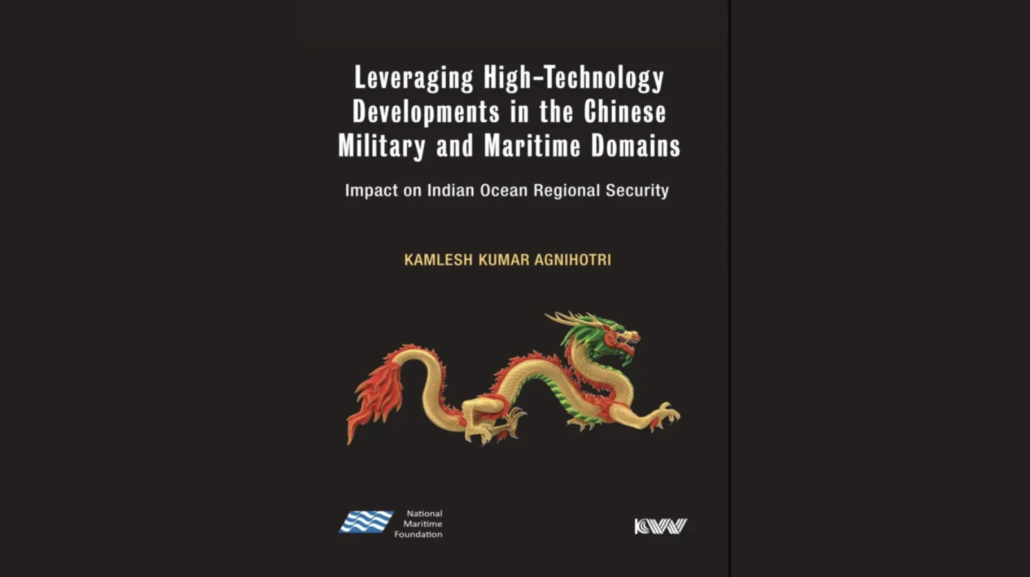
Kamlesh Kumar Agnihotri KW Publishers Pvt Ltd (New Delhi), 2022. 286 pages, ISBN: 978-93-91490-17-1, Rs. 1,280 (hardback)
‘Opportunities multiply as they are seized’
-Sun Tzu
Few maxims better capture the underlying thrust of Captain Kamlesh Kumar Agnihotri’s book than this timeless aphorism from Sun Tzu. Opportunities in the contemporary strategic landscape are largely defined by mastery over technology, and nowhere is this more evident than in China’s deliberate pursuit of high-technology capabilities across the military and maritime domains. In reviewing this work, it is important not merely to outline the author’s argument but also to situate it in a wider analytical framework—examining how his observations speak to India’s strategic realities and, crucially, to the avenues of opportunity such challenges may open.
Captain Agnihotri, with more than three decades of professional experience and long-standing engagement with China-related security studies, brings a rare combination of practitioner insight and academic rigour to this subject. The book is structured into seven chapters, tracing China’s technological evolution from its foundations in civilian industry to its cutting-edge military applications, before shifting the lens towards implications for India and the Indian Ocean Region (IOR). While the author adopts a methodical approach grounded in empirical research, his work is also underpinned by a normative tone: the urgent need for India to act, invest, and build its own technological base.
The strength of Captain Agnihotri’s analysis lies in his extensive engagement with a wide array of sources, ranging from academic journals and policy papers to media reportage, including those from Chinese state-backed outlets. This methodological breadth allows him to capture the multiple layers of China’s technological development while avoiding simplistic binaries. His insistence on applying a rational, scientific lens is particularly noteworthy, as it leads him to prioritise demonstrable trends in technological modernisation over speculative assertions regarding the philosophical motivations of the Chinese state.
This approach gives the book an empirical richness that enhances its credibility. However, it does not explore some aspects, such as the ideological motivations behind China’s political leadership. While this might be considered a limitation, it is arguably a conscious choice by the author to maintain analytical clarity in a field where data-driven evaluation is often subordinated to conjecture.
Captain Agnihotri’s introductory discussion situates China’s technological orientation within broader historical trajectories. From the lessons of the Second World War to the evolution of area denial strategies, the author highlights how China has consistently sought to insulate its strategic environment from foreign interference. Equally significant is his reference to the post-1648 model of statecraft, where nations define their strategies first and then align the necessary means, resources, and technology to achieve them. In essence, China is cast as a state that has systematically internalised this logic, allowing it to move with coherence and discipline in linking strategic ends with technological means.
This framing is important, for it elevates the book above a mere catalogue of Chinese technological achievements. Instead, it portrays Beijing as an actor guided by continuity of purpose, as evidenced by the consistent articulation of goals by successive leaders. By drawing attention to speeches and policy documents, Captain Agnihotri illuminates the alignment between political will and technological execution. For readers, this offers valuable insight into how strategy is institutionalised within the Chinese system.
The first chapter sets the stage by exploring how China’s civilian industrial and technological development provides the foundation for its military modernisation. Here the author foregrounds policies such as the ‘Made in China 2025’ initiative, which aims at technological self-reliance and industrial upgrading. Civil-military fusion emerges as a central theme, enabling dual-use technologies to seamlessly transition from commercial to military applications.
Particularly striking is the discussion of China’s embrace of emerging technologies associated with the Fourth Industrial Revolution. Cloud computing, the Internet of Things, biotechnology, neuro-technologies, and blockchain are all positioned not merely as economic assets but as enablers of future warfare. This expansive vision underscores the extent to which China conceives of technology as a holistic ecosystem.
The second chapter moves to specific domains, with artificial intelligence (AI) and quantum communication at the forefront. China’s AI development plan to 2030 demonstrates its long-term commitment, emphasising industrial-scale application across both civilian and defence sectors. Firms such as Baidu, Alibaba, and Tencent are not just commercial giants; they are also involved in developing advanced dual-use technologies.
Applications of AI within the People’s Liberation Army (PLA) are wide-ranging: refining the Observe–Orient–Decide–Act (OODA) loop, enabling swarming tactics for unmanned systems, and enhancing decision-support for air and submarine operations. The discussion of China’s supercomputing infrastructure, including Sunway Taihu Light and Tianhe-2, further illustrates the material foundations that support such ambitions. These systems provide the computational capacity required for big data analytics, simulations, and even nuclear weapons modelling.
Parallel to AI, quantum communication represents a strategic frontier. The establishment of the Beijing–Shanghai Backbone Network and the deployment of the Micius satellite mark China as a pioneer in secure communication systems. While scalability challenges remain, the significance of such initiatives lies in their potential to redefine information security in both civilian and military contexts.
The third chapter narrows the focus to advanced weapons under the direct ambit of the PLA. The enabling conditions for such advancement in military weapons development are analysed with care: the strengthening of the education system, the prioritisation of science, technology, engineering, and mathematics (STEM) fields, and the domestic availability of critical minerals and indigenous production of critical equipment. Equally important is China’s willingness to absorb foreign inputs, as evidenced by its study of the American Pershing II medium-range ballistic missile programme.
The role of industrial institutions such as the China Aerospace Science and Technology Corporation (CASC) and the China Aerospace Science and Industry Corporation (CASIC) is highlighted as central to this ecosystem. Their output ranges from Hypersonic Glide Vehicles (HGVs) such as the DF-17, to Anti-Ship Ballistic Missiles (ASBMs) including the DF-21D and DF-26. Complementary innovations include directed energy weapons, counter-space systems, and electromagnetic railguns, all of which suggest a long-term orientation towards asymmetric advantage.
Unmanned platforms represent another area of emphasis. From the Wing Loong and Caihong series of UAVs and UCAVs to stealth and vertical take-off variants such as the AV-500, China has invested in an expansive range of unmanned aerial capabilities. Loitering munitions and Ground-Effect UAVs further expand tactical options. These developments are not presented as isolated projects but as integral elements of China’s strategy to reshape operational paradigms in the Western Pacific.
The fourth chapter examines high-technology development in the maritime domain, where China has made remarkable strides. Premier Zhu Rongji’s role in consolidating the shipbuilding industry is acknowledged as a foundational step, subsequently built upon by former President Hu Jintao and incumbent President Xi Jinping. President Hu Jintao’s emphasis on China as a maritime great power has accelerated investment in naval modernisation.
A notable feature of this chapter is the detailed coverage of unmanned surface vessels (USVs) and unmanned underwater vehicles (UUVs). Examples such as the Hunter-68 USV for patrolling, use of USVs for experimental swarming tactics, illustrate China’s creativity in operational concepts. Amphibious USVs and the construction of the world’s largest unmanned cargo ship test range further underscore this ambition.
China’s engagement with UUVs dates back to the 1980s, with the CR-01 achieving a depth of 6,000 metres. Subsequent developments have included both manned submersibles such as Jiaolong and Shenhai Yongshi, and unmanned systems like Zhishui-III, Qianlong-1 to Qianlong-3, and the Haiyi-7000 underwater glider. Research institutions such as Harbin Engineering University play a critical role in sustaining this innovation.
Perhaps most strategically consequential is the development of surveillance and hydrological monitoring systems. The attempt to establish oceanic data networks, tsunami detection buoys, and SOSUS-like sound surveillance systems highlights China’s ambition to achieve comprehensive maritime domain awareness. These capabilities could profoundly shift the undersea power dynamic.
The fifth chapter broadens the analysis to include China’s naval strategy and the supporting fleet architecture. Of particular interest is the discussion of 140 special-purpose vessels within a total strength of 578. These auxiliaries, ranging from submarine rescue ships to intelligence collection platforms, provide the PLANavy with remarkable versatility. Civilian ships built to military specifications further enhance this latent capacity.
Equally significant are high-technology naval systems such as nuclear reactor-powered auxiliary plants for conventional submarines, rim-driven electromagnetic pump-jet propulsion for nuclear-powered attack submarines (SSNs), and Integrated Electrical Propulsion System. The incorporation of the Electromagnetic Aircraft Launch System (EMALS) in carriers and the experimentation with Electromagnetic Railguns (EMRG) are identified as transformative innovations, albeit with ongoing challenges. Taken together, these developments illustrate how China is methodically constructing a navy that is both technologically advanced and operationally flexible, capable of sustained power projection.
The sixth chapter shifts the focus towards India, examining how far it has kept pace with China in parallel technological domains. The comparative analysis reveals a stark asymmetry: China’s military technological accomplishment in the military domain is assessed to be approximately 2.5 times that of India. This disparity is not merely quantitative but structural, extending to research ecosystems, industrial infrastructure, and the integration of dual-use technologies.
For India, this presents formidable challenges. A relatively shallow technological base hampers the ability to address the threats posed by a rapidly modernising PLA. The implications are particularly acute in the maritime sphere, where China’s growing presence in the IOR risks undermining India’s traditional advantages.
The final chapter adopts a war-gaming methodology to illustrate plausible future scenarios. Two stand out: the bolstering of Pakistan’s naval deterrence through Chinese technological support, and the coercive presence of advanced Chinese maritime assets in the IOR. Both scenarios underline the potential consequences of unchecked technological asymmetry. The author concludes with an emphatic call for India to invest in indigenous research and development, and to accelerate technological innovation in order to secure maritime interests against these emerging threats.
It is important to highlight that the contribution of this work lies not simply in cataloguing China’s technological achievements but in providing a framework through which to interpret them. Captain Agnihotri succeeds in demonstrating how technology has become the decisive variable in contemporary strategy. His reliance on empirical evidence such as white papers, five-year plans, and defence procurement records lends credibility and precision to the analysis.
Nevertheless, readers might wish for greater engagement with the philosophical and ideological dimensions of Chinese strategy, which, though less tangible, often shape the rationale for technological choices. This, however, does not detract from the book’s value as a reference point for understanding China’s trajectory.
For India, the lessons are clear Dr S Jaishankar has reiterated on many platforms that India’s security has a ‘special China problem.’ While this formulation captures the immediacy of the threat, it also points towards the need for structural responses. Captain Agnihotri rightly stresses the urgency of technological development as the most viable counter. Going a step further, it is equally important to view this challenge as an opportunity. By accelerating indigenous innovation across both the military and civilian domains, India can not only mitigate strategic risks but also position itself as a technological leader in the decades ahead. As Sun Tzu reminds us, opportunities multiply as they are seized.
*******
About the Reviewer:
Mr Vivek Kumar Chaubey holds a Bachelor’s degree in Technology (Information Technology) from Government Engineering College, Barton Hill, Thiruvananthapuram. Mr Chaubey successfully completed his three-month internship at the National Maritime Foundation during the Autumn Internship Programme 2025.
He may be contacted at: vivekkumarchaubey1602@gmail.com


Leave a Reply
Want to join the discussion?Feel free to contribute!