
Keywords: India–Australia relations, PM Modi’s 2026 Australia visit, Australia’s 2026 National Defence Strategy, 2026 Integrated Investment Program, Maritime cooperation, Indo-Pacific, MAHASAGAR, IPOI, Maritime security, Defence cooperation.
Strategic Overview
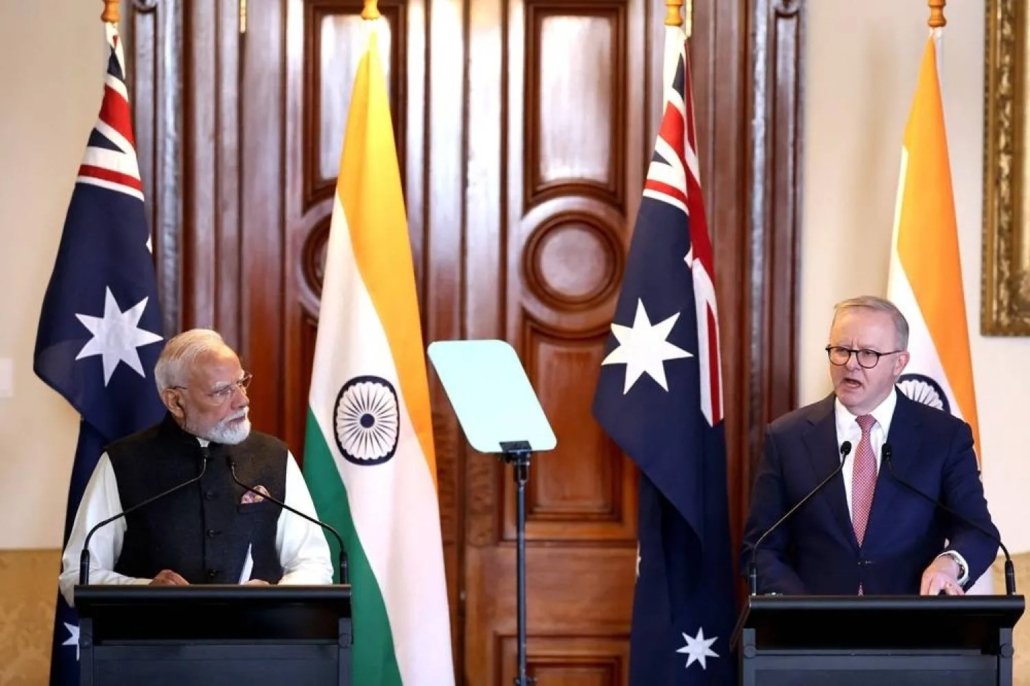
Prime Minister Narendra Modi’s visit to Australia from 08–10 July 2026 marked a decisive moment in India’s deepening engagement with Australia and the wider Indo-Pacific.[1] Held against the backdrop of intensifying geopolitical competition, growing maritime insecurity and increasing vulnerabilities across regional supply chains, the visit demonstrated the growing convergence between Indian strategic interests and Australian ones. As had been widely expected, the third Australia–India Annual Summit in Melbourne produced a comprehensive suite of agreements spanning maritime security, defence cooperation, critical minerals, civil nuclear energy, emerging technologies, science and technology, skills development and cultural exchanges.[2]
For India, the breadth of these outcomes is important because it reflects the expanding scope of a partnership that is increasingly relevant to India’s interests in the Indian Ocean in furtherance of its “Act East” policy, its maritime policy as encapsulated by the acronym MAHASAGAR (Mutual and Holistic Advancement for Security and Growth Across Regions), and New Delhi’s broader efforts to contribute to a free, open, stable and rules-based order in Indo-Pacific. First-order specificity to this maritime policy of MAHASAGAR is provided through the “Indo-Pacific Oceans Initiative” (IPOI), wherein Australia leads the “marine ecology” pillar.[3] This notwithstanding, such has been the intensity of the global geopolitical churn that the “Trump 2.0” administration has ushered — through its discernible withdrawal from global governance — that almost every spoke of the deeply interconnected web that the IPOI constitutes has willy-nilly been securitised.
Thus, Australia’s willingness to continue to lead the marine ecology endeavour notwithstanding, at the India-Australia bilateral level, maritime engagement is increasingly shaped by the “Joint Maritime Security Collaboration Roadmap” and the MOU concluded between Australia’s Maritime Border Command and the Indian Coast Guard.[4]
Prime Minister Modi’s visit also took place at a particularly important moment in Australia’s own strategic recalibration. Australia’s “2026 National Defence Strategy” (NDS), presented on 16 April 2026 by Minister for Defence Richard Marles, outlined a major shift towards increased defence spending, greater self-reliance and deterrence by denial.[5] Building on the “2023 Defence Strategic Review” and the inaugural “2024 NDS”, the strategy places deterrence-by-denial, integrated defence, maritime capability, national resilience and trusted regional partnerships, at the centre of Australia’s defence planning.[6] The accompanying “2026 Integrated Investment Program” (IIP) provides the financial architecture for this approach, including approximately AU$ 425 billion in capability investment over the coming decade.[7]
Australia’s recalibration is significant because it assigns India a higher-order role in its regional security architecture. The 2026 NDS identifies India as a “top-tier security partner” and Australia’s “most important defence partner in the Northeast Indian Ocean”.[8] On the one hand, this is an important recognition of India’s growing role. On the other, however, it also raises a question for New Delhi: how will Australia’s recognition of India’s importance translate into practical cooperation, and what role does Australia expect India to play in its evolving defence and maritime architecture? India’s importance to Australia extends beyond its naval capabilities or Quad participation. Its geographic position, centrality to the Indian Ocean, and growing capacity to contribute to maritime domain awareness, regional security, and resilient supply chains, make the partnership indispensable to Australia’s wider Indo-Pacific objectives.
At the same time, India’s relationship with Australia must not be viewed solely through the lens of Australian requirements. India has her own interest in strengthening maritime security across the Indian Ocean, diversifying partnerships, enhancing access to critical technologies and resources, developing defence and industrial capabilities, and shaping the regional order in accordance with New Delhi’s own priorities. The July summit was, therefore, significant not simply because Australia seeks deeper engagement with India, but because the agreements entered into thereat, provide India with opportunities to advance its own maritime interests through a partnership with a capable regional power.
This paper examines the July 2026 visit from an Indian perspective, asking what the summit means for India’s maritime interests and the future of India–Australia maritime cooperation. It argues that the visit represents a significant opportunity to move the relationship from broad strategic convergence to more structured, mutually beneficial cooperation. While Australia’s NDS has elevated India’s importance in Canberra’s strategic thinking, the value of the partnership for India will ultimately depend on whether this recognition yields sustained cooperation that advances India’s own maritime security, technological, economic and regional objectives. To operationalise this shift from convergence to structured cooperation, the July 2026 summit produced a set of concrete agreements across the domains of defence, technology, energy and people-to-people engagement. Against this backdrop, this paper advances the following recommendations to strengthen India–Australia maritime cooperation:
- Anchor a joint undersea warfare workstream within Australia’s next Integrated Investment Program (IIP) cycle, as a concrete test of whether Canberra’s recognition of India as a “top-tier security partner” is matched by shared capability planning.
- Operationalise the Indian Coast Guard–Maritime Border Command MoU by launching a joint capability-enhancement training exercise within twelve months, focused on law enforcement, search and rescue, and information sharing.
- Sequence cooperation in critical minerals, under the Geoscience Australia–Geological Survey of India MoU, moving systematically from joint exploration to offtake arrangements and co-processing projects.
- Launch early pilot projects under the “Australia-India Partnership on Cyber, Critical Technologies and Supply Chains” (PACTS) and the “Australia–Canada–India Technology and Innovation Partnership” (ACITI) in areas such as port cybersecurity and maritime AI.
- Use the two years that are available before the “2028–29 Australian Defence College Instructor Exchange” programme is operationalised to deepen professional military education ties and expand working-level defence engagements between India and Australia.
- Leverage India’s Chairship of IORA to jointly develop Indian Ocean minilateral initiatives on maritime security, maritime ecology, and supply-chain resilience.
To place all this within the contemporary context, Table 1 summarises the key agreements and initiatives announced, signed, or advanced during Prime Minister Modi’s visit to Australia from 08–10 July 2026.
Table 1. Major Outcomes of Prime Minister Narendra Modi’s July 2026 Visit to Australia and their Strategic Significance
| Strategic Area | Agreement / Outcome | Relevance | Strategic Significance |
| Defence and Security | Joint Declaration on Defence and Security Cooperation (renewing the 2009 Joint Declaration on Security) | Core | Establishes the overarching framework for defence cooperation, including interoperability, defence industry collaboration, maritime security, cyber cooperation, humanitarian assistance and disaster relief (HADR), counterterrorism, and cooperation through the UNCLOS (1982), ASEAN, the Pacific Islands Forum (PIF) and the Indian Ocean Rim Association (IORA). |
| Maritime Security Collaboration Roadmap | Core | Deepens operational maritime cooperation by enhancing maritime domain awareness (MDA) and maritime situational awareness (MSA), strengthening information sharing, coordinating activities, and advancing capability enhancement across the Indian Ocean. | |
| Memorandum of Understanding between the Indian Coast Guard and Australia’s Maritime Border Command | Core | Expands cooperation in maritime law enforcement, border protection, search and rescue, and information sharing, strengthening practical cooperation below the naval level. | |
| Australian invitation for an Indian military instructor to serve at the Australian Defence College (2028–29) | Supporting | Enhances professional military education, strategic dialogue and long‑term defence interoperability between the defence establishments. | |
| Critical and Emerging Technologies | Australia–India Partnership for Cyber, Critical Technologies and Supply Chains (PACTS) | Core | Strengthens cooperation in cyber security, artificial intelligence, quantum technologies, resilient supply chains and critical technology governance, supporting both economic and national security objectives. |
| Australia–Canada–India Technology and Innovation (ACITI) Partnership | Supporting | Introduces a trilateral mechanism to promote collaboration on emerging technologies, research and innovation, demonstrating the widening technological dimension of Indo-Pacific partnerships. |
| Energy Security and Critical Minerals | Joint Statement on Energy Security | Supporting | Reinforces cooperation on energy resilience, diversification of supply chains, clean energy and critical minerals amid increasing geopolitical uncertainty. |
| Administrative Arrangement implementing the India–Australia Civil Nuclear Cooperation Agreement | Supporting | Operationalises the 2014 civil nuclear agreement, facilitating Australian uranium exports to India while reinforcing long-term strategic energy cooperation. | |
| Memorandum of Understanding between Geoscience Australia and the Geological Survey of India | Core | Strengthens cooperation in critical minerals exploration, geological mapping, resource security and technical capacity building, supporting resilient supply chains. | |
| Education, Skills and Research | Agreements on mining technology training, vocational education, Australian university campuses in India, scientific research partnerships, and renewable energy skills | Enabling | Builds skills, research links and innovation to support long‑term economic strength and the broader strategic partnership. |
| People-to-People and Cultural Cooperation | Sports Roadmap, repatriation of Indian antiquities, and cooperation between film institutions | Enabling | Reinforces societal links and cultural diplomacy, strengthening the broader foundations of the Comprehensive Strategic Partnership beyond defence and security. |
Source: Collated by the author from various sources
From Strategic Convergence to Operational Cooperation
The outcomes of the July 2026 Australia–India Annual Summit suggest that the bilateral relationship has entered a new phase. Rather than introducing entirely new areas of cooperation, the agreements institutionalise a decade of growing strategic convergence by establishing mechanisms for sustained implementation. Collectively, these outcomes demonstrate that India–Australia cooperation is moving beyond high-level political dialogue and periodic naval exercises to a multidimensional partnership spanning defence, maritime governance, critical technologies, energy, supply chains and skills.
That said, defence and maritime security remain the centrepiece of this transition. The renewed “Joint Declaration on Defence and Security Cooperation” replaces the 2009 “Joint Declaration on Security” and provides an updated framework for bilateral engagement.[9] Complementing this framework, the “Maritime Security Collaboration Roadmap” and the “Memorandum of Understanding between the Indian Coast Guard and Australia’s Maritime Border Command” shift cooperation from episodic naval interaction towards more institutionalised coordination in maritime domain awareness, information sharing, maritime law enforcement, and border security.[10] Together, these initiatives recognise that safeguarding the Indian Ocean requires whole-of-government cooperation involving both naval and civilian maritime agencies.
The summit also shows that both governments now see technological capability and economic resilience as integral to maritime security. Initiatives such as PACTS and ACITI expand cooperation into cyber, AI, quantum technologies, and resilient supply chains, while agreements on energy, civil nuclear cooperation, and critical minerals, reflect a shared view that secure access to strategic resources underpins economic competitiveness and defence preparedness.[11] For two Indo-Pacific maritime powers dependent on uninterrupted shipping, resilient critical supply chains are now a core element of national security.
An equally important feature of the summit is its investment in the long-term foundations of the partnership. Agreements relating to vocational education, mining technology, university campuses, scientific collaboration and renewable energy skills broaden cooperation beyond the security domain by strengthening the research, industrial and human capital ecosystems necessary to sustain closer strategic ties. This whole-of-partnership approach mirrors Australia’s increasingly integrated conception of national security, in which economic capacity, technological innovation and skilled workforces are viewed as critical enablers of defence capability.
Taken together, the July 2026 summit marks an encouraging transition from strategic convergence to operational cooperation. While the agreements do not fundamentally alter the trajectory of the bilateral relationship, they provide the institutional architecture needed to translate political intent into sustained collaboration. Whether this momentum can be sustained, however, will depend on the extent to which Australia’s long-term defence planning and capability investments evolve to match the elevated role accorded to India in the 2026 National Defence Strategy. It is this relationship between strategic recognition and capability integration that the next section examines, beginning with Table 2, which seeks to provide an overview of where the fit appears a good one and where political rhetoric appears to be papering over real difficulties. The subsequent paragraphs offer some elaboration to this tabulated summary.
Table 2. Comparative Positioning of Partner-Countries in Australia’s “2026 National Defence Strategy” and “Integrated Investment Program:
| Country / Group | 2026 National Defence Strategy | 2026 Integrated Investment Program | Assessment |
| United States | “Indispensable ally”; core of deterrence, AUKUS, intelligence, technology, nuclear deterrence | Investment in terms of capacity is centred on US-origin platforms, especially under AUKUS, while capability-enhancement is concentrated upon interoperability, logistics and command-and-control systems. | Top priority in both words and spending |
| Japan | Top strategic partner; mentioned often on defence, technology, industry, exercises | Included in defence industry projects, advanced technology work, trilateral programs with the US | High priority in both strategy and investment |
| India | “Top-tier security partner”; “most important defence partner in the Northeast Indian Ocean” (strongest language so far) | Almost no India-specific projects, buying plans, or joint industry work in the investment plan | Long on Aspirational political rhetoric, worryingly short in actual investment and plans |
| Indonesia | Key neighbour and regional partner; important for northern approaches | Some regional cooperation programs; little joint defence capability work | Important regionally, limited concrete defence ties |
| Pacific Island countries | Important for regional security and stability | Focus on infrastructure, aid, and engagement, not hard defence capability | Regional priority, but not a defence investment focus |
| ASEAN | Central to regional architecture and diplomacy | Mainly diplomatic and institutional engagement; very little direct defence investment | Important politically, low defence spending focus |
Source: 2026 National Defence Strategy and 2026 Integrated Investment Program[12]
Australia’s Strategic Reorientation and India’s Place in the 2026 National Defence Strategy
Australia’s 2026 National Defence Strategy (NDS) confirms that Canberra now views the Indo-Pacific as its primary strategic theatre and maritime security as the foundation of national defence. Building upon the 2023 Defence Strategic Review and the 2024 National Defence Strategy, the document argues that Australia can no longer rely on warning time before conflict and must instead prepare for an era of continuous strategic competition.
China is the principal strategic driver behind this shift. Although the document avoids overtly confrontational language, it repeatedly highlights China’s military modernisation, expanding naval presence, coercive behaviour, and efforts to reshape the regional order, as factors contributing to Australia’s deteriorating security environment.[13] The accompanying “2026 Integrated Investment Program” (IIP) translates this assessment into capability priorities centred on maritime power, undersea warfare, long-range strike, guided weapons, cyber capabilities, and integrated command-and-control systems.
Within this evolving strategic framework, India’s position — at least in terms of aspirational political rhetoric — has strengthened considerably. The NDS identifies India as a top-tier security partner and Australia’s most important defence partner in the Northeast Indian Ocean—the strongest language used for India in any Australian defence strategy to date.[14] This reflects Canberra’s growing recognition that stability in the Indian Ocean cannot be achieved without India’s active participation.
However, the NDS also exposes an important disconnect between political recognition and practical implementation. While India enjoys unprecedented prominence in Australia’s strategic narrative, this has yet to be meaningfully reflected in defence capability planning. The United States remains the central pillar of Australia’s defence architecture, while Japan features consistently across discussions on advanced capability development, defence-industrial cooperation and operational integration. By comparison, India’s role is discussed primarily in the context of the Quad and the Indian Ocean, with limited reference to long-term capability collaboration or defence-industrial integration.
This divergence is particularly evident in the “2026 Integrated Investment Program”. The investment framework remains centred on sovereign capability development, AUKUS, undersea warfare, long-range strike and northern force posture. India is totally absent from this capability architecture despite Australia’s acknowledgement that its economic security depends on stable Indian Ocean maritime shipping routes and stronger regional partnerships.
It is true that India is viewed not simply as a Quad partner but as an important resident Indo-Pacific power that is capable of shaping the regional balance of power. Yet this conceptual understanding has not been matched by any meaningful institutional integration or defence-industrial cooperation. In other words, Australia’s strategic assessment of the India partnership has advanced much faster than the mechanisms required to operationalise that partnership.
Prime Minister Modi’s July 2026 visit should therefore be viewed within this broader strategic context. Rather than creating a new partnership, the summit translated Australia’s evolving assessment of India into practical cooperation through new institutional arrangements on maritime security, defence cooperation, critical technologies, energy security and supply-chain resilience. The significance of the visit lies not simply in the number of agreements concluded, but in their potential to narrow the gap between Australia’s strategic ambitions and the institutional architecture needed to realise them. Table 3 highlights this disconnect by comparing Australia’s principal capability investment priorities under the “2026 Integrated Investment Program” with their relevance for India–Australia cooperation.
Table 3. Australia’s 2026 Integrated Investment Program: Major Capability Priorities and Implications for India–Australia Cooperation
| Capability priority | Planned investment (AUD, approx) * | Relevance for India–Australia cooperation |
| Maritime capabilities | $62–77 billion | Supports collaborative maritime control in the Indo‑Pacific (incorporating wartime concepts such as “sea control” and “sea denial”); creates scope for joint maritime exercises and operational coordination. |
| Undersea warfare | $94–130 billion | Creates opportunities for joint ASW work, undersea surveillance cooperation and shared maritime domain awareness. |
| Long-range strike | $28–35 billion | Enhances long‑range deterrence across the Indo‑Pacific; limited direct India–Australia capability integration at this stage. |
| Space and cyber | $27–38 billion | Complements PACTS and ACITI, with potential for joint projects in space-based MDA, cyber resilience and maritime AI. |
| Guided weapons and explosive ordnance | $26–36 billion | Potential area for defence-industrial collaboration, including co-development or co-production of selected munitions. |
| Total IIP capability investment (all domains) | ~$425 billion | Demonstrates Australia’s maritime-focused defence modernisation and the scale of potential future cooperation. |
Note: Figures represent approximate capability investment ranges over the IIP planning horizon
Source: 2026 National Defence Strategy and 2026 Integrated Investment Program [15]
Taken in aggregate, the 2026 Summit outcomes and Australia’s revised defence planning reveal both opportunities and challenges for India. While the 2026 NDS and IIP assign India a higher-order role in Australia’s regional security architecture, capability and industrial integration remain limited compared with Australia’s partnerships with the United States and Japan. The agreements reached in July 2026—on maritime security, coast guard cooperation, critical technologies, energy and critical minerals—provide concrete entry points for India to help shape the emerging defence and maritime architecture in ways that advance its own maritime, technological and economic interests. To convert strategic recognition into sustained, mutually beneficial cooperation, India should prioritise the following steps:
Recommendations
- Anchor a Joint Undersea-Warfare Workstream in Australia’s next IIP Cycle.Australia’s 2026 IIP allocates its largest single tranche—AUD 94–130 billion—to undersea warfare, yet India remains totally absent from this investment architecture despite being named Australia’s most important defence partner in the Northeast Indian Ocean.[16] Both sides must work through the Annual Defence Ministers’ Dialogue to define a joint ASW/underwater domain awareness workstream ahead of the next IIP cycle. For India, this is the clearest available test of whether Canberra’s strategic recognition is being matched by shared capability planning, rather than remaining a one-sided investment agenda in which India has little role in shaping outcomes. India could propose a workstream that links ASW cooperation in the northeastern Indian Ocean with shared maritime domain awareness nodes and logistics access, aligning with both MAHASAGAR and Australia’s undersea warfare priorities.
- Set a Joint 12-month Timeline to operationalise the Coast Guard–Maritime Border Command MoU. The MoU between the Indian Coast Guard and Australia’s Maritime Border Command currently exists as a framework agreement. Both agencies must jointly commit to their first combined Search-and-Rescue (SAR) capability-enhancement exercise within twelve months, building on the precedent of the SAR training already conducted together for IORA member states at MRCC Chennai in June 2026. This commitment should be anchored by a published joint communique or after-action report to ensure accountability. For India, this converts a bilateral instrument into a demonstrated capability it can also offer as a model to Indian Ocean partners like Sri Lanka, Maldives and Bangladesh.
- Jointly Sequence the Geoscience Australia–GSI MoU Toward Offtake and Processing. The Geoscience Australia–GSI MoU gives both countries a basis for critical minerals cooperation. A joint sequencing plan—mapping and exploration first (e.g., lithium, rare earths), followed by negotiated offtake and co-processing arrangements—would serve India’s interests in reducing mineral-supply dependence while giving Australia a reliable partner for value-added investment, rather than leaving the relationship as an unstructured exploration exercise.
- Co-design pilot projects under PACTS and ACITI. PACTS and ACITI carry broad mandates on cyber, AI, quantum and supply-chain resilience but there are no named deliverables as yet. India and Australia must accordingly jointly select one or two pilot projects within six months—port cybersecurity or maritime-domain AI analytics are natural candidates—and announce them before the next Annual Summit. This would give both frameworks a visible, mutually designed outcome, rather than one side simply proposing projects to the other.
- Use the Run-up to the 2028–29 Instructor Exchange to Build Joint Working-level Ties. With the Australian Defence College instructor posting still a couple of years away, both sides should use the interim “General Rawat Young Officers’ Exchange” and other professional military education channels to build the working-level familiarity that makes joint capability planning (Recommendation 1) more achievable when the 2028 cycle does materialise — a two-way active investment in institutional trust, rather than a passive wait.
- Use India’s IORA Chairship to Jointly Shape Indian Ocean Minilateralism. The renewed Joint Declaration channels cooperation through IORA, UNCLOS 1982, ASEAN, and the PIF. With India currently chairing IORA, both countries have an opportunity to co-lead regional initiatives—such as joint capacity-building packages for Sri Lanka, Maldives and Bangladesh, or a trilateral maritime security exercise under IORA—combining India’s regional standing with Australia’s technical and financial resources, thereby ensuring that Australia’s growing interest in the Indian Ocean is translated into jointly designed and jointly led regional initiatives.
Conclusion
Australia’s 2026 National Defence Strategy marks a decisive shift towards a maritime-centred approach to national defence. The July 2026 India–Australia Annual Summit demonstrates that this strategy is already being translated into practical cooperation through an increasingly institutionalised partnership spanning defence, maritime governance, critical technologies, resilient supply chains and regional architecture. For India, the test of the July 2026 summit will not be the number of frameworks created, but whether New Delhi can shape Australia’s next capability cycle and regional initiatives so that rhetorical recognition of India translates into shared architecture, shared capabilities, and shared influence in the Indo-Pacific.
*******
About the Author
Ms Kripa Anand is a Research Associate at the National Maritime Foundation (NMF). Her research encompasses maritime security issues, with special focus upon the manner in which India’s own maritime geostrategies are impacted by the maritime geostrategies of the island-States of Oceania in general and Australia and New Zealand in particular. She may be reached at ocn1.nmf@gmail.com.
Endnotes
[1] Dr Teesta Prakash, “Narendra Modi’s Visit To Australia Will Be A Display Of Strategic Pragmatism”, Australia India Institute, 8 July 2026. https://aii.unimelb.edu.au/narendra-modis-visit-to-australia-will-be-a-display-of-strategic-pragmatism/.
[2] Dr Teesta Prakash, “Narendra Modi’s Visit To Australia Will Be A Display Of Strategic Pragmatism”, The Conversation, 07 July 2026, https://theconversation.com/narendra-modis-visit-to-australia-will-be-a-display-of-strategic-pragmatism-286838
[3] Australian High Commission New Delhi, “Australia-India Indo-Pacific Oceans Initiative Partnership: Grant Round 2”, https://india.highcommission.gov.au/ndli/AIIPOIP1.html
[4] Government of India, Prime Minister’s Office Press Brief, “Third India-Australia Annual Summit Joint Statement”, https://www.pib.gov.in/PressReleasePage.aspx?PRID=2282687®=48&lang=1
[5] Australian Government, Department of Defence, “2026 National Defence Strategy and Integrated Investment Program”, Media Release, 16 April 2026. https://www.minister.defence.gov.au/media-releases/2026-04-16/2026-national-defence-strategy-integrated-investment-program.
[6] Australian Government, Department of Defence, “2026 National Defence Strategy and 2026 Integrated Investment Program”, 2026. https://www.defence.gov.au/about/strategic-planning/2026-national-defence-strategy-2026-integrated-investment-program.
[7] Australian Government, Department of Defence, “2026 National Defence Strategy and 2026 Integrated Investment Program,” 2026.
[8] Australian Government, Department of Defence, “2026 National Defence Strategy and 2026 Integrated Investment Program,” 2026.
[9] Government of India, Ministry of External Affairs, “List of Outcomes: Visit of Prime Minister Shri Narendra Modi to Australia (July 08 – 10, 2026)”, 09 July 2026. https://www.mea.gov.in/bilateral-documents?dtl/41431.
[10] Government of India, Ministry of External Affairs, “List of Outcomes: Visit of Prime Minister Shri Narendra Modi to Australia (July 08 – 10, 2026)”.
[11] Government of India, Ministry of External Affairs, “List of Outcomes: Visit of Prime Minister Shri Narendra Modi to Australia (July 08 – 10, 2026)”.
[12] Australian Government, Department of Defence, “2026 National Defence Strategy and 2026 Integrated Investment Program,” 2026.
[13] Australian Government, Department of Defence, “2026 National Defence Strategy and 2026 Integrated Investment Program,” 2026.
[14] Australian Government, Department of Defence, “2026 National Defence Strategy and 2026 Integrated Investment Program,” 2026.
[15] Australian Government, Department of Defence, “2026 National Defence Strategy and 2026 Integrated Investment Program,” 2026.
[16] Australian Government, Department of Defence, “2026 National Defence Strategy and 2026 Integrated Investment Program,” 2026.


Leave a Reply
Want to join the discussion?Feel free to contribute!