
Keywords: IUU Fishing, Non-Traditional Maritime Security Threats, Maritime Security, UNODC, INTERPOL, World Customs Organisation, Indo-Pacific
Illegal, Unreported and Unregulated (IUU) fishing has evolved from being viewed primarily as a governance challenge to one where it is widely regarded as a multidimensional maritime security concern with significant strategic implications for the Indo-Pacific. Contemporary evidence demonstrates that IUU fishing rarely occurs in isolation. Rather, it is increasingly intertwined with a variety of manifestations of transnational maritime crime, including human trafficking, forced labour, migrant smuggling, document fraud, corruption, money laundering, tax evasion, illicit financial flows and the trafficking of narcotics, wildlife and other contraband.[1] Criminal syndicates exploit weak maritime enforcement mechanisms to operate across national jurisdictions with minimal risk of prosecution. The Indo-Pacific with its vast Exclusive Economic Zones (EEZs), critical international shipping lanes (ISLs), rich fisheries resources, and uneven maritime enforcement capacities and capabilities, has become particularly vulnerable to these converging threats.
Recent assessments by INTERPOL,[2] the World Customs Organisation (WCO),[3] and the Information Fusion Centre-Indian Ocean Region (IFC-IOR),[4] reveal that criminal networks increasingly exploit fishing vessels, commercial ports and maritime supply chains as low-risk, high-profit platforms for illicit activities. This paper examines the evolving relationship between IUU fishing and transnational maritime crime in the Indo-Pacific, analyses the operational methods employed by organised criminal networks, and assesses their implications for regional maritime security and governance. It argues that addressing IUU fishing requires moving beyond a resource management paradigm towards an integrated maritime security framework that combines fisheries governance, criminal justice, customs enforcement, and international maritime cooperation.
Understanding the Nexus
For decades, IUU fishing was principally regarded as a fisheries-management issue, involving the unauthorised harvesting of marine living resources, violations of conservation measures, and inadequate reporting of catches. National governments, and Regional Fisheries Management Organisations (RFMOs) largely approached the problem through licensing regimes, fisheries inspections, catch documentation schemes, and quota management. While these measures remain essential, they no longer capture the complexity of contemporary IUU fishing.
Today, IUU fishing has emerged as one of the most pervasive forms of maritime crime, extending far beyond the unlawful extraction of fish stocks. Modern IUU fishing operations increasingly exhibit the hallmarks of organised transnational criminal enterprises. Fishing vessels engaged in illegal harvesting are frequently implicated in a wider spectrum of criminal activities, including forced labour, human trafficking, migrant smuggling, document fraud, corruption, tax evasion, customs fraud, money laundering, and the trafficking of narcotics and wildlife products.[5] Rather than isolated regulatory violations, these activities form part of integrated criminal business models designed to maximise profits while exploiting governance gaps across multiple jurisdictions.
The convergence of IUU fishing with organised maritime criminality has fundamentally altered the strategic significance of the former. It now poses not only an environmental challenge but also a threat to economic security, food security, maritime governance and regional stability. The annual global economic loss attributed to IUU fishing is estimated to be in excess of US$ 10 billion,[6] while its ecological consequences include depleted fish stocks, destruction of marine biodiversity and degradation of coastal livelihoods. More significantly, the criminal networks facilitating IUU fishing undermine State authority by exploiting weak governance, corruption and fragmented enforcement mechanisms, particularly in regions where maritime jurisdictions overlap or institutional coordination remains inadequate.[7]
The Indo-Pacific exemplifies these vulnerabilities. Stretching from the eastern coast of Africa to the western coast of America, and from the southern coast of the Eurasian landmass to the northern coastline of Antarctica, the Indo-Pacific encompasses some of the world’s richest fishing grounds, busiest shipping routes, and largest Exclusive Economic Zones (EEZs). It is simultaneously characterised by significant disparities in maritime enforcement capabilities among littoral States.[8] Such conditions provide organised criminal groups with opportunities to exploit jurisdictional ambiguities, operate across multiple national boundaries and integrate fisheries-related offences with broader illicit maritime economies.[9]
Increasingly, international organisations have recognised that IUU fishing should no longer be examined solely through the lens of fisheries governance. Instead, it must be understood within the broader framework of maritime security and transnational organised crime. This conceptual evolution reflects growing evidence that criminal groups utilise fishing vessels as versatile logistics-platforms capable of transporting illicit cargo, concealing human trafficking victims, laundering illegally harvested marine products, and facilitating financial crimes across maritime supply chains.[10]
Against this backdrop, the Indo-Pacific has become an important theatre where environmental degradation, economic crime, and maritime insecurity, increasingly intersect. Understanding this evolving nexus is, therefore, essential for developing effective regional governance mechanisms capable of addressing not merely illegal fishing but the broader criminal ecosystems that sustain it.
From Fisheries Violations to Maritime Crime
The conceptual understanding of IUU fishing has undergone significant transformation over the past two decades. Initially, international legal instruments—including the 1982 “United Nations Convention on the Law of the Sea” (UNCLOS), and the Food and Agriculture Organisation’s “International Plan of Action to Prevent, Deter and Eliminate IUU Fishing (IPOA-IUU)”—approached IUU fishing primarily as a conservation and fisheries management issue.[11] Regulatory responses consequently focused on licensing requirements, monitoring vessel activities, reporting obligations and promoting sustainable exploitation of marine living resources.
However, experience has demonstrated that these regulatory frameworks only address one dimension of a much broader problem. Investigations undertaken by INTERPOL, the “United Nations Office on Drugs and Crime” (UNODC), environmental organisations, and maritime law enforcement agencies, have consistently shown that vessels engaged in IUU fishing often participate simultaneously in multiple forms of organised criminal activity. Rather than operating as independent fisheries offenders, many function as components of sophisticated criminal networks spanning multiple countries and involving numerous facilitators, intermediaries and financial actors.[12]
The emergence of the concept of “fisheries crime” reflects this broader understanding. Unlike traditional IUU fishing, which principally concerns violations of fisheries regulations, “fisheries crime” encompasses a wider range of criminal offences committed throughout the fisheries value chain. These include fraud in catch documentation, corruption of public officials, identity fraud involving vessel registration, labour exploitation, tax evasion, customs violations, illicit financial transactions, and trafficking in protected marine species. Such offences frequently extend beyond the jurisdiction of fisheries authorities and require coordinated responses involving customs agencies, immigration authorities, financial intelligence units, and criminal investigators.[13]
INTERPOL has been particularly influential in advancing this conceptual shift. Through its “Fisheries Crime Working Group” and global enforcement initiatives,[14] the organisation has demonstrated that organised criminal networks exploit the fisheries sector because it offers comparatively high financial returns with relatively limited risks of detection and prosecution. Criminal syndicates routinely employ shell companies, flags of convenience, complex ownership structures, and fraudulent documentation to obscure the identities of vessel owners and evade national regulatory frameworks.
These developments have challenged the traditional separation between environmental crime and organised crime. In practice, environmental offences associated with IUU fishing frequently generate illicit revenues that support broader criminal enterprises. Consequently, combating IUU fishing increasingly requires intelligence-led policing, international law enforcement cooperation, and financial investigations, alongside conventional fisheries enforcement.
The Criminal Business Model Behind IUU Fishing
Unlike conventional fishing enterprises, organised IUU fishing operations increasingly resemble multinational criminal businesses. They integrate legal and illegal activities within a single commercial structure, allowing illicit operations to be concealed behind apparently legitimate fishing enterprises.
A typical criminal enterprise involved in IUU fishing may own or control numerous vessels operating under different national flags. Ownership is frequently obscured through shell companies registered across multiple jurisdictions, making it difficult for enforcement agencies to identify the ultimate beneficiaries of criminal activity. Fish harvested illegally are often mixed with legally caught fish before entering international supply chains, thereby laundering illegally obtained products into legitimate global markets.[15]
These operations are further facilitated by document fraud, falsified catch certificates, manipulated vessel monitoring data, and fraudulent licensing arrangements. Fishing vessels are known to intentionally disable “Automatic Identification Systems” (AIS) transmitters, conduct illicit transhipment operations at sea, and repeatedly change vessel identities through flag-hopping and vessel-renaming so as to evade enforcement actions.[16]
Importantly, the same vessels often serve multiple criminal purposes. During periods when fishing activity is limited or enforcement risks increase, these vessels may transport narcotics, smuggle migrants, traffic protected wildlife, and facilitate other illicit commerce. This “operational flexibility” substantially increases the profitability of organised criminal enterprises while reducing the likelihood of authorities detecting the full range of these criminal activities.[17]
The maritime environment itself enhances these opportunities. Vast ocean spaces, overlapping jurisdictions, limited surveillance assets, and inconsistent enforcement capacities, create conditions in which organised criminal networks can operate across multiple EEZs before entering ports where illegally obtained products are introduced into legitimate commercial supply chains.[18]
The result is a highly adaptive criminal ecosystem that combines environmental exploitation with transnational organised crime. As subsequent sections of this paper demonstrate, this convergence has become increasingly visible across the Indo-Pacific, where evolving maritime security trends indicate that fisheries crimes can no longer be separated from broader questions of regional maritime governance and security.
Criminal Economies at Sea: Expanding the Nexus
The transformation of IUU fishing from a regulatory fisheries issue into a multidimensional maritime security challenge is most evident in its growing convergence with transnational organised crimes. Contemporary organised criminal groups no longer regard fishing vessels merely as platforms for harvesting marine resources. Rather, they exploit the fisheries sector as a flexible and relatively low-risk operating environment capable of facilitating a wide spectrum of illicit activities. Weak governance, fragmented jurisdictional authority, inconsistent law enforcement and the vastness of the maritime domain collectively provide criminal organisations with opportunities that are unavailable in most land-based criminal enterprises.
Recognising this evolution, INTERPOL has observed that depleting fish stocks, rising global seafood demand, and increasing competition over marine resources, have created favourable conditions for organised criminal networks to infiltrate the fisheries sector. Criminal organisations exploit these pressures by combining illegal fishing with other illicit revenue-generating activities, thereby diversifying profits while reducing operational risks.[19] Consequently, IUU fishing increasingly represents one component of broader criminal business models rather than an isolated environmental offence.
Unlike traditional organised crime, maritime criminal enterprises often operate across multiple jurisdictions during a single voyage. A fishing vessel may be owned through shell companies incorporated in one country, registered under another country’s flag, crewed by nationals from several developing states, harvest fish illegally in a third country’s EEZ, conduct transhipment on the high seas and ultimately land its catch in a different jurisdiction using falsified documentation. Such operational complexity significantly complicates investigation and prosecution, allowing criminal organisations to exploit differences in national legal systems and enforcement capabilities.[20]
These developments have reinforced the growing acceptance of the concept of “fisheries crime”, which encompasses criminal activities occurring throughout the fisheries value chain rather than focusing exclusively on illegal harvesting. This broader framework recognises that fisheries offences frequently intersect with corruption, customs fraud, document forgery, financial crimes, labour exploitation and trafficking networks. The Indonesian experience similarly illustrates that treating fisheries offences solely as administrative violations overlooks their increasingly organised and transnational character.[21]
Human Trafficking and Forced Labour: The Human Cost of IUU Fishing
Among the most disturbing dimensions of fisheries crimes is its close association with human trafficking, forced labour and modern slavery. Fishing vessels operating illegally often remain at sea for prolonged periods, frequently undertaking transhipment operations that enable them to avoid returning to port for months or even years. Such operational practices reduce opportunities for labour inspections and create conditions in which abuse can occur with little external oversight.
Evidence compiled by INTERPOL,[22] UNODC,[23] and numerous human rights organisations demonstrates that fishing crews employed aboard vessels engaged in IUU fishing are disproportionately vulnerable to exploitation. Recruitment commonly occurs through deceptive labour agencies promising legitimate employment before workers become trapped aboard vessels under conditions amounting to debt bondage or forced labour. Passports are confiscated, wages withheld and workers subjected to violence, intimidation, and psychological abuse.
The Indonesian study similarly documents that organised fisheries crimes frequently intersects with human trafficking and labour exploitation. It highlights evidence of trafficking for forced labour, child exploitation, and severe human rights abuses aboard fishing vessels, including prolonged working hours, physical violence, deprivation of food and sleep, and restrictions on crew mobility. These practices are not incidental but rather constitute deliberate mechanisms for reducing operating costs and maximising illegal profits.[24]
Forced labour also provides criminal organisations with a highly expendable workforce. Migrant workers recruited from economically vulnerable communities frequently possess limited legal protection and little ability to seek assistance while operating far from shore. Consequently, labour exploitation has become structurally embedded within many organised IUU fishing operations rather than representing isolated instances of abuse.[25]
Beyond humanitarian concerns, these practices undermine labour standards throughout the legitimate seafood industry. Operators complying with international labour regulations face unfair competition from criminal enterprises capable of substantially reducing production costs through exploitation. The result is a distortion of global seafood markets that rewards non-compliance while eroding incentives for responsible fisheries governance.[26]
Fishing Vessels as Platforms for Maritime Smuggling
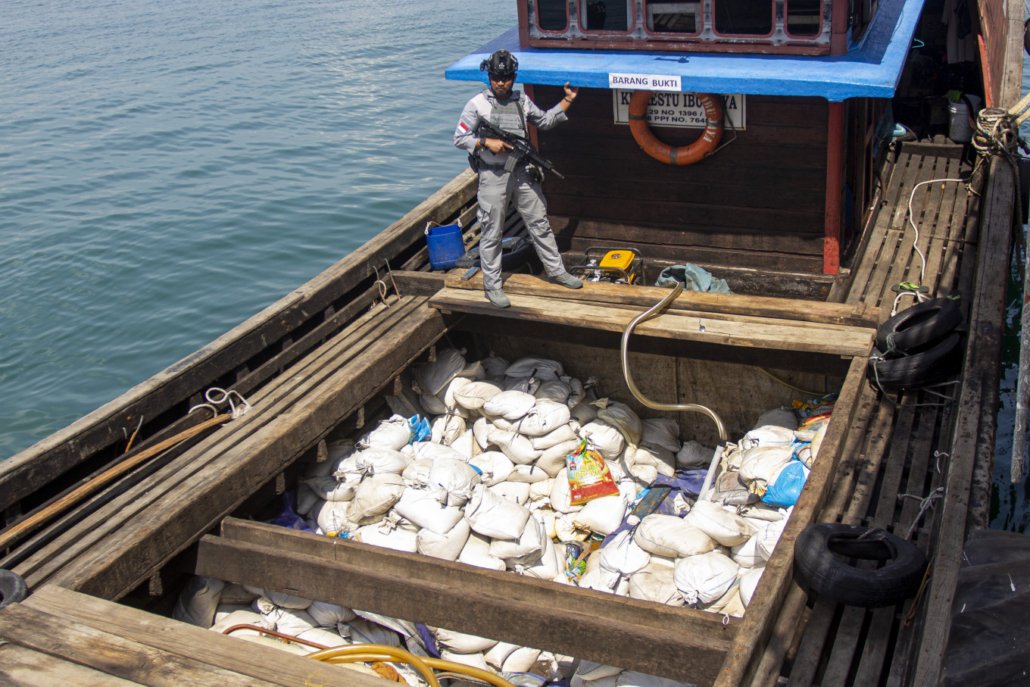
The characteristics that make fishing vessels attractive for commercial fishing equally enhance their utility for organised criminal activity. Fishing vessels routinely operate beyond coastal surveillance systems, possess legitimate reasons for remaining at sea for extended periods and frequently move across international maritime boundaries. Their cargo spaces, refrigerated compartments and irregular operational patterns provide ideal conditions for concealing illicit goods.[27]
Consequently, fishing vessels have increasingly been implicated in trafficking narcotics, small arms, wildlife products, counterfeit goods and other forms of contraband. Criminal groups frequently exploit legitimate fishing operations as cover for transporting illicit cargo between coastal States while avoiding the scrutiny generally directed towards commercial merchant shipping.[28]
The convergence between IUU fishing and narcotics trafficking has become particularly evident in the Indo-Pacific. Maritime trafficking routes used for illegal fishing frequently overlap with established smuggling corridors utilised for drugs, firearms and other illicit commodities. Fishing vessels tend to alternate between fishing operations and smuggling activities, according to seasonal opportunities, enforcement pressures, and market demand.[29]
Recent IFC-IOR “Weekly Maritime Security Updates” illustrate the persistence of narcotics trafficking across the northern Arabian Sea, western Indian Ocean and approaches to the Gulf of Oman.[30] These reports document repeated interdictions of vessels carrying significant quantities of illicit narcotics intended for regional and international markets. Although not every intercepted vessel is engaged in IUU fishing, the reports highlight the increasingly diverse use of small commercial and fishing vessels within broader maritime trafficking networks. The operational characteristics of fishing fleets—particularly their numbers, mobility and relatively limited inspection regimes—continue to make them attractive assets for organised criminal groups.[31]
Similarly, trafficking networks involved in wildlife crimes have increasingly exploited fishing vessels for transporting protected marine species, including shark, sea cucumber, abalone, coral, and other high-value marine resources harvested illegally for international markets. Such activities further demonstrate that fisheries crime increasingly intersects with broader environmental criminality rather than existing as a distinct category of offence.
Corruption, Fraud and Illicit Financial Flows
Organised IUU fishing cannot operate at industrial scale without significant financial and administrative support. Corruption, therefore, remains one of the principal enablers connecting illegal fishing with broader organised criminal activity.
Corrupt officials facilitate fraudulent licensing, manipulate inspection procedures, falsify customs documentation, and overlook regulatory violations, all in exchange for financial inducements. Similarly, private sector actors—including brokers, shipping agents and commercial intermediaries—may knowingly facilitate the movement of illegally harvested seafood through legitimate supply chains.
Financial crime further reinforces these criminal enterprises. Illegally harvested fish generate substantial revenues that require laundering through apparently legitimate commercial transactions. Criminal organisations commonly establish complex corporate ownership structures involving shell companies registered across multiple jurisdictions, making identification of beneficial ownership extremely difficult.
Fraudulent catch documentation represents another critical component of this business model. Fish harvested illegally are frequently mixed with legally obtained catches before entering processing facilities, where fraudulent documentation conceals their true origin. Once incorporated into legitimate supply chains, illegally harvested seafood becomes increasingly difficult to distinguish from lawful products.[32]
These financial and administrative crimes extend well beyond the jurisdiction of fisheries authorities. Their investigation therefore requires cooperation between customs administrations, financial intelligence units, anti-corruption agencies, and criminal investigators, reinforcing the need for integrated maritime governance rather than isolated fisheries enforcement.
Ports, Supply Chains and the Criminal Exploitation of Maritime Logistics
The convergence between fisheries crimes and organised criminality does not end at sea. Rather, criminal networks increasingly exploit legitimate ports, logistics providers and maritime supply chains to move illicit products into international commerce.
The World Customs Organisation’s 2025 report on the “infiltration of maritime cargo supply chains” demonstrates that organised criminal groups systematically target ports because they represent critical nodes within global trade networks. Rather than relying solely on physical concealment of contraband, contemporary criminal organisations increasingly exploit weaknesses in digital systems, customs procedures, freight forwarding operations, container management processes, and port labour arrangements. These sophisticated methods enable illicit cargo to be inserted into legitimate commercial supply chains while reducing the probability of detection.[33]
Although the report principally examines containerised cargo, its findings have direct relevance for fisheries crime. Illegally harvested seafood ultimately enters many of the same logistics systems used for legitimate seafood exports. Consequently, vulnerabilities within maritime supply chains facilitate not only narcotics trafficking but also seafood fraud, document manipulation, and customs evasion, all of which are associated with IUU fishing.[34]
Similarly, the World Customs Organisation’s 2025 “Illicit Trade Report” identifies maritime transport as a principal vector for numerous categories of organised crimes, including narcotics, wildlife trafficking, counterfeit products and environmental offences. The report underscores the fact that organised criminal groups increasingly operate across multiple illicit markets simultaneously rather than specialising in a single commodity. This observation reinforces growing international recognition that “fisheries crimes” should be understood within broader organised criminal ecosystems rather than being treated as a standalone environmental issue.[35]
Taken together, these findings suggest that strengthening fisheries governance alone will be insufficient to disrupt organised criminal networks. Effective responses must also enhance customs risk management, container security, port integrity, financial investigations and intelligence-sharing among maritime law enforcement agencies.
The convergence of IUU fishing with organised crimes, therefore, reflects the emergence of an integrated criminal economy spanning harvesting, transportation, logistics, finance and international trade. Fishing vessels no longer function solely as platforms for extracting marine resources; they increasingly operate as mobile components of sophisticated transnational criminal networks capable of exploiting weaknesses across the entire maritime domain.
The Indo-Pacific: The Convergence Zone of Maritime Crime
By all estimates, the Indo-Pacific is the nexus of IUU fishing and transnational maritime crime. Home to nearly two-thirds of the world’s population, some of the busiest shipping lanes (ISLs), and several of the world’s most productive fishing grounds, this region simultaneously underpins global economic growth while remaining extraordinarily vulnerable to evolving maritime security threats. Its vast maritime spaces, extensive Exclusive Economic Zones (EEZs), porous maritime boundaries and uneven enforcement capacities create an operating environment that organised criminal networks readily exploit.
The operational geography of IUU fishing overlaps significantly with key maritime trade routes traversing the Indian Ocean, the South China Sea, the Western Pacific and the Southern Ocean. These waters support large industrial fishing fleets, substantial artisanal fisheries and intense commercial shipping activity. Such convergence provides criminal groups with opportunities to conceal illicit activities within legitimate maritime traffic, complicating surveillance and law enforcement efforts.
Recent “Information Fusion Centre–Indian Ocean Region (IFC-IOR) Weekly Maritime Security Updates” indicate that the regional maritime threat environment has become increasingly complex.[36] Alongside piracy, armed robbery, narcotics trafficking, weapons smuggling and irregular migration, the reports highlight continuing law enforcement operations against illicit maritime activities across the Arabian Sea, Gulf of Oman, Mozambique Channel, Red Sea, and wider Indian Ocean Region. While individual incidents vary in nature, they collectively demonstrate that organised criminal networks increasingly exploit similar maritime routes, vessels and logistics chains for multiple illicit purposes. The convergence of these activities reinforces the assessment that maritime crimes should no longer be addressed through isolated sectoral approaches but through integrated maritime domain awareness and coordinated law enforcement.
The maritime domain has therefore evolved into an interconnected criminal operating environment in which illegal fishing, trafficking networks and maritime logistics increasingly reinforce one another.
Implications for India’s Maritime Security
For India, the growing convergence between IUU fishing and transnational maritime crimes carries implications extending well beyond fisheries management. As a major maritime power located at the centre of the Indian Ocean, India depends upon secure sea lines of communication, sustainable marine resources, and stable regional maritime governance. Any disruption to these elements directly affects national security, economic resilience and regional influence.
India possesses an EEZ whose area exceeds two million square kilometres, supports one of the world’s largest fishing communities, and ranks among the leading producers and exporters of marine products. Consequently, IUU fishing not only threatens marine biodiversity and fish stocks but also undermines coastal livelihoods, food security and export competitiveness. Criminal activities associated with illegal fishing further erode confidence in maritime governance by exploiting jurisdictional fragmentation, regulatory inconsistencies and enforcement gaps.
The strategic challenge is compounded by India’s geographic location. The Indian Ocean serves as a principal transit corridor linking West Asia, Africa, Europe and East Asia. Criminal organisations exploiting these routes for narcotics trafficking, arms smuggling or human trafficking can readily utilise fishing vessels operating alongside legitimate commercial fleets. Such activities increase the burden on maritime law enforcement agencies responsible for monitoring extensive maritime spaces with finite surveillance assets.
India has made significant investments in strengthening maritime situational awareness (MSA) and maritime domain awareness (MDA) through information-sharing initiatives such as the “Information Fusion Centre–Indian Ocean Region” (IFC-IOR),[37] the “Information Management and Analysis Centre” (IMAC), “White Shipping Agreements”,[38] and enhanced coastal surveillance infrastructure. These initiatives have substantially improved information sharing and regional maritime cooperation. Nevertheless, intelligence relating specifically to fisheries crimes remains fragmented across fisheries authorities, customs administrations, coast guards, navies, police organisations and financial intelligence agencies.
The challenge, therefore, lies not simply in improving surveillance but in integrating fisheries governance within the broader maritime security architecture.
Bridging the Governance Gap
The expanding convergence between IUU fishing and organised maritime crimes exposes significant shortcomings within existing international governance arrangements. Although numerous international legal instruments regulate fisheries management, maritime safety and transnational organised crimes, they generally operate within separate institutional and legal frameworks.
UNCLOS 1982 does establish rights and responsibilities of coastal State with regard to marine living-resources, but it was negotiated before the emergence of contemporary organised fisheries crime. Similarly, the FAO “Compliance Agreement” 1993,[39] the “UN Fish Stocks Agreement” (UNFSA) 1995,[40] and the FAO “Port State Measures Agreement” (PSMA) 2009,[41] primarily focus on fisheries conservation and compliance rather than organised criminal investigations.
Conversely, the “United Nations Convention against Transnational Organised Crime” (UNTOC), 2000, provides mechanisms for international criminal cooperation but does not specifically recognise fisheries crimes as a distinct category of transnational organised crimes. This fragmentation has practical consequences.[42] Fisheries inspectors may identify regulatory violations but lack authority to investigate money laundering or human trafficking. Customs administrations may detect documentation fraud without access to fisheries intelligence. Immigration authorities may encounter trafficking victims without recognising links to illegal fishing operations. Financial intelligence units may investigate suspicious commercial transactions while remaining disconnected from maritime enforcement agencies.
The Indonesian experience illustrates similar institutional challenges. Despite possessing an extensive legislative framework addressing fisheries management, enforcement remained constrained by overlapping institutional mandates and the absence of specific legal recognition of fisheries crimes as transnational organised crimes. The study consequently advocates strengthening legal frameworks capable of addressing fisheries crimes through integrated criminal justice mechanisms rather than solely through administrative fisheries regulation.[43] These governance deficiencies are not unique to Indonesia. They reflect broader structural challenges confronting many Indo-Pacific states where institutional responsibilities for fisheries, customs, immigration, maritime policing and environmental protection remain distributed across multiple agencies with differing mandates and priorities.
Policy Recommendations
Addressing the nexus between IUU fishing and transnational maritime crimes requires a shift from traditional fisheries management towards integrated maritime security governance. Such an approach should combine legal reform, intelligence sharing, technological innovation and regional cooperation.
- The Government of India needs to formally recognise “fisheries crime” as a multidimensional maritime security issue rather than solely an environmental or fisheries management concern. Such recognition would facilitate stronger coordination among fisheries authorities, coast guards, navies, customs administrations, immigration agencies and financial intelligence units.
- The Government’s endeavours in respect of both, maritime situational awareness (MSA) and maritime domain awareness (MDA), need to incorporate fisheries intelligence alongside conventional security information. Vessel monitoring systems, Automatic Identification System (AIS) data, satellite imagery, customs databases and financial intelligence must be integrated to identify suspicious vessel behaviour indicative of organised criminal activity.
- Beneficial ownership transparency should become a central component of fisheries governance. Criminal organisations frequently conceal vessel ownership through complex corporate structures registered across multiple jurisdictions. Improved transparency would substantially enhance law enforcement capabilities.
- Greater emphasis should be placed on disrupting illicit financial flows rather than concentrating exclusively on vessel interdiction. Financial investigations targeting organisers, facilitators and commercial beneficiaries often produce more enduring impacts than arresting vessel crews alone.
- Customs administrations and port authorities should strengthen supply chain integrity by improving cargo screening, digital risk management and cooperation with fisheries enforcement agencies. The findings of the World Customs Organisation demonstrate that maritime supply chains increasingly constitute critical vulnerabilities exploited by organised criminal groups.
- Regional information-sharing mechanisms should expand beyond piracy and maritime terrorism to include fisheries crimes intelligence. Existing regional initiatives — including the IFC-IOR, the “Indian Ocean Rim Association” (IORA), the “Indian Ocean Naval Symposium” (IONS), and “Regional Fisheries Management Organisations” (RFMOs), all provide valuable foundations for developing more comprehensive intelligence-sharing arrangements and need to be networked and synergised not merely across the national government but regionally as well.
- Capacity-building efforts must support smaller Indo-Pacific coastal States, which possess limited maritime surveillance capabilities but massive EEZs. Criminal organisations frequently exploit weaker jurisdictions to establish operational bases, register vessels or land illegally harvested catches. Enhancing governance across the region therefore contributes directly to collective maritime security.
Conclusion
The evolution of IUU fishing over the past two decades has fundamentally altered its strategic significance. Once viewed principally as a fisheries management challenge, it is now increasingly recognised as an integral component of wider transnational maritime crime. Organised criminal networks exploit fishing vessels, maritime supply chains and fragmented governance structures to facilitate a diverse range of illicit activities extending far beyond the unlawful harvesting of marine resources. Human trafficking, forced labour, narcotics trafficking, customs fraud, document forgery, corruption and illicit financial flows increasingly intersect with fisheries crime, transforming illegal fishing into a multidimensional maritime security challenge.
The Indo-Pacific illustrates this convergence with particular clarity. Its strategic geography, expansive maritime jurisdictions, and uneven enforcement capacities, create opportunities for criminal organisations to operate across national boundaries while exploiting differences in legal and institutional frameworks. Recent assessments by INTERPOL, the World Customs Organisation, and IFC-IOR collectively demonstrate that criminal activity at sea is becoming increasingly networked, adaptive and transnational. Addressing these challenges therefore demands responses that are equally integrated.
For India and other littoral States of the Indo-Pacific, strengthening maritime security can no longer be confined to naval capability, fisheries regulation or customs enforcement in isolation. Instead, effective governance requires the integration of fisheries management within broader maritime security architectures that combine criminal intelligence, financial investigations, maritime domain awareness, customs cooperation, and regional information-sharing. Such an approach recognises that the security of marine living resources is inseparable from the security of the maritime domain itself.
Ultimately, combating IUU fishing is not simply about conserving fish stocks. It is about safeguarding maritime governance, protecting vulnerable coastal communities, preserving the integrity of global supply chains, and denying organised criminal networks the ability to exploit one of the world’s most strategically significant maritime regions. The future resilience of the Indo-Pacific will, therefore, depend not only on stronger fisheries management but also on the collective capacity of regional States to address the increasingly complex nexus between IUU fishing and transnational maritime crimes.
******
About the Author
Mr John J Vachaparambil is an Associate Fellow at the National Maritime Foundation (NMF) and meaningfully contributes to the Foundation’s ‘Public International Maritime Law’ (PIML) cluster. His current research focuses on the legal aspects of fishing, including IUU fishing, and the conservation of the marine biological diversity of areas beyond national jurisdiction (BBNJ). He can be reached at law5.nmf@gmail.com
Endnotes:
[1] Aditi Chatterjee, “Non-traditional Maritime Security Threats in the Indian Ocean Region”, National Maritime Foundation website, 2014. https://maritimeindia.org/wp-content/uploads/2026/03/Non-traditional-Maritime-Security.pdf
[2] “Depleting Fish Stocks Fuelling Transnational Crime”, INTERPOL, 15 December 2021. https://www.interpol.int/en/News-and-Events/News/2021/Depleting-fish-stocks-fueling-transnational-crime
[3] “Illicit Trade Report 2025”, World Customs Organisation. https://www.wcoomd.org/-/media/wco/public/global/pdf/topics/enforcement-and-compliance/activities-and-programmes/illicit-trade-report/itr_2025_en.pdf?la=en
[4] IFC-IOR, “Weekly Maritime Security Update”, IFC-IOR, 04-10 June 2026. https://ifcior.indiannavy.gov.in/sites/default/files/2026-06/IFC_IOR_WMSU_04-10_Jun%2026.pdf
Also see: IFC-IOR, “Weekly Maritime Security Update”, IFC-IOR, 18-24 June
Also see: “Annual Report 2025”, IFC-IOR. https://ifcior.indiannavy.gov.in/sites/default/files/2026-02/IFC-IOR-ANNUAL-REPORT-2025.pdf
Also note: Non-traditional security issues that arise primarily out of non-military sources, such as climate change, resource scarcity, natural disasters, irregular migration, human smuggling, drug trafficking are nevertheless challenges to the survival and well-being of peoples and States. https://rsis-ntsasia.org/about-nts-asia/
[5] Laura Burroughs and Robert Mazurek, “Caught Red-handed Brief”, UNODC, June 2019. https://safety4sea.com/wp-content/uploads/2019/07/One-earth-futureSecure-fisheriesUNODC-Maritime-security-in-the-Indian-ocean-2019_07.pdf
[6] Jim Leape and Atsushi Sunami, “How Pacific countries can harness data sharing to drive down illegal fishing”, World Economic Forum, 10 January 2024. https://www.weforum.org/stories/nature-and-biodiversity/davos24-pacific-countries-drive-down-illegal-fishing/
[7] “Fisheries Crime”, UNODC. https://www.unodc.org/documents/about-unodc/Campaigns/Fisheries/focus_sheet_PRINT.pdf
[8] “World Drug Report 2025 – Maps”, UNODC. https://www.unodc.org/unodc/en/data-and-analysis/world-drug-report-2025-maps.html
[9] Laura Burroughs and Robert Mazurek, “Caught Red-handed Brief”.
[10] “Infiltration of Maritime Cargo Supply Chains”, World Customs Organisation. https://www.wcoomd.org/-/media/wco/public/global/pdf/topics/enforcement-and-compliance/activities-and-programmes/sci-project/wco-report_infiltration-of-maritime-cargo-supply-chains_june-2025.pdf?la=en
[11] UNCLOS 1982. https://www.un.org/depts/los/convention_agreements/texts/unclos/unclos_e.pdf
Also see: “International Plan of Action to Prevent, Deter and Eliminate IUU Fishing”, FAO. https://openknowledge.fao.org/items/dda4ea4e-5603-4984-b22b-ae6cacbf2d1c
[12] “Stretching the Fishnet – Identifying Crime in the Fisheries Value Chain”, UNODC, 2022. https://www.unodc.org/res/environment-climate/resources_html/Stretching_the_Fishnet.pdf
[13] “Fisheries Crime”, UNODC.
[14] “Fisheries-related Crimes”, INTERPOL. https://www.interpol.int/en/Crimes/Environmental-crime/Fisheries-related-crimes
Also see: “UNODC Approach to Crimes in the Fisheries Sector”, UNODC. https://www.unodc.org/documents/Wildlife/UNODC_Approach_to_Crimes_in_the_Fisheries_Sector.pdf
[15] “UNODC Approach to Crimes in the Fisheries Sector”, UNODC.
[16] IFC-IOR, “Weekly Maritime Security Update”.
[17] “Transnational Organised Crime in the Fishing Industry”, UNODC, 2011. https://www.unodc.org/documents/human-trafficking/Issue_Paper_-_TOC_in_the_Fishing_Industry.pdf
[18] “Stretching the Fishnet – Identifying Crime in the Fisheries Value Chain”, UNODC.
[19] “Fisheries-related Crimes”, INTERPOL.
[20] “Environmental Security Programme – Strengthening Law Enforcement Cooperation Against Fisheries Crime”, INTERPOL, March 2021.
Also see: “International Law Enforcement Cooperation in the Fisheries Sector – A Guide for Law Enforcement Practitioners”, INTERPOL, February 2018.
[21] Bambang Ali Kusuma, et al, “Establishment of Indonesia Maritime Power: Regulation of Transnational Organised Crime on IUU Fishing”, International Journal of Criminal Justice Science, December 2021. Top of Form
Bottom of Form
[22] Laura Burroughs and Robert Mazurek, “Caught Red-handed Brief”.
[23] “UNODC Approach to Crimes in the Fisheries Sector”, UNODC.
[24] Bambang Ali Kusuma, et.al “Establishment of Indonesia Maritime Power: Regulation of Transnational Organised Crime on IUU Fishing”.
[25] “Forced Labour and Human Trafficking in Fisheries”, International Labour Organisation. https://www.ilo.org/topics-and-sectors/forced-labour-modern-slavery-and-trafficking-persons/forced-labour-and-human-trafficking-fisheries
[26] “Forced Labour and Human Trafficking in Fisheries”, International Labour Organisation.
[27] Fadli, “BAKAMLA Foils Tin Smuggling Attempt to Malaysia”, The Jakarta Post, 02 May 2025. https://www.thejakartapost.com/indonesia/2025/05/02/bakamla-foils-tin-smuggling-attempt-to-malaysia
[28] “Infiltration of Maritime Cargo Supply Chains”, World Customs Organisation.
[29] “Drug Trafficking”, UNODC. https://www.unodc.org/unodc/en/drug-trafficking/index.html
[30] IFC-IOR, “Weekly Maritime Security Update”.
[31] “Annual Report 2025”, IFC-IOR.
[32] “Stretching the Fishnet – Identifying Crime in the Fisheries Value Chain”.
[33] “Infiltration of Maritime Cargo Supply Chains”, World Customs Organisation.
[34] “Stretching the Fishnet – Identifying Crime in the Fisheries Value Chain”, UNODC.
[35] “Illicit Trade Report 2025”, World Customs Organisation.
[36] IFC-IOR, “Weekly Maritime Security Update”.
[37] IFC-IOR, “Weekly Maritime Security Update”.
[38] Ministry of Defence, Government of India, “Signing of Agreements with other Countries”, Press Information Bureau, 05 February 2018. https://www.pib.gov.in/Pressreleaseshare.aspx?PRID=1519147®=48&lang=2
Also see: Ritika V Kapoor, “India’s Maldivian Rapprochement”, National Maritime Foundation website, 24 June 2019. https://maritimeindia.org/indias-maldivian-rapprochement/
[39] “Compliance Agreement 1993”, FAO. https://www.fao.org/iuu-fishing/international-framework/fao-compliance-agreement/en/
[40] “UN Fish Stocks Agreement 1995”, United Nations Treaty Collection. https://treaties.un.org/pages/viewdetails.aspx?src=treaty&mtdsg_no=xxi-7&chapter=21&clang=_en
[41] “Agreement on Port State Measures 2009”, FAO. https://www.fao.org/port-state-measures/en/
[42] “UN Convention Against Transnational Organised Crime”, UNODC. https://www.unodc.org/documents/middleeastandnorthafrica/organised-crime/UNITED_NATIONS_CONVENTION_AGAINST_TRANSNATIONAL_ORGANIZED_CRIME_AND_THE_PROTOCOLS_THERETO.pdf
Also see: “UN Convention Against Illicit Traffic in Narcotic Drugs and Psychotropic Substances, 1988”, UNODC. https://www.unodc.org/pdf/convention_1988_en.pdf
[43] Bambang Ali Kusuma, et.al “Establishment of Indonesia Maritime Power: Regulation of Transnational Organised Crime on IUU Fishing”.


Leave a Reply
Want to join the discussion?Feel free to contribute!