
Key Words: MARITIME COOPERATION, BAYERN, IPOI, INDO-PACIFIC DEPLOYMENT 2024, ESIWA
In making a set of policy-relevant recommendations to the Government of India that would be mutually beneficial to both India and Germany, this article outlines a few significant ongoing endeavours in the Indo-Pacific relevant to maritime security cooperation between India and Germany. In so doing, it examines regional security cooperation between the two nations, the existing cooperation on maritime safety and security, and ongoing bilateral cooperation in maritime technology.
India’s centrality within the Indo-Pacific has been gaining significant traction in Germany, as witness the latter’s recently promulgated, India-centric policy entitled, “Focus on India”, which finds tangible manifestation in several facets of Germany’s “Indo-Pacific Deployment 2024” (IPD-24). It must be conceded that Germany’s increasing focus upon India is not a brand-new phenomenon but is rather, a trend that has been increasing and sharpening over the past few years — one that began to become evident in the year 2021 itself. In that year (2021), Germany introduced its “Guidelines for the Indo-Pacific” ,[1] which served as a roadmap for engaging with regional partners such as India, Australia, and ASEAN member-States.
Key ‘International Shipping Lanes’ (ISLs) and chokepoints in the Indian Ocean (IO) are of critical importance to Germany. as any disruption to the shipping flowing along these ISLs would adversely and significantly affect European supply chains, maritime transport, maintenance of military capabilities, and trade.[2] Further, these guidelines underscored the importance of international maritime governance as outlined in the UNCLOS (United Nations Convention on the Law of the Sea) in the context of several bilateral conflicts prevalent or threatening to rise in the IO.[3]
It is significant that Germany’s approach emphasises establishing a maritime dialogue with the Bay of Bengal Initiative for Multi-Sectoral Technical and Economic Cooperation (BIMSTEC)[4], in addition to recognising the ASEAN (Association of Southeast Asian Nations)[5] centrality and the Indian Ocean Rim Association (IORA). The Guidelines also recommend the appointment of German liaison officers in the various Information Fusion Centres within the Indo-Pacific (including IFC Singapore) to maintain sustained presence in the region.[6] Of like significance is the fact that Germany’s sustainable-development goals relevant to the maritime domain include enhancing climate resilience, combating cyber threats, and countering piracy and terrorism.[7]
Given that Europe’s security and prosperity are closely intertwined with developments in the Indo-Pacific, this region clearly holds significant strategic importance for the EU and its member-states. To strengthen its security engagements in Asia, the EU has launched the ESIWA (Enhancing Security In and With Asia) project[8]. The German Federal Foreign Office has notably joined this effort by co-financing the project. Germany’s development agency, GIZ,[9] is actively involved in fostering practical cooperation between the EU and like-minded Asian partners. This collaboration includes security and defence policy dialogues, capacity-building (capability-enhancing) workshops, public diplomacy efforts, and peer-to-peer capacity-building and capability enhancement. Through the ESIWA project, cooperation has been enhanced between the EU and five ‘pilot’ countries — India, Indonesia, Japan, South Korea and Viet Nam — in areas such as maritime security, counter-terrorism, cybersecurity and UN peacekeeping.[10] GIZ manages two thematic areas within this initiative, namely, ‘Counter-Terrorism/Prevention of Violent Extremism’ and ‘Crisis Management’ (Common Security and Defence Programme and Peacekeeping). Interestingly, GIZ has yet to participate in the ‘Maritime Security’ thematic pillar that has been implemented by its French counterpart, ‘Expertise France’.[11]
Germany’s Relevance to ‘Maritime’ India
Even a cursory examination would reveal the mutual benefits of Germany-India in collaboration in areas such as maritime trade and maritime security within the Indo-Pacific. However, to better understand Germany’s strategic interests in the IOR, and Germany’s consequent relevance to India, it is essential to explore Germany’s “Focus on India” policy, Germany’s role in the EU’s Common Security and Defence Policy (CSDP) and non-CSDP initiatives, and Germany’s bilateral maritime relations with China.
“Focus on India” Policy
On 16 October 2024, the German Government released its first strategic document dedicated exclusively to engagement with India. Although not officially designated a strategy, the document’s cabinet-level-involvement and explicit prioritisation of policy areas establishes “Focus on India”[12] as a detailed framework for Germany’s intended approach towards India. Within this framework, Germany advocates strengthened relations between the EU and India, aligning with its commitments under the EU’s Common Foreign and Security Policy (CFSP).[13] Key areas of cooperation include enhanced engagement through the “EU-India Trade and Technology Council for Trade and Security”; security and defence cooperation, particularly in implementing the EU’s “Strategic Compass” vis-à-vis India; and contributing to maritime security in the Indo-Pacific, through initiatives such as the EU’s “Coordinated Maritime Presences” (CMP) and the “Critical Maritime Routes in the Indo-Pacific” (CRIMARIO) projects, both of which Germany actively endorses.
EU’s CSDP and non-CSDP Initiatives
Consequent upon the initial success of the CMP concept in the Gulf of Guinea ‘Maritime Area of Interest’ (MAI), the concept has been extended to encompass the Western Indian Ocean (WIO). Germany plays an active role in strengthening the EU’s role in the region by volunteering national assets to support monitoring and response activities in both MAIs, particularly within the Gulf of Aden and in the vicinity of the Horn of Africa.[14] Germany’s involvement in the CMP is complementary to its national objectives and broader EU initiatives such as the above-mentioned, CRIMARIO project. As part of its IPD-24, the EU’s IORIS (Indian Ocean Regional Information Sharing) platform, a vital component of CRIMARIO II, was utilised during a recent exercise between the German Navy and the navy and coast guard of the Philippines, with the Philippine’s ‘National Maritime Fusion Centre’ playing an important role. The objective of this combined exercise was to enhance coordination in developing maritime domain awareness (MDA) capabilities while intensifying defence cooperation between the two countries[15] and by extension, with the EU as well.
The ‘Focus on India’ document advocates cooperation between the Indian Navy’s Operation SANKALP[16] and the EU’s Operation ASPIDES[17] to secure ISLs passing through the Red Sea and the Arabian Sea.[18] Since 23 February 2024, the German federal armed forces (Bundeswehr) have been actively involved in the EUNAVFOR Operation ASPIDES, with one German multi-purpose frigate deployed alongside naval assets from four other EU member-states.[19] Germany has also been actively involved in the countering of illicit maritime activities, under the EU-led EUNAVFOR (European Union Naval Force) Operation ATALANTA, which was initially established to safeguard international shipping around the Horn of Africa from the threat of piracy. This security operation, under the EU’s CSDP, aims to deter, prevent, and repress illicit maritime activity off the coast of Somalia. In line with the EU’s efforts, Germany has contributed to regional stability by deploying up to 400 soldiers[20] and has collaborated closely with countries such as South Korea, Japan, Indonesia and India.[21] Participation in these efforts also fulfilled Germany’s obligations under the Permanent Structured Cooperation (PESCO).[22]
At a multilateral level, the German government collaborates with India in regional forums such as the Indian Ocean Rim Association (IORA) as a dialogue partner, and more recently, the Indo-Pacific Oceans Initiative (IPOI) within the ‘Capacity Building and Resource Sharing’ spoke/pillar.[23]
Germany’s Strategy in respect of China
In common with the European Union, Germany, too, considered China to be simultaneously a ‘partner, competitor and systemic rival’.[24] This perspective stemmed from China’s defence expenditure in maritime technology, and military prowess in terms of their naval fleet. However, this perceptual-triad has come under considerable strain given Germany’s recent focus on ‘de-risking’ its economic dependence on China. Germany, like many other countries, is attempting to diversify trade routes and suppliers while continuing to engage China economically. This approach reflects a balance between economic cooperation and cautious engagement in maritime security concerns in the Indo-Pacific. Indeed, Germany’s bilateral engagements with China complement and reinforce the delicately balanced relations of its EU partners vis-à-vis Beijing.[25] However, Germany remains acutely aware that it has significant strategic interest in maintaining freedom of navigation under the rubric of the internationally accepted and consensually derived rule based order, particularly in the Indo-Pacific — a space that has become increasingly contested due to China’s expansionist tendencies.[26] The German Federal government aims to deepen exchange in the transport sector in order to ensure that air and maritime routes are open and equitable.[27] Arguably, this has motivated Germany to participate in the EU’s, and/or multilateral and bilateral naval exercises to support an ‘open’ and ‘rules-based’ maritime order. Additionally, the German “Guidelines for the Indo-Pacific” also called for a legally binding Code of Conduct between the ASEAN member-states and the China regarding the South China Sea, with a focus on upholding international maritime law.[28]
Cooperation on Maritime Safety and Security
India and Germany have cooperated on several initiatives to enhance maritime safety and security in common areas of interest, particularly on themes such as the countering of illicit maritime activities, and maritime search and rescue (SAR). Both nations have also conducted combined maritime exercises off the coasts of their respective countries.
India-Germany Combined Maritime Exercises
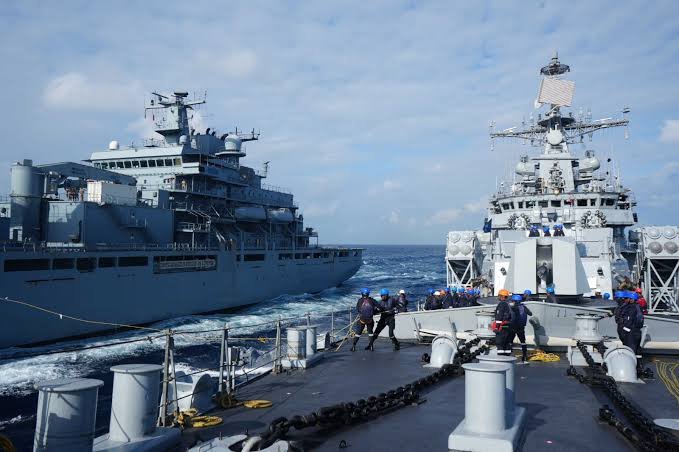
Germany is committed to expanding its presence in the Indo-Pacific as demonstrated through its Indo-Pacific Deployment 2024 (IPD-24). As a part of the IPD-24, Germany’s frigate, the Baden-Wuttermberg (pennant number F-222) and the replenishment tanker, the Frankfurt Am Main (pennant number A-1412) effected a port call at Mormugao in the Indian state of Goa.[29] From 21 to 23 October of 2024, these two German warships exercised with the Indian Navy’s guided-missile destroyer, INS Delhi in the Bay of Bengal. The exercise was designed to bolster maritime interoperability and incorporated cross-deck flying operations, underway replenishment, weapon firings, and tactical manoeuvres (see Figure 1).[30] The deployment, the port-call and the combined exercise were all intended to underscore Germany’s commitment to cooperation with like-minded countries in the Asian region.[31]
On 05 August 2024, a frontline frigate of the Indian Navy, INS Tabar, engaged in another maritime partnership exercise (MPX) with the German Navy, this time off the Kiel Canal. Participating units in this exercise, which showcased India’s expansive naval reach, included a German Naval “Sea Lynx” helicopter drawn from the 3rd Squadron Naval Air Wing (MFG5) and incorporated advanced maritime operations such as ship-controlled approaches, helicopter winching exercises, and vertical replenishment drills. In the run-up to this exercise, the Tabar had visited the Port of Hamburg (from 17 to 20 July 2024).

Fig 1: MPX between the Indian Navy and the German Navy
Source: PIB
The German Frigate Bayern was deployed to the Indo-Pacific from August 2021 to February 2022 (Figure 2 is relevant). The primary purpose of this deployment was to enhance the visibility of the German flag in waters far from Germany’s coast, underscoring the German Navy reliability as a political asset capable of operating globally. On 26 August 2021, the INS Trikand, which was deployed in the Gulf of Aden to counter illicit maritime activities, participated in an MPX with the Bayern. In the course of this exercise, the two warships conducted cross-deck helicopter landings, heliborne boarding operations, and replenishment at sea serials.[32]

Fig 2: FGS Bayern’s Deployment across the Indo-Pacific in 2021.
Source: Bundeswehr
IPD-24, encompassing a series of multinational naval exercises and international operations with a variety of partners, commenced in May of 2024 and concluded in December of that year. IPD-24 needs to be seen as a critical security deployment, especially given the ongoing Russia-Ukraine conflict in the western hemisphere, which has arguably compelled Berlin to reassess and re-prioritise its strategic approach. China’s support for Russia’s war efforts has driven the EU and its member-states to deepen their engagements in the creation of a security architecture in the Indo-Pacific that would complement their well-established transatlantic security agreement.[33]
Maritime Technology Collaboration
Germany and India have also collaborated in maritime technology, which includes shipbuilding — an hitherto neglected area but one upon which India is now focussing, and the collaborative construction of underwater systems and platforms (submarines). Included within this ambit are the submarines being inducted by the Indian Navy under “Project-75 India”, several shipbuilding contracts between Indian and German companies, and contracts for variable depth sonar systems.
Way-Ahead Recommendations
Although Germany released its “Guidelines for the Indo-Pacific” some four years ago (in 2021) actual progress in terms of both, bilateral and multilateral engagements, has been agonizingly slow. This doubly problematic since considerable scope exists for Germany to serve as a ‘catalyst’ between the EU and India, particularly on issues such as public international maritime law (PIML), capacity building, capability enhancement and energy security. Towards these ends, the following recommendations merit consideration by the Government:
- Given that the port of Hamburg and the Jawaharlal Nehru Port Authority (JNPA) are key ports for Germany and India respectively,[34] it is recommended that India’s Ministry of Ports, Shipping and Waterways (MoPSW) and Germany’s Federal Ministry of Transport and Digital Infrastructure enter into a Memorandum of Understanding (MoU) on maritime cooperation covering research and development in green shipping initiatives, shipbuilding, maintenance and recycling, ship repair facilities (commercial and defence ships), stimulation of cargo flows between the two nations, port planning and development, marine salvage and towing, maritime education and training and research.[35]
- In order to enable rapid and effective responses to maritime crises requiring humanitarian aid and disaster relief (HADR) operations, it is recommended that governments of India and Germany sign a Logistical Support Agreement (LSA). It would be noted that India already has LSAs with Australia, France, Singapore, South Korea and the United States of America.[36] Such an agreement with Germany would also enhance maritime situational awareness, thereby improving the degree of maritime domain awareness (MDA) attained, and this would, in turn, facilitate a greater number of combined maritime exercises/ operations in the IO.
- Like Germany, India, too, is heavily energy-reliant on the production and supply of energy through offshore drilling rigs, processing and control platforms and pipelines, including crude-oil pipelines, natural gas pipelines, etc.[37] With the seabed hosting several hundred undersea pipelines and cables — and given that over 90% of internet data traverses though subsea cables, it is recommended that India and Germany establish a working group on the protection of undersea critical infrastructure under the ambit of the “Indo-Pacific Oceans Initiative” (IPOI), concentrating upon the “Capacity Building and Resource Sharing” spoke of this deeply interconnected web of seven spokes. This group would focus on developing legal and physical protection measures to safeguard subsea infrastructure from both natural disruptions and those caused by malevolent human intervention.[38] While the Nord Stream Gas offshore natural gas pipelines, comprising Nord Stream 1 and Nord Stream 2, which run through the Baltic Sea between Russia and Germany, were damaged by undersea explosions in September of 2022 (Figure 3 is illustrative in this context), this is not the only instance of undersea infrastructure being wilfully damaged.[39] For a more complete update, the reader is referred to a number of research-articles published by the NMF over the past four years.[40]

Fig 3: Gas bubbles leaking to the surface of the Baltic Sea from the damage to Nord Stream 2
Source: Reuters
- “Track 1.5” and “Track 2” engagements are crucial to flesh-out the decisions of the working group mentioned in the foregoing recommendation. It is, therefore, strongly recommended that India and Germany jointly initiate a series of “Track 1.5” and “Track 2” workshops on the protection of undersea critical infrastructure, focusing upon legal, industry and defence perspectives.
- Maritime Situational Awareness (MSA), which is a sine qua non for MDA, is a common priority for both the EU and India. It is consequently recommended that Germany, much like France, appoint a German liaison officer to the Information Fusion Centre – Indian Ocean Region (IFC-IOR). This would be a logical development of Germany’s intention to second a Bundeswehr liaison officer to the IFC, Singapore.
Conclusion
While the EU’s “Strategy for Cooperation in the Indo-Pacific” relies heavily upon the contributions of France (a resident power) there is much that Germany, especially in partnership with India, can contribute to the EU’s strategic intent.
******
About the Author
Ms Saaz Lahiri is a Research Associate at the National Maritime Foundation (NMF). She holds a Bachelor’s degree in ‘History and International Relations’, and a Post Graduate Diploma in ‘International Relations’ from Ashoka University. Her research focuses upon the manner in which India’s maritime strategies interface and interact with those of the European Union (EU). She can be reached at eu4.nmf@gmail.com
Endnotes:
[1] Bundesregierung, “German Government Adopts Guidelines for the Indo-Pacific Region”, https://www.bundesregierung.de/breg-en/service/archive/indo-pacific-1781916
[2] Government of the Federal Republic of Germany, “Policy Guidelines for the Indo-Pacific – Germany-Europe-Asia”, 9 and 35, https://www.auswaertiges-amt.de/blob/2380514/f9784f7e3b3fa1bd7c5446d274a4169e/200901-indo-pazifik-leitlinien–1–data.pdf
[3] Ibid, 24
[4] Ibid, 13
[5] Ibid, 24
[6] Ibid, 15
[7] Ibid, 31, 35
[8] EEAS, “Enhancing Security Cooperation In and With Asia”, https://www.eeas.europa.eu/sites/default/files/factsheet_eu_asia_security_july_2019.pdf
[9] GIZ, “Enhancing Security Cooperation In and With Asia”, https://www.giz.de/en/worldwide/87412.html
[10] Op Cit: “Policy Guidelines for the Indo-Pacific – Germany-Europe-Asia”, 39
[11] EEAS, ‘The ESIWA Story’, https://www.eeas.europa.eu/sites/default/files/documents/2024/ESIWA%20factsheet_ipmf.pdf
[12] Government of the Federal Republic of Germany, “Focus on India”, https://www.auswaertiges-amt.de/blob/2680288/8909ac2c501ab85d55defff7d1b8b75d/241016-fokus-indien-data.pdf
[13] Ibid, 21
[14]Saaz Lahiri, “A Critical Analysis of the European Union’s Key Maritime Security Engagements in the Indian Ocean, NMF Website, 17 April 2024, https://maritimeindia.org/a-critical-analysis-of-the-european-unions-key-maritime-security-engagements-in-the-indian-ocean/
[15] CRIMARIO II, “German and Philippine Organisations and Entities Train Together for Safer Indo-Pacific Seas”, 16 September 2024, https://www.crimario.eu/german-and-philippine-organizations-and-entities-train-together-for-safer-indo-pacific-seas/
[16] Government of India, Ministry of Defence, “Indian Navy’s Ongoing Maritime Security Operations (Op SANKALP) 14 Dec 23 to 23 Mar 24”, Press Information Brief, 23 March 2024, https://pib.gov.in/PressReleaseIframePage.aspx?PRID=2016201
[17] European External Action Service (EEAS), “EUNAVFOR Operation ASPIDES”, 19 February 2024, https://www.eeas.europa.eu/eeas/eunavfor-operation-aspides_en
[18] Op Cit, “Focus on India”, 21
[19] Leonie Allard, , Cinzia Bianco, and Mathieu Droin, “With Operation ASPIDES, Europe is Charting its Own Course in and around the Red Sea”, Atlantic Council, 07 March 2024, https://www.atlanticcouncil.org/blogs/new-atlanticist/with-operation-aspides-europe-is-charting-its-own-course/
[20] Government of the Federal Republic of Germany, “Germany’s Anti-Piracy Engagement Continues”, International Cooperation, 29 April 2020 https://www.bundesregierung.de/breg-en/service/archive/atalanta-1749416
[21] Op Cit, “Policy Guidelines for the Indo-Pacific – Germany-Europe-Asia”, 35
[22] Naval News, “German Cabinet Extends Anti-Piracy Mission in Horn of Africa”, 30 April 2020, https://www.navalnews.com/naval-news/2020/04/german-cabinet-extends-anti-piracy-mission-in-horn-of-africa/
[23] Op Cit, “Focus on India”, 25
See also:
Government of India Ministry of External Affairs, “Joint Statement: 7th India-Germany Inter-Governmental Consultations (IGC)”, Point # 20, 25 October 2024, https://www.mea.gov.in/bilateral-documents.htm?dtl/38467/Joint+Statement+7th+IndiaGermany+InterGovernmental+Consultations+IGC#,
[24] Government of the Federal Republic of Germany, ‘Strategy on China’, https://www.auswaertiges-amt.de/blob/2608580/49d50fecc479304c3da2e2079c55e106/china-strategie-en-data.pdf , Pg 8
[25] Government of the Federal Republic of Germany, “Strategy on China”, https://www.auswaertiges-amt.de/blob/2608580/49d50fecc479304c3da2e2079c55e106/china-strategie-en-data.pdf
[26] Ibid, 20
[27] Government of the Federal Republic of Germany , ‘Strategy on China’, https://www.auswaertiges-amt.de/blob/2608580/49d50fecc479304c3da2e2079c55e106/china-strategie-en-data.pdf , Pg 25
[28] Government of the Federal Republic of Germany , ‘Strategy on China’, https://www.auswaertiges-amt.de/blob/2380514/f9784f7e3b3fa1bd7c5446d274a4169e/200901-indo-pazifik-leitlinien–1–data.pdf , Pg 16
[29] Goa Government, “Germany in the Indo-Pacific Region: Strengthening the Liberal Order and Regional Security- Rear Admiral Risch”, published on 26 October 2024, https://www.goa.gov.in/wp-content/uploads/2024/10/Germany-in-the-Indo.pdf
[30] Press Information Bureau, “Maritime Partnership Exercises (MPX) with German Navy (21 -23 Oct 24), Ministry of Defence, Published on 24 October 2024, https://pib.gov.in/PressReleaseIframePage.aspx?PRID=2067768#:~:text=Indian%20Navy’s%20Destroyer%20INS%20Delhi,weapon%20firing%20and%20tactical%20manoeuvres.
[31] Goa Government, “Germany in the Indo-Pacific Region: Strengthening the Liberal Order and Regional Security- Rear Admiral Risch”, published on 26 October 2024, https://www.goa.gov.in/wp-content/uploads/2024/10/Germany-in-the-Indo.pdf
[32] Government of India, Ministry of Defence, Press Release: “INS Trikand Undertakes Maritime Partnership Exercise with German Navy Ship”, Press Information Bureau, 28 August 2021, https://pib.gov.in/PressReleaseIframePage.aspx?PRID=1749945
[33] Christy Lee, “Warships in South China Sea Signal Germany’s Willingness to Counter China’s Threats”, VOA, 12 September 2024, https://www.voanews.com/a/warships-in-south-china-sea-signal-berlin-s-willingness-to-counter-beijing-s-threats-/7782259.html
[34] Rakin Rahman, “Hamburg Strengthens Ties with India”, Port Technology International, 23 February 2024, https://shipmin.gov.in/sites/default/files/MoU.pdf
[35] Government of India, Ministry of Shipping, “Memorandum of Understanding”, https://shipmin.gov.in/sites/default/files/1231842084MoUextNetherlands.pdf
[36] Rajeswari Pillai Rajagopalan, “India’s Military Outreach: Military Logistics Agreements”, The Diplomat, 09 September 2021, https://thediplomat.com/2021/09/indias-military-outreach-military-logistics-agreements/
[37] Vice Admiral Pradeep Chauhan, “Physical Protection of India’s Critical Maritime Infrastructure: Part 2: Maritime Energy Sector”, NMF Website, 06 December 2019, https://maritimeindia.org/physical-protection-of-indias-critical-maritime-infrastructure-part-2-maritime-energy-sector/
[38] Francois Very, Mark Blaine, Andrew de Wet, “Subsea Infrastructure Western Indian Ocean”, Freidrich Nauman Foundation, January 2024, 10, https://www.freiheit.org/sites/default/files/2024-03/subsea-infrastructure-western-indian-ocean.pdf
[39] Reuters, “Kremlin Says Germany is Right to Fully Investigate Nord Stream Pipelines Blasts”, 09 September 2024, https://www.reuters.com/world/europe/kremlin-says-germany-is-right-fully-investigate-nord-stream-pipeline-blasts-2024-09-09/
See also:
UN Security Council Report, “The Nord Stream Incident: Open Briefing”, 03 October 2024, https://www.securitycouncilreport.org/whatsinblue/2024/10/the-nord-stream-incident-open-briefing.php
[40] Vice Admiral Pradeep Chauhan, “Weaponisation of Trade: The Indian Ocean Dilemma”, NMF Website, 03 April 2025, https://maritimeindia.org/weaponization-of-trade-the-indian-ocean-dilemma/
See also:
- Soham Agarwal, “Underwater Domain Awareness for and by Submarine Communication Cables”, NMF Website, 03 March 2025, https://maritimeindia.org/underwater-domain-awareness-for-and-by-submarine-communication-cables/
- Soham Agarwal, “Enhancing Capacity-of and Capabilities-in Repair of Submarine Communication Cables through International Cooperation”, NMF Website, 14 May 2024, https://maritimeindia.org/enhancing-capacity-of-and-capabilities-in-repair-of-submarine-communication-cables-through-international-cooperation/
- Soham Agarwal, “Analysing the Layers of Submarine Communication Cables: Legal and Policy Measures Relevant to India” , NMF Website, 17 July 2023, https://maritimeindia.org/analysing-the-layers-of-submarine-communication-cables-legal-and-policy-measures-relevant-to-india/
- Soham Agarwal & Vice Admiral Pradeep Chauhan, “Underwater Communication Cables: Vulnerabilities and Protective Measures Relevant to India: Part-1 (07 April 2021) and Part-2 (08 April 2021)


Leave a Reply
Want to join the discussion?Feel free to contribute!