
Keywords: India-Malaysia; Comprehensive Strategic Partnership; Defence Industrial Cooperation; Defence Technology Partnership; Maritime Security; Indian Ocean Region; Indo-Pacific
Under the umbrella of the “India-Malaysia Comprehensive Strategic Partnership”, defence industry cooperation, along with research and development (R&D) collaboration, are fast emerging as key pillars of cooperation.[1] Bilateral defence ties, which date back to the colonial times, were formalised with the signing of the “Memorandum of Understanding (MoU) on Defence Cooperation” in 1993. With the exchange of the finalised “Terms of Reference” (ToR) for the establishment of the “Su-30 Forum” and the “Strategic Affairs Working Group” at the 13th meeting of the “Malaysia-India Defence Cooperation Committee” (MIDCOM) in 2025,[2] both countries have demonstrated serious intent towards operationalising defence industrial and technology cooperation. In recent years, India has sought to leverage its burgeoning defence industrial capacity to develop momentum towards achieving the goal of INR 50,000 crore in defence exports by 2029.[3] Towards achieving this target, India increasingly sees Southeast Asian countries such as Malaysia as promising markets to tap into. At the “India-Malaysia Mini Defence Expo cum Defence Industry Seminar” in February of 2024, India’s High Commissioner to Malaysia, Mr BN Reddy, announced that Malaysia had been chosen as the “regional hub in Southeast Asia” for defence industrial collaboration with Indian Defence Public Sector Undertakings (DPSUs).[4] In the near future, India is targeting the sale of Dornier (Do-228) aircraft, collaboration in mid-life upgrades and retrofitting of Scorpène Class submarines, upgradation and mid-life maintenance of the Royal Malaysian Air Force’s (RMAF) Su-30 MKM fleet, and the supply of naval platforms, to cement its position in the Malaysian defence market.[5] This article provides an overview of the Malaysian defence industry and recent policy developments, including the “Defence White Paper (2021-2030)” released in 2020, and the “National Defence Industry Policy (2026)”, to identify emerging opportunities and challenges for India in deepening defence industrial and technology cooperation with Malaysia. It argues that India’s defence industrial cooperation strategy needs to evolve from a predominantly export-led model to one based on co-development, co-production, and fostering a long-term industrial partnership. The article concludes by providing policy recommendations for India’s Ministry of Defence (MoD), Indian defence firms, and industry associations such as the “Society of Indian Defence Manufacturers” (SIDM) and the “Confederation of Indian Industry” (CII) for strengthening India-Malaysia bilateral defence industrial cooperation.
An Overview of Malaysia’s Defence Industrial Landscape
Malaysia’s domestic defence industry evolved gradually in the years following the country’s independence in 1957. Its defence industrial capacity remained miniscule and production was limited to ordnance, aerospace, and maritime sectors. During the 1980s, the government started privatising several government-owned companies involved in defence production, and this process was nearly completed by the early 1990s.[6] Since then, the industry has grown to domestically manufacture small arms and ammunition, defence electronics, and fast interceptor craft. Malaysia has also established successful joint ventures with foreign partners to manufacture armoured vehicles and offshore patrol vessels (OPVs), and also emerged as a regional MRO hub and key supplier of aerostructures and aerospace composites to global OEMs, including Boeing and Airbus.
To lend institutional support to the development of a domestic defence industrial base, the “Defence Industry Division” (DID) was established under the MINDEF in 1972, and the “Malaysia Defence Industry Council” (MDIC) — concentrating upon aerospace, maritime, automotive, weapons, ICT, and users — was set-up by the private industry in 1990.[7] Defence R&D was led by the “Defence Science and Technology Centre” (DSTC), which was set up in 1968 and later renamed the “Science, Technology, and Research Institute for Defence” (STRIDE) in 2001.[8] STRIDE’s defence R&D efforts have been supplemented by the “Centre for Defence Research and Technology” (CODRAT) at the National Defence University of Malaysia (Universiti Pertahanan Nasional Malaysia [UPNM]).
The key agencies directly involved in defence procurement are the MINDEF — its Tender Board, Procurement Division, and STRIDE, in particular — while the Ministry of Finance (MoF) and the Auditor General Department are in charge of external monitoring.[9] Procurement is facilitated by the centralised online procurement platform of the Malaysian government, the ePerolehan (https://www.eperolehan.gov.my). In recent years, officials from the MAF and Malaysian procurement agencies have faced allegations of corruption in several procurement programmes, including the Littoral Combat Ship (LCS) programme, Scorpène Class submarines, and OPVs for the Malaysian Maritime Enforcement Agency.[10] In January 2026, Prime Minister Anwar Ibrahim temporarily froze the procurement deals of the MAF and the Royal Malaysia Police (PDRM), [11] following an announcement by the Malaysian Anti-Corruption Commission (MACC) of an official probe into suspected corruption in defence procurement deals.[12] The freeze on the procurement fund was lifted in May 2026, after restructuring and anti-corruption measures were put in place.[13]
Malaysia’s domestic defence industry has developed the requisite capacity and capabilities to manufacture infantry fighting vehicles (IFVs), armoured personnel carriers (APCs), mine-resistant ambush-protected (MRAP) vehicles, light tactical and utility vehicles, armoured recovery vehicles, transport trucks, small arms, fast interceptor craft, assault boats, OPVs, auxiliary ships, and aerospace components manufacturing and machining. Table 1 provides the details of selected major defence firms in Malaysia.
| Ser | Defence Company | Domain | Key Platforms/Equipment
|
| 1. | DRB-HICOM Defence Technologies Sdn Bhd (DEFTECH)[14] | · Land vehicles manufacturing and MRO operations;
· UAVs; and · Advanced composites MRO (DEFTECH Aviation) |
· AV8 Gempita IFV/APC
· Lipan Bara MRAP · Cargo vehicles |
| 2. | Mildef International Technologies (Mildef) | · Land vehicles | · Tarantula High Mobility Armoured Vehicle (HMAV)[15] |
| 3. | Lumut Naval Shipyard (or LUNAS)[16]
(formerly Boustead Naval Shipyard) |
· Naval Shipbuilding
· MRO operations |
· Littoral Combat Ship (LCS) (Maharaja Lela-class)[17] (currently under construction) |
| 4. | Boustead Heavy Industries Corporation Berhad (BHIC)[18] and its subsidiaries | · MRO operations | · MRO (Submarines; Weapon and Combat Systems; and) Helicopters |
| 5. | Sapura Secured Technologies[19] and Velum Labs (cybersecurity arm of the firm) | · Defence Electronics and Communication Technologies | · Critical Communications
· Command and Control Systems · Tactical Network Systems · Simulation Systems · Surveillance Systems · Cybersecurity (Velum Labs’ V-Attack and V-Dark systems) |
| 6. | National Aerospace & Defence Industries Sdn Bhd (NADI) and its subsidiaries[20] | · Aerospace (SME Aerospace)
· MRO (AIROD, Aerospace Technology Systems Corp Sdn Bhd) · Arms and Ammunition (SME Ordnance) |
· Precision-engineered components and complex assemblies (SME Aerospace)
· Arms and Ammunition, weapons, engineering plastics (SME Ordnance) |
| 7. | Composites Technology Research Malaysia (CTRM)[21] | · Aerospace | · Aerostructures supplier to global OEMs (Airbus, Boeing, Embraer, etc.) |
| 8. | Weststar Defence Industries[22]
and its subsidiary Global Komited |
· Air defence systems
· MRO operations · Military vehicles (Global Komited) |
· Primary Malaysian contractor for Thales Air Defense Limited’s STARStreak VSHORAD (very short-range air defence) systems |
On the R&D front, STRIDE is currently developing Southeast Asia’s largest “Electromagnetic Compatibility (EMC) Chamber Facility” to test military vehicles and equipment, along with the region’s first “Tropical Testing Center” (TTC) as a centre of excellence (CoE).[23] Innovation by the Institute’s five divisions covers maritime technology, weapons technology, mechanical and aerospace technology, instrumentation and electronics technology, and protective and biophysical technology. The focus of its various clusters is limited to testing electronic equipment, weapons and munitions, vehicle mobility, and personnel performance. Malaysia has also utilised foreign partnerships for integrating advanced technology in the domestic defence industrial base. Some of the notable programmes undertaken by Malaysian firms in collaboration with foreign partners include the AV-8 Gempita IFV/APC programme (Malaysia’s DefTech and Turkey’s defence FNSS Defence Systems), the Littoral Combat Ship (LCS) programme (Malaysia’s Lumut Naval Shipyard and France’s Naval Group), and the STARStreak VSHORAD (Malaysia’s Weststar Defence Industries and France’s Thales Air Defense Limited).
Defence White Paper (DWP) (2020)
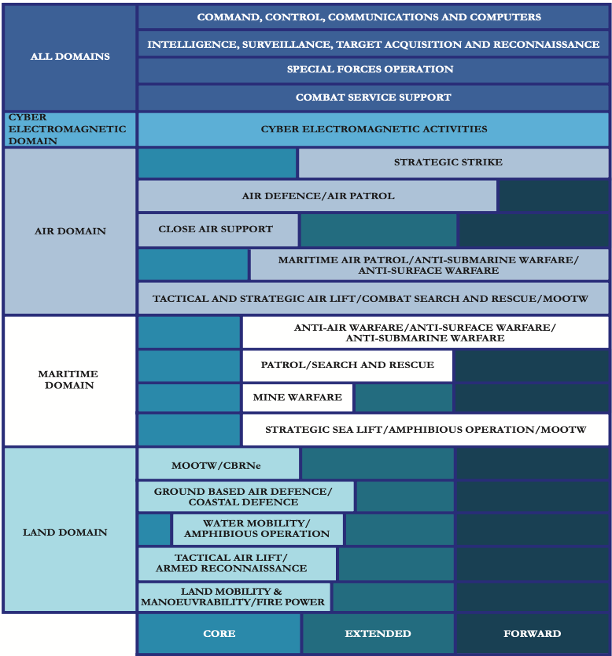
The “Defence White Paper (DWP) (2020)” describes Malaysia as “a maritime nation with continental roots, the bridging linchpin between two ocean regions [i.e., the Pacific and the Indian Oceans]”.[24] Owing to its geographical division between the territories of Peninsular Malaysia on the one hand and Sabah and Sarawak on the other, developments in the twin theatres — flanked by the Malacca Strait and the South China Sea, respectively — have immediate implications for the country’s security calculus. Towards implementing the defence strategy of “Concentric Deterrence”, the White Paper emphasises the development of a “Future Force” characterised by jointness, interoperability, technology adoption, the ability to operate simultaneously in two theatres, and mission-oriented deployment in critical waterways to protect Malaysian national interests.[25] The capacity requirements across the various domains of Malaysia’s “Future Force” are illustrated in Figure 1.
To achieve the “Future Force” transformation objectives, the Malaysian Armed Forces (MAF) seek to acquire a broad range of defence platforms and equipment, including Multi-Role Support Ships (MRSS) for amphibious operations; Littoral Mission Ships (LMS); Fast Interceptor Craft (FIC); Special Force Boats (SFBs); Autonomous Underwater Vehicles (AUVs); Mine Disposal Vehicles (MDVs); Maritime Patrol Aircraft (MPA) and Medium Altitude Long Endurance Unmanned Aerial System (MALE UAS); Maritime Mission Helicopters; coastal surveillance radars; Medium Range Air Defence (MERAD) system; 155 mm Self-Propelled Howitzers (SPH); Armoured Vehicles (AVs); Troop-Carrying Vehicles (TCVs); Tactical Transport Helicopters; and Light Combat Aircraft (LCA).[26] In addition, the Mid-term Review of the DWP 2020, which was undertaken in 2024, emphasised the centrality of cybersecurity, AI, smart sensors, and unmanned systems,[27] and these were reiterated in the recently released National Defence Strategic Plan 2026-2030 (PSPN).[28] The capacity requirements are further detailed in the service-level modernisation plans, namely, the Army for the Next Generation (Army 4NextG) Strategic Development Plan till 2050, the Royal Malaysian Navy’s (RMN) #15to5 Transformation Programme till 2050, and the Royal Malaysian Air Force’s (RMAF) Capability Development Plan 2055 (CAP55).[29]
National Defence Industry Policy (NDIP) (2026)
In January of 2026, the MINDEF released the “National Defence Industry Policy” (NDIP), which outlined several reforms to provide a fillip to the domestic defence industry. The policy emphasises AI-based innovation, and key priority areas for procurement and industrial collaboration include electronic warfare systems, high-impact technologies in the aerospace and maritime sectors, and autonomous systems.[30] The “Industrial Collaboration Programme” (ICP) mandates effective technology transfer and skill development of the local workforce by foreign contractors, particularly in the areas of cybersecurity, electronic warfare, C4ISR (Command, Control, Communications, Computers, Intelligence, Surveillance, and Reconnaissance) and UAV systems.[31] The ICP will be prioritised in the procurement process to promote strategic joint ventures with foreign partners, and its success will be monitored through a dedicated ICP monitoring system designed based on key performance indicators (KPIs).[32] To support this, a “Defence Industry Portal” (Portal Industri Pertahanan), launched along with the NDIP, integrates various stakeholders, including international OEMs, and facilitates the online submission of ICP project proposals, R&D collaboration, and effective technology transfer. [33]
Along with the launch of the NDIP, the MINDEF announced seven strategic projects, including (i) The National Defence Satellite Service project; (ii) Development of a laser-based air defence system (Directed Energy Weapon [DEW]); (iii) Development of a wheeled chassis platform for future land mobility assets; (iv) Development of assembly, repair, and manufacturing capabilities for weapon systems; (v) Development of electronic intelligence (ELINT) systems; (vi) Development of local kamikaze drones (loitering munition systems); and (vii) the development of flight simulators for the RMAF[34] In addition, the government has mandated a minimum of 30 per cent local content for all future defence procurements and stipulated that post-warranty maintenance, repair, and overhaul (MRO) work must be conducted locally.[35]
Opportunities for India in Key Sectors where Defence Industrial Cooperation can be Enhanced
Malaysia, akin to India, is increasingly focussed on becoming a “regional defence hub” and aims to achieve self-reliance, technological innovation, capability development in critical technologies, and integration with global defence supply chains while maintaining strategic autonomy. Consequently, even though the two countries have shared strategic objectives, Malaysia can no longer be regarded as merely a potential market for Indian defence exports but must rather be considered an emerging defence partner. India’s defence industrial collaboration strategy must, consequently, be primarily geared towards technology co-development and co-production in areas such as electronic warfare, autonomous systems, cybersecurity, artificial intelligence (AI) integration, predictive maintenance, and cutting-edge maritime and aerospace technologies. Illustrative (although not exhaustive) examples are:
(a) Naval Shipbuilding and Technologies. Malaysia’s Lumut Naval Shipyard Sdn
Bhd (LUNAS) has demonstrated expertise in ship design and shipbuilding on the LCS project, being undertaken in collaboration with France’s Naval Group.[36] However, the project has faced several delays and cost overruns as Malaysia tries to balance efficiency with developing indigenous shipbuilding capacity.[37] In this regard, there is an opportunity for leading Indian shipyards such as Mazagaon Dock Shipbuilders Limited (MDL), Cochin Shipyard Limited (CSL), and Garden Reach Shipbuilders & Engineers Limited (GRSE) to collaborate with LUNAS, Labuan Shipyard & Engineering Sdn Bhd, and other Malaysian shipyards to design and construct frigates, OPVs, and fast attack craft for the RMN as well as other Southeast Asian nations.
(b) Co-developing Unmanned and Autonomous Systems. For the development of loitering munitions, India’s Economic Explosives Limited (Solar Group) and Tata Advanced Systems Limited (TASL) — which have successfully supplied the ‘Nagastra-1’ and the ‘ALS-50’, respectively, to the Indian defence forces[38] — could consider collaborating with Malaysia’s DEFTECH, Pen UAS, and Aonic. Similarly, there is scope for collaboration between the Indian defence start-up HoverIt, which has developed the ‘Divyastra Mk 1’ — a fully autonomous loitering munition that has cleared initial trials by the Indian Army[39] — and Malaysian innovators to develop next-generation unmanned and autonomous systems. In the maritime sector, Malaysia’s OceanAlpha’s L25 marine unmanned surface vehicle (USV) recently cleared a public demonstration in advanced marine survey capacity,[40] and there is potential to collaborate with India’s Sagar Defence Engineering Pvt Ltd to develop USVs for defence applications.
(c) Aerospace Maintenance, Repair, and Overhaul (MRO) and Upgrades. With the finalisation of the Terms of Reference (ToR) for the Su-30 Forum and India’s offer of upgradation and mid-life maintenance of the Royal Malaysian Air Force’s (RMAF) Su-30 MKM fleet, MRO collaboration in the aerospace domain forms a central pillar of defence industrial cooperation between India and Malaysia. In this regard, it is noteworthy that India’s Samtel Avionics signed a “Strategic Collaboration and Exclusivity Agreement” with Malaysia’s Aerospace Technology Systems Corp Sdn Bhd (ATSC) to leverage the latter’s binding contract to provide MRO services for the RMAF to provide avionics systems, MRO and post-sales support for its Su-30MKM fleet.[41] In 2023, India’s Hindustan Aeronautics Limited (HAL) opened its first regional market office in Kuala Lumpur to cater to both Malaysia and the wider Southeast Asian region. Further, TASL, which is building a dedicated C-130J MRO facility in Bengaluru — the first depot-level hub outside the US and Europe — in partnership with Lockheed Martin,[42] could explore collaboration with Malaysia’s AIROD Sdn Bhd which provides MRO services for the C-130 fleets of the RMAF and several foreign air forces.[43]
(d) Defence Electronics, AI-integration, and Cybersecurity. There is potential for collaboration between the Defence Electronics Research Laboratory (DRDL) of India’s Defence Research and Development Organisation (DRDO) and Malaysia’s STRIDE on MINDEF’s strategic project to develop a passive ELINT system. The collaboration could further involve Indian defence-manufacturing firms such as Bharat Electronics Limited (BEL) and Data Patterns (India) Limited, and Malaysia’s Sapura Secured Technologies Sdn Bhd and Mindmatics Sdn Bhd, to jointly develop AI-integrated defence electronics, radars, and cybersecurity solutions.
(e) Missile and Air Defence Systems. Malaysia currently depends on imports of missiles and air defence systems and lacks the capacity and capability to design and manufacture them indigenously. India has pitched the Akash-1S and Akash Prime surface-to-air missile systems for Malaysia’s Medium Range Air Defence (MERAD) tender worth nearly USD 500 million, and is competing against prominent defence players from China, South Korea, Turkey, and several European nations[44] In this area, there is also potential for advancing R&D collaboration with STRIDE to develop Malaysia’s indigenous missile and air defence capabilities.
Challenges in Achieving Deeper Defence Industrial Cooperation with Malaysia
(a) Enhanced Local Content and Technology Transfer Requirements under the NDIP 2026. In the future, Indian defence firms would need to comply with the 30 per cent local content requirement under Malaysia’s NDIP. In the short-term, achieving integration with local Malaysian suppliers to replace existing components might prove to be challenging for smaller Indian defence firms trying to get a foothold in the Malaysian defence market. Further, to gain priority in the procurement process under the “Industrial Collaboration Programme” (ICP), Indian firms would be required to ensure effective transfer of technology, along with skill development of the local workforce, which will be closely tracked through the ICP monitoring system. This could give rise to several strategic and regulatory concerns regarding intellectual property rights (IPR), along with cost overruns, which would need to be addressed in the short- to medium-term.
(b) Market Competition with Established Foreign Defence and Domestic Players. Malaysia’s longstanding institutional partnerships and existing import dependence on established global defence firms from the United States (US), United Kingdom (UK), Europe, China, Russia, and South Korea, pose a challenge for Indian defence firms in securing tenders for major platforms. Many of these foreign firms have established local manufacturing facilities and partnerships with Malaysia’s domestic defence firms, allowing for easier compliance with the new requirements under the NDIP 2026. For instance, in 2023, HAL’s LCA Tejas Mk-1 lost to South Korea’s Korea Aerospace Industries’ (KAI) FA-50 in the competition to supply the RMAF with 18 Lead-in-Trainer-Light Combat Aircraft (FLIT-LCA), possibly owing to the latter’s advanced technology and the existing strong industrial relations between South Korea and Malaysia.[45] In addition, India faces increasing competition from emerging players such as Türkiye, which has provided Anka MALE UAVs to the MAF, is currently building three littoral mission ships to be equipped with the Atmaca surface-to-surface cruise missiles for the RMN, and concluded several partnerships with local Malaysian companies at the DSA 2026 to supply missiles, satellite communication and AI systems.[46] In addition, Malaysia’s domestic defence firms are also rapidly acquiring the technology and know-how to locally build major platforms, including armoured vehicles, UAVs, LCS, and OPVs.
(c) Tighter Scrutiny of Procurement Decisions following Recent Corruption Allegations. Future defence procurements in Malaysia are expected to face tighter scrutiny following recent corruption allegations. This is expected to lead to uncertainty and delays in procurement decisions, budgetary allocation, and bureaucratic hurdles. Consequently, smaller Indian defence firms would face challenges in long-term planning and in investing resources in the Malaysian domestic defence market that comply with the latest policy changes.
Policy Recommendations
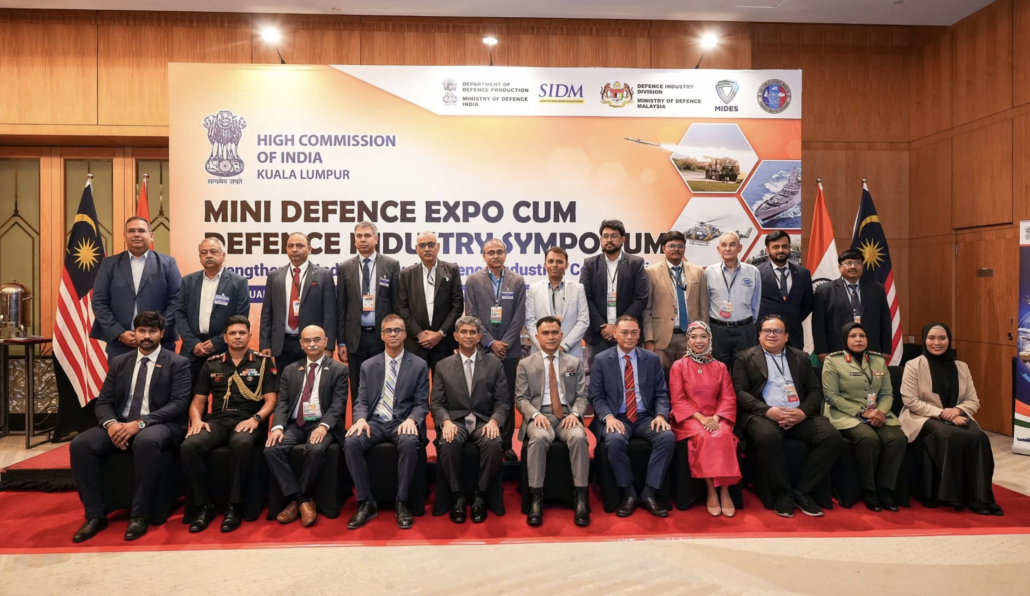
(a) Operationalise the Memorandum of Understanding (MoU) between the Society of Indian Defence Manufacturers (SIDM) and the Coalition of Defence Industry Malaysia (CDIM). In February 2026, the SIDM and the CDIM signed an MoU on the sidelines of the “Mini Defence Expo cum Defence Industry Symposium” organised by the High Commission of India in Kuala Lumpur.[47] As participation by smaller firms during defence exhibitions abroad is usually limited, the SIDM needs to operationalise the MoU to facilitate frequent in-person and virtual interactions between Indian MSMEs and start-ups and the 57 member firms of the CDIM. Further, the SIDM needs to proactively raise awareness and assist Indian firms in navigating the latest changes in Malaysia’s procurement process in light of the NDIP 2026.
(b) Indian Defence Firms Need to Transition from an Export-oriented Model to Nurturing Local Partnerships and Establishing Joint Ventures. While integrating supply chains might be a challenge in the short-term, Indian firms should aim to transition from an export-oriented model towards fostering partnerships, establishing joint ventures, technology transfer, and co-development with Malaysian defence firms to leverage their existing supplier linkages, meet the mandatory local content threshold, and secure ICP contracts to gain priority in the procurement process. Larger Indian defence firms should also consider investing in the development of testing infrastructure to support the key strategic initiative for developing defence infrastructure under the NDIP 2026.[48]
(c) Joint Training and Skill Development of Workforce. A consortium of leading Indian defence firms, led by BEL, could establish industrial training and skill development programmes in strategic areas such as AI, robotics, autonomous vehicles, and cybersecurity, in partnership with Sapura Secured Technologies, to support the strategic initiative to jointly develop a “Defence Industry-driven Talent Supply Programme” under Malaysia’s NDIP 2026. In the maritime sector, trilateral cooperation between MDL, LUNAS, and France’s Naval Group, could facilitate the exchange of best practices and MRO training in respect of Malaysia’s Scorpène Class submarines.
(d) Exchange Best Practices for Developing the Domestic Defence Industrial Base. In the NDIP 2026, Malaysia has identified India’s notable development of its domestic defence industrial base as a successful model to learn about setting benchmarks and adopting effective strategies to strengthen the local defence industry.[49] India could share its experience in increasing procurement from domestic sources, in the establishment of “Defence Industrial Corridors” (DICs) (such as those in Uttar Pradesh and Tamil Nadu), in accelerating innovation through the “Innovations for Defence Excellence” (iDEX) framework, and by facilitating indigenisation through the various Positive Indigenisation Lists and the SRIJAN portal.
Conclusion
As the focus of Malaysia’s defence industry shifts from maintenance to “high-value manufacturing and technological innovation”,[50] the Indian defence industry should transition from an export-led model to a co-development and co-production-based approach that would strengthen bilateral defence cooperation. India’s notable presence at the 2026 edition of the “Defence Services Asia” (DSA) exhibition held in Kuala Lumpur, with 25 defence firms participating, marked the largest Indian participation ever and made the India Pavilion the sixth largest by country at the DSA.[51] Interactions during major events such as these should be complemented by frequent bilateral in-person meetings and virtual exchanges, facilitated by the Ministries of Defence and External Affairs, along with established industry-bodies, to foster a long-term and deeper defence industrial partnership between India and Malaysia.
*******
About the Author
Ms Sushmita Sihwag is a Research Associate at the National Maritime Foundation. She holds a master’s degree in liberal studies from Ashoka University, Sonipat, Haryana. Her research focuses upon the manner in which India’s own maritime geostrategies are impacted by the maritime geostrategies of ASEAN and its member-States. She may be contacted at indopac6.nmf@gmail.com
Endnotes:
[1] Government of India, Ministry of External Affairs, “Joint Statement on India-Malaysia Comprehensive Strategic Partnership,” Ministry of External Affairs Media Center, 20 August 2024. https://www.mea.gov.in/bilateral-documents.htm?dtl/38187/Joint_Statement_on_India__Malaysia_Comprehensive_Strategic_Partnership
[2] Government of India, Ministry of Defence, “Defence Secretary co-chairs 13th Malaysia-India Defence Cooperation Committee Meeting in Kuala Lumpur,” Press Information Bureau Delhi, 19 February 2025. https://www.pib.gov.in/PressReleasePage.aspx?PRID=2104611®=3&lang=2
[3] Government of India, Press Information Bureau Headquarters, “Defence Atmanirbharta: Record Production and Exports,” Press Information Bureau Delhi, 20 November 2025. https://www.pib.gov.in/PressReleasePage.aspx?PRID=2191937®=3&lang=2
[4] “India-Malaysia Ties are on a Robust Trajectory — High Commissioner,” Bernama, 22 February 2024. https://bernama.com/en/news.php?id=2272684
[5] “Live: MEA Special Briefing by Secretary (East) P Kumaran on PM Modi’s Visit to Malaysia | Delhi, India,” YouTube video, 11:35, “ANI News,” 05 February 2026, https://www.youtube.com/watch?v=N7qlvWxuigg
[6] Kogila Balakrishnan, “Defence Industrialisation in Malaysia: Development Challenges and the Revolution in Military Affairs,” Security Challenges 4, No 4 (Summer 2008): 150, https://www.jstor.org/stable/26459817?seq=1
[7] Balakrishnan, “Defence Industrialisation in Malaysia,” 146.
[8] “STRIDE Chronology,” STRIDE Profile, STRIDE, accessed 10 June 2026, https://www.stride.gov.my/v1/en/stride-chronology/
[9] Chandran Jeshurun and Hanif Ismail, “Explanatory Background Note on the Role of Parliament in Defence Procurement in Malaysia,” 12-13 October 2008, Inter-Parliamentary Forum on Security Sector Governance (IPF-SSG) in Southeast Asia Regional Parliamentary Workshop, Phnom Penh, Cambodia, 2, https://www.dcaf.ch/sites/default/files/imce/APU/ExplanatoryBackgroundNoteMalaysia.pdf
Also see: Mohd Rafizu Muda, Norizan Sulong, Aini Suzana Ariffin, and Aref Charehzehi, “An Overview of Procurement Practice in the Ministry of Defence (MINDEF), Malaysia,” Journal of Science, Technology, and Innovation Policy 9, No 1 (September 2023): 47, 10.11113/jostip.v9n1.134.
[10] Sze Fung Ng, “Defence Procurement in Malaysia: A Way Forward?”, Fulcrum, 03 November 2022. https://fulcrum.sg/defence-procurement-in-malaysia-a-way-forward/
[11] “Malaysia Freezes Army and Police Procurement Decisions linked to Corruption,” Reuters, 16 January 2026. https://www.reuters.com/world/asia-pacific/malaysia-freezes-army-police-procurement-decisions-linked-corruption-pm-says-2026-01-16/
[12] Ben Golin, “Malaysia Launches Military Procurement Corruption Probe,” Jurist News, 30 December 2025. https://www.jurist.org/news/2025/12/malaysia-launches-military-procurement-corruption-probe/
[13] “Defence Ministry Lifts MAF Procurement Fund Freeze after Anti-leakage Measures,” Malay Mail, 12 May 2026. https://www.malaymail.com/news/malaysia/2026/05/12/defence-ministry-lifts-maf-procurement-fund-freeze-after-anti-leakage-measures/219674
[14] “Home,” DEFTECH, accessed 13 June 2026, https://deftech.com.my/products-services/
[15] Iylia Marsya Iskander and Fuad Nizam, “Mildef Committed to Local Production of Armoured Vehicle,” New Straits Times, 10 May 2024. https://www.nst.com.my/news/nation/2024/05/1048955/mildef-committed-local-production-armoured-vehicles.
[16] “Home,” LUNAS, accessed 13 June 2026, https://www.mylunas.com.my.
[17] “Malaysia’s Most Powerful Warship Finally Arrives: KD Maharaja Lela Set for December Delivery as South China Sea Tensions Escalate,” Defence Security Asia, 28 April 2026. https://defencesecurityasia.com/en/malaysia-kd-maharaja-lela-lcs-december-delivery-south-china-sea-rmn-warship/.
[18] “Home,” Boustead Heavy Industries Corporation Berhad, accessed 13 June 2026, https://www.bhic.com.my.
[19] “Home,” Sapura Secured Technologies, accessed 13 June 2026, https://www.sapuratech.com.my.
[20] “Subsidiaries & Partners,” National Aerospace & Defence Industries Sdn Bhd, accessed 13 June 2026, https://nadimalaysia.com.
[21] “Home,” CTRM, accessed 13 June 2026, https://ctrm.com.my.
[22] “Weststar Defence Industries,” Weststar, accessed 13 June 2026, https://www.weststar.com.my/twg/twg2/wdi.php.
[23] “Research & Development (R&D) at STRIDE,” Science & Technology Research Institute for Defence, accessed 13 June 2026, https://www.stride.gov.my/v1/en/research-development-rd-at-stride/.
[24] Government of Malaysia, Ministry of Defence (MINDEF), Defence White Paper, (Kuala Lumpur: MINDEF, 2020), 4, https://www.mod.gov.my/images/mindef/article/kertas_putih/KPP2.pdf.
[25] Ministry of Defence (MINDEF), Defence White Paper, 44-46.
[26] Ministry of Defence (MINDEF), Defence White Paper, 48-50.
[27] Kuik Cheng-Chwee, “Malaysia Reassesses Security: The Mid-Term Review of the Malaysian Defence White Paper, Perspective (ISEAS Yusof Ishak Institute), 11 February 2026, 3-6, https://www.iseas.edu.sg/wp-content/uploads/2026/01/ISEAS-Perspective_2026_11.pdf.
[28] Noel Achariam, Mindef Launches New Defence Strategy Amid Evolving Global Threats,” New Straits Times, 25 June 2026. https://www.nst.com.my/news/nation/2026/06/1472460/mindef-launches-new-defence-strategy-amid-evolving-global-threats.
[29] Kuik, “Malaysia Reassesses Security,” 7.
[30] Government of Malaysia, Ministry of Defence (MINDEF), National Defence Industry Policy (DIPN), (Kuala Lumpur: MINDEF, 2026), 17, https://myip.mod.gov.my/images/DIPN/NATIONAL_DEFENCE_INDUSTRY_POLICY.pdf
[31] Ministry of Defence (MINDEF), National Defence Industry Policy (DIPN), 30.
[32] Ministry of Defence (MINDEF), National Defence Industry Policy (DIPN), 30.
[33] “About the Defence Industry Portal,” Portal Industri Pertahanan, accessed 20 June 2026, https://myip.mod.gov.my/about.
[34] Government of the United States of America, Department of Commerce, International Trade Administration, “Malaysia Defence Industry,” 03 June 2026, https://www.trade.gov/market-intelligence/malaysia-defense-industry
[35] Fuad Nizam, “[Updated] Defence Procurements to Require 30 pc Local Content under New Policy,” New Straits Times, 21 January 2026, https://www.nst.com.my/news/nation/2026/01/1361188/updated-defence-procurements-require-30pc-local-content-under-new.
[36] “LUNAS Achieves Milestone: Completion of Detailed Design for the LCS Project,” LUNAS, 25 August 2024, https://www.mylunas.com.my/lunas-milestone-completion-of-detailed-design-for-lcs-project/
[37] Austin Camoens, “Lumut Naval Shipyard Showcases LCS3 Construction Progress,” 24 January 2026, https://www.nst.com.my/news/nation/2026/01/1363539/lumut-naval-shipyard-showcases-lcs-3-construction-progress
[38] PC Katoch, “Indigenous Loitering Munitions,” SP’s Land Forces, accessed 21 June 2026, https://www.spslandforces.com/story/?id=833&h=Indigenous-Loitering-Munitions
[39] “Major Make in India Boost: Army Tests Divyastra Mk-1 Built for Intelligence, Surveillance; What Can it Do?”, Times of India, 01 June 2026,
[40] “33 km Over-the-Horizon: OceanAlpha’s L25 USV Validates Long-Range Survey Capability in Malaysia,” OceanAlpha, 29 September 2025, https://www.oceanalpha.com/33km-over-the-horizon-oceanalphas-l25-usv-validates-long-range-survey-capability-in-malaysia/.
[41] “Samtel Avionics and ATSC Sign Strategic Collaboration and Exclusivity Agreement to Support RMAF Aircraft Avionics,” Samtel Avionics, 22 May 2025, https://samtelavionics.com/assets/newsroom/ATSC-India-Strategic.pdf.
[42] Jay Menon, “Tata and Lockheed Martin launch 1st C-130J Super Hercules MRO Hub in India,” Aerospace Global News, 09 December 2025, https://aerospaceglobalnews.com/news/tata-lockheed-martin-c130j-mro-hub-india/.
[43] “Our C-130 Customers,” AIROD, accessed 22 June 2026, https://airod.com.my/our-services-capabilities/c-130-customers/.
[44] “India Challenges China in Malaysia’s RM1.9 Billion Air Defence Battle with Akash-1S and Akash Prime Missile Systems,” Defence Security Asia, 07 May 2026, https://defencesecurityasia.com/en/india-challenges-china-malaysia-merad-akash-1s-akash-prime-air-defence-missile/.
[45] “Decoded: The Factors behind India’s LCA Tejas Loss in the Malaysian Fighter Jet Deal,” Indian Aerospace & Defence Bulletin, 03 April 2023, https://www.iadb.in/2023/04/03/decoded-the-factors-behind-indias-lca-tejas-loss-in-the-malaysian-fighter-jet-deal/.
[46] Agnes Helou, “Turkish Firms Boost Defence Ties with Malaysia in Missiles, Comms, and AI,” Breaking Defense, 22 April 2026, https://breakingdefense.com/2026/04/turkish-firms-boost-defense-ties-with-malaysia-in-missiles-comms-and-ai/.
[47] “SIDM-CDIM MoU Exchange Advances Malaysia-India Defence Industry Cooperation,” Coalition of Defence Industry Malaysia, 19 February 2026, https://www.mycdi.my/post/sidm-cdim-mou-exchange-advances-malaysia-india-defence-industry-cooperation.
[48] Ministry of Defence (MINDEF), National Defence Industry Policy (DIPN), 31.
[49] Ministry of Defence (MINDEF), National Defence Industry Policy (DIPN), 17.
[50] Ministry of Defence (MINDEF), National Defence Industry Policy (DIPN), 4.
[51] Government of India, Ministry of External Affairs, High Commission of India (Kuala Lumpur), Instagram Post, 20 April 2026, https://www.instagram.com/p/DXYjFdOCZTz/


Leave a Reply
Want to join the discussion?Feel free to contribute!