
India’s approach to “Constructive Engagement” in the maritime domain presently rests on five distinct, yet complementary, lines-of-thrust. The first is through multilateral constructs, which provide broad-based platforms for regional cooperation. The second is the Indo-Pacific Oceans Initiative (IPOI), India’s principal framework for promoting practical collaboration across the Indo-Pacific. The third comprises minilateral and trilateral arrangements, which bring together like-minded partners to address specific regional challenges. The Colombo Security Conclave (CSC) is situated within this category as a focused sub-regional security mechanism. The fourth approach is the Quadrilateral Security Dialogue (Quad), which advances cooperation among four major Indo-Pacific democracies across a range of functional domains. The fifth is maritime connectivity, which seeks to strengthen physical, digital, cultural, economic, and institutional linkages across the Indo-Pacific.[1]
For any regional security architecture to endure, it must operate across three mutually reinforcing layers: the conceptual layer, the political layer, and the executive layer. The “conceptual layer” provides the vision. In India’s case, this is articulated through India’s maritime policy, which is encapsulated in the acronym MAHASAGAR (Mutual and Holistic Advancement for Security and Growth Across Regions), and the first-order specificity that is provided to this policy by the Indo-Pacific Oceans Initiative (IPOI). The “political layer” translates this vision into diplomatic and institutional arrangements through multilateral, minilateral, and bilateral partnerships. The “executive layer”, however, is where strategy is operationalised through institutions, procedures, interoperability, and sustained cooperation among participating States.
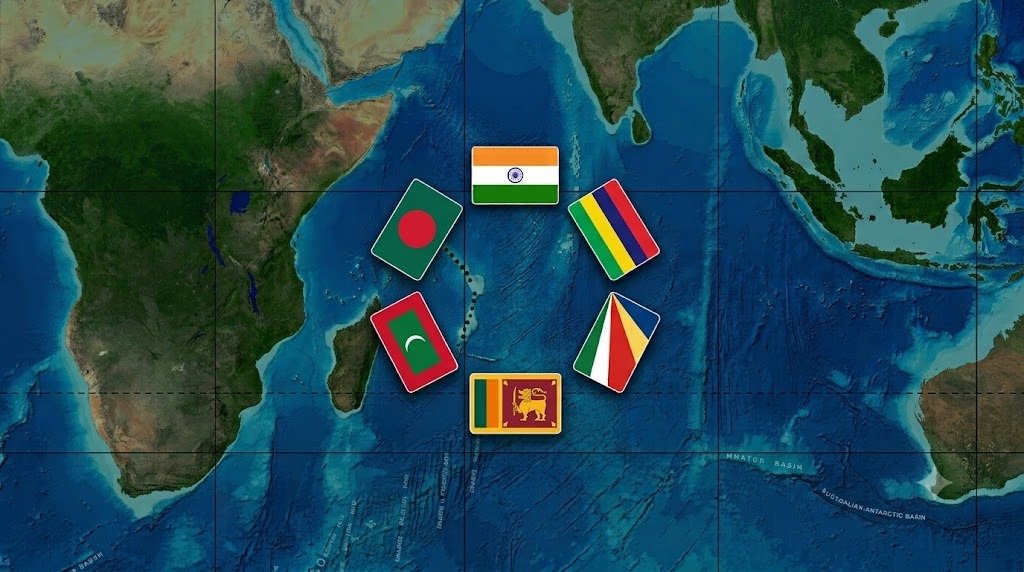
It is within this executive dimension that the CSC assumes particular significance. The CSC has evolved from a revived trilateral dialogue between India, Sri Lanka, and the Maldives, into a six-member minilateral with an adopted charter and, more recently, recognition as an international organisation.[2] The accession of Seychelles as a full member, during the seventh meeting (in New Delhi) of national security advisers, alongside Malaysia’s participation as a “guest State”, reflects the CSC’s expanding regional profile and growing institutional maturity.[3] However, all this notwithstanding, institutional expansion should not be mistaken for institutional consolidation.
Despite these developments, the CSC remains fundamentally a coordination mechanism. Cooperation is driven through periodic meetings of national security advisers and deputy national security advisers, supported by a permanent secretariat and pillar-based cooperation. As such, the CSC lacks the institutional attributes that characterise a mature regional security organisation, namely, dedicated financing, standing multinational capabilities, legally binding commitments, and permanent implementation mechanisms. The gap between the CSC’s growing political profile and its limited operational capacity forms the central concern of this paper.
This is not a critique of the CSC’s potential, but of the assumptions surrounding its evolution. Current discourse tends to oscillate between two extremes: one views the CSC as an already mature regional security architecture, while the other dismisses it as little more than a consultative forum. Both perspectives overlook the more important question of institutional design. The issue is not whether the CSC is a security organisation or a dialogue mechanism, but what degree of institutionalisation is necessary for it to deliver sustained and measurable outcomes while remaining politically acceptable to its member States.
This paper argues that the CSC has reached a critical stage in its evolution. The political framework has largely been established; the next phase must focus on operationalisation. If India intends the CSC to become the principal mechanism for maritime security cooperation in its immediate neighbourhood, it must move beyond just cooperation and invest in permanent institutional structures, interoperable capabilities, stable financing arrangements, and a stronger legal and policy framework.
The Institutional Evolution and Instruments of the Colombo Security Conclave
The CSC traces its origins to the Trilateral Maritime Security Cooperation mechanism established in 2011 by India, Sri Lanka, and the Maldives at the National Security Adviser (NSA) level.[4] The initiative lost momentum after 2014, following the deterioration in India-Maldives relations under President Abdulla Yameen, before being revived in November 2020 under its present name.[5] Since then, the CSC has progressively expanded, with Mauritius joining as a full member in 2022, Bangladesh in 2024,[6] and Seychelles in 2025.[7] While this expansion reflects growing regional acceptance of the CSC, fluctuations in participation by Maldives and Bangladesh, shaped largely by domestic political transitions, also demonstrate the vulnerability of arrangements that depend principally on executive-level political commitment rather than institutional mechanisms.
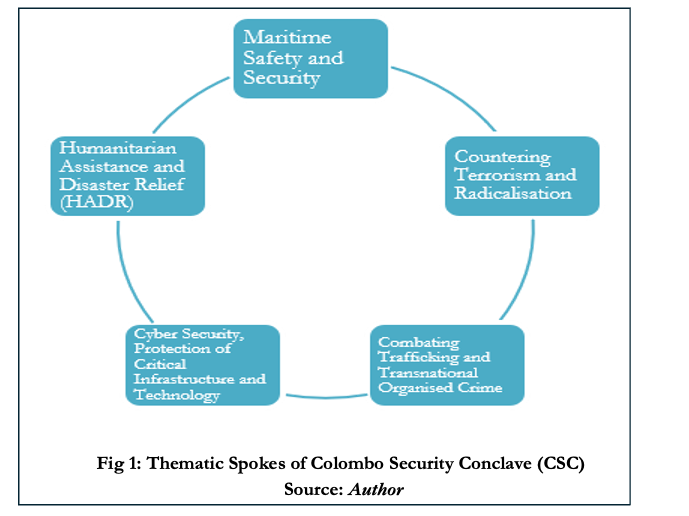
The CSC today rests on four principal institutional pillars. At the apex is the NSA-level meeting, held on a rotational basis, which provides strategic direction and reviews progress across the organisation’s agenda.[8] Supporting this, is a more frequent layer of deputy NSA-level meetings, conducted both physically and virtually, which oversee implementation and maintain momentum between NSA summits. A third milestone in the CSC’s evolution was the signing of the CSC charter and the memorandum of understanding (MoU) establishing the secretariat in Colombo in 2024,[9] providing the conclave with its first permanent institutional structure. The fourth component is its functional architecture, organised around five thematic spokes: Maritime Safety and Security; Counter-Terrorism and Radicalisation; Combating Trafficking and Transnational Organised Crime; Cyber Security and Protection of Critical Infrastructure; and Humanitarian Assistance and Disaster Relief (HADR).[10] These spokes provide the framework for cooperation, capacity-building initiatives, information exchange, and periodic joint exercises.
 Equally telling is what the CSC does not yet possess. Despite its growing institutional profile, it remains primarily a coordination mechanism rather than a standing regional security organisation. It has no dedicated funding mechanism, no permanent multinational operational capabilities, no collective command-and-control arrangements, and no independent analytical or information-sharing infrastructure. Existing capabilities continue to be provided largely by member States. For instance, the Indian National Centre for Ocean Information Services (INCOIS) supports the CSC through a dedicated ocean information portal, operational ocean forecasting, and scientific cooperation, but these remain Indian national assets made available to the conclave rather than collectively owned institutional capabilities.[11] Consequently, the CSC continues to rely on national capacities instead of possessing instruments of its own.
These institutional gaps should not be interpreted as evidence of weakness. Rather, they indicate the next phase of the CSC’s evolution. The Conclave has already established the political legitimacy and institutional framework necessary for regional cooperation. The imperative now is to strengthen its operational foundations through financing arrangements, permanent implementation mechanisms, shared capabilities, and greater interoperability among member States.
In this analysis, it is also worth being precise about what India’s “gains” from the CSC should mean, since the expression can easily be misconstrued to imply institutional dominance. The analysis does not seek to measure the CSC by how much diplomatic credit it can generate for New Delhi, nor by how effectively it signals its resolve to Beijing. It entails assessing the CSC by whether it gives India — and the five members — a more reliable, lower-cost (whether in terms of time, financial resources, and political capital) way of handling shared maritime issues than each State managing them bilaterally or alone. From India’s perspective, the CSC’s relevance will ultimately depend on the extent to which these institutional developments translate into practical cooperation and measurable security outcomes.
The CSC’s importance for India can be understood through three interrelated considerations:
- It encompasses India’s immediate and proximate maritime neighbourhood. The CSC brings together the island and littoral States located closest to India’s maritime borders, making it the only sub-regional security framework concentrated on India’s maritime periphery. The security and political stability of this region are therefore foundational to India’s maritime security. Instability in these waters would increase vulnerabilities to piracy, maritime terrorism, illegal, unreported and unregulated (IUU) fishing, trafficking, organised crime, and other transnational threats, while simultaneously creating opportunities for extra-regional powers to expand their strategic presence in ways that could constrain India’s operational freedom and political influence. Conversely, sustained cooperation through the CSC strengthens trust among neighbouring States, improves interoperability between maritime agencies, enhances maritime domain/situational awareness, and enables faster responses to humanitarian crises and other non-traditional security challenges. Securing this maritime space, is, therefore, not simply a defensive imperative, it is the prerequisite for India to emerge as a credible preferred security partner and to advance its broader vision for the Indo-Pacific.
- The CSC provides India with an opportunity to shape the rules and practices of sub-regional maritime governance. Unlike broader multilateral forums, where outcomes are often constrained by diverse memberships and competing priorities, the CSC brings together a small group of geographically proximate States with shared maritime interests. This enables its members to develop common approaches to specific issues. For India, this is more than a platform for cooperation, it is an opportunity to exercise institutional leadership by shaping regional norms, standard operating procedures, capacity-building and capability-enhancement priorities, and operational practices through consensus rather than coercion. In doing so, the CSC allows India to move from being a participant in regional governance to becoming one of its principal architects.
- The CSC can provide institutional resilience against fluctuations in bilateral political relations. Relations among neighbouring States are often influenced by domestic political change, electoral transitions, and shifts in foreign policy. Such developments can temporarily disrupt bilateral cooperation, particularly in the security domain. The experience of India-Maldives relations following President Mohamed Muizzu’s election in 2023 illustrates this dynamic. Although the Maldives did not participate in the 2023 NSA-level meeting in Mauritius,[12] it remained within the CSC framework and subsequently joined the signing of the Charter and the MoU, establishing the Secretariat in 2024. The episode demonstrates that institutionalised mechanisms can preserve channels of engagement even during periods of political friction, allowing cooperation to resume without rebuilding relationships from the ground up. As the CSC becomes more deeply institutionalised, its value will increasingly lie not only in facilitating cooperation during periods of political convergence, but also in sustaining it when bilateral relations become strained.
The Constraints and Comparative Advantage of Mini-lateral Cooperation
The CSC was not created to bring together a new set of regional actors. Rather, it created a new security function for a group of States that already cooperate through broader regional institutions. India, Sri Lanka, the Maldives, Mauritius, Bangladesh, and Seychelles are all members of both the Indian Ocean Rim Association (IORA) and the Indian Ocean Naval Symposium (IONS). The overlap narrows further in The Bay of Bengal Initiative for Multi-Sectoral Technical and Economic Cooperation (BIMSTEC), which includes India, Sri Lanka, and Bangladesh but excludes the island States on geographical grounds.[13] A similar overlap exists with the Information Fusion Centre-Indian Ocean Region (IFC-IOR), whose liaison officer network includes all CSC member states, but whose mandate covers enhanced maritime domain awareness through information-sharing. The CSC, therefore, occupies the same strategic space as these organisations in terms of membership, albeit not in terms of purpose. Its distinctiveness lies in the type of cooperation it seeks to facilitate rather than just the countries it brings together.
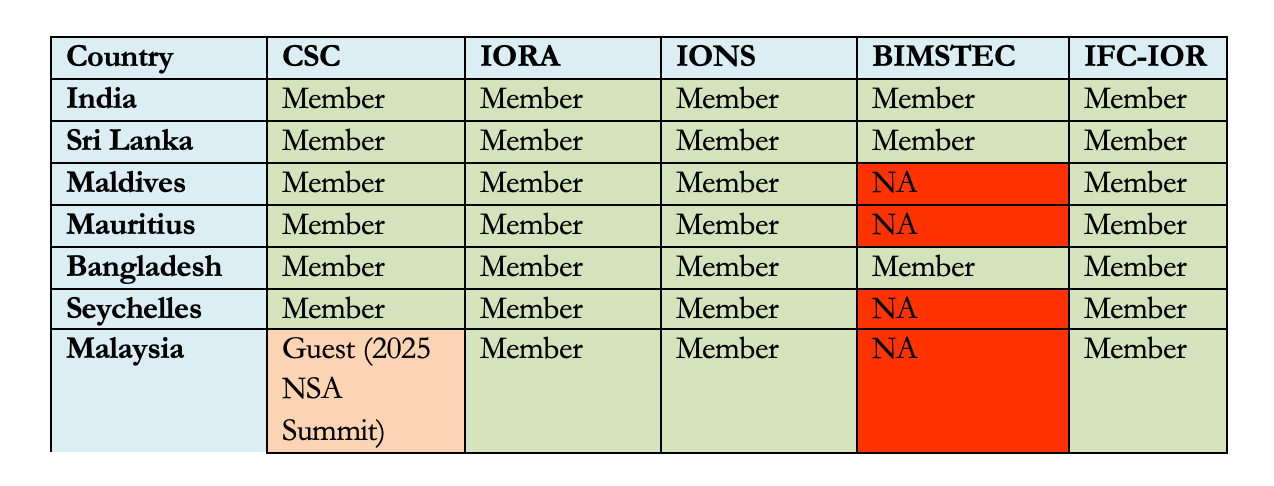
Table 1.1: Membership Status of CSC Members Across Multilateral Forums in the IOR
Source: Collated by the Author
A similar pattern emerges when comparing institutional mandates. Maritime safety and security and Humanitarian Assistance and Disaster Relief (HADR) feature across all four groupings, although with different levels of emphasis. IORA addresses these issues within a broader economic and developmental agenda, while IONS focuses primarily on cooperation and interoperability amongst the principal seagoing agencies responsible for maritime security. BIMSTEC incorporates maritime security alongside connectivity and economic integration in the Bay of Bengal. The CSC, however, is the only regional framework that combines maritime security, counter terrorism, trafficking and transnational organised crime, cyber security, and HADR under a single mechanism. Conversely, areas such as the blue economy, trade, and environmental cooperation, which dominate IORA and BIMSTEC, occupy only a limited place within the CSC.
This comparison suggests a functional division of labour rather than institutional duplication. IORA remains the principal platform for economic cooperation and the blue economy; IONS focuses on maritime-security cooperation; BIMSTEC prioritises regional connectivity and economic integration within the Bay of Bengal; and the CSC occupies the niche of sub-regional hard security cooperation. Rather than duplicating existing institutions, the CSC fills a gap by integrating traditional and non-traditional security issues within a compact, geographically contiguous grouping.
Yet, the CSC operates within constraints that affect regional institutions across the Indian Ocean. The first is consensus-based decision-making, which often limits the ability of regional organisations to move beyond declarations towards implementation. The second is capacity asymmetry. Smaller States frequently lack the institutional and financial capacity to engage simultaneously across multiple regional organisations, stretching limited diplomatic and administrative resources.[14] The third is mandate overlap. Maritime security and HADR are recurring themes across IORA, IONS, BIMSTEC, and the CSC, yet there is no shared perception of what maritime security constitutes, nor is there any allocation of responsibilities, creating duplication rather than complementarity.[15] The fourth constraint arises from great-power sensitivities. Broad-based organisations such as IORA include members with diverse strategic alignments, making consensus on hard-security issues difficult and encouraging a preference for less contentious economic and developmental agendas.
These constraints also explain why the CSC has evolved differently from larger regional organisations. Its relatively small membership, geographical coherence, and direct participation of NSAs allow for quicker political decision-making, closer policy coordination, and greater operational focus than is possible in broader consensus-driven forums. At the same time, this agility depends heavily on Indian diplomatic leadership, financial support, technical assistance, training, and capacity-building. For the foreseeable future, India’s role will remain indispensable in sustaining the conclave’s institutional momentum.
This dependence, however, should not be mistaken for institutional weakness. The CSC’s limited membership is arguably its greatest comparative advantage. It brings together States that share a common maritime geography, face similar security challenges, and possess strong incentives for sustained cooperation. More importantly, it remains the only regional mechanism that integrates maritime security, terrorism, trafficking, cyber security, and HADR under a single institutional framework with a common membership and decision-making structure. In that sense, the CSC functions as the inner security ring of India’s maritime architecture, complementing rather than competing with India’s presence in broader regional institutions.
Where the CSC Falls Short
Despite its steady institutional evolution, the CSC continues to face several structural limitations that constrain its effectiveness as a regional security architecture. Two challenges are particularly significant:
- Institutional Financing and Financial Governance. As the CSC transitions from a consultative security dialogue into a more institutionalised regional security architecture, the question of sustainable financing will become central to its future. Unlike purely deliberative forums, the CSC will have to eventually operationalise initiatives such as information-sharing, coordinated maritime security mechanisms, cyber cooperation, capacity-building programmes, all of which require sustained financial support. The challenge, however, is not merely to secure more resources but to create a financing architecture capable of supporting these ambitions without compromising the CSC’s strategic cohesion. Expanding membership simply to broaden the contributor base is unlikely to offer a durable solution. A larger membership risks slowing consensus-building, increasing institutional complexity, introducing strategic divergences, and potentially inviting free-riding, while doing little to address the underlying asymmetry in members’ financial capacities. Given the significant economic disparities among existing members, India will inevitably remain the principal contributor irrespective of membership expansion. Experiences from other regional organisations reinforce this lesson. ASEAN finances its secretariat through equal member contributions while relying on differentiated, externally administered funds for major projects;[16] BIMSTEC follows an assessed contribution formula but continues to suffer from an underfunded secretariat;[17] IORA depends largely on voluntary member and dialogue partner contributions through its special fund;[18] and the Pacific Islands Forum’s Pacific Resilience Facility combines member-led governance with substantial external donor capital.[19] Collectively, these models demonstrate that neither rigid equal-contribution formulas nor indefinite reliance on a select external benefactors produce resilient institutions. India needs to advocate a three-tier financing architecture comprising: (i) an assessed contribution mechanism for financing the Secretariat’s core administrative functions; (ii) a dedicated CSC capability and resilience fund, supported by differentiated member contributions and project-based co-financing from like-minded partners, and (iii) continued bilateral capacity-building and technical assistance, with a defined proportion coordinated and reported through CSC mechanisms to strengthen institutional ownership, transparency, and the visibility of collective regional initiatives. Finally, the CSC’s institutional maturity ultimately depends upon predictable financial governance.
- The Absence of Enabling Legal and Operational Frameworks. India needs to spearhead the development of supplementary protocols that transform broad political commitments into operational arrangements. Given that member States have consistently identified information-sharing as a core area of cooperation, the CSC should adopt a binding information-sharing protocol establishing common standards for intelligence classification, data handling, cybersecurity, confidentiality, dissemination procedures, and liability arising from the use of shared information. Without such agreed rules, intelligence cooperation remains dependent on bilateral understandings. As cooperation will increasingly encompass training, capacity-building and capability enhancement, India must advocate a draft CSC framework agreement on operational cooperation. The framework should harmonise legal procedures governing the temporary deployment of personnel, movement of mission equipment and relief supplies, customs and immigration clearances, jurisdictional responsibilities, liability, logistical support, and administrative arrangements, training programmes, HADR operations, and other cooperative activities. Standardising these procedures would reduce administrative delays while preserving the CSC’s non-alliance and member-driven character. The CSC secretariat’s role in presenting periodic reviews of progress should be formalised through a monitoring, reporting and implementation protocol. Taken together, these instruments would progressively transform the CSC into an institution capable of delivering accountable and operational cooperation.
Policy Recommendations
In order for India to more constructively engage with the CSC and enable it to realise its outcomes, the following recommendations are submitted:
- Launch a CSC Website and Establish Social Media Presence. At present, the CSC lacks an official website and dedicated social media presence, limiting public awareness, institutional transparency, and the visibility of its activities. Information on the Conclave remains fragmented across national government websites and press releases, making it difficult for researchers, media, and external partners to access authoritative information on the conclave. This has also resulted in misinformation about the conclave’s initiatives being floated across domains. India should encourage the secretariat to develop and maintain an official CSC website as the organisation’s primary digital platform. Complementing the website, the CSC should establish verified accounts on professional social media platforms such as LinkedIn and X to communicate institutional developments, highlight cooperative activities, disseminate key announcements, and engage with the wider strategic community.
- Leverage the IFC-IOR Liaison Officer Network for CSC Information-Sharing. Rather than establishing a separate maritime information-sharing mechanism, the Colombo Security Conclave (CSC) should institutionalise the use of the existing liaison officer network at the IFC-IOR as its primary conduit for maritime situational awareness and operational information exchange.
- Adopt the three-tier financing structure within a fixed timeline. The CSC must negotiate an assessed-contribution formula for secretariat running costs by the next NSA meeting, set up a dedicated capacity building and capability enhancement fund with defined contribution tiers, and create a registry that logs bilateral capacity-building so that it is accounted by the CSC rather than remaining untracked bilateral aid.
- Adopt Supplementary Legal and Operational Protocols. India should lead negotiations on protocols on information-sharing, operational cooperation, monitoring and evaluation, legal liability, and HADR coordination. These instruments would translate political commitments into operational procedures.
- Mandate Deconfliction and Lead-Nation Allocation. The CSC should require each member-State to submit a ranked statement of priorities across the five thematic spokes, rather than treating all five as equally weighted for all members. This would clarify where priorities genuinely converge versus where they are nominal. Building on this, the Secretariat should convene a working-level exercise to build a shared threat assessment — even a non-binding, periodically updated document — so that ‘maritime security’ stops being defined differently by each member and instead has a common baseline upon which members can build. Finally, for each of the five pillars, the CSC must designate a lead State responsible for convening working groups, tracking implementation, and reporting to the secretariat. This directly addresses the overlap/duplication problem and prevents the CSC from being a forum where every member nominally owns everything and therefore owns nothing.
- Institutionalise CSC–Regional Organisation Coordination. Establish structured engagement between the CSC and organisations such as IORA, IONS and BIMSTEC to ensure complementarity, reduce duplication and redundancy, and align activities in overlapping areas such as maritime safety, HADR, and capacity building.
- Prioritise Institutional Depth over Width. While broader participation can enhance diplomatic outreach, premature expansion risks diluting the very characteristics that distinguish the CSC from larger regional organisations. Its principal strengths lie in its limited membership, geographical proximity, shared maritime challenges, and the high degree of political trust among its members. India should, therefore, advocate a strategy of institutional deepening before geographical widening. Rather than expanding the membership base, the Conclave should continue to engage interested partners through observer status, guest participation, or pillar-specific cooperation, thereby preserving flexibility.
Conclusion
The CSC has established the political foundations of a credible sub-regional security mechanism. Its future relevance, however, will depend on institutional consolidation rather than expansion. By strengthening its financing, legal frameworks, operational capabilities, and governance, India can help transform the CSC into the cornerstone of maritime security cooperation in its immediate neighbourhood.
*******
About the Author
Ms Junyali Gusain is a Research Associate at the National Maritime Foundation. She was awarded her BA (Hons) in Political Science with a minor in History from Maitreyi College, University of Delhi; and holds a Master’s degree in “Diplomacy, Law and Business”, with a specialisation in “Economics and Foreign Policy”, from OP Jindal Global University, Sonipat, Haryana. Her current research focuses upon the manner in which India’s own strategies in the Bay of Bengal and the Indo-Pacific are impacted by collectives such as BIMSTEC and IORA. She can be reached at irms5.nmf@gmail.com.
Endnotes:
[1] VAdm Pradeep Chauhan, “Overview of India’s Maritime Geopolitics (Part 3)”, (PowerPoint Presentation, National Maritime Foundation, New Delhi, 25 Feb 2026).
[2] Rushali Shaha, “The Colombo Security Conclave Upgrade Is Timely. But Is It Enough?”, The Diplomat, 27 April 2026, https://thediplomat.com/2026/04/the-colombo-security-conclave-upgrade-is-timely-but-is-it-enough/.
[3] Government of India (GoI), Ministry of External Affairs (MEA), Press Release, “07th NSA-Level Meeting of the Colombo Security Conclave (November 20, 2025)”, Ministry of External Affairs, 20 November 2025, https://www.mea.gov.in/press-releases?dtl/40314/7th_NSALevel_Meeting_of_the_Colombo_Security_Conclave_November_20_2025.
[4] Sayantan Haldar and Aditya Gowdara Shivamurthy, “Expansion of Colombo Security Conclave: A step closer to maritime South Asia”, Observer Research Foundation, 27 July 2024, https://www.orfonline.org/expert-speak/expansion-of-colombo-security-conclave-a-step-closer-to-maritime-south-asia.
[5] Rajeswari Pillai Rajagopalan, “Why the India-Sri Lanka-Maldives NSA-level Talks Matter”, The Diplomat, 04 December 2020 https://thediplomat.com/2020/12/why-the-india-sri-lanka-maldives-nsa-level-talks-matter/.
[6] “Colombo Security Conclave: Bangladesh welcomed as 05th member”, The Business Standard, 11 July 2024, https://www.tbsnews.net/bangladesh/colombo-security-conclave-bangladesh-welcomed-5th-member-896751.
[7] GoI, MEA, Press Release, “07th NSA-Level Meeting of the Colombo Security Conclave (November 20, 2025)”, Ministry of External Affairs, 20 November 2025.
[8] “Ajit Doval to Host Counterparts for Colombo Security Conclave NSA Meet”, ANI News, 19 November 2025,
https://www.aninews.in/news/world/asia/ajit-doval-to-host-counterparts-for-colombo-security-conclave-nsa-meet20251119175332/.
[9] Government of India (GoI), Ministry of External Affairs (MEA), Press Release, “Joint Press Statement on Colombo Security Conclave”, Ministry of External Affairs, 30 August 2024, https://www.mea.gov.in/press-releases?dtl/38242/Joint+Press+Statement+on+Colombo+Security+Conclave.
[10] Government of India (GoI), Ministry of External Affairs, Press Release, “Joint Press Statement on Colombo Security Conclave”, Ministry of External Affairs, 30 August 2024, https://www.mea.gov.in/press-releases?dtl/38242/Joint+Press+Statement+on+Colombo+Security+Conclave.
[11] Government of India, Ministry of Earth Sciences, “INCOIS contributes to the Colombo Security Conclave (CSC)”, Ocean Information Portal for countries of Colombo Security Conclave, https://incois.gov.in/oceanservices/cscocean.jsp.
[12] Keshav Padmanabhan, “At Security Meet, India, SL & Mauritius Deepen Cooperation on Maritime Safety & Countering Terrorism”, The Print, 08 December 2023, https://theprint.in/diplomacy/at-security-meet-india-sl-mauritius-deepen-cooperation-on-maritime-safety-countering-terrorism/1877203/.
[13] “Member States”, The Bay of Bengal Initiative for Multi-Sectoral Technical and Economic Cooperation (BIMSTEC), https://bimstec.org/member-states/.
[14] Capt Ranendra S Sawan, “Problems and Prospects of Maritime Security Cooperation in the Indian Ocean Region: A Case Study of the Indian Ocean Naval Symposium, Part-I”, National Maritime Foundation website, 23 June 2022, https://maritimeindia.org/problems-and-prospects-of-maritime-security-cooperation-in-the-indian-ocean-region-a-case-study-of-the-indian-ocean-naval-symposium-ions-part-i/.
[15] Capt Ranendra S Sawan, “Problems and Prospects of Maritime Security Cooperation in the Indian Ocean Region: A Case Study of the Indian Ocean Naval Symposium, Part-I”, National Maritime Foundation, 23 June 2022, https://maritimeindia.org/problems-and-prospects-of-maritime-security-cooperation-in-the-indian-ocean-region-a-case-study-of-the-indian-ocean-naval-symposium-ions-part-i/.
[16] Association of Southeast Asian Nations (ASEAN), “Funding Mechanisms and Modalities”, The ASEAN Secretariat, https://asean.org/funding-mechanisms-and-modalities/.
[17] The BIMSTEC Charter, “Preamble”, BIMSTEC, https://www.mea.gov.in/Portal/LegalTreatiesDoc/022M3847.pdf.
[18] “The IORA Special Fund”, IORA, https://www.iora.int/iora-special-fund.
[19] Pacific Resilience Facility, “Prospectus: Pacific Resilience Facility”, PRF, https://forumsec.org/sites/default/files/2024-09/Annex%20A%20-%20PRF%20Prospectus.pdf.


Leave a Reply
Want to join the discussion?Feel free to contribute!