
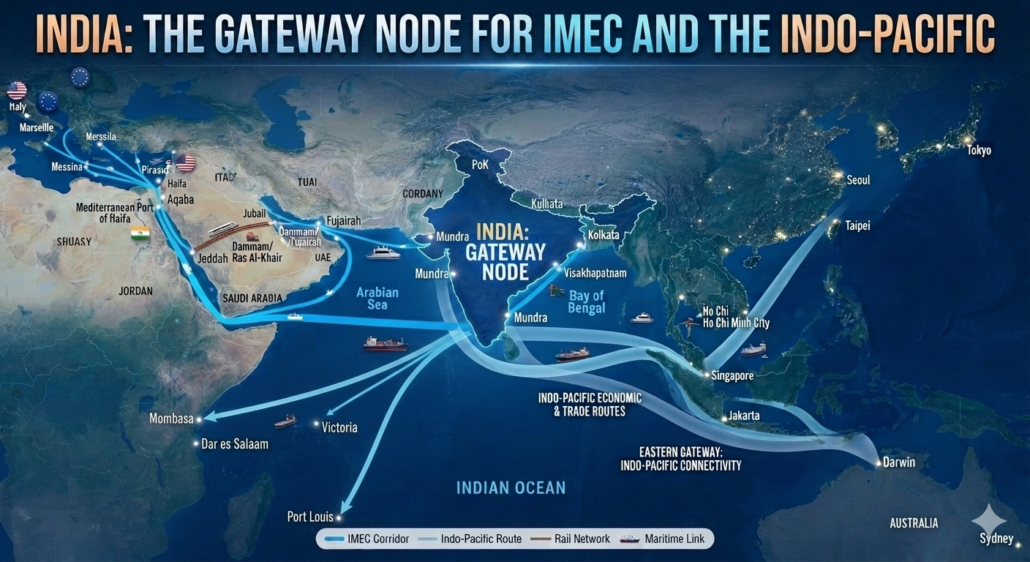
In September 2023, at the G20 Summit in New Delhi, eight parties signed a Memorandum of Understanding for the India-Middle East-Europe Economic Corridor (IMEC), a multimodal connectivity framework linking India to Europe through the Gulf. The geopolitical logic was sound. The corridor offered an alternative to China’s Belt and Road Initiative, a physical embodiment of normalisation across a historically fractious region, and a demonstration that the international community could build, not merely contest, the future of Eurasian connectivity.
The military conflict with Iran in 2026 shattered the geopolitical landscape within which that vision had been conceived. The effective closure of the Strait of Hormuz produced an unprecedented global energy security crisis. Oil and gas production in the Gulf collapsed, supply chains were disrupted, food and fertiliser vulnerabilities intensified, and the economic consequences travelled far beyond the states directly involved in the conflict.
India neither initiated nor took sides in this conflict. The consequences for India were nevertheless severe and immediate.
What the crisis demonstrated, with the empirical force of lived consequence, is that IMEC is not merely desirable but strategically necessary. The corridor was not built fast enough.
IMEC Was Never Merely a Logistics Project
IMEC is persistently misread as a faster and cheaper route for cargo between Asia and Europe. This framing is not wrong, but it fundamentally undersells the corridor’s architecture.
IMEC was not designed merely to move goods. It was designed to move the structural incentives of an entire region.
Its deeper logic rests on economic interdependence. Indian manufacturing generates sustained commercial demand. Gulf states become industrial partners and investors rather than mere transit points. Economic integration progressively raises the cost of instability for those most capable of causing or permitting disruption. A functioning corridor, meanwhile, physically reduces exposure to some of the world’s most weaponisable maritime chokepoints.
Economic interdependence does not eliminate conflict. History offers no such guarantee. The more defensible proposition is that integration raises the structural cost of disruption and changes strategic calculations at the margin over time.
The events of 2026 demonstrated what the prolonged absence of sufficient resilience and integration can produce.
The Crisis Exposed the Architecture That Was Missing
The closure of the Strait of Hormuz transformed theoretical vulnerability into lived economic consequence within days.
The crisis demonstrated that existing infrastructure possessed neither sufficient redundancy nor a viable alternative logistics architecture capable of sustaining critical economic flows during prolonged disruption. Pipeline bypass capacity remained inadequate. Infrastructure outside Hormuz was itself vulnerable. Renewed threats to Red Sea shipping placed simultaneous pressure on the Suez route.
No redundancy existed at the required scale. No resilience had been built.
For Gulf states, the implications were existential. A region heavily dependent upon imported food discovered the vulnerability of supply systems concentrated around a maritime chokepoint. Disruption to fertiliser flows and attacks on desalination and associated infrastructure demonstrated how quickly an energy crisis could acquire food-security and humanitarian dimensions.
IMEC, therefore, is not an obligation Gulf states discharge in favour of India or Europe. It is an infrastructure requirement for the Gulf’s own food security, supply-chain resilience, and long-term economic transformation.
IMEC is as much Gulf insurance as it is Indian opportunity.
For India, the crisis carried an equally direct lesson. India’s dependence upon imported crude oil, LPG, Gulf-linked energy inputs for fertiliser production, and remittance flows from millions of Indians working in Gulf states meant that an external conflict translated almost immediately into domestic developmental consequences.
Cooking gas shortages, fertiliser disruptions, threats to agricultural production, repatriation and remittance pressures, and the wider macroeconomic consequences of the crisis were not produced by failures of Indian domestic policy. They arose from structural exposure to chokepoints over which India exercises no sovereign control.
This is why IMEC is not, for India, a geostrategic amenity.
It is a development imperative of the first order.
The Original Vision Must Now Be Expanded
The 2026 crisis proved the necessity of IMEC. It did not, however, resolve the geopolitical fractures obstructing its construction.
The Saudi-UAE rivalry lies directly across the corridor’s geographic centre. The northern segment requires diplomatic conditions that do not presently exist. Saudi Arabia’s strategic relationship with Pakistan introduces complexity into India’s security calculus. Turkey is developing competing connectivity and influence architectures. The India-United States relationship itself requires greater strategic candour if the investment logic underlying IMEC is to operate at its full potential.
A viable corridor cannot be built by refusing to name these fractures.
At the same time, the corridor should no longer be understood simply as a route carrying Indian goods westward to Europe.
IMEC can and should become the connective spine of a multi-directional, multi-regional geoeconomic architecture linking the European Atlantic economy, the Gulf’s energy and capital economy, India’s manufacturing and services economy, and the Indo-Pacific’s consumer and production economy.
European industrial products can flow east. Gulf petrochemicals, fertiliser feedstocks, and industrial inputs can support Indian manufacturing. Indian finished goods can move westward. The corridor’s digital pillar can support data infrastructure and AI-enabled logistics across regions.
Both sides are producers. Both sides are consumers. Both sides acquire a direct stake in the corridor’s efficiency and continuity.
Most importantly, India must not be conceived as IMEC’s eastern terminus. India is the corridor’s Indo-Pacific gateway.
India’s location at the apex of the Indian Ocean places its ports at the convergence of the Gulf-Europe maritime axis and the South and Southeast Asian maritime arc. Vizhinjam, India’s coastal shipping network under Sagarmala, and the future transshipment infrastructure at Galathea Bay provide the emerging physical foundations of this gateway function.
In this conception, IMEC is not a corridor connecting two endpoints. It is the western segment of a Eurasian-Indo-Pacific connectivity arc, with India as the pivotal node.
Resilience Requires More Than One Gulf Gateway
The conflict also exposed the concentration risk inherent in a corridor dependent upon a single Gulf entry architecture.
The expanded IMEC should formally recognise three complementary entry nodes.
The UAE, through Jebel Ali and Fujairah, should remain the primary commercial gateway for high-value and time-sensitive cargo.
Oman, through Salalah, Duqm, and Sohar, should serve as the Hormuz-independent resilience pathway. Its open-ocean access and relative political insulation give it a unique place within the corridor’s strategic architecture. Oman should be formalised as a full IMEC participant and integral corridor node.
Saudi Arabia, through Jubail and Jeddah and its emerging rail infrastructure, should provide the direct Arabian Peninsula entry and transit architecture central to the corridor’s continental spine.
A three-node architecture would create what the original design lacked: the ability to reroute.
The central design principle must be straightforward. No single point closure should be capable of paralysing the corridor.
The Human Stakes Cannot Be a Footnote
India’s developmental trajectory gives this debate an urgency that conventional geostrategic analysis sometimes fails to capture.
Hundreds of millions of Indians have moved out of poverty over the past two decades. The households that escaped poverty most recently often possess the thinnest buffers against external shocks.
A cooking gas shortage that forces a family back to biomass burning is not merely a supply-chain inconvenience. A fertiliser shock affecting crop yields is not merely an input-cost problem for a subsistence farmer. The loss of a monthly remittance from a Gulf-based worker is not simply a change in a macroeconomic dataset for the family dependent upon that income.
These are developmental reversals.
The consequences of chokepoint vulnerability reach directly into Indian households, agricultural systems, employment, public welfare, and the country’s broader growth trajectory.
Every year the corridor is delayed is another year of unnecessary and avoidable exposure.
From Strategic Intent to Operational Reality
A viable IMEC now requires institutional architecture equal to the scale of its ambition.
Manufacturing commitments must become bankable and timebound. A dedicated IMEC Manufacturing Investment Facility should connect Indian industrial capacity, Gulf capital, and European technology in sectors capable of generating the cargo volumes upon which the corridor’s commercial logic ultimately depends.
Corridor governance requires a Gulf coordination mechanism for cross-border transit, customs harmonisation, and infrastructure investment. Oman must be formalised as an integral node. The northern segment should be formally phased rather than allowed to delay infrastructure that can be built immediately.
A permanent IMEC Secretariat is equally necessary. A strategic project spanning multiple governments, jurisdictions, ports, rail networks, industrial ecosystems, and regulatory regimes cannot remain dependent upon intermittent political attention.
India, however, must apply the same analytical standard to itself.
The existence of IMEC will not automatically produce manufacturing investment. Investors compare locations, not narratives. They ask whether land can be acquired within predictable timelines, whether goods can move without a logistics premium, whether the regulatory environment is certain, and whether India offers a genuine comparative advantage for the manufacturing that the corridor is designed to carry.
The challenge is increasingly one of execution.
Physical connectivity must be matched by institutional and digital interoperability. Customs systems, documentation, cargo tracking, port integration, investment facilitation, and manufacturing policy must evolve alongside railways and maritime infrastructure.
The success of IMEC will ultimately be measured not by kilometres of railway constructed, but by the industrial activity, investment, trade, and structural economic integration generated across the corridor.
The Obligation of the Moment
The India-Middle East-Europe Economic Corridor was announced in a moment of diplomatic optimism.
It must be built in a period of strategic urgency.
The conditions are different, and they demand a different approach: more honest about obstacles, more phased in construction, more ambitious in vision, and more disciplined in acting upon the lessons the 2026 crisis has delivered at substantial human and economic cost.
The corridor must be multi-directional. It must possess a resilient three-node Gulf entry architecture with Oman as an integral designed component. It must be institutionally grounded, anchored by manufacturing and investment commitments, and designed from the outset to serve as the connective spine of a Eurasian-Indo-Pacific geoeconomic architecture with India as its pivotal gateway node.
The corridor creates an opportunity. It does not guarantee an outcome.
For India, the obligation is straightforward: to match the scale of its strategic ambition with an equivalent commitment to execution.
The corridor was not built fast enough before the fire. The obligation now is to build it right.
This article presents an abridged overview of the arguments developed in the author’s full monograph, “IMEC After the Fire: From Connectivity Corridor to Indo-Pacific Resilience Architecture.” The complete monograph examines the structural lessons of the 2026 conflict, the geopolitical fractures confronting IMEC, India’s propositions for a viable corridor, the domestic manufacturing and investment agenda, and a detailed three-horizon implementation framework.
Read the full monograph in the NMF Monographs section: CLICK HERE


Leave a Reply
Want to join the discussion?Feel free to contribute!