
Keywords:
Maritime History, Indian Ocean Trade, Cowrie Currency, Maritime Heritage, Ancient Indian Knowledge Systems, Maritime Consciousness, Indian Maritime Civilisation, Economic History
The maritime history of India has traditionally been narrated through the study of ports, merchant guilds, navigational traditions, and overseas trade. However, an equally revealing indicator of maritime connectivity lies in an object so small that it is frequently overlooked by historians: the cowrie shell. Known across the Indian subcontinent as kodi, kaudi, kadi, or kapardaka,[1] the cowrie functioned as an accepted medium of exchange across large parts of India for centuries.
The diversity of its regional names reflects not merely linguistic variation but the widespread assimilation of a marine object into the economic vocabulary of Indian society. Unlike metallic coinage produced through minting authorities, cowries originated within the marine ecology of the Indian Ocean. India occupied the geographical and commercial centre of this transformation. Located between the natural habitat of Cypraea Moneta (depicted in Figure 1) and the expanding markets of eastern India and Southeast Asia, the subcontinent became the principal intermediary through which cowries acquired monetary value and circulated across the Indian Ocean world.[2]
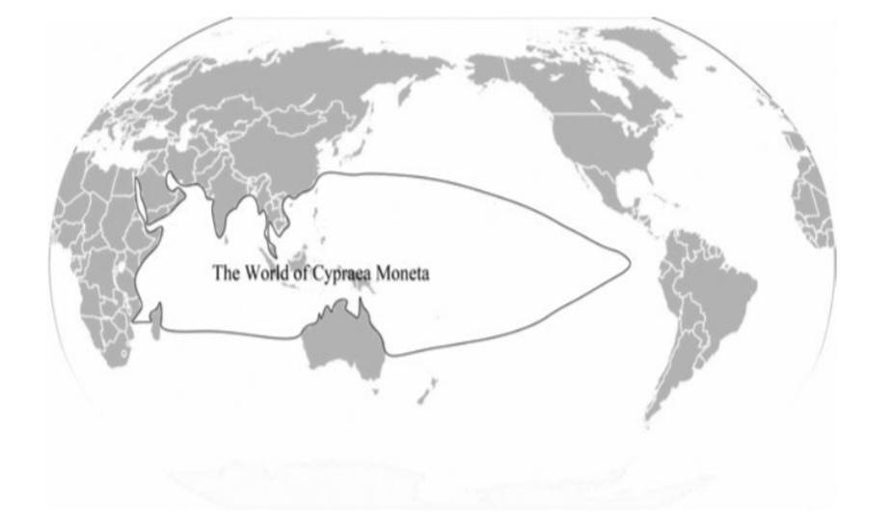
Fig 1: The World of Cyprae Moneta
Source: Bin Yang, Cowrie Shells and Cowrie Money: A Global History (Abingdon: Routledge, 2019), 45.
The history of shell currency, therefore, reveals a sophisticated maritime consciousness — an inherent knowledge a people possess and demonstrate of a history rooted in the sea and of a future inextricably linked with it[3] — which recognised the strategic importance of marine resources and integrated them into complex systems of trade, taxation, diplomacy, and everyday economic life.
The Money Cowrie: Properties and Habitat
Among more than two hundred species of cowries, Cypraea Moneta, commonly known as the “money cowrie”, became the most widely circulated shell currency in history. It possesses a smooth porcelain-like surface, a naturally polished appearance, an oval body, and a narrow slit lined with fine teeth. These characteristics gave the shell a remarkable degree of standardisation rarely found in natural objects. Unlike most metals, it neither rusted nor deteriorated, while its distinctive form made counterfeiting extremely difficult.[4] Its compact size facilitated transport in enormous quantities, and its aesthetic appeal ensured acceptance across societies with diverse cultural traditions. Beauty, durability, uniformity, portability, and scarcity together transformed an ordinary marine shell into an extraordinary monetary instrument.[5]
The natural habitat of “money cowries” extends primarily through subtropical and tropical oceans between 30° N and 30° S of the equator.[6] Coral reefs and shallow lagoons provide ideal ecological conditions, making island environments particularly suitable for their survival. No region was more important than the Maldives, whose coral atolls supplied vast quantities of Cypraea Moneta for more than a thousand years.[7] Even today, the historical significance of the shell is reflected in Maldivian cultural identity. The official emblem of the Maldives Monetary Authority (MMA), for instance, incorporates the cowrie as an enduring symbol of the country’s maritime and monetary heritage.
Harvesting and Processing in the Maldives
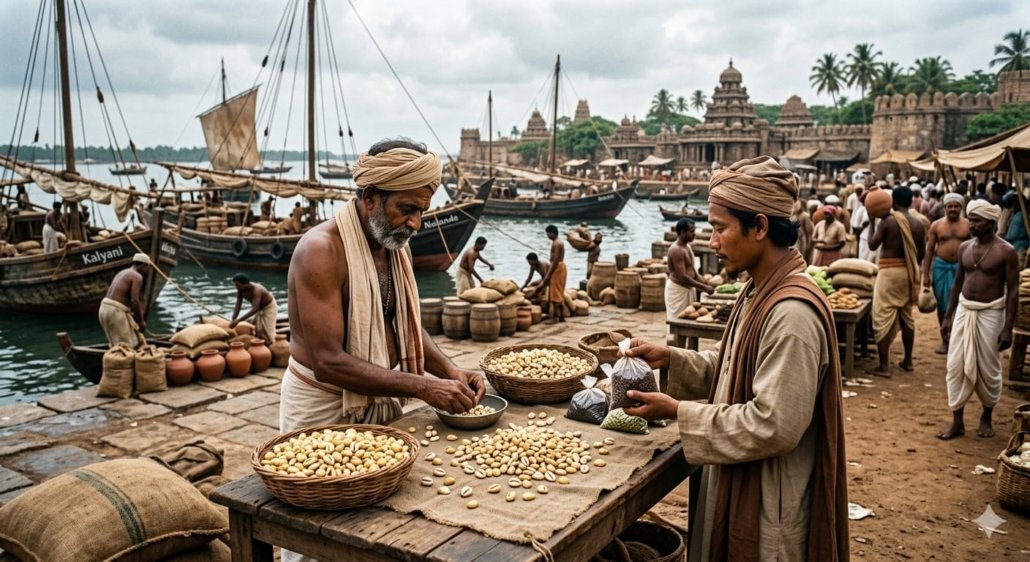
The collection of cowries in the Maldives was itself an expression of specialised ecological knowledge. Historical accounts described how coconut leaves and palm branches were submerged in shallow lagoons, attracting shells that attached themselves to the vegetation. The Arab traveller Suleiman, writing in the ninth century, described this process and recorded that the cowrie was called Al Kabtadj in Arabic.[8]
The collectors of the cowries preferred harvesting the shells twice a month, three days preceding and the three days following the full moon, when tidal conditions and lunar cycles facilitated greater accumulation.[9] Once gathered, the shells were spread under the sun until the animal decomposed naturally, leaving behind the empty shell. They were subsequently washed, cleaned, sorted according to quality, and packed into sacks or coconut leaves for export aboard merchant vessels navigating the Indian Ocean.[10] This process transformed a living marine organism into one of the earliest standardised commodities capable of functioning as money.
Cowries in Eastern India
From the Maldives, cowries entered Indian commercial networks. The most significant destination was eastern India, particularly Bengal (which largely spread across Bengal Region in India and Bangladesh), Odisha (where the ancient kingdom of Kalinga was located), Ahom (present-day Assam) in northeast India, and contemporary Bihar in northern India.[11] It is difficult to trace when “cowrie money” emerged in Bengal but by the middle of the first millennium CE, a large area of Bengal had adopted “cowrie money” together with locally issued coinage to form a dual monetary use. In India, metal coinage had probably been local money earlier than the cowrie shell.[12] As local markets expanded and commercial activity intensified, however, metal coinage proved unable to meet popular demand, and cowrie shells consequently came to serve as a supplementary form of currency.
Historically, Bengal represented a much larger geo-cultural entity than the present political state, encompassing extensive deltaic regions connected by the Ganga-Brahmaputra river system. These waterways created one of the world’s most vibrant commercial landscapes, requiring an abundant supply of low-denomination currency suitable for local markets, agricultural exchange, taxation, and wages.[13] Cowries fulfilled this need with remarkable efficiency and eventually became inseparable from the economic life of eastern India.
According to Robert Lindsay (1754-1836), a Scottish East India Company official who served as collector of the frontier district of Sylhet in Bengal from 1778-1790, the cowrie was “well known in every part of Bengal, and used in the purchase of the smaller articles of life by the lower ranks of society, and they answer all the purposes of commerce.”[14]
There is an old Bengali proverb: Phelo kari macho tel (lay down your cowries and take what you want).[15] This saying illustrates the important role of cowries used as money in India.
During the initial phase of British Rule in India, Warren Hastings (1732-1818), the first Governor of the Presidency of Fort William (Bengal), paid to translate the “Gentoo Code” — a legal code translated from Sanskrit into Persian by Brahmin scholars and then translated from Persian into English. The “Gentoo Code” contains dozens of entries for the term “cowrie”.[16]
In 1755, to manage the large stock of cowries in Calcutta, the East India Company hired a local bania called Kali Charan Podar.[17] He was offered a free warehouse, a monthly salary of eight rupees for his assistant and a commission of two pun for every rupee, or fifty pounds of cowries. He was also asked to deliver cowries to the various offices of the East India Company to meet their daily demands.
The Indian Ocean Network
The maritime movement of cowries demonstrates that the Indian Ocean did not function as a barrier but as an integrated commercial system. Collected in Maldives, cowrie shells were shipped to Bengal in exchange for rice, silk and cotton.[18] From present-day Bengal, Bihar, and Orissa, the circulation of cowries extended eastwards to Siam (present-day Thailand), Yunnan (an extension of the Tibetan Plateau, located in the upper mainland of Southeast Asia), and westwards to the Persian Gulf, the Red Sea, and beyond.[19]
In the 1660s, the Maldivian king even wrote a letter to the local ruler of Balasore, a centre of the cowrie trade in Orissa, asking the latter to request the Mughal emperor to prohibit the visits of both Dutch and English vessels to the Maldives. Evidently, the king preferred to trade with his old partners such as the Bengalis and the Ceylonese.[20]
Archaeological and Textual Evidence
Archaeological discoveries indicate that the relationship between the Indian subcontinent and cowries extends deep into prehistory. Excavations at Indus Valley Sites such as Mohenjo-Daro and Lothal have yielded cowrie shells dating to the second millennium BCE; similar discoveries at Shahr-i-Sokhta (present-day Iran) reveal financial interactions between South Asia and regions farther west of it, through maritime long-distance trade.[21] Neolithic sites such as Gufkral and Burzahom, in the Karakoram Mountains of Kashmir Valley, have also unearthed cowrie shells, although their exact functions is less certain.[22] Archaeologists generally interpret these finds as ornaments or ritual objects rather than currency, suggesting that symbolic and cultural meanings preceded their economic role.
Kaparda — a word of Sanskrit origin, which denotes a “coil of hair” — finds mention in the Rigveda, and refers to the Hindu god, Shiva. The god is traditionally associated with cowries, which represent divine protection, oceanic wealth, and the union of masculine and feminine cosmic energies. According to mythological origins, the cowries emerged alongside Goddess Lakshmi during the cosmic churning of the ocean (Samudra Manthan).
Historical texts provide evidence that is more accepted by contemporary scholars. The Harshacharita (The Deeds of Harsha), written by the seventh-century poet, Banabhatta, mentions that Bhaskaravarman of Kamarupa (present-day Assam) sent Harsha “heaps of black and white cowries.”[23] This demonstrates the economic resources of the Kamarupa kingdom and the diplomatic as well as commercial value of the cowries.
The Pala and Sena were two major dynastic powers of eastern India and played a crucial role in local and international politics, economy and religion (such as Buddhist interactions across Bengal, Southeast Asia and Tibet) from the eighth to the twelfth century. Neither dynasty issued metal coinage, and as a result, “cowrie money” dominated both governmental and private economic activity.[24] Archaeological excavations, such as those at Paharpur (present-day Naogaon District, Bangladesh), revealed hoards of cowrie shells within Pala-era strata, which confirm the textual evidence of the period. The records detail land boundaries and donations where small daily transactions were exclusively carried out using cowries.[25]
Evidence from Odisha further illustrates this continuity. The Garttesvara Shiva Temple in the village of Alagum, preserves sculptural and inscriptional traditions employing the term Kapardaka, connecting cowries with religious symbolism as well as material wealth. This village (Alagum) was a significant distribution centre for the import and storage of cowrie shells. Two stone inscriptions at the temple entrance — one in Sanskrit and the other in Telugu — preserves this commercial vocabulary. In these inscriptions, the term Kaparyaka is mentioned which is derived from the Sanskrit word Kapardaka, meaning “cowrie dealer.”[26]
On one occasion, Chinese Buddhist monk Faxian (337-422 CE), writing in his “A Record of Buddhistic Kingdoms”, mentioned that in Mathura, transactions were conducted in cowries. Other documents of Chinese dynastic histories, such as the Jiu Tangshu (Old History of the Tang Dynasty), compiled in the mid-tenth century, have stated that people used cowrie shells in trade in India. It further acknowledges commercial connections between South Asia and maritime regions where cowries functioned as a recognised medium of exchange, confirming the international character of this monetary system.[27]
The convergence of Indian, Arab, and Chinese sources demonstrates that shell currency cannot be understood within isolated regional histories but must, instead, be interpreted as part of an interconnected maritime economy extending across Asia.
The Colonial Transition
The expansion of European commercial influence in the Indian Ocean gradually altered these conditions. By the eighteenth century, the East India Company confronted a complex monetary landscape in which cowries remained indispensable for small transactions while silver rupees increasingly dominated long-distance trade and revenue administration. The British witnessed several challenges in shell money transactions.
Throughout the eighteenth century, the British witnessed price fluctuations in the value of the cowrie shells. Around the year 1727, one rupee could be exchanged for 2,500-3,000 cowries; in 1740, one rupee was worth 2,400 cowries; in 1756, it was worth 2,560.[28]
Until the first years of the nineteenth century, the British East Company continued to accept cowrie shells as revenue. However, the task of collecting and shipping cowrie shells from local areas to colonial centres proved to be a formidable one.[29] Given that collecting, counting, shipping, storage and use of cowrie shells in India certainly added a lot of administrative and economic burden on the British, and imposed a loss of some ten per cent,[30] it became increasingly clear that the answer lay in the minting of coins to replace “cowrie money”. However, the value and medium of exchange in the form of cowrie shells could not be easily converted into gold and silver, which the British desired for use in areas where cowrie shells were not recognised as money.
These challenges encouraged a series of reforms intended to integrate regional economies into a more uniform monetary framework. Colonial administrators promoted the rupee as the principal unit of account for revenue assessment and official transactions. Greater reliance on minted coinage simplified accounting procedures, reduced transportation costs, and facilitated fiscal standardisation across diverse territories. Such measures gradually diminished the economic space occupied by shell money.
Conclusion
It is a pity that the very smallness of the cowrie has obscured its enormous importance to scholars in India and abroad. Archaeologists frequently recover individual shells during excavations, yet their significance has often been overlooked or underestimated because they appear insignificant beside monumental architecture, coins, or inscriptions. Nevertheless, the cumulative evidence suggests that these shells illuminate one of the most enduring commercial systems in world history. They demonstrate that Indian maritime civilisation possessed not only the navigational capacity to sustain oceanic trade but also the institutional sophistication to transform a marine organism into a universally recognised medium of exchange whose influence extended across Indo-Pacific.
The broader significance of cowrie currency lies in what it reveals about India’s maritime civilisation. Their transformation into money required sustained maritime procurement, organised transportation, commercial redistribution, and widespread social acceptance. Each stage depended upon connections linking island environments, coastal ports, riverine markets, and inland consumers. India occupied the centre of this process, serving as the principal arena in which cowries were monetised, circulated, and integrated into everyday economic life before spreading further across Indo-Pacific.
The history of “money cowrie” invites a reconsideration of maritime consciousness, particularly in the Indian Ocean world. Maritime influence was expressed not only through ports and overseas settlements but also through the ability to identify, mobilise, and assign value to oceanic resources. The “money cowrie” represented one such resource. Small enough to be overlooked and commonplace enough to appear insignificant, it nevertheless connected diverse societies through a shared medium of exchange for more than a millennium. Its story demonstrates that the sea was not merely a route of communication but a source of economic innovation, whose products shaped commercial institutions far beyond the coastline. Through the history of cowrie currency, it becomes possible to recognise the depth of India’s engagement with the maritime world and the central role that oceanic exchange played in the making of its economic civilisation.
********
About the Author:
Ms Lalita Sharma is a Research Intern at the National Maritime Foundation. She holds a Bachelor’s degree in Sociology from Hindu College, University of Delhi, and a Master’s degree in Sociology from Indira Gandhi National Open University (IGNOU). She may be contacted at lalita369sharma@gmail.com
Endnotes:
[1] Monier Monier-Williams, A Sanskrit-English Dictionary: Etymologically and Philologically Arranged with Special Reference to Cognate Indo-European Languages (Oxford: Clarendon Press, 1899), sv “kapardaka”.
[2] Felix Lorenz Jr and Alex Hubert, A Guide to Worldwide Cowries (Wiesbaden: Verlag Christa Hemmen, 1993), 205.
[3] Ranendra S Sawan, “India’s Maritime Identity,” National Maritime Foundation, 18 January 2023.
[4] Jan S Hogendorn and Marion Johnson, The Shell Money of the Slave Trade (Cambridge: Cambridge University Press, 1986), 6.
[5] Hans Ulrich Vogel, Marco Polo Was in China: New Evidence from Currencies, Salts and Revenues (Leiden: Brill, 2013), 230.
[6] Clarence M Burgess, Cowries of the World (Cape Town: G Verhoef Seacomber Publications, 1985), 8; Felix Lorenz Jr and Alex Hubert, A Guide to Worldwide Cowries (Wiesbaden: Verlag Christa Hemmen, 1993), 23–28.
[7] Gray and Bell, “Early Notices of the Maldives,” in The Voyage of François Pyrard of Laval to the East Indies, the Maldives, the Moluccas and Brazil, vol 3, Appendix A (London: Hakluyt Society, 2010), 423–492.
[8] Gray and Bell, “Early Notices of the Maldives,” 429.
[9] Gray and Bell, “Early Notices of the Maldives,” 236.
[10] Gray and Bell, “Early Notices of the Maldives,” 430.
[11] Susmita Basu Majumdar and Sharmistha Chatterjee, “Cowries in Eastern India: Understanding Their Role as Ritual Objects and Money,” in Journal of Bengal Art, Vol 19, ed Enamul Haque (Dhaka: International Centre for Study of Bengal Art, 2014), 39–56.
[12] John S Deyell, “Cowries and Coins: The Dual Monetary System of the Bengal Sultanate,” in The Indian Economic and Social History Review 47, No 1 (2010): 63–106.
[13] Anthony Reid, “Economic and Social Change, c 1400–1800,” in The Cambridge History of Southeast Asia, Volume 2: From c 1500 to c 1800, ed Nicholas Tarling (Cambridge: Cambridge University Press, 1999), 141.
[14] Robert Lindsay, “Anecdotes of an Indian Life,” in Lives of the Lindsays, or A Memoir of the Houses of Crawford and Balcarres, ed Lord Lindsay, vol III (London: John Murray, 1849), 169.
[15] Anirban Biswas, Money and Markets from Pre-Colonial to Colonial India (New Delhi: Aakar Books, 2007), 143.
[16] Nathaniel Brassey Halhed, A Code of Gentoo Laws, or, Ordinations of the Pundits: From a Persian Translation, Made from the Original, Written in the Sanskrit Language (London: East India Company, 1776), 85.
https://archive.org/details/codeofgentoolaws00halh
[17] Garg, Economic History of Bengal, 251.
[18] Pyrard, The Voyage of François Pyrard of Laval, vol I, 78
[19] Bin Yang, Cowrie Shells and Cowrie Money: A Global History (London: Routledge, 2019), 77–82.
[20] Jan Hogendorn and Marion Johnson, The Shell Money of the Slave Trade (Cambridge: Cambridge University Press, 1986), 42.
[21] UNESCO World Heritage Centre, “The Archaeological Site of Lothal: The Port City of the Harappan Civilisation,” UNESCO World Heritage Centre, accessed 15 April 2014
https://whc.unesco.org/en/tentativelists/5918/
[22] Heidi J Miller, “Spiraling Interconnectedness: A Fresh Look at Double-Spiral-Headed Pins in the Indian Subcontinent,” in Connections and Complexity: New Approaches to the Archaeology of South Asia, ed Shinu Anna Abraham et al (New York: Routledge, 2013), 228.
[23] Robert S Wicks, Money, Markets, and Trade in Early Southeast Asia: The Development of Indigenous Monetary Systems to AD 1400, (Ithaca, NY: Cornell University Southeast Asia Program, 1992), 75.
[24] Yang, Cowrie Shells and Cowrie Money, 45.
[25] RC Majumdar, ed, History of Bengal, Vol I: Hindu Period (Lohanipur, Patna: NV Publications, 1971) 2014, 49-50.
[26] Susmita Basu Majumdar and Sharmistha Chatterjee, “The Alagum (Odisha) Garttesvara Śiva Temple and the Two Temple Inscriptions,” Pratna Samiksha, New Series, vol 5 (2014): 97–107.
[27] Jiu Tangshu, juan 198, Xin Tangshu, juan 221, Zhao Rukuo, Zhufanzhi Jiaoshi (Beijing: Zhonghua Shuju, 2000), 86.
[28] Sushil Chandra De, “The Cowry Currency in India,” The Orissa Historical Research Journal 1, No 1 (1952): 8.
[29] Yang, Cowrie Shells and Cowrie Money, 61.
[30] Debendranath Bijoy Mitra, Monetary System in the Bengal Presidency, 1757–1835 (Calcutta and New Delhi: KP Bagchi & Company, 1991), 9–10.


Leave a Reply
Want to join the discussion?Feel free to contribute!