
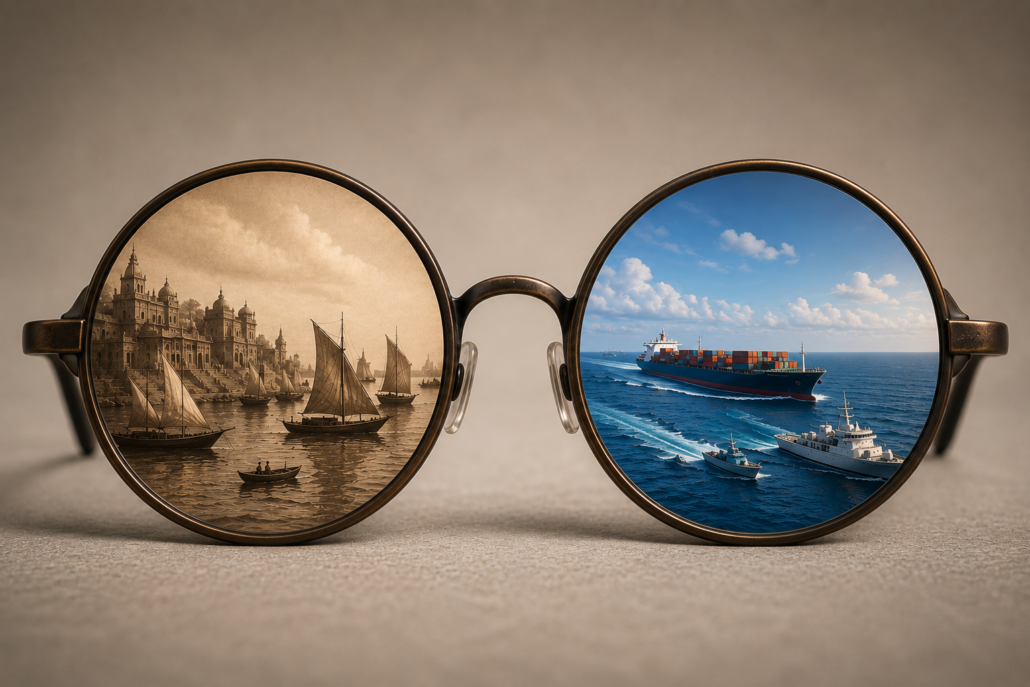
Present discussions surrounding sea-blindness carry a deeper subtext. India’s legitimacy as a maritime nation has rarely been disputed, yet the country continues to think of itself largely through a continental lens rather than a maritime one, despite the fact that the Government of India has increasingly articulated the nation’s maritime orientation with clarity and purpose. However, for much of the wider populace, the sea remains something that is viewed only within narrow contexts — whether it be trade, tourism, fisheries, or naval conflict — rather than as a holistic force shaping India’s strategic outlook.
Recent developments in the Persian Gulf suddenly brought the Strait of Hormuz and its environs into the public discourse as though it were an unfamiliar and distant geography, despite the fact that Indians have maintained commercial and cultural linkages with the societies of West Asia for millennia. In some cases, such as Oman, these connections have gone onto evolve beyond trade into deeply embedded social and familial ties, producing communities whose histories and identities straddle both shores of the Arabian Sea.[1] This disconnect did not emerge suddenly. Modern Indian institutional structures were, to a significant extent, transplanted through the colonial experience, forcing the postcolonial state into a philosophical and strategic dichotomy. India inherited systems designed (at least initially) through external priorities, while simultaneously attempting to recover an indigenous sense of self. Therefore, the result has often been a State suspended between competing inheritances, where strategic imagination struggles beneath the accumulated weight of historical disruption. Consequently, the reasons behind sea-blindness in modern India cannot be listed out through a simplistic or linear process of elimination, for it is not merely the absence of maritime thinking, but the outcome of a long temporal process through which education, institutions, and historical narratives gradually altered spatial imagination itself.
Over generations, established systems of knowledge and governance normalised a continental outlook to such a degree that the entire populace became increasingly detached from the sea as a civilisational space. The historical conditioning of perspective over time is what now manifests itself, at its most superficial level, as geographical ignorance. Yet this conclusion may appear somewhat paradoxical when situated against the longer arc of Indian history. If maritime consciousness was, indeed, deeply embedded within the subcontinent’s social and economic life, questions naturally arise regarding its representation within the historical record. For instance, what are the reasons behind maritime themes appearing less prominently in tangible artistic forms such as sculpture, painting, and monumental architecture than one might expect from a civilisation so intimately connected to the sea? Such observations, however, should not establish inversely proportionate truths. The apparent scarcity of evidence does not necessarily constitute evidence of absence. Exceptional examples of maritime imagery and material evidence across foundational literature, folklore, travel accounts, and regional traditions, do exist, even if they remain comparatively sparse within the broader corpus of Indian art and archaeology.
This raises a different set of questions altogether, suggesting that the issue might not lie in the historical absence of maritime consciousness, but in the very nature of the questions traditionally asked of Indian history and the categories through which evidence has been sought and interpreted. Much of India’s maritime past remains dispersed across regional archives, oral traditions, vernacular literature, coastal communities, and underexplored archaeological sites. As a result, another aspect to sea-blindness may be the insufficient examination of substantial portions of India’s maritime inheritance.
Nonetheless, Indian maritime identity emerged long before the birth of the modern nation-state because the subcontinent’s geography naturally encouraged an outward maritime orientation. This maritime orientation was not solely, or even primarily, military in nature. Nor did it always function through a singular imperial framework. Instead, it manifested through layered systems of commerce, pilgrimage, migration, artisanal production, and cultural interaction. Societies often think and behave “maritime” before States institutionalise such behaviour strategically.
The organic question that follows, then, is not whether India possessed maritime consciousness, but an enquiry into when its erosion began and through what processes. To that end, the Battle of Diu in 1509 may be understood as a major point of inflection in the gradual weakening of indigenous sea control in the Indian Ocean. The battle itself was not a mere naval encounter between the Portuguese and regional powers. It represented the arrival of a new model of maritime expansion in the Indian Ocean, one that fused naval force, mercantilism, cartography, and state-sponsored commerce into a coherent strategic project.
The coalition opposing the Portuguese included forces from the Sultanate of Gujarat, the Mamluk Sultanate of Egypt, and the Zamorin of Calicut, with support from Venice as well as Ottoman-linked elements.[2] The very fact that such geographically dispersed powers coordinated against a common maritime threat demonstrates the existence of sophisticated maritime awareness and interconnected political interests across the Indian Ocean world. Yet, the coalition lost — not necessarily because of an absence of courage or maritime familiarity but because the Portuguese possessed certain advantages in naval artillery, ship design, manoeuvrability, and integrated command structures.[3] In many respects, it was the ships rather than the sailors that determined the outcome of the battle. The significance of Diu, therefore, lies less in the event itself than in what it symbolised — the gradual transfer of maritime dominance towards externally organised powers capable of combining commerce, military force, and State capacity into a unified maritime strategy.
At the same time, caution must be exercised against reducing this transformation to a singular event or a singular actor. The Portuguese may well have initiated this shift, but they were soon followed by the Dutch, the French, and eventually the British. The erosion of indigenous maritime traditions unfolded across centuries through layered processes of colonial intervention, institutional restructuring, and historical reorientation. The colonial phase witnessed repeated disruptions to seaward attitudes, coastal systems, and indigenous maritime practices, many of which were gradually erased, marginalised, or detached from mainstream historical narratives. Furthermore, the reorganisation of education under British colonial rule deeply influenced how India came to understand its own past.[4]
One of the earliest examples of this shift may be observed in the Portuguese Cartaz system introduced during the 16th century. Prior to European intervention, Indian Ocean commerce functioned through relatively decentralised patterns of exchange shaped by seasonal monsoons, merchant relationships, and coastal intermediaries. The Portuguese, however, sought to convert maritime mobility into something that was administratively regulated and militarily enforceable.[5] Merchant vessels sailing through the Indian Ocean were increasingly expected to carry Cartaz (passes) issued by Portuguese authorities thereby effectively transforming navigation itself into a licensed activity. Ships travelling without authorisation faced the possibility of seizure or attack.[6] The system established the precedent that maritime space could be controlled through bureaucratic permission.
Subsequent colonial powers deepened similar tendencies through customs regimes, port administration, monopolistic trading privileges, and shipping regulations that increasingly privileged imperial interests over indigenous autonomy. Under British rule in particular, maritime commerce became progressively integrated into the wider machinery of imperial governance. Ports, shipping routes, and commercial activity were reorganised to sustain imperial economic priorities, gradually narrowing the space within which indigenous maritime enterprise could evolve independently. The cumulative effect was subtle but profound. Maritime activity did not disappear, but control over its terms increasingly shifted away from local actors.
The transformation was equally visible in the realm of maritime labour. Indian sailors, widely referred to as lascars, (a term that is considered pejorative in the extreme) became deeply embedded within European commercial and naval systems across the Indian Ocean and beyond. By the 18th and 19th centuries, large numbers of Indian seafarers crewed British and other European vessels travelling across global trade routes.[7] Their familiarity with monsoon conditions, navigation patterns, and shipboard labour made them indispensable to imperial maritime operations. Despite Indian labour remaining central to European maritime expansion, Indian maritime agency diminished steadily. Typical of colonial practices, lascars often operated within unequal labour structures while occupying subordinate positions despite sustaining the very networks upon which imperial commerce depended.[8] In many ways, the colonial maritime economy absorbed indigenous skill without allowing indigenous control to expand alongside it.
The commercial restructuring of the colonial economy further accelerated this imbalance. India increasingly came to occupy the role of a supplier of raw materials within a wider imperial framework, and maritime industries were drawn into this transformation. This was particularly evident in shipbuilding. Indian shipyards had long possessed sophisticated knowledge traditions, especially in the use of teak, whose durability gave Indian-built vessels remarkable longevity.[9] British interest in Indian timber intensified considerably during periods when access to traditional oak supplies became constrained. The loss of the America as a colony (along with its abundance of timber) and strategic difficulties surrounding Baltic timber procurement placed Britain under growing material pressure, leading to what some historians describe as a “teak rush” towards India.[10] Ships constructed from Indian teak frequently proved more resilient than many of their European counterparts, and Indian shipyards became important suppliers for imperial maritime needs.
The colonial maritime encounter, therefore, did not simply suppress maritime activity but also altered the conditions under which maritime life operated. Legal regulation, commercial dependency, labour extraction, and systemic restructuring collectively weakened the organic relationship between Indian society and the sea.
While the fight for independence was arduous enough, the attainment of freedom marked the beginning of a new set of challenges for the newly sovereign Indian State. It was confronted by the partition, consequent mass displacement, food insecurity, economic fragility, and unresolved territorial questions almost simultaneously. Unsurprisingly, India’s earliest strategic anxieties emerged overwhelmingly from the land. The partition violently redrew frontiers in the northwest and east, while subsequent conflicts in Kashmir and later along the Himalayan frontier with China further consolidated a continental security outlook within the Indian strategic imagination. National consolidation, border management, territorial sovereignty, and internal development naturally became immediate priorities for a State attempting to stabilise itself after colonial rule. In such circumstances, the sea remained important, but largely as an economic utility rather than as a central organising principle of national strategy. This shift did not signify ignorance of the sea altogether, rather the sea increasingly occupied a psychologically peripheral position within wider public and strategic thinking.
What emerged over time was not the absence of maritime interaction altogether, but a gradual distancing of maritime consciousness from indigenous control, eventually contributing to the broader phenomenon of sea-blindness inherited in the modern period. This inherited outlook has only recently been disrupted largely owing to the strategic realities of the 21st century, although scholars and practitioners within the maritime domain have long recognised the need to raise awareness. The rise of Indo-Pacific geopolitics, signified by renewed great power competition, climate vulnerability, and logistics-based economic statecraft has pushed the oceans back to the centre of strategic discourse. Accordingly, the Indian government has already begun a gradual process of maritime reorientation. The articulation of a new and vibrant maritime policy, encapsulated in the acronym MAHASAGAR (Mutual and Holistic Advancement for Security and Growth Across Regions),[11] and the first order specificity that it provides to the Indo-Pacific Oceans Initiative (IPOI),[12] indicates a wider strategic recognition of the Indian Ocean’s growing centrality. Simultaneously, discussions around the ‘blue-ing’ of the Indian economy, port-led development, supply chain resilience, and so on, suggest an important shift. However, formal State recognition alone cannot fully resolve sea-blindness in the society.
There are both ‘passive’ and ‘active’ dimensions to the practice of cultivating maritime consciousness. The passive dimension lies in the gradual accumulation of knowledge. As evidence-based research, scholarly enquiry, and informed public debate increasingly occupy mainstream intellectual space, maritime affairs become normalised within national discourse. Universities, research institutions, museums, archives, think tanks, and policy forums all contribute to this process by generating and disseminating knowledge. Over time, such efforts help establish a healthy communication loop between policymakers, practitioners, and researchers, ensuring that maritime concerns are discussed not merely within specialised institutions but across Track 1, Track 1.5, and Track 2 platforms alike.
However, this discussion remains bound by institutional frameworks. Ultimately, the wider populace remains the inheritor of India’s maritime heritage and should ideally participate in its recovery. This is particularly true of coastal communities for instance, many of which continue to preserve knowledge systems transmitted orally across generations. Embedded within local languages, folklore, occupational practices, navigational traditions, ecological observations, and community memory, are repositories of maritime knowledge that often remain absent from formal archives. Preserving and documenting such knowledge would be an exercise within the ‘active’ dimension, contributing to cultural conservation and recovering lived maritime experience that has historically connected communities to the sea.
Equally important is the translation of specialised knowledge into forms accessible to wider audiences. Academic scholarship rarely travels far beyond specialist circles unless it is accompanied by compelling public narratives. Here, experienced practitioners, historians, filmmakers, writers, educators, and maritime professionals, all play a vital role, albeit through different mediums. Documentaries, films, digital media, museums, exhibitions, and episodic storytelling on web-streaming platforms, possess the ability to bridge the gap between scholarly research and public understanding. Such mediums transform maritime history and contemporary maritime affairs from abstract or inaccessible subjects into relatable stories, allowing society to engage with the sea as a living component of national identity.
The significance of such efforts extends beyond the production of knowledge itself. Sustained engagement across academic, policy, and practitioner communities contributes to the gradual formation of an intellectual ecosystem within which maritime issues are examined, debated, and understood. As maritime perspectives become increasingly embedded within research agendas, educational curricula, public discourse, and policy deliberations, they begin to shape the assumptions through which questions of national consequence are interpreted. In this sense, maritime consciousness serves not merely as a cultural or intellectual attribute, but as a foundation for the development of maritime-oriented state capacity.
Conclusion
In conclusion, sea-blindness not the product of a singular decision, event, or generation, but the accumulated outcome of layered historical processes that gradually altered how Indian society perceived its relationship with the sea. Colonial restructuring, changing economic priorities, educational narratives, technological transitions, and post-independence developmental imperatives collectively contributed to a widening disconnect between India’s maritime geography and its public consciousness. Given that sea-blindness emerged through both institutional and societal processes, its reversal similarly demands interventions at multiple levels. This is crucial to integrate maritime considerations become integrated into routine processes of governance and strategic assessment instead of being viewed as sectoral concerns comprising only part of the holistic overview. Furthermore, it is to foster a society that recognises, articulates, and acts upon the opportunities and responsibilities that arise from that maritime reality.
*******
About the Author
Ms Priyasha Dixit is a Research Associate at the National Maritime Foundation. Her area of focus is the enhancement of maritime consciousness in India— a theme that incorporates multiple issues of seminal importance including, inter alia, India’s maritime (seafaring) history (incorporating ancient Indian knowledge systems), the maritime history of the Indian Ocean, India’s maritime heritage and its underwater cultural heritage. The scope of her research is widening and now encompasses evaluations and analyses of maritime geopolitics within the Indo-Pacific. She may be contacted at indopac8nmf@gmail.com.
Endnotes:
[1] Vishnu Prakash Mangu, “India and Oman: A Saga of Commerce, Culture, and Connectivity”, International Journal of Humanities Social Science and Management (IJHSSM), Volume 5 (2), Mar-Apr 2025, 683-692, https://ijhssm.org/issue_dcp/India%20and%20Oman%20%20A%20Saga%20of%20Commerce,%20Culture,%20and%20Connectivity.pdf
See Also: Suraj Palavalsa, “Reconnecting Ancient Sea Lanes Through the India-Oman Maritime Heritage Memorandum of Understanding”, 21 December 2025, https://maritimeindia.org/reconnecting-ancient-sea-lanes-through-the-india-oman-maritime-heritage-memorandum-of-understanding/
[2] Maritime History Society, Blogs, “Battle of Diu: Onset of Portuguese Dominance in the Indian Ocean”, 15 July 2023, https://mhsindia.org/all/battle-of-diu-onset-of-portuguese-dominance-in-the-indian-ocean/210053/
[3] Maritime History Society, “Battle of Diu: Onset of Portuguese Dominance in the Indian Ocean”.
[4] The dilemma, however, regarding the incomplete recovery and assimilation of India’s maritime history remains relevant. Even before colonial intervention, significant gaps persist in the historical representation. The issue, therefore, is not solely one of colonial erasure at the current juncture.
[5] Jobi John. “The Portuguse Cartaz System in the Maritime Trade at Canannore”, Journal of Indian History, Vol XCIX, 2022, https://jihku.org/wp-content/uploads/2024/09/9.pdf
See Also: Liji K, “The Portuguese Cartaz System and the Maritime Trade of Kollam”, International Journal of Research and Analytical Reviews (IJRAR), Vol 1 (2), https://www.ijrar.org/papers/IJRAR19D1163.pdf
[6] K S Mathew, “Portuguese Trade with India and the Theory of Royal Monopoly in the Sixteenth Century” Proceedings of the Indian History Congress 40 (1979), 389–98, http://www.jstor.org/stable/44141978
[7] G Balachandran, “Workers in the World: Indian Seafarers, c. 1870s–1940s”, In Global Histories of Work (ed. Andreas Eckert. De Gruyter), 1st ed., 2016, http://www.jstor.org/stable/j.ctvbkjv3d.7
[8] G Balachandran, “Workers in the World: Indian Seafarers, c. 1870s–1940s”.
[9] Louiza Rodrigues, “Commercialisation of Forests, Timber Extraction and Deforestation of Malabar: Early Nineteenth Century” Proceedings of the Indian History Congress 73 (2012): 809–19. http://www.jstor.org/stable/44156277.
[10] Lucas Sérougne (Translated by J Johnson), “Teak Conquest. Wars, Forest Imperialism and Shipbuilding in India (1793-1815)” Annales Historiques de la Révolution Française, No 399(1), 2022, 123-152, https://doi.org/10.3917/ahrf.399.0123
[11] Government of India, Ministry of Home Affairs, “Prime Minister Modi’s maritime policy has evolved into MAHASAGAR (Mutual and Holistic Advancement for Security and Growth Across Regions), becoming a symbol of India’s growing global footprint”, Press Information Bureau (Delhi), 27 October 2025, https://www.pib.gov.in/PressReleasePage.aspx?PRID=2182946®=3&lang=2
[12] Government of India, Ministry of External Affairs, “Prime Minister’s Speech at the East Asia Summit, 04 November 2019”, 04 November 2019, https://www.mea.gov.in/Speeches-Statements.htm?dtl/32171/Prime_Ministers_Speech_at_the_East_Asia_Summit_04_November_2019


Leave a Reply
Want to join the discussion?Feel free to contribute!