
Keywords: FISHERIES POLICY, FISHERIES PARTNERSHIP AGREEMENT, INDO-PACIFIC, RFMO, FAD, IUU FISHING
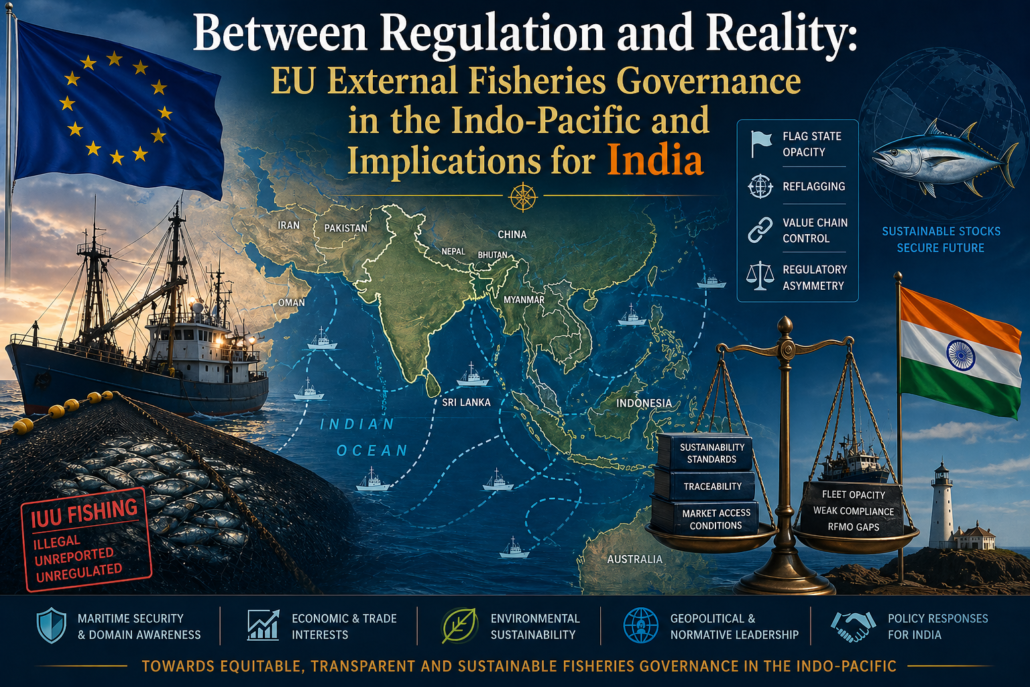
The governance of global fisheries has become increasingly complex in the Indo-Pacific, where ecological pressures, economic interests and strategic competition intersect. Within this evolving landscape, the European Union (EU) has positioned itself as a leading advocate of sustainable fisheries through instruments such as its “Common Fisheries Policy” (CFP), its “Sustainable Fisheries Partnership Agreements” (SFPAs), and its “Illegal, Unreported and Unregulated (IUU) Fishing Regulations”. These frameworks collectively project the EU as a normative power committed to transparency, conservation and rules-based maritime governance.
However, this outward regulatory posture coexists with an expanding operational footprint of EU-linked fishing fleets across the Indo-Pacific, particularly in the western segment of the Indian Ocean, i.e., the Arabian Sea. This paper argues that the EU’s external fisheries model is characterised by a structural contradiction: while it promotes stringent sustainability standards at the regulatory level, gaps in enforcement, fleet ownership, transparency, and monitoring mechanisms, taken in aggregate, create conditions for regulatory arbitrage in practice. These inconsistencies are most visible in areas such as reflagging practices, discrepancies in vessel authorisations and activity, and the large-scale use of drifting Fish Aggregating Devices (FADs).
Drawing from the data of the compliance reports of Regional Fisheries Management Organisations (RFMOs), as also independent studies, the paper examines how these governance-gaps enable practices that may not always be overtly illegal but nevertheless undermine the effectiveness of global fisheries regulations. In doing so, it shifts the focus from individual violation to systemic vulnerabilities embedded within the EU’s external fisheries architecture.
The paper further situates these dynamics within the Indo-Pacific construct, highlighting how the concentration of industrial fishing capacity, coupled with weak enforcement measures exacerbates stock depletion and distorts regional fisheries economies. Against this backdrop, it assesses the economic, ecological and strategic implication for India — an emerging maritime power with growing stakes in fisheries governance — and outlines policy recommendation for navigating these challenges within an increasingly contested maritime domain.
EU’s Common Fisheries Policy and its Indo-Pacific Reach
The EU’s “Common Fisheries Policy” (CFP)—focused on the conservation and management of fish stocks, particularly through the setting of catch limits (total allowable catch [TAC] and quotas)—dates back to 1983. This early development took place against the backdrop of declining open access to global fisheries following the adoption of the UNCLOS 1982, under which many States declared EEZs, bringing approximately 90 per cent of the world’s fisheries resources under the jurisdiction of coastal states.
To enable the fleets of member States of the EU to continue operating in waters in which they had traditionally fished,[1] the European Economic Community (the Community) began negotiating fisheries agreements with third countries,[2] making the de facto emergence of an ‘external’ component to the fisheries policy. This framework expanded further as new member States with established fishing interests—particularly Spain and Portugal—joined the Community, leading to the incorporation of their bilateral agreements into EU-level arrangements. At the same time, as governance over areas beyond national jurisdiction became more institutionalised, the EU increased its participation in RFMOs (Table 1 and Figure 1 refer).[3]
|
Table 1. EU’s Participation in RFMOs (Indo-Pacific) |
|||
| RFMO Acronym | RFMO Name | Year Established | EU Participation |
| Generic RFMOs | |||
| NPFC | North Pacific Fisheries Commission | 2015 | Since 2022 |
| SIOFA | Southern Indian Ocean Fisheries Agreement | 2012 | Since inception |
| SPRFMO | South Pacific Regional Fisheries Management Organisation | 2012 | Since inception |
| Tuna RFMOs | |||
| CCSBT | Commission for the Conservation of Southern Bluefin Tuna | 1994 | Since 2015 |
| IOTC | Indian Ocean Tuna Commission | 1996 | Since inception |
| IATTC | Inter-American Tropical Tuna Commission | 1950 | Since 2006 |
| WCPFC | Western and Central Pacific Fisheries | 2004 | Since inception |
| AIDCP | Agreement on the International Dolphin Conservation Program | 1999 | Since 2006 |
|
Source. European Parliamentary Research Service |
|||
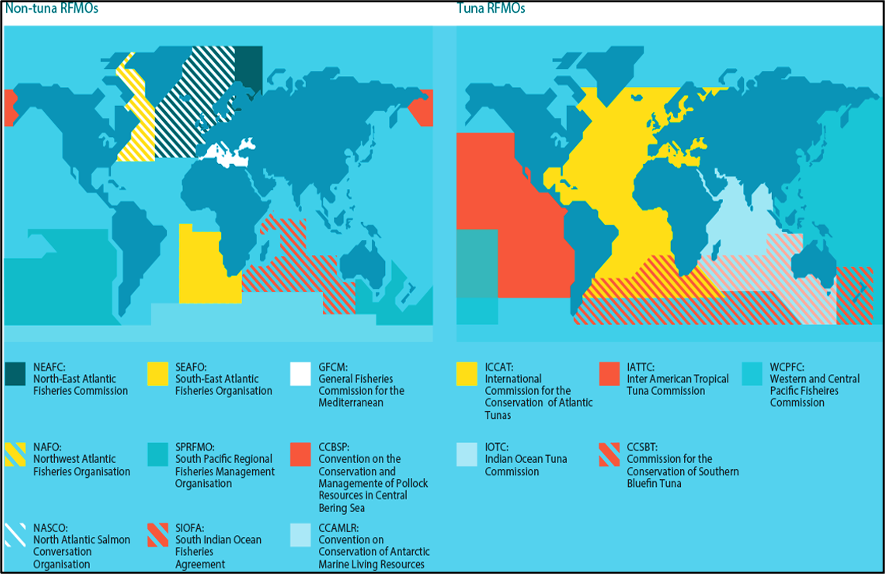
Fig.1. RFMOs (Non-tuna and Tuna)
Source. Directorate-General for Natural Resources, Safety and Maritime Services, Portugal
Notwithstanding EU’s participation in the above mentioned RFMOs, this part of the paper will focus on only four of them: (1) the Southern Indian Ocean Fisheries Agreement (SIOFA), (2) the South Pacific Regional Fisheries Management Organisation (SPRFMO), (3) the Commission for the Conservation of Southern Bluefin Tuna (CCSBT), and (4) the Indian Ocean Tuna Commission (IOTC). This specific focus is due to the lack of data on EU-flagged fishing vessel activity in the other RFMO areas.
Within the SIOFA, both the EU and France (on behalf of its Indian Ocean territories) are members, reflecting a sustained European institutional and operational presence in the region. According to EU reports, the active vessels recorded a catch of approximately 1,000 tonnes in 2023, primarily comprising Portuguese dogfish and Patagonian toothfish. The location of SIOFA HQ in La Réunion further reinforces the EU’s embedded influence in the Indian Ocean fisheries governance.[4]
A similar pattern is evident in the SPRFMO region. In 2023, four vessels operated near the Chilean EEZ, targeting jack mackerel, with total catches of approximately 69,000 tonnes (76 per cent target species and 24 per cent as bycatch [especially chub mackerel]).
The CCSBT governs southern Bluefin tuna across a distribution range that overlaps multiple RFMO jurisdictions.
The IOTC represents the principal area of EU fishing activity in the Indo-Pacific and illustrates more clearly the scale—and risks—of its operations. The EU fleet, primarily composed of vessels flagged to Spain, France, Italy and Portugal, is dominated by large purse seiners and longliners.[5] The purse seine segment alone, consisting of 27 vessels, accounted for approximately 220,000 tonnes of catch in 2022, while longliners (31 vessels, including vessels from La Réunion, targeting swordfish, with associated catches of pelagic sharks and tuna) contributed a further 7,000 tonnes.[6] The western Indian Ocean has consequently emerged as the EU’s primary tuna fishing ground. Reflecting this scale, the IOTC’s Record of Authorisation (RAV) for 2026 lists over 130 EU-flagged vessels (62 Spanish, 49 French, and 19 Portuguese) authorised to operate in the region.[7]
Crucially, this concentration of industrial fishing capacity in a region already facing stock depletion—particularly for species such as Yellowfin tuna—intensifies concerns regarding overfishing, weak enforcement, and the ineffectiveness of RFMO oversight. Moreover, beyond the RFMO authorisations, the increasing number of EU SFPAs with Indo-Pacific countries, reflect the EU’s expanding interest in regulating global fisheries.
The EU’s SFPAs with Indo-Pacific countries
The EU’s SFPAs draws its foundation from Article 62(2) of the UNCLOS 1982, which provides that “where a coastal State lacks the capacity to harvest the entire allowable catch, it shall grant other States’ access to the surplus through agreements or similar arrangements.” Notably, these agreements subject EU-flagged fishing vessels to supervisory and transparency requirements and form the basis of the EU’s external fisheries policy. The transition from the 2002 Fisheries Partnership Agreements (FPAs) to SFPAs took place post the 2013 reform to the EU’s CFP, thereby embedding key principles into law. These include mutual benefits for both parties, the application of EU standards to vessels operating outside EU waters, and the restriction that fishing activities target only surplus stocks, consistent with UNCLOS 1982 provisions. An exclusivity clause further stipulates that EU vessels may operate in third-country waters only with the framework of these agreements.
As of 2024, 14 SFPAs were in force. Most are ‘tuna SFPAs’, targeting highly migratory species (Table 2 refers),[8] while the remainder are ‘mixed agreements’ covering multiple species, often with a tuna component. Average catches under SFPAs are estimated at approximately 300,000 tonnes, comprising largely small pelagic species and tuna. Notably, around 90 per cent of the catch—particularly tuna—is ultimately destined for EU markets, often after processing in third countries, reflecting the integration of these agreements into EU supply chains.[9]
|
Table 2. Highly Migratory Species of Tuna, other Species and Marine Mammals |
|||
| Ser | Species | Scientific Name | Family |
| 1 | Albacore tuna | Thunnus alalunga | – |
| 2 | Bluefin tuna | Thunnus thynnus | – |
| 3 | Bigeye tuna | Thunnus obesus | – |
| 4 | Skipjack tuna | Katsuwonus pelamis | – |
| 5 | Yellowfin tuna | Thunnus albacares | – |
| 6 | Blackfin tuna | Thunnus atlanticus | – |
| 7 | Little tuna | · Euthynnus alletteratus
· Euthynnus affinis |
– |
| 8 | Southern bluefin tuna | Thunnus maccoyii | – |
| 9 | Frigate mackerel | · Auxis thazard
· Auxis rochei |
– |
| 10 | Pomfrets | – | Bramidae |
| 11 | Marlins | · Tetrapturus angustirostris
· Tetrapturus belone · Tetrapturus pfluegeri · Tetrapturus albidus · Tetrapturus audax · Tetrapturus georgei · Makaira Mazara · Makaira indica · Makaira nigricans |
– |
| 12 | Sail-fish | · Istiophorus platypterus
· Istiophorus albicans |
– |
| 13 | Swordfish | Xiphias gladius | – |
| 14 | Sauries | · Scomberesox saurus
· Cololabis saira · Cololabis adocetus · Scomberesox saurus scombroides |
– |
| 15 | Dolphin | · Coryphaena hippurus
· Coryphaena equiselis |
– |
| 16 | Oceanic sharks | · Hexanchus griseus
· Cetorhinus maximus
|
· Alopiidae
· Rhincodon typus · Carcharhinidae · Sphyrnidae · Isurida |
| 17 | Cetaceans | – | · Physeteridae
· Balaenopteridae · Balaenidae · Eschrichtiidae · Monodontidae · Ziphiidae · Delphinidae |
|
Source. Annex I, UNCLOS 1982 |
|||
In 2024, the EU’s budgetary contribution under SFPAs amounted to €109 million. However, the distribution of these funds remains uneven. For instance, within the Indo-Pacific, Seychelles received €5.30 million but Madagascar only €1.80 million. Notably, the agreements with Kiribati, Mauritius and the Cook Islands each accounted for less than €01 million. This disparity raises questions regarding the balance of benefits between the EU and partner States.
In the western Indian Ocean, SPFA’s include active tuna agreements with Madagascar, Mauritius and Seychelles, enabling EU vessels to operate both in the high seas under the IOTC and within national EEZs.[10]
In the Pacific, SFPAs are more recent but strategically significant, providing access to some of the world’s richest tuna fishing grounds, which account for roughly half of global tuna catches. The agreement with Kiribati, concluded in 2003, was the first in the region and remains one of only two active agreements as of 2024. The EU and Cook Islands have signed a new SFPA protocol, effective from 09 December 2025 to 08 December 2032, allowing up to four Spanish/French tuna purse seiners access to Cook Islands EEZs.[11]
Despite the existence of these formal arrangements, parallel access mechanisms persist. In 2024, direct authorisations were granted to 38 EU-flagged fishing vessels by individual coastal States, with some vessels receiving permits from multiple countries. For instance, Tanzania authorised 14 vessels, while Kenya authorised one.[12] Such practices, operating alongside SFPAs complicate oversight and weaken the exclusivity principle, thereby creating potential regulatory gaps that may facilitate unreported or poorly monitored fishing activities.
Ensuring Sustainability and Regulatory Compliance
While fishing activities of EU-flagged vessels on the high seas under RFMO jurisdiction and within the EEZs of Indo-Pacific nations under SFPAs can raise questions on sustainability, the EU has positioned itself as an important player in regulating global fisheries thereby ensuring sustainability and regulatory compliance. For instance, the EU’s IUU Fishing Regulations of 2010 empower the Directorate-General for Maritime Affairs and Fisheries (DG MARE [European Commission]) to issue a formal warning—a “yellow card”—to States that fail to address illegal fishing. A “‘red card” is issued for persistent non-compliance, leading to the member designation of the nations concerned as “non-cooperating countries”.[13] The Regulation applies not only to EU-flagged vessels but also to EU fishing vessel operators globally, irrespective of the flag. It further mandates that only fishery products accompanied by a valid catch certificate from the competent flag State may be imported into the EU, while also maintaining an updated list of vessels identified for IUU fishing, including those recognised by RFMOs.[14] In addition, the EU Parliament has called for the expansion of global fisheries governance. In its Resolution of January 2024, it emphasised that all ocean areas should fall under the jurisdiction of an RFMO.[15]
Additional sustainability measures include the following:
- Regulation of Shark-fin Trade. The EU has also promoted stricter conservation measures such as the “fins naturally attached” principle, which requires sharks caught by EU fishing vessels—or within EU waters—to be landed with fins attached to their bodies, a measure widely regarded as effective in preventing shark finning, despite opposition from some States.
- Regulation of FADs. The EU actively promotes sustainability measures within RFMOs. For instance, within the IOTC, it has supported the regulation of fish aggregating devices (FADs)—floating devices used to attract tuna but also associated with overfishing—leading to limits on their deployment per vessel.[16]
- Designation of MPAs. The EU also advocates the integration of climate-change considerations into fisheries science and management, including the designation of MPAs to enhance ecosystem resilience. Notably, India supported the EU-backed proposal to designate the Weddell Sea in Antarctica as an MPA.[17]
These sustainability and regulatory compliance mechanisms notwithstanding, concerns persist regarding the consistency and scope of the EU’s enforcement.[18] For instance, while numerous EU-flagged fishing vessels have been given authorisations by RFMOs, as also under SFPAs, the IOTC IUU vessel list dated 16 April 2025 lists only four vessels with current/past linkages to the EU. Moreover, no EU-flagged fishing vessels are currently listed by the SIOFA or SPRFMO (SIOFA’s IUU list has not been updated since 2018). These issues raise concerns regarding the realities of EU-flagged fishing vessels.
Uncovering the EU’s IUU F Practices
Inconsistency in Authorisations and Active Vessel Numbers. In 2024, the SIOFA issued authorisations for two Spanish fishing vessels to operate in its area, although available data indicate that only one vessel has been consistently active in recent years. Similarly, while the SPRFMO issued authorisations to eight EU fishing vessels in 2024, only one to four vessels have been active. Also, in the same year, the CCSBT issued 114 authorisations to Spanish and Portuguese fishing vessels (in total), prohibiting these vessels from directly targeting tuna and limited to incidental by-catch. Interestingly, since 2012, no EU fishing vessel catch has been reported to the RFMO. While this may suggest compliance, it also reflects the limitations of self-reported data within RFMO frameworks, where the absence of reported catches does not necessarily equate to the absence of fishing activity.[19] Moreover, the inconsistencies between authorised and active vessels underscore vulnerabilities that can facilitate IUU F practices.
Lack of Data on the EU’s External Fleet Numbers. A 2008 study identified 718 EU fishing vessels operating in foreign EEZs,[20] accounting for approximately 21 per cent of the EU’s total catch and as much as 92 per cent of all tuna and related species caught. However, an access-to-information request revealed that between 2010 and 2014, as many as 15,264 fishing vessels operated in foreign EEZs, all under the flags of EU member-states and authorised under the EU’s Fisheries Authorisation Regulation (FAR).[21]
Re-flagging Issues. Many EU citizens and companies maintain extensive ownership of fishing vessels registered under non-EU flags. A study revealed the ownership of nearly 7,000 large-scale fishing vessels, globally and found that EU companies own at least 344 vessels flagged to 43 non-EU countries, with a capacity of 290,853 GT. When these vessels are included, the EU’s distant-water fleet expands to 588 vessels—140 per cent higher than the officially reported figure of 244 vessels in 2022—while total capacity more than doubles to 549,553 GT.[22] Many of these vessels operate under flags associated with weak regulatory oversight, including Panama, Senegal and Guinea-Bissau, heightening the risk of illegal fishing activities.[23]
Limitations of IOTC Regulations. The IOTC, in 2016, introduced a “yellowfin tuna rebuilding plan” to regulate catch limits by purse seiners. However, reports found that EU-flagged vessels exceeded agreed limits in 2017 and 2018.[24] Monitoring remains constrained by the IOTC’s reliance on self-reporting, making independent verification difficult. This is compounded by evidence of an inconsistent use of the Automatic Identification System (AIS). An analysis revealed especially low transmission rates among Spanish- and Seychelles-flagged fishing vessels between 2017 and 2019, undermining traceability and enforcement.
The EU’s Dominance in Tuna Value Chains. EU fishing fleets supply canneries in Seychelles, Madagascar and Mauritius, whose processed tuna are mainly destined for EU markets. “Rules of Origin” embedded in fisheries agreements further reinforce this dependency by requiring that processing facilities use fish sourced either domestically or from EU fleets. This integrated supply structure amplifies the EU’s influence over both production and trade, while limiting transparency and accountability.[25]
Bycatch and Finning of Sharks. Although the EU banned shark finning in 2023 for all EU-flagged fishing vessels and within EU waters, the trade in detached shark fins—through imports, exports and transit—remains legal, with fleets from Spain and Portugal playing a prominent role in shark fisheries. According to a 2022 report, 45 per cent of shark-fin related products imported into key Asian markets originated from EU member States.[26] Moreover, EU-flagged purse seiners are catching shark, turtles, and marine mammals, as bycatch. Juvenile silky sharks alone account for substantial mortality, with an estimated 100,000 individuals affected annually in the Indian Ocean.
Unregulated use of FADs. Weak global governance and limited transparency mean that the total number of deployed FADs remains unknown. Additionally, data from the Parties to the Nauru Agreement suggest extremely high densities in parts of the Pacific.[27] In the Indian Ocean, both yellowfin and bigeye tuna stocks are currently overfished, with scientific evidence linking stock depletion to the large-scale capture of juvenile tuna around FADs. Since 2015, industrial fleets have caught over 100 million juvenile yellowfin tuna using drifting FADs.[28] The IOTC also highlighted non-compliance with existing FAD management measures, particularly under Resolution 19/02.[29]At the fourth Special Session of the IOTC in March 2021, the EU delegation opposed enhanced FAD controls, citing insufficient scientific evidence. This position stands in contrast to the precautionary principle enshrined in the UN FSA, to which the EU is a party, as well as to its own commitments under the CFP.[30]
While numerous studies and reports reveal the EU’s IUU fishing practices in the Indo-Pacific region, there are challenges within the EU’s fisheries regulation which could exacerbate the threat of IUU fishing for global fisheries.
Challenges within the EU’s FAR
Under the current Fisheries Authorisation Regulation (FAR), there is no requirement for vessels to provide key operational details such as target species, fishing area, duration of activity, or gear used. This lack of disclosure limits the ability of the European Commission and other stakeholders to effectively monitor and assess the activities of vessels operated by EU member-States.
This problem is compounded by the absence of an EU-wide database covering private fisheries agreements between EU companies and third countries. Although vessels operating under such arrangements may fly EU flags or be controlled by EU nationals, there are no established mechanisms to ensure that these agreements comply with EU fisheries law. As a result, a significant portion of EU-linked fishing activity remains insufficiently regulated — even opaque.
Additional governance gaps arise from weak controls over reflagging practices. Vessels frequently alternate between EU flags and those of ‘flags of convenience’. States with weaker regulatory oversight or shift to countries that have received ‘yellow cards’ from the European Commission for inadequate fisheries management. Despite this, such vessels may subsequently re-enter the EU fleet and regain access to Sustainable Fisheries Partnership Agreements (SFPAs) and subsidies, without being required to demonstrate compliance with EU- or international fisheries standards during their period under a foreign flag.
These weaknesses are reinforced by the absence of a mandatory requirement for a unique vessel identifier, such as an International Maritime Organization (IMO) number, as a condition for obtaining a FAR. This makes it difficult to trace vessel histories across jurisdictions, particularly where frequent reflagging occurs, and further undermines transparency and enforcement.[31]
Strategic Implications and Policy Responses for India
Maritime Security and Maritime Situational/ Domain Awareness (MSA/ MDA). The Indo-Pacific’s fishing grounds (particularly the Indian Ocean’s EEZs and adjacent high seas) are increasingly characterised by overlapping jurisdiction, uneven surveillance capacity and capabilities, and regulatory ambiguity. Within this environment, the operational footprint of distant-water fishing fleets, including those linked to EU ownership structures, places additional strain on India’s MSA/MDA architecture.[32]
A central challenge lies in fleet opacity. Reflagging practices and complex ownership structure (often involving flags of convenience or third-country registries) limit the effectiveness of VMS, particularly in the EEZs of smaller Indian Ocean States. While the IFC-IOR has several agreements on the sharing of data pertaining to “White Shipping” (a term that denotes merchant ships), its current orientation remains focused on traditional maritime security threats and non-traditional maritime security threats (specifically piracy, drug trafficking, weapons smuggling, human trafficking) rather than the systematic tracking of commercial fishing fleets operating in regulatory grey zones.
The strategic risk extends beyond IUUF as an economic concern. Large-scale fishing fleets (by virtue of their persistence, mobility and proximity to sensitive maritime spaces) form part of the broader Maritime Situational Awareness (MSA) landscape. Even in the absence of demonstrable malign intent, gaps in transparency and enforcement, create conditions that could be exploited by State or non-State actors.
Policy Responses:
- India should expand its conception of MDA to explicitly include fisheries-intelligence and information-sharing. In the short term, this requires integrating commercial fishing vessel tracking into IFC-IOR workflows with the Fisheries Monitoring Centres under the Ministry of Fisheries, Animal Husbandry and Dairying.
- India should develop a dedicated “Fisheries Intelligence Function” within its maritime security architecture to monitor anomalous fleet behaviour and ownership patterns. Concurrently, under the country’s maritime policy, encapsulated by the acronym MAHASAGAR, India could extend fisheries-related MSA/ MDA capacity-building such as VMS technology, fisheries officer training, port-state control capacity, and catch documentation. This would simultaneously serve India’s development-diplomacy objectives and create a network of better-governed coastal States less susceptible to asymmetric SFPA-type arrangements.
Economic and Trade Interests. Despite being one of the world’s largest fish producers and exporters, India remains largely positioned as a supplier of low-to-mid-value seafood products. In contrast, the EU’s dominance across the tuna value chain (spanning harvesting, processing, certification and retail) reflects a structurally embedded advantage.[33]
SFPAs and associated supply chains reinforce a system in which value addition is concentrated outside source regions, particularly in EU-linked processing hubs.[34] At the same time, EU market access is conditional upon stringent regulatory and sustainability standards, creating compliance costs for Indian exporters who are not fully integrated into certification ecosystems.
In the context of the ongoing India-EU FTA negotiations, this raises the risk of institutionalising regulatory asymmetry — where Indian exporters must comply with EU-defined standards while EU-linked fleets benefit from governance gaps at the production stage.
Policy Responses:
- India’s strategy could move beyond export volume towards the repositioning of value chains. This includes auditing regulatory asymmetries in India-EU fisheries trade and using these findings to shape FTA negotiations, particularly around a mutual recognition of standards. India’s Ministry of Commerce and Industry, and the Department of Fisheries (Ministry of Fisheries, Animal Husbandry & Dairying, especially the Marine Products Export Development Authority [MPEDA]) should commission a joint audit of the regulatory and compliance cost asymmetries embedded in EU market access conditions for Indian seafood exporters.
- India should invest in certified, value-added processing capacity — especially in the tuna segment — through targeted public-private partnerships and alignment with global certification bodies. This requires not just capital investment but technical assistance partnerships, potentially with Japan, South Korea and/or Australia — all of which have high-value certified seafood processing industries. This investment programme can be developed by the National Fisheries Development Board (NFBD) and the Ministry of Commerce, targeting Marine Stewardship Council certification for Indian tuna fishing operations and EU-standard processing capacity in coastal special economic zones.
- Additionally, integrating fisheries governance into India’s draft Blue Economy Framework will be essential to transitioning from a commodity exporter to a standards-setting participant in global seafood markets.
Environmental and Resource Sustainability. The ecological consequences of industrial fishing practices (particularly the large-scale deployment of FADs) are increasingly evident in the Indian Ocean.[35] These practices enable high-volume tuna-extraction but are also associated with significant bycatch, including juvenile tuna, shark, and other non-target species, thereby undermining long-term shock sustainability.
Scientific assessments by the IOTC continue to highlight stress on key stocks, particularly yellowfin tuna.[36] For India, the impact is direct and unevenly distributed. Its fisheries sector, dominated by small-scale and artisanal operators, is biologically downstream of industrial fishing activity undertaken by distant-water fleets.[37] Declining catch rates reported along India’s coasts are consistent with broader stock-depletion trends, pointing to a structural imbalance in which ecological costs are localised while economic gains accrue to external actors.[38]
This challenge is compounded by limitations in existing RFMO governance. The IOTC’s reliance on self-reporting, uneven compliance with FAD management measures, and limited enforcement capacity, constrain its ability to address industrial-scale overfishing effectively.[39] As a result, sustainability outcomes remain contingent on voluntary compliance rather than robust regulatory enforcement.
Policy responses:
- India should move beyond reactive engagement within RFMO frameworks and take a more proactive role in shaping regional fisheries governance. This requires strengthening its technical and negotiating capacity within the IOTC, particularly on FAD regulation, bycatch mitigation, and stock rebuilding measures. The Ministry of Fisheries, Animal Husbandry & Dairying (Government of India) in coordination with the Central Marine Fisheries Research Institute (CMFRI) and the National Institute of Oceanography (NIO) should establish a dedicated IOTC Negotiation Support Unit with standing expertise in stock assessment, legal interpretation of RFMO instruments and coalition management.
- More structurally, India should explore the development of a PNA-inspired coalition of Indian Ocean coastal States — anchored through platforms such as the IORA’s Blue Economy Working Group (or structure-light constructs such as the Indo-Pacific Oceans Initiative (IPOI).[40] While the Pacific’s “Parties to the Nauru Agreement” model cannot be directly replicated, its core principles offer useful lessons. These include:
- Effort-based management mechanisms (such as a Vessel Day Scheme-type system) to regulate fishing pressure rather than relying solely on catch limits.[41]
- Coordinated restrictions on FAD deployment, including seasonal or spatial bans.[42]
- An independent observer programme, and electronic monitoring systems, so as to improve compliance and verification.[43]
- Collective bargaining by coastal States to enhance negotiating leverage vis-à-vis distant-water fishing nations.[44]
Adapting these elements to the Indian Ocean context would allow India and partner littoral States to shift from fragmented RFMO engagement towards more coordinated, coastal State-driven governance. This could rebalance negotiating dynamics within the IOTC and improve enforcement outcomes. Domestically, India should align its fisheries practices with sustainability objectives improved data systems, bycatch-reduction measures, and stricter monitoring of its own fleet. This will not only strengthen ecological resilience but also enhance India’s credibility as a shaper of regional norms.
Leveraging IORA Fisheries Support Unit. India urgently needs to operationalise the mandate of the “Fisheries Support Unit” in coordination with the “Regional Centre for Science and Technology Transfer”, by institutionalising a structure programme of regional workshops and technical exchanges.[45] These initiatives — building on previously planned knowledge-sharing efforts — could focus on:
- Enhancing member-States’ capabilities in monitoring, control and surveillance including data-sharing and reporting-practices related to IUUF.
- Promoting sustainable fisheries management practices, particularly with regard to FAD usage, bycatch mitigation and ecosystem-based approaches.
- Supporting small-scale and artisanal fishers through the exchange of best-practices that impact livelihoods, resilience and value-chain integration.
- Facilitating technical dialogue on traceability systems and sustainability standards to improve market access.
Given IORA’s limited enforcement capacity and capability, the objective should not be regulatory control but rather, norm-diffusion and the enhancement of capacity and capability. By scaling and systematising existing workshop-based engagements under the FSU and RCSTT, India can shape regional fisheries practices, inherently strengthening governance outcomes across littoral States without creating institutional friction.
India could introduce, both through IORA and as a bilateral condition in fisheries access agreements, a requirement for disclosure of the beneficial ownership of fishing vessels operating in the EEZs of partner States. This would align with the Financial Action Task Force (FATF) beneficial ownership framework and would impose no costs on India, even while creating reputational pressure on opacity-dependent fleet operators.[46]
Conclusion
The EU’s role in global fisheries governance reflects a paradox that is increasingly difficult to ignore. On the one hand, it remains one of the most influential actors in shaping international norms on sustainability, traceability and the regulation of IUUF. On the other hand, its external fisheries practices — characterised by opaque fleet structures, reflagging, uneven enforcement and industrial-scale extraction — reveal structural gaps that weaken the very regulatory framework it seeks to promote. This contradiction is not merely a question of compliance, but out of design. The fragmentation of oversight across the RFMOs, SFPAs and private agreements, combined with limited transparency in vessel ownership and activity, created an enabling environment for regulatory arbitrage. As a result, practices that fall within legal grey zones can cumulatively produce outcomes comparable to IUUF, particularly in regions such as the Arabian Sea where monitoring capacity remains uneven.
For India, these dynamics carry significant implications. Beyond the immediate ecological impact of overfishing and bycatch, the EU’s entrenched position across the fisheries value chain and its ability to rope market access standards introduce longer-term structural challenges. These include constrained opportunities for domestic industry development, increased compliance pressures in export markets and growing complexities in MDA. Addressing these challenges requires India to move beyond a reactive posture. A more proactive strategy — anchored in stronger engagement within RFMOs, enhanced fisheries-related MDA capabilities, and targeted investments in domestic value-chains — will be essential. Equally important is India’s potential role as a regional norm-shaper, leveraging its position in the IOR to advocate for more transparent, equitable and enforceable fisheries governance frameworks.
Ultimately, the issues are not the presence of external fishing actors per se but the loopholes in the rules that govern them. As the Indo-Pacific becomes central to both global fisheries and geopolitical competition, ensuring the governance mechanisms keep pace with operational realities will be critical. For India, this represents not only a challenge, but also an opportunity to shape the future of maritime resource governance in its near and extended neighbourhood.
*******
About the Authors
Mr John J Vachaparambil is an Associate Fellow at the National Maritime Foundation (NMF) and meaningfully contributes to the Foundation’s ‘Public International Maritime Law’ (PIML) cluster. His current research focuses on the legal aspects of IUU fishing and the conservation of the marine biological diversity of areas beyond national jurisdiction (BBNJ). He can be reached at law5.nmf@gmail.com
Ms Saaz Lahiri is a Research Associate at the National Maritime Foundation (NMF). She holds a bachelor’s degree in ‘History and International Relations’, and a post-graduate diploma in ‘International Relations’ from Ashoka University. Her research focuses upon the manner in which India’s maritime strategies interface and interact with those of the EU, its member States, and the UK. She can be reached at eu4.nmf@gmail.com
Endnotes:
[1]A derogation to the principle of equal access was adopted in 1973 and has been maintained ever since (it applies to the waters within 12 nm of member States’ coastlines, where access may be reserved to the national fleet and to local fleets from mostly neighbouring member States that have traditionally fished in those waters.
[2] The EU signed the UNCLOS 1982 on 07 Dec 1984 under Article 2 of Annex IX of the Convention and formally confirmed its participation on 01 April 1998. While Signing the Convention, the European Economic Community declared that “its member States have transferred competence to it with regard to the conservation and management of sea fishing resources. Hence, in the field of sea fishing it is for the Community to adopt the relevant rules and regulations (which are enforced by the member States) and to enter into external undertakings with third States or competent international organizations.”
[3] European Parliamentary Research Service, “Fishing outside the EU – the external dimension of the CFP”, European Parliament, January 2025.
Also see: AIDCP is a sister organisation to IATTC (running in the same agreement area and relying on its secretariat) and the successor to the 1992 Agreement on the Conservation of Dolphins. Its main aim is to prevent incidental dolphin mortalities in the tuna fishery.
Also see: IWC membership is restricted to countries, but the EU has observer status. Most EU countries (24) are members of the organisation. Prior to the annual meetings, the EU coordinates their position on whaling issues.
Also see: DGRM, “RFMOs”. https://www.dgrm.pt/en/zonas-internacionais
[4] SIOFA, “National Report of the EU (2024)”, Delegation of the EU, 9th Meeting of the Scientific Committee, 18-27 March 2024. https://siofa.org/sites/default/files/documents/sc-meetings/SC-09-04-%28REP%29-2024-EU-National-Report.pdf
[5] Fishing vessels from French Indian Ocean territories of Mayotte and La Réunion focus on small-scale coastal fisheries within 12 nm of their territories.
[6] Laura Marot, “EU Report for the Scientific Committee of the IOTC, 2023 (2022 data)”, FAO & IOTC. https://iotc.org/sites/default/files/documents/2023/11/IOTC-2023-SC26-NR06FE_EU.pdf
Also see: European Commission, “STEFC – The 2024 Annual Economic Report on the EU Fishing Fleet”, JRC Publications Repository, Eds. Raul Prellezo et.al, November 2024. https://publications.jrc.ec.europa.eu/repository/handle/JRC139642
[7] IOTC, “Record of Authorised Vessels”. https://rav.iotc.org/fe/
[8]Annex I, UNCLOS 1982.
Also see: Dolphin and Cetaceans are marine mammals.
[9] Rod Cappell etal “The EU Oceans and Fisheries Policy”, European Parliament, Policy Department for Structural and Cohesion Policies, DG for Internal Policies, September 2024. https://www.europarl.europa.eu/RegData/etudes/STUD/2024/747291/IPOL_STU(2024)747291_EN.pdf
[10] European Parliamentary Research Service, “Fishing outside the EU – the external dimension of the CFP”.
[11] DG MARE, “Cook Islands”. https://oceans-and-fisheries.ec.europa.eu/fisheries/international-agreements/sustainable-fisheries-partnership-agreements-sfpas/cook-islands_en#:~:text=Overview,national%20strategy%20for%20sustainable%20fisheries
Also see: European Parliamentary Research Service, “Fishing outside the EU – the external dimension of the CFP”.
[12] In previous years, EU vessels were also granted authorisations for fishing activities in the waters of Congo, the Falkland Islands (Malvinas), Tokelau and Tuvalu (Pacific Island States).
[13] Oceana, “Problematic EU ownership of fishing vessels in countries that fail to tackle illegal fishing”. https://europe.oceana.org/wp-content/uploads/sites/26/2022/10/FACTSHEET-Flags-of-convenience-6-pages-web-1.pdf
[14] European Commission, “EC Regulation 1005/2008 to Prevent, Deter and Eliminate IUUF – Information Note”. https://oceans-and-fisheries.ec.europa.eu/system/files/2016-09/information_note01_en.pdf
Also see: European Commission, “Illegal Fishing”. https://oceans-and-fisheries.ec.europa.eu/fisheries/rules/illegal-fishing_en
Also see: FAO, “IOTC IUU Vessel List”, 16 April 2025. https://iotc.org/sites/default/files/documents/compliance/vessel_lists/IUU%20lists/IOTC_IUU_Vessels_List_20250416EF.pdf
Also see: Vessel Southern Star 136 has been listed by CCSBT for IUUF.https://www.ccsbt.org/sites/default/files/userfiles/file/docs_english/CCSBT%20IUU%20List.pdf
Also see: EUR-Lex, “Commission Implementing Regulation (EU) 2025/153 of 12 September 2025 amending Regulation (EU) No 468/2010 establishing the EU list of vessels engaged in IUU Fishing”. https://eur-lex.europa.eu/eli/reg_impl/2025/1853/oj
Also see: https://www.europarl.europa.eu/RegData/etudes/STUD/2014/529069/IPOL_STU(2014)529069_EN.pdf
[15] European Parliament, “Texts adopted”, 18 January 2024. https://www.europarl.europa.eu/doceo/document/TA-9-2024-0045_EN.html
[16] European Commission, “The Commission welcomes the agreement on sustainable fisheries reached at IOTC”, Press Release, 17 May 2024. https://ec.europa.eu/commission/presscorner/detail/en/ip_24_2683
[17] DG MARE, “Antarctica: EU leads efforts to designate new large-scale MPAs”, News, 29 September 2021. https://oceans-and-fisheries.ec.europa.eu/news/antarctica-eu-leads-efforts-designate-new-large-scale-marine-protected-areas-2021-09-29_en
[18] Beatrice Gorez, “A CFP external dimension fit for the future: more focus on good governance, less on paying access rights for EU fleets”, CFFA, 24 September 2024. https://www.cffacape.org/publications-blog/a-cfp-external-dimension-fit-for-the-future-more-focus-on-good-governance-less-on-paying-access-rights-for-eu-fleets
[19] CCSBT, “SBT Data”. https://www.ccsbt.org/en/content/sbt-data
[20] Study on the European External Fleet Contract FISH/2006/02 Final Report, January 2008. The Study looked only at vessels that operated more than 90 per cent of the time outside EU waters.
[21] Max Schmid, et.al “EU External Fisheries: How to make them transparent, accountable and sustainable”, EJF, Oceana, The Pew Charitable Trusts, WWF. https://www.iuuwatch.eu/wp-content/uploads/2015/07/FAR-2pp-FINAL-Version.2016.LOW_.pdf
[22] A Kinds, et.al “Beyond the Flag State Paradigm: Reconstructing the World’s Large-Scale Fishing Fleet through Corporate Ownership Analysis”, OCEANA.
[23] According to the 2024 Scientific, Technical and Economic Committee for Fisheries (STECF) Report on the EU fishing fleet, in terms of capacity the active vessels of distant water fleet show a capacity of 258,700 GT (21.5 per cent of total), or 351,600kW (7.9 per cent of total).
Also see: Oceana, “The EU’s hidden fishing fleet: How foreign vessel ownership is undermining Europe’s fight against illegal fishing”, June 2025. https://europe.oceana.org/wp-content/uploads/sites/26/2025/06/The-EUs-hidden-fishing-fleet-Oceana.pdf
Also see: Malavika Vyawahare, “Predatory European ships push Indian Ocean tuna to the brink”, Mongabay, 19 April 2021. https://india.mongabay.com/2021/04/predatory-european-ships-push-indian-ocean-tuna-to-the-brink/#:~:text=EU%2Dcontrolled%20ships%20have%20pulled,they%20are%20blaming%20poorer%20countries.%E2%80%9D
[24] EUMOFA, “Yellowfin Tuna”.
[25] Malavika Vyawahare, “Predatory European ships push Indian Ocean tuna to the brink”.
[26] Victoria Schneider, “EU citizens file complaint for delays in response to anti-shark fin campaign”, Mongabay, 08 April 2026. https://news.mongabay.com/short-article/2026/04/eu-citizens-file-complaint-for-delays-in-response-to-anti-shark-fin-campaign/
Also see: Stop Finning EU, “Violations of the EU fishing fleet relating to shark fins”. https://stop-finning-eu.org/wp-content/uploads/2023/04/Examples_of_Violations_of_the_EU_Fishing_Fleet_relating_to_shark_fins.pdf
[27] Blue Marine Foundation, “Minimum Requirements for Responsible Drifting FAD Use”, August 2021. https://www.bluemarinefoundation.com/wp-content/uploads/2025/06/Minimum-Requirements-for-Responsible-Drifting-FAD-Use.pdf
[28] Pew Charitable Trusts, “FADs and Tuna: Impacts and Management Options”, 21 June 2011. https://www.pew.org/en/research-and-analysis/reports/2011/06/21/fish-aggregating-devices-fads-and-tuna-impacts-and-management-options
[29] IOTC, “Systematic non-compliance of drifting FADs with Resolution 19/02 ‘Procedures on a FAD Management Plan’’, Information Paper, 19th Session of the IOTC Compliance Committee, May 2022. https://iotc.org/sites/default/files/documents/2022/05/IOTC-2022-CoC19-INF03_Rev2_-_Compliance_concerns_dFADs_and_CMM_1902.pdf
Also see: Guillermo Gomez, et.al “The IUU nature of FADs: Implications for Tuna Management and markets”, Taylor and Francis, 2020. https://www.tandfonline.com/doi/epdf/10.1080/08920753.2020.1845585?needAccess=true
Also see: Malavika Vyawahare, “European tuna boats dump fishing debris in Seychelles waters ‘with impunity’, Mongabay, 09 April 2021. https://news.mongabay.com/2021/04/european-tuna-boats-dump-fishing-debris-in-seychelles-waters-with-impunity/#:~:text=European%20tuna%20boats%20dump%20fishing%20debris%20in%20Seychelles%20waters%20’with%20impunity’,-by%20Malavika%20Vyawahare&text=Tuna%20love%20to%20congregate%20around,to%20round%20up%20the%20tuna
Also see: S D Balderson and L E C Martin, “Environmental Impacts and causation of ‘breached’ drifting FADs around Seychelles Islands: A Preliminary report on data collected by island conversation society”, IOTC, 23 August 2015. https://openknowledge.fao.org/server/api/core/bitstreams/874fe4b3-7eb5-4d85-aafc-004d29128a70/content
[30] International Pole and Line Foundation, “Urgent Call on the EU to Support Effective Management Measures of FADs”.
[31] Max Schmid, et.al “EU External Fisheries: How to make them transparent, accountable and sustainable”.
[32] Captain (Dr) Nitin Agarwala et al, “Enhancing Maritime Domain Awareness in the Indo-Pacific and the Eastern Mediterranean,” Maritime Perspectives. Regions: Indian and Israeli Perspectives,” https://maritimeindia.org/wp-content/uploads/2023/04/Non-Traditional-Dimensions-of-Maritime-Security-1.pdf
[33] Andy Thorpe et.al “Unpacking the tuna traceability mosaic – EU SFPAs and the tuna value chain”, Marine Policy. https://www.sciencedirect.com/science/article/pii/S0308597X22000847
[34] Andy Thorpe et.al “Unpacking the tuna traceability mosaic – EU SFPAs and the tuna value chain”.
[35] Abdirahim Sheik Heile et.al “Drifting fish aggregating devices in the Indian Ocean impacts, management, and policy implications”, nature portfolio, 19 December 2024. https://www.nature.com/articles/s44183-024-00091-5
[36] Agurtzane Urtizberea et.al “Stock assessment of yellowfin tuna in the Indian Ocean for 2024”, IOTC. https://iotc.org/sites/default/files/documents/2024/11/2024_stock_assessment_of_YFTrev2.pdf
[37] Rakesh Ranjan, “Caught in troubled waters: climate change and industrial shipping threaten fishing communities around the world”, IHRB, 06 November 2024. https://www.ihrb.org/latest/caught-in-troubled-waters-climate-change-and-industrial-shipping-threaten-fishing-communities-around-the-world#:~:text=In%202022%2C%20these%20foreign%20fleets,to%20even%20more%20rampant%20violations
[38] Hetal Jain, “Socio-economic and ecological impact of overfishing and a strategic sustainable approach for Indian fisheries”, International Journal of Fisheries and Aquatic Studies, 2025. https://www.fisheriesjournal.com/archives/2025/vol13issue6/PartC/13-6-13-280.pdf
Also see: KS Mohamed, “Towards Ecosystem based management of Marine Fisheries – Building Mass Balance Trophic and Simulation Models”, CMFRI. https://eprints.cmfri.org.in/5411/1/Technical_Notes_Winter_school_on_Towards_Ecosystem_Based_management.pdf
[39] IOTC, “A Review of FAD Management Measures Implemented in other RFMOs”, 2022. https://iotc.org/fr/documents/WGFAD/03/04#:~:text=Accueil-,A%20review%20of%20FAD%20management%20measures%20implemented%20in%20other%20RFMOs,any%20dFADs%20fished%20should%20be
[40] The Parties to the Nauru Agreement. https://pnatuna.com/
[41] PNA, “Home”. https://pnatuna.com/content/about-pna
[42] PNA, “Home”.
[43] PNA, “Home”.
[44] PNA, “Home”.
[45] IORA, “Specialised Agencies”. https://www.iora.int/specialised-agencies#:~:text=The%20FSU%20plays%20a%20vital%20role%20in,of%20fisheries%20resources%2C%20facilitating%20knowledge%20exchange%2C%20and
[46] FATF, “Beneficial Ownership”. https://www.fatf-gafi.org/en/topics/beneficial-ownership.html


Leave a Reply
Want to join the discussion?Feel free to contribute!