
Note: This paper was penned just prior to the outbreak of hostilities in the Persian Gulf on 28 February 2026.
The security landscape stretching from West Asia to the Eastern Mediterranean is undergoing a quiet but consequential reconfiguration. Expanding defence coordination among key Sunni-majority states, periodic discussions around an “Islamic NATO”, the strengthening of Saudi–Pakistan defence cooperation with reported conversations about Turkish participation, and Ankara’s assertive maritime posture under its Mavi Vatan doctrine, all taken in aggregate, signal a broader restructuring of regional alignments.[1] While speculation around a formalised Islamic security bloc has receded and appears unlikely in the near term[2], the structural drivers behind such conversations — ideological convergence, defence-industrial collaboration, expeditionary military activism, and shared threat perceptions — remain intact.[3] Türkiye’s ongoing recalibration across West Asia reflects a sustained effort to expand its strategic depth and diplomatic leverage.[4] Should a more institutionalised mechanism emerge in the future, it should not come as a strategic surprise.
For India, these developments cannot be viewed in isolation. Türkiye’s expanding footprint — whether in the Eastern Mediterranean, the Persian Gulf, or through its defence partnership with Pakistan — intersects directly with India’s extended maritime neighbourhood. Ankara’s outreach is not confined to rhetoric; it is backed by naval deployments, drone diplomacy, defence exports, and calibrated political signalling that increasingly links the Mediterranean to the Indian Ocean.[5] The Suez Canal is no longer a dividing line between theatres; it is a connective hinge.
Against this backdrop, India’s deeper engagement in the Eastern Mediterranean may appear to some as a geographic stretch. It is not. It is a strategic extension. Westward sea lines of communication, energy flows, diaspora linkages, and connectivity initiatives such as the India–Middle East–Europe Economic Corridor (IMEC) embed Indian interests firmly in this maritime arc. If new alignments consolidate west of Suez, their ripple effects will travel eastward along precisely the routes that sustain India’s economic and strategic security.
Importantly, India’s growing Mediterranean presence is not self-generated alone. Greece has repeatedly expressed interest in expanding cooperation with India beyond bilateral ties[6], and the existing Greece–Cyprus–Israel trilateral framework has informally considered wider formats that could include New Delhi.[7] Israel, too, has articulated the need for broader, flexible partnerships linking India with Eastern Mediterranean actors in response to shifting regional security dynamics.[8] These overtures underscore a structural reality: India is increasingly seen as a stabilising maritime power whose participation strengthens emerging cooperative architectures.
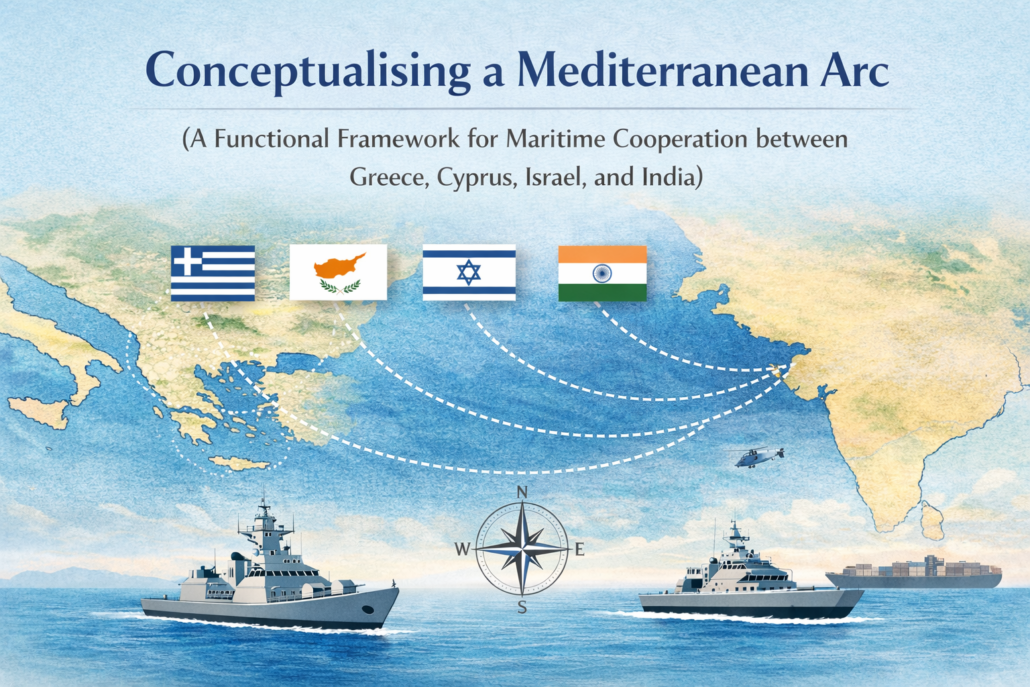
The challenge for New Delhi, therefore, is not whether to react to speculative blocs, but whether to shape the evolving Indo-Mediterranean order in ways that safeguard its long-term interests. This paper advances the concept of a Mediterranean Arc (MedArc) as a sustained, policy-aligned framework through which India can anchor itself west of Suez — not as part of a counter-bloc, but as a strategic presence. Through calibrated partnerships, maritime coordination, and institutional continuity, the MedArc offers India strategic hold without alliance entanglement, and influence without overextension.
Intended for policymakers, strategic planners, and maritime security practitioners in India, Cyprus, Greece and Israel, this article moves the conversation beyond episodic bilateral engagement toward a structured conceptualisation of the MedArc as a functional framework. By outlining shared pillars of cooperation and identifying institutional pathways for implementation, it seeks to encourage proactive shaping of an Indo-Mediterranean maritime architecture that enhances strategic depth, secures connectivity and reinforces resilience west of Suez.
The Mediterranean Arc: Continuity and Strategic Autonomy
The Mediterranean Arc must be understood not as an abstract geopolitical construct but as a calibrated extension of India’s strategy of multi-alignment.[9] Unlike formal military alliances that risk constraining diplomatic manoeuvrability or provoking adversarial signalling, the MedArc is conceived as a flexible cooperation framework well-suited to a multipolar environment. It enables India to deepen engagement with key partners — Greece, Cyprus and Israel — without entering binding mutual defence commitments or explicitly positioning itself against any third party. This distinction is critical: the objective is structural embedding, not bloc formation.[10]
The trilateral framework between Greece, Cyprus and Israel — operational since 2016 — has progressively expanded from energy coordination to structured defence consultations and maritime cooperation.[11] India’s engagement with these States has similarly moved beyond episodic diplomacy. The elevation of India–Greece ties to a Strategic Partnership in 2023[12], the inauguration of an India–Greece Maritime Security Dialogue[13], and regular naval port calls in the Mediterranean reflect a steady institutionalisation of security engagement.[14] Parallel developments include the 2025–2029 Action Plan between India and Cyprus, spanning maritime security, fintech, energy cooperation and coordination in support of advancing the EU–India Free Trade Agreement.[15] These mechanisms signal policy alignment rather than symbolic outreach.
Importantly, the MedArc is not conceived as a reactive counterweight to Turkish assertiveness or earlier discourse around an “Islamic NATO.” Its rationale is longer-term. By prioritising continuity, coordination and resilience, India positions itself within the Mediterranean security calculus without adopting the rigid, enmity-based posture associated with traditional military blocs.[16] The emphasis is functional: maritime situation/domain awareness, infrastructure security, naval interoperability, connectivity protection and economic integration. Such an approach aligns with the logic underpinning the India–Middle East–Europe Economic Corridor, which depends on stability and cooperation across precisely this trans-regional arc.[17]
The path forward, however, demands careful calibration. The resurgence of conflict in West Asia has already exposed the vulnerability of trans-regional connectivity initiatives. Economic asymmetries among partner States and the enduring tensions between Greece and Türkiye require diplomatic steadiness from New Delhi. India must therefore navigate these volatile theatres in keeping with its middle-path tradition — expanding presence through functional, non-military collaboration while avoiding overextension.[18] Strategic depth west of Suez will not be secured through declaratory alignment, but through patient institutional layering that reinforces India’s role as a stabilising maritime actor in an increasingly interconnected Indo-Mediterranean space.
Operationalising the MedArc: Converging Bilateral Strengths
If the MedArc provides the conceptual frame, its durability rests on how effectively India weaves together its bilateral partnerships with Greece, Cyprus and Israel into a coherent, mutually reinforcing strategy. These States are not merely tactical collaborators; they are democracies with shared stakes in maritime stability, infrastructure protection and a rules-based order. The strength of the MedArc lies in differentiated synergies — each partner anchors a distinct pillar of India’s westward strategy while deriving tangible strategic and economic benefits from deeper engagement with New Delhi.
Greece: The Strategic and Military Pivot. Greece serves as India’s principal strategic pivot in the Mediterranean, providing geographic depth at the gateway to Europe and operational access in the Aegean and Eastern Mediterranean theatres. Since the elevation of bilateral ties to a Strategic Partnership in 2023, defence cooperation has gained operational substance. The maiden India–Greece bilateral maritime exercise in September 2025[19] — involving advanced anti-submarine warfare and coordinated manoeuvres — marked a transition from goodwill port calls to structured naval interoperability. The subsequent India–Greece Maritime Security Dialogue institutionalised discussions on maritime situational awareness (MSA) and a discernible movement towards domain awareness (MDA), sea lane security and emerging naval technologies.[20]
For India, Greece offers three advantages: proximity to key Mediterranean chokepoints, political leverage within the European Union (EU), and a capable naval partner experienced in managing contested maritime spaces. For Athens, engagement with India diversifies its strategic partnerships beyond traditional Euro-Atlantic structures and strengthens deterrence signalling in a volatile Aegean environment. Reported discussions on defence-industrial cooperation, including missile technologies and data-sharing mechanisms, suggest a gradual move towards capability-based alignment rather than symbolic convergence.[21]
Cyprus: The Logistical and Regulatory Bridge. Cyprus anchors the MedArc’s logistical, regulatory and intelligence dimension, functioning as a stable maritime node embedded within European financial and legal systems. Prime Minister Narendra Modi’s 2025 visit to Nicosia produced a Five-Year Joint Action Plan (2025–2029) covering maritime security, defence industry collaboration, fintech integration and digital cooperation.[22] Cyprus’ strategic location along major east–west shipping routes and its well-developed shipping registry system offer India a reliable entry point into Mediterranean commercial networks. Ongoing coordination on maritime cybersecurity and monitoring irregular shipping activity complements India’s own Information Fusion Centre–Indian Ocean Region (IFC-IOR), effectively extending situational awareness west of Suez.
For Nicosia, deeper engagement with India expands economic diversification, attracts investment into port and shipping infrastructure, and embeds Cyprus within the wider connectivity architecture associated with the India–Middle East–Europe Economic Corridor.[23] The relationship thus merges logistics, digital security and regulatory alignment into a coherent bridge between South Asia and Europe.
Israel: The Technology and Infrastructure Catalyst. Israel provides the technological, defence-industrial and infrastructure backbone of the MedArc, linking maritime cooperation with advanced innovation ecosystems. As one of India’s foremost defence suppliers and technology partners, Israel anchors collaboration in missile systems, unmanned platforms, cybersecurity and artificial intelligence.[24] Its strategic infrastructure — including Haifa Port as a critical Mediterranean node — intersects directly with IMEC’s westward corridor logic. Energy interconnection initiatives linking Israeli, Cypriot and Greek grids further reinforce the Mediterranean’s role as a connectivity hub.[25]
For India, Israel offers cutting-edge defence technology, intelligence cooperation, and innovation-driven resilience, across sectors ranging from cyber defence to water security. For Israel, partnership with India broadens access to Asian markets, strengthens strategic outreach beyond the immediate region, and situates bilateral ties within a larger Indo-Mediterranean framework.
To illustrate how these bilateral synergies translate into concrete policy outcomes and strategic benefits, the following table synthesises objectives, mechanisms and desired geopolitical payoff:
| Strategic Objective | Mediterranean Arc Implementation Mechanism | Desired Geopolitical Outcome |
| Strategic depth, west of Suez | Sustained naval presence, port access in Greece/Israel, and institutionalised security dialogues.[26] | Enhanced maritime situational awareness and influence over Mediterranean sea lanes. |
| Economic Safeguarding | Integration of IMEC connectivity with Greek and Israeli ports; focus on Blue Economy.[27] | Resilience of supply chains against regional disruption and chokepoint blockade |
| Infrastructure Protection | Coordination through the Maritime Cybersecurity Centre of Excellence and Information Fusion Centre Indian Ocean Region.[28] | Security of undersea data cables and energy pipelines critical for global commerce |
| Normative Influence | Multi-alignment and adherence to UNCLOS without formal military treaties | Maintenance of Strategic autonomy while contributing to a rules-based region order |
Operationalising the Mediterranean Arc: Four Functional Pillars
If the MedArc provides the strategic logic, its credibility depends on operational coherence. Rather than a declaratory alignment, it rests on four functional pillars: Maritime Situational / Domain Awareness (MSA/MDA), Infrastructure Resilience, IMEC-linked Connectivity and Blue Economy integration, and Humanitarian Assistance and Disaster Relief (HADR). These pillars convert political convergence into sustained, structured cooperation across the Indo-Mediterranean.
Pillar I: Maritime Situational Awareness (MSA), Maritime Domain Awareness (MDA), and Information-Sharing
The creation of a comprehensive Common Operating Picture (COP) is the indispensable starting point for regional security. Al three countries have reasonable MSA, which is the foundation of MDA and is described as the comprehensive fusion of data to improve knowledge of a particular area or situation of interest within the maritime domain. All three are well placed to integrate maritime awareness across the wider geography of the MedArc and can thus move towards genuine MDA, which is defined as, the effective understanding of any activity associated with the maritime environment that could impact upon the security, safety, economy or environment.[29] In the Indo-Mediterranean context, this extends beyond naval deployments to include “white shipping” data — commercial vessels, fishing fleets and irregular maritime actors operating across interconnected sea lanes.[30]
India’s IFC-IOR, established in 2018, provides a tested institutional template. By hosting International Liaison Officers (ILOs) and maintaining dozens of operational linkages with maritime agencies, it enables near real-time information exchange and maritime trend analysis.[31] Integrating MedArc partners into this ecosystem — through the positioning of an Israeli liaison presence and structured communication channels with Greek and Cypriot maritime authorities — would generate a trans-regional MDA grid, capable of monitoring illicit trafficking, sanctions evasion, irregular migration and grey-zone maritime tactics in the Eastern Mediterranean.[32]
This architecture would function through complementary institutional nodes:
| Institutional Framework | Geographic Focus | Primary Function |
| IFC-IOR (India) | Indian Ocean Region | Nodal centre for maritime security information sharing and COP generation |
| Maritime Cybersecurity Centre of Excellence (Cyprus) | Eastern Mediterranean | Protection of maritime cyber systems and digital infrastructure[33] |
| National Maritime Information Sharing Centres (India) | National/Regional | Localised information hubs linked to partner nations[34] |
| Eastern Mediterranean Gas Forum | Mediterranean Basin | Energy coordination with maritime security implications[35] |
Technologically, effective MDA requires information-sharing (which essentially distinguishes it from MSA), a “tip-and-cue” approach that fuses Synthetic Aperture Radar (SAR), electro-optical sensors, radio frequency detection, and Automatic Identification System (AIS) data. The decisive innovation lies in reducing latency between detection and decision-making.[36] Machine-learning (ML) tools can identify anomalous patterns such as AIS shutdowns, route deviation, suspicious loitering near subsea infrastructure, etc. Israel’s strength in sensor- and cyber technologies,[37] India’s space-based surveillance assets and experience in managing a vast Exclusive Economic Zone, and the geographic positioning of Greece and Cyprus, collectively bridge Asian and European maritime awareness systems. The result is not duplication but layered situational awareness, and, through information-sharing technologies, procedures, and processes, increased maritime domain awareness across the Indian Ocean and the Mediterranean theatres.
Pillar II: Infrastructure Resilience and the Submerged Domain
Critical maritime infrastructure — incorporating subsea pipelines, electricity interconnectors, and fibre-optic cables, amongst a host of others — has emerged as a new frontier of maritime security. These assets underpin regional energy markets and digital connectivity. By corollary, their disruption would have serous and adverse systemic consequences. For the MedArc, their protection is a strategic necessity.
The Eastern Mediterranean is a dense corridor for undersea cables linking Europe, West Asia and India.[38] These face accidental risks as well as deliberate sabotage in grey-zone contexts.[39] The MedArc framework addresses such vulnerabilities through coordinated naval patrolling, seabed monitoring and the establishment of a Maritime Cybersecurity Centre of Excellence (MCCE) in Cyprus (2026).[40] This MCCE is intended to bridge civilian and military stakeholders, strengthening the cyber resilience of navigation, port management, and communication systems.[41] For India, cooperation with Cyprus and Israel secures the western nodes of its digital and commercial connectivity; Greece contributes surveillance capacity and joint training frameworks.[42]
Energy infrastructure reinforces this logic. Major gas discoveries in the Levant Basin — including Israel’s Leviathan and Tamar fields and Cyprus’ Aphrodite field — have transformed the region’s geoeconomic profile.[43] Associated interconnectors and transport projects require sustained maritime security coordination:
| Infrastructure Project | Type | Participants | Strategic Significance |
| Great Sea Interconnector[44] | Undersea electricity cable | Israel–Cyprus–Greece | Integrates regional grids; reduces energy isolation |
| EastMed Pipeline[45] | Natural gas pipeline | Israel–Cyprus–Greece | Transports Levant gas to Europe; enhances energy resilience |
| GREGY Link[46] | Power interconnection | Greece–Egypt | Connects North Africa to Europe; relevant to wider Arc stability |
Coordinated naval presence and subsea monitoring provide a protective envelope for these assets. India’s maritime expansion aligns with the shared objective of ensuring freedom from threats arising “in”, “from”, or “through” the sea — encompassing both conventional conflict and disruptions to energy flows or the marine environment.
Pillar III: IMEC Connectivity and the Blue Economy
The India–Middle East–Europe Economic Corridor (IMEC) constitutes the economic backbone of the MedArc. Designed to link India to Europe through multimodal rail and shipping networks via West Asia and the Levant, IMEC remains a structural driver of cooperation despite geopolitical turbulence. Its viability depends on secure maritime routes and efficient Mediterranean terminals.
The Israeli port of Haifa, which serves as a vital logistics hub where rail networks from West Asia meet the sea, is a key link in this “Northern Corridor” of the IMEC.[47] Greece’s port of Piraeus, Thessaloniki and Alexandroupoli, provide access to European markets and inland transport corridors.[48] Cyprus serves as a strategic logistics and regulatory node within the European Union framework.[49]
| Key Port/Hub | Role in IMEC | Strategic Advantage |
| Haifa (Israel) | Rail-to-sea node | Direct interface with Gulf rail networks |
| Piraeus (Greece) | European terminal | Deep-sea capacity and EU rail linkages |
| Limassol (Cyprus) | Regional logistics hub | EU jurisdiction and transshipment advantage |
| Alexandroupoli (Greece) | Eastern Europe gateway | Emerging energy and cargo corridor |
Cyprus’ status as a major shipping registry and EU gateway provides a stable jurisdictional platform for Indian maritime enterprises, while also offering scope to align IMEC with broader European infrastructure funding frameworks.[50]
Beyond connectivity, the Blue Economy adds a sustainability dimension to the MedArc. Offshore renewables, sustainable aquaculture, marine biotechnology and maritime tourism represent non-military avenues of cooperation consistent with global climate and ocean governance goals. The BCCE in Cyprus reflects this orientation, and India’s marine scientific capabilities complement the regulatory and shipping expertise available with Cyprus. The MedArc thus integrates growth, sustainability and security within a single maritime framework.[51]
Pillar IV: Humanitarian Assistance and Cooperative Resilience
Humanitarian Assistance and Disaster Relief (HADR) provides the most visible and trust-building dimension of the MedArc. Both, the Mediterranean Sea and the Indian Ocean are environmentally volatile, vulnerable to wildfires, cyclones, marine pollution, and complex emergencies. Institutionalising HADR cooperation through a trilateral working group on emergency preparedness ensures rapid mutual assistance and operational interoperability.[52]
| HADR Mechanism | Primary Function | Regional Impact |
| Cyprus Regional Aerial Firefighting Station | Wildfire suppression | Rapid response across Eastern Mediterranean[53] |
| Marine Oil Pollution Contingency Plan | Spill containment and recovery | Joint exercises (2026) to protect vulnerable Mediterranean ecosystems[54] |
| Amalthea Maritime Corridor | Humanitarian aid distribution | Coordinated aid delivery to Gaza involving Cyprus, Israel and Greece[55] |
| MAITRI Disaster Platform | Regional resilience and relief | India initiative for broader Indo-Pacific HADR cooperation[56] |
Cooperation extends to maritime search and rescue and crisis logistics. The Amalthea corridor demonstrated the grouping’s ability to coordinate humanitarian flows under complex conditions.[57] India’s experience as a first responder in the Indian Ocean — conducting evacuation and relief operations at scale — provides operational depth that can be institutionalised through joint training, shared standard operating procedures and interoperable planning.[58]
Collectively, these four pillars move the MedArc from concept to structured architecture. Maritime awareness underpins security; infrastructure resilience protects prosperity; connectivity integrates markets; and HADR builds legitimacy. The result is a flexible, function-driven maritime partnership anchored in shared strategic interests across the Indo-Mediterranean continuum.
Strategic Constraints and Geopolitical Cross-Pressures
While the MedArc presents a structured and function-driven framework, its consolidation will unfold within a dense and competitive geopolitical environment. The MedArc is not, after all, being built in a vacuum; it intersects with existing rivalries, alliance systems, energy politics and great-power competition. Its durability, therefore, depends not only on operational coherence but also on the management of external sensitivities and structural constraints.
Turkish Sensitivities and Eastern Mediterranean Rivalries. Any security architecture involving Greece, Cyprus and Israel inevitably interacts with the strategic calculus of Türkiye. Ankara’s assertive maritime posture in the Eastern Mediterranean — framed through its “Blue Homeland” doctrine — reflects long-standing disputes over Exclusive Economic Zones, hydrocarbon exploration, and the political status of Cyprus.[59] Although the MedArc is not conceived as an exclusionary bloc, deeper maritime coordination among its members could be perceived by Türkiye as indirectly reinforcing rival alignments.
For India, this demands a delicate balancing act. New Delhi maintains functional defence and economic ties with Ankara even amid episodic political friction. The MedArc must, therefore, avoid appearing as a containment mechanism. Its emphasis on infrastructure protection, connectivity and HADR provides useful strategic ambiguity, allowing cooperation to remain issue-based rather than overtly coalitionary. However, in periods of heightened Greek–Turkish tensions, India may face pressure to calibrate its visibility.
European Union Dynamics and Institutional Complexity. The MedArc’s economic and connectivity ambitions are intertwined with EU regulatory frameworks and funding mechanisms. Ports such as Piraeus and Limassol operate within EU competition law, State-aid regulations, and trans-European transport network priorities.[60] While Cyprus’ presidency of the Council of the EU in 2026 may create political momentum, institutional processes in Brussels are often slow and consensus-driven.[61]
Moreover, intra-EU divergences on relations with West Asia, energy diversification, and defence-industrial policy may affect how enthusiastically IMEC-linked initiatives are embraced. The MedArc must, therefore, navigate not only State-level diplomacy but also supranational regulatory ecosystems. This adds complexity to project timelines and financing structures.
NATO, Russia, and Security Layering. Security coordination in the Mediterranean cannot be disentangled from NATO’s presence. Greece is a NATO member; Israel is a close NATO partner; and Cyprus, though not a member, cooperates with European security frameworks. Any expansion of maritime information-sharing or infrastructure protection mechanisms must remain compatible with existing alliance structures.
Simultaneously, Russia retains a sustained naval footprint in the Eastern Mediterranean and views regional energy corridors and NATO-linked activities through a competitive lens. Although the MedArc is certainly not directed against Moscow, enhanced MSA/MDA integration, or coordinated naval patrolling, could be interpreted as part of a broader Western-aligned security network. India’s historically balanced relationship with Russia adds another layer of diplomatic sensitivity. Maintaining the MedArc’s functional, non-alliance character will be essential to avoid entanglement in extra-regional rivalries.
China’s Economic Footprint and Connectivity Competition. The Mediterranean is also a theatre of Chinese commercial engagement, particularly through port investments and infrastructure-financing under the Belt and Road Initiative (BRI).[62] The presence of Chinese capital in key logistics nodes — including Piraeus — complicates the strategic landscape.[63] IMEC is frequently interpreted as a connectivity alternative, even if its declared purpose is diversification rather than competition.[64]
For MedArc members, economic pragmatism often coexists with strategic hedging. For India, positioning IMEC as complementary rather than confrontational may reduce zero-sum perceptions. Yet geopolitical narratives may nonetheless frame the MedArc within broader US–China competition, especially if infrastructure financing and supply-chain reconfiguration accelerate.
Regional Instability and Conflict Spillover. The Eastern Mediterranean and the Levant remain volatile. Escalation involving Israel, instability in Gaza, or broader regional conflict, could easily disrupt connectivity corridors, energy projects, and humanitarian channels. The Amalthea corridor demonstrated the MedArc’s capacity for coordinated response; yet sustained conflict would test the resilience of commercial flows and political cohesion.[65]
Further, subsea infrastructure remains vulnerable to hybrid tactics, cyber intrusions and sabotage. Even with advanced MDA systems and cyber resilience measures, effective deterrence is unrealistic. The MedArc must therefore prioritise redundancy, rapid response mechanisms, and crisis-management protocols, rather than assuming immunity from disruption.
Strategic Autonomy and Resource Allocation. Finally, there are internal constraints. India’s maritime resources, though expanding, are finite, and primarily oriented toward the Indian Ocean and Indo-Pacific theatres. Sustained presence west of Suez requires logistical planning, diplomatic bandwidth, and defence-industrial coordination. Overextension risks diluting focus in primary theatres. Similarly, Greece, Cyprus and Israel each operate within domestic political cycles and fiscal considerations. Infrastructure resilience and subsea monitoring are capital-intensive endeavours. Political changes could recalibrate priorities, particularly if economic pressures intensify.
Managing Constraints Through Functionalism. These constraints do not invalidate the MedArc; rather, they define its operating environment. The MedArc’s strength lies precisely in its functional and pillar-based design. By focusing on MDA integration, infrastructure protection, connectivity and HADR — rather than formal defence commitments — it preserves strategic flexibility. Its incrementalism allows cooperation to deepen without triggering overt balancing behaviour.
The test of the MedArc will, therefore, not be the absence of geopolitical friction, but its ability to remain adaptive amidst such friction. If it can sustain institutional linkages, protect critical infrastructure, and deliver tangible economic and humanitarian benefits despite external pressures, it will mature from a strategic concept into a durable maritime architecture across the Indo-Mediterranean continuum.
Conclusion
The MedArc represents a calibrated evolution in India’s westward maritime engagement — neither an alliance structure nor a symbolic diplomatic alignment, but a functional architecture anchored in shared interests. By integrating MDA, infrastructure resilience, IMEC-linked connectivity, Blue Economy cooperation, and HADR coordination, the MedArc translates strategic convergence into operational substance. It links India’s expanding maritime footprint with the geographic centrality of Greece, Cyprus and Israel, thereby extending India’s strategic depth west of Suez, while reinforcing stability across the Eastern Mediterranean.
At the same time, the MedArc is shaped by a complex geopolitical environment — from Turkish sensitivities and EU institutional processes to NATO layering, and great-power competition. Its durability will therefore depend less on declaratory ambition and more on incremental institutionalisation. The emphasis on information-sharing, infrastructure protection and humanitarian cooperation provides a degree of strategic ambiguity that preserves India’s autonomy while strengthening regional resilience.
Ultimately, the Mediterranean Arc signals a broader transformation in India’s maritime outlook: from a predominantly Indian Ocean focus to a more continuous Indo-Mediterranean conception of strategic space. If sustained through pragmatic cooperation and insulated from overt bloc politics, it can evolve into a flexible, multi-layered partnership that enhances connectivity, secures critical infrastructure and contributes to a rules-based maritime order without formal treaty entanglements. In doing so, it positions India not merely as a participant in Mediterranean affairs, but as a shaping actor in the wider maritime continuum linking the Indian Ocean to Europe.
*******
About the Authors
Ms Aditi Thakur is a Research Associate at the National Maritime Foundation. She holds a master’s degree in political science from Centre for Political Studies, Jawaharlal Nehru University, New Delhi. Her research primarily focuses upon the manner in which India’s own maritime geostrategies in the Indo-Pacific are impacted by those of Russia and Turkey. She may be contacted at irms3.nmf@gmail.com.
Ms Saaz Lahiri is a Research Associate at the National Maritime Foundation (NMF). She holds a bachelor’s degree in ‘History and International Relations’, and a Post Graduate Diploma in ‘International Relations’ from Ashoka University. Her research focuses upon the manner in which India’s maritime strategies interface and interact with those of the European Union (EU), its member-States, and the UK. She can be reached at eu4.nmf@gmail.com.
Endnotes:
[1] Selcan Hacaoglu, Faseeh Mangi, and Firat Kozok, “Turkey Said to Seek Membership of Saudi-Pakistan Defense Pact,” Bloomberg, -09 January 2026. https://www.bloomberg.com/news/articles/2026-01-09/turkey-said-to-seek-membership-of-saudi-pakistan-defense-pact
[2] “No ‘Islamic NATO’: Saudi Arabia Rejects Turkey’s Inclusion in Pakistan Defence Pact,” The Week, 06 February 2026. https://www.theweek.in/news/middle-east/2026/02/06/no-islamic-nato-saudi-arabia-rejects-turkeys-inclusion-in-pakistan-defence-pact.html
[3] Burak Elmalı, “The Logic Behind a Türkiye-Saudi-Pakistan Alignment,” Daily Sabah, 01 February 2026. https://www.dailysabah.com/opinion/op-ed/the-logic-behind-a-turkiye-saudi-pakistan-alignment
[4] Salim Çevik, “Turkey’s Repositioning in the Middle East’s Emerging Order,” Arab Center Washington DC, 17 June 2025. https://arabcenterdc.org/resource/turkeys-repositioning-in-the-middle-easts-emerging-order/
[5] Aditi Thakur, “Türkiye in the Indian Ocean: Strategic Implications for India’s Maritime Outlook,” National Maritime Foundation, 12 June 2025. https://maritimeindia.org/turkiye-in-the-indian-ocean-strategic-implications-for-indias-maritime-outlook/
[6] Ministry of Defence, “Raksha Mantri Holds Bilateral Talks with Minister of National Defence of Hellenic Republic in New Delhi,”, Press Information Bureau, Government of India, 09 February 2026. https://www.pib.gov.in/PressReleasePage.aspx?PRID=2225523®=3&lang=2
[7] “Greece Pushes ‘Mediterranean QUAD’ Concept as Counterweight to Turkey-Led Islamic Bloc, Will India Join?” Indian Defence Research Wing, 30 January 2026. https://idrw.org/greece-pushes-mediterranean-quad-concept-as-counterweight-to-turkey-led-islamic-bloc-will-indian-join/
[8] Ministry of External Affairs, Government of India, “India-Israel Joint Statement (26 February 2026),” Bilateral Document No 40828, Bilateral/Multilateral Documents, 26 February 2026. https://www.mea.gov.in/bilateral-documents.htm?dtl/40828
[9] Defne Gonnec and Rajeev Ranjan Chaturvedy, “Drivers of Indian Foreign Policy in the Eastern Mediterranean: A Review of the Indian Foreign Policy towards Greece and Egypt,” The International Journal of Economic and Social Research, 2023, 19 (2), 517. https://dergipark.org.tr/tr/download/article-file/3269194
[10] Devasmita Dutta, “India and the Quad: Strategic Balancing or Containment of China?” CESCUBE, 25 August 025. India and the QUAD: Strategic Balancing or Containment of China?
[11] Elis Gjevori, “What’s Netanyahu’s Planned ‘Hexagon’ Alliance – and can it work?” ALJAZEERA, 23 February 2026. https://www.aljazeera.com/news/2026/2/23/whats-netanyahus-planned-hexagon-alliance-and-can-it-work
[12] Government of India, Ministry of External Affairs, “India-Greece Joint Statement”, 22 February 2024, https://www.mea.gov.in/bilateral-documents.htm?dtl/37656/IndiaGreece_Joint_Statement
[13] Government of India, Ministry of External Affairs, “Inaugural India-Greece Maritime Security Dialogue (December 11, 2025). 11 December 2025. https://www.mea.gov.in/press-releases.htm?dtl/40446/Inaugural_India_Greece_Maritime_Security_Dialogue_December_11_2025
[14] “INS Tamal Concludes Port Call at Souda Bay, Greece,” Indian Navy Website, https://indiannavy.gov.in/content/ins-tamal-concludes-port-call-souda-bay-greece
See Also:
“Arrival of HS Psara at the Port of Mumbai,” Hellenic Navy, 14 July 2025. https://hellenicnavy.gr/en/kataplous-tis-fregatas-psara-sto-limena-tis-vomvais/
[15] Trade and Economic Security, “EU-India Free Trade Agreement, Investment Protection Agreement and Geographical Indications Agreement”, European Commission. https://policy.trade.ec.europa.eu/eu-trade-relationships-country-and-region/countries-and-regions/india/eu-india-agreements_en
[16] “Mediterranean Quad: India eyes Strategic Entry into Greece-Cyprus-Israel Axis,” Resonant News, 26 January 2026. https://resonantnews.com/2026/01
[17] Finance Newsroom, “Greece Highlights Strategic Role in Emerging IMEC Corridor,” Tovima, 05 December 2025. Greece Highlights Strategic Role in Emerging IMEC Corridor – tovima.com
[18] Defne Gonnec and Rajeev Ranjan Chaturvedy, “Drivers of Indian Foreign Policy in the Eastern Mediterranean.”
[19] Government of India, Ministry of Defence, Indian Navy, “Maiden Bilateral Maritime Exercise between Indian Navy and Hellenic Navy Concludes in the Mediterranean”, 20 September 2025. https://www.pib.gov.in/PressReleasePage.aspx?PRID=2168932®=3&lang=2
[20] Ajay Banerjee, “India, Greece Sign Joint Declaration to Boost Defence Industrial Cooperation”, The Tribune, 10 February 2026. https://www.tribuneindia.com/news/india/india-greece-sign-joint-declaration-to-boost-defence-industrial-cooperation/
[21] Arun Kumar, “India and Greece Forge Ahead: A New Era in Defence Industrial Cooperation”, Geojuristtoday, 16 February 2026. https://www.geojuristoday.in/post/india-and-greece-forge-ahead-a-new-era-in-defence-industrial-cooperation
See also,
“India’s “unofficial offering” of S400-Evading Cruise Missile to Greece shakes Turkey”, Economic Times, 07 July 2025. https://economictimes.indiatimes.com/news/new-updates/indias-unofficial-offering-of-s400-evading-cruise-missile-to-greece-shakes-turkey/articleshow/122291543.cms?utm_source=contentofinterest&utm_medium=text&utm_campaign=cppst
[22] Government of India, Ministry of External Affairs, “Joint Declaration on the Implementation of the Comprehensive Partnership between the Republic of Cyprus and the Republic of India (June 16, 2025)”, 16 June 2025. https://www.mea.gov.in/bilateral-documents.htm?dtl/39681/Joint_declaration_on_the_implementation_of_the_comprehensive_partnership_between_the_Republic_of_Cyprus_and_the_Republic_of_India_June_16_2025
[23] Kallol Bhattacherjee, “Cyprus Ready to be Part of the IMEC: Foreign Minister Kombos”, The Hindu, 31 October 2025. https://www.thehindu.com/news/national/cyprus-ready-to-be-part-of-imec-foreign-minister-kombos/article70222736.ece#:~:text=%E2%80%9CCyprus%20attaches%20great%20importance%20
[24] Haim Azure, “India–Israel: A Strategic Convergence in a Changing World,” The Jerusalem Strategic Tribune, February 2026. https://jstribune.com/india-israel-a-strategic-convergence-in-a-changing-world/
[25] Rafi Glick, “Modi in Israel Amid US Iran Tensions: The Axis, IMEC and the Path to Great Power,” The Times of Israel, 24 February 2026. https://blogs.timesofisrael.com/modi-in-israel-amid-us-iran-tensions-the-axis-imec-and-the-path-to-great-power/
[26] Zee Media Bureau, “From Mediterranean To Caucasus: Why Indian Navy is Sending Warships Near Turkey; How These Countries Are Helping New Delhi,” Z News, 06 October 2025. From Mediterranean To Caucasus: Why Indian Navy Is Sending Warships Near Turkey; How These Countries Are Helping New Delhi | World News | Zee News
[27] Rafi Glick, “Modi in Israel Amid US Iran Tensions: The Axis, IMEC and the Path to Great Power.”
[28] “Israel: Trilateral Summit with Cyprus and Greece Strengthens Security, Energy, and Development,” Nova News, 22 December 2025. Israel: Trilateral summit with Cyprus and Greece strengthens security, energy, and development – Nova Agency
[29] Capt (Dr) Nitin Agarwaka, Dr Ram Erez and Suriya Narayanan, “Enhancing Maritime Domain Awareness In The Indo-Pacific And The Eastern Mediterranean Regions: Indian And Israeli Perspective”, National Maritime Foundation, 02 August 2021. enhancing Maritime Domain Awareness in the Indo-Pacific and the Eastern Mediterranean Regions: Indian And Israeli Perspective – National Maritime Foundation
[30] Capt (Dr) Nitin Agarwaka, Dr Ram Erez and Suriya Narayanan, “Enhancing Maritime Domain Awareness In The Indo-Pacific And The Eastern Mediterranean Regions”.
[31] IFC-IOR, Indian Navy, https://ifcior.indiannavy.gov.in/about_us
[32] Capt (Dr) Nitin Agarwaka, Dr Ram Erez and Suriya Narayanan, “Enhancing Maritime Domain Awareness In The Indo-Pacific And The Eastern Mediterranean Regions”.
[33] Nova News, “Israel: Trilateral summit with Cyprus and Greece Strengthens Security, Energy, and Development.”
[34] Anum Khan, “India’s Maritime Capacity-Building and Capability-Enhancement in the Western Indian Ocean,” National Maritime Foundation, 23 July 2025. https://maritimeindia.org/indias-maritime-capacity-building-and-capability-enhancement-in-the-western-indian-ocean/
[35] Elis Gjevori, “What’s Netanyahu’s Planned ‘Hexagon’ Alliance – and Can It Work?”
[36] Dr Kumar Navulur, “Maritime Domain Awareness: When Every Hour Counts”, Synespective, 03 November 2025. Maritime Domain Awareness: When Every Hour Counts – Synspective
[37] Capt (Dr) Nitin Agarwaka, Dr Ram Erez and Suriya Narayanan, “Enhancing Maritime Domain Awareness In The Indo-Pacific And The Eastern Mediterranean Regions”.
See also:
IAI, “Maritime Domain Awareness: Integrated Sensing for Coastal and Deep-sea Operations”, https://www.iai.co.il/solution/maritime-domain-awareness/
[38] Christian Bueger, “The Mediterranean Subsea: Protecting a Super Data Highway”, IEMed, 2023. https://www.iemed.org/publication/the-mediterranean-subsea-protecting-a-super-data-highway/
[39] Government of Israel, Israel National Cyber Directorate, “Israel, Greece, and Cyprus Launch Joint Maritime Cybersecurity Center of Excellence (MarCCE)”, 26 February 2026. https://www.gov.il/en/pages/mcce260226
[40] Nova News, “Israel: Trilateral Summit with Cyprus and Greece Strengthens Security, Energy, and Development”.
[41] Nova News, “Israel: Trilateral summit with Cyprus and Greece Strengthens Security, Energy, and Development”.
[42] “Cyprus, Greece and Israel Quietly Strengthen Their Mediterranean Alliance”, The Maritime Executive, 31 December 2025. Cyprus, Greece and Israel Quietly Strengthen Their Mediterranean Alliance
[43] Hriday Sharma, “Natural Gas Discoveries in the Levant Basin: India’s Prospects”, National Maritime Foundation, 30 March 2016. https://maritimeindia.org/natural-gas-discoveries-in-the-levant-basin-indias-prospects/
[44] “Powering Nations, Connecting Futures”, Great Sea Connector, https://www.great-sea-interconnector.com/en
[45] Amichai Stein, “Israel to Europe Gas Pipeline Idea Back on Table, Minister Eli Cohen tells ‘Post’”, The Jerusalem Post, 06 November 2025. https://www.jpost.com/israel-news/article-872979
[46] Aid, Development Cooperation, Fundamental Rights, “GREGY – High Voltage Electrical Interconnection in the Eastern Mediterranean”, European Commission, https://international-partnerships.ec.europa.eu/policies/global-gateway/gregy-high-voltage-electrical-interconnection-eastern-mediterranean_en
[47] Naga Bindhu Madhuri Annem, “Oman’s Integration into IMEC: Strategic Imperatives for Enhancement of the IMEC Eastern Corridor”, National Maritime Foundation, 09 July 2025. https://maritimeindia.org/omans-integration-into-imec-strategic-imperatives-for-enhancement-of-the-imec-eastern-corridor/
[48] Security and Foreign Policy, “Connecting Opportunities: Greece’s Strategic Role in the India-Middle East – Europe Economic Corridor (IMEC)”, Hellenic Foundation for European & Foreign Policy, 22 January 2025. https://www.eliamep.gr/en/syndeontas-efkairies-o-stratigikos-rolos-tis-elladas-ston-oikonomiko-diadromo-indias-mesis-anatolis-evropis-imec/
[49] “Supply Chain in Cyprus: A Strategic Logistics Bridge between Continents”, Mailboxes etc., 25 September 2025. https://mbefranchise.com/blog/supply-chain-in-cyprus-a-strategic-logistics-bridge-between-continents/
[50] Greater Kashmir, “PM Modi’s Cyprus Visit Heralds New Chapter in India-EU partnership”, 16 June 2025. PM Modi’s Cyprus visit heralds new chapter in India–EU partnership
[51] Government of India, Ministry of External Affairs, “Joint Declaration on the Implementation of the Comprehensive Partnership between the Republic of Cyprus and the Republic of India (June 16, 2025)”, 16 June 2025. Joint declaration on the implementation of the comprehensive partnership between the Republic of Cyprus and the Republic of India (June 16, 2025)
[52] Mose Apelblat, “Cyprus Reinforces Trilateral Cooperation in Eastern Mediterranean Ahead of EU Presidency”, The Brussels Times, 24 December 2025. Cyprus reinforces trilateral cooperation in eastern Mediterranean ahead of EU Presidency
[53] Menelaos Hadjicostis, “Cyprus will Host a Regional Firefighting Hub as Climate Change Worsens Blazes”, Helicopters, 10 September 2025. Cyprus will host a regional firefighting hub as climate change worsens blazes – Helicopters MagazineHelicopters Magazine
[54] “Strengthening National Oil Spill Contingency Plans in Central and Eastern Mediterranean Countries”, International Maritime Organisation, 26 October 2022. https://www.imo.org/en/mediacentre/pages/whatsnew-1777.aspx
[55] Government of Cyprus, Ministry of Foreign Affairs, “Joint Statement by the Republic of Cyprus and the United Arab Emirates on the Humanitarian Assistance for the civilians in Gaza through the Maritime Corridor (Amalthea)”, 29 August 2025. Joint Statement by the Republic of Cyprus and the United Arab Emirates on the Humanitarian Assistance for the civilians in Gaza through the Maritime Corridor (Amalthea) – Gov.cy
[56] Devasmita Dutta, “India and the Quad: Strategic Balancing or Containment of China?”
[57] Mose Apelblat, “Cyprus Reinforces Trilateral Cooperation in Eastern Mediterranean ahead of EU Presidency”.
[58] Vice Admiral Pradeep Chauhan (Retd), “Foreword”, Maritime Perspectives 2022: Non-Traditional Dimensions of Maritime Security (National Maritime Foundation, 2022), iv. https://maritimeindia.org/wp-content/uploads/2023/04/Non-Traditional-Dimensions-of-Maritime-Security-1.pdf
[59] Daria Isachenko and Erol Kaymak, “Turkey’s Strategic Autonomy in the Black Sea and the Eastern Mediterranean”, SWP Comment No 39/2024 (Stiftung Wissenschaft und Politik [SWP], German Institute for International and Security Affairs, September 2024). https://www.swp-berlin.org/publications/products/comments/2024C39_TurkeysStrategicAutonomy.pdf
[60] Regulation (EU) 2017/352 of the European Parliament and of the Council of 15 February 2017 establishing a framework for the provision of port services and common rules on the financial transparency of ports, Official Journal of the European Union L 57 (3 March 2017), CELEX 32017R0352. https://eur-lex.europa.eu/legal-content/EN/TXT/?uri=CELEX%3A32017R0352
[61] Republic of Cyprus, “Presidency of the Council of the EU”, Presidency of the Council of the European Union (Official Website), https://cyprus-presidency.consilium.europa.eu/en/presidency/presidency-of-the-council-of-the-eu/
[62] Alicia García-Herrero, “China’s Eastern Mediterranean Ambitions: A Challenge to Europe’s Strategic Autonomy”, Bruegel Newsletter, 02 June 2025. https://www.bruegel.org/newsletter/chinas-eastern-mediterranean-ambitions-challenge-europes-strategic-autonomy
[63] Valbona Zeneli, “Greece’s Policy on China: Debt-Era Deals and Recalibration”, Atlantic Council, 10 November 2025. https://www.atlanticcouncil.org/in-depth-research-reports/report/greeces-policy-on-china-debt-era-deals-and-recalibration/
[64] Umair Pervez Khan and Muhammad Asif Khan, “IMEC without Türkiye: Can India Succeed Without Bridge to Europe?”, Daily Sabah (op-ed), 03 September 2025. https://www.dailysabah.com/opinion/op-ed/imec-without-turkiye-can-india-succeed-without-bridge-to-europe
[65] “Operation Amalthea: Cyprus Dispatches 940 Tonnes of Aid to Gaza via New Maritime Corridor”, VisaHQ News, 02 November 2025. https://www.visahq.com/news/2025-11-02/cy/operation-amalthea-cyprus-dispatches-940-tonnes-of-aid-to-gaza-via-new-maritime-corridor/
 https://aumund.com/en/editorials/samson-ship-loading-solutions-for-copper-concentrate-in-latin-america/
Leave a Reply
Want to join the discussion?Feel free to contribute!