
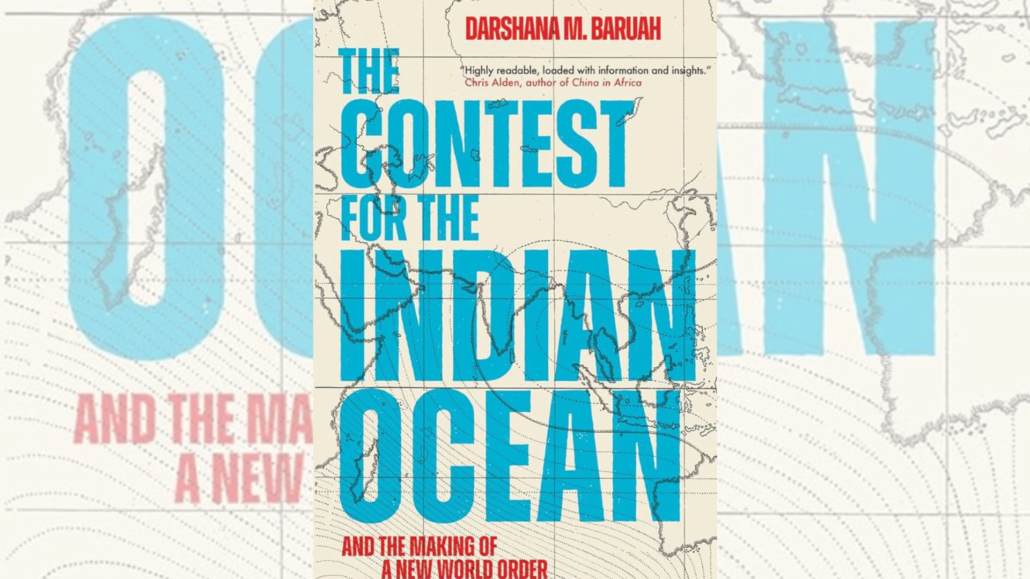
Darshana M Baruah. New Haven: Yale University Press, 2024. 206 Pages, ISBN 978-0-300-27091-4.
Darshana M Baruah’s recent book, “The Contest for the Indian Ocean: And the Making of A New World Order”, which examines the evolving geopolitical dynamics in the Indian Ocean, makes a bold assertion – “[T]his is the theatre where the competition between today’s two great powers [the US and China] will be decisive.” Emphasising the necessity of considering the Indian Ocean as a continuous theatre, the book puts a spotlight on the geostrategic relevance of this often-neglected western segment of the Indo-Pacific. In broad terms, it explores three key themes pertaining to the Indian Ocean region (IOR): the strategic implications of geography in shaping competition; the influence of emerging actors such as Turkey, the UAE, and Saudi Arabia, on regional dynamics; and the crucial role of islands in shaping great power politics.
The book opens with a comprehensive introduction, focussing on the geography and evolving geopolitics of the region. Notably, it argues for considering the Indian Ocean as a continuous geographical space. By drawing attention to the presence of “sea lanes of communication”, the strategic importance of critical chokepoints, and the significant volume of energy trade transiting through the region, Baruah seeks to underscore the centrality of the Indian Ocean to global trade connectivity. In this context, it is important to highlight the frequently misunderstood distinction — one that is also overlooked by the author — between International Shipping Lanes (ISLs) and Sea Lines of Communication (SLOCs), with the latter being relevant only to times of tension or conflict and generally involving the partial or complete re-routing of shipping traffic away from the ISLs. Baruah further asserts the necessity for dominant powers to secure access to these maritime routes to maintain their strategic advantage in the region. In addition, the book addresses several key issues, including the increasingly blurred lines between traditional and non-traditional security concerns in the resource-rich maritime region, the geopolitical significance of island nations when seen through a maritime rather than a sub-continental lens, and the absence of a cohesive Indian Ocean community or shared maritime identity among many of the littoral States of the Indian Ocean.
The second chapter examines the history behind the evolution of Diego Garcia as a US military base in the Indian Ocean, within the framework of the “strategic island concept” developed by the US Navy. By delving into the American strategic perspective at the height of the Cold War, Baruah offers the readers insights into how a dominant superpower approached strategic competition in the region. Analysing the “National Security Study Memorandum 199: Indian Ocean Strategy”, published by the US National Security Council (NSC) in 1974, Baruah examines how the US continued to look at the region primarily through the lens of its competition with the USSR, alongside considerations of securing its energy supplies, access to ISLs, managing the volatile security situation in West Asia, and ensuring access to communications, intelligence, and future deployments. She further highlights the organisational challenges within the US military, particularly the division of responsibility for the IOR between three combatant commands (COCOMs), namely, the INDOPACOM, CENTCOM, and AFRICOM. Regardless of foreign policy priorities and considerations of resource availability, this division has contributed to a siloed approach, hindering the development of a cohesive strategy for the Indian Ocean.
Shifting the focus to “Chokepoints and Naval Competition”, the subsequent chapter underscores how this strategic neglect of the IOR as a unified theatre has resulted in the “continentalisation” of what is, in essence, a predominantly maritime region. It highlights the centrality of key chokepoints, including the Strait of Hormuz, the Strait of Bab-el-Mandeb, the Strait of Malacca, and the Mozambique Channel, in ensuring unhindered trade connectivity and the global energy supply. She highlights how this is crucial for China in addressing its “Malacca Dilemma” across the IOR, given that 80% of Beijing’s energy imports must necessarily traverse these chokepoints, as must its overall maritime trade. It is only through these chokepoints that China can expand its diplomatic footprint across South Asia, Africa, and West Asia, as also ensure maritime connectivity with Europe and its other global partners. With a military facility in Djibouti, Baruah anticipates that China’s “second base” will soon be established in the western Indian Ocean, likely between Djibouti and Mozambique. Here, the author demonstrates a lack of doctrinal precision by failing to distinguish between a “military base” and a “place” (also known as a “Strategic Strong Point” or SSP) — the former needing to be capable of viable defence in conflict and the latter providing advantages in terms of intelligence, reconnaissance, and surveillance (ISR) but only in times short of conflict. Furthermore, considering the launch of the China-Indian Ocean Region Forum in 2022 and the opening of Chinese embassies in all six island nations of the Indian Ocean, the author feels that China has significantly consolidated its influence in the region. She adds that it is already the primary source of imports and a key trading partner for many littoral nations in the IOR. Thus, the author posits that the Indian Ocean serves both as a theatre of opportunities and vulnerabilities for China in its geostrategic competition with the United States, although a limited conflict is more likely to erupt in the Pacific. “Connecting the Silos” within the region is, therefore, in her opinion, a more effective approach to creating deterrence against China.
Baruah is on much firmer ground while focusing specifically on the role of island nations in shaping great power politics in the 21st century in her fourth chapter. Here, she explores how the strategic decisions of smaller players are increasingly influencing the actions of traditional powers, including India, France, and the US, in the region. Baruah cautions against dismissing China’s investments in ports and maritime infrastructure in these island nations as “debt-trap diplomacy”, while overlooking the agency of sovereign island nations themselves in inviting Beijing to invest in infrastructure projects. Drawing on first-hand interviews to capture the perspective of the island nations, she highlights how they view China as filling a void created by the “strategic inertia” of their traditional security partners. Consequently, Baruah argues that even recent initiatives by traditional powers to promote infrastructure development and connectivity in the region are often perceived not as genuine attempts to address the concerns of the island nations, but rather as geopolitical manoeuvres to counter China’s investments and strategic gains.
Further, the author underscores how the concept of maritime security of island nations differs from that of their traditional security providers, namely, France and India, in the western and eastern segments of the Indian Ocean, respectively. While the latter tend to focus primarily on geopolitical and military conflicts, the former are far more concerned with securing their extensive exclusive economic zones (EEZs) and addressing non-traditional security threats, such as illegal, unreported, and unregulated (IUU) fishing, drug smuggling, human trafficking, marine pollution, and addressing the adverse maritime impacts of climate change, including sea-level rise. In fact, they view geopolitical competition as a significant barrier to being able to leverage their collective strengths in addressing these issues in collaboration with other regional stakeholders. Thus, Baruah recommends that traditional powers like India should adopt a “two-pronged strategy”, which recognises the agency of island nations in making their sovereign choices and supports them in addressing the aforementioned issues of concern, while turning the focus on leveraging the maritime geography of their island territories to advance military and strategic objectives in the region.
The next section argues that traditional powers should better utilise their island territories, including the Andaman and Nicobar Islands (India), Cocos Keeling Islands (Australia), La Réunion (France), and Diego Garcia (US/UK), to “maintain and gain geostrategic advantages” in the region, rather than becoming entangled in the internal politics of sovereign island nations. Focusing specifically on the history and evolution of the Andaman and Nicobar Islands (ANI) within India’s strategic calculus, the author advocates moving beyond the perception of the islands as merely a “springboard to Southeast Asia” and calls for reimagining their role in ensuring both Indian and regional maritime security. This, she opines, can be achieved through leveraging the islands for enhanced maritime domain awareness (MDA), intelligence, surveillance, and reconnaissance (ISR), and anti-submarine warfare (ASW) operations. To address the environmental challenges that may arise from future infrastructure development on the islands, Baruah recommends collaborating with France to draw lessons from its experience in developing La Réunion.
The final chapter offers a future outlook on the evolving geopolitical dynamics in the IOR and explores how the adversarial relationship between India and China will shape the region over the coming decades. It broadly addresses key issues, such as the weaponisation of fishing, particularly by China, as a means of conducting ISR and generating MDA in the region. The chapter also addresses the adverse impacts of climate change on the maritime domain and the pressing need to promote the blue economy model, especially from the perspective of small island nations. It highlights the use of the blue economy as a strategic tool and emphasises the importance of military, economic, and research capacity to sustain the blue economy while simultaneously achieving a country’s developmental and broader economic goals. Mauritius is cited as a case study to demonstrate how island nations in the IOR are leveraging the abundant natural resources within their vast EEZs to gain access to emerging technologies from developed countries, such as Germany. Shifting focus to another critical area in the debates surrounding the future of energy and maritime security, the chapter discusses the opportunities and risks associated with the imminent commercialisation of the deep sea, stressing the need for the development of legal frameworks to close existing loopholes and mitigate potential risks.
Overall, despite the aforementioned instances of doctrinal fuzziness, the book provides a reasonable analysis of the recent developments in the IOR, positioning it as a critical theatre for great power competition in the 21st century. The author highlights the significance of the region, not only for traditional powers such as India, France, and the US, but also for increasingly influential players like China. By integrating historical, strategic, and geopolitical perspectives of traditional powers and small island nations, the book presents a balanced take on the evolving geopolitics in the region. Importantly, by delving specifically into the maritime security perspectives of each of the island nations in the IOR, it offers useful insights into the need for reconciling the differing priorities of these island nations and their traditional security partners. However, while the book attempts an analysis of the current geopolitical landscape in the IOR, it offers little by way of direct policy recommendations, particularly for India, on how to navigate the challenges that have been brought out. Her predominantly theoretical analysis could certainly have benefitted from detailed, practical solutions that could be implemented by India’s ministries (especially those of Defence and of External Affairs) and its maritime agencies, which would have made it a useful scholarly resource for scholars and practitioners alike. Nevertheless, “The Contest for the Indian Ocean” does provide an analysis of the IOR’s evolving dynamics and emphasises the need for India to pursue its various policies in the face of rising competition with China and emerging maritime security challenges in the region.
About the Reviewer
Ms Sushmita Sihwag is a Research Associate at the National Maritime Foundation. She holds a master’s degree in liberal studies from Ashoka University, Sonipat, Haryana. Her research primarily focuses upon the manner in which India’s own maritime geostrategies in the Indo-Pacific are impacted by those of ASEAN and its member-States. She may be contacted at indopac6.nmf@gmail.com


Leave a Reply
Want to join the discussion?Feel free to contribute!