
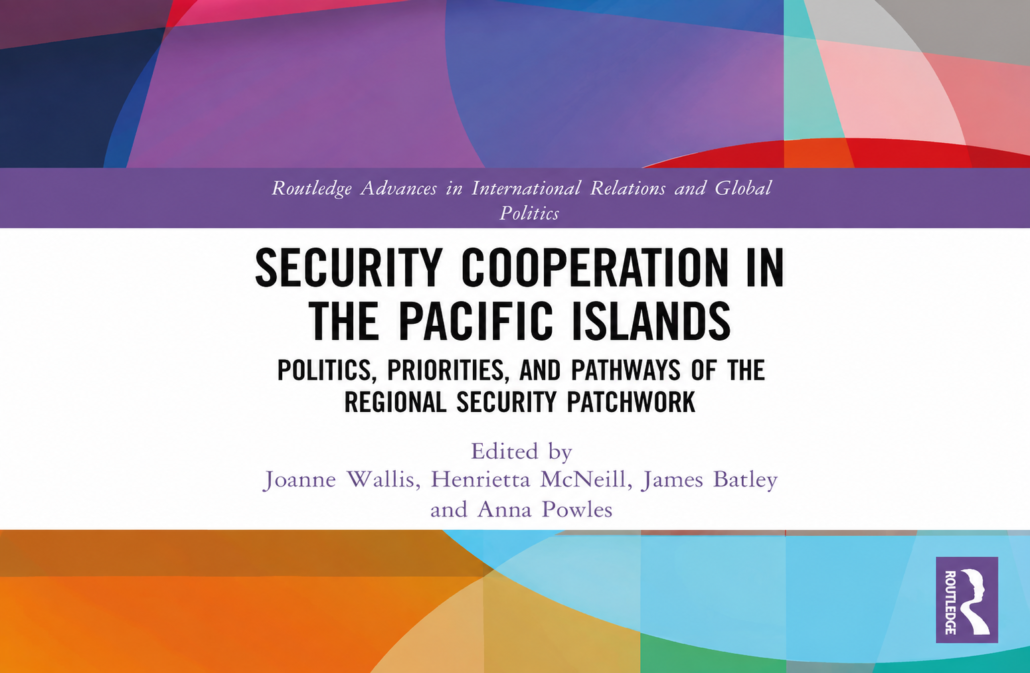
Edited by Joanne Wallis, Henrietta McNeill, James Batley and Anna Powles. Routledge, London and New York 2025. 334 pages, ISBN: 978-1-003-61319-0, (Open Access)
As strategic competition between the United States and China increasingly plays out across the “Blue Pacific”,[1] the question of how the South Pacific’s island States and territories manage their security relationships — with each other and with an expanding cast of external partners — has moved from the margins of Indo-Pacific scholarship to its centre. “Security Cooperation in the Pacific Islands”, a recent book edited by Joanne Wallis, Henrietta McNeill, James Batley and Anna Powles, is among the most comprehensive attempts yet to map this terrain. The four editors bring deep, albeit sometimes overlapping, expertise in Pacific security studies: Wallis is a Professor of International Security at the University of Adelaide and a non-resident senior fellow of the Brookings Institution; both McNeill and Batley are based in the Department of Pacific Affairs at the Australian National University; and Powles is an Associate Professor in the Centre for Defence and Security Studies at Massey University. The book opens with an introduction by the editors and brings together twenty chapters across three parts, drawing on the perspectives of scholars, practitioners and, notably, Pacific leaders themselves — including a foreword by former Pacific Islands Forum (PIF) Secretary General, Dame Meg Taylor. Collectively, the volume characterises regional security cooperation not as a coherent architecture, but as a “patchwork”: a layered, overlapping, and often contested assemblage of bilateral, minilateral, and multilateral arrangements, operating simultaneously at the local, national, regional and international levels.
The book’s organisation reflects this ambition. Part One examines regional-level cooperation, opening with a history of the PIF’s evolving security-role and leading on to contributions from other scholars of Pacific studies, who trace the development of the 2018 Boe Declaration on Regional Security through consensus and the “Pacific Way” — the region’s own tradition of consensus-based diplomacy and dialogue, rather than confrontation or externally imposed rules. The Declaration broadened the definition of security to encompass climate change, human security and transnational crime alongside traditional concerns. The section then situates Pacific security bodies within the wider UN and Bretton Woods system and closes with a case study of peacekeeping that highlights Pacific agency within ostensibly Western-led global security cooperation.
Part Two shifts the focus to the subregion’s major external security partners and examines how their own priorities intersect with those of Pacific Island States. Across its chapters on Australia, New Zealand, the United States, Japan, France, and China, the volume reveals how varying strategic priorities and degrees of engagement shape external approaches to security cooperation. Australia and New Zealand, for instance, are increasingly grappling with how to align their security and assistance activities with Pacific priorities, while US and Japanese engagement reflect questions of strategic coherence and changing geopolitical interests. France faces the additional challenge of defining its role while navigating the delicate status of its own Pacific territories. The section closes with a useful counterpoint to this partner-focused discussion. Collectively written by a graduate class at the University of Hawaii under Tarcisius Kabutaulaka, the final chapter foregrounds Pacific and Oceanic perspectives and thus challenges the partner-centric framing of the preceding six chapters.
Part Three addresses thematic challenges — human and health security cooperation during COVID-19, humanitarian response, climate “securitisation”, fisheries, border security and corruption — that cut across the region’s expanded security agenda, with Meg Keen’s chapter on humanitarian response and Salā George Carter’s chapter on climate securitisation standing out for their attention to the friction between donor timelines and locally led disaster-response.
The editors ultimately frame Pacific security cooperation through “congruence” (partner and Pacific priorities aligning), “convergence” (partial overlap between the two), and “congestion” (competing initiatives straining already stretched institutions) — asking whether the region’s patchwork reflects one of these or some combination of the three. When Pacific priorities and partner interests align, cooperation adds value. When they diverge, new partner-driven institutions pile up outside the PIF’s own governance structure, straining Pacific institutions that are already stretched thin. McNeill’s chapter on border security makes this concrete: while most such organisations operate under, or alongside, the Forum Officials Sub-Committee on Regional Security, McNeill finds they are not formally bound by it — even where individual initiatives, like the Pacific Fusion Centre, have worked to build credibility with the Forum. The volume describes this accumulation of initiatives as “saturation”. The chapters on health security and disaster-response make a similar point — donor activity keeps expanding, but durable region-wide coordination has not kept pace. The fisheries chapter offers an exception, showing how the Parties to the Nauru Agreement and the Forum Fisheries Agency count among the world’s most effective fisheries bodies precisely because Pacific States built them around their own priorities rather than having these imposed. The contrast is the point: the book works best when it lets these cases test its central thesis, rather than treating each chapter as a standalone survey.
The volume’s treatment of the China question is notably measured. Rather than framing Beijing’s presence solely through the lens of great-power rivalry, Denghua Zhang’s chapter argues that how China’s engagement is perceived by Pacific States matters as much as its material scale. This reflects the editors’ broader insistence — drawing on Pacific voices — that island States should not be cast as pawns in a contest not of their making. This is one of the book’s most valuable contributions: its argument — grounded in the “Blue Pacific” narrative and the tradition of consensus encapsulated in the terms, the “Pacific Way” — that regional security cooperation must be assessed primarily against Pacific priorities rather than the strategic anxieties of metropolitan partners. The chapter on corruption extends this logic usefully into non-traditional territory, treating governance failure itself as a transboundary security concern that regional mechanisms have yet to address coherently.
For Indian readers, the volume’s relevance lies less in direct India-Pacific content than in the transferable analytical framework it offers. Disappointingly, India features only in passing: the Forum for India-Pacific Islands Cooperation (FIPIC) is noted alongside comparable US and Republic of Korea summit mechanisms as evidence of the diversifying field of external partners courting Pacific leaders. India is grouped elsewhere, in the France and China chapters, among the “non-Western security partners” reshaping the region’s geopolitical landscape. India also surfaces incidentally through references to the Quadrilateral Security Dialogue (Australia, India, Japan and the US) and to French and Chinese strategic framings of the Indian Ocean, but these are contextual asides rather than sustained engagement — there is no chapter, or even a sub-section, devoted to India’s own Pacific Islands security cooperation comparable to those afforded Australia, New Zealand, the US, Japan, France and China. It must, however, be admitted that this is a defensible editorial choice given India’s comparatively modest security footprint in the Pacific Islands to date, yet it does leave a gap that future scholarship could usefully fill.
The book’s central idea travels well beyond the six external partners it examines: security cooperation in the Pacific functions less as a coherent ‘architecture’ than as a patchwork of overlapping bilateral, mini-lateral and multilateral arrangements. Donor proliferation can burden rather than strengthen partner-State capacity, particularly where institutions are already stretched thin. The book’s wider point is that recipient agency matters: small island States are not passive terrain for competition. That is a useful corrective for any external partner, India included, seeking to expand its engagement without reproducing the saturation the book documents. Effective cooperation depends less on the scale of resources committed than on whether assistance strengthens existing capabilities and responds to locally identified priorities.
The book is not without its limitations. As an edited collection spanning some thirty-nine contributors, the analytical register shifts noticeably between chapters, and the thematic chapters in Part Three occasionally read as freestanding case studies rather than sustained engagements with the “congruence, convergence and congestion” lens that the editors apply in their conclusion. Some partner chapters — those on France and Japan in particular — would have benefited from deeper comparative engagement with the Australian and American cases that dominate both the literature and, correspondingly, much of the volume’s attention.
The book’s temporal anchoring around the Boe Declaration Action Plan (2019) and the 2050 Strategy (2022), with developments tracked up to 2024, is also somewhat problematic: it ensures currency but will require updating given the rapid evolution of the region’s security architecture, not least because of the ongoing PIF Review of the Regional Architecture referenced in several chapters.
For scholars and practitioners of Indo-Pacific security, Security Cooperation in the Pacific Islands offers an empirically grounded account of a rapidly evolving regional security landscape. It also provides a “patchwork” analytical framework that merits application beyond the Pacific Islands themselves. Its central lesson is particularly timely: in an increasingly crowded Indo-Pacific, more cooperation is not necessarily better cooperation. The quality of regional security partnerships will depend increasingly on whether external initiatives reinforce existing institutions, respond to locally identified priorities, and leave sufficient space for island States to define their own security agendas.
********
About the Author
Ms Kripa Anand is a Research Associate at the National Maritime Foundation (NMF). Her research encompasses maritime security issues, with special focus upon the manner in which India’s own maritime geostrategies are impacted by the maritime geostrategies of the island-States of Oceania in general and Australia and New Zealand in particular. She may be reached at ocn1.nmf@gmail.com.
Endnotes:
[1] “Blue Pacific” is the Pacific Islands Forum’s own framing of the region as a vast, interconnected maritime continent rather than a periphery — formalised in the 2050 Strategy for the Blue Pacific Continent (2022). “18 Countries and Territories. One Blue Pacific Continent”, the Pacific Islands Forum, https://forumsec.org/pacific-islands-forum.


Leave a Reply
Want to join the discussion?Feel free to contribute!