
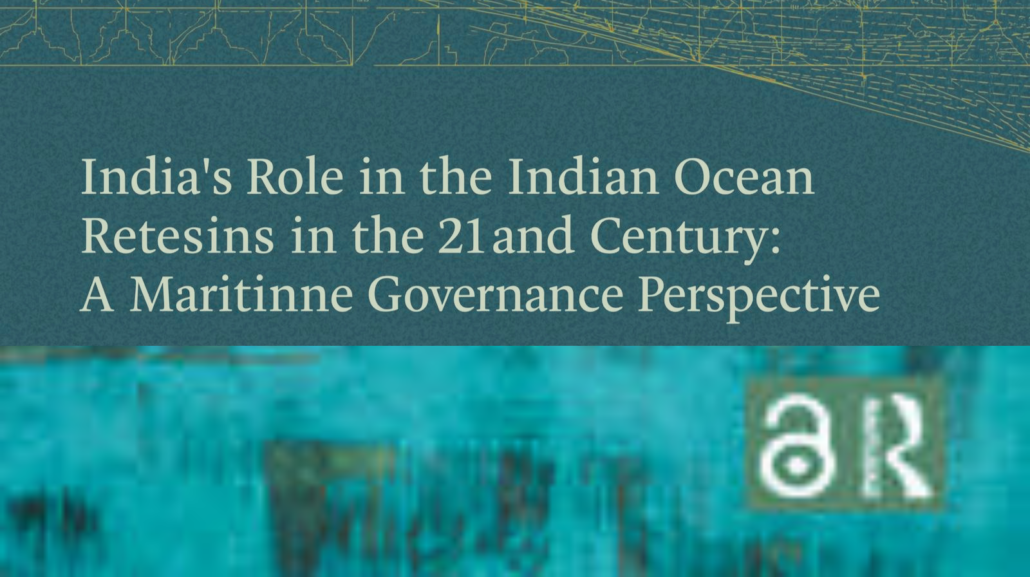
Authors: Tomasz Łukaszuk. Routledge (Taylor & Francis Group), US & UK 2025. 192 pages, Rs 1136, ISBN: 978-1-032-91248-6 (Paperback)
The strategic importance of the Indian Ocean Region (IOR) has grown significantly in the twenty-first century. As one of the world’s most vital maritime spaces, the Indian Ocean carries a substantial share of global trade and energy flows while connecting major economic centres across Asia, Africa, and West Asia. These developments have elevated the geopolitical importance of the region and intensified the need for effective mechanisms to regulate maritime activities, ensure maritime security, and promote the sustainable use of ocean resources. Against this backdrop, Tomasz Łukaszuk’s book, “India’s Role in the Indian Ocean Region in the 21st Century: Maritime Governance Perspective” examines India’s evolving maritime role and its contribution to the governance architecture shaping the regional maritime order.
Ambassador Łukaszuk is a Marie Skłodowska-Curie Global India Research Fellow associated with the Global India Programme and a member of the Faculty of Political Science and International Studies at the University of Warsaw. A career diplomat with over two decades in the Polish Foreign Service, he served as Ambassador of Poland to India from 2014 to 2017 and to Indonesia from 2005 to 2010. His research focuses on maritime governance, international maritime security, and the evolving strategic dynamics of the Indian Ocean Region. The book draws on several years of research conducted within the Global India project and reflects the author’s engagement with policymakers, diplomats, and scholars working on maritime issues in the region.
At the core of the book lies the concept of maritime governance, which the author defines as the process through which the activities of State and non-State actors at sea are regulated and monitored through policies, institutions, and legal frameworks operating at national, regional, and global levels. Rather than focusing solely on naval power or traditional strategic competition, Łukaszuk situates India’s maritime engagement within a broader framework of maritime governance, encompassing legal regimes, maritime security cooperation, environmental protection, and economic development. This perspective allows the author to analyse India’s maritime policies not only in terms of strategic capabilities but also through the institutional and normative structures that shape maritime order in the Indian Ocean.
The analytical framework of the book draws upon Christian Bueger’s matrix of maritime security. Within this framework, maritime governance is located at the intersection of four interconnected domains: the maritime legal framework, maritime security, marine environmental protection, and the blue economy. By adopting this approach, the author seeks to capture the multidimensional nature of maritime governance and to thereby examine how India’s policies interact across these different domains. This framework enables the study to move beyond narrow strategic interpretations and instead analyse maritime governance as a complex system of institutional, legal, and cooperative arrangements.
The opening chapter, “The Concept of Maritime Governance in International Relations”, traces the emergence of maritime governance as a concept within international relations scholarship and highlights the growing importance of governance frameworks in managing maritime spaces. The chapter emphasises the continuing centrality of States in shaping governance structures, even as international organisations and non-State actors increasingly participate in maritime governance processes. In this context, the author highlights the importance of institutional cooperation and legal norms in regulating activities within maritime domains that are inherently transnational.
The second chapter explores India’s historical and geopolitical relationship with the Indian Ocean. The author underscores India’s geographical centrality in the region and traces the evolution of its maritime outlook across different historical periods. In doing so, he briefly refers to earlier maritime traditions in the Indian subcontinent, including the seafaring activities of the Chola Kingdom, which contributed to the development of maritime trade networks across the Indian Ocean. The chapter then examines how India’s maritime orientation evolved in the post-independence period and particularly after the economic reforms of 1991. These reforms significantly increased India’s reliance on maritime trade and underscored the strategic importance of shipping lanes, often described as ‘sea lines of communication’, although this term is more appropriately used in a strategic or wartime context. The growing presence of extra-regional powers in the Indian Ocean is also identified as a factor that has reinforced the region’s strategic significance in India’s foreign policy thinking.
The third chapter, “India’s Role in The Legal Maritime Framework in IOR”, focuses on the legal dimension of maritime governance. It examines India’s engagement with international maritime law and its participation in the development of global legal frameworks governing the oceans. Particular attention is given to the role of the 1982 United Nations Convention on the Law of the Sea (UNCLOS) as the foundation of the contemporary maritime legal order. This, of course, is both simplistic and incorrect. Nevertheless, the author also discusses India’s approach to maritime boundary delimitation with neighbouring States and its broader commitment to a rules-based maritime order. Through these legal mechanisms, India seeks to contribute to stability and predictability in the maritime domain.
Chapter four entitled, “India’s Role in Maritime Security in IOR”, examines the security dimension of maritime governance and the evolution of India’s naval capabilities and maritime strategy. The author traces the gradual expansion of the Indian Navy’s operational scope from coastal defence to broader regional responsibilities across the Indian Ocean. This transformation reflects India’s growing recognition of the importance of maritime security for protecting international shipping lanes, ensuring energy security, and safeguarding maritime trade. The chapter also discusses India’s role in addressing non-traditional maritime threats such as piracy, maritime terrorism, and illicit trafficking, as well as its participation in regional maritime security cooperation.
The fifth chapter addresses the environmental and economic dimensions of maritime governance, particularly the concept of the blue economy. The author discusses India’s efforts to promote the sustainable use of marine resources while balancing economic development with environmental protection. In this context, the book examines India’s engagement with global frameworks such as the United Nations Sustainable Development Goals, especially SDG-14, which focuses on the conservation and sustainable use of oceans and marine resources. The chapter also highlights the importance of regional cooperation in addressing shared maritime challenges such as climate change, marine pollution, and fisheries management.
The final chapter brings together the book’s main arguments and evaluates India’s broader role in shaping maritime governance in the Indian Ocean Region. Drawing on role theory in international relations, the author suggests that India performs several interrelated roles in the regional maritime order. These include acting as a supporter of sustainable maritime development, as also as a promoter of a rules-based maritime order, a provider of maritime security through initiatives incorporating naval cooperation, capacity-building, and capability-enhancing. Through these roles, India seeks to contribute to the development of cooperative governance mechanisms that can help maintain stability and address shared maritime challenges in the region.
A key strength of the book is its interdisciplinary perspective. By integrating insights from international law, security studies, and environmental governance, the author provides a comprehensive understanding of maritime governance in the Indian Ocean. This approach moves beyond conventional strategic analyses that focus primarily on naval power or geopolitical rivalry and instead highlights the institutional and normative dimensions of maritime order.
At the same time, the study struggles with its own limitations. While the author offers a detailed analysis of India’s maritime policies and initiatives, he pays relatively little attention to how these initiatives are perceived by smaller Indian Ocean littoral States. Greater engagement with perspectives from smaller coastal and island States could have provided additional insight into the dynamics of maritime cooperation and the challenges of implementing governance initiatives in a diverse regional environment. Similarly, while the book acknowledges the evolving geopolitical landscape of the Indian Ocean, a more sustained discussion of how intensifying strategic competition among external powers might influence regional governance frameworks would have further strengthened the analysis.
Despite these limitations, the book makes a valuable contribution to the growing literature on maritime governance and Indian Ocean security. By situating India’s maritime engagement within a broader governance framework, Tomasz Łukaszuk provides a nuanced assessment of the country’s evolving role in shaping the regional maritime order. The study’s interdisciplinary approach offers a useful analytical lens through which to understand the legal, security, environmental, and economic dimensions of maritime governance. As such, the book will be of interest to scholars, policymakers, and practitioners engaged in debates on maritime strategy, ocean governance, and the future of cooperation in the Indian Ocean Region.
*******
About the Reviewer
Ms Kripa Anand is a Research Associate at the National Maritime Foundation (NMF). Her research encompasses maritime security issues, with special focus upon the manner in which India’s own maritime geostrategies are impacted by the maritime geostrategies of the island-States of Oceania in general and Australia and New Zealand in particular. She may be reached at ocn1.nmf@gmail.com.


Leave a Reply
Want to join the discussion?Feel free to contribute!