
India’s National Maritime Day, observed on 05 April each year, commemorates a single episode in India’s colonial history, the maiden voyage of the SS Loyalty under the British-Indian flag in 1919 from Bombay to London.[1] While this date honours the pioneering spirit of India’s merchant marine, it remains firmly rooted in the colonial-era narrative and the late awakening of a modern merchant marine in India. Its scope is correspondingly narrow, focusing on twentieth-century shipping achievement and professional seafarers, rather than India’s vast maritime heritage. As a result, the April observance resonates chiefly with the shipping and the merchant marine community, leaving India’s deep civilisational maritime identity largely unacknowledged.
This limited framing misses an opportunity to forge a national sense of maritime history and pride. India’s maritime story extends back millennia, from the colourful shipbuilding centres of ancient Kalinga to the glittering trade routes linking the subcontinent with Southeast Asia, China, Africa, Arabia, and the Roman world. These exchanges were so central to our civilisation that classical poets like Kalidas hailed Kalinga’s rules as ‘Mahodadhipati,’ which translates to “lords of the ocean.”[2] Indeed, archaeological evidence from Bengal, Odisha and Northern Andhra Pradesh, shoresides studded with Romain coins, Chinese ceramics and inscriptions, vividly attests to this seaborne grandeur.
In this context, the choice of 05 April seems arbitrary and historically narrow. A more fitting focal point for national maritime commemoration (National Maritime Day or Week) would resonate with India’s ancient nautical traditions and its shared heritage with the Indo-Pacific littorals. In particular, the Kartika Purnima in late autumn (October-November) offers a powerful anchor for India’s maritime narrative. For centuries, the full moon of the Kartika month (Vikram Samvat Calendar) has been celebrated along the eastern seaboard of India as a time of launching voyages to distant lands.[3] Known locally as Boita Bandana (“mooring of boats”) or Danga Bhasa (“the floating of boats”), and commemorated most grandly by the Bali Jatra festival in Odisha, this tradition directly evokes India’s ancient mariners setting sail for Bali, Java, Sumatra and beyond till the southern shores of China (Hangzhou).
This article argues that India should realign its principal maritime commemoration around Kartika Purnima. April 05 could continue as the “National Merchant Mariners Day,” but a new week of events in late autumn would better reflect the country’s civilisational maritime identity. Such a shift would not be mere symbolism but would be a structural and cultural correction, bringing national observance into harmony with India’s coastal traditions, linking with our maritime neighbours through shared rituals, and reinforcing India’s Act East policy and Project MAUSAM initiative. Ultimately, it would strengthen a sense of maritime citizenship among Indians at large, anchoring modern policy in a thousand years of global voyaging.
Long before the coming of steamships, Kalingan shipwrights and mariners dominated the Bay of Bengal routes. From as early as the 3rd century BCE, when Emperor Ashoka sought to control Kalinga’s lucrative sea lanes, Odisha’s ports were nodes in a vast commercial network extending from Rome to Japan.[4] The Hathigumpha inscription of King Kharavela (circa 1st century BCE) explicitly records fleets and merchants (“Vanija” and “Vanik-Patha”) reaching far-off lands. By the early centuries CE, Tamralipti (near modern Tamluk in West Bengal) was famed as a thriving maritime hub described by Chinese pilgrims.[5] Nearby was Palur (possibly the Danthapuri of Tamil Sources), and to the South lay Pithunda (on today’s Andhra coast), all bristling with shipyards and warehouses.
The goods transported were no less illustrious than the ports. Kalinga’s exports included fine textiles (especially cotton and silk), aromatic woods (sandal, camphor), pearls, gemstones and even live elephants, prized creatures carried on board to adorn foreign courts.[6] In return, Kalingans imported exotic treasures: Chinese silk and celadon porcelain, Arabian incense, East African ivory and Zambezi gold, even Roman amphorae. Archaeological excavations at coastal sites like Manikapatna (near Chilika Lake) have turned up Chinese celadon and a coin of a Sri Lankan king (a copper coin of King Sahasamalla), reflecting two-way trade with Sri Lanka and China. In Odisha’s interior, Roman gold coins have been unearthed; in southern India, Tamil Brahmi inscriptions testify to active trade with Sri Lanka and beyond.[7]
Mariners from Kalinga even helped shape political cultures overseas. By the 5th century CE, the Chinese monk Faxian recorded how ports in Kalinga played a decisive role in the transmission of Buddhist doctrines. Two centuries later, Hiuen Tsang noted more than fifty temples at Tampralipti when he reached the eastern seaboard. His account reinforces the point that the sea was not a peripheral feature but a structural element of Kalingan civilisation.
Kalinga’s maritime networks extended across the Bay of Bengal and shaped early kingdoms in Southeast Asia. Two thousand years ago, traders from the Kalingan coast are believed to have travelled through Basudevpur and other ports toward the shores of present-day Vietnam, establishing the Champa kingdom.[8] Architectural continuities between the temple complexes of Vietnam and Kalinga illustrate the scale of cultural transfer. The similarities in iconography, stonework, and spatial organisation point to artisans, priests, and merchants who carried their knowledge systems overseas and adapted them to local settings. Evidence from inscriptions further strengthens the case for Kalinga’s far-reaching maritime role. The Vo-Chanh rock inscription from southern Vietnam, dated to the second or third century CE, is among the earliest epigraphic traces of this presence. Written in Sanskrit, it refers to the first kingdom in Champa. It attributes its establishment to the royal family of Sri Mara, who identified himself as Kalingan by origin and a descendant of the Varmas.[9] Chinese chronicles similarly describe Sri Mara as a Shaiva, mapping the religious networks that accompanied commerce and migration. His coronation edict portrays a ruler committed to justice and benevolence, characteristics that resonated strongly with Indian political thought of the period. With Sri Mara’s ascent, a Hindu dynasty took firm root in Champa, marking one of the earliest documented instances of Kalinga’s overseas statecraft.
A similar influence is visible in the Mekong Delta. The Brahmin Kaundinya, traditionally associated with Kalinga, is regarded as the founder of the Funan polity in the first century CE. Regional and Chinese sources narrate how he sailed from the eastern coast of India, married the Naga princess Soma, and established a dynasty that introduced Sanskrit, Indian religious practices, and new administrative norms.[10] This development set the foundations for the political evolution of mainland Southeast Asia. In a symbolic recognition of this legacy, the Indian Navy named its reconstructed stitch-planked vessel INSV Kaundinya after him, linking contemporary maritime initiatives with one of the earliest recorded voyages from the eastern seaboard.[11]
The pièce de résistance of this maritime tradition was India’s connection to Southeast Asia. The Bay of Bengal itself was a highway, seasonal sailors called Sadhabas would depart from coastal estuaries in the monsoon south-west winds and return on the north-east winds half a year later.[12] Kalinga’s influence in maritime Southeast Asia culminated under the Sailendra and Srivijaya empires (8th–13th centuries CE), which drew priests, poets and traders from the Indian east coast.[13] These voyages, trade and cultural exchanges long predated European arrival. Yet today’s national commemorations barely reflect this rich legacy. By reviving Kartika Purnima as the focal point, India would symbolically re-centre its maritime story on the age of temples and mariners rather than on colonial-era shipping records.
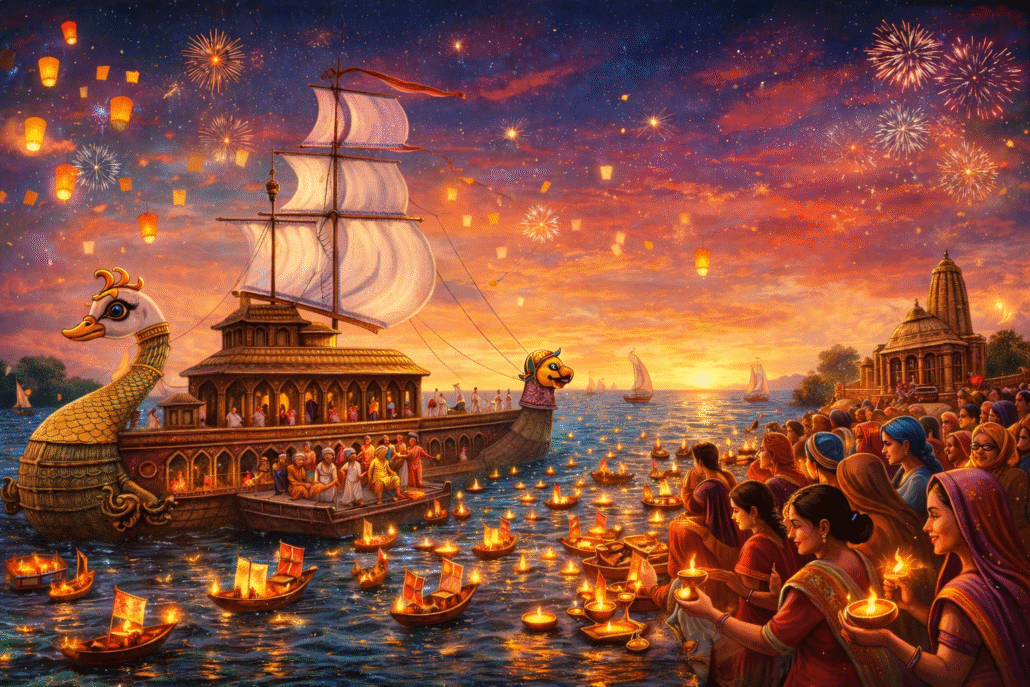
India’s maritime heritage may be under-represented in formal historiography, but it survives strongly in folk memory and ritual. Bali Jatra is one such memory, held every Kartika Purnima. Bali Jatra literally means “voyage to Bali.” On the auspicious full moon night, millions gather to float toy boats (biotas) made of banana stems, cork or paper, carrying tiny oil lamps and betel nuts.[14] This is Boita Bandana, the “mooring” or “launching” of boats, re-enacting the send-off of ancient merchants. The miniature boats represent the vessels that once set sail from that very spot, bound for distant lands. One famous legend connected to Bali Jatra is the “ballad of Tapoi”: two sisters who rowed out on the river (Mahanadi), awaiting the return of their brothers from the faraway islands, their sorrow immortalised in Odia poetry.[15]
The significance of Kartika Purnima is grounded in the rhythms of the Indian Ocean monsoon cycle. Traditional sailing calendars recognise July (Ashadha) through November (Karthik) as the seafaring season.[16] This period offered favourable winds: ships would depart as the southwest monsoon raged and return with the northeast monsoon’s turn. Thus, Kartika Purnima, falling after the turbulent seas abated, came to be seen as the perfect day to set forth. Indeed, many Sadhabas and their patrons of yesteryear would flock to temples and riversides in early November, praying for the almighty’s favour as they launched expeditions. In Odisha lore, the date became synonymous with dashing off across the blue, making it an annual point of both hope and anticipation.
Remarkably, the Kartika Purnima maritime rites of Odisha are mirrored by customs across the broader Indian Ocean. These parallels underscore the shared seafaring culture linking South and Southeast Asia. For example, in Bali (Indonesia) the Masakapan Ke Tukad festival, held on November’s full moon, involves lighting candles on miniature boats and floating them on local rivers, in memory of Bali’s own seafaring ancestors.[17] In Thailand, the famous Loy Krathong festival of brightly decorated baskets bearing candles and flowers takes place on the same lunar day; it carries an explicit wish for safe voyages over water and bountiful catches.[18]
In fact, scholars have noted that the floating-boat-and-lamp motif appears wherever the monsoon-influenced cultures are found, within the Indian Ocean and the Pacific. It is even present in parts of Cambodia (Bon Om Touk)[19] and among Thai communities, once part of the Srivijaya trade network. These resemblances suggest that more than a coincidence binds these rituals; rather, they are a fragment of a much older Indo-Pacific cultural circuit. This shared heritage offers India a powerful narrative link to modern ASEAN countries, reinforcing policies like the Act East Initiative. By reviving the Kartika Purnima maritime commemoration at the national level, India would not only celebrate its own history but also underscore a common legacy with Southeast Asia.
One might ask: why change an established date? 05 April has indeed become known as National Maritime Day in official circles. However, the story of its origin reflects post-colonial India’s maritime awakening more than India’s full seafaring saga. The date commemorates the day in 1919 when the SS Loyalty, the first ship bearing the Indian merchant flag, sailed from Bombay to London with a majority of its crew being Indian.[20] India’s first National Maritime Day observance took place in 1964, and since then, each year’s celebrations have highlighted the growth of the modern merchant navy and the shipping industry. Themes have centred on current issues like sustainability, seafarer welfare, port development, and so on. These are important topics, certainly, but they frame India’s maritime dimension in purely economic and technical terms.
This framing carries a colonial echo. The heritage emphasised begins with steamships and trade in the 20th century, effectively sidelining millennia of Indian seafaring that flourished long before European colonisation. Coastal communities, from Bengal’s sailors to Konkan dhow-men, have their own centuries-old ocean narratives, but these rarely appear on the radar of the official April 5th event. Moreover, the date falls outside traditional maritime seasons; it has no direct cultural resonance. As such, National Maritime Day on April 5 is largely observed by the Ministry of Shipping, merchant marine unions, and port authorities, but it has neither captured the popular imagination of India nor been integrated into the national cultural discourse.
Some may argue that retaining 05 April as a day of remembrance for merchant mariners is, nevertheless, valuable, and this is, indeed, so. A “National Merchant Marine Day” can and should continue to be commemorated on this date, reflecting India’s tribute to its contemporary seafarers and those of the relatively recent past, who braved hostile waters in both World Wars and contributed to the nation’s supply chains. However, this should be seen as one piece of a larger mosaic. If India truly aims to foster a maritime identity, beyond mere industry statistics, then the nation’s calendar needs to reflect the deep-rooted traditions that once animated entire societies.
A two-tiered approach is therefore recommended. The Government of India should institute a “National Maritime Week” anchored on Kartika Purnima. This week-long period in late October or early November, as determined by the Hindu calendar, would serve as the principal window for national maritime commemorations. Its conceptualisation and design should accommodate ceremonial, educational, cultural, and policy activities that draw on India’s civilisational maritime traditions while engaging contemporary maritime stakeholders. Such a “National Maritime Week” would create a bridge between India’s history and its present-day aspirations. By coordinating with cultural and tourism ministries, state governments (especially those of Odisha and Andhra Pradesh) and civil society, the “National Maritime Week” could galvanise public interest across India’s diverse regions. Crucially, the week should be national in scope, not restricted to one or another state alone. While Odisha’s Bali Jatra might well be the anchor, other maritime states — Andhra Pradesh, Gujarat, Goa, Karnataka, Kerala, Maharashtra, Tamil Nadu, and West Bengal— should also host their own events commemorating their rich maritime history and traditions. For instance, Kerala might highlight its backwater boat traditions and the ancient port of Muziris; Tamil Nadu could showcase its shoreline pilgrimages; West Bengal may revive Tamralipti’s story.
Culminating this “National Maritime Week” on Kartika Purnima would not only fit seamlessly into India’s religio-cultural fabric but would also dovetail neatly with India’s broader cultural and people-to-people connectivity initiatives as embodied in Project MAUSAM. Launched in 2014, Project MAUSAM explicitly seeks to revive ties with Indian Ocean and Southeast Asian littoral states by celebrating shared cultural and religious moorings.[21] Joint celebrations with countries like Indonesia, Thailand, Sri Lanka or Vietnam would reinforce India’s role as convener of the Indian Ocean dialogue and reinforce ties in line with the Act East policy. The Act East policy, a core plank of India’s external relations, emphasises connectivity, trade, and cultural links with Southeast Asia.[22] Reviving an ancient maritime festival of Kalinga would send a clear signal that India’s linkages to ASEAN are not just modern conveniences, but a continuum of centuries-old civilisational exchange. This would be a powerful form of soft diplomacy, complementing the steady grind of trade and defence cooperation.
In practice, implementing this would, of course, require coordinated action. The Ministry of Ports, Shipping and Waterways, the ministries of Culture, Tourism, and Education, along with state governments, would need to collaborate. A small task force could draft a roadmap for this “National Maritime Week”: deciding the exact dates each year (dates in a lunar calendar move about within the Gregorian calendar), allocating budgets, guiding states on programming, and liaising with ASEAN partners. The National Maritime Foundation could host an annual conference bringing together historians, economists and naval strategists to mark the kick-off. Civil society, including organisations of coastal communities, could be mobilised to participate. Thus, while it begins as a policy proposal, it should quickly become an organic, participatory tradition involving multiple stakeholders.
Conclusion
Our maritime destiny lies beyond arguing for another holiday. It lies in recognising that landlocked introspection must yield to seascape awareness. India’s geography is interwoven with its ocean boundaries, yet for too long the sea has been peripheral to the national psyche. Embracing Kartika Purnima as the anchor of the “National Maritime Week” would symbolise a rebalancing of that perspective. Such a move would meld the practical with the poetic. It would allow India’s sailors and maritime officials to celebrate not only tonnage and ports but also the hard-pressed daughters of Sadhabas who once lit lamps of hope, the temple of the Konark Sun God built by a dynasty of shipbuilders, and the distant islands where Indian bells still toll in pagodas. It would remind every citizen that India was a great maritime nation and is now reclaiming its heritage. In sum, realigning our national commemoration with Kartika Purnima and the Boita Bandana tradition is a structural and cultural correction whose time has come. It is both a tribute to our ancestors and a strategic investment in the future. By forging these links between past and present — through festivals and policy — India can reinforce its identity as a seafaring civilisation, amplify its voice in the Indo-Pacific, and inspire a new generation of maritime citizens to sail towards tomorrow.
*******
About the Author:
Mr Suraj Palavalsa is a Research Associate at the National Maritime Foundation. He is a graduate of the Banaras Hindu University (BHU), where he gained a Bachelor’s degree in Sociology, History, Political Science and Economics (Ancillary), and earned his Master’s degree in International Relations (South Asian Studies) from Pondicherry University, Puducherry. His current research focuses on matters pertaining to reviving India’s maritime consciousness through an interdisciplinary approach. He can be reached at emc1.nmf@gmail.com.
Endontes:
[1] “India Marks 62nd National Maritime Day Honouring Seafarers as the Nation Advances towards a Sustainable Maritime Future,” Press Information Bureau, Government of India, 05 April 2025, https://www.pib.gov.in/PressReleasePage.aspx?PRID=2119352®=3&lang=2#:~.
[2] Balabhadra Ghadai, “Maritime Heritage of Orissa,” Orrisa Review (2009), 62, https://magazines.odisha.gov.in/Orissareview/2009/July/engpdf/62-64.pdf.
[3] Prof RK Nanda, “Kalinga Bali Yatra and the Maritime Trade of Odisha,” Odisha Review, November 2019, 41, https://magazines.odisha.gov.in/Orissareview/2019/Nov/engpdf/41-45.pdf.
[4] “The Kalinga War and Ashoka Maurya: From Incredible Conquest to Compassion (c. 261 BCE),” Indosphere, 30 August 2023, https://theindosphere.com/history/the-kalinga-war-and-ashokas-conquest/?srsltid=AfmBOortaQG-0b4ZHBXRR0DtkZ3s0S0RTRLx-mi3aHvQMQxZ8e5pRgPy.
[5] Sharmin Akhtar and Hanizah Idris, “Ancient Trade Corridor Tamralipti and Bengal’s Glory (200 BCE–700 CE),” Kemanusiaan 29, No 1, (2022), 1–22, http://web.usm.my/kajh/vol29_1_2022/kajh29012022_01.pdf.
[6] Sila Tripati, “Ancient Ports of Kalinga,” CSIR-National Institute of Oceanography (NIO), https://share.google/BeBcL18cKq7I2FfkG.
[7] Sila Tripati and KH Vohra, “Maritime heritage in and around Chilika Lake, Orissa: Geological evidence for its decline,” Current Science 88, No 7, 10 APRIL 2005, https://drs.nio.res.in/drs/bitstream/handle/2264/28/Curr_Sci_88_1175.pdf?sequence=1.
[8] Dr Benudhar Patra, “Kalinga and Champa: A Study in Ancient Maritime Relations,” Odisha Review, November 2017, https://magazines.odisha.gov.in/Orissareview/2017/November/engpdf/22-26.pdf.
[9] Dines Chandra Sircar, “Maritime Trade in the Indian Ocean and Its Influence on Art,” The Journal of the Greater Indian Society, 6, No 2 (1939), 53-55, https://criticalcollective.in/ArtHistoryDetail.aspx?Eid=529.
[10] Dr Benudhar Patra, “Kalinga and Champa: A Study in Ancient Maritime Relations,” Odisha Review, November 2017, https://magazines.odisha.gov.in/Orissareview/2017/November/engpdf/22-26.pdf.
[11] Purnima Sah, “INSV Kaundinya: Navy revives maritime heritage with stitched ship inspired by Ajanta mural,” The Hindu, 24 May 2025, https://www.thehindu.com/news/cities/mumbai/insv-kaundinya-navy-revives-maritime-heritage-with-stitched-ship-inspired-by-ajanta-mural/article69613987.ece.
[12] Dr Sunil Kumar Patnaik, “Exploring Maritime Silk Route and Ancient Odisha: Recent Research,” Odisha Review (Nov-Dec 2021), https://magazines.odisha.gov.in/orissareview/2021/Nov-Dec/engpdf/nov-dec-or-2021.pdf.
[13] Benudhar Patra, “Kalinga in South East Asia,” Orissa Review, November 2004, https://magazines.odisha.gov.in/orissareview/nov2004/englishPdf/kalingainsoutheastasia.pdf.
[14] “Bali Jatra commemorates rich maritime heritage and culture of Odisha,” Press Information Bureau, Government of India, 06 Feb 2025, https://www.pib.gov.in/PressReleasePage.aspx?PRID=2100365&noshow=1®=3&lang=2.
[15] Dr Rabindra Nath Dash, “Baliyatra: A Festival of Odisha’s Ancient Maritime Trade,” Odisha Review, November 2017, https://magazines.odisha.gov.in/orissareview/2017/November/engpdf/baliyatra.pdf.
[16] Dr Sunil Kumar Patnaik, “Exploring Maritime Silk Route and Ancient Odisha: Recent Research,” Odisha Review (Nov-Dec 2021), 11, https://magazines.odisha.gov.in/orissareview/2021/Nov-Dec/engpdf/nov-dec-or-2021.pdf.
[17] “Merging Culture with Commerce: The Legacy of Bali Jatra,” Odisha Heritage, 01 December 2023, https://odishaheritage.com/history/merging-culture-with-commerce-the-legacy-of-bali-jatra/.
[18] “Merging Culture with Commerce: The Legacy of Bali Jatra,” Odisha Heritage, 01 December 2023.
[19] “Bon Om Touk – The Cambodian Water Festival,” Heritage Line, 18 November 2021, https://heritage-line.com/magazine/bon-om-touk-the-cambodian-water-festival/.
[20] “India Marks 62nd National Maritime Day Honouring Seafarers as the Nation Advances towards a Sustainable Maritime Future,” Press Information Bureau, Government of India, 05 April 2025, https://www.pib.gov.in/PressReleasePage.aspx?PRID=2119352®=3&lang=2#:~.
[21] “39 countries identified under Project ‘Mausam’,” Press Information Bureau, Government of India, 20 December 2017, https://www.pib.gov.in/PressReleasePage.aspx?PRID=1513339®=3&lang=2.
[22] “Neighbourhood First Policy,” Ministry of External Affairs, Government of India, 02 February 2024, https://www.mea.gov.in/Images/CPV/LU-157-EN-02-02-2024.pdf.


Leave a Reply
Want to join the discussion?Feel free to contribute!