
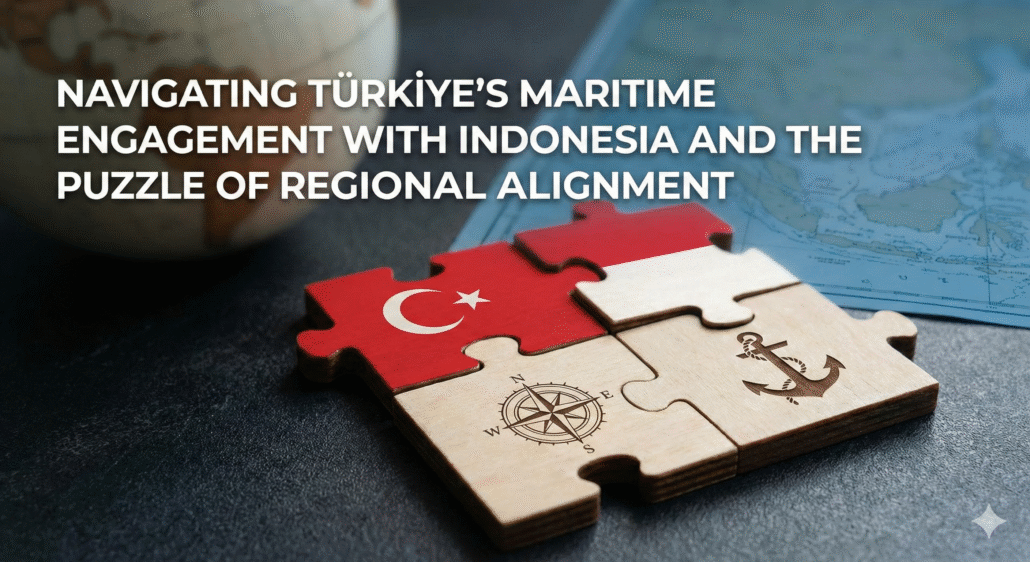
Abstract: As part of its continuing efforts to expand its reach into the Indian Ocean, Türkiye’s strategy in the region is increasingly shaped by its alignment with Muslim-majority states, with the broader aim of crafting an alternative power bloc to the Saudi-led order—as many scholars interpret it, a step towards realising Ankara’s neo-Ottoman aspirations. This article is the fourth in an ongoing series examining Türkiye’s activities in the Indo-Pacific—particularly in the Indian Ocean—and focuses on its evolving relationship with Indonesia, which is gradually offering Ankara a strategic foothold in Southeast Asia. Concentrating specifically on maritime engagement and its broader geopolitical consequences, the article assesses how Indonesia may fit into the larger puzzle of Türkiye’s regional outreach and leadership ambitions. Following earlier analyses of Türkiye’s maritime ties with Pakistan and Bangladesh, it explores the convergences and divergences between Türkiye and Indonesia, including the implications of their respective identities and demographic dynamics. In doing so, it identifies key maritime challenges and gaps for India, offering policy recommendations on how India can respond by prioritising specific areas and adopting a more agile and calibrated diplomatic approach.
Keywords: TÜRKIYE–INDONESIA RELATIONS, MARITIME DIPLOMACY, INDIAN OCEAN, INDO-PACIFIC GEOPOLITICS, REGIONAL ALIGNMENT, NEO-OTTOMANISM, MUSLIM-MAJORITY STATES, FOREIGN POLICY, SOUTHEAST ASIA, MARITIME COOPERATION, INDO-PACIFIC OUTREACH.
As India’s immediate maritime neighbour, Indonesia plays a strategic role in the Indo-Pacific, owing to its critical geographical location and regional weight. Positioned at the confluence of the Indian and Pacific Oceans and overseeing the critical Strait of Malacca, Indonesia’s geopolitical orientation has direct and indirect implications for India’s maritime security, trade routes, and regional standing.[1] In addition to its maritime centrality, Indonesia holds a pivotal position within ASEAN, both economically and geopolitically. As the region’s largest economy and its only G20 member, it plays a leading role in shaping ASEAN’s strategic direction. With a population exceeding 275 million—accounting for over 40% of ASEAN’s total—Indonesia functions not only as an economic powerhouse but also as a key political actor within the regional framework.[2] Its influence is particularly evident in advancing trade integration, maritime governance, and digital connectivity. For an external actor such as Türkiye, Indonesia presents both a strategically situated partner and a gateway to the broader Southeast Asian market—especially as geopolitical configurations in the Indo-Pacific continue to shift.
Türkiye’s growing strategic interest in Southeast Asia represents a notable evolution in its foreign policy beyond traditional zones of influence.[3] In recent years, Ankara has intensified its diplomatic, defence, and economic engagement with the region, strengthening ties with ASEAN and positioning itself as an emerging player in the Indo-Pacific order. From expanding naval exports and security cooperation to deepening political and economic dialogue, Türkiye is increasingly aligning itself with Southeast Asian States that offer both commercial opportunities and geopolitical relevance. Within this broader outreach, Indonesia has emerged as a key focus. While subsequent articles in this series will examine Türkiye’s evolving engagement with nations of South- and Southeast Asia, the current analysis focuses exclusively on Indonesia. This focus is shaped not only by the fact that Indonesia is home to the world’s largest Muslim population, but also by the unique complexities of its pluralistic society, archipelagic geography, and pivotal role in regional power dynamics—all of which make it a distinctive partner in Ankara’s Southeast Asian calculus.
The ascent of President Prabowo Subianto—whose military background and assertive nationalist vision mark a departure from the more development-oriented and pragmatic diplomacy of the Jokowi era—has further shaped the contours of Indonesia’s international engagement.[4] Prabowo’s emphasis on national defence and strategic autonomy has created space for Türkiye to present itself as a credible partner in Indonesia’s ongoing military modernisation and technological advancement. Against this backdrop, this article addresses three interrelated concerns. First, it examines the current scope and trajectory of Türkiye–Indonesia engagement, with an eye toward its future evolution. Second, it considers whether Indonesia—despite being the most populous Muslim-majority state—can meaningfully align with Türkiye’s broader efforts to build partnerships across the Islamic world, given the country’s deeply pluralistic character, enshrined in the national motto Bhinneka Tunggal Ika (Unity in Diversity). Lastly, it evaluates the implications of this relationship for India, considering both the strategic challenges posed by Türkiye’s expanding regional presence and the opportunities available to New Delhi to strengthen its own engagement with Indonesia by leveraging long-standing goodwill, shared democratic values, and deepening socio-cultural ties.
Defence and Diplomatic Ties Between Türkiye and Indonesia
Türkiye and Indonesia have markedly deepened their defence and diplomatic cooperation since early 2025, underpinned by high-level State visits and multi-layered institutional engagement. As part of his three-nation tour of Asia[5], Turkish President Recep Tayyip Erdoğan visited Indonesia in February 2025, where he and Indonesian President Prabowo Subianto inaugurated the first High-Level Strategic Cooperation Council.[6] This mechanism institutionalised annual 2+2 diplomacy and structured strategic dialogue, symbolising Türkiye’s strategic outreach to Southeast Asia and reinforcing Jakarta’s growing relevance within Ankara’s Indo-Pacific vision.
This diplomatic momentum was reciprocated during President Prabowo’s state visit to Türkiye in April 2025, where a series of memoranda and cooperation agreements were signed.[7] Among the key outcomes was an agreement to establish a joint Baykar drone production facility in Indonesia—signalling a significant shift from transactional defence procurement to long-term defence-industrial collaboration.[8]
Concurrently, the two countries elevated cooperation in strategic manufacturing and arms procurement. At the Indo Defence Expo 2025 in Jakarta, Indonesia agreed to acquire 48 Turkish-made KAAN fifth-generation fighter jets in a landmark deal valued at approximately USD 10 billion—Türkiye’s first export order for this advanced platform.[9] The agreement includes provisions for technology transfer and local integration within Indonesia’s defence production chains, thereby supporting Jakarta’s ambition to build robust indigenous defence capabilities. This confirmed acquisition—making Indonesia the first international customer for Türkiye’s ambitious KAAN project—offers substantial evidence of the two nations’ growing strategic alignment.[10] It not only marks a historic breakthrough for Türkiye’s aerospace industry but also affirms the trust Jakarta places in Ankara’s emerging defence technologies, turning speculation about deepening ties into tangible reality.
This high-level engagement builds on a foundation of earlier collaboration. The two countries signed a defence industry cooperation agreement in 2010, and during the 2010s, Indonesian state-owned arms manufacturer PT Pindad and Turkish firm FNSS co-developed the Kaplan MT medium-weight tank.[11] In the intelligence and security domain, Türkiye and Indonesia have intensified cooperation on counterterrorism and surveillance. In 2023, Indonesia purchased twelve Turkish-made reconnaissance drones worth $300 million, a deal that reinforced operational-level trust and capability-sharing.[12]
Further expanding this bilateral synergy, Turkish missile-maker Roketsan signed an agreement during the Antalya Diplomacy Forum 2025 to establish a joint defence production facility in Indonesia.[13] The collaboration will encompass the co-development of anti-ship missiles, cruise missiles, and smart ammunition systems—reflecting Ankara’s strategic preference for co-production over conventional arms sales.
Naval cooperation has also gained momentum. In July 2025, Türkiye’s TAIS Shipyards secured a contract to deliver two Istanbul-class (I-class) frigates—Indonesia’s first procurement of Turkish-built warships.[14] These advanced platforms, equipped with Turkish sensors, missile systems, and combat management technologies, represent a milestone in Indonesia’s naval modernisation drive and further solidify Türkiye’s position as a credible maritime defence partner in Southeast Asia.
These growing ties are further enabled by the two countries’ shared participation in key multilateral organisations such as the G20, Organisation of Islamic Cooperation (OIC), Developing-8 (D-8), and MIKTA (Mexico, Indonesia, Korea, Türkiye, and Australia). These platforms offer diplomatic bandwidth and economic synergy that can be leveraged to sustain long-term cooperation, especially in areas like defence production, strategic technology, and maritime connectivity.
These initiatives reflect a growing convergence between Ankara and Jakarta in the defence sector. As Nuri Dogan Karadeniz, head of the Türkiye-Indonesia Business Council of the Foreign Economic Relations Board (DEIK), remarked, the defence industry is the “crown jewel” of Türkiye’s industrial sector.[15] He noted that “since Indonesia’s newly elected president previously served as defence minister, defence cooperation agreements with Türkiye have been maturing over the past five years and are now in full bloom.”[16]
Faith and Differences: Türkiye’s Place in Indonesia’s Islamic Landscape
Despite frequent invocations of Islamic solidarity between Türkiye and Indonesia, the two nations’ religious landscapes reflect markedly different trajectories, each shaped by distinct civilisational experiences and state-building ideologies. While both countries are Muslim-majority and constitutionally recognise religion as central to public life, the role, expression, and embeddedness of Islam in their respective societies reveal important divergences that complicate Ankara’s ideological outreach in Southeast Asia.
In Indonesia, Islam has evolved within a pluralistic and syncretic cultural matrix. The religion’s spread across the archipelago—primarily through trade, Sufi networks, and local courts rather than conquest—allowed it to assimilate with pre-existing Hindu-Buddhist traditions and indigenous customs.[17] This historical layering produced a culturally embedded Islam marked by tolerance, flexibility, and accommodation. Often referred to as “Islam with a smiling face,” it reflects a theological and political ethos that privileges coexistence and local context over strict orthodoxy.[18]
This pluralism is institutionally enshrined in the Pancasila, Indonesia’s state philosophy comprising five foundational principles, whose very name derives from the Sanskrit pañca (five) and sīla (moral precepts).[19] Central among these is “belief in the One and Only God”, which anchors religious life to national identity but avoids privileging any one faith.[20] Citizens must formally affiliate with one of six officially recognised religions—Islam, Protestantism, Catholicism, Hinduism, Buddhism, or Confucianism—underlining religion’s importance in social and legal life, yet within a framework that legally safeguards religious diversity.[21] Political Islam, in the sense of State-imposed sharia, remains largely peripheral, as mainstream Islamic organisations such as Nahdlatul Ulama and Muhammadiyah advocate for a contextualised, culturally resonant interpretation of Islam aligned with the Pancasila order.
By contrast, Türkiye’s Islamic evolution has been shaped by its Ottoman imperial legacy, republican secularism, and, more recently, a State-driven re-Islamisation project under the Justice and Development Party (AKP). The Turkish State—founded on a strict separation between mosque and State under Mustafa Kemal Atatürk—has witnessed a recalibration under President Erdoğan, whose administration seeks to reassert Islamic narratives in national and foreign policy alike. Ankara’s projection of religious soft power, notably through institutions like the Diyanet (Türkiye’s Directorate of Religious Affairs, a powerful state body overseeing Islamic education, sermons, and mosque administration) and its embrace of pan-Islamic symbolism, aligns with a broader ambition to position Türkiye as a moral and political leader of the Muslim world.
This top-down, often instrumentalised Islamic identity does not always resonate with Indonesia’s grassroots religiosity. While Indonesian leaders may rhetorically embrace Türkiye as a fellow Muslim-majority democracy, the underlying theological, institutional, and historical contexts remain dissimilar. Türkiye’s Islamic discourse, increasingly infused with neo-Ottoman and political-Islamic overtones, contrasts with Indonesia’s pluralist, consensus-driven model anchored in Pancasila. This divergence tempers Türkiye’s aspirations for ideological leadership in Southeast Asia. While both countries emphasise religious identity in their national narratives, the nature of that identity—and its relationship with democracy, pluralism, and the State—differs significantly. In Indonesia, Islam is not a vehicle for majoritarian politics but one component of a diverse national tapestry. Thus, while the Türkiye–Indonesia partnership may be gaining momentum in defence and diplomacy, Ankara’s religious soft power faces structural limitations in a context where Islam is already deeply indigenised and pluralistically framed.
India–Indonesia Cooperation and the Türkiye Challenge
As its immediate maritime neighbour, Indonesia plays a pivotal role in India’s eastern seaboard strategy. The two countries are bound not only by geography and overlapping maritime interests, but also by deeper philosophical and cultural affinities. Indonesia’s national motto, Bhinneka Tunggal Ika (“Unity in Diversity”), closely mirrors India’s own commitment to pluralism and diversity, reinforcing a shared civilisational ethos that underpins their strategic partnership.[22] This foundational congruence has facilitated growing alignment across military, economic, and multilateral domains—anchoring one of the region’s most consequential bilateral relationships.
With overlapping maritime boundaries in the Andaman Sea and shared interests in securing vital sea lanes, India and Indonesia have steadily institutionalised their defence and maritime cooperation. Naval engagements such as Coordinated Patrols (CORPAT), the bilateral exercise SAMUDRA SHAKTI, combined participation in multilateral exercises like MILAN, and involvement in forums like the Indian Ocean Naval Symposium (IONS) enhance operational interoperability between the two navies.[23] Similarly, the GARUDA SHAKTI army exercises and the 2018 Defence Cooperation Agreement have expanded joint training and information exchange.[24] Maritime safety and defence industry collaboration have also deepened in recent years, exemplified by the 2025 renewal of cooperation between the Indian Coast Guard and Indonesia’s BAKAMLA.[25] These initiatives are guided by a shared commitment to freedom of navigation, respect for international law, and support for ASEAN centrality—principles that underpin both India’s policy of MAHASAGAR (Mutual and Holistic Advancement for Security and Growth for All in the Region) and Indonesia’s Global Maritime Fulcrum vision (GMF).[26]
However, Türkiye’s increasing defence and diplomatic engagement with Indonesia—particularly its success in finalising multi-billion-dollar defence deals involving KAAN fifth-generation fighter jets and stealth frigates—has introduced an element of competition. Indonesia’s decision to become the first confirmed buyer of the KAAN jet and its partnership in Exer production of advanced platforms with Turkish firms reflects a strategic convergence with Ankara that extends beyond transactional procurement. The emerging alignment not only underscores Türkiye’s ambition to shape Southeast Asian security dynamics but also positions it as a rising interlocutor in a space where India has traditionally maintained strong maritime influence.
This shift poses several challenges for New Delhi. Türkiye’s close and expanding military ties with Pakistan—ranging from naval shipbuilding to combined air force training—inevitably colour Indian perceptions of its engagements in Southeast Asia.[27] The prospect of shared defence technology between Türkiye and Pakistan heightens concerns of technology spillovers and dual-use platforms entering regional security equations. Additionally, Türkiye’s assertive outreach to ASEAN, as evidenced by its recent diplomatic overtures and deepening ties with Indonesia, may undermine India’s efforts to serve as a maritime security provider in the eastern Indian Ocean.
Moreover, Türkiye’s engagement is not limited to defence cooperation; it seeks broader ideological and geopolitical inroads in Southeast Asia, with implications for regional balancing. If Türkiye succeeds in embedding itself more deeply into ASEAN’s strategic landscape—via Indonesia as a gateway—it may challenge India’s normative frameworks in the Indo-Pacific, particularly those related to maritime governance, multilateralism, and security alignments.
For India, therefore, the imperative is twofold. First, it must proactively deepen its strategic investments in Indonesia through capacity-building, naval modernisation, and industrial cooperation. The 2024 ratification of the Defence Cooperation Agreement and increased cadet exchanges are steps in this direction, but sustained engagement is necessary to retain strategic traction. Second, India must remain vigilant of how Türkiye’s partnerships in the region evolve, particularly if Ankara begins to link its Southeast Asian policy more explicitly with its Pakistan-driven Indian Ocean calculus.
While Indonesia remains committed to a balanced foreign policy rooted in ASEAN centrality and strategic autonomy, the emergence of Türkiye as a defence partner compels India to reassess the landscape. Ensuring that the India–Indonesia relationship remains the cornerstone of its eastern maritime outreach will require diplomatic agility, continued maritime cooperation, and a calibrated strategic response to emerging external actors in the region.
Way Forward: Recommendations for India
To preserve strategic space and strengthen its eastern maritime partnerships amid Türkiye’s expanding defence presence in Southeast Asia, India must adopt a proactive and layered approach. The following recommendations aim to reinforce India’s partnership with Indonesia, sustain its maritime advantage in the eastern Indian Ocean, and mitigate potential strategic complications posed by external actors like Türkiye.
- Deepen Defence Industrial Collaboration with Indonesia. India should expedite joint ventures in defence manufacturing with Indonesian firms, focusing on platforms aligned with Indonesia’s modernisation priorities—such as UAVs, maritime surveillance systems, coastal defence batteries, and light transport aircraft. Fast-tracking technology transfer, co-development frameworks, and licensing agreements will help establish long-term industrial interdependence and reduce Jakarta’s dependence on Turkish or Chinese systems.
- Expand Naval and Coast Guard Engagement. While exercises like SAMUDRA SHAKTI and CORPAT have laid strong foundations, India must now move toward more complex and multilateral maritime drills with Indonesia involving anti-submarine warfare, disaster relief, and MDA (Maritime Domain Awareness) cooperation. Regularising cross-deployments between the Indian Navy and BAKAMLA would also bolster joint operational familiarity in the Andaman-Aceh maritime corridor.
- Strengthen Strategic Infrastructure and Connectivity. New Delhi should fast-track development of the Sabang–Andaman shipping link and other connectivity projects under the Andaman–Aceh framework. Enhancing port infrastructure, digital logistics, and undersea cable linkages between eastern Indian and western Indonesian ports would anchor long-term economic and security cooperation while counterbalancing external infrastructure initiatives.
- Institutionalise a 2+2 Dialogue Mechanism. India should propose a structured 2+2 ministerial dialogue involving foreign and defence ministers to synchronise strategic planning and ensure continuity in bilateral cooperation. This mechanism would serve as a counterweight to Türkiye’s increasingly institutionalised defence diplomacy in Indonesia and ensure coordination across political, security, and economic domains.
- Enhance Maritime Capacity-building Support. Offering targeted maritime training and equipment assistance—such as radar systems, fast patrol boats, or integrated MDA systems—would build India’s reputation as a reliable partner in safeguarding shared waters. This would also deepen India’s footprint in areas where Türkiye has made inroads through training and soft-security programmes.
- Leverage Trilateral and Multilateral Forums. India must increase trilateral engagements involving Indonesia and other convergent partners (e.g., Australia, Japan, France) that share concerns about Türkiye’s growing activism. Concurrently, reinforcing joint narratives within ASEAN-led mechanisms (such as the ASEAN Defence Ministers’ Meeting Plus or East Asia Summit) will help sustain normative support for India’s Indo-Pacific vision.
- Track and Engage Türkiye’s Defence Diplomacy. India should establish a focused inter-agency mechanism to monitor Türkiye’s military-industrial outreach in Southeast Asia—especially deals involving dual-use technologies and platforms with Pakistan linkages. Selective/ cautious diplomatic engagement with Türkiye on Southeast Asian security issues may also be considered to pre-empt misperceptions or proxy alignments.
Conclusion
Türkiye’s expanding presence in the Indian Ocean—bolstered by deepening strategic ties with Pakistan and emerging defence linkages with Bangladesh—has introduced fresh layers of complexity into India’s maritime and regional calculus. While India and Indonesia share longstanding civilisational bonds, a maturing defence and maritime partnership, and a broadly convergent Indo-Pacific outlook, the entry of Türkiye into this strategic theatre—often couched in the rhetoric of shared Islamic identity—adds an ideological and geopolitical dimension to Southeast Asia’s evolving security landscape.
Türkiye’s engagement with Indonesia blends symbolic Islamic outreach with substantive defence diplomacy, exemplified by initiatives like the KAAN fighter jet deal and institutional cooperation. Yet, historical divergences, differences in Islamic traditions, and distinct regional priorities limit the depth of any presumed ideological affinity. At the same time, Türkiye’s growing traction in Bangladesh through defence sales and proposed industrial partnerships further reflects its calibrated ambition to shape strategic narratives across South and Southeast Asia.
Ultimately, Türkiye’s strategic manoeuvring across the eastern Indian Ocean signals the emergence of a multipolar Indo-Pacific, where alignments are increasingly fluid and transactional. India’s response must therefore be grounded in sustained diplomatic engagement, long-term strategic planning, and a coherent Indo-Pacific vision rooted in inclusivity and rule of law. Only through such a comprehensive approach can New Delhi not only withstand external disruptions but also reinforce a maritime order based on trust, transparency, and shared prosperity.
*******
About the Author
Ms Aditi Thakur is a Research Associate at the National Maritime Foundation. She holds a master’s degree in Political Science from Centre for Political Studies, Jawaharlal Nehru University, New Delhi. Her research primarily focuses upon the manner in which India’s own maritime geostrategies in the Indo-Pacific are impacted by those of Russia and Turkey. She may be contacted at irms3.nmf@gmail.com.
Endnotes:
[1] “Indonesia,” Encyclopædia Britannica, accessed 31 July 2025. https://www.britannica.com/place/Indonesia
[2] Dr Kao Kim Hourn, “Steering Through Turbulent Waters: Indonesia’s Leadership in Shaping ASEAN’s Economic Resilience,” op‑ed, Association of Southeast Asian Nations, 12 November 2024. https://asean.org/wp-content/uploads/2024/11/Op-Ed-Steering-Through-Turbulent-Waters-Indonesias-Leadership-in-Shaping-ASEANs-Economic-Resilience_FINAL.pdf.
[3] Aditi Thakur, “Türkiye in the Indian Ocean: Strategic Implications for India’s Maritime Outlook,” National Maritime Foundation, 12 June 2025. https://maritimeindia.org/turkiye-in-the-indian-ocean-strategic-implications-for-indias-maritime-outlook/
[4] “Who Is Indonesian President Prabowo Subianto, the Chief Guest of India’s Republic Day?,” The Economic Times, 26 January 2025. https://economictimes.indiatimes.com/news/new-updates/who-is-indonesian-president-prabowo-subianto-the-chief-guest-of-indias-republic-day/articleshow/117571962.cms?from=mdr
[5] “President Erdoğan Embarks on Three‑Nation Asia Tour to Boost Ties,” Daily Sabah, 9 February 2025. https://www.dailysabah.com/politics/diplomacy/president-erdogan-embarks-on-three-nation-asia-tour-to-boost-ties
[6] “Erdoğan Begins Indonesia Visit with Warm Welcome,” Daily Sabah, 12 February 2025. https://www.dailysabah.com/politics/diplomacy/erdogan-begins-indonesia-visit-with-warm-welcome
[7] Adinda Khaerani Epstein, “There Are Signs That Türkiye Is Growing Closer to Indonesia—and to ASEAN,” Atlantic Council, 14 April 2025. https://www.atlanticcouncil.org/blogs/turkeysource/there-are-signs-that-turkey-is-growing-closer-to-indonesia-and-to-asean/
[8] Epstein, “Türkiye Is Growing Closer to Indonesia—and to ASEAN.”
[9] “Indonesia Signs Deal to Acquire Turkish KAAN Fighter Jets,” Air Force‑Technology, 12 June 2025. https://www.airforce-technology.com/news/indonesia-turkish-kaan-fighter/
[10] Sakshi Tiwari, “It’s Official: Turkey’s 5th-Gen KAAN Gets Its 1st International Buyer In $10B Deal; Delivers Stunning Blow To US,” The Eurasian Times, 30 July 2025. https://www.eurasiantimes.com/its-official-turkeys-5th-gen-kaan-gets-its-1st/
[11] Epstein, “Türkiye Is Growing Closer to Indonesia—and to ASEAN.”
[12] “Indonesia Buys Drones Worth $300 Mln from Turkish Aerospace,” Reuters, 1 August 2023. https://www.reuters.com/business/aerospace-defense/indonesia-buys-drones-worth-300-mln-turkish-aerospace-2023-08-01/
[13] Daily Sabah with Anadolu Agency (AA), “Turkish Firm to Set Up Joint Defense Production Facility in Indonesia,” Daily Sabah, 13 April 2025. https://www.dailysabah.com/business/defense/turkish-firm-to-set-up-joint-defense-production-facility-in-indonesia
[14] Vavasseur, Xavier, “Indonesia Inks Deal with Turkiye for Two I‑Class Frigates,” Naval News, 26 July 2025. https://www.navalnews.com/event‑news/idef‑2025/2025/07/indonesia‑inks‑deal‑with‑turkiye‑for‑two‑i‑class‑frigates/
[15] Zeynep Duyar, Sehernur Karsu and Mucahithan Avicoglu, “Türkiye, Indonesia Set to Boost Defense Industry Ties,” Anadolu Agency, 11 April 2025. https://www.aa.com.tr/en/asia-pacific/turkiye-indonesia-set-to-boost-defense-industry-ties/3535588
[16] Duyar, Karsu, and Avicoglu, “Türkiye, Indonesia Set to Boost Defense Industry Ties.”
[17] Carool Kersten, A History of Islam in Indonesia: Unity in Diversity (Edinburgh: Edinburgh University Press, 2017), 7–24. https://www.academia.edu/96903019/A_History_of_Islam_in_Indonesia_Unity_in_Diversity_by_Carool_Kersten
[18] Jajat Burhanudin and Kees van Dijk, Islam in Indonesia: Contrasting Images and Interpretations (Amsterdam: Amsterdam University Press, 2013), 25–47. https://doi.org/10.2307/j.ctt46mwqt
[19] Burhanudin and van Dijk, Islam in Indonesia.
[20] Burhanudin and van Dijk, Islam in Indonesia.
[21] Kersten, A History of Islam in Indonesia.
[22] Government of India, Press Information Bureau, “Speech by the President of India, Shri Pranab Mukherjee, at the banquet hosted in honour of Mr Joko Widodo, President of Indonesia,” 13 December 2016. https://www.pib.gov.in/newsite/PrintRelease.aspx?relid=155298
[23] Kamalkant Behera, “Maritime Cooperation between India and Indonesia in the 21st Century,” South Asian History and Culture (SAHCA), 2021. https://www.esijournals.com/image/catalog/Delete%20journals%20papers/SAHCA/5-Kamalkant%20Behera.pdf
[24] “India‑Indonesia Joint Statement during Visit of Prime Minister to Indonesia,” Media Center, Ministry of External Affairs, Government of India, 30 May 2018. https://www.mea.gov.in/bilateral-documents.htm?dtl/29932/IndiaIndonesia+Joint+Statement+during+visit+of+Prime+Minister+to+Indonesia+May+30+2018
[25] “ICG and Indonesian Coast Guard Renew MoU for Another Three Years,” Press Information Bureau, Ministry of Defence, Government of India, 28 January 2025. https://www.pib.gov.in/PressReleasePage.aspx?PRID=2097082
[26] Gurjit Singh, “75 Years of India‑Indonesia Relationship: A Historical Perspective,” ASEAN‑India Centre at RIS, December 2024. https://aseanindiacentre.org.in/sites/default/files/Publication/AIC%20Woring%20Paper%20No.%2014%20Amb%20Gurjit%27s%20paper.pdf
[27] Aditi Thakur, “The Turkiye–Pakistan Nexus: Strategic Implications for Maritime India,” National Maritime Foundation, 14 June 2025. https://maritimeindia.org/the-turkiye-pakistan-nexus-strategic-implications-for-maritime-india/


Leave a Reply
Want to join the discussion?Feel free to contribute!