
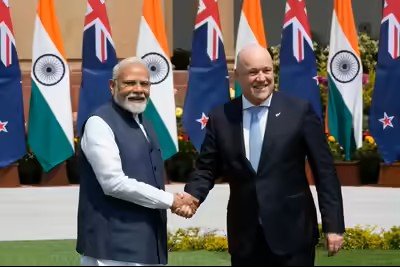
Following several rounds of negotiations launched in March 2025, India and New Zealand concluded one of India’s fastest-negotiated Free Trade Agreements (FTA) in December 2025.[1] The Agreement significantly enhances market access and tariff preferences for Indian exports to New Zealand, marking a substantive upgrade in bilateral economic relations. Beyond its immediate commercial value, the FTA assumes wider significance by positioning New Zealand as an important economic and strategic gateway for India’s engagement with the broader Oceania region and the Pacific Island Countries (PICs).
The conclusion of the FTA reflects a growing convergence between India and New Zealand within the evolving Indo-Pacific economic and maritime landscape. While the two countries have long shared warm diplomatic ties and common institutional affinities, economic engagement remained limited in scale and scope for much of the past decade. The FTA represents a structural intervention aimed at correcting this imbalance by embedding bilateral trade, investment, and regulatory cooperation within a predictable and rules-based framework.
Importantly, the India–New Zealand FTA must be understood not merely as a trade liberalisation instrument, but as part of India’s broader effort to diversify its economic partnerships, reduce over-dependence on select markets, and strengthen its presence across Oceania. New Zealand’s geographical position, deep institutional linkages with Pacific Island States, and role within regional economic and maritime governance structures enhance its relevance to India’s expanding Indo-Pacific strategy.
This paper examines the strategic and economic rationale underpinning the India–New Zealand FTA, situating the agreement within the wider context of India’s engagement with Oceania and the South Pacific. It argues that the FTA constitutes a critical enabling framework for advancing India’s long-term interests in maritime connectivity, regional economic integration, and strategic influence in the Pacific, extending well beyond the immediate gains of tariff liberalisation.
Rationale and Structural Constraints in the Pre-FTA Phase
India and New Zealand share longstanding and warm relations, with diplomatic ties established in 1950 with a Trade Commission, which was upgraded to a Consulate General in 1952.[2] Their partnership is underpinned by shared institutional foundations, including Commonwealth membership, common law traditions, and democratic governance, alongside enduring people-to-people links through tourism, education, and sporting exchanges such as cricket, hockey, and mountaineering.[3]
Recognising India’s growing economic and strategic significance, New Zealand identified India as a priority country under its “Opening Doors to India” (2011, reiterated 2015) and subsequently launched the “NZ Inc India Strategy” (2011) to coordinate government, business, and educational stakeholders.[4] In 2020, New Zealand further signalled its intent to deepen the partnership through the “India–New Zealand 2025: Investing in the Relationship” document.[5] While these initiatives were important in signalling intent and fostering engagement, they primarily functioned as coordination and promotional frameworks rather than instruments of market liberalisation. They did not incorporate binding commitments on tariffs, services market access, professional mobility, or investment facilitation, leaving structural barriers largely unaddressed.
This gap between diplomatic goodwill and economic substance was reflected in modest trade volumes. Bilateral merchandise trade remained around USD 1–1.5 billion for much of the decade, despite the complementarity and growth trajectories of the two economies.[6] Services trade, although expanding, lacked an enabling institutional framework, particularly in sectors where India holds clear comparative advantages such as information technology, healthcare, education, and professional services.
Several structural constraints characterised India–New Zealand economic relations prior to the FTA:
- Trade in Goods: Indian exports faced tariff and non-tariff barriers limiting competitiveness. Labour-intensive sectors, including textiles, apparel, leather, footwear, and engineering products, faced tariffs of up to 10 per cent, reducing price competitiveness relative to suppliers with preferential access.[7]
- Services and Professional Mobility: Institutional support for services trade was fragmented. Market access for Indian professionals, students, and service providers depended largely on ad hoc visa arrangements and evolving domestic policy, constraining scale, predictability, and long-term engagement.[8]
- Investment Linkages: Prior to the FTA, bilateral investment flows between India and New Zealand were modest and lacked a structured, rules-based framework to foster deep, long-term commitments across sectors such as agri-technology, food processing, education, climate innovation, and infrastructure. The agreement’s inclusion of a US$ 20 billion investment commitment over 15 years helps establish such a framework, enhancing predictability and signalling confidence in longer-term economic cooperation.[9]
- Strategic Engagement: From a regional perspective, the absence of a comprehensive economic agreement constrained India’s broader engagement with Oceania.[10] New Zealand occupies a pivotal position in the South Pacific, maintaining strong institutional, development, and maritime linkages with Pacific Island Countries (PICs). Without a formal trade and investment partnership, India’s ability to leverage New Zealand as a strategic gateway to the Pacific remained limited.
The India–New Zealand FTA directly addresses these structural shortcomings by institutionalising market access, embedding services, mobility, and investment cooperation within a predictable legal framework, and aligning trade liberalisation with India’s domestic development and employment priorities. By bridging the gap between diplomatic intent and economic reality, the FTA transforms a politically cordial but economically underdeveloped relationship into a structured platform for sustained bilateral and regional engagement.
The India–New Zealand Free Trade Agreement: Scope, Architecture, and Strategic Design
The India–New Zealand Free Trade Agreement (FTA), represents a structural recalibration of bilateral relations. The FTA addresses four interlinked domains—goods, services and mobility, investment, and maritime–supply chain connectivity—and collectively advances India’s strategic and economic objectives.
- Trade in Goods: Market Access as a Strategic Enabler
As mentioned in the earlier limitations, Indian exports previously faced tariffs of up to 10% on labour-intensive and value-added goods such as textiles, apparel, engineering products, and select agricultural commodities.[11] The FTA eliminates these tariffs in a phased manner across priority sectors, including pharmaceuticals, processed foods, rice, spices, and light manufacturing, while safeguarding sensitive sectors like dairy and certain agricultural items.[12]
Market access under the FTA serves multiple strategic objectives:
- Benchmarking and Standards Alignment: Compliance with New Zealand’s high standards facilitates entry into other developed markets in Oceania and the Pacific.[13]
- Supply Chain Diversification: Broader market access reduces over-reliance on traditional destinations, enhancing resilience.
- Pacific Market Signalling: Preferential access strengthens India’s credibility as a long-term economic partner in the South Pacific.[14]
- Services and Professional Mobility: Institutionalising India’s Comparative Advantage:
Services constitute the most transformative component of the FTA. Indian strengths in IT, healthcare, education, engineering, wellness (AYUSH, yoga), and creative sectors now benefit from structured pathways and regulatory recognition.[15] The agreement establishes structured pathways for the temporary movement of professionals, enables mutual recognition of qualifications, and improves transparency in licensing procedures.[16] This shifts services engagement from ad hoc, discretionary arrangements to a more predictable and rules-based framework. This institutionalisation yields strategic benefits:
- Economic Diplomacy Through People: Professionals embedded in New Zealand create durable networks beyond trade flows.
- Labour Market Complementarity: India’s skilled workforce meets New Zealand’s demographic and labour needs.
- Template for Pacific Engagement: Services integration with New Zealand offers a replicable model for engagement with Pacific Island economies.
- Investment Frameworks and Technology Partnerships
Investment provisions under the FTA clarify rules, enhance dispute settlement mechanisms, and facilitate two-way capital flows, with New Zealand committing USD 20 billion in investment into India over the next 15 years to strengthen long-term economic cooperation.[17] New Zealand investors gain opportunities in India’s agri-tech, food processing, renewable energy, education services, and climate innovation sectors as the FTA deepens economic engagement and promotes investment flows,[18] while Indian firms access stable markets in New Zealand and a platform for Pacific expansion.[19]
- Maritime Trade, Logistics, and Supply Chain Connectivity
India and New Zealand are maritime nations with seaborne trade forming the backbone of bilateral exchanges. The FTA facilitates smoother maritime flows, port services cooperation, and logistics efficiency, enhancing supply-chain resilience and providing indirect access to Pacific markets.[20] This aligns with India’s broader objective of securing reliable maritime trade routes in the Indo-Pacific.
- FTA Provisions at a Glance
The following table summarises the FTA’s multidimensional provisions, the gaps they address, and strategic significance for India. (Table 1 refers)
| Dimension | What the FTA Provides | What Was Missing Earlier | Strategic Significance for India |
| Trade in Goods | Tariff elimination or reduction on key Indian exports including pharmaceuticals, textiles and apparel, rice, processed foods, engineering goods, and light manufacturing | Indian exports faced MFN tariffs and regulatory barriers; no preferential access despite economic complementarity | Improves price competitiveness in a high-income market; supports India’s labour-intensive manufacturing and MSMEs; enhances India’s credibility as a rules-based trading partner |
| Services Trade | Market access and regulatory cooperation in IT, engineering, healthcare, education, construction, wellness (including AYUSH and yoga), and creative services | Services engagement depended on domestic regulations and ad hoc arrangements; no binding commitments | Positions India as a services provider for Oceania; leverages India’s comparative advantage in human capital and knowledge-based services |
| Mobility & Skilled Workforce | Structured provisions for temporary movement of skilled professionals, educators, health workers, and specialised service providers | No formal framework for professional mobility; people-to-people ties not translated into economic integration | Deepens long-term influence through workforce integration; strengthens India’s soft power and professional footprint |
| Standards & Regulatory Cooperation | Cooperation on technical standards, SPS measures, transparency, and regulatory procedures | Indian exporters faced high compliance costs and uncertainty in meeting New Zealand’s regulatory standards | Builds exporter capacity to meet OECD-level standards, enabling spillover access to Pacific Island and other developed markets |
| Investment Frameworks | Improved investment facilitation, transparency, and policy predictability for two-way investments | Investment flows remained modest; lack of structured, rules-based framework for long-term commitments | Encourages collaboration in agri-tech, food processing, education, climate innovation, and infrastructure |
| Maritime Trade & Logistics | Smoother maritime trade flows, cooperation in port services, shipping reliability, and logistics efficiency | Maritime cooperation was indirect and largely transactional | Strengthens India’s role in Indo-Pacific maritime commerce; supports resilient sea-borne trade routes |
| Supply Chain Resilience | Diversification of supply chains across food products, agri-tech, manufacturing inputs, and select minerals | Limited access to trusted supply chains in the South Pacific | Reduces vulnerability to disruptions; aligns with India’s emphasis on resilient and diversified supply chains |
| Blue Economy Cooperation | Scope for cooperation in fisheries management, ocean governance, marine sustainability, and related capacity-building | India’s engagement with Pacific blue economy issues was fragmented and project-based | Creates structured entry points for India to support Pacific maritime governance using New Zealand as a regional anchor |
| Digital Trade & Innovation | Enabling environment for fintech, digital payments, AI-enabled logistics, and technology collaboration | Digital engagement lacked institutional backing | Expands India’s digital public infrastructure and technology presence in Oceania |
| Oceania & PIC Spillover | New Zealand functions as a commercial, regulatory, and logistical gateway to Pacific Island Countries | India lacked institutionalised economic pathways into PIC markets | Enables India to scale engagement with PICs without duplicating diplomatic or commercial infrastructure |
| Strategic & Diplomatic Signalling | High-standard FTA with a developed economy | India often perceived as cautious or slow in trade negotiations | Signals India’s evolution into a confident Indo-Pacific economic actor using trade as strategic statecraft |
Table 1: Source: Various sources, compiled by author.
Table 1 underscores the point that the FTA is not just transactional, but a strategic platform for long-term bilateral and regional engagement.
Maritime and Strategic Implications for India’s Engagement with Oceania and the Pacific
Although primarily an economic agreement, the India–New Zealand FTA has important maritime and strategic implications for India’s engagement with Oceania. As discussed in the book Girt by Sea, geography and the surrounding oceans shape how States trade, connect, and exercise influence.[21] In island regions such as Oceania, economic activity, development, and regional cooperation are fundamentally linked to the sea.
Against this backdrop, the FTA allows India to deepen its regional engagement through maritime-linked economic cooperation. By strengthening sea-borne trade, logistics connectivity, and regulatory alignment with New Zealand, India positions itself more firmly within the maritime networks that underpin economic and strategic interaction in the Pacific.
- Oceania and the Pacific as a Maritime Strategic Space
Vast maritime distances, dispersed island States, and dependence on sea-borne trade make maritime connectivity central to economic and strategic relevance. Indian engagement through initiatives such as FIPIC has strengthened political ties but lacked commercial and logistical depth.[22] The FTA partially remedies this by anchoring India’s Pacific engagement through a maritime-connected partner.
- New Zealand as a Maritime and Economic Gateway
New Zealand functions as a logistics hub, regulatory reference point, and development partner for multiple PICs.[23] The FTA allows Indian firms to utilise New Zealand-based infrastructure and regulatory familiarity to access Pacific markets[24], integrating India more closely into maritime supply chains without overstretching diplomatic capacities.[25]
- Trade, Maritime Security, and Supply Chain Resilience
Enhanced trade flows reduce vulnerability to disruptions in key maritime corridors. Cooperation in port services, shipping reliability, and logistics digitisation under the FTA strengthens India’s reputation as a dependable partner and aligns with Indo-Pacific emphasis on resilient supply chains.[26]
Blue Economy and Ocean Governance Cooperation
The FTA creates opportunities for joint initiatives in fisheries, marine biodiversity, sustainable tourism, and ocean governance. Triangular cooperation combining Indian technology, New Zealand expertise, and PIC implementation can enhance India’s image as a development-oriented maritime partner while contributing to regional sustainability objectives.
- Strategic Signalling
The FTA demonstrates India’s capacity to conclude high-standard agreements, countering perceptions of protectionism. For PICs, it signals India’s long-term economic commitment and positions economic statecraft as a core pillar of Indo-Pacific influence.
- Limitations and Strategic Risks
Strategic impact is contingent on timely implementation of services, mobility, and investment provisions; commercial scale in Pacific markets; and management of competition from other major powers.
Policy Recommendations for India
- Activate Services and Mobility Provisions as Strategic Economic Tools
India should move swiftly from negotiated commitments to operational outcomes by prioritising services trade and professional mobility—areas where India holds clear comparative advantages and where demand exists across Oceania.
- Establish an India–New Zealand Services and Mobility Task Group under the Ministry of Commerce and MEA by mid-2026, mandated to operationalise visa pathways created under the FTA for IT professionals, healthcare workers, educators, and AYUSH practitioners.
- Pursue Mutual Recognition Agreements (MRAs) for qualifications in healthcare, engineering, and education within 18 months, reducing entry barriers for Indian professionals and enabling scalable services exports.
- Pilot a “Skills Bridge” digital platform, linking Skill India certification databases with New Zealand immigration and employer systems, beginning with select cohorts (AYUSH practitioners, IT professionals, technical instructors).
- Leverage New Zealand as a testing ground for Indian services standards before extending similar models to Pacific Island Countries (PICs), particularly in healthcare delivery, vocational training, and digital services.
This approach allows India to convert mobility provisions into sustained services exports while creating templates transferable to smaller Pacific economies facing acute skills shortages.
- Use New Zealand as an Economic Gateway to the Pacific Islands
India should consciously position the FTA as a platform for wider Pacific engagement, rather than a standalone bilateral instrument.
- Establish an India–Oceania Business Facilitation Mechanism, in partnership with New Zealand Trade and Enterprise and Indian industry bodies, to support Indian firms seeking market access in Papua New Guinea, Fiji, Solomon Islands, and Vanuatu.
- Encourage Indian exporters in pharmaceuticals, processed foods, textiles, and construction materials to use New Zealand-based logistics, warehousing, and regulatory familiarity to access Pacific markets.
- Align India’s development assistance and Lines of Credit in the Pacific with commercial follow-through, enabling Indian firms to supply equipment, services, and training linked to funded projects.
- Strengthen coordination between FIPIC and New Zealand-linked regional institutions, ensuring India’s economic initiatives complement existing Pacific regional structures rather than bypass them.
This would shift India’s Pacific engagement from episodic diplomacy to sustained economic presence.
- Deepen Maritime and Blue Economy Cooperation
The FTA provides a stable economic foundation upon which India can expand maritime cooperation with New Zealand and, by extension, the wider South Pacific.
- Initiate India–New Zealand maritime cooperation frameworks covering port efficiency, logistics digitisation, and maritime safety, with provisions for Pacific Island participation.
- Integrate maritime data-sharing initiatives by linking Indian Ocean maritime awareness capabilities with New Zealand’s Pacific-focused monitoring systems to support search and rescue, fisheries management, and disaster response.
- Promote joint capacity-building programmes in sustainable fisheries, port management, and coastal resilience for PIC officials and practitioners, hosted alternately in India and New Zealand.
- Encourage Indian private sector participation in Pacific port infrastructure, vessel maintenance, and maritime services, supported by public risk-sharing instruments.
Such cooperation strengthens India’s credibility as a maritime development partner in Oceania while advancing regional stability.
- Align Climate, Agriculture, and Blue Economy Initiatives
Climate vulnerability is a defining concern for Oceania and the Pacific Islands. India should leverage the FTA to link trade, technology, and climate adaptation.
- Expand India–New Zealand collaboration in agri-technology, food processing, and cold-chain logistics, with joint pilots designed for replication in PICs.
- Support Pacific Island countries through triangular cooperation models—Indian technology and skills, New Zealand regional expertise, and local Pacific implementation.
- Position Indian solutions in renewable energy, coastal resilience, and climate-resilient infrastructure as part of a broader Indo-Pacific public goods approach.
This reinforces India’s image as a partner focused on capability enhancement rather than extractive engagement.
- Institutionalise FTA-driven Regional Engagement
To ensure durability, India should embed the FTA within its wider Indo-Pacific economic architecture.
- Hold annual India–New Zealand FTA review dialogues at the ministerial or senior official level, with a standing agenda item on Pacific Island engagement.
- Invite Pacific Island representatives and regional organisations to select FTA-linked business and development forums, normalising India’s economic presence in the Pacific.
- Task Indian missions in Oceania with identifying FTA spillover opportunities—services, training, and supply chains—that directly benefit PICs.
Institutionalising these linkages prevents the FTA from becoming siloed and maximises its regional multiplier effect.
Conclusion
The India–New Zealand Free Trade Agreement should be viewed not merely as a trade liberalisation instrument but as a strategic enabler—one that strengthens India’s services exports, enhances maritime and climate cooperation, and provides a practical pathway for deeper engagement with Pacific Island Countries. By leveraging New Zealand’s regional connectivity, institutional familiarity, and Pacific linkages, India can amplify its economic and strategic footprint across Oceania in a manner that is sustainable, demand-driven, and aligned with regional priorities.
The FTA marks a transition from an under-realised bilateral relationship to a structured, forward-looking partnership anchored in long-term economic and strategic convergence. By addressing gaps in market access, services mobility, and investment cooperation, the FTA serves both commercial and strategic objectives. Viewed through a maritime lens, the agreement reflects the growing recognition that economic connectivity, trade architecture, and maritime stability are mutually reinforcing pillars of influence in the Indo-Pacific.
*******
About the Author
Ms Kripa Anand is a Research Associate at the National Maritime Foundation (NMF). Her research encompasses maritime security issues, with special focus upon the manner in which India’s own maritime geostrategies are impacted by the maritime geostrategies of the island-States of Oceania in general and Australia and New Zealand in particular. She may be reached at ocn1.nmf@gmail.com
Endnotes:
[1] Government of India, “India-New Zealand Free Trade Agreement,” Press Information Bureau, 22 December 2025. https://www.pib.gov.in/PressNoteDetails.aspx?NoteId=156654&ModuleId=3®=3&lang=
[2] “India–New Zealand: Bilateral Brief,” Consulate General of India. https://www.cgiauckland.gov.in/page/india-new-zealand-bilateral-brief/
[3] “India–New Zealand: Bilateral Brief,” Consulate General of India.
[4] “India–New Zealand: Bilateral Brief,” Consulate General of India.
[5] “India–New Zealand: Bilateral Brief,” Consulate General of India.
[6] “India – New Zealand Free Trade Agreement,” Press Information Bureau, GoI, 22 December 2025.
[7] Melissa Cyrill, “India–New Zealand FTA: Business, Trade & Market Access FAQs for Exporters and Investors”, India Briefing, December 2025. https://www.india-briefing.com/news/india-new-zealand-fta-business-trade-faqs-41527.html.
[8] “New Zealand-India Free Trade Agreement: Key Outcomes,” New Zealand Foreign Affairs and Trade, https://www.mfat.govt.nz/en/trade/free-trade-agreements/free-trade-agreements-concluded-but-not-in-force/new-zealand-india-free-trade-agreement/key-outcomes.
[9] Byron Kaye and Shivangi Acharya, “New Zealand concludes FTA with India with aim to double trade”, Reuters, December 2025. https://www.reuters.com/world/india/new-zealand-concludes-free-trade-agreement-with-india-2025-12-22/.
[10] Darshana M Baruah, “India in the Indo-Pacific: New Delhi’s Theater of Opportunity,” June 2020. https://carnegieendowment.org/research/2020/06/india-in-the-indo-pacific-new-delhis-theater-of-opportunity?lang=en.
[11] “India – New Zealand Free Trade Agreement,” Press Information Bureau, GoI, 22 December 2025.
[12] “India – New Zealand Free Trade Agreement,” Press Information Bureau, GoI, 22 December 2025.
[13] “India – New Zealand Free Trade Agreement,” Press Information Bureau, GoI, 22 December 2025.
[14] “Australia and Pacific: Our relationship with the Pacific,” New Zealand Foreign Affairs and Trade. https://www.mfat.govt.nz/en/countries-and-regions/australia-and-pacific.
[15] “India – New Zealand Free Trade Agreement,” Press Information Bureau, GoI, 22 December 2025.
[16] “India – New Zealand Free Trade Agreement,” Press Information Bureau, GoI, 22 December 2025.
[17] “India – New Zealand Free Trade Agreement,” Press Information Bureau, GoI, 22 December 2025.
[18] Byron Kaye and Shivangi Acharya, “New Zealand concludes FTA with India with aim to double trade”, Reuters, December 2025.
[19] Melissa Cyrill, “India and New Zealand Conclude Landmark FTA: What’s in it for Businesses,” India Briefing, December 22, 2025. https://www.india-briefing.com/news/india-new-zealand-fta-concluded-provisions-sector-opportunities-41493.html.
[20] Jagjeet Singh Uberoi “India seals landmark FTA with New Zealand, boosts services and mobility,” ET Insights, 22 December 2025. https://etedge-insights.com/featured-insights/geopolitics-and-strategy/india-seals-landmark-fta-with-new-zealand-boosts-services-and-mobility/.
[21] Rebecca Strating and Joanne Wallis, Girt by Sea (Collingwood, Australia: La Trobe University Press in conjunction with Black Inc, 2024).
[22] Kripa Anand, “Leveraging FIPIC For India’s Indo-Pacific Ambitions,”, National Maritime Foundation, 18 June 2025. https://maritimeindia.org/leveraging-fipic-for-indias-indo-pacific-ambitions/.
[23] “New Zealand freight and supply chain strategy,” Ministry of Transport. https://www.transport.govt.nz/area-of-interest/freight-and-logistics/new-zealand-freight-and-supply-chain-strategy.
[24] “India – New Zealand Free Trade Agreement,” Press Information Bureau, GoI, 22 December 2025.
[25] “Australia and Pacific: Our relationship with the Pacific,” New Zealand Foreign Affairs and Trade.
[26] “Indo-Pacific Economic Framework for Prosperity (IPEF) Supply Chain Agreement,” Ministry of Business, Innovation and Employment. https://www.mbie.govt.nz/business-and-employment/business/trade-and-tariffs/trade-agreements-and-partnerships/indo-pacific-economic-framework-for-prosperity-ipef-supply-chain-agreement.


Leave a Reply
Want to join the discussion?Feel free to contribute!