
Abstract
This article examines the tenuous cross-Strait dynamics under the shadow of China’s sustained military and grey-zone coercion against Taiwan and the attendant risks to regional peace and global maritime stability. It situates contemporary PLA brinkmanship within the broader geopolitical contestations of the western Pacific. It further evaluates the strategic linkages drawing Japan and the Philippines into the cross-Strait calculus, thereby expanding the potential arena of escalatory geopolitics. Given the Taiwan Strait’s centrality to global shipping lanes, energy flows, and semiconductor supply chains, the paper underscores the severe economic ramifications of any disruption. It reviews the legal status of the Strait under UNCLOS and the contestation surrounding the freedom of navigation. The analysis highlights the role of extra-regional stakeholders, including India, whose trade interests are directly affected, and advocates a collaborative blend of credible deterrence and synergistic commitment to a rules-based maritime order to preserve open, safe and secure seas.
“The People’s Republic of China’s unprecedented military buildup, combined with intensifying provocations in the Taiwan Strait, East and South China Seas and across the Indo-Pacific, have highlighted the fragility of peace in the region. Beijing’s willingness to alter the status quo by force has become increasingly evident.”
- Taiwan’s President, Lai Ching-te (November 2025)[1]
The western Pacific littoral is beset with a variety of geopolitical contestations, simmering tensions, underlaying faultlines and consequent potential for conflict and instability. The contentious territorial sovereignty disputes and overlapping maritime claims between various States — including Russia, Japan, China, North Korea, South Korea, Taiwan, Philippines, Vietnam — lie at the root of the tenuous regional situation. The adjoining maritime space — ranging from Russia’s east coast to the Korean Peninsula, and covering the entire East and South China Seas — is consequently being used for wide-ranging activities by various contestants to increase their influence, project power or simply intimidate other countries into submission, subjugation or silence. These activities either take the form of ‘grey zone’ tactics — with every coercive action just short of open conflict included therein — or manifest themselves in open display of offensive intent by showcasing their military force, missile and nuclear capabilities. While these powerplay gambits may or may not meet their geopolitical objectives, they would certainly threaten the freedom of navigation, openness, security and stability of the Pacific region.
This Paper specifically provides an overview of the prevailing contemporary geopolitical environment and the existing volatile situation in and around the Taiwan Strait, where the acts of Chinese military coercion are casting an ominous shadow of confrontation. It argues that the risk of consequent military escalation in the region could cause widespread disruption in the global maritime supply chains, considered so vital for the economic well-being of the world at large, and offers certain recommendations to mitigate such challenges.
Contemporary Cross-Strait Dynamics
The cross-Strait security situation was always simmering with sporadic incidents interspersed with three distinct Taiwan crises ever since the 1950s.[2] The visit of Ms Nancy Pelosi, Speaker of the US House of Representatives, to Taiwan in August 2022 provided China with just the right pretext to ratchet up its proactive stance vis-à-vis Taiwan and create the proverbial fourth crisis. Since then, the PLA Navy has been openly engaging in increased deployment and aggressive manoeuvres in the Taiwan Strait, as well as off the eastern coast of Taiwan. The PLA Air Force (PLA AF) aircraft and drones have also started flying across the median line on an almost-daily basis and have been intruding into Taiwan’s Air Defence Identification Zone (ADIZ) at will.
China issued a White Paper on Taiwan in August 2022 entitled “The Taiwan Question and China’s Reunification in the New Era.” The title itself suggested that a ‘historically transformed’ and ‘rejuvenated China of the new era’ considered the current time-period as “a new starting point for reunification.”[3] The release of this boldly stated White Paper — generally coinciding with the visit of Ms Nancy Pelosi — has since been followed through with appropriate military-posturing and heightened patrolling by maritime law enforcement agencies, duly backed by the three-warfare concept of multi-pronged media reportage, self-serving legal interpretations and an onslaught of psychological narratives.
The inflexible Chinese position on Taiwan was reiterated yet again in the 2025 White Paper named “China’s National Security in the New Era”, which was released in the Chinese language in May 2025. The English translated content made available by Andrew Erickson asserts that “Taiwan is a province of China and has no basis, reason or right to participate in the United Nations and other international organizations…”, and that “China will never allow any person, any organization, any political party, at any time, in any form, to separate any piece of Chinese territory from China”.[4] The White Paper also warned the so-called ‘external forces’ and ‘some countries’ against “deliberately playing the Taiwan card” and creating trouble in the Taiwan Strait, South and East China Seas, Hong Kong, Tibet and Xinjiang.[5]
The main ‘external force’ implied in the above Chinese White Papers — and in fact, in many other documents and media releases — is, of course, the US and its forward-deployed military forces. However, the ambiguous stance adopted by Washington, DC vis-a-vis defence of Taiwan from time to time, and its ‘blow-hot blow-cold’ relations with China — especially so during the second term of the Trump administration — have created an environment of uncertainty in cross-Strait dynamics. This change of US foreign policy approach towards China is quite evident between Trump 1.0 and 2.0. The 2017 edition of the US National Security Strategy (NSS) clubbed China together with Russia as a ‘revisionist power’, and further posited that Beijing was seeking to “displace the United States in the Indo-Pacific Region”.[6] Eight years later, China now finds itself in a much better spot, wherein the US, in the recently released NSS-2025, wants to “rebalance America’s economic relationship with China …” so as to grow from “… $30 trillion economy in 2025 to $40 trillion in the 2030s …”[7]
These developments, coupled with President Trump’s exhortations to Taiwan to take more ownership of its national security by increasing its defence budget, have injected some misgivings amongst the Taiwanese political and military establishment about the capability and/or willingness of Washington to provide wholehearted and timely support during an existential cross-Strait crisis. Given this context, a rain-check on balance of forces between the two counties, becomes quite relevant.
China Taiwan – Balance of Forces
Taiwan is trying its best to meet the existential challenge emanating from the extremely provocative posture adopted by the PLA Navy and PLA AF, all around Taiwan, by tactful deployment of its military assets. However, a substantial differential between the capacities and capabilities of the defence forces of China and Taiwan, is quite well known. Still various official documents make such comparisons so as to drive home the stark inequalities. For instance, the balance of naval forces between China and Taiwan, as shown in the US Department of Defense’s Annual report on military capabilities of China-2025, is reproduced at Figure 1. [8]
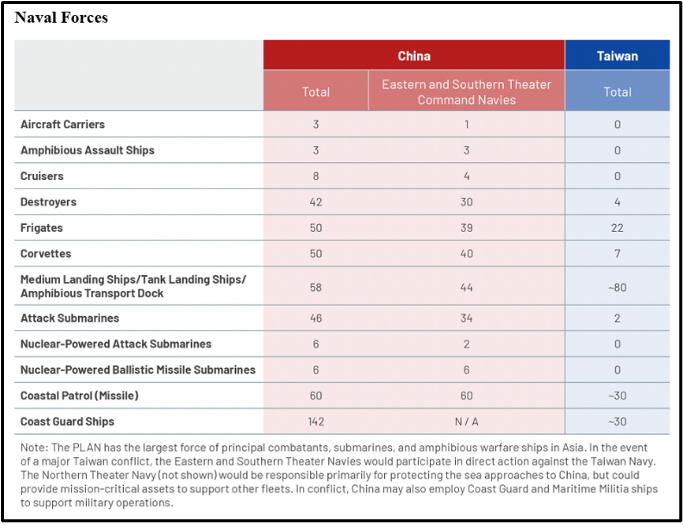
Figure 1: China Taiwan – Balance of Naval Forces
Source: US DoD Annual report on military capabilities of China-2025
Chinese Brinkmanship against Taiwan
The rising trend of PLA’s excessive show of strength assumed especially alarming connotations in 2024, particularly between the DPP victory during the Taiwan presidential elections in January, extending through the Presidential inauguration in May and culminating with President Lai Ching-Te’s first speech on 10 October 2024 to mark Taiwan’s 113th National Day. Within three days of Taiwan’s new President assuming office on 20 May 2024, the Chinese PLA conducted a well-publicised Exercise JOINT SWORD-2024-A. The 24-hour long multi-domain exercise involved the PLA Navy ships and submarines, PLA AF aircraft, PLA Army’s amphibious troops, PLA Rocket Force units, and CCG ships, for the first time. The exercise was spread over many areas all around Taiwan, and also brought the outlying islands of Kinmen, Matsu, Wuqiu, and Dongyin into its ambit.
The blatant display of scaremongering was repeated just four days after the Taiwanese President’s first National Day speech, in the form of exercise JOINT SWORD 2024-B on 14 October 2024, at locations yet closer to Taiwan, and with even greater intensity and a larger force, including the participation of the Liaoning aircraft carrier group. Official website of the PLA did not mince any words, with the aim of the exercise JOINT SWORD 24-B being articulated as:
“… testing the joint operations capabilities of the Eastern Theatre command units in conducting sea- and air-based combat-readiness patrol, laying blockade against key Taiwanese ports, carrying out assault on maritime and ground targets, as also seize joint superiority in the combat-zone”.[9]
While Exercise STRAIT THUNDER 2025-A of April 2025, with the objective of “seizing control of key areas and controlling chokepoints”,[10] continued to ratchet up the pressure on Taiwan, Beijing decided to end the year 2025 on an alarming note by conducting yet another mega exercise named JUSTICE MISSION 2025 around Taiwan. Initial inputs suggested that the PLA’s Eastern Theatre Command promulgated five exclusion zones for conducting live-fire drills.[11] These PLA-announced restricted areas are marked on the graphic at Figure 2.
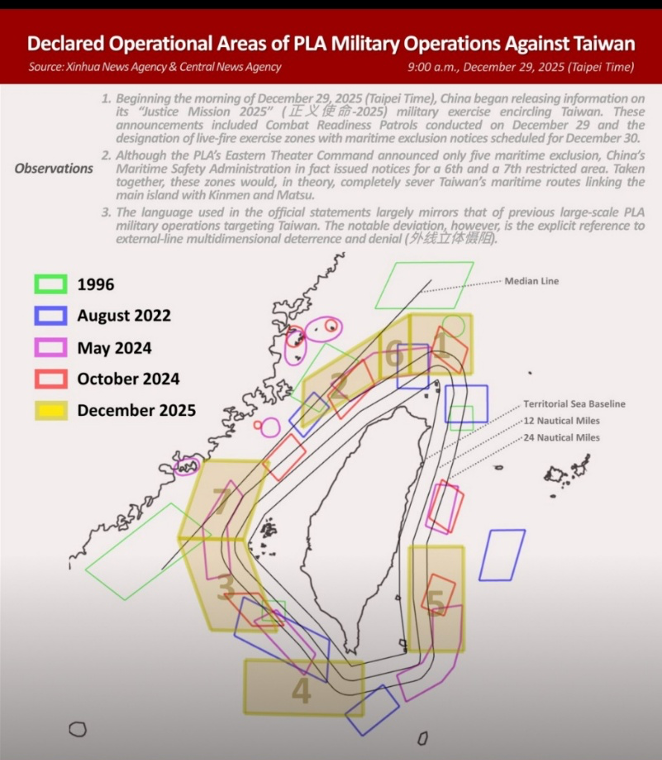 Figure 2: PLA promulgated exclusion zones for live-firing drills
Source: K. Tristan Tang, LinkedIn Post
Taiwan’s Ministry of National Defense (MND) confirmed these developments by counting 130 sorties of PLA AF aircraft, 14 PLA Navy ships and 8 Chinese government vessels operating around Taiwan within 24 hours — from 0600 hours on 29 December till 0600 hours on 30 December 2025 — and released a corresponding graphic depicting the activities of those fighters and bombers (Figure 3).[12]
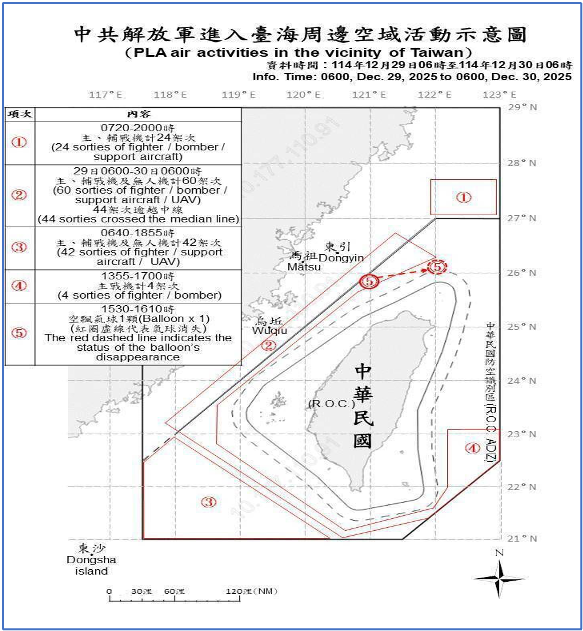 Figure 3: PLA air activities in the vicinity of Taiwan – 29 Dec 2025
Source: Taiwan Ministry of National Defense
The Chinese Ministry of National Defense, on its part, stated that the main focus of Exercise JUSTICE MISSION 2025 was on blockading of main ports and areas around Taiwan, testing of PLA’s sea-air combat readiness, practicing joint seizure of comprehensive superiority, and notably, posing multi-dimensional deterrence to external forces approaching from outside.[13] It further stated that the exercise was meant to serve as a “stern warning against Taiwan Independence separatist forces and external interference, and a legitimate and necessary action to safeguard China’s sovereignty and national unity.”[14]
Taiwan’s Defensive Response Strategy
Taiwan has been grappling with this doomsday scenario of ‘reunification by use of Force’ since 1949 itself, when the Taiwanese nationalist dispensation, having lost the civil war against the communists, had to leave the mainland and relocate to Taiwan under extreme duress. Without going into the details of inter-se animosity of the subsequent half-century, communist China’s pressure to unify Taiwan gained greater traction after the Democratic Progressive Party (DPP) came to power for the first time in 2000. The inherent ‘independence-oriented’ outlook of the DPP, which has again been in power since 2016 till date, has progressively irked China no end; and Beijing has progressively hardened its stance on the issue as its comprehensive national power — riding on its economic strength and military muscle — has grown to a point where it is considered to be a ‘near-peer competitor’ to the US itself.
Taiwan’s ‘Quadrennial Defense Review (QDR) of 2021’ carried out a realistic assessment of the national security situation vis-a-vis Chinese intentions. With Taiwan’s Defence Minister highlighting the extent of threat from China by stating that “China has never renounced the ‘use of Force’ against Taiwan”, the 2021 QDR identified overwhelming superiority in the following aspects of Chinese military capabilities:[15]
- Joint Intelligence, Surveillance and Reconnaissance (ISR) Capabilities
- Military Coercive Capabilities
- Improved Combat Efficiency Capabilities
- Joint Strike Capabilities
- Joint Blockade Capabilities
- Joint Landing operations Capabilities
- Strategic Support Capabilities
- Joint Logistics Support Capabilities
In order to respond to such an overwhelming threat from China in the best possible way, Taiwan has worked out a military strategy based on two major postulates, namely, (a) secure territory with resolute defence and; (b) multi-domain deterrence by joint capabilities. The execution of these broad strategic objectives on the ground would entail:[16]
- Constant and comprehensive monitoring of the situation across the Taiwan Strait through a multi-source maritime domain awareness (MDA) structure’ including through the exchange of information and intelligence with allies and friendly countries.
- Possession/acquisition of hardware of comparable capabilities to engage in kinetic warfare. This would require modern ships, submarines, different-role missiles, early warning assets and other weapon systems.
- Constant training of manpower and joint exercises, internally, as well as with friends and allies, in order to operate above hardware with optimum effectiveness.
The Defense Minister of Taiwan reiterated the looming threat to the national security in the recently published ‘ROC National Defense Report-2025’ (NDR-2025), by stating that “… PRC conducts joint operational readiness patrols and targeted military exercises against Taiwan without warning, attempting to create the model of invading Taiwan by turning training into exercises, and turning exercises into war. This has destabilized the situation in the Taiwan Strait …” [17] Taiwan’s national defence imperatives have accordingly been tweaked in NDR-2025, to “building of agile and resilient armed forces”, and “pursuing a new strategy of Multi-Domain Deterrence and Resilient Defense” as the core operational concept. These have been further elaborated to include the undermentioned focus areas:[18]
- Strategic Shift. Moving from traditional defence to building national resistance against escalating PRC pressure (cognitive, grey zone).
- Multi-Domain Deterrence. Enhancing capabilities across land, sea, air, space, and cyber to deny aggression.
- Asymmetric Warfare. Investing in low-cost, high-impact weapons like anti-ship missiles, drones, and coastal defence forces.
- Whole-of-Nation Defense. Integrating societal resilience (energy, civil defense) with military strength, emphasizing collective effort.
- Force Modernisation. Implementing reforms in force structure, logistics, manpower, and training, supported by significant budget allocation.
- International Cooperation. Highlighting alliances (especially with the U.S.) and partnerships as crucial to defense.
In order to financially support the abovementioned major national defence initiatives articulated in QDR-2021 and NDR-2025, Lai Ching-te administration announced gradual increase in defence spendings to five percent of GDP over next five years (till 2030).[19] About three and half percent of this outlay is proposed to be utilised for core military requirements like acquisition of military platforms, sensors, weapon systems; augmenting training hardware and facilities; and increasing force recruitment, skilling, sustenance and post-service disposal. The balance one and half percent is meant for creating, upgrading or refurbishing the associated MDA and ISR infrastructure, including the space-based architecture for supporting military operations and making them more operationally effective.
President Lai also announced a special package of USD 40 billion — to be spent over eight years — for Taiwan’s defence sector, so as to meet critical and emergent defence hardware acquisition requirements from the US, enhance asymmetric warfare capabilities, invest in cutting-edge technologies and expand Taiwan’s defense industrial base. In fact, the driving force behind the whole exercise was explained in his Washington Post Op-Ed of 25 November 2025 titled: “I will boost defense spending to protect our democracy.” [20] He also reiterated his commitment to keeping the Indo-Pacific region safe despite record number of PLA incursions into Taiwan’s vicinity and military drills extending from Japan to the Philippine archipelago, and going past the so-called ‘First Island Chain’.[21]
Effect of Cross-Strait Dynamics on extended Neighbourhood
The Chinese reunification bid by use of force would present a serious risk of military escalation. Since the Taiwan Strait and the adjoining East and South China Seas are critical international shipping lanes (ISLs) for global trade and energy flow, the consequent developments will have adverse ramifications for the entire Pacific region. The historically strained Japan-China relations have resurfaced in the form of increasing confrontations around the Senkaku Islands. The South China Sea (SCS) littoral states in particular, are already witnessing an extreme brand of ‘grey zone’ tactics adopted by the CCG ships and the Chinese maritime militia vessels under their ‘benign-sounding’ objective of “safeguarding maritime rights and interests”. In this context, the knock-on effects of cross-Strait dynamics in the proximate and connected littoral have been briefly investigated.
Japanese Linkage with Cross-Strait Dynamics
The continuing downturn in China-Japan relations — due to repeated CCG and PLA AF aircraft and drone activities around Senkaku Islands, increasing China-Russia military cooperation, and new propaganda questioning Japan’s sovereignty over Okinawa and the Ryukyu Islands — in contemporary times is a proverbial trigger-point for possible Japanese involvement in the Cross-Strait Dynamics. Japan has been forced to evaluate its vulnerabilities in the event of a Taiwan-type blockade mounted by Beijing, such as the effect on its energy reserves, electricity supply, digital payment resilience, and availability of essential goods for national sustenance. Owing to cultural connectedness and geographic proximity to Taiwan, Japan feels threatened in the case of a Taiwan contingency. With the southernmost Japanese island of Yonaguni lying just about 70 nautical miles (NM) from Taiwan, and a number of islands interspersed till Okinawa (about 700 km/400 NM) — where a large amount of US military assets are forward-based — Japan is well aware of being circumstantially dragged into the cross-Strait conflict. In fact, when China fired ballistic missiles over Taiwan’s skies in a ‘show of force’ after the visit of US House Speaker Nancy Pelosi in August 2022, some missiles actually fell in the Japanese EEZ, as marked in figure 4).[22]
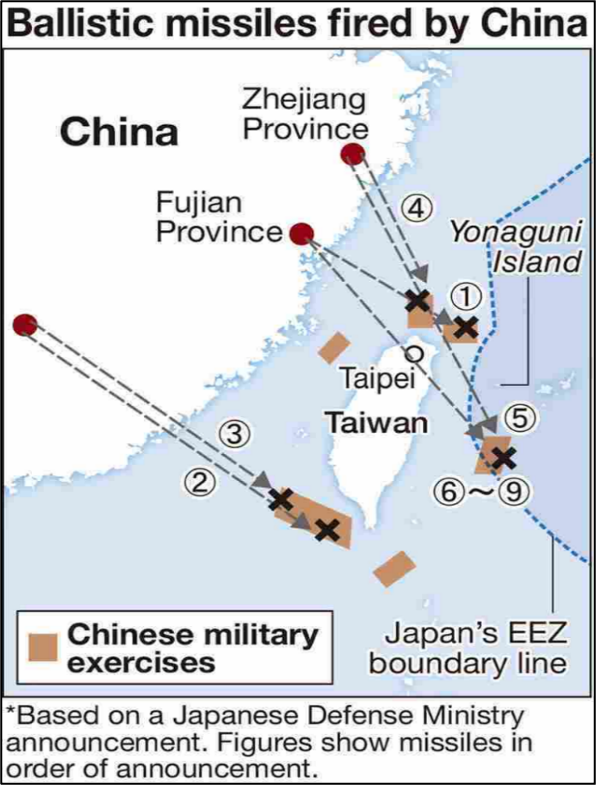 Figure 4: Chinese Missiles fired over Taiwan, fell into the Japanese EEZ – Aug 2022
Source: The Japan News
In recognition of this possibility, many Japanese lawmakers and even former Prime Ministers have asserted at different forums that Taiwan’s security is closely linked to that of Japan. In fact, Former Prime Minister, Taro Aso, while holding the official position Vice President of the ruling Liberal Democratic Party (LDP), publicly stated during the Ketagalan Dialogue of 2023 that there has never been a time like now when Japan, Taiwan, the United States and like-minded countries need the resolve to put into action a strong deterrence, and that this must be a resolve to fight.[23]
The latest episode in this ongoing Japan-China ‘strategic messaging’ chain transpired on 07 November 2025, when the newly elected Prime Minister of Japan, Sanae Takaichi, while responding to a question about a possible Taiwan contingency, stated that a Chinese military attack on Taiwan could constitute a ‘survival-threatening situation’ for Japan. This scenario could potentially compel Tokyo to exercise its right to collective self-defence and respond militarily.[24] Chinese response to her articulation was unusually harsh, wherein Xue Jian, a Chinese diplomat stationed in Osaka, Japan, rhetorically posted on X (Erstwhile Twitter) that “the dirty neck that sticks itself in, must be cut off”.[25] The Chinese government subsequently continued to inflame the controversy by using various leverage to convey its hypersensitivity to the so-called Japanese interference in the cross-Strait affairs. Though PM Takaichi subsequently softened her approach somewhat, she, however, did not retract her November statement. All these crossed interactions clearly indicate that Japan and China will continue to be at loggerheads as far as Japanese involvement in the cross-Strait dynamics is concerned.
The Philippines: Inextricably linked to Cross-Strait Tensions
A close look at the regional map reveals that the northernmost island of Batanes (also known as Amianan/Mavulis Island) lies just 80 NM south-east of Taiwan in the Luzon Strait. (Figure 5) The Philippines’ President, Ferdinand Marcos Jr., considering this geographical reality, stated quite unequivocally that “…when we look at the situation in the Taiwan Strait, we can see that just by our geographical location, should there be conflict in that area… it is tough to imagine a scenario where the Philippines will not somehow get involved.”[26]
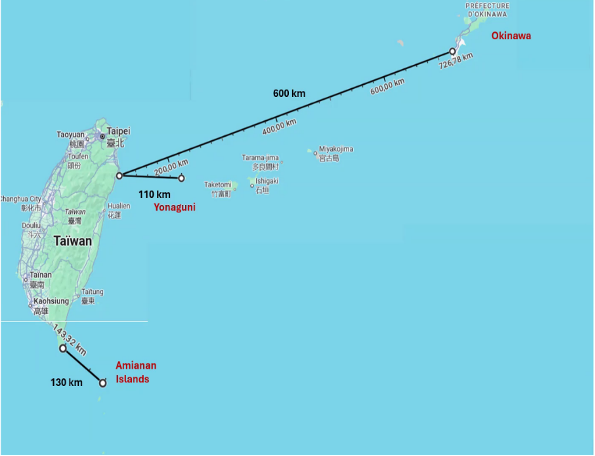 Figure 5: Closest Islands of Philippines and Japan from Taiwan
Source: French Institute for International Relations (IFRI) Conference on Taiwan – Nov 2025
China, which is quite unhappy with the confrontationist stance of the current Marcos administration, as compared to a that of an acquiescing one led by earlier President, Duterte, has stepped up its intimidatory activities against various features located within the EEZ of the Philippines. Since China also claims these features — despite the International Tribunal declaring its claims as illegal — it has used its coast guard ships, maritime militia vessels, and fishing fleet, often in tandem, to systematically deny the access of such features to Filipino fishermen, government vessels, Philippine Coast Guard (PCG) vessels and even warships. Three features in particular, namely, the Second Thomas Shoal, Scarborough shoal and Sabina Shoal, are presently at the center of the Philippines-China standoff, where the Chinese so-called ‘grey zone’ activities have assumed increasingly alarming proportions, just about bordering on open conflict.
Manila has therefore sought to proactively invoke the US security guarantee as a treaty ally. In order to be prepared for the Chinese overreach towards the Philippines in a cross-Strait conflict, Manila has also decided to activate a new forward military base at its northern-most island of Batanes. The US forces, in close coordination with those of the Philippines, are conducting military exercises, carrying out infrastructure development, deploying anti-ship missile systems, and increasing troop presence in and around Batanes Island as part of a broader strategy to deter Chinese aggression. It is therefore quite logical to presume that if the Philippines is actually forced to join the cross-Strait conflict as President Marcos is quite certain about, then it may leave the US with very little choice other than to get involved, thus raising the escalatory quotient by manifold.
Impact on Shipping Lanes’ Security
Taiwan and its surrounding waters and airspace are major ISLs and airways, respectively. Nearly 50 per cent of all global maritime container traffic passes through the Taiwan Strait. Further, approximately 30 per cent of the global passenger and cargo flights pass through the airspace near Taiwan annually. [27] A source which compares the ship transits through six very busy global maritime passages — Dover Strait, Suez Canal, Bab-al Mandab, Taiwan Strait, Cape of Good Hope and Hormuz — pegs the weekly transit of merchant ships across the Taiwan Strait at 1200. While general cargo ships account for about 60 per cent of total transits, container vessels and tankers comprise the balance of 15-17 per cent each.[28] The graph in Figure 6 depicts this data for better appreciation.
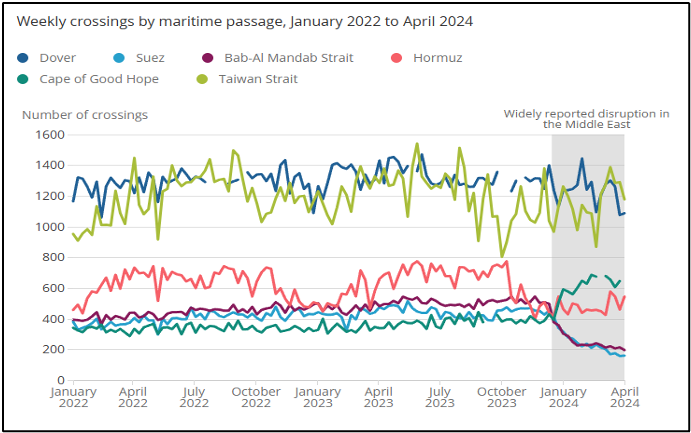 Figure 6: weekly transit of merchant ships across selects global maritime passages
Source: UK Office of National Statistics[29]
A CSIS study quantified the value of maritime trade passing through Taiwan Strait in 2022 at about USD 2.45 Trillion.[30] Over 95 percent of Japan’s crude oil and 65 percent of South Korea’s oil, passes through this Strait, making it a critical energy lifeline for both these countries. China’s own maritime exports by value that transit through the Strait exceed 562 billion USD. Nearly whole of Taiwan’s trade — including over 90 percent of the global demand of advanced semiconductors — is exported through ports located adjacent to the Strait. In 2022, Taiwan’s ports handled an estimated $586 billion worth of trade, nearly all of which passed through the Taiwan Strait. Therefore, the very economic sustenance of the Island state is dependent on the Taiwan Strait.[31] The import, export and total trade values of certain important countries, that pass through the Taiwan Strait, as compiled by CSIS, are shown at Table 1.
| Country | Export | Import | Total |
| China | 562 | 831 | 1392 |
| Japan | 186 | 258 | 444 |
| South Korea | 158 | 200 | 357 |
| Taiwan | 179 | 119 | 298 |
| India | 64 | 106 | 170 |
| UAE | 101 | 64 | 165 |
| Indonesia | 90 | 66 | 156 |
| USA | 54 | 100 | 154 |
| Saudi Arabia | 125 | 21 | 146 |
| Australia | 109 | 109 | 141 |
Table 1: Value of Trade Flow through Taiwan Strait in 2022 (Billion USD)
Source: CSIS data
The CSIS study presented yet another perspective vis-à-vis the importance of the Taiwan Strait for the global mercantile traffic, by compiling the percentage of total national imports and exports of individual countries comprising the BRICs and G7 groupings. The key inference is that about 57, 47, 45, 33 and 28 per cent of the total trade of Japan, China, UAE, Iran and India, respectively, crossed the Taiwan Strait in 2022. [32] The details are shown in Figure 7.
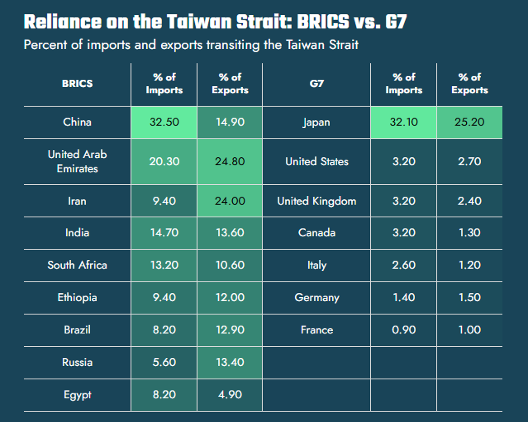 Figure 7: Percent of total imports & exports via Taiwan Strait in 2022 – BRICS and G7
Source: CSIS
Thus, the Taiwan Strait, with more than 62,400 vessels transiting annually therefrom, and transporting over one-fifth of global maritime trade by value, certainly qualifies it as one of the world’s busiest shipping lanes. Therefore, any disruption of trade flows through these critical waters on account of heightened volatility quotient due to worsening Taiwan Strait dynamics will have significant economic implications at global scale.
Maintaining Open, Safe and Secure Seas
It is therefore imperative for the global stakeholders — and particularly so for countries whose economic well-being is contingent on the uninterrupted energy and commodity supply chains — to collectively prepare to face the highly probable trade disruption through the Taiwan Strait, and develop viable measures to mitigate adverse impacts of such a contingency. Since the unified effort must be considered within the rubric of ‘rules-based order’ to engender ‘free, open and secure seas’ for global commerce and connectivity, the foremost issue that merits examination is the legal status of the Taiwan Strait.
Part III of the United Nations Convention on the Law of the Sea (UNCLOS)-1982 provides governance guidelines for the ‘Straits used for international navigation’. While Article 37 sets the spatial context for the “straits which are used for international navigation between one part of the high seas or an exclusive economic zone and another part of the high seas or an exclusive economic zone”, Article 38 confers the right of unimpeded transit passage to ‘all ships and aircraft’ within such straits. Further, Article 44 prohibits the States bordering such straits from hampering or suspending transit passage.[33]
The Taiwan Strait fits into this description of UNLOS provisions, and the commercial maritime and aviation traffic is enjoying this freedom of navigation and overflight therein under the UNCLOS provisions. The issue of discord arises mainly due to the Chinese attempts to proactively obstruct the passage of warships and military aircraft as part of its broader assertion of jurisdictional control linked to its sovereignty claim over Taiwan, while the UNCLOS makes no such distinction by using the sweeping phrase ‘all ships and aircraft’. The Chinese attempt to unilaterally distort the provisions of UNCLOS vis-à-vis the Taiwan Strait has been clearly called out by Taiwan, too, in its National Defense Report of 2025.[34]
The US Navy, as part of its global ‘Freedom of Navigation operations’ (FONOPs) has been deploying its warships and military aircraft for Taiwan Strait transits — and also through contested waters around disputed islands in the South China Sea — on a regular basis for many years, in order to challenge excessive maritime claims that it considers inconsistent with the UNCLOS provisions.[35] The data compile by a Taiwanese website shows that till 2020, the only warships that transited through the Taiwan Strait — barring very few exceptions — belonged to the US Navy. Things began to change somewhat since 2021, when warships from Canada and the UK began transiting the Strait — either independently or jointly with the US Navy — despite strong opposition from China. However, there has been a significant increase in the number of countries whose warships crossed the Strait over the past two years — seven in 2024 and six in 2025.[36] A detailed breakdown of countries involved and the number of their warships is shown in Table 2.
| Country/Year | 2021 | 2022 | 2023 | 2024 | 2025 | Remarks | |
| 1 | US | 12 | 9 | 5 | 5 | 3 | |
| 2 | Canada | 1 | 1 | 3 | 2* | 2 | Includes one Independent Transit |
| 3 | UK | 1* | 2 | Independent Transit | |||
| 4 | Germany | 1* | Independent Transit | ||||
| 5 | Australia | 1 | 1 | ||||
| 6 | Japan | 1* | 2 | First ever Independent Transit | |||
| 7 | New Zealand | 1 | 1* | Independent Transit | |||
| 8 | Netherlands | 1* | Independent Transit | ||||
| Total | 14 | 10 | 8 | 12 | 11 | ||
| * – Denotes independent transit | |||||||
Table 2: Countries whose warships crossed Taiwan Strait (with no. of transits) – 2021-25
Source: Compiled by the Author. Data from Taiwan Security Monitor
It can also be seen from Table 1 and Figure 7 that 170 billion USD worth of India’s trade, amounting to about 28 per cent of the total trade pie by value, also transited the Taiwan Strait in 2022. This substantial amount of Indian mercantile trade makes the country an important stakeholder in the maintenance of peace and stability in the Taiwan Strait, and consequently keeps the associated ISL free and safe for navigation. In recognition of this imperative, India has been lending its voice at the highest level in global forums and key leadership summits towards upholding the principle of ‘free, open and inclusive’ Indo-Pacific region. Indian Prime Minister, Shri Narendra Modi outlined his vision for the Indo-Pacific in his keynote address at the Shangri La Dialogue in 2018 wherein he reiterated that “… we should all have equal access as a right under international law to the use of common spaces on sea and in the air that would require freedom of navigation, unimpeded commerce and peaceful settlement of disputes in accordance with international law”.[37] This has been the consistent Indian position since then. Thus, while India’s adherence to the ‘One-China Policy’ may preclude a direct articulation of its concerns regarding the precarious cross-Strait situation, it is well within its right to collectively raise its apprehensions on the adverse implications to its economic well-being if the critical maritime trade lines passing through the Taiwan Strait are disrupted.
Conclusion
It is a well-established fact that the Taiwanese defence forces are highly outnumbered as compared to the PLA, and hence will not be able to prevent the Chinese onslaught on their own. However, the longstanding American commitment to support Taiwan towards its defence has kept the Chinese reunification agenda in check for more than half a century. Ironically, as the Chinese intent to unify Taiwan has progressively hardened with every passing year in tandem with its rising economic power and military muscle — particularly since President Xi Jinping came to power in 2013 — so has the international support for maintenance of the status quo in the Taiwan Strait grown in equal measure. The overt demonstration of Chinese assertiveness vis-à-vis Japan in the East China Sea and hyper-aggressive grey zone tactics in the South China Sea — particularly against the Philippines — have also forced both these countries to adopt a hardened posture in response. The proximity of the outlying islands of both these countries to Taiwan, as well as the presence of large diasporas therein, has also conflated their maritime security interests with those of Taiwan.
The resultant fluidity of the situation, borne out of existing inter-se geopolitical dynamics in the western Pacific, would certainly play on the minds of the present Chinese leadership with regard to the appropriateness of the timing for undertaking a high-risk reunification campaign. Beijing’s decision-making process may be further weighed down by the fact that the US — whose forces are forward-deployed in large numbers in the region — is a treaty ally of all these countries, with a firm commitment of support towards their national defence. Thus, the crux of the matter lies in making the Chinese Communist leadership believe that neither the timing nor the regional geopolitical environment is conducive enough for embarking on a ‘win-all or lose-all’ campaign against Taiwan.
It must therefore be a collective endeavour of all the global stakeholders whose maritime security and economic interests are contingent on the prevalence of peace and stability in and around Taiwan, to ensure that this cognitive uncertainty in Zhongnanhai continues to prolong indefinitely. This possible outcome can perhaps be achieved in large measure through a twin-pronged approach of putting up a unified show of deterrent capabilities; while concurrently engaging in a comprehensive and widespread dissemination of counter-narrative at global scale, so as to check the proclivity of certain revisionist powers to unilaterally alter the generally accepted rules-based order which has stood the world in good stead for close to a century.
The way forward is certainly not easy to implement, particularly when it calls for concerted collaborative effort from a large number of countries whose conceptual orientations, national interests, and priorities may be markedly at variance with one another. Nevertheless, this course of action must be accorded an honest consideration if the openness, safety and security of the ‘global commons’ — on which the whole world is so dependent for its economic well-being — has to be preserved against dubious designs and agendas of compulsive disruptors.
*******
About the Author
Captain Kamlesh K Agnihotri, IN (Retd), is a Senior Fellow at the National Maritime Foundation (NMF), New Delhi. His research concentrates upon maritime facets of hard security vis-à-vis China, Pakistan, Russia, and Turkey. He also delves into maritime security challenges in the Indo-Pacific Region and their associated geopolitical dynamics. Views expressed in this article are personal. He can be reached at kkumaragni@gmail.com.
End Notes:
[1] Office of the President of the Republic of China (Taiwan), “President Lai pens Washington Post article on boosting defence spending to protect Taiwan’s democracy”, 26 November 2025, https://english.president.gov.tw/NEWS/7047.
[2] The first and second Taiwan crises relate to the bombing of the outlying islands of Taiwan, namely, Kinmen and Matzu, by China in 1954 and 1958, respectively. The Third Taiwan Strait Crisis extended from 21 July 1995 to 23 March 1996, when China conducted a number of missile tests in the waters around Taiwan, including in the Taiwan Strait.
[3] The State Council of the People’s Republic of China, “China releases white paper on Taiwan question, reunification in new era”, 10 August 2022, https://english.www.gov.cn/archive/whitepaper/202208/10/ content_WS62f34f46c6d02e533532f0ac.html
[4] Andrew S Erickson, “New White Paper: ‘China’s National Security in the New Era’, 12 May 2025, https://www.andrewerickson.com/2025/05/new-white-paper-chinas-national-security-in-the-new-era/
[5] Andrew S Erickson, “New White Paper: ‘China’s National Security in the New Era’, 12 May 2025.
[6] The White House, “National Security Strategy,” December 2017, https://trumpwhitehouse.archives.gov/wp-content/uploads/2017/12/NSS-Final-12-18-2017-0905.pdf.
[7] The White House, “National Security Strategy,” December 2025, https://www.whitehouse.gov/wp-content/uploads/2025/12/2025-National-Security-Strategy.pdf.
[8] US Department of War, “Annual Report to Congress: Military and Security Developments Involving the People’s Republic of China-2025”, December 2025, p. 76, https://media.defense.gov/2025/Dec/23/2003849070/-1/-1/1/ANNUAL-REPORT-TO-CONGRESS-MILITARY-AND-SECURITY-DEVELOPMENTS-INVOLVING-THE-PEOPLES-REPUBLIC-OF-CHINA-2025.PDF.
[9] Li Weichao, “Chinese Eastern Theater Command Conducts Joint Sword 2024B Drills”, China military, 14 October 2024, http://eng.chinamil.com.cn/CHINA_209163/TopStories_209189/16345114.html
[10] Tai-yuan Yang, K. Tristan Tang, “Strait Thunder-2025A’ Drill Implies Future Increase in PLA Pressure on Taiwan”, China Brief of Jamestown Foundation, Vol 25, Issue: 7, 11 April 2025, https://jamestown.org/program/strait-thunder-2025a-drill-implies-future-increase-in-pla-pressure-on-taiwan/.
[11] K. Tristan Tang, “Early information on ‘Justice Mission 2025’ Exercise”, LinkedIn Post, 29 December 2025, https://www.linkedin.com/posts/k-tristan-tang_early-information-on-the-justice-mission-activity-7411250340689457152-5-oc.
[12] Taiwan Ministry of National Defense, “PLA air activities in the vicinity of Taiwan”, 30 December 2025, https://www.mnd.gov.tw/en/news/plaact/85593
[13] Ministry of National Defense of People’s Republic of China, “PLA conducts ‘Justice Mission 2025’ drills around Taiwan islands”, 29 December 2025, http://eng.mod.gov.cn/2025xb/N/T/16429628.html
[14] Ministry of National Defense of People’s Republic of China, “PLA conducts ‘Justice Mission 2025’ drills around Taiwan islands”, 29 December 2025.
[15] Taiwan Ministry of National Defense, “2021 Quadrennial Defense Review,” March 2021, https://www.mnd.gov.tw/InformationServices/QDRFile/5/2/110%20QDR(%E8%8B%B1%E6%96%87%E6%AD%A3%E5%BC%8F%E7%89%88).pdf
[16] Taiwan Ministry of National Defense, “2021 Quadrennial Defense Review,” March 2021.
[17] Taiwan Ministry of National Defense, “ROC National Defense Report-2025,” 12 October 2025, https://www.mnd.gov.tw/newupload/ndr/114/114ndreng.pdf.
[18] Taiwan Ministry of National Defense, “ROC National Defense Report-2025,” 12 October 2025.
[19] Taiwan Today, “President Lai announces NT$1.25 trillion in special defense spending”, 27 November 2025, https://taiwantoday.tw/Politics/Top-News/278281/President-Lai-announces-NT%241.25-trillion-in-special-defense-spending
[20] Office of the President of Republic of China (Taiwan), “President Lai pens Washington Post article on boosting defense spending to protect Taiwan’s democracy.”
[21] Office of the President of Republic of China (Taiwan), “President Lai pens Washington Post article on boosting defense spending to protect Taiwan’s democracy.”
[22] The Japan News, “Chinese ballistic missiles fall within Japan’s EEZ for 1st time”, 05 August 2022, https://japannews.yomiuri.co.jp/politics/defense-security/20220805-49667/.
[23]“Ketagalan Forum-2023 Indo-Pacific Security Dialogue-Live streaming”, YouTube Video, 8:56:11, 08 August 2023 [From minute 53:56 to 58:10] https://www.youtube.com/live/2z_qDOICjPA?app=desktop&feature=share.
[24] Japan Wire, “Taiwan emergency could be “survival-threatening” for Japan: PM Takaichi”, Kyodo News, 07 November 2025, https://english.kyodonews.net/articles/-/64475.
[25] The offensive personal remark has since been deleted. However, its reference can be seen at: John Geddie and Laurie Chen, “Japan rebukes Chinese diplomat as Taiwan furore escalates”, Reuters, 10 November 2025, https://www.reuters.com/world/china/japan-protests-extremely-inappropriate-comments-by-chinese-envoy-2025-11-10/.
[26] Cliff Venzon, “Marcos says ‘hard to imagine’ Philippines can avoid Taiwan conflict”, Nikkei Asia, 12 February 2023, https://asia.nikkei.com/editor-s-picks/interview/marcos-says-hard-to-imagine-philippines-can-avoid-taiwan-conflict
[27] Taiwan Ministry of National Defense, “ROC National Defense Report-2025” ibid, 24.
[28] Office of National Statistics, “Ship crossings through global maritime passages: January 2022 to April 2024”, 24 April 2024, https://www.ons.gov.uk/businessindustryandtrade/internationaltrade/bulletins/shipcrossingsthroughglobalmaritimepassages/january2022toapril2024#:~:text=1.,%25%20in%20the%20Taiwan%20Strait.
[29] “Ship crossings through global maritime passages: January 2022 to April 2024,” Office for National Statistics, Govt of UK, 24 Apr 2024, https://www.ons.gov.uk/businessindustryandtrade/internationaltrade/bulletins/shipcrossingsthroughglobalmaritimepassages/january2022toapril2024.
[30] Matthew P. Funaiole, Brian Hart, David Peng, Bonny Lin, and Jasper Verschuur, “Crossroads of Commerce: How the Taiwan Strait Propels the Global Economy”, Centre for Strategic & International Studies, 10 October 2024, https://features.csis.org/chinapower/china-taiwan-strait-trade/#:~:text=Yet%20nearly%20all%20of%20this%20activity%20flowed,prompt%20shipping%20companies%20to%20avoid%20the%20area.
[31] Matthew P. Funaiole, Brian Hart, David Peng, Bonny Lin, and Jasper Verschuur, ibid.
[32] Ibid.
[33]United Nations, “United Nations Convention on the Law of the Sea-1982, Articles 37, 38 and 44.
[34] Taiwan Ministry of National Defense, “ROC National Defense Report-2025” ibid, 84.
[35] Office of the Staff Judge Advocate, “International Law Studies: U.S. Freedom of Navigation Program”, Volume 97 (2021), https://www.pacom.mil/Portals/55/Documents/pdf/J06%20TACAID%20-%20FONOPs.pdf?ver=pH6FtE-cpgyhqfBJi2vEKg%3D%3D
[36] Taiwan Security Monitor, “Taiwan Strait Transit Tracker”, https://tsm.schar.gmu.edu/taiwan-strait-transit-tracker/.
[37] Ministry of External Affairs, Government of India, “Prime Minister’s Keynote Address at Shangri La Dialogue “, 01 June 2018, https://www.mea.gov.in/Speeches-Statements.htm?dtl/29943/Prime+Ministers+Keynote+Address+at+Shangri+La+Dialogue+June+01+2018.

Leave a Reply
Want to join the discussion?Feel free to contribute!