

Keywords: Data Analytics, Big Data Analytics, Big Data, Maritime Data, Blue Economy, Blueing the Economy, Marine Spatial Planning
Abstract
Data Analytics (DA) refers to the practices and tools through which raw data is (or can be) turned into ‘value’, or at least into valuable information.[1] As a direct consequence of India’s size, expanse, coastline, and geographical position (including as a major node in global supply chains connecting the ‘East’ and ‘West’ to each other), India’s maritime data has today become truly vast. It is also growing rapidly, driven, inter alia, by expanding digitalisation initiatives and programmes in India’s maritime sector. Clearly, India is well-positioned to extract a large amount of value from her maritime data. However, literature and material exploring DA on India’s maritime data is relatively limited. Despite broad governmental awareness about its potential inside as well as outside government, official efforts in this regard remain fragmented and ad-hoc. Consequently, this article undertakes an exploration of DA in India’s maritime domain/of India’s maritime data. It is written as a basic primer that seeks to provoke further study into this fast-evolving domain.
Introduction to Data Analytics
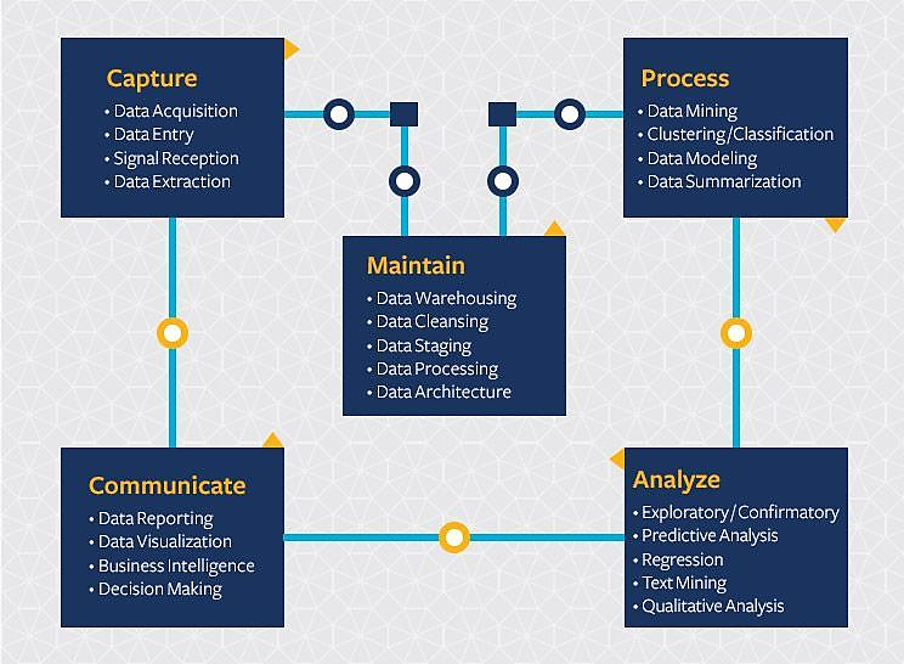
In technical terms, DA is a subset of data science. Data science is a broader domain that covers multiple disciplines, including but not limited-to, mathematics, programming, computer science, software engineering, and statistics. It focuses upon the collection and management of large-scale data (structured as well as unstructured) for a variety of purposes and applications, as determined by the organisation concerned. As such, data science covers a wide range of data-related tasks, and DA is a task that resides under the data science umbrella, as may be discerned from Figure 1:[2]
 |
|
Fig 1: Broad data-related tasks in Data Science Source: UC Berkeley School of Information |
Thus, DA is used to query, interpret and visualise datasets, and data scientists frequently perform DA to ‘understand’ a dataset, extract ‘value’ therefrom, and find answers to specific questions. As such, DA itself covers an extensive – and evolving – range of tools, methods, computations, and practices. Indeed, different approaches and outcomes of DA can be devised, formulated or legally mandated, based-on or dictated-by organisation-specific factors such as objectives, data-availability, and resource-availability.[3]
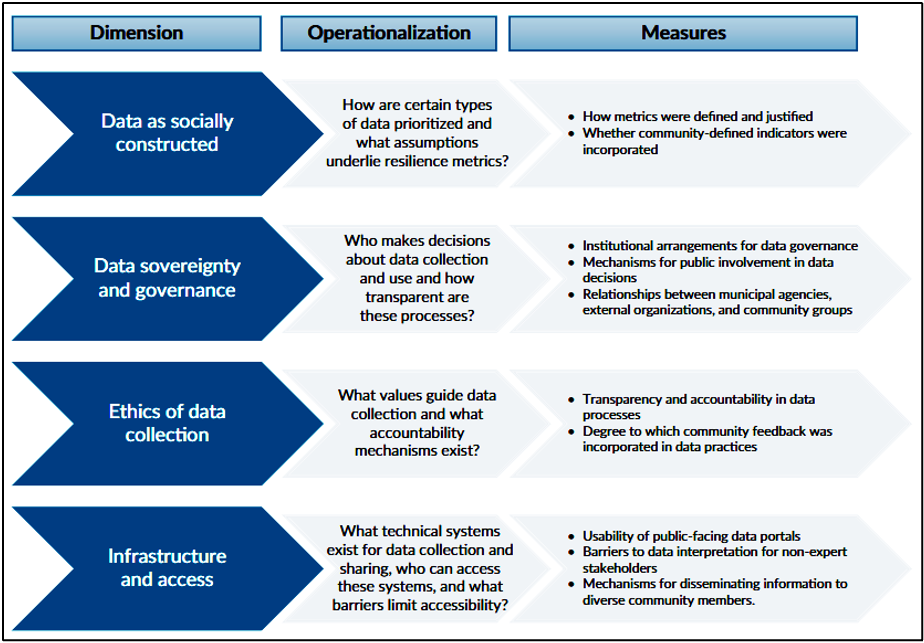
From a legal standpoint, the definition and performance of the data-related tasks (such as those outlined in Figure 1) is “neither neutral nor inevitable”. Quite to the contrary, “seemingly technical decisions about data collection, analysis, and deployment,” with clear (and frequently profound) legal implications, are a result and function of “specific institutional choices, power dynamics, and historical legacies that shape whose knowledge counts and whose needs are prioritised.”[4] In other words, “data is not neutral but reflects the values, priorities, and power structures of those who collect, analyze, and deploy it….[T]his means questioning what is measured, by whom, and for what purpose.” Figure 2 shows (as an example) these dynamics and choices as they arise in the context of (say) resilience planning for coastal population centres:
 |
|
Fig 2: Data-related Choices and Dynamics when Planning for Resilience of Coastal Cities Source: Kristen Hudak Rosero et al (2025) |
Policymakers and researchers alike should also note that all file formats and data types are not equally suitable for or amenable to DA. Consequently, India faces clear policy-choices in this regard, because the choice of format/data type has substantial implications for the ease and efficiency with which DA may be performed on the data.[5]
Finally, it is important to mention Big Data Analytics (BDA), which can be seen as a subset of DA (i.e. ‘traditional DA’). Through its own tools and techniques, BDA can deal with massive amounts of data, which is in varying file formats and includes structured, semi-structured and unstructured data (an apt description of India’s maritime data).[6] Consequently, “Maritime India” needs DA as well as BDA (in particular).
In the following section, this article explores the different approaches that could guide India’s efforts to harness her maritime data.
Approaches to Data Analytics
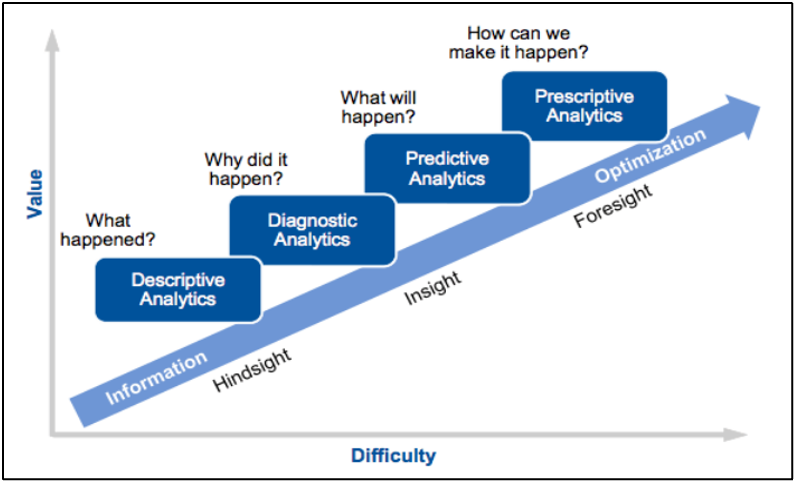
DA can be broadly categorised into four sets or types[7]:
Descriptive analytics focus on what ‘has happened’, and attempt to identify trends, patterns, and anomalies.
Diagnostic analytics seek to understand the reason(s) behind past outcomes, and ‘why things happened.’
Prescriptive analytics recommend action(s) to optimise outcomes and seek to answer questions relating to ‘what should be done.’
Predictive analytics seek to forecast future events, and answer questions relating to ‘what is likely to happen.’
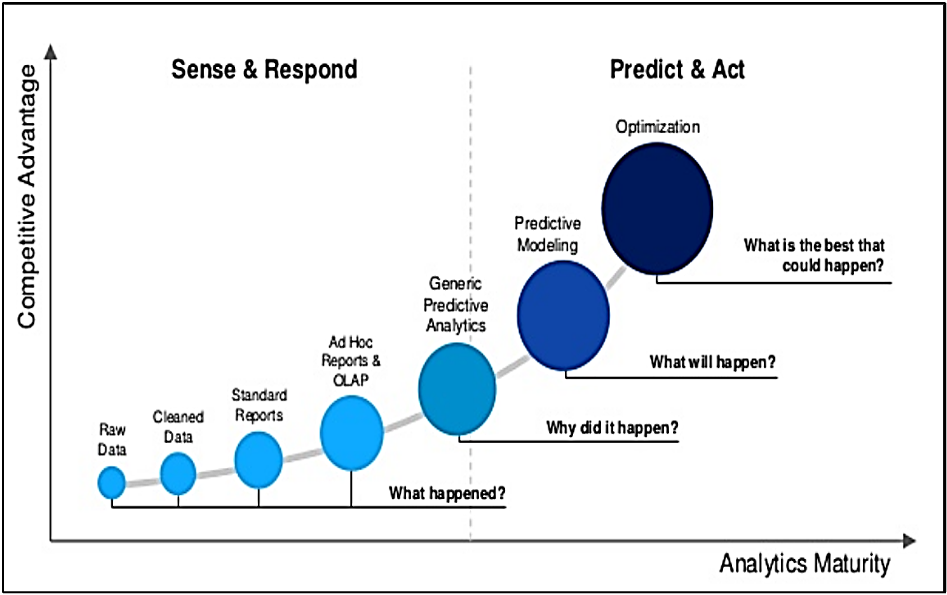
There is, of course, more than one way of conceptualising or categorizing DA. For instance, some business analysts see these sets/types of DA as stages-in or components-of an organisation’s ‘ascendancy’ or ‘maturity’ model, as may be seen in Figures 3 and 4:[8]
 |
|
Fig 3: An ‘Ascendancy’ model for an organisation’s use of data analytics Source: Computd, https://computd.nl/4-levels-of-data-maturity/ |
 |
|
Fig 4: A ‘Maturity’ Model for an Organisation’s Use of Data Analytics Source: Martin Zych, “Data Analytics Maturity Models,” Jirav, https://www.jirav.com/blog/data-analytics-maturity-models |
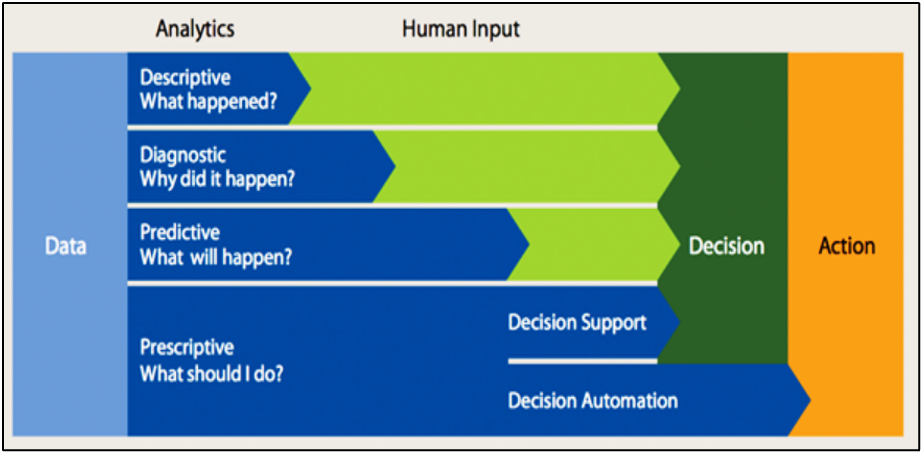
Figure 5, on the other hand, depicts the intra-organisation interplay between human input(s) and data analytics.
 |
|
Fig 5: Intra-organisation Interplay between Human Input(s) and Data Analytics Source: “Eyal Katz, “Evaluating the Maturity of Your Analytics System,” Anodot, https://www.anodot.com/blog/evaluating-the-maturity-of-your-analytics-system/ |
The point sought to be made here is that irrespective of the conceptual framework adopted to analyse or implement DA in India’s maritime domain, it is logical to assume that India will require all four; and perhaps others, too, that may be devised/articulated as technology evolves.
The next section undertakes an overview of DA in India’s maritime domain, and examines some opportunities and challenges therein.
DA on India’s maritime data: An Overview
India’s official and private actors use DA extensively, in their own way and for their own purposes. For instance, the Comptroller and Auditor General (CAG) of India uses DA to discharge its ‘auditing’ function, and notes further that the principles and methods of the DA it deploys for audits can be used for accounting and administration as well.[9] Another case in point is offered by the “Data Management and Analysis” vertical/division of Niti Aayog, which provides “tools for [DA] and visualisation.”[10] Likewise, the “Special Intelligence Information Agency and Data Analysis Research Council” (SIIADARC), under the Ministry of Corporate Affairs, also uses DA extensively.[11] In similar vein, the Ministry of Finance uses DA to monitor tax compliance, among other things.[12] Unsurprisingly, the “Data and Strategy Unit” of the Ministry of Housing and Urban Affairs uses DA to monitor performance and identify trends and challenges.[13]
Within the maritime domain, the “Transport Research Wing” of the Ministry of Ports, Shipping and Waterways (MoPSW) provides some DA support to its parent ministry, although its extent and efficacy is unclear.[14] The “India Meteorological Department” (IMD), under the Ministry of Earth Sciences, provides heatwave warnings based on various DA. “Mission Mausam” and the “National Framework for Climate Services” (NFCS) also use DA for their assessments of heatwaves, droughts, rainfall, and sea-level rise.[15] Likewise, the “Trade Intelligence and Analytics” (TIA) portal of the Ministry of Commerce and Industry executes/provides DA in a unique way, worthy of further study and perhaps emulation. It has “designed and developed multiple existing analytics requirements into automated analytical capabilities.”[16]
These examples notwithstanding, however, the use of DA on India’s maritime data, when seen against its tremendous potential and growing volume, continues to be relatively limited. To its credit, the Government of India appears to be aware of this. In November 2025, the Ministry of Electronics and Information Technology organised a two-day training programme as a part of capacity-building towards “Digital India”. The programme focused on “Big Data and Data Analytics” and sought to “equip government officers with a comprehensive understanding of big data technologies, address the challenges of their adoption, and demonstrate how data-driven insights can strengthen public policy and administration.”[17]
The Indian defence and security ecosystem certainly appears to be better equipped to harness India’s maritime data using DA. The Indian Navy’s “Operational Data Framework” is expected to deal with many data- and DA-related issues.[18] The Indian Navy “Maritime Security Strategy 2026” (INMSS-2026) also indicates the Indian Navy’s willingness to adopt “data-centric” approaches in and out of conflict – not simply for “awareness”, but also to gain informational advantages in a domain or over an adversarial actor:
“Data centric warfare shifts focus from connecting and synchronising platforms, to exploiting data itself, to gain informational advantage. Artificial Intelligence/ Machine Learning (AI/ ML) driven analytics, and automation convert large volumes of maritime data into actionable intelligence at machine speed. This approach enables predictive assessments, autonomous cueing of sensors and faster decision options. The Indian Navy’s networks are continually evolving to support data centric warfare to enable real-time targeting grade fusion of multi-source data, and accelerate decision-making cycle across distributed forces…. The need to sustain naval forces in prolonged, as well as high-intensity operations, [necessitates] adoption of predictive and data-driven sustainment processes.”[19]
INMSS-2026 also implicitly recognises the ability of data-owners to “shape a favourable maritime environment”, within and outside of conflict. Accordingly, support towards oceanographic research in and around India — and in particular the “collection” of associated data — is seen as a specific task, to be performed as a part of the Indian Navy’s military and benign roles.[20] The proposed, new “Data Force” within India’s defence forces is also expected to play its own role(s) as and when it becomes operational.[21] When it does, it will, at the very least, be performing DA upon data.
It must however be reiterated that India’s maritime data can be leveraged for more than defence and security applications/purposes. These domains — which are really “sub-domains” of India’s maritime domain — are (inter alia) the blueing of the Indian economy, the development of India’s coastal communities and small-scale fishermen, and marine spatial planning in/around/of India’s coastal areas. These areas remain under-explored and under-exploited from a DA perspective. In its 2015 report on the Millenium Development Goals, the United Nations itself highlighted the criticality of good-quality data for development and sustainability, stating:
“The [Millenium Development Goals] monitoring experience has clearly demonstrated that effective use of data can help to galvanize development efforts, implement successful targeted interventions, track performance and improve accountability. Thus, sustainable development demands a data revolution to improve the availability, quality, timeliness and disaggregation of data to support the implementation of the new development agenda at all levels.”[22]
It further advised all parties and stakeholders to “measure what we treasure,” because “what gets measured gets done.”[23]
The use-cases for DA on India’s maritime data are, in fact, limited only by one’s imagination, especially when one considers the advent of artificial intelligence. One clear use-case would be maritime risk management. The recently-approved “Bharat Maritime Insurance (BMI) Pool” will gain significantly by deploying DA — like the P&I Clubs and marine insurance companies with whom it seeks to compete or may end-up competing with anyway — for (inter alia) the following objectives:
- Vetting and screening (including against sanctions lists).
- Monitoring trading limits, ship-to-ship transfers, and other environmental and liability risks.
- Casualty investigation(s) and reconstruction(s).
- Claim(s) defence, management, and building evidentiary records.
- Claim(s) prevention.
- Portfolio management.[24]
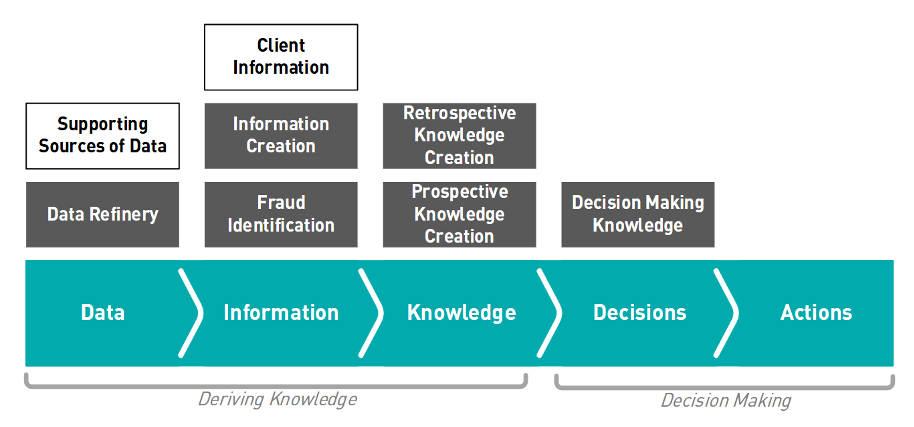
Thus, for instance, a 2021 case-study of the marine insurance business model used by the ‘Insurtech’ company, “Concirrus Quests”, found that it adopted the approach depicted in Figure 6 for “blending the historic art of underwriting with the emerging science of data”:[25]
 |
|
Figure 6: Key components of Concirrus Quest’s Marine Insurance Business Model Source: Paul D Timms et al (2021) |
Another potential use-case that deserves standalone examination by India is the use of DA for the safety, protection, and maintenance of India’s Single Point Moorings/Single Buoy Moorings.[26]
Against this background of opportunity and potential, the next section examines some of the challenges that face those seeking to harness India’s maritime data and extract value therefrom.
Challenges
As mentioned above, efficient and effective DA will require work to address several technical and ‘non-technical’ (i.e., legal, administrative, and institutional) challenges. Some of more significant of these are outlined in the succeeding paragraphs.
While it is certainly true that India’s maritime data is vast and growing, its quality is less than what it ought to be if its full potential is to be realised. In April of 2026, the Union Ministry of Statistics and Programme Implementation (MoSPI) convened a “National Deliberative Summit on Harmonising Administrative Data for Governance”.[27] The MoSPI note circulated prior to the summit highlights (albeit indirectly) the DA-related issues in the administrative data and datasets in India’s maritime sector:
“Administrative datasets have mostly been designed for a single purpose: operational management…. The data served its purpose within the department. The reuse of data was not so much on the horizon especially when produced by a different department. With the changing priorities, policymakers are now asking cross-cutting questions…These questions cannot be answered from any single department’s data or a dashboard. They require linked data from multiple sources enabled for advanced analysis. And [data] analytics readiness requires harmonisation… A second, equally important shift is the arrival of AI and automated analytical systems. AI tools, unlike human analysts, cannot infer missing context, work their way through inconsistent definitions, or work around undocumented changes in data structure. They require explicit metadata, stable data models, and machine-readable provenance. Data that is perfectly adequate for a human analyst reading a report may be completely unusable by an AI system trying to answer a policy question.”[28]
The issue of data-quality is not new. When, in 2020, Niti Aayog published its vision document for India’s “National Data and Analytics Platform” (NDAP), it had noted:
“[Government] data is not published in a user-centric manner. The current data formats are often not conducive for research and innovation. Many departments maintain public dashboards with visualisations, and options to download data in analysable formats. However, some datasets are only available in PDF, webpage or as an image, making it difficult for further analysis. If this issue is resolved, researchers and data scientists will significantly save time and resources in cleaning and preparing government datasets for analysis…. [India’s] data ecosystem is [also] incoherent due to different standards. Ministries and Departments do not use a shared standard for common indicators. Attributes like region and time period defined differently. This makes it difficult for datasets to speak to each other and present a coherent picture. If we can solve this, many use-cases can emerge. For example, a District Magistrate can access data across all departments for their district, easily, in one platform.”[29]
Internal, consultative workshops with Indian states and union territories, held prior to MoSPI’s April 2026 Summit, shed further light on the technical challenges:
- Nationally notified standards for metadata, classifications, etc., exist but their adoption across States/UTs and departments remains uneven. This limits interoperability.
- Limited and uneven use of identifiers for people, enterprises/assets and locations restricts linkages across datasets. It prevents cross-sectional insights and longitudinal analysis of outcomes at the beneficiary or enterprise level.
- Unique identifiers can be personal identifiers, leading to inhibitions within departments to share datasets, due to concerns around privacy and potential liability for use/misuse. This results in inconsistent data practices and consequent under-utilisation of administrative data for DA.
- Although data quality frameworks such as the Statistical Quality Assessment Framework (or SQAF) have been notified, their systematic and sustained application across administrative datasets remains uneven.
- Data is unavailable/inadequately available in machine-readable types/formats. Even where machine-readable data is available, it is not shared through standardised APIs. [30]
In addition to the technical challenges, some legal and institutional challenges were also identified. These included issues relating to data-fragmentation, siloed systems, manual and ad hoc data practices, and differing organisational/departmental/ministerial priorities.[31]
Clearly, implementing effective DA of India’s maritime data is less than straightforward. In the final section below, this article concludes this introduction to DA and offers some early recommendations in respect of this evolving technological domain.
Conclusion and Early Recommendations
It is true that data science and DA are not the ‘core’ functions of government. In India in particular, they are often far removed from the day-to-day functioning of governments and bureaucracies, who seem to prefer (for good and bad reasons) that DA-related functions are best ‘outsourced’ to the private sector and multinational consulting firms. However, if India seeks to harness – now and in the future – her maritime data and extract value therefrom, she must start thinking seriously about systematic use(s) of DA in all sub-sectors of her maritime domain.
The discussion in this article has noted how all file formats and data types are not equally suitable-for or amenable-to DA. Accordingly, ministries of the Government of India may consider fine-tuning their respective data-collection practices to enable the collection of specific types/formats of data which is suitable for the DA performed by that particular ministry. In time, such collection can be legally mandated. India should also consider formulating a ‘Data Analytics Strategy’ for her maritime domain.[32]
Separately, India should conceptualise and mandate a DA framework or approach for India’s maritime data as a whole, with individual treatments accorded to the sub-categories therein. In the interim, Ministries, agencies, and organisations outside government need to be encouraged to adopt their own, customised approaches to the data-driven, evidence-based decision-making that they seek to do.
The quality of India’s maritime data is linked directly to its credibility as raw material or feedstock in data-driven, evidence-based governance and decision-making. The quality of data is also linked to the overall legitimacy of decision(s) based upon that data. Accordingly, India must pay special attention to ‘cleaning’ the vast amounts of maritime data she continues to collect.[33]
The technical realities associated with efficient DA also dictate the need to ‘standardise’ and/or ’harmonise’ many (if not all) aspects of India’s maritime data and the various activities associated with it. Thus, on the NDAP at least, it needs to be ensured that “all datasets are standardised to a common schema, which makes it easy to merge datasets and do cross-sectoral analysis.” [34]
To sum-up, India’s maritime data is a lesser known but extremely valuable strategic asset in the modern world. India must accordingly treat it as such.
********
About the Author
Mr Mayank Mishra is a litigator and researcher. He has a background in technology and has worked extensively in India’s social sector. Presently, he is a Senior Associate Fellow within the PIML cluster of the NMF. Before re-joining the NMF in January 2026, he was a legal consultant at a Centre of Excellence established by the Research and Information System for Developing Countries (RIS) and the Ministry of Ports, Shipping and Waterways (MoPSW) of the Government of India. He may be reached at law9.nmf@gmail.com
Endnotes:
[1] “What is Data Analytics,” 02 September 2024, SAP, https://www.sap.com/resources/what-is-data-analytics
See also: “What is Data Analytics,” 21 April 2025, Grow with Google, https://grow.google/grow-your-career/articles/what-is-data-analytics/
[2] “Data science vs data analytics: Unpacking the differences,” IBM, https://www.ibm.com/think/topics/data-science-vs-data-analytics
See also: “What is Data Science?,” UC Berkeley School of Information, https://ischoolonline.berkeley.edu/data-science/what-is-data-science/
See also: “What Is Data Science? Definition, Skills, Applications & More,” Harvard School of Engineering and Applied Sciences, https://seas.harvard.edu/news/what-data-science-definition-skills-applications-more
See also: “What is data science?”, IBM, https://www.ibm.com/think/topics/data-science
[3] Augusto Azael Pérez Azcárraga et al., “Customs Matters: Strengthening Customs Administration in a Changing World,” 15 June 2022, IMF eLibrary, 222, https://doi.org/10.5089/9798400200120.071
[4] Kristen Hudak Rosero et al., “Data‐Driven Equitable Planning for Urban Resilience: Innovation, Risk, and Outcomes in Boston, New Orleans, and Norfolk,” Urban Planning 10 (2025), 4-5, 16, https://doi.org/10.17645/up.10043
[5] Aadhitya Dev, “6 Different Data Formats Commonly Used in Data Analytics,” 06 October 2025, https://dev.to/aadhitya_dev_/6-different-data-formats-commonly-used-in-data-analytics-243n
See also: Pulkit Singhal and Sheldon Tauro, “File formats for Analytical systems,” 25 June 2025, ACM Digital Library, https://doi.org/10.1145/3703323.3704282
See also: “What are Data Formats? Common types explained,” Snowflake, https://www.snowflake.com/en/fundamentals/data-formats/
[6] “What is Big Data Analytics,” IBM, https://www.ibm.com/think/topics/big-data-analytics
See also: “What is big data analytics?”, Microsoft, https://azure.microsoft.com/en-us/resources/cloud-computing-dictionary/what-is-big-data-analytics
[7] Dr Manisha Sharma (ed.), “Advances in Data Analytics for Business Decision-making”, Imperial Publications, 2024, 1-3, https://sbm.nmims.edu/docs/2024/Advances-in-Data-Analytics-for-Business-Decision-Making.pdf
See also: “Data analytics Breakdown: Key Types and their Uses,” Paxcom, 2, https://share.google/b1H5T6WV9tdXiSaV2
[8] “The 4 levels of data maturity that you should absolutely know about,” Computd, https://computd.nl/4-levels-of-data-maturity/
See also: Martin Zych, “Data Analytics Maturity Models,” 11 September 2017, Jirav, https://www.jirav.com/blog/data-analytics-maturity-models
See also: “Eyal Katz, “Evaluating the Maturity of Your Analytics System,” Anodot, https://www.anodot.com/blog/evaluating-the-maturity-of-your-analytics-system/
See also: Milind Desai, “Understanding the Analytics Maturity Model,” 05 March 2022, Medium, https://medium.com/@milind.bapuji.desai/understanding-the-analytics-maturity-model-84982836b107
See also: “What is Data and Analytics,” Gartner, https://www.gartner.com/en/topics/data-and-analytics
See also: “Customs Matters: Strengthening Customs Administration in a Changing World,” 222.
[9] Office of the Comptroller and Auditor General of India, “Guidelines on Data Analytics,” 2017, 1, https://cag.gov.in/uploads/guidelines/Guidelines-on-Data-Analytics-book-05de4f7fd52e565-67820093.pdf
[10] “Data Management and Analysis,” Niti Aayog, https://niti.gov.in/divisions/division/data-management-and-analysis
[11] “The Special Intelligence Information Agency and Data Analysis Research Council (SIIADARC),” https://www.siiaindia.in/
[12] “CBDT identifies non-filers through Non-filers Monitoring System (NMS) by using Data Analytics,” 22 January 2019, Income Tax Department, https://www.incometaxindia.gov.in/w/cbdt-identifies-non-filers-through-non-filers-monitoring-system-nms-by-using-data-analytics-1
[13] “Data and Strategy Unit (DSU),” Ministry of Housing and Urban Affairs, https://stats.mohua.gov.in/
[14] Ministry of Ports, Shipping and Waterways (Govt of India), “Annual Report 2025-26,” 131, https://shipmin.gov.in/sites/default/files/Annual%20Report%202025-26%20english.pdf
[15] “Parliament Question: Climate Monitoring Data,” 01 April 2026, Ministry of Earth Sciences, https://www.moes.gov.in/static/uploads/2026/04/47d45e443a4baa0d80cd6d803dc7d848.pdf
[16] “Union Minister of Commerce and Industry, Shri Piyush Goyal launches Trade Intelligence and Analytics Portal,” 18 November 2025, Press Information Bureau, https://www.pib.gov.in/PressReleasePage.aspx?PRID=2191430®=3&lang=2
[17] “NeGD Organises ‘Big Data and Data Analytics’ Programme: A Capacity Building Programme under Digital India,” 28 November 2025, Press Information Bureau, https://www.pib.gov.in/PressReleasePage.aspx?PRID=2195811®=3&lang=2
[18] “Phase two of first edition of Naval Commanders’ Conference 2025,” 04 April 2025, Press Information Bureau, https://www.pib.gov.in/PressReleasePage.aspx?PRID=2120559®=3&lang=1
[19] Indian Navy, “Indian Navy Maritime Security Strategy (INMSS-2026),” April 2026, 38, 47, 56, 75, https://indiannavy.gov.in/sites/default/files/2026-04/Book_Indian%20Navy%20Maritime%20Security%20Strategy_Version6_ver3-3_web.pdf
[20] Ibid, 68.
[21] Ministry of Defence (Govt. of India), “Defence Forces Vision 2047,” 23, https://t.co/RtPEyqdvFB
[22] United Nations, “The Millenium Development Goals: Summary Report 2015”, 9, https://www.un.org/millenniumgoals/2015_MDG_Report/pdf/MDG%202015%20Summary%20web_english.pdf
[23] Ibid.
[24] Cameron Meek, “How maritime intelligence is strengthening P&I Club risk management,” 09 March 2026, Kpler, https://www.kpler.com/blog/how-maritime-intelligence-is-strengthening-p-i-club-risk-management
See also: Samuel A Markov, “Evolving Risk Assessment in Marine Insurance,” 29 August 2025, International Union of Marine Insurance, https://iumi.com/newsletter-september-2025/evolving-risk-assessment-in-marine-insurance/
See also: Brian Gedalla et al, “A Practitioner’s Approach to Marine Liability Pricing Using Generalised Linear Models,” 2004, CAS, https://www.casact.org/abstract/practitioners-approach-marine-liability-pricing-using-generalised-linear-models
[25] Paul D Timms et al, “Concirrus Quest Marine’s Insurance Business Model: The Role of AI and Big Data,” 10 March 2021, SSRN, 7, https://dx.doi.org/10.2139/ssrn.3801555
See also: “North P&I partners with insurtech Concirrus,” 24 January 2020, Reinsurance News, https://www.reinsurancene.ws/north-pi-partners-with-insurtech-concirrus/
See also: Terry Gangcuango, “UK P&I Club partners up for geospatial intelligence,” 26 April 2018, Insurance Business, https://www.insurancebusinessmag.com/asia/news/breaking-news/uk-pandi-club-partners-up-for-geospatial-intelligence-98950.aspx
[26] Peng Li et al, “Evaluation of Dynamic Tensions of Single Point Mooring System under Random Waves with Artificial Neural Network,” Journal of Marine Science and Engineering 10, No 5 (2022): 666, https://doi.org/10.3390/jmse10050666
See also: Sue Wang, “Improving Mooring Reliability Through Risk Based Monitoring and Inspection,” August 2020, Eagle, https://ww2.eagle.org/content/dam/eagle/articles/abs-improving-mooring-reliability-eandP2020.pdf
See also: Matthew Hall, “Generalized Quasi-Static Mooring System Modeling with Analytic Jacobians,” Energies 17, No 13 (2024): 3155, https://doi.org/10.3390/en17133155
[27] “MoSPI to Convene National Deliberative Summit on “Harmonizing Administrative Data for Governance” on 29-30 April, 2026 in Bhubaneswar, Odisha,” 27 April 2026, Press Information Bureau, https://www.pib.gov.in/PressReleasePage.aspx?PRID=2255778®=3&lang=1
[28] Ministry of Statistics and Programme Implementation (Govt of India), “Using Administrative Data for Governance: Harmonising Departmental Data at the State/UT Level,” April 2026, 9-10, https://share.google/xQO7dQowcKbqDJItI
[29] Niti Aayog, “National Data and Analytics Platform: Vision Document,” January 2020, 6, https://www.niti.gov.in/sites/default/files/2020-01/Vision_Document_30_Jan.pdf
[30] “Using Administrative Data for Governance: Harmonising Departmental Data at the State/UT Level,” 17.
[31] Ibid.
See also: “Bharat Space Conclave 2026 Highlights Need to Break Data Silos,” 12 March 2026, NewsonAIR, https://www.newsonair.gov.in/bharat-space-conclave-2026-highlights-need-to-break-data-silos/
See also: Anju Gaur, “Breaking down data silos in the water sector,” 08 November 2020, India Water Portal, https://www.indiawaterportal.org/agriculture/farm/breaking-down-data-silos-water-sector
See also: Pushkar Bhat, “Re-inventing India – Big Data in Government Sector,” 22 November 2015, SAP, https://community.sap.com/t5/additional-blog-posts-by-sap/re-inventing-india-big-data-in-government-sector/ba-p/13199153
[32] Indeed, a separate ‘Data Analytics Strategy’ may be considered for each strategic geography.
[33] Niti Aayog, “India’s Data Imperative: The Pivot towards Quality,” June 2025, https://niti.gov.in/sites/default/files/2025-09/india-data-imperative-the-pivot-towards-quality.pdf
See also: Kumar Gandharv, “How & why to take care of data cleaning, the initial stage for an ML project,” 21 January 2022, IndiaAI, https://indiaai.gov.in/article/how-why-to-take-care-of-data-cleaning-the-initial-stage-for-an-ml-project
See also: Julie Rogers and Alexandra Jonker, “What is Data Cleaning”,” IBM, https://www.ibm.com/think/topics/data-cleaning
[34] “NITI Aayog Launches the National Data & Analytics Platform,” 13 May 2022, Press Information Bureau, https://www.pib.gov.in/PressReleaseIframePage.aspx?PRID=1825145®=3&lang=2


Leave a Reply
Want to join the discussion?Feel free to contribute!