
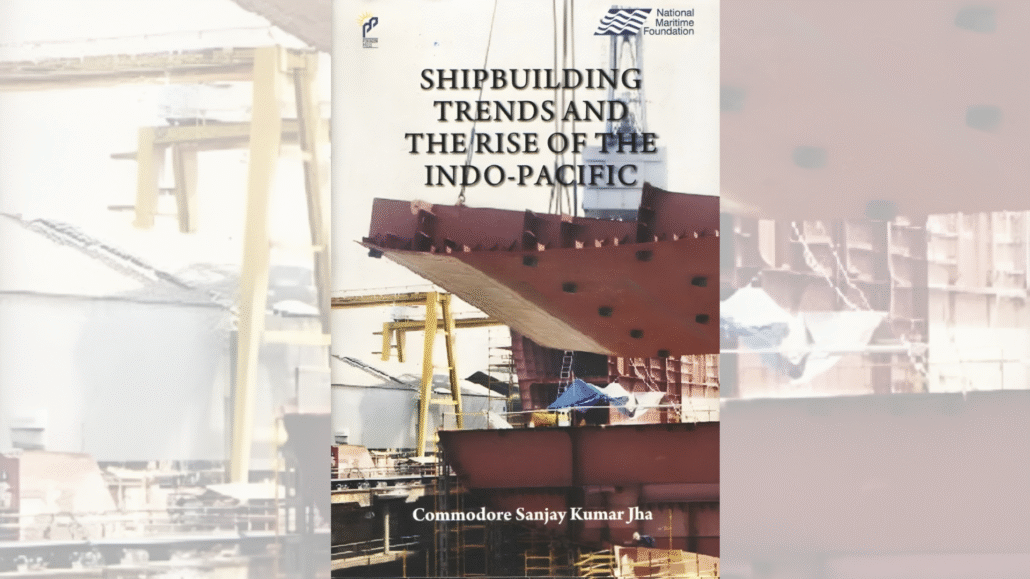
Commodore (Dr) Sanjay Kumar Jha (Retd); Pentagon Press, 2024; 201 Pages, ISBN: 978-93-90095-94-0, Rs 995 (Hardback)
“The relationship between human evolution and the seas is symbiotic. Shipbuilding has been the foundation of this relationship.”
This quote by Commodore Jha captures the essence of his book, which traces humanity’s maritime journey from simple paddled canoes to today’s autonomous, unmanned vessels, demonstrating how vessel design, construction, and maintenance, have shaped and been shaped by economic imperatives, technological revolutions and power transitions in tandem with the evolution of mankind. The narrative opens by revealing that nearly 80 per cent of the world’s population lives within sixty miles of a coast and that two-thirds of global economic output depends on maritime activities. Thus, shipbuilding emerges not merely as an activity but as a genesis of globalisation and State power.
The early chapters analyse how Mediterranean republics such as Venice, harnessed advances in hull design, navigation, and dockyard infrastructure, to forge commercial empires. The protracted voyages of Vasco da Gama, for instance, signposted a pivotal shift: mastery of the oceans granted direct access to new markets and upended established trade networks. The Industrial Revolution accelerated this dynamic. Coal-fired steam engines and the transition from wood to iron, and then steel, enabled ships that were larger, faster and more reliable than ever before. Britain’s financial innovations, in the form of modern banking and long-term government debt, financed its naval build-up and underscored the integral link between maritime capacity and geopolitical ambition.
Joseph Schumpeter’s postulation of the “Kondratieff Wave” (K Wave) explains that capitalist economies experience long (50-60 year) cycles wherein major technological breakthroughs such as steam and steel ships, then electricity, and later computers and artificial intelligence, trigger rapid growth. After these innovations spread and are copied, growth slows before the next wave begins. These cycles of “creative destruction” continually reshape how and where goods are produced and traded. The nation leading each cycle secures global economic dominance and, through new innovations, materials, and design, achieves superiority. In this context, the chapter shows how in the pre-World War Two era, Europe’s standardised military shipbuilding and trade networks leveraged successive K-Waves to build centralised sea power, whereas Asia’s decentralised, pluralistic and cooperative maritime traditions, despite China’s superior designs, eventually lagged behind. However, subsequent to the second World War, K-Wave driven innovation in shipbuilding (post the development of computers, semiconductors and advent of the internet) pivoted to Asia although Western navies retained strategic control. While this reflects a decoupling between shipbuilding capacities and naval dominance, shipbuilding nevertheless remains a keystone in determining comprehensive national power.
The two World Wars further illustrate shipbuilding’s transformative impact. Wartime urgency drove mass-production techniques to levels of efficiency that were earlier unimagined. In the United States, Liberty-class ships rolled off the slipways in weeks rather than months, thanks to standardised components and assembly-line methods transplanted from the automotive sector. Yet, for all its energy, this American predominance would prove transient: after the 1950s, shipyards migrated east, guided by power-transition theory’s prediction that rising nations absorb mature industries relinquished by established powers.
As the book’s gaze turns towards the east, Japan’s post-war resurgence provides for a fascinating case study. Despite scarce raw materials, Japan leveraged intact wartime shipyards, American technical assistance and a disciplined workforce to conquer the tanker market during the Suez Crisis and later, to dominate global merchant shipping. Techniques imported from American shipyards such as block construction, flow-line assembly and rigorous quality-control regimes reduced labour hours and delivery schedules. Moreover, Japan’s early focus on automation, robotics and digital integration, which continues under its Industrial Value Chain Initiative, ensured that it’s shipbuilding industry was put in a position to capitalise on the gains of the fourth K-Wave of the digital revolution.
South Korea followed a similar trajectory, drawing on allied aid and chaebol-led industrial policy to supplant Japan by the early 2000s. China’s ascent, meanwhile, was characterised by State-directed cluster development, reverse-engineering Soviet vessels, and strategic procurement of foreign technology. By the end of the first decade of the twenty-first century, China had doubled its global share to become the world’s largest shipbuilder. Co-located feeder industries including engine plants, electronics and steel mills, enhanced supply-chain resilience, while Five-Year Plans set precise targets.
India’s protracted but slow industrial growth contrasts with Japan’s rapid postwar ascent. India remained on the margins of the Industrial Revolution due to the impediments placed upon it by colonisation. After independence, India began reviving modern shipbuilding with government-led initiatives including the Scindia Shipyard at Visakhapatnam and the Cochin Shipyard, leveraging foreign technical collaboration with France. India’s major breakthrough was in warship construction with Mazagon Dock’s Leander Class frigates under British technology transfer, and later, Soviet submarines and destroyers, creating designs adapted for Indian tactical requirements. While focus has been placed upon strengthening India’s maritime industries in the form of investments and renewing government focus upon indigenous shipyards, and policies such as MAHASAGAR (Mutual and Holistic Advancement for Security and Growth Across Regions), India has a powerful navy but nevertheless needs to bridge its industrial gap to sustain maritime power.
The author’s exploration of the contemporary frontier, exemplified in the advent of ‘Industry 4.0’ in shipbuilding is both insightful and thought-provoking. Artificial intelligence, machine learning and advanced robotics are no longer distant case-studies but integral to modern yards. Hyundai Heavy Industries’ 670-kg welding robots, cloud-based unified applications optimising hull design, and predictive maintenance using big data analytics demonstrates a revolution in productivity and reliability. Augmented reality and virtual reality platforms are being deployed to enhance design reviews and maintenance training, while 3D printing of metal components reduces lead times. The book also delves into the regulatory and security implications of these technological advances. Autonomous ships, such as DARPA’s Sea Hunter and DNV GL’s ReVolt prototype, challenge existing frameworks for liability, navigation standards and collision avoidance. Therefore, while these new technologies offer significant upgrades in the domain of shipbuilding, there remains a requirement for regulatory and legal frameworks to keep up with the pace of evolving technology.
A compelling causal fishbone analysis in the conclusion weaves together the threads of technological revolutions, power-transition cycles and industry life-cycle patterns to explain how shipbuilding has shifted from Europe and North America to Asia. The diagram attributes the Indo-Pacific’s rise and shipbuilding ascendancy to first, the historical factors of centuries of seafaring legacies, traditions and knowledge that endures till date. Second, technological cycles that injected breakthroughs and avenues for Asia to insert itself in the equation. Third, economic plans that prioritised export-oriented industrialisation by seeking support from the Western financial order. Fourth, the strategic landscape that evolved in the Indo-Pacific, positioning shipbuilding as a vital component of projecting power and influence.
To conclude, this work provides a detailed yet coherent narrative of shipbuilding’s role in global affairs. Its core argument, that mastery of maritime industrial capacity has, and will continue to bolster national power, resonates through case studies and contemporary technological insights. For scholars and policymakers alike, it offers both a warning and a blueprint: as emerging powers integrate digital technologies into shipyards, their ability to shape maritime commerce and security will only increase. And for those of us observing from the Indian subcontinent, it underscores an important opportunity. As we stand at the cusp of the next K-Wave, there is bound to be a seismic shift in the power-dynamics of the shipbuilding industry. The question remains whether India can seize this moment to anchor itself as a shipbuilding power or will only watch from afar as others set the course for the next era of the maritime industry.
*******
About the Reviewer
Ms Junyali Gusain is a Research Associate at the National Maritime Foundation. She was awarded her BA (Hons) in Political Science with a minor in History from Maitreyi College, University of Delhi; and holds a Master’s degree in “Diplomacy, Law and Business”, with a specialisation in “Economics and Foreign Policy”, from OP Jindal Global University, Sonipat, Haryana. Her current research focuses upon the manner in which India’s own strategies in the Bay of Bengal and the Indo-Pacific are impacted by collectives such as BIMSTEC and IORA. She can be reached at irms5.nmf@gmail.com.


Leave a Reply
Want to join the discussion?Feel free to contribute!