
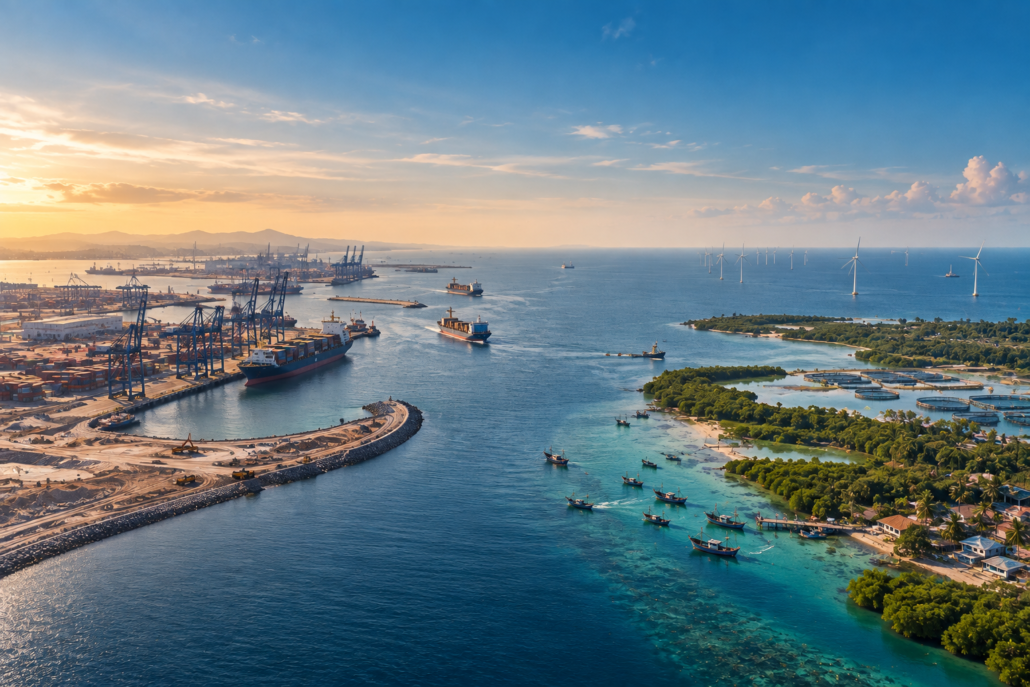
The “Blue Economy”, at its broadest, seeks to balance economic development with environmental sustainability and equity, including the interests of communities that depend on marine resources, unlike the ocean economy’s narrower focus on extraction and output.[1] Its legal foundations are linked to the 1982 UN Convention on the Law of the Sea (UNCLOS), while the concept gained wider prominence at the 2012 Rio+20 summit.[2] The fact that the term itself was first coined by Gunter Pauli in his book entitled The Blue Economy: 10 Years, 100 Innovations, 100 Million Jobs is, ironically enough, the very source of the lack of clarity about what exactly the term denotes. Pauli’s book, which was published in 2010, outlines a shift from scarcity to abundance through nature-inspired, biomimetic business models in which “nothing is wasted”, and local resources generate multiple cash flows.[3] Only two years later, however, at the 2012 UN Conference on Sustainable Development (Rio+20), the very same term, the “Blue Economy”, but now denoting a sustainable-development framework centred upon the world ocean, was formally pushed to the forefront of global policy by Small Island Developing States (SIDS). Even with this latter context, governments, institutions, and a variety of scholars, have interpreted and applied the term very differently from one another, leading to what some scholars have described as ‘shades of blue’.[4] These differences reflect competing views over how ocean resources should be used, governed and shared.
Staying with the intent underpinning the advocacy by the SIDS in the Rio+20 Conference, this paper advocates the “Blue Economy” as a framework for economic development, much like the green economy, rather than simply as a collection of ocean-based industries. Both concepts (‘green’ and ‘blue’) ask how economic activity can be organised to advance prosperity without undermining the environmental systems on which it depends. The distinction lies in their primary ecological focus in that the “Blue Economy” places the ocean at the centre of that inquiry. This matters because the ocean is not merely a source of fish, minerals, energy, and transport routes. It is the foundation of life itself, supporting ecological processes, livelihoods, and economic activity, far beyond the maritime sector. It is, therefore, averred that a national policy cannot be considered “blue” solely because it concerns the ocean; its economic aims must be tested against the health and limits of ocean systems.
Different interpretations are reflected in the tools developed around the Blue Economy. “Blue finance”, for instance, directs investments towards activities intended to deliver environmental benefits; “blue carbon” seeks to recognise the climate value of ecosystems such as mangroves, seagrasses and salt marshes; and emerging nature-repair markets attempt to attach economic value to ecological restoration.[5] Such mechanisms can align economic incentives with conservation, but they do not by themselves determine how much extraction or development an ecosystem can sustain. Nor does the use of a “blue” label establish that the environmental benefits claimed by a project outweigh its wider ecological or social costs.
Governments increasingly use the language of the blue economy while pursuing expanded production, infrastructure and resource extraction.[6] The resulting ambiguity has allowed the term to accommodate very different policy choices. As the blue economy has increasingly been used as an umbrella for ocean-based industries, it risks becoming difficult to distinguish from the narrower ocean economy it was intended to move beyond.[7] It also creates a risk of bluewashing presenting an activity as sustainable because it includes selected environmental measures, without adequately accounting for its overall effects on ecosystems and coastal communities.[8] The central question, therefore, is not only whether growth can be made more efficient or environmentally friendly, but whether growth can be made more efficient or environmentally friendly, and where ecological limits should constrain growth in the first place.
Hence, the National Maritime Foundation (NMF) views the blueing of the economy as a more substantive objective than the a “Blue Economy” that defined by the growth of specific maritime sectors of the economy or by the ocean’s contribution to national income alone. “Blueing” requires ocean health, ecological limits and equitable access to inform decisions on investment, infrastructure and resource use from the outset.
India’s maritime policy increasingly centres on expanding economic activity across fisheries, aquaculture, ports, shipping, offshore energy and deep-sea resources. India’s Blue Economy policy landscape includes, among others, India’s Blue Economy – A Draft Policy Framework,[9] opened for public comment in 2020 (India’s Ministry of Earth Sciences (MoES) is yet to finalise a “National Policy on the Blue Economy”);[10] the “SAGARMALA megaproject”, launched in 2015 to promote port-led development and increase India’s port capacity from 2800 to over 10 billion metric tons of cargo annually by 2047;[11] the “Maritime India Vision (MIV) 2030”,[12] which sets near-term targets for this decade; and the “Maritime Amrit Kaal Vision” (MAKV) 2047, unveiled in 2023, which sets long-term goals in line with “Viksit Bharat 2047”. Taken in aggregate, these initiatives demonstrate the breath of India’s maritime ambitions, albeit not its naval ones. They also make it necessary to ask whether sustainability is shaping the direction and scale of development or primarily improving the efficiency of an expansion of the national GDP that has already been assumed to be desirable.
India’s Blue Economy ambitious have yet to answer one question clearly: when does sustainability mean producing more efficiently, and when does it mean extracting less? The distinction matters. This paper seeks to identify the gaps in India’s Blue Economy ambitions and examine what is at stake if they remain unaddressed. It is the first in a two-part series; the second will examine Australia’s Blue Economy framework and draw out policy recommendations, both for India’s own government and for closer India-Australia cooperation.
Understanding the Blue Economy
The World Bank and the United Nations gave the concept an important empirical basis in 2017 through their joint report, The Potential of the Blue Economy.[13] The report noted that 31.4 per cent of the world’s fish stocks were already being fished at biologically unsustainable levels, while illegal, unreported and unregulated fishing accounted for an estimated 11–26 million tonnes of catch and US$ 10–22 billion in unlawful or undocumented revenue each year.[14] These figures illustrate the central challenge for the Blue Economy: increasing the value derived from the ocean without undermining the ecosystems that make that value possible.
Countries have approached this challenge differently. Small Island Developing States (SIDS) have generally retained a stronger focus on food security, livelihoods, climate resilience, and ocean health. Seychelles’ 2013 “Blue Economy Strategy”, for example, placed these concerns alongside economic development. Larger economies, on the other hand, have tended to incorporate the concept into existing sectoral and economic planning. The United States uses it to describe sustainable use of ocean resources for economic growth, while the European Union applies it across established maritime sectors. India’s approach, as noted earlier, similarly centres upon developing its ocean resources and the infrastructure needed to support them. These different approaches help explain why the Blue Economy remains a contested concept: agreement on its broad objectives does not necessarily produce agreement on the scale or form of development that is environmentally acceptable.
The question is particularly consequential for India. India holds the title of the world’s fastest-growing major economy,[15] with a coastline of approximately 11,000 kms, which must be managed as the country expands its maritime economy.[16] India’s exclusive economic zone is estimated to contain 7.16 million tonnes of deep-sea fish stocks that remain largely untapped.[17] This creates significant economic potential but also raises the question of whether expanding deep-sea fishing would reduce pressure on coastal fisheries or simply shift fishing pressure to previously less-exploited areas.
That tension is already visible in India’s fisheries sector. Most fisherfolk remain engaged in small-scale or traditional fishing and increasingly compete for the same waters as a growing mechanised fleet. The NITI Aayog’s 2025 strategy for deep-sea fisheries explicitly recognises this problem, presenting offshore fishing partly as a way to reduce pressure on near-shore stocks while proposing cooperative and shared-ownership models to bring small-scale fishers into the expansion.[18] Such measures acknowledge that growth must be accompanied by attention to access and livelihoods. They do not, however, resolve the underlying ecological question: whether additional fishing capacity can be developed without increasing overall pressure on marine resources.
This is where blueing the economy provides a useful test. Rather than treating greater maritime output as evidence of progress in itself, it asks whether economic gains are achieved within ecological limits and without transferring costs to fishing communities, other coastal users or future generations. Applied to fisheries, that means assessing not only the value of a larger catch or a more capable fleet, but also the condition of fish stocks, the distribution of access and the capacity to monitor and enforce sustainable use. The same test applies to ports, offshore energy and deep-sea resources. It distinguishes an expanding ocean economy from one whose development is genuinely becoming blue.
Deconstructing the Documents: A Policy Gap Analysis
India’s Blue Economy policy architecture places growing emphasis on expanding maritime capacity alongside environmental sustainability, resource efficiency and community concerns. Yet the mechanisms for establishing ecological limits and reconciling competing uses of marine space remain less developed than the instruments driving infrastructure, production and investment. The result is not an absence of environmental policy. Rather, sustainability is increasingly incorporated as a condition for making maritime growth cleaner and more efficient, without consistently determining whether the scale or location of that growth should itself be limited.
This section examines that distinction across India’s principal maritime policies and programmes. It asks not only whether each document recognises environmental and social concerns, but whether those concerns can influence decisions before investment commitments and development pathways become difficult to reverse. This is the practical test of whether policy is contributing to the blueing of the economy, rather than merely applying a “blue” label to the expansion of what is essentially ocean-based activity.
Draft National Policy on Blue Economy
The Draft National Policy on Blue Economy is the most useful benchmark against which India’s wider maritime policy landscape can be assessed. Unlike sector-specific programmes, it attempts to bring economic development, environmental sustainability and social welfare within a single framework. The draft proposes spatial planning based on scientific assessment of ocean resources, sustainable resource use, low-carbon technologies, and the protection of fishermen’s welfare and livelihoods.[19] In this respect, it provides a relatively comprehensive attempt to reconcile economic, environmental and social objectives within a common framework. It also envisages the Ministry of Earth Sciences as the nodal ministry and, once approved, makes this draft the primary policy framework for India’s Blue Economy.
The problem lies in that qualification: “as and when approved”.[20] The policy remains a draft and therefore lacks the authority its own architecture presupposes. Meanwhile, port development, fisheries, energy and industrial infrastructure are being advanced through separate programmes with their own mandates and investment structures. The document that comes closest to treating the Blue Economy as an integrated economic model is thus less institutionally consequential than the programmes shaping maritime development on the ground.
The draft recognises the need to balance competing uses of marine space but does not clearly set out how conflicts between development and ecological protection should be resolved. It is clearer about what India could develop than when development should be limited. It is similarly more precise about what should be done to protect the oceans than about who will implement and enforce those measures. Under ocean health, for example, it calls for “effective monitoring and management” and recommends using technology to monitor, prevent and mitigate marine pollution, including plastics and microplastics.[21] However, it does not clearly establish who is responsible for monitoring compliance, what standards or protocols should apply, or how adherence will be enforced across sectors and jurisdictions.
This gap also has implications for the credibility of sustainability claims. If a policy does not specify how environmental outcomes will be measured and verified, activities may be described as “blue” simply because they adopt selected safeguards or technologies, even though their cumulative ecological and social effects remain uncertain. Avoiding such “bluewashing” requires more than a statement of intent. A credible framework needs clear ecological thresholds, exclusion zones, cumulative-impact requirements, defined institutional responsibilities, transparent reporting and enforceable consequences for non-compliance.
Without these elements, environmental protection remains a stated objective rather than a considered constraint on types and forms of development that are damaging to the ocean drivers of the ecology. The resulting institutional imbalance is central to this paper’s argument: the policy that provides India’s most integrated vision of the Blue Economy remains a draft, while the sectoral programmes driving port, fisheries and resource development have stronger implementation mechanisms.
SAGARMALA Programme
SAGARMALA is a government programme launched in 2015 to promote port-led development by improving port capacity, connectivity and logistics efficiency.[22] Its “National Perspective Plan” (NPP), released in 2016, provides the programme’s overarching framework, covering port modernisation, greenfield port development, port connectivity, port-led industrialisation and coastal community development.[23] The programme also incorporates environmental management measures intended to integrate sustainability into port-led growth.[24] The more important question, however, is whether these measures operate at the same scale as the cumulative environmental effects of port expansion.
A port may be assessed as an individual project, while coastal ecosystems experience the combined effects of dredging, reclamation, breakwaters, access roads, industrial clusters, and shipping channels. Capital dredging at Old Mangalore Port, which has been modernised under SAGARMALA, illustrates the problem.[25] Deepening harbour channels can enable larger vessels and increase throughput but can also alter sediment movement, contribute to erosion and affect nearby habitats. A 2022 study of Old Mangalore Port modelled sediment plumes generated by capital dredging and their implications for nearby mangrove ecosystems.[26] The broader concern is that the economic benefits of port expansion may be concentrated within the port and logistics system, while some environmental costs are borne by neighbouring coastal areas.
The same issue applies to communities. Where port development changes access to beaches, fishing grounds or landing sites, coastal spaces that previously supported fishing livelihoods can find themselves converted to infrastructure or become inaccessible to fishing communities. Assessing a port’s contribution to the Blue Economy, therefore, requires attention not only to cargo capacity and employment, but also to whose access to coastal space changes and how those losses are addressed.
The Vadhavan project illustrates this tension: in June 2026, the Bombay High Court permitted diversion of 9.24 hectares of mangrove forest, containing 208 mangrove trees, for an access-controlled highway associated with the port, after considering environmental-clearance conditions and the project’s stated public-utility and economic benefits.[27] Vadhavan was identified as a potential new port under the SAGARMALA framework.[28] Vizhinjam provides a useful comparator: although it is not itself a SAGARMALA project in the narrow administrative sense, academic research has documented coastal erosion, livelihood disruption, and concerns over the exclusion of fish workers from the development process.[29]
These examples do not suggest that port development and environmental protection are necessarily incompatible. They show, rather, why project-level safeguards and efficiency improvements cannot by themselves establish that port-led development is genuinely “blue”. A port may reduce emissions per tonne of cargo while its associated infrastructure places additional pressure on habitats, sediment systems and fishing access. Describing such development as “green” or “blue” without assessing those wider effects would risk allowing an environmental claim to stand-in for an assessment of the project’s overall consequences.
The gap, therefore, is not simply a conflict between infrastructure development and environmental protection. It is the absence of an equivalent mechanism for accounting for ecosystem services, displaced livelihoods and cumulative coastal impacts when the costs and benefits of infrastructure development are assessed. For SAGARMALA to contribute to the “blueing” of the economy, these considerations would need to inform decisions about where ports and associated infrastructure are built, as well as how efficiently they operate once built.
Maritime India Vision 2030
“Maritime India Vision 2030” (MIV 2030) turns the growth orientation into quantified targets for capacity, competitiveness and efficiency.[30] Its sustainability measures include renewable energy at ports, cleaner operations and improved logistics.[31] These measures can reduce environmental impact per unit of activity, but they do not necessarily address the absolute scale of activity.
This distinction is central to the paper’s research question. A port that handles more cargo with lower emissions per tonne may become more efficient while still generating greater pressure through increased traffic, dredging, land conversion, and coastal construction. MIV 2030 also envisages substantial new capacity, including a potential capacity of around 300 MTPA at Vadhavan.[32] Sustainability is therefore largely framed through optimisation: making a larger maritime system cleaner and more productive.
The missing instrument is “Strategic Environmental Assessment” (SEA). India has an established system for project-level “Environmental Impact Assessment” (EIA), but SEA is not a mandatory, systematically integrated requirement for national sectoral planning.[33] An individual port EIA can assess the impacts of that port; it cannot adequately determine whether the combined expansion of ports, shipping routes, industrial clusters and associated infrastructure is compatible with the carrying capacity of an entire coastline.
This matters because MIV 2030 is precisely the kind of document for which strategic assessment would be valuable. Assessment at the planning stage could inform choices about the location, sequencing and scale of development before individual projects are advanced. Without it, cumulative effects may be considered only after the broader development trajectory has already been established.
MIV 2030, therefore, illustrates a broader limitation in how sustainability is operationalised: efficiency measures can reduce the environmental intensity of maritime activity without necessarily establishing ecological limits on its overall expansion. Such measures remain valuable, but they should not be treated as proof that increased activity is sustainable in aggregate.
Maritime Amrit Kaal Vision 2047
The “Maritime Amrit Kaal Vision 2047” (MAKV-2047) extends this trajectory through its long-term development targets. Its vision includes around 10,000 MTPA of port capacity and approximately ₹75–80 lakh crore in investment, alongside green ports, renewable energy, alternative fuels and green-hydrogen hubs.[34] These commitments reflect an effort to address the environmental impacts of an expanding maritime system. They also raise a question that runs through this paper: whether environmental considerations will shape decisions about the scale and location of that expansion, rather than only the technologies used to support it.
This creates the possibility of infrastructure lock-in.[35] Ports, terminals, breakwaters, industrial corridors and associated utilities are long-term investments. Once capital has been committed and coastal space transformed, reversing the development pathway becomes difficult. Assessing environmental impacts only when individual projects seek approval may, therefore, leave limited scope to reconsider the wider pattern of development of which they form a part.
Green hydrogen illustrates the same ambiguity. It may help decarbonise shipping and industry, but the infrastructure required to produce, store and transport it still occupies land and coastal space. Its climate benefits should be assessed alongside the water, energy, land-use and coastal-infrastructure requirements of the projects that deliver it. A lower-carbon technology does not make its entire spatial footprint environmentally neutral.
The Great Nicobar project (especially the transhipment hub being developed at Galathea Bay) demonstrates the trade-off that long-term maritime planning will repeatedly encounter. The proposed transhipment port, airport, township and power infrastructure have faced scrutiny over forest diversion, biodiversity, coastal regulation and tribal rights. In February 2026, the National Green Tribunal declined to interfere with the environmental clearance, while litigation concerning compliance with the Forest Rights Act remains before the Calcutta High Court.[36] The case does not by itself establish that the project is environmentally unsound; it demonstrates, instead, how strategic infrastructure can proceed through statutory approvals even where ecological and social costs remain the subject of serious concern.
MAKV 2047 should, therefore, be assessed not only by whether it delivers cleaner ports and fuels but by whether its long-term investment choices are compatible with coastal and marine ecological limits. This is where the distinction between a growing “blue economy” and the “blueing” of the economy becomes consequential. The latter requires environmental and social considerations to inform strategic choices before infrastructure pathways are locked in; it does not treat “green” technologies as a substitute for those choices.
Deep Ocean Mission and PMMSY
The same tension becomes clearer when India’s resource frontier is considered. The “Deep Ocean Mission” (DOM) is advancing exploration of polymetallic nodules and other seabed resources, including through India’s International Seabed Authority exploration contracts.[37] The issue is not an absence of regulation: exploration in areas beyond national jurisdiction operates under the international seabed regime administered through the International Seabed Authority, while offshore mineral activities within India’s maritime zones are governed by domestic legislation, including the “Offshore Areas Mineral (Development and Regulation) Act, 2002”.[38] The more significant gap is that technological capacity is advancing faster than a mature governance architecture for potential commercial exploitation and cumulative ecological consequences.
Deep-sea mining presents a particularly difficult test because seabed ecosystems remain incompletely understood. Sediment plumes, habitat disturbance and impacts on organisms could extend beyond the immediate extraction site.[39] Here, the ability to access a resource cannot, in and of itself, establish that extracting it is ecologically justified. A genuinely blue approach would require the anticipated economic benefits to be considered alongside scientific uncertainty, the potential for long-lasting harm and the limits of monitoring and remediation in the deep sea.
The Pradhan Mantri Matsya Sampada Yojana (PMMSY) illustrates the need to align fisheries expansion with effective resource management.[40] It combines sustainability and fisher welfare with production goals, supporting deep-sea fishing, modern vessels, mariculture and improved value chains.[41] Expanding fishing offshore may well help reduce pressure on near-shore stocks, but that outcome cannot be simply assumed. It depends on whether offshore fishing replaces some existing pressure or adds to total fishing capacity, and on whether stock assessment, monitoring and enforcement are sufficient to keep catches within sustainable limits.
The 2025 NITI Aayog strategy on deep-sea and offshore fisheries makes this tension explicit.[42] It proposes advanced vessels, additional fishing harbours, vessel monitoring and onboard observers while also seeking greater participation by small-scale and artisanal fishers.[43] The approach is more sophisticated than simply promoting extraction, but it raises a fundamental question: can stock assessment, monitoring and enforcement capacity expand as quickly as fishing capacity? If not, technological expansion risks outpacing the institutions intended to make it sustainable.
The DOM and the PMMSY operate in different settings but expose a common policy challenge. Greater access to marine resources can increase economic opportunity without necessarily improving the condition of the ecosystems on which that opportunity depends. The blueing of the economy requires scientific evidence and governance capacity to shape decisions about whether, where and how extraction expands— not merely to accompany expansion once it is underway.
Coastal Regulation Zone 2019
The “Coastal Regulation Zone” regime provides the legal framework within which much of this coastal development occurs. CRZ 2019 retains objectives relating to environmental protection and fisher livelihoods, while also introducing greater flexibility for development. In CRZ-IIIA areas, for example, the No Development Zone (NDZ) was reduced from 200 metres to 50 metres from the high tide line, subject to approved “Coastal Zone Management Plans”.[44] The notification also provides that the NDZ provision under CRZ-III does not apply within notified port limits.[45]
CRZ 2019 should not, however, be characterised as a regulatory exemption created solely for SAGARMALA.[46] It applies much more broadly and retains significant environmental protections. The policy gap lies, instead, in the combination of greater development flexibility with the absence of a corresponding national mechanism for assessing cumulative spatial pressure along the coast.
This highlights the distinction between regulation and spatial governance. CRZ can determine whether a particular activity is permissible within a particular coastal category; it does not determine whether the coastline as a whole is becoming over-allocated among ports, fisheries, tourism, industry, conservation and infrastructure. Nor does permission for an individual development necessarily establish that the combined pattern of coastal development remains compatible with ecosystem health or continued community access.
Vadhavan and Great Nicobar illustrate why this distinction matters. Individual projects can proceed through environmental and coastal regulatory processes even as their wider ecological and social implications raise questions that extend beyond a single project boundary. The issue is not whether CRZ approval is irrelevant, but whether project-level compliance is being asked to answer a broader question it was not designed to resolve.
Coastal regulation must, therefore, be complemented by planning that considers competing uses of marine space and the cumulative effects of development across a coastal region. Without that broader view, a series of individually permissible decisions may still produce a coastline that is ecologically stressed and increasingly difficult for coastal communities to access.
Cross-Document Synthesis
Read sequentially, these documents reveal a consistent movement from principle to programme to physical transformation. The “Draft Blue Economy Policy” provides the strongest language on integration and sustainable use but remains a draft. “SAGARMALA” converts maritime ambition into infrastructure and industrial development. “MIV 2030” makes expansion more efficient and measurable. “MAKV 2047” extends that trajectory over the long term. The DOM and the PMMSY push resource use into deeper waters and more intensive forms of production, while CRZ provides much of the legal framework within which coastal transformation occurs.
Five structural gaps emerge:
- The first is an institutional and legal gap. India has multiple institutions with relevant expertise, but no sufficiently authoritative mechanism to reconcile their competing objectives.
- The second is the gap between efficiency and reduction. Green ports, cleaner fuels, and better technology can reduce environmental intensity without reducing total extraction or spatial pressure.
- The third is an equity and spatial gap. Coastal communities may benefit from investment while simultaneously losing access to fishing grounds, landing sites, or coastal space. The issue is not simply how much economic value a project creates, but who bears its ecological costs and who participates in the decision.
- The fourth is a gap in cumulative-impact governance. Project-level environmental assessments and sector-specific regulations can mitigate individual impacts, but they do not necessarily determine whether the combined transformation of a marine region is ecologically acceptable.
- The fifth is a credibility and accountability gap. Sustainability claims may highlight selected improvements without establishing whether a project’s overall ecological and social effects are consistent with those claims. Without clear baselines, transparent reporting and independent verification, “blue” can become a description of a project’s stated intentions rather than its demonstrated outcomes.
This creates scope for regulatory arbitrage: not necessarily deliberate evasion of law, but the ability of major programmes to move through multiple approval processes without a single strategic assessment determining whether the cumulative development trajectory is sustainable.
The central policy gap is, therefore, not that India has chosen development instead of sustainability. It is that sustainability has largely been incorporated as a means of making development more efficient, less polluting, and more technologically sophisticated, while the harder question of ecological limits remains less institutionally developed. India’s framework is strongest when it asks what the ocean can contribute to national growth; it is less developed when it must determine how much activity the ocean can sustain, where it should occur, and when extraction or expansion should stop.
Taken together, these gaps do not point to the absence of sustainability measures in India’s maritime policy architecture. Rather, they show that these measures vary considerably in their ability to influence development decisions. Table 1 summarises the principal policy objectives, sustainability mechanisms and unresolved gaps identified across the documents examined above:
Table 1: Policy Matrix vis-à-vis India’s Maritime Policies
| Policy Document / Law | Primary Mandate | Stated Sustainability Mechanism | Unaddressed Policy/Ecological Gap | Real-World Consequence / Conflict |
| Draft National Policy on Blue Economy | Integrate India’s ocean-based sectors within a common Blue Economy framework | Spatial planning, sustainable resource use, ocean accounting, low-carbon technology and fisher welfare | Remains a draft; proposed coordinating role lacks equivalent decision-making authority | The most comprehensive Blue Economy framework remains weaker institutionally than sectoral development programmes |
| Sagarmala Programme | Port modernisation, connectivity, new ports and port-led industrialisation | Green ports, improved logistics and coastal-community development | No equivalent ecological ceiling for cumulative port, dredging, reclamation and industrial pressure | Coastal erosion, sediment disruption, habitat loss and conflicts overfishing space |
| MIV 2030 | Increase maritime capacity, competitiveness and efficiency | Renewable energy, cleaner operations, green ports and technological efficiency | No mandatory SEA or equivalent cumulative carrying-capacity framework | Efficiency gains can coexist with increasing absolute maritime activity and spatial pressure |
| MAKV 2047 | Long-term expansion of ports, shipping, waterways, shipbuilding and maritime investment | Green ports, alternative fuels, green hydrogen, renewable energy and digitalisation | Long-lived infrastructure decisions precede a comprehensive determination of ecological carrying capacity | Risk of infrastructure lock-in and difficult-to-reverse coastal transformation |
| Deep Ocean Mission / PMMSY | Expand access to deep-sea resources and fisheries production | Scientific research, monitoring, traceability, sustainable fishing and technological innovation | Scientific and regulatory capacity may not scale at the same rate as extraction and fishing capacity | Deep-sea ecosystem disturbance, redistribution of fishing pressure and conflicts over access |
| CRZ Notification 2019 | Regulate coastal development while protecting ecosystems and livelihoods | CRZ categories, NDZs, CZMPs and protection of ecologically sensitive areas | Project-level regulation does not substitute for strategic marine spatial planning or cumulative-impact assessment | Greater development flexibility alongside conflicts over ports, reclamation, mangroves, fishing access and sensitive habitats |
Compiled by the author
The table suggests that the principal gaps are structural rather than sector-specific, recurring across different policy instruments as questions of ecological thresholds, cumulative impacts, institutional coordination and competing uses of marine space.
Conclusion
India’s Blue Economy framework reflects a substantial and growing effort to integrate environmental sustainability into maritime development. The central challenge, however, is whether these measures can shape decisions about the scale, location, and cumulative effects of that development — not only how to make individual activities cleaner or more efficient.
The analysis, therefore, returns to the question at the heart of the “blue economy” concept: what does it mean for an economy to be genuinely “blue”? If the term “blue economy” is used only to describe maritime growth accompanied by cleaner technologies, environmental safeguards or improved efficiency, it risks becoming a label for conventional expansion rather than a distinct approach to ocean development. A genuinely “blue economy” approach must ask not only how economic activity can be made less environmentally damaging, but whether the scale, location and form of that activity are compatible with ecological limits and equitable access to marine resources. Sustainability, in this sense, cannot simply be an attribute added to development; it must also shape decisions about what development should occur, where, and within what limits.
India’s policy architecture has increasingly incorporated sustainability into maritime development but has yet to consistently use sustainability as a basis for determining the limits of that development. The challenge is therefore not simply to make maritime growth more sustainable, but to make it genuinely “blue” — ensuring that the term retains its substantive meaning as a framework for balancing economic development with ecological sustainability and equity.
The next part of this study examines Australia’s Blue Economy framework to assess how a different policy and institutional context approaches these questions. The purpose is not to treat Australia as a model to be replicated, but to identify approaches to marine spatial planning, ecological thresholds, community participation and cross-sectoral governance that may offer useful lessons for strengthening India’s endeavours at “blueing” the economy and making the India–Australia maritime partnership more robust.
*********
About the Author
Ms Kripa Anand is a Research Associate at the National Maritime Foundation (NMF). Her research encompasses maritime security issues, with special focus upon the manner in which India’s own maritime geostrategies are impacted by the maritime geostrategies of the island-States of Oceania in general and Australia and New Zealand in particular. She may be reached at ocn1.nmf@gmail.com.
Endnotes:
[1] “Blue Economy”, University of Wollongong, Australia, https://www.uow.edu.au/ancors/our-research/blue-economy/.
[2] “The Blue Economy: Origin and Concept”, Commonwealth of Learning, 06 Jun 2016, https://www.col.org/news/the-blue-economy-origin-and-concept/.
[3] Gunter Pauli, Blue Economy – 10 Years, 100 Innovations, 100 Million Jobs (Paradigm Publications: Colorado, Jan 2010.
[4] Dr Michelle Voyaer et al, “Shades of Blue: What do competing interpretation of the Blue Economy mean for oceans governance?” University of Wollongong, 01 Jan 2018, https://ro.uow.edu.au/articles/journal_contribution/Shades_of_blue_what_do_competing_interpretations_of_the_Blue_Economy_mean_for_oceans_governance_/27731757?file=50489439.
[5] World Bank Group, “Accelerating Blue Finance: Instruments, Case Studies, and Pathways to Scale”, June 2025. https://www.worldbank.org/en/topic/environment/publication/accelerating-blue-finance-instruments-case-studies-and-pathways-to-scale.
[6] Esteban Morelle-Hungría et al., “Bluewashing and the Illusion of Sustainability in the Cruise Industry”, Critical Criminology (2026), https://link.springer.com/article/10.1007/s10612-026-09904-0#citeas.
[7] Chime Youdon, “Our Oceanic Foundation – Why the Blue Economy is the Entire Economy”, National Maritime Foundation, 30 Dec 2025, https://maritimeindia.org/our-oceanic-foundation-why-the-blue-economy-is-the-entire-economy/.
[8] Esteban Morelle-Hungría et al, “Bluewashing and the Illusion of Sustainability in the Cruise Industry”.
[9] Government of India, “India’s Blue Economy: A Draft Policy Framework”, Indian National Centre for Ocean Information Services (INCOIS), 2020. https://services.incois.gov.in/documents/Blue_Economy_policy.pdf.
[10] Government of India, Ministry of Earth Sciences, “Blue Economic Policy”, Press Information Bureau (PIB), Government of India, 27 Jul 2022, https://www.pib.gov.in/Pressreleaseshare.aspx?PRID=1845257®=48&lang=2.
[11] Government of India, Ministry of Ports, Shipping and Waterways, “Sagarmala Programme: Powering India’s Maritime Revolution”, Press Information Bureau, Government of India, 27 Mar 2026, https://www.pib.gov.in/PressReleasePage.aspx?PRID=2115878®=48&lang=2.
[12] “Maritime India Vision 2030”, Ministry of Ports, Shipping and Waterways, Government of India, Feb 2021, https://shipmin.gov.in/en/content/maritime-india-vision-2030.
[13] World Bank & United Nations Department of Economic and Social Affairs, “The Potential of the Blue Economy: Increasing Long-term Benefits of the Sustainable Use of Marine Resources for Small Island Developing States and Coastal Least Developed Countries”, Open Knowledge Repository, 02 Jun 2017, https://openknowledge.worldbank.org/entities/publication/a36b153d-0284-58b0-b7b3-35a26438f31b.
[14] World Bank & UN-DESA, “The Potential of the Blue Economy”, 2017.
[15] “Economic Outlook: GDP and inflation projections, June 2026”, Organisation for Economic Co-operation and Development, https://www.oecd.org/en/topics/sub-issues/economic-surveys/india-economic-snapshot.html.
[16] Government of India, Ministry of Earth Sciences, “Parliament Question: Coastline of the Country”, Press Information Bureau, Government of India, 04 Dec 2025, https://www.pib.gov.in/PressReleasePage.aspx?PRID=2198800®=3&lang=1.
[17] Government of India, NITI Aayog, “NITI Aayog releases report on: India’s Blue Economy: Strategy for Harnessing Deep-Sea and Offshore Fisheries”, PIB Delhi, Government of India, 13 Oct 2025, https://www.pib.gov.in/PressReleasePage.aspx?PRID=2178659®=48&lang=2.
[18] Government of India, NITI Aayog, “NITI Aayog releases report on: India’s Blue Economy: Strategy for Harnessing Deep-Sea and Offshore Fisheries”.
[19] Government of India, “India’s Blue Economy: A Draft Policy Framework”, Indian National Center for Ocean Information Services (INCOIS), 2020. https://services.incois.gov.in/documents/Blue_Economy_policy.pdf.
[20] Government of India, “India’s Blue Economy: A Draft Policy Framework”.
[21] Government of India, “India’s Blue Economy: A Draft Policy Framework”.
[22] “Introduction: SAGARMALA”, Ministry of Ports, Shipping and Waterways, Government of India, https://shipmin.gov.in/en/division/sagarmala.
[23] “Introduction: SAGARMALA”, MoPSW, GoI.
[24] “SAGARMALA: Transforming India’s Maritime Landscape”, Press Information Bureau, Ministry of Information and Bureau, GoI, 11 Apr 2026, https://www.pib.gov.in/PressNoteDetails.aspx?NoteId=158151&ModuleId=3®=32&lang=1.
[25] “Abdul Azeez et al., “Modelling of sediment plume associated with the capital dredging for sustainable mangrove ecosystem in the Old Mangalore Port, Karnataka, India”, Regional Studies in Marine Science, Nov 2022, https://www.sciencedirect.com/science/article/abs/pii/S2352485522002882.
[26] Abdul Azeez et al., “Modelling of sediment plume associated with the capital dredging for sustainable mangrove ecosystem in the Old Mangalore Port, Karnataka, India”.
[27] Press Trust of India, “Court Approves Mangrove Trees Cutting For Vadhvan Port Project In Maharashtra”, NDTV, 26 Jun 2026, https://www.ndtv.com/india-news/bombay-high-court-approves-cutting-of-mangrove-trees-for-vadhvan-port-project-in-palghar-11689148.
[28] “SAGARMALA: New Dimensions in Coastal Economy”, Press Information Bureau, Ministry of Information and Broadcasting, Government of India, 06 Nov 2021, https://www.pib.gov.in/FactsheetDetails.aspx?Id=148570®=48&lang=2.
[29] Aishwarya Bajpai, “UN Ocean Decade vs. Coastal Reality: ‘They Took Our Sea,’ Say Vizhinjam Fishworkers”, Global Issues, 08 Jun 2025, https://www.globalissues.org/news/2025/06/08/40075.
[30] “MIV 2030”, MoPSW, GoI.
[31] “MIV 2030”, MoPSW, GoI.
[32] “Vadhavan Port Development: Brochure”, Vadhavan Port Project Ltd., Nov 2025, https://vadhvanport.in/wp-content/uploads/2025/11/JNPT-Vadhvan-Brochure-English.pdf.
[33] Soham Agarwal, “Resource Mining and Offshore Environmental Impact Assessments in India”, National Maritime Foundation, 09 Aug 2025, https://maritimeindia.org/resource-mining-and-offshore-environmental-impact-assessments-in-india/.
[34] Government of India, Ministry of Ports, Shipping and Waterways, “Year End Review-Ministry of Ports, Shipping and Waterways 2023”, Press Information Bureau, Government of India, 02 Jan 2024, https://www.pib.gov.in/PressReleaseIframePage.aspx?PRID=1992273®=48&lang=2.
[35] Cleopatra Mtetwa, “Infrastructure Lock-In and Path Dependency”, in: James Kanyepe and Innocent Chirisa (eds) Advancing the Green Agenda in the Transport and Logistics Sector in Global South Countries. World Sustainability Series. Springer, Cham. DOI: https://doi.org/10.1007/978-3-032-31374-4_5.
[36] Balakrishna Ganeshan, “Explained: Why the NGT refused to interfere in the Great Nicobar Mega Project”, The News Minute, 19 Feb 2026, https://www.thenewsminute.com/news/explained-why-the-ngt-refused-to-interfere-in-the-great-nicobar-mega-project.
[37] Government of India, Ministry of Earth Sciences, “Parliament Question: Deep Sea Exploration for Minerals, Oil and Natural Gas”, Press Information Bureau, Government of India, 04 Dec 2025, https://www.pib.gov.in/PressReleaseIframePage.aspx?PRID=2198797&ref=official-press.com®=48&lang=2.
[38] “Exploration Areas”, International Seabed Authority, 2026, https://isa.org.jm/exploration-contracts/exploration-areas/.
[39] Daniel O. B. Jones et al., “Long-Term Impact and Biological Recovery in a Deep-Sea Mining Track,” Nature 642, no. 8066 (2025): 112–118, https://www.nature.com/articles/s41586-025-08921-3.
[40] Government of India, Department of Fisheries, “Pradhan Mantri Matsya Sampada Yojana: Beneficiary Oriented Sub-Components of Centrally Sponsored Scheme of PMMSY”, Ministry of Fisheries, Animal Husbandry and Dairying, Government of India, September 2020, https://static.pib.gov.in/WriteReadData/userfiles/PMMSY%20BookEnglish.pdf.
[41] Department of Fisheries, “Pradhan Mantri Matsya Sampada Yojana”.
[42] “India’s Blue Economy: Strategy for Harnessing Deep-Sea and Offshore Fisheries”, NITI Aayog, 2025, https://www.niti.gov.in/sites/default/files/2025-10/Indias-Blue-Economy-Strategy-For-Harnessing-Deep-Sea-And-Offshore-Fisheries.pdf.
[43] “India’s Blue Economy”, NITI Aayog, 2025.
[44] Neha Kumari, India’s Coastal Regulation Zone (CRZ) Rules, 2019: Balancing Development, Ecology, and Coastal Community Livelihoods”, Impact and Policy Research Institute, 16 Aug 2026, https://www.impriindia.com/insights/policy-update/indias-coastal-regulation-zone-crz-rules-2019-balancing-development-ecology-and-coastal-community-livelihoods/#google_vignette.
[45] Government of India, Ministry of Environment, Forest and Climate Change, Coastal Regulation Zone Notification, 2019, G.S.R. 37(E), 18 January 2019, as amended by S.O. 4886(E), 26 November 2021, and S.O. 5495(E), 24 November 2022, consolidated text available at Kerala Coastal Zone Management Authority, https://keralaczma.gov.in/images/pdf/Notifications/CRZ%20Notification%202019%20with%20Amendments.pdf.
[46] Annual Report 2018-19, Ministry of Environment, Forestry and Climate Change, Government of India, https://moef.gov.in/uploads/2019/08/Annual-Report-2018-19-English.pdf?

Leave a Reply
Want to join the discussion?Feel free to contribute!