
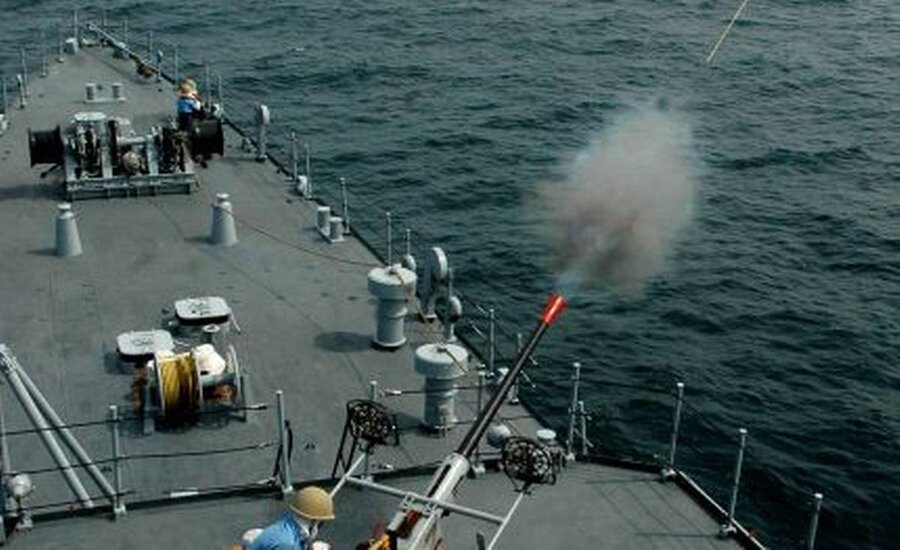
On 13 March pirates hijacked an oil tanker, named Aris 13, off the Somali coast, when the tanker was carrying fuel from Djibouti to Mogadishu. It is interesting, however, to note that this was the first successful hijacking of a commercial ship by Somali pirates since 2012. Even more interesting is the fact that, in less than three days, the pirates released the 08 men Sri Lankan crew and the ship without ransom.
The last decade was witness to an unprecedented surge in piracy emanating from Somalia, which became the most serious threat to global shipping passing through the area. The Somali coasts sits astride two of the most significant maritime trade routes; one that connects Asia and the Persian Gulf with Europe, through the Gulf of Aden, and the other, the North–South trade route running along the East African coast. Severe lack of economic opportunities and an absence of government in Somalia allowed some of these Somali rebels to hijack some hapless merchant ships plying on these two busy sea routes, and trade them off for handsome ransoms.
Heightened piracy activities along one of the busiest maritime routes inflicted overwhelming financial losses for the shipping community. These costs were in the form of lost cargo, ransom money, higher insurance costs, added shipping times, extra compensation to crews, litigation and legal fees, etc. Even cruising faster through the area, in an effort to discourage pirates, added to fuel costs. A study has indicated that for a supertanker, cruising at 17.9 knots versus the typical 12.8 knots speed, adds an extra $88,000 in fuel expense per ship per day. Some ships even started avoiding the area altogether by taking a much longer alternative route, adding to huge fuel, time and opportunity costs.
As the piracy incidents off the Horn of Africa crossed the threshold, the United Nations Security Council (UNSC), in 2008, issued its first resolution that empowered foreign navies to act against piracy in the waters around Somalia. Despite that, the acts of piracy continued unabated off the Somali coast and even expanded beyond its coastal waters into the high seas. These resulted in a series of other UN resolutions on piracy in general and Somali piracy in particular.
One immediate fallout of Somali piracy and subsequent UNSC sanctions was the assemblage of warships in the region from almost all major powers. There are a number of international naval alliances active in the region, these include the Combined Task Force (CTF) 151 under the 30-nations Combined Maritime Forces partnership; NATO’s Operation Ocean Shield; and EU Naval Force Atalanta. In addition, there are a number of navies operating in the region individually which include China, Iran, India, Japan, Korea, Russia and Malaysia, etc. Such is the congregation of these warships in the region that it would rival the largest maritime firepower that would have come together anywhere during the World War II.
The piracy risk off Gulf of Aden is much suppressed today, and this has been possible due to deployment of a large number of warships in the region. However, the larger issue consequential to Somali piracy is the permanent presence of extra regional navies in the region. Deployment of warships for anti-piracy operations is a gross overkill. Deployment of a destroyer/ frigate sized warship with an array of advanced weaponry against a handful of pirates armed with basic personal weapons defeats all logic. Accordingly, the contention that warships are present in the region purely for anti-piracy operations appears to be implausible. China demonstrated this blatantly when it deployed one of its submarines for the operations. The huge assemblage of warships for anti-piracy operations is so much out of proportion that presently, there are more number of warships in the region than the total estimated number of pirates.
It is also true that the ground situation in Somalia has not improved and the pirate networks remain. It is, therefore, essential that credible foreign-led counter-piracy efforts remain in place. However, if the intent is transparent, stakeholders could handle the piracy issue by simply deploying helicopter carrying merchant ships, with Special Forces contingent embarked. Deployment of container vessels as Naval Auxiliary vessels by the Royal Malaysian Navy, for instance, Bunga Mas Lima, is a copy book example showcasing economy of effort and transparent intent in the case.
Such a large congregation of warships in its primary area of interest doesn’t auger well for India. Accordingly, India should advocate progressive de-militarization of the region, with only appropriate number of warships deployed in the region, based on the nature and the scale of threat. On its part, India could deploy a modified ship from the Shipping Corporation of India (SCI) for anti-piracy operations, on similar lines as Malaysia’s auxiliary vessels, and thereafter recommend the same for other stakeholders as well.
************************
*Commander Dinesh Yadav is a Research Fellow at the National Maritime Foundation (NMF), New Delhi. The views expressed are his own and do not reflect the official policy or position of the NMF, the Indian Navy or the Government of India. He can be reached at cdrdinesh8y@yahoo.in

 Image Credit- Eunavfo
  Image Credits: The Brookings Institution
  Image Credits: Council on Foreign Relations
 Voice of america
Leave a Reply
Want to join the discussion?Feel free to contribute!