
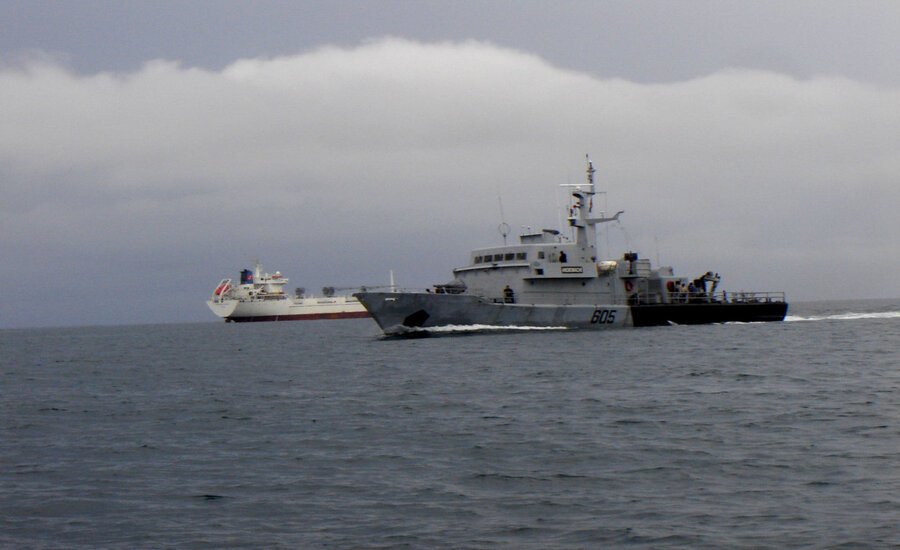
 Image Credit- Eunavfo
In July 2015, at the 18th Plenary Session, the Contact Group on Piracy off the coast of Somalia (CGPCS) accepted the Government of Seychelles offer to take over the Chairmanship of the CGPCS for the year 2016 from the European Union. It acknowledged Seychelles proactive engagement in international efforts to fight Somali piracy. Earlier this month, in his message as the incoming Chair of the CGPCS for 2016, Joel Morgan, Minister for Foreign Affairs and Transport announced that his country’s ‘mantra’ during the chairmanship would be to see the Indian Ocean as a ‘Zone of Peace and Opportunity’. Although the statement does not elaborate on the words ‘Peace’ and ‘Opportunity’, it is a reflection of Seychelles commitment to ensure maritime order in the Indian Ocean is upheld. There are at least four issues in the statement that merit attention.
First, the statement warns that the decline in incidents of piracy off Somalia and the Gulf of Aden does not necessarily mean that the pirates have ‘gone home’ given that the last big merchant vessel hijacked by Somali pirates was in May 2012; instead Somalia remains unstable with a number of criminal organizations engaged in arms, drugs, and human trafficking. Further, the international community must continue to remain vigilant and the investments made in bringing “like-minded states and entities together to combat piracy” are not lost. These concerns are further corroborated by experts who believe that it is too early to ‘lower your guard’. The Puntland’s Counter- Piracy Minister Abdalla Jama Saleh has also cautioned that pirates “are not dead, but dormant now, so they will come definitely… straight away, no question about it [as soon as the warships leave]”. Seychelles is keen that naval operations in the Gulf of Aden continue and any let up would necessarily mean the return of piracy.
The second issue in the statement is about the mariners held hostage by various pirate groups who need to be released and returned home. According to UKMTO weekly report 10-16 October 2015, there were no incidents of attack/board/hijack reported in the Gulf of Aden and no merchant vessels or its crew were under pirate control except 45 Personnel belonging to a fishing vessel (Naham 3; 26 persons held since March 2012)and a dhow (Siraj; 9 persons since March 2015). Interestingly, another Iranian dhow, the Jaber, which was captured along with Siraj by the Somali pirates, was successful in escaping in August 2015 and was able to seek refuge under the EUNAVFOR. The rescue of the crew of these vessels is a complex task and it remains to be seen who would be willing to send forces into Somalia.
The third issue relates to Seychelles call for a regional approach to addressing piracy given that it began within the region and it is therefore important that a regional approach be adopted to end it. The counter piracy operations in the Gulf of Aden are good examples of cooperative approach to security. The international community responded firmly through a number of political, diplomatic, security, legal and financial initiatives with positive results. The international shipping industry, concerned about the threat of piracy, also joined hands with the governments and instituted best business practices to protect ships against pirate attacks. At the heart of these engagements was a firm belief that the pirates are hostis humani generis; meaning “enemy of all mankind”.
Fourth, the statement argues for an inclusive approach through consultations with regional partners by sharing experiences which would help Seychelles drive agenda during its chairmanship. In the Indian Ocean, two important multilateral forums i.e. Indian Ocean Rim Association (IORA) and Indian Ocean Naval Symposium (IONS) are proactively engaged addressing the issue of piracy in the Gulf of Aden. The Bengaluru Declaration (2011), the Gurgaon Communique (2012) and the Perth Communiques (2013 and 2014) have noted with concern the “prevailing situation regarding maritime security in the Indian Ocean”, and called on regional countries to cooperate and fight piracy.
Although Seychelles begins the Chairmanship of the CGPCS in January 2016 with a near clean piracy ‘slate’, there are disturbing reports of Illegal, Unregulated and Unreported (IUU) fishing by foreign vessels in Somali waters. For instance, fishing vessel Al Amal, flying North Korean flag, was suspected of illegal fishing in the Somali waters. It is useful to mention that Somalia loses over USD 200 million annually due to illegal fishing by vessels from Yemen, Iran, China, Taiwan, Korea and European-owned vessels. Among these, the Yemeni and Iranian vessels are perhaps the most aggressive who operate in hundreds.
The 2016 Chairmanship offers Seychelles a unique opportunity to invest its political-diplomatic capital to highlight the menace of IUU fishing in Somali waters. After all, this was the very reason that prompted the Somali fishermen to stand up to fight foreign fishing vessels and turn into pirates. Also, IUU can potentially undermine the durability of what has been achieved in the Gulf of Aden by the international community over the last five years.
About the Author
Dr Vijay Sakhuja is Director, National Maritime Foundation (NMF), New Delhi
 Image Credits: The Brookings Institution
 Image Credits: Asian Voice
  The dollar business
  Image Credits: Dhaka Tribune
 Image Credit- The Hindu
  Image Credit - The Hindu
Leave a Reply
Want to join the discussion?Feel free to contribute!