
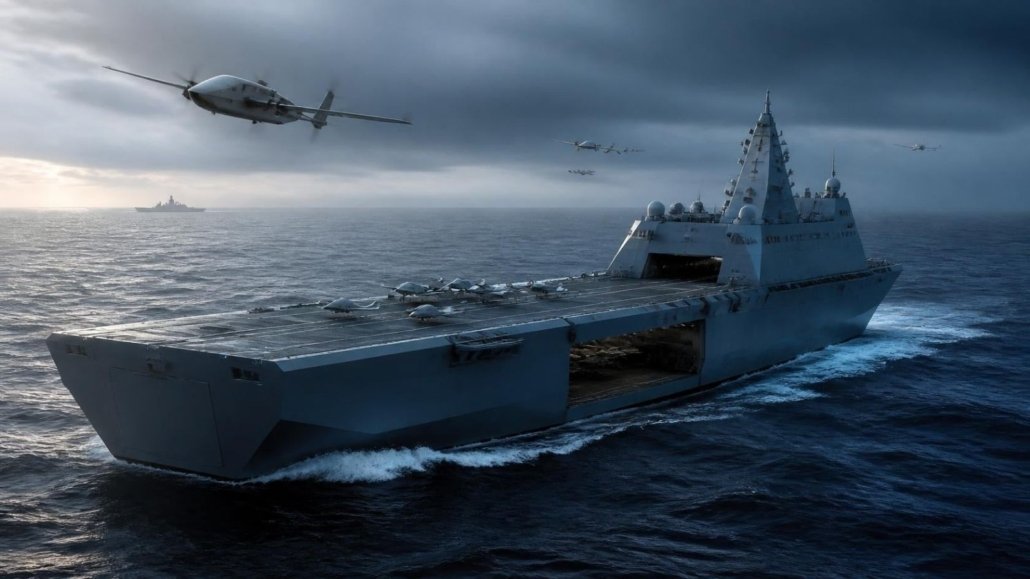
Every revolution in naval power has arrived twice. The first time as a machine. The second time, years later and at much greater cost, as an organisation. Carrier aviation did not transform naval warfare the day the first carrier entered service. It transformed naval warfare only once navies reorganised themselves to fight through carriers rather than battleships. Network-centric warfare, Aegis, and nuclear-powered submarines each followed the same pattern. The machine arrived on schedule, and the institution capable of using it arrived later, usually after a war had already exposed the gap. Autonomy is the next machine.
India’s future Landing Platform Docks are usually discussed as amphibious ships. That is correct, and it is also the least interesting thing about them. These vessels are being designed to command a mixed force of crewed and uncrewed systems across the air, surface and sub-surface domains at once. Put plainly: India risks solving the easiest part of the LPD problem first. A shipyard can deliver displacement, propulsion and a well deck. Industry can deliver drones. None of that gives a ship’s command team the ability to fight dozens of semi-autonomous systems in real time, under pressure, without becoming the slowest part of its own kill chain.
If we picture the moment the test. An LPD is closing an island objective. Helicopters are in the air, landing craft are in the water, drones are searching ahead, unmanned surface vessels are screening the approach, underwater vehicles are clearing the inshore lanes, and somewhere in the middle of all of it a command team that trained for a much simpler war is trying to keep up. That is not amphibious warfare with extra steps. It is a different kind of problem we would be dealing with.
A recent CNA Occasional Paper on Chinese military writing on drone swarms is not, on its face, about India. Its value lies in what Chinese authors noticed when they studied an American “drone swarm mothership” concept from around 2014 — a 20,000-to-30,000-tonne flat-deck ship with electromagnetic launch and recovery gear for drones. The Chinese account is unusually specific about why the idea stalled: not the drones, not the catapult, not the hull, but American institutional bureaucracy and the sheer difficulty of commanding a swarm-sized number of unmanned platforms from one ship.[1] That is the lesson worth keeping, and it is narrower than it sounds. It is not that motherships are a bad idea, or that swarms are premature, or that electromagnetic launchers are overreach. It is that a mothership can be fully buildable and still operationally hollow, if the navy sailing it has not redesigned who commands what, and how.
Ironically, China may be asking the more ‘real’ question. It is not really experimenting with drones. It is experimenting with Command. Its Type 076 amphibious assault ship, Sichuan, has drawn attention for its size and its catapult, but the more telling detail is in how China’s own commentary describes the ship’s purpose. CSIS assesses that the Type 076 will operate aircraft, drones, landing craft and marines together, with its catapult enabling fixed-wing unmanned combat operations.[2] The Sasakawa Peace Foundation calls it something more pointed: a “joint unmanned special warfare carrier” : a Command ship built to fuse special forces with air, surface and underwater unmanned systems into one mission.[3] China is not just throwing drones onto an amphibious ship. It is testing whether one command structure can absorb several different kinds of autonomous wars at the same time. Whether it succeeds is still an open question. That China is asking it in public, on a ship at sea, while its own writers pick over an earlier American failure to do the same thing, is the part India can draw the correct lessons from.
India’s own LPD programme is underway. The Defence Acquisition Council cleared Acceptance of Necessity for four LPDs in October 2025.[4] Published details put them at 25,000 to 30,000 tonnes, fully electric, through-decked, with a well deck and a mandate to support amphibious operations alongside the IA and IAF.[5] The original RFI named the role more bluntly: these ships are meant to be a “mother ship for unmanned capability,” operating air, surface and underwater systems together.[6] Every one of those roles is demanding on its own. Stacked on a single hull, they do not add up but compound.
Doctrine is not the problem. India’s Maritime Doctrine 2025 already acknowledges autonomy, AI, unmanned systems and assessments of it note its emphasis on predictive analytics and machine-assisted decision support across the fleet.[7] What doctrine cannot do, is answer the question that actually decides whether an LPD works as a mothership. Who, aboard that ship, holds the authority to task a drone, override an algorithm, or break off a USV screen mid-mission. How does that authority sit alongside the Captain, the Fleet Commander and personnel manning the helicopters and landing crafts.
There is a second problem hiding behind the first. India’s unmanned systems are growing up separately. Mine-countermeasure drones, surface vessels, underwater systems and manned-unmanned teaming concepts are each maturing under their own requirement, their own timeline, their own institutional sponsor.[8] This disjointedness was seen in the PLA Navy until a national level effort brought in all systems under one umbrella.
Everyone is talking about interoperability. That may be the wrong conversation. Ships have exchanged data for decades; a drone passing a track to a command system will not, by 2026, be a complex problem. The harder question is whether a Captain can command an autonomous fleet without becoming the bottleneck in his own decision cycle. Interoperability asks whether systems can talk to each other. Command asks whether a human being can still decide faster than the machines he is responsible for. A mothership earns that name not when its drones fly, but when its command team can prioritise, deconflict and redirect a moving mass of autonomous decisions without falling a step behind them. That is the failure mode the Chinese literature found in the American case, and it is the one failure mode that will not show up on any trial certificate, because the catapult will have worked perfectly the whole time.
If India waits for the first LPD to discover how to command an autonomous force, the programme would have begun in the wrong sequence. The command problem does not need a finished hull. It needs an institution willing to practise getting it wrong now, cheaply, on a ship that already exists. That argues for a different kind of investment than the one currently underway. An Autonomous Operations Cell, built into the LPD squadron from the outset rather than improvised from borrowed staff, would give cross-domain tasking, autonomy supervision and lost-link decisions an actual home aboard ship, with its authority written into procedure rather than left to be negotiated under fire. An annual exercise in which an existing ship is deliberately, repeatedly, made to behave like a mothership. This would be not to merely demonstrate that it can be done, but to find out exactly where it breaks. And the unmanned systems still maturing on separate tracks should be made to prove, before they are finished, that they can be tasked and recovered inside one shipboard architecture, because integration is never cheaper later.
None of this is an argument against the blue water capability of a maritime power such as India. India needs the lift, reach, and flexibility. The argument is that the hulls may turn out to be the least original part of the entire programme. The genuinely new thing being attempted is the expectation that one ship, one captain, and one command team can become the nervous system for a partly autonomous, multi-domain force. With the Chinese diagnosis of an American failure, and watching China building its own version at sea, we should not forego the advantage which is unlikely to last long. The real test of India’s future LPDs will not be whether they can launch autonomous systems. It will be whether they can command them effectively in an increasingly complex and challenging maritime and aerospace environment.
About the Author:
Capt Abhishek Prasad is an alumnus of the Indian Naval Academy and the Command and Overseas Staff Course, Malaysia. He is a gunnery specialist and has served onboard Veer and Talwar-class ships. He has commanded INS Suvarna. The officer has undergone the Naval Higher Command Course 38 and is presently the Directing Staff at Naval War College, Goa.
Endnotes:
[1]Timothy Ditter and Eleanor Harvey, “PRC Concepts for UAV Swarms in Future Warfare,” CNA Occasional Paper, 2025, https://www.cna.org/reports/2025/07/PRC-Concepts-for-UAV-Swarms-in-Future-Warfare.pdf.
[2]Matthew P Funaiole, Brian Hart, Aidan Powers-Riggs and Joseph S Bermudez Jr, “China’s Massive Next-Generation Amphibious Assault Ship Takes Shape,” Center for Strategic and International Studies, 1 August 2024, https://www.csis.org/analysis/chinas-massive-next-generation-amphibious-assault-ship-takes-shape.
[3]Yasuhiro Kawakami, “China’s New Amphibious Assault Ship Launched: Analysis of the Type 076 Amphibious Assault Ship Sichuan and Possible Tactics,” The Sasakawa Peace Foundation, 11 March 2025, https://www.spf.org/iina/en/articles/kawakami_05.html.
[4]Press Information Bureau, Government of India, “DAC Clears Proposals, Worth about Rs 79,000 Crore, to Enhance the Capability of the Armed Forces,” 23 October 2025, https://www.pib.gov.in/PressReleasePage.aspx?PRID=2181814.
[5]Indian Navy, “Details of Acceptance of Necessity (AoN) for Procurement of 04 x Landing Platform Docks,” 23 October 2025, https://indiannavy.gov.in/sites/default/files/DETAILS%20OF%20ACCEPTANCE%20OF%20NECESSITY%20%28AoN%29%20FOR%20PROCUREMENT%20OF%2004%20x%20LANDING%20PLATFORM%20DOCKS.pdf.
[6]Martin Manaranche and Xavier Vavasseur, “India Issues RFI for the Procurement of Four LPD Amphibious Vessels,” Naval News, 25 August 2021, https://www.navalnews.com/naval-news/2021/08/india-issues-rfi-for-the-procurement-of-four-lpd-amphibious-vessels/.
[7]Abhay Kumar Singh and R Vignesh, “Indian Maritime Doctrine 2025: An Assessment,” Manohar Parrikar Institute for Defence Studies and Analyses, 9 March 2026, https://idsa.in/publisher/issuebrief/indian-maritime-doctrine-2025-an-assessment.
[8]Indian Navy, Request for Information for Procurement of Unmanned MCM Suite for MCMVs, 2023, https://indiannavy.gov.in/sites/default/files/RFI%20for%20Unmanned%20MCM%20Suit%20for%20MCMVs.pdf.


Leave a Reply
Want to join the discussion?Feel free to contribute!