
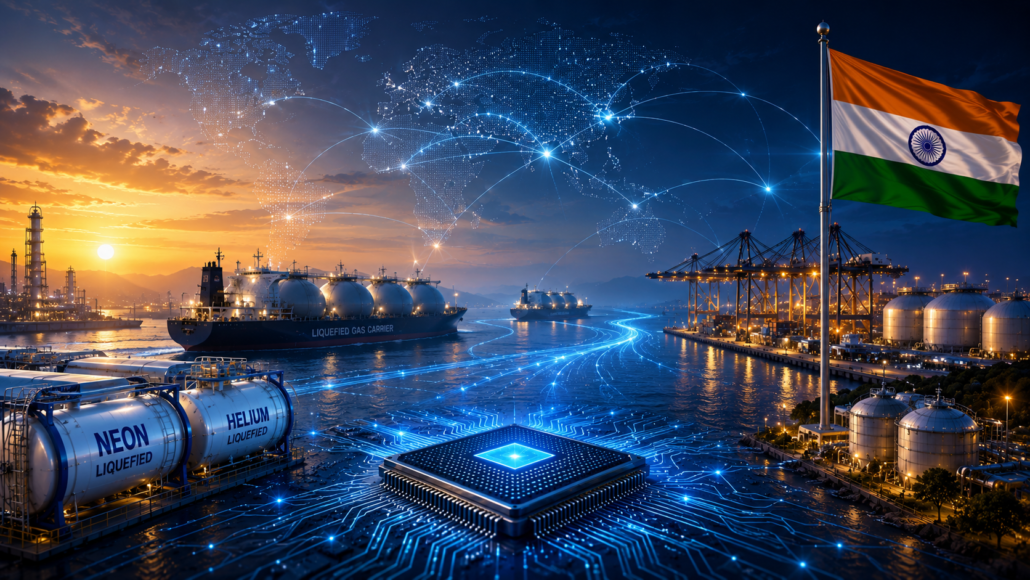
Trouble at the Root of Supply Chains
The present global milieu has been ushered into an age of recalibration, resulting from analyses that usually transcend traditional assumptions, mainly because the reliably pinned-down factors that served as the denominator for such analyses have radically shifted. Thus, the focus of this article is this very shift in base determinants, and its effect on the global semiconductor dimension over the past five years — with the COVID pandemic, the 2022 Russia-Ukraine War, along with the recent US-Iran confrontation and consequent turbulence in West Asia, forming the contextual backdrop. Several episodes of instability have revealed critical vulnerabilities at the very root of supply chains concerning the availability of critical semiconductor raw materials and their transportation, among other factors. The 2022 Russia-Ukraine war, which disrupted 40-55% of the global semiconductor-grade neon supply[1], thereby revealing the dangers of geographic concentration in a single location, represents merely a single manifestation of a far broader architectural fragility that is inherent within the semiconductor ecosystem.
The fact is that disruption of any one component cascades across the entire chain, thereby creating systemic vulnerabilities that extend far beyond the material itself. Raw material compounds do not occupy identical positions within the supply chain, and are vulnerable for varying reasons. They lie at successive points along a broader spectrum of systemic vulnerabilities, each characterised by a distinct combination of factors such as production concentration, processing requirements, transport dependencies, inventory constraints, and geopolitical exposure. Understanding these differences is essential because supply-chain resilience cannot be achieved through uniform policy responses for resources, but through resilience measures that are tailored to the dominant source of vulnerability associated with each material.
The neon gas disruption, for instance, was consequential because it exposed not only the overreliance on Ukraine but also the fragility of maritime-dependent networks, in which all determinants — production, purification, shipping, and fabrication — operate as tightly coupled systems. Likewise, gases such as helium, xenon, and krypton, along with “critical strategic minerals” such as gallium and germanium, and a few other specialised chemicals, form a metaphorical lattice of dependencies that collectively constitute the physical foundation of modern semiconductor production. Occupying different positions along the semiconductor supply chain, each material demands a tailored approach to resilience, diversification, and governance.
Previous analyses by this author have independently examined these two gases — neon and helium — focusing on their respective strategic implications of production concentration and maritime logistics. Taken together, however, these cases demonstrate that the strategic significance of critical semiconductor materials lies not in the materials themselves, but in the distinct forms of systemic vulnerability they reveal. Neon gas exemplifies the risks associated with production and purification concentration. Although recovered through cryogenic air separation, its value to the semiconductor industry depends upon a limited number of facilities capable of refining it to ultra-high-purity electronic-grade specifications.[2] The collapse of Ukrainian purification capacity following the outbreak of the Russia-Ukraine war has vividly demonstrated how the failure of a handful of specialised upstream facilities generates disproportionate consequences across global semiconductor manufacturing.[3]
Helium gas represents a different category of systemic vulnerability. Recovered primarily as a by-product of helium-bearing extraction of natural gas, its supply depends not only on geographically concentrated production but also on specialised liquefaction infrastructure, cryogenic storage, and long-distance transport networks. The concentration of major production in countries such as Qatar once again links helium availability further to the importance of uninterrupted functioning of critical maritime routes, particularly the Strait of Hormuz. Thus, recent disruptions affecting energy infrastructure in the Persian Gulf have once again illustrated how geopolitical instability may end-up constraining the movement of liquid helium as uncertainty rapidly propagates through highly specialised logistics systems.[4]
Viewed collectively, these cases demonstrate that vulnerabilities within semiconductor supply chains are neither homogeneous nor interchangeable. They exist as distinct vulnerability profiles comprising varying combinations of production concentration, technological dependence, processing complexity, maritime connectivity, inventory constraints, and geopolitical exposure. Although these factors recur across the semiconductor ecosystem, their relative significance differs across individual materials and the States that produce, process, transport, or consume them. Consequently, resilience must be calibrated to the specific configuration of vulnerabilities associated with each material and stakeholder, rather than being absorbed into a broad solution-based framework on the classification of the raw material — “critical semiconductor gases” in this instance; especially since the resilience challenge naturally extends beyond the two illustrative cases discussed previously. The wider ecosystem involves electronic-grade gases, specialised chemicals, and strategic minerals, each comprising elements that would further exhibit distinct patterns of vulnerability.
India and Taiwan Industrial Partnership
An additional underlying implication emerging from the preceding discussion is that resilience within semiconductor supply chains is shaped by technological capability alone, but equally by the strategic positioning of nations within the broader ecosystem of critical materials, industrial processing, and maritime connectivity. As governments and industries increasingly diversify away from concentrated sources of supply, the question is no longer solely one of whether additional manufacturing capacity is required, but one of identifying where trusted resilience nodes can emerge within the semiconductor architecture. This author opines that India is well positioned to occupy one such role. Furthermore, the evolution of India-Taiwan industrial relations provides an increasingly favourable institutional foundation to support this proposition.
Expanding trade, growing Taiwanese investment in India’s technology sector ranging to $5.7 Billion,[5] Track-One-point-Five and Track-Two strategic engagement, labour mobility agreements,[6] technology cooperation, and the establishment of India’s first major semiconductor fabrication facility (FAB) at Dholera in Gujarat, collectively demonstrate a relationship that has evolved beyond conventional commercial exchanges.[7] These developments establish the institutional scaffolding necessary for cooperation across material requirements, logistics, technology security, and maritime resilience.
India’s suitability as a resilience partner rests less on its present market share than on its latent industrial capacity. Although the domestic market for semiconductor-grade neon remains comparatively small, India’s steel industry provides an extensive industrial base from which electronic-grade gas production can be expanded. With more than 150 million tonnes of annual crude steel production and with potential to establish an incremental network of air separation units, the underlying resource base already exists.[8] The principal gap lies in advanced purification infrastructure capable of producing semiconductor-grade neon to electronic-grade specifications. Consequently, India’s opportunity is not one of resource discovery, but of industrial upgrading. Industrial capability, however, represents only one dimension of resilience.
Maritime Geopolitics as the Determinant of Semiconductor Resilience
Taken in aggregate, the systems perspective developed so far, along with wider promise through India’s industrial capabilities, maritime geography, and expanding partnership with Taiwan, present an opportunity to strengthen resilience across multiple points within the semiconductor ecosystem. This raises a further analytical question which can be answered through the example of India-Taiwan partnership — If the resilience of semiconductor manufacturing depends upon diversified production, trusted suppliers, and uninterrupted access to critical materials, why should these challenges ultimately be understood as “maritime” rather than purely “industrial”?
The answer lies in the physical architecture of contemporary semiconductor supply chains. Although discussions of semiconductor security frequently concentrate on fabrication capacity, technological sophistication, and industrial policy, these capabilities remain contingent upon the uninterrupted movement of critical materials, electronic-grade gases, specialised chemicals, manufacturing equipment, and finished products through maritime networks. The resilience of semiconductor supply chains is therefore determined as much by maritime geopolitics as by industrial capability.
Taiwan’s efforts to broaden its supplier base are motivated by determinants beyond commercial efficiency, that is, a wider objective of reducing systemic dependence upon geographically concentrated and strategically sensitive sources of supply. Despite considerable advances in recycling technologies, semiconductor fabrication continues to require the continuous replenishment of electronic-grade gases and specialised inputs. More significantly, the qualification of new suppliers often requires several months, preventing rapid substitution during supply disruptions. Consequently, resilience depends not only upon diversified sourcing but also upon the existence of reliable suppliers capable of maintaining uninterrupted deliveries. These dependencies are reinforced by Taiwan’s maritime geography. Nearly all of the island’s external trade moves through a limited number of major ports, making semiconductor manufacturing inherently dependent upon secure maritime communications. The vulnerability therefore extends beyond material availability to encompass shipping routes, port infrastructure, specialised logistics, and maritime stability itself.
Therefore, as the world’s leading producer of advanced semiconductors, Taiwan’s strategic vulnerability begins well before questions of territorial control or military confrontation arise. It originates, instead, in the uninterrupted functioning of the maritime system that sustains semiconductor production. The security, predictability, and continuity of international shipping lanes (ISLs) underpin every stage of the supply chain, from the import of critical semiconductor materials to the export of finished chips. Consequently, the resilience of Taiwan’s semiconductor industry depends not solely upon technological leadership or manufacturing capacity, but equally upon the stability of the surrounding maritime environment and the uninterrupted flow of international commerce.
Conventional analyses of cross-Strait relations often focus upon the possibility of military conflict. While such scenarios remain strategically significant, contemporary analysis suggest that the more immediate challenge lies in the expanding spectrum of coercive measures that fall below the threshold of outright confrontation.[9] Maritime quarantine operations, customs inspections, selective enforcement actions, coast guard deployments, exclusion zones, and persistent naval presence possess the capacity to disrupt commercial confidence without requiring the declaration of a blockade or even the commencement of hostilities.[10] Such measures invariably introduce uncertainty into shipping schedules, insurance markets, and investment decisions, producing economic consequences long before kinetic conflict becomes a reality.
This gradual expansion of “maritime” pressure reflects an important shift in contemporary geoeconomic competition. Rather than denying access outright, nations increasingly possess the ability to influence commercial behaviour through uncertainty itself.[11] Shipping companies reassess routeing decisions, insurers adjust war-risk premiums, and manufacturers expand inventory buffers or diversify suppliers in anticipation of potential disruption.[12] For industries operating under “just-in-time” (JIT) production models, uncertainty becomes economically consequential even when physical trade continues uninterrupted. Semiconductor manufacturing is particularly susceptible to these dynamics because production depends upon the timely arrival of highly specialised inputs that often possess limited inventories and lengthy supplier qualification cycles.
Taiwan exemplifies this structural exposure. Producing approximately 60% of global semiconductors and around 90% of the world’s most advanced chips, the island remains fundamentally dependent upon uninterrupted maritime commerce.[13] Nearly all of Taiwan’s external trade moves by sea, while imports of critical semiconductor materials remain concentrated through a limited number of specialised ports serving the country’s fabrication clusters. Therefore, disruptions affecting maritime access propagate rapidly beyond logistics into manufacturing continuity itself.
The increasing operational tempo of platform-deployments by the People’s Liberation Army Navy (PLAN) around Taiwan, including the transit of the aircraft carrier, Fujian, through the Taiwan Strait[14] and expanded military exercises, has contributed to a progressively more uncertain maritime environment. These activities increase strategic risk perceptions and reinforce the possibility that maritime access could become subject to political leverage during periods of heightened tension without ever necessarily interrupting commercial shipping directly. Contemporary strategic assessments have similarly explored the prospect of maritime quarantine or customs inspection regimes designed to exert economic pressure without crossing the legal and political thresholds associated with a formal blockade.[15] Such scenarios illustrate that economic coercion may increasingly operate through selective disruption of commercial flows rather than through outright denial of access.
Taiwan’s maritime exposure is not confined to the Taiwan Strait alone. The semiconductor ecosystem depends upon globally distributed supply chains extending across multiple maritime theatres. The earlier stated dependence of helium supplies upon the production of natural gas in the Persian Gulf sub-region, or neon from Ukraine, once again illustrates this wider geography of vulnerability. The disruption of energy infrastructure and shipping during the recent crises highlighted how events thousands of kilometres distant from East Asia could constrain the specialised cryogenic logistics essential for semiconductor manufacturing. Furthermore, disruptions rarely remain confined to individual commodities. Instead, they cascade through interconnected industrial, energy, petrochemical, logistical, and maritime chains. Consequently, procurement decisions increasingly prioritise resilience, redundancy, and trusted partnerships alongside cost and efficiency.
Implications for India
These developments carry important implications for India. As semiconductor supply chains transition from efficiency-driven optimisation towards resilience-oriented diversification, maritime geography assumes relatively greater strategic importance. India’s dominant geographic position within the Indian Ocean (which is better thought-of as the eastern segment of the Indo-Pacific), its expanding port infrastructure, established shipping connectivity, and growing interest in the semiconductor ecosystem, provide it with excellent opportunities to contribute as a stable maritime partner within a broader resilience architecture. Direct connectivity between India’s eastern seaboard and Taiwan, for instance, reduces transit times, diversifies sourcing options, and embeds bilateral trade within a wider Indo-Pacific network extending towards Southeast Asia, the Gulf, Europe, and Africa. Such connectivity broadens Taiwan’s economic geography while relieving it from excessive dependence upon concentrated production and logistics networks.
More importantly, India occupies a distinctive position within the Indo-Pacific strategic landscape. As the region’s largest stable democracy, it represents an alternative model of political and economic governance whose continued success carries significance beyond its national boundaries. The Taiwan question remains rooted in the complex political relationship between mainland China and Taiwan. Nevertheless, instability across the Taiwan Strait would generate consequences extending far beyond the immediate parties involved, affecting maritime trade, critical technology supply chains, investor confidence, and broader perceptions of the resilience of the rules-based economic order. For India, whose economic and strategic interests are increasingly linked to secure maritime commerce and advanced technology ecosystems, preserving resilient maritime supply chains therefore represents both an economic necessity and a strategic imperative.
Strategic Way Forward
The establishment of a non-governmental India-Taiwan Track Maritime Semiconductor Dialogue would represent a gradual transition from latent capability to operational resilience. It would move the conversation beyond isolated industrial investments, and enable coordinated evolution of industrial policy, maritime infrastructure, technological capability, and institutional cooperation.
Such a dialogue must recognise the that the greatest priority must be accorded to strengthening India’s upstream industrial capacity. While the country’s steel industry output is quite high, there is an urgent need to improve the network of air separation units to provide a substantial resource base; the absence of semiconductor-grade purification facilities continues to constrain its participation in global electronic-gas supply chains. Targeted investments in advanced purification technologies, supported through public-private partnerships and international technology collaboration, would enable India to move beyond the production of industrial gases towards the manufacture of electronic-grade materials capable of serving advanced semiconductor fabrication. Industrial capability must then be complemented by corresponding improvements in maritime infrastructure. Ports such as Visakhapatnam, Chennai, and Paradip possess favourable geographic locations but require specialised cryogenic storage, handling, testing, customs-processing, and quality assurance facilities to support the movement of semiconductor-grade materials. Integrating these capabilities within existing port modernisation programmes would strengthen India’s role not merely as a producer but as a reliable maritime logistics partner within the Indo-Pacific semiconductor ecosystem. Discussions on these themes would facilitate long-term planning across supply-chain management, technical standards, quality certification, research collaboration, and procurement coordination.
Conclusion
The maritime domain is no longer simply the medium through which semiconductor supply chains operate. It has become one of the principal determinants of their resilience. Recognising this transformation is essential for designing the partnerships, infrastructure, and institutions that will underpin the next generation of resilient global supply chains.
Within this evolving geopolitical landscape, India possesses an opportunity that extends beyond industrial expansion alone. Its extensive manufacturing base, favourable maritime geography, growing port infrastructure, and exponentially expanding semiconductor ecosystem ,position it to emerge as a credible resilience partner within global semiconductor supply chains. Realising this potential, however, requires a transition from comparative advantage to strategic capability through investments in purification technologies, maritime logistics, institutional coordination, and trusted international partnerships.
For Taiwan, and indeed for the wider Indo-Pacific, diversification represents a core strategic necessity. The continued concentration of critical materials and processing capabilities within a limited number of geographies has reinforced the importance of resilient, trusted, and geographically diversified supply networks capable of withstanding both geopolitical and consequential logistical disruption. In this respect, the proposed India-Taiwan partnership should be read into the emerging resilience architecture embedded within the broader maritime geography of the Indo-Pacific.
*******
About the Author
Mr Chemi Rigzin is a Research Associate at the National Maritime Foundation. He holds an MPhil in Geography from the University of Delhi. His current research concentrates on Taiwan’s evolving security posture, its geopolitical dynamics, and its role in the contemporary Indo-Pacific security environment. This is an important part of his overall research on key hard-security issues, including the PLA Navy’s modernisation, China’s overseas port development, and broader Chinese maritime strategy across the Indo-Pacific region.
Endnotes:
[1] Alexandra Alper, “Exclusive: Russia’s attack on Ukraine halts half of world’s neon output for chips”, Reuters, 11 March 2022, https://www.reuters.com/technology/exclusive-ukraine-halts-half-worlds-neon-output-chips-clouding-outlook-2022-03-11/?utm
[2] Jiatong Tan et al, “Review of Technologies for Helium Extraction from Natural Gas”, Industrial & Engineering Chemistry Research, 2026 65 (5), 2393-2411, DOI: 10.1021/acs.iecr.5c03485
[3] Jiatong Tan et al, “Review of Technologies for Helium Extraction from Natural Gas”.
[4] Giulia Petroni and Mauro Orru, “Why the Middle East Helium Supply Shock Didn’t Hit Chip Makers”, Wall Street Journal, 25 June 2026, https://www.wsj.com/finance/why-the-middle-east-helium-supply-shock-didnt-hit-chip-makers-471585a0?utm
[5] MSN, “Global and Taiwanese firms boost India investments despite uncertainty”, MSN, 26 June 2026, https://www.msn.com/en-in/news/insight/global-and-taiwanese-firms-boost-india-investments-despite-uncertainty/gm-GM9319DF63?gemSnapshotKey=GM9319DF63-snapshot-1&uxmode=ruby
[6] Press Trust of India, “India, Taiwan sign migration and mobility pact”, 16 Feb 2024, https://www.ptinews.com/story/national/india-taiwan-sign-migration-and-mobility-pact/1296736
[7] Government of India, Ministry of Commerce and Industry, “Government Notifies India’s First Chip Fabrication Plant at SEZ Dholera”, Press Information Bureau Delhi, 16 April 2026, https://www.pib.gov.in/PressReleasePage.aspx?PRID=2252649®=3&lang=1
[8] Government of India, Ministry of Steel, “Indian Steel Industry Shows Strong Growth Amid Emerging Challenges in 2025-26”, Press Information Bureau Delhi, 08 April 2026, https://www.pib.gov.in/PressReleasePage.aspx?PRID=2250022®=48&lang=2
[9] Lyle Morris et al, “Gaining Competitive Advantage in the Gray Zone”, RAND, 27 June 2019, https://www.rand.org/pubs/research_reports/RR2942.html?utm
[10] Li Jingyao, “Beijing Could Isolate Taiwan Through Maritime and Air Customs Inspections, Researcher Warns”, Vision Times, 04 May 2026, https://www.visiontimes.com/2026/05/04/beijing-could-isolate-taiwan-through-maritime-and-air-customs-inspections-researcher-warns.html
[11] Lyle Morris et al, “Gaining Competitive Advantage in the Gray Zone”.
[12] Bruce Randolph Tizes, “The Insurance Chokepoint: War-Risk Pricing as an Instrument of Maritime Coercion”, CIMSEC, 24 June 2026, https://cimsec.org/the-insurance-chokepoint-war-risk-pricing-as-an-instrument-of-maritime-coercion/
[13] Morris Chang, “How Taiwan came to dominate the global chip industry”, The Conversation, 01 April 2026, https://theconversation.com/how-taiwan-came-to-dominate-the-global-chip-industry-276939
[14] Albee Zhang, “PLA’s advanced aircraft carrier Fujian transits Taiwan Strait amid military drills”, SCMP, 24 June 2026, https://www.scmp.com/news/china/military/article/3358227/plas-advanced-aircraft-carrier-fujian-transits-taiwan-strait-amid-military-drills
[15] Bonny Lin et al, “How China Could Quarantine Taiwan”, CSIS Briefs, June 2024, https://csis-website-prod.s3.amazonaws.com/s3fs-public/2024-06/240605_Lin_Taiwan_Quarantine_0.pdf?VersionId=cwWSonEkmcw5tKypIqfhpazQkNKZ3aYf&utm


Leave a Reply
Want to join the discussion?Feel free to contribute!