
Keywords: Nicobarese, Maritime Knowledge, Traditional Ecological Knowledge, Maritime Anthropology, Austroasiatic Migration, Andaman and Nicobar Islands, Hodi Canoe, Oral Tradition, Monsoon Navigation, Canoe Technology, Island Communities, Indian Ocean History, Maritime Heritage, Indigenous Knowledge.
When historians write about maritime civilisations, they reach for Phoenicia, Greece, Portugal. They speak of daring navigators who conquered unknown seas armed with instruments, maps, and the might of empires behind them. What they rarely speak of is a small indigenous people living on a remote island chain in the Bay of Bengal who have been reading the ocean — its currents, its colours, its moods, its silences — for five thousand continuous years without interruption.[1]
Among them, the Nicobarese of the Andaman and Nicobar Islands occupy a distinctive place. They represent one of its most enduring living traditions.[2] While the Harappan dockyard at Lothal survives as an archaeological monument and the Periplus of the Erythraean Sea preserves written accounts of ancient navigation, the Nicobarese embody a maritime heritage that has been sustained through continuous practice rather than written records.[3] Their knowledge has been transmitted across generations through canoe-building, seasonal calendars, named ocean currents, star-based navigation, and the everyday experience of life at sea. Despite tsunamis, colonial rule, missionary influence, and rapid social change, many of these traditions continue to survive today.
This article argues that the Nicobarese constitute one of India’s most significant examples of indigenous maritime knowledge. Their history and traditions deserve a central place in any meaningful discussion of India’s long-standing relationship with the sea.[4]
Who Are the Nicobarese? Origins Across the Water
The Nicobar Islands form a chain of 19 islands (12 inhabited) in the Bay of Bengal, stretching toward the tip of Sumatra.[5] The Nicobarese are the dominant indigenous population of this archipelago, referring to themselves as Holchu — meaning “friend.”[6] They are an Austroasiatic-speaking people, linguistically linked not to mainland India but to the Mon-Khmer language families of Southeast Asia — a detail that is itself a piece of maritime evidence.[7]
The question of how the Nicobarese came to inhabit these islands is now answered by genetics, not just oral tradition. A landmark 2024 study published in the European Journal of Human Genetics, led by researchers at Banaras Hindu University, conducted genome-wide analyses of 1,554 individuals across Austroasiatic-speaking populations.[8] The findings were unambiguous: the Nicobarese retain the highest proportion of an ancestral Austroasiatic genetic component among all contemporary populations. Temporal analyses of haploid DNA suggested that the forebears of the Nicobarese arrived on the Nicobar Islands approximately 5,000 years ago.[9] The genetic evidence strongly supports a maritime migration to the Nicobar Islands.
Their closest genetic relatives on earth are the Htin Mal people of the Laos-Thailand border region — thousands of kilometres away across open water.[10] It offers compelling evidence of an early maritime movement into the Bay of Bengal, predating the earliest written accounts of Indian Ocean navigation.
The Nicobarese were not passive inhabitants of an island. They were, from the very beginning, people who came from the sea and continued to live by it.
The Hodi: A Canoe as Civilisation
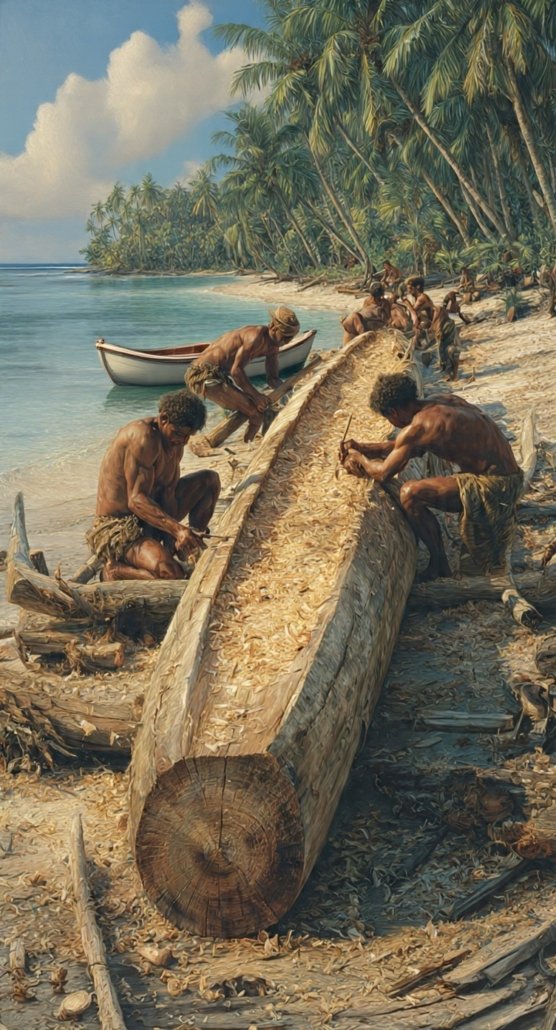
The most tangible object of Nicobarese maritime culture is the Hodi [11] — the traditional outrigger dugout canoe that has served as vehicle, livelihood, social unit, and cultural symbol for these people across millennia.[12]
The Hodi is not a simple boat. It is a precision-engineered vessel with specific construction rules passed down through generations as indigenous technical knowledge. According to documentation of Hodi construction techniques, the length of the finished canoe must be exactly 12 times its width[13] — while the length of the raw, undressed tree trunk must be 15 times that width, accounting for material lost in shaping.[14] This is not guesswork. It is applied engineering knowledge, orally transmitted, maintained to consistent specifications across generations and islands.
The selection of the tree itself requires expertise. Among the Nicobarese, only a few elderly specialists — recognised by the community for their accumulated knowledge, are considered qualified to select the appropriate tree for a Hodi.[15] Construction takes place from weeks to months. Earlier tools were the axe and the Fel (sword-sickle); today some modern instruments supplement these, but the fundamental design remains unchanged.
The Hodi varies slightly in design from island to island — adapted to local coastal conditions, water depths and fishing requirements. Critically, it is categorised not just as a fishing tool but as a social asset. Among the Nicobarese, the tuhet — a group of families under a headman — consider the Hodi a collective asset, a measure of communal wealth and capability.[16]
The Hodi is used for fishing, transporting people and goods between islands, for sending coconuts (the primary cash crop), and for the culturally significant event of the Nicobarese: Hodi racing. Inter-island and inter-village canoe races are major social occasions — ceremonial and deeply embedded in Nicobarese identity.[17] The Canoe Dance (Nrityam) performed by Nicobarese women at the Ossuary Feast directly mimics the rowing of a Hodi — the body movements of paddle strokes, the swaying of ocean waves — making the sea not just an economic space but also lived and embodied cultural experience.[18]
A Science of the Sea: Currents, Winds, Tides, and Depth
One of the most distinctive features of Nicobarese maritime tradition is their extensive knowledge of the surrounding marine environment. Developed through generations of observation and experience, this indigenous system encompasses ocean currents, tides, winds, and seasonal changes, forming a practical body of knowledge that guides navigation and fishing.
The Nicobarese have identified and named four directional ocean currents based on their geographic origin:[19]
- Heam Kudi — current from the north
- Heam Kulam — current from the south
- Heam Kuli — current from the east
- Heam Kuvath — current from the west
Nicobarese fishers determine the direction and strength of ocean currents by placing the Hallis (paddle) on the water and observing its drift.[20] This traditional technique enables them to assess local current conditions before setting out to sea.
The Nicobarese also recognise that tidal currents weaken between the ninth and fourteenth days following the full moon and strengthen thereafter.[21] This observation broadly corresponds with the neap — spring tidal cycle recognised in modern oceanography.[22] Their oral traditions also associate tidal movements with the phases of the moon.
Their understanding of seasonal winds is equally systematic. The Nicobarese recognise four principal wind directions; each is associated with a particular season.[23]
- Chu — West wind (January-March)
- Kaba — North wind (April-June)
- Susam — East wind (July-September)
- Lohaah — South wind (October-December)[24]
Among these, the East wind (Susam) is traditionally regarded as the most favourable for navigation and fishing. During the Amu season (April-May), seafaring and fishing are traditionally avoided because of hazardous sea conditions. The seasonal cycle functions as an indigenous maritime calendar that continues to guide community practices.
The Nicobarese also estimate sea depth by observing changes in water colour, with darker waters generally indicating greater depth. In addition, they identify approaching storms through changes in cloud formations and the movement of cool air masses.[25]
Navigating Without Instruments: Stars, Waves, and 30-Kilometre Open-Sea Crossings.
The practical application of Nicobarese maritime knowledge is most visible in their inter-island voyages. The island of Chowra — approximately 2.8 kilometres with over 2,300 inhabitants — lies roughly 30 kilometres from other Southern Nicobar Islands. Nicobarese from Car Nicobar regularly undertake voyages to Chowra and other islands in the archipelago using traditional canoes and navigational methods.
These voyages are carefully timed to coincide with the ebb tide, allowing the natural movement of the water to assist the canoe’s initial departure.[26] Navigation during these open-sea crossings relies on celestial observations for direction-finding. Travellers carry food, coconuts, and trade goods, staying at their destination for up to ten days before returning.
Chowra Island: Where the Sea Is Sacred
Among the islands of the Nicobar chain, Chowra holds a special status. It is described in ethnographic accounts as the “Land of Wizards”[27] — a reputation built on its inhabitants’ exceptional navigational skills. Chowra pots and Chowra canoes are considered sacred objects across the Nicobar archipelago, imbued with properties of protection and good fortune.
The most respected ritual specialists among the Nicobarese — the Menluana (witch doctors and healers) — are traditionally said to come from Chowra.[28] And the Ossuary Feast (Panuohonot), the most significant ceremonial event in Nicobarese culture, directly integrates maritime symbolism: the Chowra practice of placing the corpse of the deceased on a broken canoe — the very vessel of sea travel — as the first stage of burial rites ties death, ancestry and the ocean together in a single ritual act.[29]
The canoe, in Nicobarese cosmology, is not merely a fishing tool. It is a vessel of passage — in life and death.
The Manimekhalai, the ancient Tamil epic, describes the sea as a space of both commerce and spiritual significance. For the Nicobarese, this dual nature of the ocean — practical and sacred — is lived reality, not literary metaphor.[30]
Historical References to the Nicobar Islands
Historical records also confirm the long-standing maritime importance of the Nicobar Islands. The Chinese Buddhist monk Yijing, who travelled through the Indian Ocean in the seventh-century CE, referred to the islands as a stopping point on the maritime route between Southeast Asia and India.[31]
More significantly, eleventh-century South Indian inscriptions from the Chola period refer to the islands as Nakkavaram – indicating that the Nicobar Islands were known to Indian maritime traders and were part of the wider Indian Ocean trading circuit during the height of Chola naval expansion.[32]
Geographical Indication and Contemporary Recognition
In December 2024, the Hodi was formally awarded Geographical Indication (GI) status by the Government of India — recognising it as a specific cultural and geographic origin, deserving legal protection of its identity.[33]
The recognition acknowledges the canoe as a distinctive cultural product associated with the Nicobarese community and highlights its importance as part of India’s maritime heritage.
Conclusion
The Nicobarese case for India’s ancient maritime consciousness is unusual precisely because it is not archaeological. There is no brick basin at Lothal here, no seal from Mohenjo-Daro, no Periplus entry. What there is instead is something more remarkable: a living, functioning, unbroken maritime tradition that is still practised today by a people whose ancestors arrived by sea over the past five millennia and never stopped reading the ocean.
Yet this living tradition is also a fragile one. Missionary influence, administrative resettlement, the pull of wage labour, and the steady homogenisation of island life have already reshaped Nicobarese society once — and each of these pressures continue to bear on how much of this knowledge the next generation will inherit.
Unlike a Harappan seal or a Chola inscription, this heritage cannot be excavated once lost; it survives only as long as someone still knows how to read the drift of a paddle, the colour of deep water, the shape of a cloud before a storm. The 2004 tsunami is itself a reminder of what this knowledge is worth in practice — communities across the Nicobar Islands who recognised the sea’s warning signs were among those who moved to higher ground before the waves arrived. That is not folklore. That is applied science, tested against the worst the ocean can do.
The GI tag granted to the Hodi in 2024 is a meaningful first step, but recognition is not the same as preservation. If India is serious about its claim to an ancient and continuous maritime civilisation, that claim must extend beyond monuments and museums to the living custodians of this knowledge — through systematic documentation of navigation and ecological practices, through support for inter-generational knowledge transfer within Nicobarese communities, and through space for indigenous maritime knowledge within India’s own maritime and disaster-resilience frameworks.
India often speaks about its ancient civilisational legacy. The Nicobarese are that legacy — still breathing, still paddling, still reading the sea. The only question is whether India chooses to listen while there is still time to.
********
About the Author:
Ms Lalita Sharma is a Research Intern at the National Maritime Foundation. She holds a Bachelor’s degree in Sociology from Hindu College, University of Delhi, and a Master’s degree in Sociology from Indira Gandhi National Open University (IGNOU). She may be contacted at lalita369sharma@gmail.com
Endnotes:
[1] Madhumala Chattopadhyay, The Nicobarese (Calcutta: Seagull Books, 1990), 17–24
[2] TN Pandit, The Nicobarese (Calcutta: Anthropological Survey of India, 1989), 1–12
[3] Madhumala Chattopadhyay, Car Nicobar: The Change from Traditional to Modern (Calcutta: Anthropological Survey of India, 2003), 41
[4] Himanshu Prabha Ray, The Archaeology of Seafaring in Ancient South Asia (Cambridge: Cambridge University Press, 2003), 5–15
[5] EH Man, The Nicobar Islands and Their People (Guildford: Billing and Sons Ltd, 1932), 1.
[6] KK Mathur, Nicobar Islands (New Delhi: National Book Trust, 1967), 24.
[7] George van Driem, Languages of the Himalayas, vol 2 (Leiden: Brill, 2001), 1198–1205.
[8] Gyaneshwer Chaubey et al, “Reconstructing the Population History of the Nicobarese,” European Journal of Human Genetics (2024).
https://www.nature.com/articles/s41431-024-01720-w
[9] Rahul Kumar Mishra, Prajjval Pratap Singh, Niraj Rai, et al, “Reconstructing the Population History of the Nicobarese,” European Journal of Human Genetics (2024).
https://pubmed.ncbi.nlm.nih.gov/39639149/
[10] Mishra et al, “Reconstructing the Population History of the Nicobarese.”
[11] Anthropological Survey of India, Traditional Knowledge Systems of the Nicobarese (Kolkata: ASI, 2016), 73–82.
[12] T Ravikumar et al, “Hodi, a Traditional Craft of Nicobari Tribe,” Indian Journal of Traditional Knowledge, (2016): 161–168.
[13] S Rajamanickam, “Traditional Canoe Building among the Nicobarese,” Indian Journal of Traditional Knowledge 12, No 3 (2013): 456–463.
[14] Man, “Material Culture” In The Nicobar Islands and Their People
[15] Anstice Justin, The Nicobarese (Calcutta: Seagull Books for the Anthropological Survey of India, 1990), 1.
[16] Mathur, “Social Organisation” in Nicobar Islands.
[17] Mathur, “Social Organisation” in Nicobar Islands.
[18] Man, “Ceremonies and Festivals” in The Nicobar Islands and Their People
[19] Man, “Navigation and Reckoning of Time and Distance” in The Nicobar Islands and Their People
[20] S Rajamanickam and Anbarasan, “Traditional Ecological Knowledge,” 241.
[21] Man, “Navigation and Reckoning of Time and Distance” in The Nicobar Islands and Their People
[22] Rajamanickam and Anbarasan, 242–243.
[23] Rajamanickam and Anbarasan, 242–243.
[24] Man, “Calendrics” in The Nicobar Islands and Their People
[25] T Ravikumar et al, “Subsistence Fishing Methods of Nicobari Tribes Using Traditional Knowledge,” Journal of Marine and Island Cultures 5, no 1 (2016): 79–87.
[26] CB Kloss, In the Andamans and Nicobars (London: John Murray, 1903).
[27] AR Radcliffe-Brown, The Andaman Islanders (Cambridge: Cambridge University Press, 1922), 364–366.
[28] Chattopadhyay, The Nicobarese, 163–170.
[29] Man, “Funerals and Memorial Ceremonies” in The Nicobar Islands and Their People
[30] Alain Daniélou, trans, Manimekhalai (New Delhi: Penguin India, 1993), Book 1.
[31] CB Kloss, In the Andamans and Nicobars.
[32] KA Sastri, The Cholas (Madras: University of Madras, 1955), 214–216.
[33] Government of India, Geographical Indication Registry, “Hodi (Traditional Craft of Nicobari Tribe),” (GI Registry, 2024).
https://search.ipindia.gov.in/GIRPublicSearch/Application/Details/998


Leave a Reply
Want to join the discussion?Feel free to contribute!