
Abstract
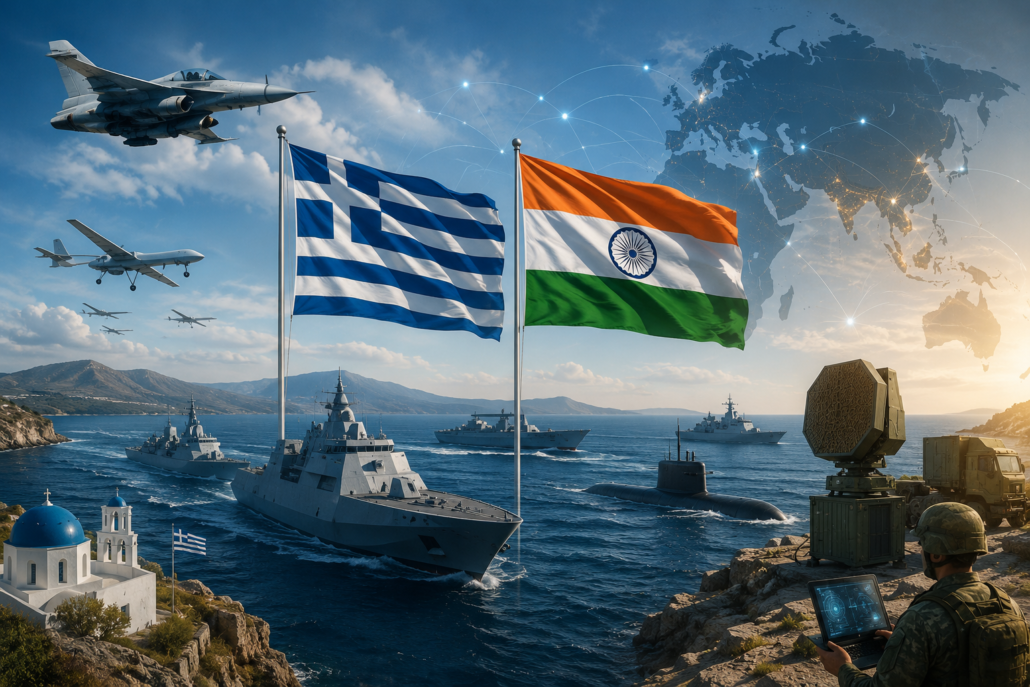
Greece is entering a period when deterrence can no longer be understood solely in terms of possessing advanced platforms. Rafale fighter jets, Kimon Class FDI HN frigates, upgraded F-16 Vipers, Type 214 submarines, and future F-35 aircraft remain indispensable, but recent conflicts have shown that endurance, industrial capacity, affordable mass production, unmanned systems, electronic warfare, resilient infrastructure, and rapid adaptation now shape military effectiveness as much as traditional platforms. This paper argues that Greece’s “Agenda 2030” should be treated not solely as a procurement programme, but as a fast-adaptation defence-transformation project for the entire national defence ecosystem. India’s military adaptation debate, particularly the analysis of contemporary warfare by the National Maritime Foundation’s senior fellow, Captain KS Vikramaditya, IN, offers a useful comparative lens for Greece, showing how a middle power facing a larger industrial competitor must combine conventional modernisation with drones, attritable systems, air and sea denial, domestic production, rapid repair and civilian technological innovation. The Greece–India Strategic Partnership, the New Rimland concept, and the India-Middle East-Europe Corridor (IMEC), reinforce this argument further by situating Greek defence transformation within a broader maritime and geoeconomic architecture linking the Indo-Pacific, the Persian Gulf, the Eastern Mediterranean, and Europe.
Keywords: Greece, India, “Agenda 2030”, deterrence, defence industry, unmanned systems, sea denial, air denial, electronic warfare, IMEC, strategic endurance, industrial resilience.
Greece can no longer afford to think of defence solely in terms of acquiring major platforms. Rafale fighters, Kimon Class FDI HN frigates, upgraded F-16 Vipers, Type 214 submarines, and future F-35 aircraft all provide reach, credibility, interoperability, and operational edge. They also signal political resolve and anchor Greece within Western defence networks. Yet the armed conflicts and crises of the last decade have shown that advanced systems alone do not guarantee endurance. Increasingly, the critical factor is the capacity to sustain operations, recover from losses, and adapt under pressure.
One of the key insights derived from the conflicts in Ukraine, Nagorno-Karabakh, and West Asia is that cheap drones, loitering munitions, electronic warfare, commercial sensors, software and mass-produced precision systems can reshape the economics of military operations. A State may possess sophisticated aircraft, ships, and air-defence systems; but ultimately, if it is forced to spend million-euro interceptors against drones that cost a fraction of that amount, it may prevail in individual engagements but lose the wider contest of endurance. The “Centre for Strategic and International Studies” (CSIS) describes the Russia-Ukraine conflict as a watershed in modern military history, especially because autonomous systems, electronic warfare, information operations, contested logistics and air-defence adaptation have become central to battlefield effectiveness.[1]
This article draws upon official documentation, think-tank assessments, and operational lessons from recent conflicts. Its main purpose is to examine how Greece can use its “Agenda 2030” not merely as a procurement and restructuring program but as a comprehensive mechanism for defence transformation. The Hellenic Ministry of National Defence has presented “Agenda 2030” as an overhaul of the Hellenic Armed Forces designed to modernise its capabilities and defence ecosystem.[2] Reuters has also reported that Greece plans by 2036 to allocate more than €25 billion for arms procurement, including submarines, drones, satellites, fighter aircraft, and the anti-aircraft and anti-drone “Achilles Shield”.[3] The central question is not whether Greece is upgrading its military systems, but whether modernisation is construed as procurement or, more generally, as adaptation. If “Agenda 2030” is reduced to a list of platforms, its strategic impact will be limited. If it becomes a mechanism for learning, production, repair, dissemination, and rapid technological absorption, it can materially strengthen national deterrence.
“Agenda 2030” is thus a national opportunity to connect high-end platforms with domestic production, counter-drone systems, electronic warfare, unmanned systems, protected infrastructure, digital command systems, resilient logistics, and help forge stronger linkages between the Greek armed forces and Greek industry. India’s ongoing military adaptation discourse is, in this regard, highly germane because it addresses a similar problem, albeit in a different context. India faces a more powerful industrial and technological competitor in China and cannot close every gap symmetrically within a meaningful timeframe. Captain KS Vikramaditya’s analysis advocates a model that maintains conventional modernisation while incorporating disruptive technologies, low-cost attritable systems, air and sea denial, resilient infrastructure, and fostering synergies and coordination between the armed forces, industry, and start-ups.[4]
The Indo-Greek Strategic Partnership
The strategic convergence between Greece and India lends this argument greater diplomatic and geopolitical weight. During Prime Minister Narendra Modi’s visit to Athens in August 2023, Greece and India elevated their bilateral relationship to a “strategic partnership”.[5] The Greek side depicted the visit as a new starting point in bilateral relations, emphasising cooperation in security, economy, defence, technology, and shared maritime interests.[6] This framework was reinforced in February 2026, the Greek Minister of National Defence, Mr Nikolaos Dendias, visit to India led to the signing of a “Joint Declaration of Intent on Defence-Industrial Cooperation” and the development of a five-year roadmap linking India’s Aatmanirbhar Bharat initiative with Greece’s “Agenda 2030”.[7] Although India and Greece are not adjacent States, they are connected by maritime geography, energy flows, commercial corridors, and a common interest in a rules-based order at sea. This partnership bears directly upon military adaptation.
Greece is located at the intersection of the Eastern Mediterranean, the Balkans, the Black Sea, and the emerging Europe-West Asia-India connectivity space. India is a major Indo-Pacific actor with expanding naval, technological, and industrial ambitions. Both States are maritime democracies at sensitive strategic junctions. As such, their cooperation goes beyond symbolism. It can serve as a practical channel for maritime security dialogue, defence-industrial cooperation, technology exchange, start-up collaboration, and shared lessons on how middle powers operate and adapt under pressure. PM Modi also referred to a more intensive cooperation in the defence and security sectors, infrastructure, emerging technologies and skills, as well as closer military and defence-industrial relations.[8] This is important because the future of Greek deterrence is inextricably tied to technology, industry, and maritime connectivity. India’s experience in balancing conventional modernisation with domestic production and disruptive technologies offers Greece a comparative template – not for imitation but for selective and targeted adaptation.
The New Rimland, IMEC, and Greece’s Maritime Role
The strategic convergence between Greece and India reflects a broader realignment spanning the Eastern Mediterranean and the Indo-Pacific. Kotoulas suggests that both nations can be understood as maritime actors within a broader New Rimland architecture linking the Mediterranean, the Persian Gulf and the Indian Ocean through sea-oriented, pro-Western powers.[9] In this reading, Greece is not a peripheral European State. It is a maritime hub connecting Europe to the Eastern Mediterranean and the Indo-Pacific via energy corridors, naval access, ports, and shipping lanes.
India’s role in this architecture is crucial. India is not merely an endpoint of the India-Middle East-Europe Corridor (IMEC) or a large Asian market. It is the central maritime power of the Indian Ocean and a principal stabilising actor across the Indo-Pacific, the Persian Gulf, and Europe. Its geographic position astride major international shipping lanes (ISLs), its growing naval capabilities, its economic scale, and its political and diplomatic leverage make it indispensable to any durable connectivity structure linking Asia and Europe. India serves as the eastern anchor of this emerging corridor, while Greece can evolve into its western gateway into Europe. The India-Middle East-Europe Economic Corridor (IMEC) strengthens this argument. Gavalas and Dikaios argue that Greece occupies a pivotal strategic position within IMEC because of its port infrastructure, maritime connectivity, and role in linking India, West Asia and Europe. Their analysis lays particular emphasis on the geostrategic value of the Port of Piraeus as an entrepot connecting Asian and West Asian commercial flows to mainland Europe.[10]
Hence, IMEC should not be perceived solely as a commercial initiative. It is a strategic alternative to China’s Belt and Road Initiative (BRI), which incorporates maritime transport, rail connectivity, digital infrastructure, and energy interconnections within a broader geopolitical framework.[11] For Greece, this presents both an exceptional opportunity and an arduous task. Ports, shipping lanes, energy routes, undersea infrastructure and digital networks are no longer secondary security concerns. They are integral to national deterrence. In this sense, “Agenda 2030” is not just a structural reform. It is also a national security corollary of Greece’s prospective role as a maritime, energy, and connectivity hub.
“Agenda 2030” and Greek Defence-Transformation
“Agenda 2030” provides Greece with a timely institutional vehicle for rapid adaptation. Its impact will depend on how quickly it will manage to process and transpose lessons from the Ukraine, Red Sea and West Asia conflicts and the wider contemporary battlespace into Greek capabilities.[12] The danger for any State is that procurement cycles move slowly while the character of conflict changes quickly. By the time a system is fully fielded, the threat environment may already have been transformed or even shifted.
The most pressing priorities are clear: layered counter-drone defence, electronic warfare, low-cost interceptors, passive detection, secure communications, resilient satellite links, rapid repair capacity, dispersed logistics, and domestic production of expendable systems. The Greek armed forces require advanced aircraft and ships, but they also need depth. Depth is associated with ammunition, spare parts, trained technicians, local production, hardened infrastructure, and the ability to continue operating after the initial phase of a crisis. The Associated Press has described Greece’s defence overhaul as focused upon high-technology warfare, including the Achilles Shield, networked capabilities, artificial-intelligence-enabled systems, drone technologies and secure satellite communications.[13] This indicates that the Greek debate is already moving beyond traditional platform replacement. “Agenda 2030” can provide a mechanism by which Greece adapts faster than the threat environment evolves. A medium-sized EU State cannot afford waste, delay, or symbolic procurement. The funds spent on defence should strengthen combat power, survivability, readiness, stockpiles, infrastructure protection, or domestic production. Major platforms remain necessary, but they must not dominate strategic thinking. Current conflicts show that the expensive and the expendable must coexist within the same force design.[14]
India’s Strategic Adaptation: Lessons for Greece
Capt Vikramaditya’s paper does not reject conventional military modernisation. It does not claim that aircraft, ships, missiles, or submarines have lost their value. Rather, it warns that high-end platforms alone cannot address the changing character of contemporary warfare. India must continue pursuing conventional modernisation while investing in a consistent manner in disruptive technologies, unmanned systems, and low-cost attritable capabilities.[15] This distinction is crucial for Greece. The question is not whether to choose between Rafale and drones, FDI and unmanned maritime systems, or F-35 and electronic warfare. The issue at stake is how these capabilities can be combined. High-end platforms provide reach, escalation control, allied interoperability, and strategic signalling. Affordable unmanned systems provide persistence, deception, saturation, and local tactical effect. One without the other is incomplete and inadequate.
Capt Vikramaditya’s comparison of India and China is especially instructive. He identifies economic robustness, technological competence, and industrial assets as the fundamental conditions for prevailing in a long confrontation. His warning is that India cannot aspire to challenge China’s industrial and technological advantage through direct emulation. It must identify asymmetric and cost-effective ways to impose operational and strategic costs.[16] Greece faces a different geography and is part of a different strategic setting, but the rationale is similar: a medium-sized European maritime power should not be confined to symmetrical imitation when rival powers have greater depth. It can capitalise upon geography, alliances, technology, selective industrial autonomy and operational creativity to erode the adversary’s confidence.
Industrial Endurance, Affordable Mass, and Defence Innovation
The first lesson from India’s adaptation process is endurance and resilience. The opening phase of a crisis may be rapid and politically decisive, but if the confrontation continues, the balance of power depends on ammunition stocks, spare parts, repair cycles, trained manpower, fuel, energy, logistics, and industry. The Ukrainian case made this clear: advanced systems lose their value if they cannot be maintained, supplied, and replaced.
The research conducted by Royal United Services Institute (RUSI) on attritional warfare reaches a similar conclusion. Vershinin contends that attritional war is shaped by force preservation, replacement of losses, and sustained industrial output; such wars are decided not solely by manoeuvre or initial shock, but also by regeneration, ammunition production, and a State’s ability to continue fighting.[17] For Greece, this means that deterrence must be measured not only by what is available on the first day of a crisis, but by what can be sustained on the thirtieth, sixtieth, or hundredth day.
The second lesson is affordable mass. The conventional, clear-cut distinction between precision and quantity has been withering away. Cheap drones, first-person-view systems, one-way attack drones, and loitering munitions can be deployed in large numbers with increasing accuracy and precision. Their purpose is not merely to destroy specific targets but also to deplete air defences, overload decision-making, force the use of expensive interceptors, and maintain pressure. A cheaper system does not need to be flawless. Operational effectiveness is increasingly becoming dependent on quantity, adaptability, and rapid replacement rather than perfection.
Capt Vikramaditya’s recommendations for India are deliberately ambitious. He calls for a mass induction of low-cost attritable systems, including large numbers of first-person-view and one-way attack drones, supported by dedicated production, industrial capacity and protection of intellectual property developed by domestic start-ups.[18] Admittedly, the exact numbers are India-specific and cannot be applied to the Greek case. Nevertheless, the main insights apply to Greece as well. Greece needs sufficient unmanned aerial vehicles, loitering munitions, passive sensors, low-cost interceptors, and counter-drone systems to make hostile action costly, uncertain, and operationally slow. This necessitates a different equation between the armed forces and industry. Modern drone warfare evolves too quickly for slow procurement cycles. Software, sensors, datalinks, electronic protection, and tactics can become outdated and obsolete within a few months. A system that cannot be modified swiftly may lose relevance before it is fully fielded.[19] “Agenda 2030” connects Greece’s armed forces with shipyards, electronics companies, software firms, universities, research centres, and start-ups. The objective is operational independence: systems that can be produced, modified, and repaired domestically, including drones, counter-drone systems, electronic warfare modules, passive sensors, maritime unmanned systems, secure communications, AI-supported surveillance tools, and affordable precision weapons.
RUSI’s publication “Drones Win Battles, Components Win Wars” strengthens this argument by noting that Ukraine’s drone success brings to the fore a crucial NATO lesson: technological sovereignty at the component level is absolutely essential to future battlefield advantage.[20] From Greece’s viewpoint, this means thinking beyond the final platform. Batteries, sensors, processors, warheads, datalinks, navigation, electronic protection, and repair capacity matter as much as the airframe or hull. India’s adaptation debate also revolves around the differentiation between tactical and strategic adaptation. Tactical adaptation denotes the ability of junior leaders and field units to innovate under pressure. Strategic adaptation signifies the ability of a State and its military leadership to translate field lessons into changes in doctrine, organisation, procurement, and industry. This principle is the bedrock of Greece’s “Agenda 2030”: exercises, fleet operations, air-defence drills, island-defence training, and cyber-electronic warfare activity feed directly into industry and procurement.
Air- and Sea Denial and Critical Infrastructure Resilience
Capt Vikramaditya stresses that air denial warrants serious doctrinal attention: the experience in Ukraine shows that denying an adversary’s air superiority may be as important as achieving complete air superiority oneself. Mobile ground-based air defence, dispersion, camouflage, deception, legacy guns integrated into the air-defence network, and anti-drone electronic warfare have all taken on added significance. For Greece, this is highly relevant: it must judiciously avoid ending up in a situation in which each small drone is countered by an expensive missile.[21] The Achilles Shield component of “Agenda 2030” is, therefore, vital because it represents a layered, mobile, networked, and adaptable architecture.[22] Electronic warfare, spoofing, passive detection, mobile guns, low-cost interceptors, decoys, camouflage, and hardened positions can complement high-end systems. Expensive missiles must be reserved for high-value threats. Cheap threats should be addressed with cheaper means whenever possible. This does not diminish the value of advanced air-defence systems. It protects them from exhaustion.
The maritime aspect is equally crucial in this connection. The Aegean and Eastern Mediterranean are not open oceans. They are crowded, politically and economically sensitive maritime domains shaped by islands, narrow passages, ports, energy infrastructure, and shipping lanes. Greece does not need to secure numerical symmetry by building a larger fleet. It needs to make hostile movement uncertain, slow, costly, and politically risky. Unmanned surface vessels, unmanned underwater systems, coastal anti-ship missiles, distributed sensors, electronic warfare, submarines, and drones can create a dense sea-denial environment. Maritime drones may not yet be ideal for permanent sea control, but they are valuable for sea denial. They can force caution, complicate planning, create uncertainty, and compel larger naval forces to disperse or redeploy. For Greece, the geographical configuration of the Aegean amplifies this effect.
The growing Greece-India Strategic Partnership can enhance the maritime dimension: both nations share strong interests in maritime security, sea lane protection, connectivity, freedom of navigation, international law, and a rules-based maritime environment. Greece’s position in the Eastern Mediterranean region and India’s role in the Indo-Pacific create opportunities for structured maritime dialogue, naval exchanges, defence-industrial contacts and joint analysis of unmanned systems, port security, sea denial and the protection of critical maritime infrastructure. Resilience is the final node of this model. Air and naval bases, radar stations, ammunition depots, LNG terminals, undersea cables, energy infrastructure and command nodes cannot be treated as fixed and secure. They require dispersion, redundancy, deception, hardened shelters, mobile systems, and rapid repair capability. The objective is not to render every target invulnerable or impregnable, but to dispel the notion that a first strike could paralyse Greek decision-making, operations or national infrastructure. Resilience becomes a core component of deterrence rather than a secondary support function.
Conclusion
India’s military adaptation debate offers Greece a useful framework for comparison. India is complementing advanced platforms with attritable systems, drones, air and sea denial, industrial resilience, and rapid adaptation. Greece could reflect on these issues along similar lines with an eye to its own geography, economy, and alliances. The Greece-India Strategic Partnership reinforces this logic. It indicates that Greece’s adaptation agenda is not only a national defence issue but also part of a broader alignment between two democratic seafaring nations which value maritime safety, defence cooperation, technology, connectivity, and a rules-based order. The New Rimland and IMEC dimensions lend this argument a solid geoeconomic foundation: Greece’s ports, maritime infrastructure, shipping capabilities, and privileged location in the Eastern Mediterranean place it at the European end of a strategic corridor linking India, West Asia and Europe. India, as the most important maritime power of the Indian Ocean, anchors the eastern end of this emerging line of connectivity.
“Agenda 2030” offers Greece the institutional opportunity to move in this direction quickly and articulate a new National Defence model: high-end platforms bolstered by affordable mass production and domestic production, counter-drone defence, electronic warfare, resilient infrastructure, rapid repair and a tangible connection between Greece’s armed forces and the technology industry. The future and effectiveness of Greece’s deterrent posture should rest on a balance: Greece must retain systems that guarantee strategic reach, allied interoperability and StratCom messages while developing domestically produced capabilities that make hostile action more difficult and more costly. Quality without quantity can lead to depletion. Quantity without quality is unlikely to have a substantial impact. Greece needs both elements, underpinned by industrial resilience, operational imagination and creativity. In the coming years, deterrence will no longer be contingent upon a State’s capacity to purchase the most advanced weapons, but rather on its potential to produce, repair, adapt, disperse and endure. Greece possesses the geography, human capital, maritime tradition and alliance networks to construct such a model. What it needs now is a clear and firm decision to treat “Agenda 2030” as a fast-adaptation project for its entire defence ecosystem.
*********
DISCLAIMER
The views expressed in this article are personal and do not bind the Hellenic Navy General Staff (HNGS), nor do they reflect its policy or decisions.
About the Author(s)
Commander Athanasios Drivas is Deputy Commandant of the Hellenic Navy Naval War College, with service in Hellenic Navy surface units, senior national staff positions and NATO, including NCIA at JFC Naples. He holds an MSc in Electrical Engineering with Distinction from the Naval Postgraduate School in California and is a University of Plymouth MA scholarship student, with research interests in naval operations, maritime security, geopolitics, StratCom, and the strategic environment of the Eastern Mediterranean.
Prof Vasileios Syros is a faculty member at the MSc Leadership: Ethics and Politics at the University of Athens (Greece) and an Honorary Adjunct Fellow at the National Maritime Foundation. He is also a Life Member of Clare Hall, University of Cambridge. His areas of specialty include the history of medieval and early modern political and strategic thought and cross-cultural leadership.
Endnotes:
[1] Matthew Slusher, “Lessons from the Ukraine Conflict: Modern Warfare in the Age of Autonomy, Information and Resilience”, Center for Strategic and International Studies, 02 May 2025, https://www.csis.org/analysis/lessons-ukraine-conflict-modern-warfare-age-autonomy-information-and-resilience.
[2] Hellenic Ministry of National Defence, “Minister of National Defence N Dendias Presents Phase B of ‘“Agenda 2030”’ Armed Forces Reform”, 24 July 2025, https://www.mod.mil.gr/en/minister-of-national-defence-n-dendias-presents-phase-b-of.
[3] Lefteris Papadimas, “Greece to Spend More than 25 bln Euros in Arms Procurements by 2036”, Reuters, 12 March 2025, https://www.reuters.com/business/aerospace-defense/greece-spend-more-than-25-bln-euros-arms-procurements-by-2036-2025-03-12.
[4] KS Vikramaditya, “From the Traditional to the Contemporary: How India Must Prepare for War,” National Maritime Foundation, 12 May 2025, 1, 39–40, https://maritimeindia.org/wp-content/uploads/2025/06/Captain-KS-Vikramaditya-IN-12-May-2025.pdf.
[5] Manjari Singh and Vasileios Syros, “The India-Greece Defense Partnership: From Symbolism to Robust Strategic Convergence,” Review ATHENA, Hellenic National Defence College 59 (2025): 6–12, ATHENA_web_2-Τελικό.pdf.
[6] Hellenic Ministry of Foreign Affairs, “Prime Minister Kyriakos Mitsotakis’ Article in The Times of India,” 25 August 2023, https://www.mfa.gr/missionsabroad/en/india-en/news/prime-minister-kyriakos-mitsotakis-article-in-the-times-of-india-2582023.html.
[7] Government of India, Press Information Bureau, “Raksha Mantri Holds Bilateral Talks with Minister of National Defence of Hellenic Republic in New Delhi,” 09 February 2026, https://www.pib.gov.in/PressReleasePage.aspx?PRID=2225523.
[8] Government of India, Ministry of External Affairs, “India-Greece Joint Statement,” 22 February 2024, https://www.mea.gov.in/bilateral-documents.htm?dtl/37656/IndiaGreece_Joint_Statement.
[9] Ioannis E. Kotoulas, “India and Greece as Strategic Partners,” Defence and Security Alert 12, No. 7 (2021), https://www.researchgate.net/publication/350617914_Ioannis_E_Kotoulas_India_and_Greece_as_Strategic_Partners.
[10] Dimitrios Gavalas and Georgios Dikaios, “Connecting Opportunities: Greece’s Strategic Role in the India-Middle East-Europe Economic Corridor (IMEC),” ELIAMEP Policy Brief No. 194/2025, January 2025), https://www.eliamep.gr/wp-content/uploads/2025/01/Policy-brief-194-GAVALAS-and-DIKAIOS.pdf.
[11] Gavalas and Dikaios, Connecting Opportunities, 4–5.
[12] Hellenic Ministry of National Defence, “Minister of National Defence N. Dendias Presents Phase B of ‘“Agenda 2030”’ Armed Forces Reform.”
[13] Derek Gatopoulos, “Greece Vows to Spend $27B on Armed Forces Overhaul Centred on High-Tech Warfare Technology,” Associated Press, 02 April 2025, https://apnews.com/article/f0a96590823e5fc3e263473912fe4844.
[14] Grigoris Dimitriadis, “ΑΠΟΨΗ: Ο Γρηγόρης Δημητριάδης γράφει για τις Ένοπλες Δυνάμεις, το στοίχημα του αύριο και τη νέα οικονομία του πολέμου” [“OPINION: Grigoris Dimitriadis Writes on the Armed Forces, the Challenge of Tomorrow and the New Economics of War”], PTISI 71, May 2026, https://flight.com.gr/dimitriadis-arthro-ptisi-may-26.
[15] Capt KS Vikramaditya, “From the Traditional to the Contemporary,” 39.
[16] Capt KS Vikramaditya, “From the Traditional to the Contemporary,” 3.
[17] Alex Vershinin, “The Attritional Art of War: Lessons from the Russian War on Ukraine”, Royal United Services Institute, 18 March 2024, https://www.rusi.org/explore-our-research/publications/commentary/attritional-art-war-lessons-russian-war-ukraine.
[18] Capt KS Vikramaditya, “From the Traditional to the Contemporary,” 39.
[19] Capt KS Vikramaditya, “From the Traditional to the Contemporary,” 26.
[20] Mirko Niederkofler, “Drones Win Battles, Components Win Wars,” Royal United Services Institute, 17 December 2025, https://www.rusi.org/explore-our-research/publications/commentary/drones-win-battles-components-win-wars.
[21] Capt KS Vikramaditya, “From the Traditional to the Contemporary,” 39–40.
[22] Reuters, “Greece in Talks to Buy Anti-aircraft, Artillery Systems from Israel,” Reuters, 14 November 2025, https://www.reuters.com/business/aerospace-defense/greece-talks-buy-anti-aircraft-artillery-systems-israel-2025-11-14/.


Leave a Reply
Want to join the discussion?Feel free to contribute!