
Keywords: Indo-Pacific Energy Security, India–Australia Cooperation, Us–Israel–Iran Conflict, Strait of Hormuz, Energy Vulnerability, LNG and LPG Supply Chains, Supply Chain Disruption, Strategic Reserves, Maritime Chokepoints, Energy Geopolitics, Fuel Security, Energy Resilience.
This article examines the implications of the ongoing United States-Israel-Iran conflict for India and Australia, focusing upon energy disruptions and policy responses to mitigate long-term effects. The trajectory of US-Iran relations remains rooted in the rupture of 1979, when the Iranian Revolution fundamentally altered Tehran’s political orientation and its engagement with the West.[1] Since then, the relationship has been marked by persistent friction, driven by concerns over Iran’s nuclear programme, its expanding regional footprint, and its opposition to key US partners, especially Israel.[2]
The ongoing conflict — triggered by a combined US-Israel strike (Operation EPIC FURY) on Iranian military infrastructure on 28 February 2026— marks a significant departure from earlier patterns of indirect confrontation.[3] Unlike previous episodes characterised by dissuasion, deterrence, and strategic restraint, this escalation represents one of the most direct military engagements between the US-Israel axis and Iran in recent history, with immediate as well as long-term implications on maritime security, especially energy security, as also the security of the actual flow of energy.
The conflict matters for India and Australia not merely because of their diplomatic positions, but because both countries are tied to the global energy system through maritime trade, fuel imports, and price-sensitive supply chains. India’s vulnerability is most visible in crude oil price inflation and LPG (Liquefied Petroleum Gas) supply, while Australia’s exposure lies in the paradox of being a major exporter of crude oil and LNG (Liquefied Natural Gas), while simultaneously being a net importer of refined petroleum products. In both cases, the conflict demonstrates that energy security is directly inseparable from maritime stability and supply-chain resilience and is averse to geopolitical risks.
Energy Disruptions and the Strait of Hormuz
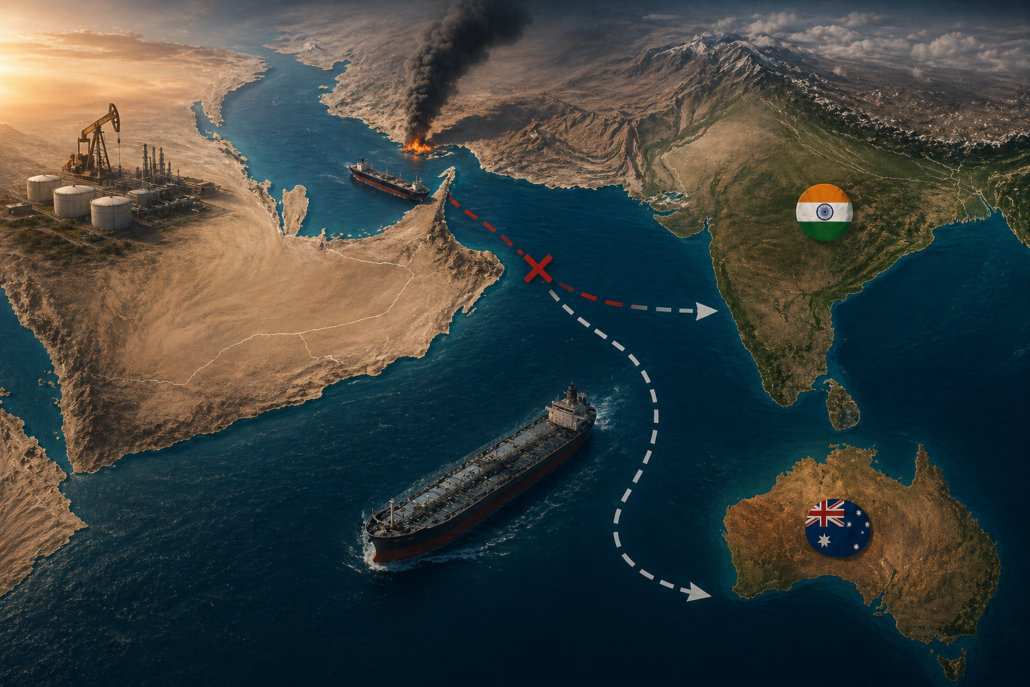
The most immediate global consequence of the conflict has been the disruption to the flow of energy through the Strait of Hormuz. As one of the world’s most critical maritime chokepoints, the Strait facilitates the movement of a substantial share of global crude oil, liquefied petroleum gas (LPG), and liquefied natural gas (LNG), quite apart from fertilisers, and gases such as helium and neon (both of which are critical for the manufacture of semi-conductors). Even a partial disruption — through attacks on shipping, increased naval presence, higher insurance premiums (or their denial altogether), or tanker rerouting — has had disproportionate effects on global energy supply chains.
The significance of the Strait of Hormuz lies not only in the volume of energy passing through it, but also in the fuels involved and the sectors they sustain. Crude-oil disruptions immediately affect global price benchmarks, given the centrality of oil to the transport sector and to industry. LNG disruptions, in turn, impact power generation, industrial activity, and fertiliser production, particularly in import-dependent economies. LPG disruptions are even more socially sensitive, especially in countries such as India, where it serves as a primary household cooking fuel rather than a purely commercial energy source.
As a result, disruptions in Hormuz do not affect a single sector in isolation but are transmitted across multiple layers of the economy — from global pricing to industrial output and household consumption. The Strait, therefore, functions not merely as a geographical chokepoint, but as a critical artery linking global energy markets to domestic economic and social stability.
In the weeks following the outbreak of hostilities, oil prices rose sharply, while Asian gas markets experienced significant volatility. However, the more enduring impact has stemmed less from physical supply disruption and more from the perception of risk surrounding energy transport. Rising and withdrawal of war-risk premiums, higher marine insurance costs, increased freight rates, and uncertainty in tanker availability have collectively raised the cost of moving energy across maritime routes.[4] Consequently, even where physical supply has continued, the landed cost of energy imports across Asia has increased significantly, transmitting the effects of the conflict into domestic markets.
The scale and duration of disruption will ultimately determine the severity of the global shock. According to Oxford Economics, a baseline scenario assumes that the conflict lasts for approximately two months, with maritime traffic recovering gradually thereafter.[5] However, a prolonged conflict could push global GDP growth down to 1.4 per cent in 2026 — well below baseline — while keeping oil prices above US$ 150 per barrel for several months and driving inflation close to 2022 peak levels.[6]
The conflict has also altered regional perceptions of the United States. Strikes on Gulf States have generated frustration within the Gulf Cooperation Council (GCC), particularly over the lack of prior consultation and the perceived inadequacy of defence following Iran’s retaliation.[7] While US–GCC relations are unlikely to collapse, they may not return quickly to their pre-war equilibrium. In this context, platforms such as BRICS may gain relevance as supplementary avenues for economic engagement and political signalling, even if they cannot substitute for existing security arrangements.[8]
It is within this broader context of disrupted energy flows, rising costs, and strategic uncertainty that the specific vulnerabilities of India and Australia become evident.
India: Layered Energy Vulnerabilities Beneath Short-Term Stability
India’s exposure to the current crisis is both structural and immediate. Official statements have emphasised that there is no immediate shortage of petroleum products, with supplies being managed through diversification, domestic production, and prioritisation of essential consumption.[9] This reflects the State’s capacity to stabilise supply in the short term. However, short-term stability should not be mistaken for structural insulation.
To better understand the differentiated nature of India’s energy vulnerability, the following table compares LPG, LNG, and crude oil across key dimensions.
Table 1: India’s Comparative Vulnerability Across LPG, LNG, and Crude Oil
| Dimension | LPG (Liquefied Petroleum Gas) | LNG (Liquefied Natural Gas) | Crude Oil / Petroleum Fuels |
| Import dependence | ~60% of consumption; the highest import dependence among petroleum products | ~45–50% of gas demand met through LNG imports | ~85–88% import dependent; largest energy import by volume |
| Primary use in India | Household cooking fuel (including welfare-linked access) | Power generation, fertiliser production, city gas distribution, and industry | Transport fuels, petrochemicals, and economy-wide use |
| Hormuz exposure | ~80–90% of imports via Strait of Hormuz; highly concentrated | ~50–60%; significant Gulf dependence (especially Qatar) | ~40–50%; declining due to diversification toward non-Gulf suppliers |
| Supply diversification | Limited; supply chains remain heavily Gulf-linked | Moderate; increasing diversification (US, Australia), but the Gulf is still important | High imports sourced from 40+ countries |
| Storage/reserves | No strategic reserves; dependent on continuous imports and terminal storage | Limited storage; dependent on regasification capacity and contracts | Strategic Petroleum Reserves (~9–10 days) + commercial stocks (~50–60 days) |
| Demand elasticity | Very low; household consumption is largely inelastic | Medium; some industrial and power-sector adjustment possible | Medium–high; demand responds to price signals over time |
| Substitutability | Very low; alternatives (biomass, kerosene) have welfare and health costs | Moderate; substitution possible but costly and inefficient | Relatively high at the supply level; crude sourcing can be adjusted |
| Immediate crisis impact | Supply disruption risk + direct household impact | Price volatility + industrial and fertiliser sector impact | Global price shock + economy-wide macroeconomic impact |
| Price sensitivity | High; affects subsidy burden and household expenditure | High; exposed to global LNG spot market volatility | Very high; linked to global oil benchmarks |
| Logistics vulnerability | Very high; specialised carriers, bottling, and distribution network required | High; dependent on LNG carriers, terminals, and infrastructure | Moderate; flexible tanker market but affected by insurance and freight costs |
| Economic spillover | Household welfare, subsidy burden, inflation | Fertiliser costs, power tariffs, and industrial output | Inflation, fiscal deficit, current account deficit, transport and logistics costs |
| Strategic assessment | Most socially sensitive and structurally fragile | Price-sensitive industrial vulnerability | Physically manageable but macroeconomically exposed |
Source: Collated by the author from various sources
India’s energy vulnerability is not uniform. Crude oil, LNG, and LPG, each expose the country to distinct but interconnected risks. Crude oil — used for transport fuels and industrial energy — primarily generates macroeconomic and price exposure. LNG — used in power generation, fertiliser production, and industry — creates industrial and agricultural cost pressures. LPG — used mainly as a household cooking fuel — introduces direct welfare and political risk. This layered structure complicates any assessment of energy security based solely on import dependence.
At the macro level, India’s crude oil system appears relatively resilient. Despite importing around 88 per cent of its requirements,[10] India has diversified its supplier base across Russia, the United States, Africa, and other regions.[11] As a globally fungible commodity traded in liquid markets, crude oil can be sourced from multiple suppliers, allowing India to maintain physical supply continuity even when specific routes or suppliers are disrupted.
However, this resilience is limited to availability. Crude oil markets are globally integrated, and disruptions in West Asia quickly translate into higher benchmark prices. As a result, even diversified sourcing does not shield India from price shocks. Rising crude prices increase the cost of petrol, diesel, and aviation fuel, feeding into transport costs, logistics, and economy-wide inflation. Government intervention can moderate immediate price impacts but often shifts the burden onto public finances or oil marketing companies.
A different vulnerability emerges in the LNG sector. India relies on LNG imports for a significant share of its gas consumption, particularly in fertiliser production, city gas distribution, and industry.[12] While sourcing is more diversified than LPG, LNG markets remain highly price sensitive. During periods of stress, fuels, unlike general or containerised cargo, are often redirected to higher-paying markets, tightening availability for price-sensitive importers such as India. This creates a direct fiscal trade-off between higher subsidies and rising costs for agriculture, both of which carry broader economic implications.
The most acute vulnerability, however, lies in LPG. Unlike crude oil or LNG, LPG in India is primarily a household fuel. Around 60 per cent of consumption is met through imports, reflecting a widening gap between domestic production and demand.[13] A large share of these imports (nearly 90 per cent) originates in West Asia and transits through the Strait of Hormuz, creating a highly concentrated chokepoint dependency.[14]
LPG supply chains are less flexible than crude oil, relying on specialised carriers, terminals, and distribution systems. This makes them more difficult to adapt during disruptions. At the same time, demand is highly inelastic — households cannot easily switch away from LPG without reverting to more polluting or less efficient fuels. As a result, supply disruptions or price increases translate directly into welfare and political pressure. Recent emergency measures, including directing refiners to increase LPG output and prioritising domestic distribution, underscore the sensitivity of this sector.[15]
Taken together, India’s energy system reflects a set of layered vulnerabilities. Strength in one segment — such as crude oil diversification — does not offset weaknesses in others, particularly LPG supply chains and LNG price exposure.
Energy Buffers and the Storage Constraint
India’s ability to manage prolonged disruption depends on its petroleum and gas buffers. Oil remains a structural vulnerability: India imports nearly 89 per cent of its crude, and demand is projected to rise further.[16]
Public discourse often cites “10 days” of reserves, but this refers only to Strategic Petroleum Reserves (SPR). India’s SPR capacity — 5.33 million metric tonnes across Visakhapatnam, Mangaluru and Padur — provides roughly 9–10 days of mitigation.[17] Including commercial inventories held by oil companies, the total petroleum cover rises to about 74–90 days.[18]
This distinction matters. SPRs are sovereign emergency reserves; commercial stocks are part of operational supply chains and are not fully deployable. This framework applies primarily to crude oil. India’s oil system is relatively more resilient due to diversified sourcing, refining capacity, and inventories. Yet high import-dependence persists.
The more serious constraint lies in LPG and LNG, where comparable strategic reserves are extremely limited or absent altogether. India’s LPG vulnerability is particularly acute. Nearly 60 per cent of its LPG demand is met through imports, and over 90 per cent of these imports transit the Strait of Hormuz.[19] India relies on just two underground LPG storage caverns — Visakhapatnam (60,000 tonnes), operated by South Asia LPG Company (a joint venture between HPCL and TotalEnergies), and Mangaluru (80,000 tonnes), operated by HPCL.[20] Together, they provide about 1.4 lakh tonnes of storage, covering less than two days of the national demand of roughly 90,000 tonnes per day.[21]
This reflects a system built for flow rather than for storage. LPG moves rapidly from import terminals to consumers, with minimal stockpiling.[22] While efficient under normal conditions, it is highly vulnerable to disruption, with shortages quickly affecting households, businesses and prices.
LNG, too, faces similar limitations. India lacks a strategic gas reserve, and imports are largely regasified for immediate use, leaving a minimal buffer. Recent shocks have prompted proposals to expand storage capacity, including terminal-level buffers and underground reserves such as salt caverns.[23] The result is an uneven system with moderate resilience in terms of crude oil, but acute vulnerability in terms of both, LPG and LNG. India’s energy strategy has prioritised diversification and price management in oil, while storage capacity in other fuels remains underdeveloped.
The broader economic implications of energy disruption can be understood through scenario modelling. Estimates from “SBI Research” and the “Central Electricity Authority”, clearly show that sustained increases in oil prices generate measurable macroeconomic stress.
Table 2: Oil Price Scenarios and Macroeconomic Impact on India
| Oil Price Scenario | GDP Growth | Inflation (CPI) | Fiscal Deficit | Current Account Deficit |
| Baseline | ~7.0–7.2% | ~2.75% | ~4.4% | ~0.7–0.8% |
| $100/barrel | ~6.6% | ~4.1% | ~5.0% | ~2.0% |
| $120/barrel | ~6.2% | ~4.8% | ~5.3% | ~2.5% |
| $130/barrel | ~6.4% | ~5.5% | ~5.6%+ | ~3.2% |
Source: India’s World[24]
This table serves a distinct analytical function from the structural comparison above. While Table 1 identifies where vulnerabilities lie within the energy system, Table 2 shows how these vulnerabilities translate into macroeconomic outcomes. Sustained oil price increases reduce growth, raise inflation, widen fiscal deficits, and increase external imbalances.
The transmission channels are multiple. Higher fuel prices increase transportation and logistics costs, affecting food distribution, manufacturing, aviation, and e-commerce. Increases in the price of petrochemicals adversely impact plastics, packaging, pharmaceuticals, and consumer goods. Even everyday products, such as bottled beverages become more expensive due to energy-intensive production and transport. In this way, an oil shock becomes a generalised cost shock across the economy.
Australia: Export Strength, Domestic Fragility
Australia offers a contrasting but equally instructive case. As a major LNG exporter, it appears insulated from global energy shocks.[25] The ongoing crisis, however, has revealed the opposite — energy abundance coexists with vulnerability in refined fuels.
Australia’s exposure is not import-dependence in terms of crude oil, as is the case in India, but rather, lies in the erosion of domestic refining capacity. Over time, Australia has shifted towards importing refined products such as petrol, diesel, and aviation fuel. The conversion of BP’s Kwinana refinery into an import terminal,[26] and the closure of ExxonMobil’s Altona refinery in 2021, illustrate this transition.[27] Only a limited number of facilities, including the Geelong[28] and Lytton refineries,[29] remain operational.
This outcome reflects structural pressures rather than short-term disruptions. Australian refineries have struggled against larger and more efficient Asian counterparts, particularly in Singapore, South Korea, and China.[30] Economies of scale, lower operating costs, tightening environmental standards, and high labour costs, have, taken in aggregate, steadily eroded viability. The result is a model dependent on imported refined fuels, with Singapore alone accounting for over half of light oil imports,[31] embedding reliance on regional supply chains and maritime routes.
As prices rise and supply chains tighten, the domestic impact becomes visible. Oxford Economics estimates that in a prolonged conflict scenario, Australia’s GDP could contract by 0.3 per cent in Q2 and a further 0.8 per cent in Q3, driven by inflation and the onset of fuel rationing.[32] Outside the pandemic, this would mark the sharpest quarterly decline since the early 1990s.[33]
The burden would fall unevenly. Transport, manufacturing, mining, and agriculture face the most immediate pressures.[34] Transport absorbs fuel cost spikes directly. Manufacturing contends with both energy and input costs. Mining remains diesel-intensive and logistics-dependent. Agriculture faces a squeeze between rising energy and fertiliser costs and declining yields. Regionally, commodity-dependent and export-oriented states are more exposed, while diversified economies are relatively insulated.[35]
Australia’s LNG export strength introduces a policy dilemma. Higher prices boost export revenues but also raise domestic energy costs, sharpening debates over reservation policies and export controls. The issue is not supply alone, but the balance between export competitiveness and domestic resilience. Policy responses have centred on fuel conservation, prioritisation of essential sectors, and renewed focus on stockholding and refining resilience.[36] These measures point to a broader shift: in prolonged disruptions, fuel allocation and demand management become instruments of national resilience.
Unlike India’s import-driven exposure, Australia’s vulnerability stems from internal imbalances in its fuel system. Resource wealth has not eliminated risk; it has redistributed it.
The United States–Israel–Iran conflict underscores a wider transition across the Indo-Pacific from efficiency-driven supply chains to resilience-oriented frameworks. As maritime routes face sustained geopolitical risk, India and Australia must use their Comprehensive Strategic Partnership to stabilise long-term energy flows.
Critical Analysis of Energy Vulnerability
Despite being a major energy producer, Australia faces acute domestic vulnerabilities due to its reliance on imported petroleum products and limited strategic stockpiles. India confronts similar, but more pronounced, challenges, given its heavy dependence on crude imports and the short duration of its strategic reserves. Both now face a clear constraint: sustained reliance on global spot markets during prolonged conflicts is not viable.
- Rebalance Strategic Storage Across Fuels
India’s energy buffer architecture remains largely crude-oil centric. Strategic Petroleum Reserves (SPRs) at Visakhapatnam, Mangaluru, and Padur (5.33 MMT), along with the Phase II expansion at Chandikhole and Padur (6.5 MMT), provide for some short-term cushioning. LPG and LNG, however, operate within a flow-based system, dependent on uninterrupted imports, terminal throughput, and distribution efficiency. A more balanced framework, therefore, requires three shifts:
- Accelerated SPR expansion alongside a formal assessment of strategic or quasi-strategic LPG storage, particularly near high-demand centres.
- Greater LNG flexibility through expanded regasification capacity, storage buffers, and clear prioritisation for critical sectors such as fertiliser and power.
- The development of regional buffer systems to limit system-wide disruptions.
Australia’s priorities differ. Its focus is on refined fuel resilience through stronger stockholding requirements, greater import-terminal redundancy, and emergency distribution capacity for petrol, diesel, and aviation fuel. There is a clear basis for cooperation. A joint India–Australia effort on storage modelling and stockpiling frameworks, combining India’s scale with Australia’s external stockholding experience, offers a practical pathway.
- Institutionalise Diversification Beyond Crude Oil
While crude oil sourcing has diversified significantly, LPG and LNG supply chains remain more geographically concentrated and structurally rigid. Diversification must, therefore, evolve from market-driven procurement to institutionalised, contract-based resilience.
Key elements include:
- Long-term LNG and LPG agreements with non-Gulf suppliers, including Australia and the United States
- Greater use of destination flexibility, priority cargo access, and supply assurance mechanisms during periods of market stress
- Expansion of sourcing across Atlantic and Pacific basins, while maintaining stable West Asian partnerships
India–Australia cooperation is central in this context. The India–Australia Energy Dialogue provides an existing institutional platform that can be expanded to include a dedicated Energy Resilience Track, covering LNG security, emergency coordination, and supply contingency planning.
This approach reframes diversification as a strategic instrument, rather than a reactive adjustment to market conditions.
- Build Flexibility Across Refining, Midstream Systems, and Critical Infrastructure
Energy resilience depends as much on internal system flexibility as on external supply. The recent need to divert propane and butane toward LPG production illustrates the importance of coordinated response across refining, petrochemicals, and distribution networks. Strengthening this dimension requires:
- Improved coordination across refineries, oil marketing companies, LPG distributors, petrochemical users, and port authorities.
- Pre-defined emergency protocols for feedstock reallocation, reducing delays and sectoral disruption.
- Expanded investment in midstream infrastructure, including LNG regasification, LPG terminals, storage, and transport networks.
Integration of private-sector actors—including refiners, shipping firms, and logistics operators—into crisis planning is essential, given their central role in energy flows.
In parallel, the digitisation of energy systems introduces new vulnerabilities. Refinery automation, pipeline management, port operations, and trading platforms increasingly constitute Critical Information Infrastructure, requiring targeted protection against cyber disruption during geopolitical crises.
- Strengthen Fiscal and Market Shock Absorption Mechanisms
Energy disruptions transmit rapidly into inflation, fiscal stress, and currency volatility. Current responses — primarily through tax adjustments and subsidies — remain reactive and fiscally burdensome. Consequently, a more structured approach involves:
- The development of a counter-cyclical, rules-based energy-price stabilisation mechanism, funded during periods of low global prices
- Targeted deployment to protect vulnerable households, transport-intensive sectors, and fertiliser-linked agriculture, without distorting long-term price signals
- Continued exploration of alternative settlement mechanisms, including local-currency arrangements where commercially viable
Such mechanisms would enable more predictable fiscal responses while preserving market efficiency.
- Advance “Green Security” as a Long-Term Structural Hedge
The energy transition must be understood not only as a climate imperative but as a geopolitical risk mitigation strategy. India’s targets — 500 GW of non-fossil capacity by 2030 and expanded ethanol blending — are central to reducing long-term hydrocarbon dependence.[37]
However, these measures do not address immediate vulnerabilities, particularly in LPG and maritime fuel flows. Their role lies in gradually reducing structural exposure.
Key priorities include:
- Expansion of electric mobility, public transport, and energy efficiency
- Development of renewable-backed industrial systems and domestic gas infrastructure
- Promotion of cleaner cooking alternatives, reducing long-term dependence on imported LPG
India–Australia cooperation provides a clear pathway here. Australia’s resource base and India’s manufacturing scale enable collaboration in green hydrogen, solar manufacturing, battery storage, and grid technologies, supported through existing frameworks such as the Renewable Energy Partnership and the Strategic Research Fund.
In parallel, critical minerals cooperation must be treated as an integral component of energy security. Expanding the India–Australia Critical Minerals Investment Partnership toward joint processing, offtake agreements, and financing mechanisms would strengthen supply chains for lithium, cobalt, and rare earths—reducing reliance on single-source dependencies in clean-energy systems.
- Integrate Energy Security with Maritime Strategy and Institutional Coordination
Energy flows are fundamentally dependent on the stability of open sea lanes, making maritime considerations central to energy security planning. The crisis has demonstrated that risks arise not only from physical disruption but also from insurance costs, freight volatility, and operational uncertainty in shipping networks.
An integrated approach requires:
- Alignment of energy policy with maritime planning, naval preparedness, and port resilience
- Development of contingency frameworks for alternative routing, cargo prioritisation, and insurance coordination
- Closer engagement with shipping companies, insurers, and port operators, recognising their role in maintaining energy flows
India–Australia cooperation can operationalise this through:
- Integration of energy considerations into bilateral maritime cooperation frameworks
- Expansion of collaboration in maritime domain awareness, open sea lane risk mapping, logistics coordination, and port resilience
- Establishment of structured dialogues linking energy ministries, defence establishments, and maritime regulators
Institutional engagement should remain targeted. The IEA provides critical support for market intelligence and emergency coordination; the IMO offers regulatory frameworks for shipping risk; and platforms such as the Quad and IORA enable regional coordination on maritime awareness and supply chains. Bilaterally, the India–Australia Energy Dialogue remains the primary vehicle for operationalising these efforts.
Conclusion
The US–Iran conflict has exposed the fragility of global energy systems, particularly the systemic impact of disruption in the Strait of Hormuz. For India, the risk extends beyond crude oil to LPG-dependent households, LNG-linked fertiliser and industrial costs, petrochemical inputs, transport inflation, and fiscal pressure. Diversified sourcing has improved supply security, but price exposure and chokepoint risks persist. India remains in a position of managed vulnerability.
Australia reflects a different constraint. Despite its status as a major LNG exporter, it remains exposed due to dependence on imported refined fuels, reduced refining capacity, and reliance on external supply chains. The issue is not availability, but domestic fuel system resilience. This crisis should be understood not as a temporary shock, but as a structural warning. In a more volatile environment, countries that depend on long and exposed energy supply chains will continue to face repeated disruptions.
For both countries, the lesson is clear: energy security is inseparable from maritime security, geopolitical stability, and supply-chain resilience. Diversification is necessary but insufficient. Long-term resilience requires storage, infrastructure, demand management, maritime coordination, and transition planning.
*******
About the Author
Ms Kripa Anand is a Research Associate at the National Maritime Foundation (NMF). Her research encompasses maritime security issues, with special focus upon the manner in which India’s own maritime geostrategies are impacted by the maritime geostrategies of the island-States of Oceania in general and Australia and New Zealand in particular. She may be reached at ocn1.nmf@gmail.com.
Endnotes:
[1] “History of US-Iran relations: From the 1953 regime change to Trump strikes”, Al Jazeera, June 2025. https://www.aljazeera.com/news/2025/6/23/history-of-us-iran-relations-from-the-1953-regime-change-to-trump-strikes#:
[2] “History of US-Iran relations: From the 1953 regime change to Trump strikes,” Al Jazeera.
[3] US Department of War, “Operation Epic Fury”, Department of War Information Activity, US Department of War, 28 Feb 2026, https://www.war.gov/Spotlights/Operation-Epic-Fury/.
[4] Koustav Das, “More Risk, Higher Premiums: How West Asia War is Fuelling a Shipping Crisis”, India Today, 07 Apr 2026, https://www.indiatoday.in/business/story/west-asia-conflict-raises-marine-insurance-costs-impacting-global-shipping-2892597-2026-04-07
[5] Research Briefing, “Drawn-out Iran Conflict Prompts Broad-based Forecast Revisions”, Oxford Economics, 02 Apr 2026, https://www.oxfordeconomics.com/resource/the-economic-impact-of-a-prolonged-iran-war-in-australia/
[6] Research Briefing, “Drawn-out Iran Conflict Prompts Broad-based Forecast Revisions”, Oxford Economics, 02 Apr 2026.
[7] TOI World Desk, “Left to Fend for Themselves? Gulf Allies Claim US Gave No Warning Before Strikes”, Times of India, 06 Mar 2026, https://timesofindia.indiatimes.com/world/middle-east/left-to-fend-for-themselves-gulf-allies-claim-us-gave-no-warning-before-strikes/articleshow/129133565.cms
[8] Rushali Saha, “Don’t Write Off the BRICS Just Yet”, Lowy Institute, 20 Apr 2026, https://www.lowyinstitute.org/the-interpreter/don-t-write-brics-just-yet
[9] Government of India, Ministry of Petroleum & Natural Gas, “Statement by Union Minister for Petroleum and Natural Gas Shri Hardeep Singh Puri in Parliament on Measures Taken to Address Global Energy Supply Disruptions Arising from the Conflict in West Asia”, Press Information Bureau (PIB), 12 Mar 2026, https://www.pib.gov.in/PressReleasePage.aspx?PRID=2239021®=3&lang=2
[10] Sukalp Sharma, “India’s Oil Import Dependency On Course to Hit Fresh Full-Year High in FY25 Amid Growing Demand, Stagnant Domestic Production”, The Indian Express, 22 Mar 2025, https://indianexpress.com/article/business/indias-oil-import-dependency-on-course-to-hit-fresh-full-year-high-in-fy25-amid-growing-demand-stagnant-domestic-production-9897857/
[11] TOI Business Desk, “Hormuz Supply Shock: India Diversifies Oil Basket as Middle East Conflict Drags On”, Times of India, 08 Mar 2026, https://timesofindia.indiatimes.com/business/india-business/hormuz-supply-shock-india-diversifies-oil-basket-as-middle-east-conflict-drags-on/articleshow/129263464.cms
[12] Soutik Biswas, “Will the Iran War Squeeze India’s Piped Gas Next?’ BBC, 18 Mar 2026, https://www.bbc.com/news/articles/cj6dl175w01o
[13] Anjishnu Das, “Explained, in 3 Charts: How India Became so Dependent on LPG Imports”, The Indian Express, 15 Mar 2026, https://indianexpress.com/article/explained/explained-economics/india-lpg-imports-dependence-explained-10582355/
[14] Government of India, Ministry of Petroleum & Natural Gas, “Inter-Ministerial Briefing held on Recent Developments in West Asia”, Press Information Bureau (PIB), 11 Mar 2026, https://www.pib.gov.in/PressReleasePage.aspx?PRID=2238525®=3&lang=1
[15] Government of India, Ministry of Petroleum & Natural Gas, “Statement by Union Minister for Petroleum and Natural Gas Shri Hardeep Singh Puri in Parliament on Measures Taken to Address Global Energy Supply Disruptions Arising from the Conflict in West Asia”, Press Information Bureau (PIB), 12 Mar 2026.
[16] Irina Slav, “India’s Oil Import Dependence Climbs to Nearly 89% as Domestic Output Lags”, 24 Feb 2026, https://oilprice.com/Latest-Energy-News/World-News/Indias-Oil-Import-Dependence-Climbs-to-Nearly-89-as-Domestic-Output-Lags.html
[17] Government of India, Ministry of Petroleum & Natural Gas, “Strategic Crude Oil Reserves”, Press Information Bureau (PIB), 11 Mar 2026, https://www.pib.gov.in/PressReleasePage.aspx?PRID=2238525®=3&lang=1
[18] Richa Mishra, “All You Want to Know About India’s Crude Oil and Gas Reserves and Why We Are Lagging on This Count”, 19 March 2026, https://www.thehindubusinessline.com/blexplainer/all-you-want-to-know-about-indias-crude-oil-and-gas-reserves-and-why-we-are-lagging-on-this-count/article70760627.ece
[19] Government of India, Ministry of Petroleum & Natural Gas, “Inter-Ministerial Briefing held on Recent Developments in West Asia”, Press Information Bureau (PIB), 03 Mar 2021, https://www.pib.gov.in/Pressreleaseshare.aspx?PRID=1694712®=3&lang=2
[20] Richa Mishra, “All you want to know about India’s crude oil and gas reserves and why we are lagging on this count”, 19 March 2026.
[21] Richa Mishra, “All You Want to Know About India’s Crude Oil and Gas Reserves and Why We Are Lagging on This Count”, 19 March 2026.
[22] Anupam Manur and Anisree Suresh, “Policy Responses to India’s LPG Supply Crisis”, Takshashila Report 2026-07, Takshashila Institute, 18 Mar 2026, https://takshashila.org.in/content/publications/20260318-Policy-Responses-to-India-LPG-Supply-Crisis.html
[23] Richa Mishra, “All You Want to Know About India’s Crude Oil and Gas Reserves and Why We Are Lagging on This Count”, 19 March 2026.
[24] “When the Strait Bleeds: How the US-Israel War on Iran Is Shaking India’s Economy,” India’s World, 06 Apr 2026, https://indiasworld.in/when-the-strait-bleeds-how-the-us-israel-war-on-iran-is-shaking-indias-economy/
[25] “LNG powerhouse Australia Leans on Export Strength to Weather Energy Shock”, Financial Times, 02 April 2026, https://www.ft.com/content/39cc02b4-062c-4878-966e-9e06ab3e6f1e?syn-25a6b1a6=1
[26] “BP to Cease Production at Kwinana Refinery and Convert to Fuel Import Terminal”, BP Australia, 30 Oct 2020, https://www.bp.com/en/global/corporate/news-and-insights/press-releases/bp-to-cease-production-at-kwinana-refinery-and-convert-to-fuel-import-terminal.html
[27] “Farewell to Our Former Altona Refinery Facilities”, ExxonMobil, 17 Jul 2025, https://corporate.exxonmobil.com/locations/australia/australia-newsroom/mobil-community-outreach/2025/farewell-to-our-former-altona-refinery-facilities
[28] “Operations: Geelong Refinery”, VIVA Energy Australia, https://www.vivaenergy.com.au/operations/geelong
[29] “Ampol to Continue Refining Operations at Lytton”, Ampol Ltd, https://www.ampol.com.au/about-ampol/news-and-media/lytton-refinery-to-continue
[30] Will Jackson, “Australia Facing ‘Crunch Time’ as Oil Shortages Begin to Hit Asian Suppliers”, 22 Mar 2026, https://www.abc.net.au/news/2026-03-22/iran-war-leaves-asias-oil-refiners-scrambling/106470932
[31] “LNG Powerhouse Australia Leans on Export Strength to Weather Energy Shock”, Financial Times, 02 April 2026, https://www.ft.com/content/39cc02b4-062c-4878-966e-9e06ab3e6f1e?syn-25a6b1a6=1
[32] Research Briefing, “The Economic Impact of a Prolonged Iran War in Australia”, Oxford Economics, 02 Apr 2026. https://www.oxfordeconomics.com/resource/the-economic-impact-of-a-prolonged-iran-war-in-australia/
[33] Research Briefing, “The Economic Impact of a Prolonged Iran War in Australia”, Oxford Economics, 02 Apr 2026.
[34] Research Briefing, “The Economic Impact of a Prolonged Iran War in Australia”, Oxford Economics, 02 Apr 2026.
[35] Research Briefing, “The Economic Impact of a Prolonged Iran War in Australia”, Oxford Economics, 02 Apr 2026.
[36] “LNG Powerhouse Australia Leans on Export Strength to Weather Energy Shock”, Financial Times, 02 April 2026.
[37] Government of India, Ministry of Power, “Non-Fossil Fuel Share In Total Installed Power Capacity” Press Information Bureau (PIB), 05 Feb 2026, https://www.pib.gov.in/PressReleasePage.aspx?PRID=2223720®=3&lang=2


Leave a Reply
Want to join the discussion?Feel free to contribute!