
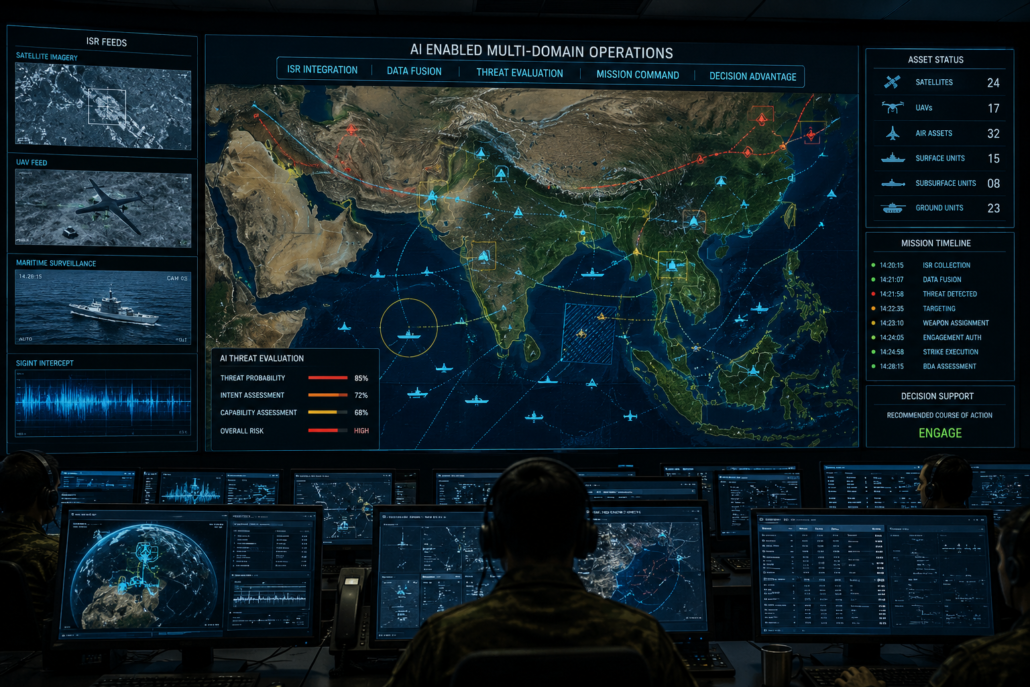
- The character of warfare is undergoing a profound transformation, driven not merely by the introduction of new platforms or weapons, but by the emergence of data as the central element of combat power. Modern battlefields are increasingly saturated with sensors, ranging from satellites and unmanned aerial systems, to electronic intelligence platforms and open-source data streams, producing volumes of information that far exceed human capacity to process in real time. In this environment, the decisive advantage no longer lies solely in possessing superior platforms, but in the ability to rapidly ingest, fuse, interpret, and act upon data. Artificial Intelligence (AI) has emerged as the critical enabler of this transformation.
- At its core, AI is reshaping warfare by compressing the traditional “kill chain”, the sequence of steps from detection and identification of a target to engagement and assessment. Historically, this process has been labour-intensive and time-consuming, requiring multiple layers of human analysis and coordination. However, AI-enabled systems are increasingly capable of automating key stages of this chain, particularly in intelligence, surveillance, and reconnaissance (ISR), threat evaluation, and target prioritisation. The result is a shift from deliberative, human-paced decision-making to near real-time, algorithmically assisted operations.
- This transformation is underway as we speak. Contemporary conflicts, particularly in Ukraine and across the Middle East, provide clear evidence of how AI and autonomy are altering the conduct of warfare. In Ukraine, the widespread use of unmanned systems ranging from inexpensive first-person-view (FPV) drones to more sophisticated loitering munitions has demonstrated the growing importance of scalable, data-driven targeting. Similarly, Iran’s deployment of systems such as the Shahed-series drones, and Russia’s adaptation of these platforms into the Geran series, illustrate how relatively low-cost systems can achieve strategic impact when combined with persistent ISR and coordinated targeting. To Read More: CLICK HERE


Leave a Reply
Want to join the discussion?Feel free to contribute!