
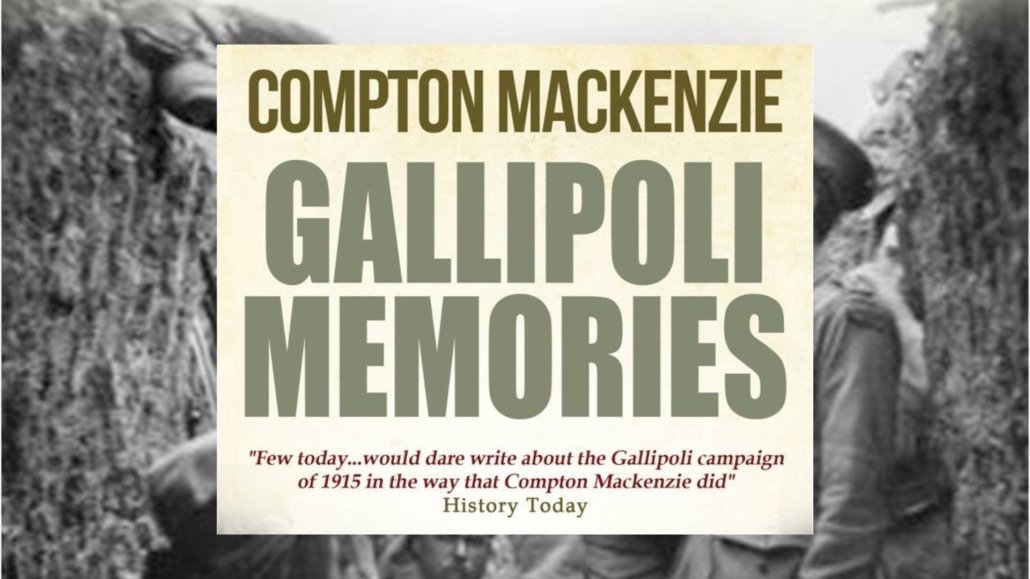
Compton Mackenzie.
Panther Books (London), 1965. 315 pages, ISBN: 9781846649616 (Paperback)
“One is so apt nowadays to regard even one’s own motives and actions during the War with a contemptuous cynicism that it is as well to remind oneself of emotions which were profoundly and sincerely felt.”
Compton Mackenzie
“Gallipoli Memories” is a book that hovers between archive and art. Compton Mackenzie, who was also a successful novelist when he joined the Royal Marines in 1915, spent most of the Dardanelles campaign working in Intelligence at Sir Ian Hamilton’s headquarters, and staying on the periphery of the battle. His forays to the front were periodic. This memoir recounts those months in 1915 through a multitude of lenses: the eye of a well-established storyteller, a curious staff officer, and the wounded loyalty of a man who still believed that the campaign could have changed the war.
The narrative opens with the beginning of World War I and the mobilisation of troops. Mackenzie, who truly wished to serve in the war, was deemed unfit due to his chronic sciatica. However, his literary talent caught the eye of Sir Ian Hamilton, and he was given a commission on his staff. From this point, the narrative moves chronologically: a troop ship voyage to Alexandria; the confusion about GHQ tents at Kephalo; in the Aegean, comic struggles with the bedding, uniform, and flies; the battle of Fourth June, viewed through binoculars from a shelter at a terrifyingly close range; the desperate months that follow; and, finally, the disastrous Suvla operation in August, during which Mackenzie sat up in his signals tent all night, waiting for news that never quite arrived. The culminating chapters delve into Mackenzie’s convalescence in Athens and his lingering conviction that the enterprise was doomed not because of a flawed strategy, but bungled politics. The book’s aims seem twofold: to defend the Gallipoli campaign from the blanket of condemnation that had formed against it, and to preserve what life was like behind the lines — the blunders, superstitions, jokes, and stupefying horrors that official histories flatten out.
The book has been written in a hybrid voice. The reader will find it almost classical-essayist in certain sections, and very mess table-style gossipy in others. Sheets of pastoral descriptions — poppies bright as the redcoat battalions on Achi Baba and moonlight frosting the harbours at Mudros — sit next to comic set pieces. The dominant tone is sardonic affection. Mackenzie is acerbic about pomposity but does value gallantry. Certain points turn incandescently serious. For instance, Mackenzie records stepping in what he believed to be mud only to later realise that it was, in fact, the decomposing, severed head of a Turkish soldier. The switches from mess-room anecdotes to existential horrors are brutally swift, almost imitating the vertigo effect of the campaign itself.
The memoir unfolds in long, loosely stitched chapters. Descriptions of frantic hours of telegraphy, waiting for orders and for ships, abound before digressing into mini essays on the acoustics of naval gunfire, the Australian physique, the whine of shells, etcetera. However, all these descriptions and digressions lead back to the question of why Gallipoli failed. The argumentative spine appears gradually and almost stealthily towards the end. There are a whole slew of reasons and excuses that Mackenzie starts dispensing. For instance, he believes that had there been better support and supply of guns, shells, and moral backing from London, the peninsula could have been tamed. Indeed, in his opinion, the Suvla campaign failed not because it was impossible, but because the IX Corps commander, “let his men bathe when by an effort the peninsula might have been straddled.” This very amalgamation of memoir and apologia is the signature move of the book.
The fact that Mackenzie is an established author is quite evident. The official documents recording history remain flat, but his memoir contains a multiplicity of textures. The details with which the events have been recorded anchor themselves in one’s sensory memory. Accurate descriptions of the pitch of a Taube’s falling bomb, or the solidarity found within the chorus of frogs around GHQ, for instance, add the lived-in quality.
Mackenzie remains loyal to Hamilton but does not whitewash the headquarters. He describes in detail how the officers cracked under the pervasive heat and boredom, how optimism transformed into pettiness, and how men clung to gossip to avoid the contemplation of failure. To highlight how despair had begun to seep in, Mackenzie offers the reader a phrase that crossed his mind: “we have lost our amateur status tonight.”
Mackenzie’s text is interspersed with Victorian-style verses and Homeric similes. The contrast between his inherited Edwardian grandeur and the squalid trench outskirts is quite riveting. The classical and imperial mental world that the author had taken residence in was vanishing, and its elements were being used to describe something that was devastating.
The book, with its detailed descriptions, offers itself as a gold mine on the hinterland of Gallipoli: censorship, code-work, inter-ally friction, the Greek islands filling up with refugees and suspected spies, and the micro-politics between them. Entire subplots on the pursuit of the phantom Müller gang rarely appear elsewhere.
Mackenzie simply refrains from entertaining the idea that the entire enterprise was misconceived. He was writing the book as though he were still fighting against the London press of 1915. Journalists, civilians, and a band of timid generals, all come under his fire and are blamed. Detached, flatter accounts may need to be consulted simply to supply a balance.
The book contains moments of sketch-comedy stereotypes of Levantine cunning. Further, the readers of the present day might struggle with the dense classical diction that addresses Virgil, Homer, and Lewis Carroll, and the presence of quotations in Greek or Latin. All these elements mark Mackenzie as a man of his era and community. One may read around them, of course, but they remain.
All in all, “Gallipoli Memories” offers what no strategic study can: a human temperature of the campaign. One look at the official documents, recordings, and videos suffice to inform the reader that Gallipoli has been narrated as a saga of topographical traps mixed with mistimed landings. Within this, however, Mackenzie restores all the gossip, the stubborn idealism that was present before the campaign and continued to linger even after its failure, and, of course, the queasy humour. The book demonstrates that Edwardian confidence was not destroyed immediately by the war and that the pockets of belief survived, and their gradual disillusionment is one of the keys to the mood that gripped post-war Britain.
The book also holds significance for naval historians, highlighting the complexities that go into naval operations, dynamics, and logistics. Mackenzie’s keen eye allows for a detailed description of how trawlers were repurposed and how auxiliary craft kept crucial supply lines running even under fire. He also brings to the fore the sheer difficulty of conducting amphibious assaults as ground troops and naval forces, generals and admirals struggle to synchronise with each other.
The book also offers a mix of entertainment and gravitas. The reader will laugh at his impersonations of a staff colonel and then, forty pages later, be forced to confront a corpse-strewn ravine. And in the end, this very oscillation between comedy and horror is the rhythm of memory. They refuse to separate in the mind. The book is certainly not a definitive history, nor does it try to be one. It is one densely textured witness of an act. It is partisan and exasperating at times, but unquestionably alive. Read alongside sober strategies and official records, the work shows not only what happened at Gallipoli but how it also felt, sounded, and smelt to those who lived through this event.
This volume endures as a significant portrait of the campaign.
******
About the Reviewer
Ms Sonali Talreja is a Research Intern at the National Maritime Foundation. She holds a Master’s in English from St Xavier’s College, Ahmedabad and a second post graduate degree in International Relations from OP Jindal Global University. She can be reached at sonali.tal98@gmail.com.

 https://pragyata.com/
Leave a Reply
Want to join the discussion?Feel free to contribute!