
CHINA IS WELL ON THE PATH TOWARDS A NUCLEAR-POWERED AIRCRAFT CARRIER
Rear Admiral Monty Khanna (Retd) – Issue No 3 dated 15 Jan 2025
China’s third aircraft carrier, Fujian returned from her sixth round of sea trials on 07 Jan 2025. While much has changed on her when compared to her predecessors insofar as aviation capabilities are concerned, her propulsion system is largely a replication of that on the Liaoning and Shandong, with possibly a few iterative improvements. There has been considerable speculation about the configuration of China’s next aircraft carrier, more so as no photographs of its construction have been posted by open sources as yet.
A reliable harbinger of what China’s future aircraft carriers are likely to look like is developments that take place at the Ship Integration Facility of the China Ship Design and Research Center located at Wuhan.
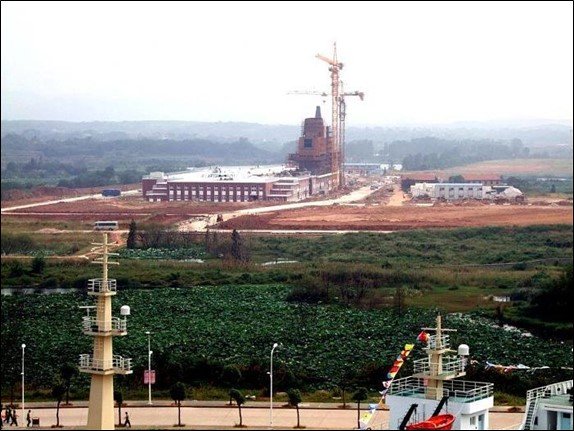
Full-Scale Mock-Up of Liaoning Under Construction at Wuhan
The facility primarily comprises of a 1:1 scale model of China’s first aircraft carrier Liaoning. Construction of the full-scale mock-up commenced in early 2008 and completed in late 2009. This was done so as to dovetail with the progress of work on the Liaoning (Ex -Varyag) which commenced her modernization at Dalian shipyard in 2005.
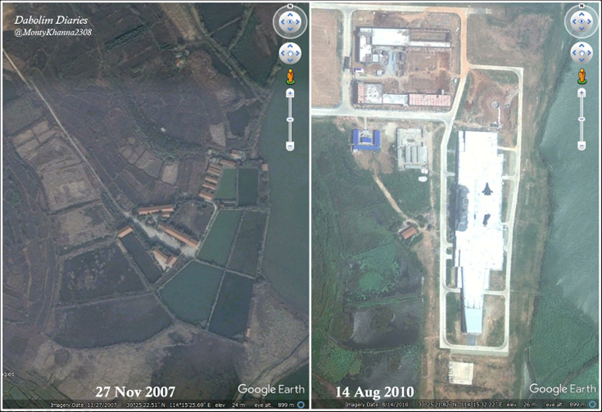
Google Earth Imagery of the Mock-Up Site Before and After Construction
The full-scale mock-up is a unique way of derisking the integration of sensors and systems in aircraft carrier construction. It also assists in optimally configuring the layout of aviation associated systems. This is evident from the different models of aircraft that are frequently seen on its deck.
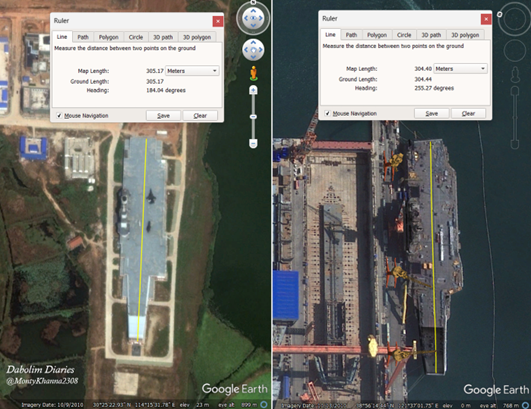
The near identicalness in the dimensions and layout of the full-scale mock-up with the Liaoning is evident from the images below, both of which are of 2010 vintage. Two prominent aspects in this respect are the ski-jump at the bows and the island structure on the starboard.
Google Earth Images of Mock-Up (09 Oct 2010) and Liaoning (13 Oct 2010)
Of particular interest is the dimensions and layout of the island structure with its associated mast. This houses the sensors as well incorporates the command platforms i.e. the Bridge and Flyco. In the case of the Liaoning, the island structure is fitted with the first variant of the Dragon Eye radar (346) with its characteristic four curved panels, each mounted at cardinal points of the island.
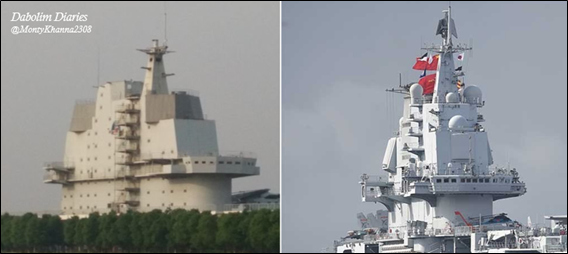
Liaoning Island Mock-Up (Left) and Actual (Right)
The island is 70 m long. Both the structures i.e. the full-scale mock-up and the actual vessel have identical dimensions as shown below.
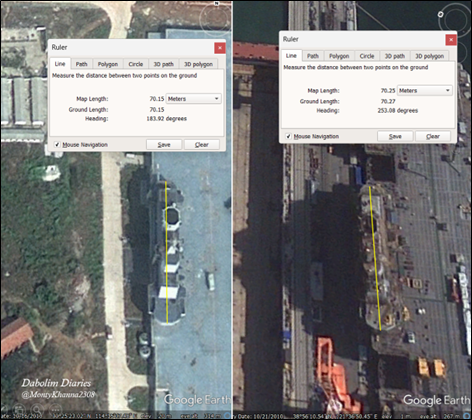
Google Earth Images Showing Length of Liaoning Island Mock-Up (Left) and Actual (Right)
Steel cutting of China’s second carrier, the Shandong commenced on 28 August 2013 with the keel being laid on 10 March 2015 at Dalian Shipyard. While her hull dimensions remained identical to that of the Liaoning, considerable changes were made to the size and layout of the island as well as to her sensor fit. An early indication of these changes came with modifications made to the full-scale mock-up. The replacement of the 346 Dragon Eye radar by its improved variant, the 346A as well as the placement of its flat panels at inter-cardinal points of the island are evident in the changed configuration of the full-scale mockup.
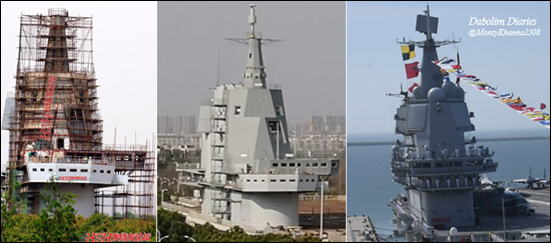
Island of Mock-Up Being Modified (Left), Completed (Center), Actual on Shandong (Right)
From images of changes to the full-scale mock-up (above), it is seen that while the configuration of the mast and the sensors on the island were changed to that of the Shandong, the structure of the island itself and the layout of the command platforms moved a step further ahead to replicate China’s third aircraft carrier, the Fujian. This may have been done as the length of the island on both the aircraft carriers i.e. Shandong and Fujian, is similar at approximately 60 m.
In 2018, fresh rounds of iterations commenced on the full-scale mockup. This was done in two phases. In the first, the ski-jump was entirely dismantled and replaced with a flat deck consistent with a CATOBAR aircraft carrier.
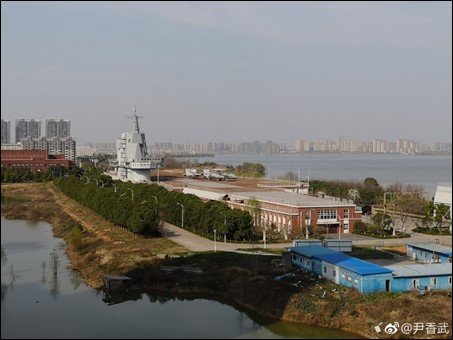
Ski Jump of Full-Scale Mock-Up Dismantled
In the second phase, the structure of the mast was changed with new arrays being added to replicate what was to come on the Fujian.
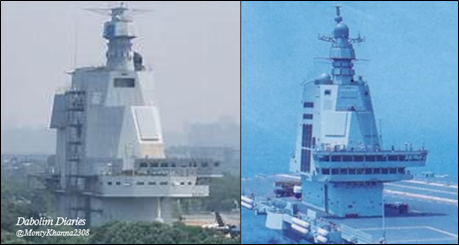
Fujian Island Mock-Up (Left) and Actual (Right)
The staged modifications of the island of the full-scale mockup as a precursor to construction of the aircraft carriers themselves is clearly evident in the set of photographs below.
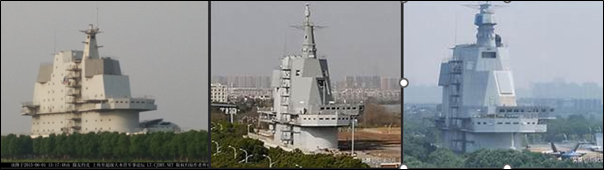
Mock-Up of Island of Liaoning (Left), Shandong (Center), Fujian (Right)
After several years of inactivity, major changes are underway once again at the full-scale mockup. As per photographs posted on social media on 01 Jan 2025, the entire island has been dismantled and is being shifted to the aft of the flight deck.
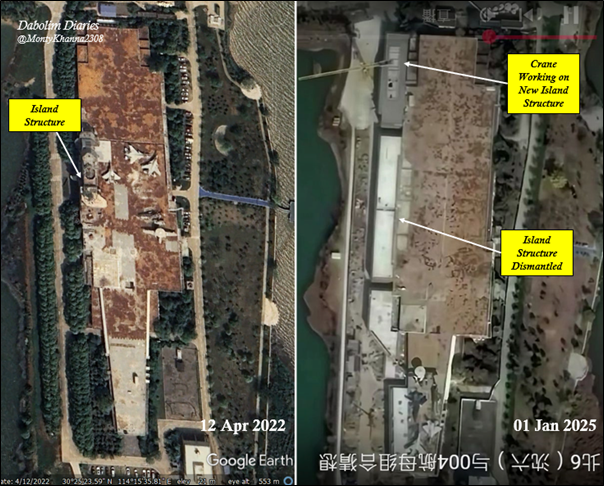
Imagery of the Mock-Up dated 12 Apr 2022 (Left) and 01 Jan 2025 (Right)
One of the major considerations of sighting the island of an aircraft carrier is the facilitation of unimpeded aircraft operations. On the USS Ford for instance, the island has been shifted further aft of the location it had on the Nimitz class. The new location allows far greater parking space for aircraft ahead of the island while minimising the space astern. This is an advantage as if an aircraft had to be moved from aft of the island to ahead of it or vice versa, landing operations on the angled flight deck have to stop. The concomitant disadvantage of bridge watchkeepers having a large blind zone ahead of the ship has been addressed by placement of lookouts near the bows as well as by using modern day EO/IR pods.
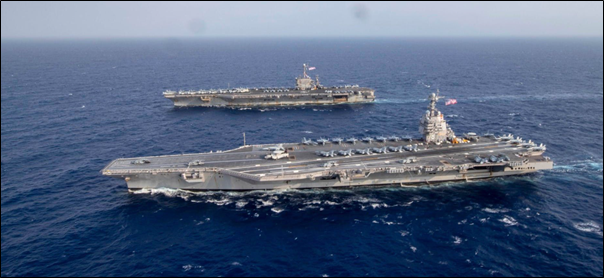
USS Ford (Foreground) with a Nimitz Class Aircraft Carrier (Background)
Such flexibility in the placement of the island is not available to conventionally powered aircraft carriers as the island also houses the funnel for locating up-takes and down-takes that cater for the voluminous amount of air required to power hydrocarbon-based fuel burning engines; be they boilers or gas turbines. These passages are required to be short to cater for efficiency and minimise the use of internal volume. Further, machinery spaces at the bowels of the ship are typically spread over two or more sections in a central position of the hull so as to ensure flooding or damage of any one section does not result in a catastrophic failure of the entire propulsion system. As a consequence, the island perforce has to be located close to the midships position or may even be split into a twin-island configuration as done in the Royal Navy’s Queen Elizabeth Class aircraft carriers.
Further confirmation of China’s move towards nuclear power for aircraft carriers will emerge once additional pictures of the island structure at the full-scale mock-up become available as the absence of a funnel will re-enforce the above inference.
Assessment. Nuclear powered aircraft carriers will give China the ability to project power well beyond the second island chain into the central Pacific as well as the Indian Ocean. It will also partially address the shortfall of bases that they currently have at distant locations by easing the quantum of logistical support required to sustain such operations. Continued investment in large aircraft carriers also tells us that in spite of rapid developments in Anti-Access Area-Denial (A2AD) capabilities such as Anti-Ship Ballistic Missiles (ASBMs), China assesses that these platforms will continue to play a significant role in times to come.


Leave a Reply
Want to join the discussion?Feel free to contribute!