
Keywords: TÜRKIYE–BANGLADESH, BAY OF BENGAL, SOUTH ASIA STRATEGIC ALIGNMENTS, INDIA–BANGLADESH RELATIONS, EMERGING REGIONAL BLOCS, GEOPOLITICAL REALIGNMENT
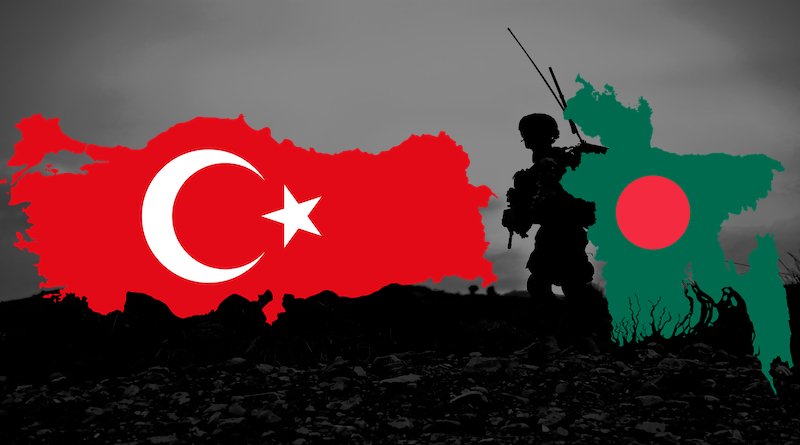
This policy paper examines the Türkiye–Bangladesh relationship through the lenses of defence cooperation, ideological affinity, and geopolitical alignment. It explores whether this engagement marks a temporary convergence based on political convenience, or whether it has the potential to evolve into a lasting strategic partnership. If the latter, Bangladesh could become Türkiye’s second strong ally in a region largely dominated by India, deepening Ankara’s South Asian presence and potentially reshaping regional dynamics.
The paper first traces the evolution of Türkiye–Bangladesh ties, then assesses the implications for India’s strategic and maritime interests in the Bay of Bengal and the wider Indian Ocean. It also considers whether a Türkiye–Pakistan–China–Bangladesh axis is emerging and what this might mean for India’s regional posture. Finally, it offers policy recommendations for India to manage this shifting landscape and prevent the consolidation of a potentially hostile bloc on its eastern flank.
Türkiye–Bangladesh Relations: From Historical Affinity to Strategic Engagement
Türkiye’s engagement with Bangladesh remains a relatively underexplored dimension of South Asian geopolitics, with limited academic or policy analyses in the public domain addressing the strategic implications of this growing relationship. The partnership gained wider attention when reports emerged that Bangladesh had released a controversial map of “Greater Bangladesh” that included Indian territory — allegedly backed by a Turkish NGO involved in local political activities.[1] This incident raised concerns in New Delhi and triggered broader questions about whether Bangladesh’s increasing closeness with Türkiye reflects a strategic shift and whether this development should be viewed as a potential challenge to India’s interests in the region.
The context of this evolving relationship is particularly significant. India–Bangladesh ties are currently strained, while Türkiye–India relations have deteriorated in recent years, especially after Ankara’s vocal support for Pakistan during Op SINDOOR. Against this backdrop, the Mohammad Yunus-led government in Dhaka has been accused of enabling the reemergence of Islamist political forces and creating conditions conducive to stronger Bangladesh-Türkiye ties.[2] This raises important questions: is the Yunus government positioning Bangladesh as Türkiye’s next key partner in South Asia — similar to Pakistan — or is this simply a case of diplomatic opportunism?
Although both countries now refer to “shared historical and cultural ties”, the relationship has a complex past. Türkiye’s long-standing support for Pakistan not only led it to back Pakistan —both politically and materially — during the 1971 Liberation War, but also contributed to its hesitation in recognising Bangladesh as an independent State.[3] It only recognised Bangladesh in 1974, during the Organisation of Islamic Cooperation (OIC) Summit held in Lahore.[4] Following this, formal diplomatic relations were established, marked by the opening of the Turkish embassy in Dhaka in 1976 and the Bangladeshi embassy in Ankara in 1981.[5] While the formative years of their bilateral relations were marked by cordiality and symbolic gestures, the depth and breadth of engagement remained limited, largely owing to Türkiye’s historically West-centric orientation of Ankara’s foreign policy. This gradually changed with the Justice and Development Party (AKP)’s rise to power in the early 2000s, and especially after the launch of the “Asia Anew” policy in 2019, which aimed to enhance Türkiye’s strategic visibility across the broader Asia-Pacific.
Despite their geographic distance, Türkiye and Bangladesh have long shared religious and cultural affinities, particularly those rooted in Islamic solidarity. These affinities were often reaffirmed through diplomatic support in international fora. During the 1970s and 1980s, for instance, Bangladesh supported Türkiye’s positions on contentious issues such as Cyprus, the delimitation of the continental shelf, and the Exclusive Economic Zone.[6] Such gestures demonstrated Dhaka’s willingness to endorse Türkiye’s geopolitical concerns, even in arenas beyond its immediate regional focus. Türkiye, for its part, invoked historical Islamic bonds and civilisational unity as a means to reinforce bilateral goodwill. This cultural affinity found expression in symbolic exchanges, including the naming of roads and public spaces in Dhaka and Ankara after Sheikh Mujibur Rahman, Ziaur Rahman, and Mustafa Kemal Atatürk, signifying mutual respect and recognition.[7]
Bilateral relations witnessed a notable acceleration from 2009 onwards.[8] This turning point corresponded with Ankara’s redefinition of its global diplomatic posture under the AKP’s assertive foreign policy vision. President Abdullah Gül’s visit to Bangladesh in 2010, and the subsequent visit by Prime Minister Recep Tayyip Erdoğan in November the same year — the first by a Turkish premier in 21 years — signalled a renewed commitment to strengthening ties.[9]
During these visits, agreements were signed in a range of sectors including health, tourism, education, customs cooperation, and investment protection. The establishment of the Turkey–Bangladesh Business Council and growing activities by the Turkey–Bangladesh Chamber of Commerce and Industry (founded in 2007) became pivotal institutional mechanisms for promoting economic cooperation.[10] These initiatives also coincided with a visible expansion of Turkish soft-power instruments, such as development assistance and civil society outreach, particularly through the Turkish Cooperation and Coordination Agency (TİKA), which began implementing projects in Bangladesh in health, education, agriculture, and infrastructure.[11]
Defence and security cooperation between Türkiye and Bangladesh — discussed in detail in subsequent sections — also began to intensify during this period. Agreements on military training, equipment procurement, and technical exchange were signed, building upon an earlier 1981 defence cooperation agreement.[12] Defence ties further solidified after a 2008 protocol under which Türkiye committed to supply one military unit of Bangladesh annually with training and equipment support.[13] More recently, Bangladesh has emerged as a major importer of Turkish defence hardware, including drones, artillery systems, and possibly armoured vehicles and tanks.[14]
Yet, bilateral relations have not been without strain. The execution of top leaders of the Jamaat-e-Islami party in Bangladesh between 2013 and 2016 — following their conviction for war crimes committed during the 1971 Liberation War — drew strong condemnation from Ankara.[15] Erdoğan publicly expressed his disapproval, describing the judicial process as politically motivated and undemocratic. Türkiye even temporarily recalled its ambassador from Dhaka.[16] The incident marked the lowest point in the bilateral relationship in the post-2000 era.
Nevertheless, this period of diplomatic chill was short lived. Following the attempted coup in Türkiye on 15 July 2016, Bangladesh was among the first countries to extend support to the Erdoğan government, with Prime Minister Sheikh Hasina unequivocally condemning the coup and affirming her support for the democratically elected government.[17] This gesture proved critical in resetting the tone of bilateral engagement. Türkiye, in turn, reciprocated with renewed diplomatic outreach, appointing a new ambassador and expressing its intent to rebuild and deepen relations.[18]
Türkiye–Bangladesh ties gained momentum through high-level visits and humanitarian cooperation during the Rohingya crisis, including aid pledges and hospital support by Turkish leaders.[19] This goodwill was followed by structured political consultations, trade missions, and diplomatic engagements. In 2019 and 2020, foreign ministers from both sides met in Ankara and Dhaka, with President Erdoğan proposing a $3 billion trade target and support for a friendship hospital.[20] During his visit to Dhaka in December 2020, Turkish Foreign Minister Mevlüt Çavuşoğlu described Bangladesh as “the rising star of Asia,” affirming Türkiye’s commitment to deepen engagement across multiple domains.[21]
As of 2025, Türkiye–Bangladesh relations appear to have reached a new zenith — propelled by the strategic coherence of Türkiye’s “Asia Anew” initiative and Bangladesh’s openness to diversifying its partnerships beyond traditional players. Notably, the deepening of ties coincides with a fluid political environment in Dhaka, following the fall of the Sheikh Hasina government. While the political transition introduces a degree of uncertainty, it also presents opportunities for Türkiye to recalibrate its engagement with new stakeholders in Bangladesh’s evolving political landscape.
However, these increasingly close ties have not gone unnoticed by regional stakeholders. The growing influence of Turkish-affiliated NGOs and civil society actors in Bangladesh, particularly in the context of rising political Islam, has drawn scrutiny from New Delhi. Indian authorities have flagged concerns over ideological narratives linked to Türkiye’s outreach, including the activities of groups like “Saltanat e Bangla”, which reportedly advocates a vision of a “Greater Bangladesh” encompassing parts of India’s northeast and Myanmar.[22] Although such views are not endorsed by either Ankara or Dhaka, they have added an element of ideological unease to an otherwise pragmatic bilateral engagement. Consequently, India has taken measures to limit the operational scope of Turkish entities in Bangladesh, particularly in sectors deemed sensitive to national security.
Türkiye–Bangladesh Defence Convergence: Strategic Evolution and Industrial Deepening
In recent years, Türkiye and Bangladesh have markedly intensified their defence and security cooperation, transitioning from a transactional arms trade relationship to a comprehensive and strategically significant partnership. Anchored in Bangladesh’s broader Forces Goal 2030 military modernisation agenda, this evolving alliance reflects Dhaka’s ambition to reduce dependency on traditional suppliers and build indigenous defence-industrial capabilities.[23] For Ankara, the partnership aligns with its “Asia Anew” initiative, expanding its strategic footprint in South Asia and the Indian Ocean region.
At the centre of this defence convergence is Bangladesh’s procurement of key Turkish platforms, notably Bayraktar TB2 drones, TRG-300 multiple rocket launchers, MKE Boran howitzers, and the expected acquisition of Tulpar light tanks.[24] These systems are bolstering Dhaka’s tactical and operational capabilities while introducing NATO-standard interoperability into its armed forces. Operational deployment of Turkish-made drones along Bangladesh’s borders — particularly areas adjacent to India — has been noted, although Dhaka maintains that these are routine surveillance operations.[25] These acquisitions are closely aligned with Bangladesh’s pursuit of modernisation and technological sophistication under Forces Goal 2030.
This defence convergence, however, is not a recent development but builds upon decades of institutional cooperation. The genesis of formal military ties dates back to 1978, when Bangladesh President Ziaur Rahman visited Türkiye, setting in motion technical discussions that led to the 1981 Military Training Cooperation Agreement.[26] This agreement facilitated exchanges in military education and training, and Turkish naval special forces began training Bangladesh Navy’s elite SWADS units in areas such as special warfare diving and salvage operations.[27] Over time, a number of Bangladesh Army officers also began receiving training at Türkiye’s military academies, deepening personnel-level interoperability.
Türkiye’s role in Bangladesh’s defence transformation expanded notably after 2013, when the Bangladesh Army procured Otokar Cobra light armoured vehicles.[28] This was followed by a major Government-to-Government (G2G) contract in 2015 in which Türkiye offered guided missile frigates to Bangladesh.[29] In 2017, a US$1 billion order for 680 light armoured vehicles was placed with Turkish firm Delta Defence.[30] A landmark agreement was signed in March 2019 between Bangladesh and ROKETSAN for multiple regiments of the TRG-300 Kaplan medium-range rocket system, further enhancing Bangladesh’s artillery capabilities.[31] This was followed in June 2021 by in-country training for 41 Bangladeshi military personnel on the system.[32]
Beyond procurement, the bilateral relationship has expanded into joint production and industrial cooperation. A 2021 MoU facilitated the establishment of a production line for 105mm and 155mm artillery shells at the Bangladesh Ordnance Factories in collaboration with Turkish firm REPKON.[33] Further institutional cooperation is unfolding through efforts to establish defence-industrial zones in Chittagong and Narayanganj, guided by high-level engagements and site assessments.[34] Turkish defence firms including MKE, ASFAT, and STM are involved in ongoing discussions, supported by the Bangladesh Investment Development Authority (BIDA).[35] These efforts are being formalised through anticipated memoranda of understanding and the formation of a bilateral Defence Industrial Working Group.
Türkiye’s support has also extended to repair and logistics support. Following the 2020 Beirut port explosion, Ankara assisted in repairing Bangladesh Navy ships damaged in the blast.[36] Additionally, Türkiye’s naval design influence has been visible in Bangladesh’s defence procurement — such as the 2021 order for three dive support boats from Khulna Shipyard based on Turkish blueprints.[37]
Naval and aerospace collaboration has also seen significant progress. In May 2024, the Turkish naval corvette TCG Kınalıada (F 514) made a goodwill visit to Chattogram Port, marking 50 years of diplomatic relations and signalling greater maritime engagement.[38] In April 2025, Foreign Affairs Adviser Md Touhid Hossain met with Turkish Aerospace CEO, Mehmet Demiroğlu, at the Antalya Diplomacy Forum to explore cooperation in aviation investment, technology transfer, and human resource development.[39] A Turkish delegation is expected to visit Bangladesh to advance this dialogue, further diversifying the scope of bilateral defence cooperation.
Security collaboration, too, has advanced. A comprehensive MoU signed on 08 January 2022 institutionalised cooperation on counterterrorism, cybercrime, anti-narcotics operations, and intelligence sharing.[40] This includes capacity-building for Bangladesh’s police, border guards, coast guard, and paramilitary forces. Türkiye has also extended humanitarian and technical support for Rohingya repatriation efforts, including the reopening of its field hospital at Bhasan Char.[41]
Taken together, these developments illustrate a deepening, multidimensional Türkiye–Bangladesh strategic partnership — one rooted in defence-industrial cooperation, capability enhancement, and institutional trust. As this trajectory continues, it signals a deliberate shift in Dhaka’s strategic calculus towards greater diversification and autonomy in defence affairs, with Türkiye positioned not merely as a supplier, but as a long-term collaborator in Bangladesh’s evolving security landscape.
The Türkiye–Pakistan–China Nexus and Bangladesh’s Tilt
Türkiye has rapidly emerged as a principal defence partner for Bangladesh, especially since 2021, as Dhaka recalibrates its foreign and security policy under the Forces Goal 2030 framework.[42] From advanced rocket launchers and howitzers to Bayraktar drones and potentially Tulpar light tanks, Bangladesh has inducted at least 15 categories of Turkish military equipment, positioning itself as the fourth-largest importer of Turkish defence products in early 2021.[43] In parallel, high-level defence visits between the two sides — including trips by all three Bangladeshi service chiefs to Türkiye and naval goodwill visits by Turkish vessels — have reinforced operational familiarity and institutional trust.[44] Turkish defence firms such as ROKETSAN, REPKON, ASFAT, and STM are now embedded in Bangladesh’s defence-industrial ecosystem through joint production, site development, and technology transfer.
Alongside this Turkish footprint, Pakistan has re-entered the Bangladeshi defence landscape in a development that would have been considered politically untenable just a few years ago. In a landmark agreement signed in late 2024, the Pakistani Army was invited to train Bangladeshi military personnel, with the programme commencing in February 2025.[45] This is the first time since Bangladesh’s liberation war that Pakistani forces are officially present in any capacity on Bangladeshi soil. This arrangement is widely viewed as having been brokered in part by Ankara and represents a significant breach in the historical firewall that had existed between Dhaka and Islamabad. Pakistan’s return is not only symbolic of changing attitudes within Bangladesh’s military-political establishment but also indicative of the subtle trilateral alignment between Pakistan, Türkiye, and Bangladesh. Türkiye’s longstanding strategic embrace of Pakistan — reflected in defence collaboration and ideological commonalities — provides a diplomatic bridge that facilitates this rapprochement.
Meanwhile, Bangladesh’s economic realignment is also accelerating. Türkiye, already Bangladesh’s second-largest South Asian trading partner after India, is pushing to capitalise upon Dhaka’s shifting preferences.[46] Although a proposed Free Trade Agreement was stalled due to EU objections over Türkiye’s Customs Union, Ankara has publicly stated that it is prepared to “replace India” in Bangladesh’s import market — especially in strategic sectors like aviation, defence, ordnance, and electronics.[47] This economic convergence comes against the backdrop of deteriorating India–Bangladesh trade relations. In May 2025, India imposed sweeping restrictions on Bangladeshi exports at 11 land ports, rerouting ready-made garments, processed foods, plastics, and other goods to seaports like Kolkata and Nhava Sheva.[48] A month later, similar restrictions were imposed on jute products.[49] While New Delhi framed these moves as reciprocal trade enforcement, many analysts see them as strategic countermeasures in response to Dhaka’s growing proximity to adversarial states.
The rupture extends into the political and security realms as well. Since Prime Minister Sheikh Hasina’s departure in August 2024, the interim government led by Muhammad Yunus has undertaken overt diplomatic realignment, with senior visits to Beijing and renewed security cooperation with Islamabad. Yunus’s reference to Bangladesh as the “guardian of the ocean” for India’s Northeast, especially in the context of the Siliguri Corridor, has provoked deep anxiety in Delhi.[50] India fears that access to and influence over the corridor — the so-called “chicken’s neck” connecting India’s northeastern states to the rest of India — could now be subjected to competing claims or leverage. Security challenges, too, are multiplying. Rising illegal migration, transborder extremist movement, and reports of ideological radicalisation linked to external actors, have heightened India’s perception of internal vulnerability.
The evolving geopolitical realignment in South Asia — marked by Bangladesh’s intensifying defence and economic engagement with Türkiye, its re-engagement with Pakistan, and expanding cooperation with China — has triggered mounting concerns in New Delhi. Once seen as India’s closest regional partner, Bangladesh is now becoming the focal point of a strategic axis that potentially excludes and challenges India’s traditional position in its eastern flank. This shift is not simply symbolic; it is structural, and it is unfolding across military, economic, and diplomatic domains. While the formation of a formal Türkiye–Pakistan–China–Bangladesh quadrilateral alliance remains an unlikely near-term development, the growing convergence among these actors in defence, trade, and ideology points towards a latent strategic bloc that could marginalise India in its own neighbourhood. Ankara and Islamabad — both of which openly oppose India’s position on Kashmir and frequently invoke pan-Islamic solidarity — have found in Dhaka a willing partner under its current leadership. China’s parallel role as an economic investor and defence collaborator completes the circle. For India, this emerging alignment poses a multidimensional challenge: not only is its eastern flank increasingly slipping from its sphere of influence, but the presence of competing powers in close proximity — both physically and ideologically — threatens to complicate its strategic calculus in South Asia and the Indian Ocean region.
Way Forward: Recommendations for India
- Recalibrate Bilateral Engagement with Bangladesh. India must initiate a calibrated political reset with Dhaka, avoiding overt pressure while discreetly re-engaging key stakeholders across the Bangladeshi political spectrum. While the interim government led by Muhammad Yunus may be ideologically distant, long-term stability in bilateral relations depends on depoliticising engagement and maintaining continuity beyond individual regimes. This includes reopening Track-II dialogues, backchannel diplomacy, and issue-specific working groups on trade, water-sharing, and counterterrorism.
- Expand and Modernise Defence Cooperation. India must revitalise its defence cooperation with Bangladesh, perhaps through an offer of joint production, training exchanges, and high-end technology transfers, particularly in the naval and aerospace domains. Rather than viewing Türkiye’s involvement as a zero-sum game, India must offer alternatives that are attractive on both economic and operational grounds — such as co-developing naval platforms or providing scholarships at Indian defence institutions. A revival of bilateral defence dialogues, last held in 2023, should be prioritised.[51]
- Strengthen Border Infrastructure and Surveillance Capabilities. Given the potential for cross-border spillovers from Pakistani-trained elements or surveillance via Turkish drones, India should urgently enhance its security along its eastern frontier. This includes expanding UAV fleets, real-time satellite surveillance, integrated border management systems, and deepening intelligence cooperation with Bangladesh’s security apparatus to prevent third-party manipulation or infiltration.
- Revitalise Soft Power and Counter Ideological Narratives. India should boost its soft-power presence in Bangladesh through cultural outreach, academic exchanges, and civil society partnerships that highlight shared history and regional stability. At the same time, it must monitor Turkish-linked ideological networks, track their funding, and deploy counter-narratives via digital platforms and civil society, backed by stronger cyber surveillance and threat assessment.
- Cultivate Countervailing Regional Partnerships. In response to the emerging Türkiye–Pakistan–China–Bangladesh axis, India should intensify cooperation with other Indian Ocean and Bay of Bengal states such as Sri Lanka, the Maldives, and Mauritius. Strengthening BIMSTEC and IORA frameworks — especially on maritime security and economic connectivity — would dilute the influence of any exclusive grouping emerging around Bangladesh.
Conclusion
Bangladesh’s evolving defence and foreign policy trajectory — marked by deepening ties with Türkiye, renewed engagement with Pakistan, and a growing economic embrace of China — signals a significant realignment in South Asia’s strategic landscape. Once a steadfast partner of New Delhi, Dhaka is increasingly asserting its strategic autonomy by diversifying partnerships and pursuing alternative security and economic arrangements.
For India, this reorientation presents a multi-layered strategic dilemma. Türkiye’s rising presence in Bangladesh’s defence-industrial sphere, its ideological inroads through NGOs, and its symbolic naval outreach in the Bay of Bengal challenge India’s long-standing maritime and regional influence. The re-entry of Pakistan into Bangladesh’s military domain — facilitated by Ankara — raises the prospect of revived hostilities and destabilisation along India’s eastern borders. China’s continued infrastructural and financial entrenchment in Bangladesh further intensifies the competitive environment, especially as India grapples with strategic encirclement on multiple fronts.
Yet even amid this shifting equation, it is imperative that Dhaka recognises the enduring realities of geography and interdependence. Surrounded by India on three sides and historically enmeshed in shared economic, cultural, and ecological systems, Bangladesh cannot afford to completely alienate or adopt an overtly adversarial posture towards India. Despite recent tensions, the two countries have been among each other’s largest trading partners in key sectors, and continued diplomatic engagement remains essential to mutual stability and prosperity.
At the same time, India must avoid reactive or coercive approaches that could further alienate Dhaka. While India holds clear strategic and economic advantages, adopting a condescending or an overtly punitive posture would be counterproductive. The Muhammad Yunus-led government is an interim arrangement, and India must look beyond immediate provocations to invest in long-term strategic gains. Reinvigorating soft diplomacy, rebuilding trust, and addressing misperceptions — particularly among the Bangladeshi public — are vital steps towards reshaping the narrative and restoring influence.
Although the strategic embrace of Türkiye by Bangladesh may seem, prima facie, to be a temporary alignment driven by short-term political shifts, a deeper analysis suggests that it is part of Türkiye’s broader Asia Anew initiative — an effort aimed at deepening influence across Muslim-majority states in Asia. The current political flux in Bangladesh has merely served as the icing on the cake, accelerating Ankara’s outreach. However, unlike the entrenched Türkiye–Pakistan strategic axis, the Türkiye–Bangladesh partnership is not yet irreversible. With historical ties, geographic proximity, and strong economic interdependence, India retains significant leverage. If approached with patience, pragmatism, and careful diplomacy, New Delhi still has the opportunity to recalibrate the relationship and reassert its role as a stable and preferred partner in Dhaka’s strategic calculus.
******
About the Author
Ms Aditi Thakur is a Research Associate at the National Maritime Foundation. She holds a Master’s degree in Political Science from Centre for Political Studies, Jawaharlal Nehru University, New Delhi. Her research primarily focuses upon the manner in which India’s own maritime geostrategies in the Indo-Pacific are impacted by those of Russia and Türkiye. She may be contacted at irms3.nmf@gmail.com.
Endnotes:
[1] Dipanjan Roy Chaudhury, “Turkey‑Backed Group in Bangladesh Circulates ‘Greater Bangladesh’ Map Showing Indian Territory,” Economic Times (India), 17 May 2025. https://economictimes.indiatimes.com/news/india/turkey-backed-group-in-bangladesh-circulates-greater-bangladesh-map-showing-indian-territory/articleshow/121240059.cms?from=mdr
[2] Mujib Mashal and Saif Hasnat, “As Bangladesh’s Politics Lurch Right, Islamists Find an Opening,” The New York Times, 3 April 2025. https://www.nytimes.com/2025/04/01/world/asia/bangladesh-islam.html
[3] Selçuk Çolakoğlu, “Turkey–Bangladesh Relations: A Growing Partnership between Two Friendly Nations,” Middle East Institute, 25 June 2019. https://www.mei.edu/publications/turkey-bangladesh-relations-growing-partnership-between-two-friendly-nations
[4] Republic of Türkiye, Ministry of Foreign Affairs, “Türkiye–Bangladesh Relations,” last accessed 29 June 2025. https://www.mfa.gov.tr/turkiye%E2%80%93bangladesh-relations.en.mfa
[5] Republic of Türkiye, Ministry of Foreign Affairs, “Türkiye–Bangladesh Relations.”
[6] Afzalur Rahman, Bilateral and Regional Dimensions of the Relations Between Turkey and Bangladesh (Master’s thesis, Middle East Technical University, 2022). https://open.metu.edu.tr/handle/11511/96694
[7] Rahman, Turkey and Bangladesh Relations, 2022.
[8] Gürol Baba, “The Waves of Turkey’s Proactive Foreign Policy Hitting South-Asian Coasts: Turkey-Bangladesh Relations,” Yönetim Bilimleri Dergisi / Journal of Administrative Sciences 15, No 30 (2017): 573–584. https://www.researchgate.net/publication/339137102_The_Waves_of_Turkey%27s_Proactive_Foreign_Policy_Hitting_South-Asian_Coasts_Turkey-Bangladesh_Relations
[9] Baba, “Turkey’s Proactive Foreign Policy,” 2017.
[10] Baba, “Turkey’s Proactive Foreign Policy,” 2017.
[11] Baba, “Turkey’s Proactive Foreign Policy,” 2017.
[12] Rahman, Turkey and Bangladesh Relations, 2022.
[13] Rahman, Turkey and Bangladesh Relations, 2022.
[14] “Bangladesh’s Strategic Leap with Türkiye in Defence Industry.” BDMilitary, 1 June 2024. https://www.bdmilitary.com/defence-news/defence-industry/bangladeshs-strategic-leap-with-turkiye-in-defence-industry/1550/
[15] Baba, “Turkey’s Proactive Foreign Policy,” 2017.
[16] Çolakoğlu, “Turkey–Bangladesh Relations,” 2019.
[17] Çolakoğlu, “Turkey–Bangladesh Relations,” 2019.
[18] Çolakoğlu, “Turkey–Bangladesh Relations,” 2019.
[19] Faisal Mahmud, “Rohingya Crisis Brings Turkey and Bangladesh Closer,” Al Jazeera, 22 December 2017. https://www.aljazeera.com/news/2017/12/22/rohingya-crisis-brings-turkey-and-bangladesh-closer
[20] Ehteshamul Haque, “Asia Anew Initiative and Bangladesh-Türkiye Defense Ties: Implications in South Asian Geopolitics,” Asia Anew Initiative and Bangladesh-Türkiye Defense Ties 4 (2024): 39–50. https://www.researchgate.net/publication/384501408_Asia_Anew_Initiative_and_Bangladesh-Turkiye_Defense_Ties_Implications_in_South_Asian_Geopolitics
[21] Imran Hossain, “Turkish Foreign Minister: Bangladesh a Rising Star,” Dhaka Tribune, 23 December 2020. https://www.dhakatribune.com/bangladesh/234159/turkish-foreign-minister-bangladesh-a-rising-star
[22] Chaudhury, “Turkey Backed Group in Bangladesh.”
[23] Khandakar Tahmid Rejwan, “Revisiting Forces Goal 2030: Bangladesh’s Military Modernization Plan under the New Government,” The Diplomat, 6 December 2024. https://thediplomat.com/2024/12/revisiting-forces-goal-2030-bangladeshs-military-modernization-plan-under-the-new-government/
[24] Ujjal Roy, “Bangladesh-Turkey Defence Ties Deepen: Industrial Complex Raising Eyebrows in India,” The CSR Journal, 6 June 2025. https://thecsrjournal.in/bangladesh-turkey-defence-ties-deepen-industrial-complex-raising-eyebrows-india/
[25] “India Keeps Close Watch as Bangladesh Deploys Armed Turkish Bayraktar Drones near Border,” The Economic Times, 4 May 2025. https://economictimes.indiatimes.com/news/defence/india-keeps-close-watch-as-bangladesh-deploys-armed-turkish-bayraktar-drones-near-border/articleshow/118702817.cms
[26] Rahman, Turkey and Bangladesh Relations, 2022.
[27] Rahman, Turkey and Bangladesh Relations, 2022.
[28] Baba, “Turkey’s Proactive Foreign Policy,” 2017.
[29] Çolakoğlu, “Turkey–Bangladesh Relations,” 2019.
[30] Rahman, Turkey and Bangladesh Relations, 2022.
[31] “Bangladesh Starts Operating New Turkish-Made TRG-300 Kaplan MLRS.” Asia-Pacific Defense Journal, 23 June 2021. https://www.asiapacificdefensejournal.com/2021/06/bangladesh-starts-operating-new-turkish.html
[32] Rahman, Turkey and Bangladesh Relations, 2022.
[33] Rahman, Turkey and Bangladesh Relations, 2022.
[34] Chandan Nandy, “Bangladesh, Turkey Aim for Joint Defence Production Facilities in Chittagong and Narayanganj,” Northeast News, 30 May 2025. https://nenews.in/neighbours/bangladesh-turkey-aim-for-joint-defence-production-facilities-in-chittagong-and-narayanganj/26265/
[35] Nandy, “Bangladesh, Turkey Aim for Joint Defence Production.”
[36] Dilara Aslan, “Turkey to Repair Bangladeshi Naval Vessel Damaged in Beirut Blast,” Daily Sabah, 28 August 2020. https://www.dailysabah.com/politics/turkey-to-repair-bangladeshi-naval-vessel-damaged-in-beirut-blast/news
[37] Rahman, Turkey and Bangladesh Relations, 2022.
[38] Nurul Islam Hasib, “Turkish Ship Coming to Bangladesh to Increase Naval Cooperation,” Dhaka Tribune, 6 May 2024. https://www.dhakatribune.com/bangladesh/foreign-affairs/345773/turkish-ship-coming-to-bangladesh-to-increase
[39] “FA: Aerospace Cooperation Would Be Win-Win for Bangladesh, Türkiye,” Dhaka Tribune, 12 April 2025. https://www.dhakatribune.com/bangladesh/foreign-affairs/378491/fa-aerospace-cooperation-would-be-win-win-for
[40] Ozair Islam, “Bangladesh, Turkey Sign New Security and Counterterrorism Deal,” The Diplomat, 11 January 2022. https://thediplomat.com/2022/01/bangladesh-turkey-sign-new-security-and-counterterrorism-deal/
[41] “Bangladesh Not Alone While Dealing with Rohingya Crisis: Turkish Minister,” United News of Bangladesh, 8 January 2022. https://unb.com.bd/category/Bangladesh/bangladesh-not-alone-while-dealing-with-rohingya-crisis-turkish-minister/85510
[42] Rejwan, “Revisiting Forces Goal 2030.”
[43] SM Najmus Sakib, “Bangladesh Stepping Up Defense Ties with Turkey,” Anadolu Agency, 21 June 2021. https://www.aa.com.tr/en/asia-pacific/bangladesh-stepping-up-defense-ties-with-turkey/2280868
[44] Selçuk Çolakoğlu, “Turkey and Bangladesh: From the Rift of Jamaat-e-Islami to Defence Cooperation,” Manara Magazine, 8 December 2021. https://manaramagazine.org/2021/12/turkey-and-bangladesh-from-the-rift-of-jamaat-e-islami-to-defence-cooperation/
[45] Dipanjan Roy Chaudhury, “Pakistan Army Plans to Return to Bangladesh for the First Time since 1971,” Economic Times (India), 29 December 2024. https://economictimes.indiatimes.com/news/defence/pakistan-army-plans-to-return-to-bangladesh-for-the-first-time-since-1971/articleshow/116751122.cms
[46] Çolakoğlu, “Turkey–Bangladesh Relations,” 2019.
[47] Ashish Dangwal, “‘We Can Replace India’: Turkish Ministers Make Big Statement on Bangladesh as Dhaka-Ankara Ties Surge,” EurAsian Times, 11 January 2025. https://www.eurasiantimes.com/we-can-replace-india-turkish-ministers/
[48] “India’s Decision to Curb Bangladeshi Exports via Land Ports Aimed at Ensuring Fairness: Sources,” The Economic Times, 18 May 2025. https://economictimes.indiatimes.com/news/economy/foreign-trade/indias-decision-to-curb-bangladeshi-exports-via-land-ports-aimed-at-ensuring-fairness-sources/articleshow/121251139.cms
[49] Kallol Bhattacherjee, “India Imposes Land and Sea Port Restrictions on Jute from Bangladesh,” The Hindu, 28 June 2025. https://www.thehindu.com/news/national/india-imposes-land-and-sea-port-restrictions-on-jute-from-bangladesh/article69747448.ece
[50] “Seven States of India Are Landlocked: Yunus Invites China to Expand, Calls Bangladesh the Only Guardian of the Ocean,” Economic Times (India), 1 April 2025. https://economictimes.indiatimes.com/news/international/world-news/seven-states-of-india-are-landlocked-yunus-invites-china-to-expand-calls-bangladesh-the-only-guardian-of-the-ocean/articleshow/119813977.cms
[51] Government of India, Press Information Bureau, India & Bangladesh Hold the Fifth Annual Defence Dialogue in Dhaka, 28 August 2023. https://www.pib.gov.in/PressReleaseIframePage.aspx?PRID=1951716

 https://moderndiplomacy.eu/
Leave a Reply
Want to join the discussion?Feel free to contribute!