
The People’s Republic of China (PRC) is actively engaging with countries worldwide through varied activities such as trade, investments, infrastructure projects, diplomacy, military diplomacy, naval port calls and military exercises. Similar activities are being carried out by the PRC in the Indian Ocean Region (IOR) as well. However, the activities being undertaken by China in the IOR have a different connotation, since China, geographically speaking, is not a resident IOR country. A series of Chinese activities that have occurred in the IOR since 2009, when viewed through the lens of hindsight, indicate something interesting in respect of the PRC in the IOR.
This paper seeks to identify activities that the PRC has undertaken, and to and assess the impact that these have or may have.
2009
- Anti-Piracy Escort Force (APEF)
A PLA Navy anti-piracy escort force (APEF) comprising two destroyers and one tanker set sail on 26 December 2008 from Sanya to commence anti-piracy escort operations in the Gulf of Aden.[1] The first APEF commenced on 06 January 2009. Chinese naval destroyers joined a multinational constellation of naval vessels in cooperation with the Somali Transitional Federal Government to combat piracy.[2] Since then, these deployments have continued unabated, and presently, the 48th APEF is on task in the region.[3]
Commentary: China has been maintaining a continuous naval presence in the IOR for the past 17 years. Interestingly, this does not appear to have caused any significant alarm. Rather, the Chinese naval presence is increasingly being seen as a normal feature of the IOR. There even seems to be a degree of anticipation in terms of when the next APEF will make its appearance in the region. The fact that China is not a resident IOR power is being ignored. No incongruity appears to be being seen in the repeated deployment for anti-piracy escort duties, of these Chinese platforms, with their impressive firepower including long range anti-ship missiles and surface-to-air missiles. In the event of any hostilities breaking out in the IOR, these are the very platforms that are most likely to be the “first responders”. Thus, either by default or (very probably) by design, Chinese naval presence in the IOR has become normalised.
2010-11
- Allocation of Area for Polymetallic Sulphides in Indian Ocean
In May 2010, the “China Ocean Mineral Resources Research and Development Association” (COMRA) submitted an application to the International Seabed Authority (ISA) to explore a prospective polymetallic sulphide ore deposit in the Indian Ocean. The ISA Council approved the application in July of 2011, and COMRA was permitted to explore this seabed area measuring 10,000 sq km, located in the southwestern Indian Ocean.[4]
Subsequently, on 18 November 2011, COMRA signed a 15-year exploration contract with the ISA. The contract remains valid till 17 Nov 2026, with the area being located on the South-West Indian Ridge.[5] According to the terms of this contract, the Chinese association will have to give up 75 per cent of the ore deposit region within 10 years before enjoying possible rights of commercially mining the remaining 2,500-sq km. In accordance with the terms of the contract, the Chinese association will, of course, have to fulfil specified duties in terms of the conduct of environmental monitoring, environmental baseline research, and training scientific workers for other developing countries.[6]
Commentary: The allocation of this area to China is under the aegis of the ISA and is, as such, perfectly legal. However, this helps in justifying the deployment of Chinese Scientific Research Vessels (CSRVs) to the IOR. Hence, as and when these CSRVs enter IOR, they have ceased to raise any alarm, as their activities in this region have once again become legitimised and normalised.
2012
- Chinese Navy Statement at the Galle Dialogue
On 13 December 2012, Vice Admiral Su Zhiqian, Commander of the East China Sea Fleet under the Navy of the Chinese People’s Liberation Army (PLA), stated, “the peace and stability of the Indian Ocean bear upon that of the world. The freedom and safety of the navigation in the Indian Ocean play a very important role in the recovery and development of global economy and the Chinese navy will actively maintain the peace and stability of the Indian Ocean.” Su Zhiqian added, “… the Chinese navy is a staunch force in safeguarding world peace and an active advocate and implementer of the idea of constructing a ‘harmonious ocean’. China is expecting to carry out more extensive and in-depth maritime security cooperation with the navies of various countries through this ‘Galle Dialogue’ so as to make due contributions to and play an active role in maintaining the peace and stability of the Indian Ocean as well as the world at large.”[7]
Commentary: Considering that this statement was made in 2012, at which point in time the capability of the PLA Navy was far smaller than it presently is, this seems like a clear statement of intent on the part of China to embed itself into the architecture of the IOR.
2013
- Deployment of Chinese Submarine for Anti-Piracy to the IOR
Indian media reported that between December of 2013 and February of 2014, a Type-093 nuclear-propelled submarine of the Chines navy was on deployment in the Indian Ocean and that the Chinese Ministry of National Defence (Foreign Affairs Office) had informed the Indian military attaché in Beijing of the submarine deployment “to show respect for India.” Apparently, the information of the deployment was also shared with the United States, Singapore, Indonesia, Pakistan, and Russia.[8] Since 2013, Chinese submarines have been in the Indian Ocean, and they claim to be deployed for anti-piracy duties.[9]
Commentary: The logic of deployment of submarines for anti-piracy obviously does not hold much water. These deployments seem to be aimed at the Chinese submarines gaining operational experience in the region for any future combat situation.
- Belt and Road Initiative (BRI)
The “Belt and Road Initiative” (BRI) is China’s main international cooperation and economic strategy. The BRI is also known as the “One Belt One Road” (OBOR), the “Silk Road Economic Belt”, the “21st century Maritime Silk Road”, and is sometimes referred-to simply as the “New Silk Road”. Its Chinese name is (yi dai yi lu). It was announced by Chinese President Xi Jinping, in Kazakhstan, in October of 2013. The construction of the BRI is anchored in the Chinese Constitution.[10] A total of 148 countries have joined the BRI, of which 25 are IOR countries.[11] The year of signing of MoUs for BRI by various countries is depicted in Figure 1:
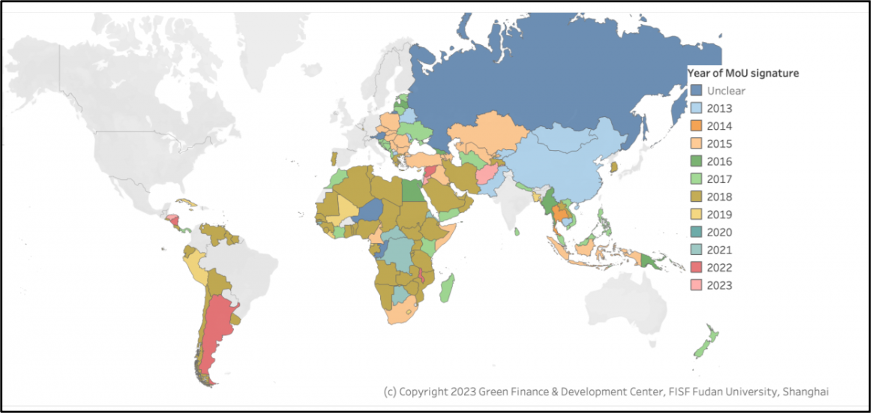 Fig 1: Chronological Sequence of Countries Joining the BRI
Source: see Note 11
The “21st century Maritime Silk Road” (MSR) is also a part of the BRI, and envisions a network of interconnected markets linking ASEAN, South Asia, West Asia, North Africa, and Europe, as also a strategic partnership for the South China Sea and the Pacific- and the Indian oceans. As part of the MSR, a significant component of the “China-India Ocean-Africa-Mediterranean Sea Blue Economic Passage” runs westward via the South China Sea to the Indian Ocean, and links with the “China-Indochina Peninsula Economic Corridor”, and also connects with the China-Pakistan, and the Bangladesh-China-India-Myanmar economic corridors.[12]
Commentary: The BRI is enshrined in the Constitution of China and is a major strategic interest of that country. Further, a significant portion of it is anchored in the IOR. This initiative provides China with a firm footing in the region and makes it a major stakeholder, in spite of being geographically distant.
2014 to 2026
- Memorandums of Understanding (MOUs) for Marine Scientific Research with IOR Countries
Sri Lanka.
- 2014: The University of Ruhuna and the South China Sea Institute of Oceanology (SCSIO) of the Chinese Academy of Sciences (CAS) established a “China-Sri Lanka Joint Centre for Research and Education” (CSL-CER) with the aim of promoting research and science education in Sri Lanka. In this endeavour, the two parties signed a Memorandum of Understanding on 16 September 2014, in the presence of high level delegations from both China and Sri Lanka. Other Chinese entities that are part of the CSL-CER include the Guangzhou Institute of Geo-Chemistry (GIG), the Research Centre for Eco-Environmental Sciences (RCEES): Chongqing Institute of Green and Intelligent Technology (CIGIT), the Institute of Remote Sensing and Digital Earth (RADI), the South China Botanical Garden (SCGB), the Kunming Institute of Zoology (KIZ), and the University of Chinese Academy of Sciences (UCAS).[13]
- 2018: On 12 September 2018, the Shanghai Museum signed an MOU with the Sri Lanka Central Cultural Fund for a five-year archaeological cooperation programme. Yang Zhigang, the curator of the Shanghai Museum, said on 12 September 2018 that the MOU was a comprehensive cultural exchange programme incorporating joint excavation, relic protection and museum exhibitions, to educational cooperation. “Sri Lanka is an important stop on the Maritime Silk Road. Chinese explorer Zheng He (1372-1433) visited Sri Lanka in 1405 for the first time,” Yang said, explaining why the museum made Sri Lanka the first station in its overseas joint archaeological research on the Maritime Silk Road.[14]
- March 2023: On 24 March 2023, a Memorandum of Understanding (MoU) was signed online between the Dalian Ocean University (DLOU), the University of Kelaniya, and the Island Research Centre, of China’s Ministry of Natural Resources (MNR). Present at the online signing ceremony were Professor Zhang Guochen, Vice President of DLOU; Professor Sudath RD Kalingamudali, Acting Vice Chancellor and Dean of the Faculty of Science of the University of Kelaniya; Professor Lin Heshan, Deputy Director of the Island Research Centre, MNR; and members of the International Exchange and Cooperation Office and the School of Marine Technology and Environment of DLOU. Zhang Guochen gave a brief introduction of the DLOU, and pointed out that the signing of this MoU was an important measure for the three parties to take advantage of the several opportunities offered by China’s BRI, collaborate with one another, and make common progress. He said that the MOU was of great significance to the development of the international marine causes of China and Sri Lanka, and the in-depth cooperation amongst the three parties. The purported purpose of signing this MoU was to promote talent cultivation, academic collaboration, cultural interaction, and partnership by supporting educational, professional, and cultural activities among faculties and students of the parties.[15]
- October 2023: In October of 2023, the Chinese research vessel, Shi Yan 6 docked in Colombo for an extended period. The vessel was reportedly engaged in geophysical scientific research in collaboration with Sri Lanka’s National Aquatic Resources Research and Development Agency (NARA). [16]
Commentary: India expressed concerns, contending that Shi Yan 6 might gather sensitive data on underwater features, submarine routes, and biological resources “within India’s perceived sphere of influence.” US Under Secretary of State, Victoria Nuland, met with the Sri Lankan foreign minister in New York, during which she personally conveyed America’s concerns regarding the ship’s visit. All this notwithstanding, the Chinese vessel nevertheless entered Sri Lankan waters and conducted research with NARA for several days.[17] However, Sri Lanka did announce a one-year-moratorium, with effect from 01 January 2024, on foreign research vessels visiting the country. The spokesperson for the Sri Lankan Foreign Ministry nevertheless asserted that such port-calls were aimed at enabling local universities and research centres to enhance their capacity for the conduct joint research with foreign counterparts and also vigorously refuted Indian media reports suggesting that the moratorium was specifically targeted at Chinese ships, in order to appease New Delhi.[18] This appeared to be one of the few occasions wherein some form of pushback was experienced by the Chinese with respect to their activities in the IOR. Sri Lanka reversed this year-long ban on foreign research vessels in its waters with effect from 2025, opting instead to draft new protocols that aim to balance India’s security concerns with China’s growing presence in the Indian Ocean.[19] This reversal of the ban is indicative of the continuing tussle between India and China in IOR.
Maldives. The foundation of the enduring relationship between China and the Maldives can be traced back to ancient times, fostering a sense of kinship between the two peoples. Records from the Tang Dynasty (618-907AD) reveal the presence of Maldivian delegations in China as early as 658 AD carrying gifts from King Baladitiya to Emperor Kao-Tsung. The Maldives, then referred to as “Mo-lai” served as a stop-over for sailors traversing the Indian Ocean trade routes. Archaeological discoveries, such as 10th-century Chinese porcelain found in Malé, and literary accounts like Francois Pyrard’s writings from 1611, offer glimpses into material exchanges between the Maldives and China.[20] Maldives is also called “Liushan Guo” or “Liuyang Guo” in Chinese history. In Yongle 10th year (1412) and Xuande 5th year (1430) of the Ming Dynasty, leading a fleet of merchant ships, the Chine admiral Zheng He reached Maldives twice. In Male Museum are displayed ancient and medieval Chinese porcelain and coins the have been unearthed in the Maldives, bearing witness to China’s friendly contacts and trade relations with Maldives across history.[21]
- 2014: An MoU on marine cooperation was signed between China and Maldives in September of 2014.[22] It incorporated, inter alia, the building of a Joint Observation Station on Makunudhoo Island in the north of the Maldives. Makunudhoo is the westernmost inhabited island in the Maldives. .[23]
- 2018: The upward trajectory of bilateral relations between China and Maldives faced its biggest hurdles in 2018, when Ibrahim Solih was elected President. The Soleh regime adopted a pro-India approach built on a “multifaceted, mutually beneficial partnership.” Consequently, Maldives retracted from the Joint Ocean Observation Station to be built by China located in Makunudhoo in North Western Maldives.[24]
Commentary: The references to historical linkages and Zheng He’s visits provides China with a valid reason to continue with the attempts to dispatch oceanographic research ships under the guise of marine archaeology. The retraction of Maldives from establishing the Joint Ocean Observation Station offers another instance wherein China faced some form of pushback in the IOR.
2018-2026
Pakistan
- The Pakistan National Ocean Research Institute and the Nanhai Ocean Research Institute of the Chinese Academy of Sciences (CAS) conducted a survey off the Makran Coast in January and February of 2018. This survey included a joint team of scientists from both Pakistan and China and was conducted by Chinese research vessel Shiyan 3.[25]
- 2018: An MoU on Cooperation in the field of Marine Sciences between the China Geological Survey (CGS), Ministry of Natural Resources of China and the Pakistan Institute of Oceanography, Ministry of Science and Technology, was signed in April of 2018.[26]
- 2019: The China Geological Survey and the Geological Survey of Pakistan signed a Memorandum of Understanding (MOU), fostering cooperation in marine sciences and research, particularly in exploring natural mineral and hydrocarbon resources within Pakistan’s territorial waters.[27]
- 2020: A second PN-China Geological Survey (CGS) scientific research cruise was undertaken from December of 2019 to February of 2020 for systematic seismic and magnetic surveys to understand the geology of Pakistan’s EEZ. The PNHD, on behalf of the PN, hosted the CGS research ship ‘Hai Yang Di Zhi Jiu Hao’ and all-out support, at sea, in harbour, and the coastal areas, was provides for survey activities. Along with Chinese scientists, scientists from National Institute of Oceanography, Pakistan Petroleum Limited and Pakistan Navy Hydrographic Department also participated.[28]
- 2026: The Pakistan Navy, through its National Hydrographic Office (NHO), actively supported a Pakistan–China Joint Oceanographic Cruise, conducted by the National Institute of Oceanography (NIO) in partnership with China’s Second Institute of Oceanography (SIO) in January 2026. Pakistan Navy’s survey vessel, PNS Behr Masah, was deployed to assist with this scientific mission, reflecting the Pakistan Navy’s commitment to promoting maritime awareness and advancing marine scientific research within the country.[29]
Commentary: Oceanographic research cooperation activities between China and Pakistan are unlikely to face any challenges and are likely to continue well into the distant future.
2023-2025.
Bangladesh.
- 2023: The Bangladesh Maritime University, Bangladesh (BMU) and the National Ocean Technology Cebtre (NOTC), China, signed a Cooperation Agreement on Promoting Marine Spatial Planning (MSP) Advancing Blue Economy Development. The agreement was signed in China on 09 August 2023 by Rear Admiral Mohammad Musa, Vice-Chancellor of BMU, and Peng Wei, Director General of NOTC. It was felt that through this agreement, realising the importance of MSP and deriving the imperatives for its implementation while supporting the advancement of the Blue Economy would be possible in the context of Bangladesh.[30]
- 2025: In a significant step towards advancing scientific cooperation in marine and environmental research, the South China Sea Institute of Oceanology (SCSIO), Chinese Academy of Sciences (CAS), and the University of Chittagong (CU), Bangladesh, signed a Memorandum of Understanding (MoU), on 30 May 2025, during the “Climate Change and Ecological Environment” Symposium held in Guangzhou.[31]
Commentary: As on date, there are no inputs in the open domain about any significant activity by CSRVs in Bangladesh. However, considering the present orientation of the government in Bangladesh, there is considerable scope for these activities to pick up in the near future.
2023
China-Africa Marine Science and Blue Economy Cooperation Centre. A “China–Africa Marine Science and Blue Economy Cooperation Seminar” — jointly organised by the Department of International Cooperation of the Ministry of Natural Resources of China (State Oceanic Administration) and the UNESCO/IOC Sub Commission for Africa & the Adjacent Island States (IOCAFRICA), and co-hosted by the Second Institute of Oceanography (SIO) and the China Ocean Development Foundation — was held in Hangzhou from 25 to 26 July 2023. During the event, the “China-Africa Marine Science and Blue Economy Cooperation Centre” (hereinafter referred to as “the Cooperation Centre”) was officially established. More than 100 representatives from 14 African countries, including Egypt, Mozambique, Kenya, Seychelles, Tanzania, Côte d’Ivoire, South Africa and Madagascar attended. The centre aims to serve as an accelerator for high-quality blue economy development by sharing China’s experience and exploring development models suited to African national realities. Second, it would become a new engine for marine science and technology innovation by strengthening alignment between the UN Ocean Decade China Action Framework and the Africa Ocean Decade Roadmap, offering solutions to fundamental scientific questions and providing public platforms and policy advice. Third, it would become a new base for cultivating marine science and technology talent, playing an important role in capacity building for China-Africa cooperation.[32]
Commentary: There appears to be immense potential for China to become active in the marine scientific research arena with relevant African countries in IOR.
2024
Mauritius.
- In August of 2024, as part of a project jointly undertaken by the Chinese tech giant Huawei and the Mauritius non-governmental environmental protection group Eco Mode Society, “25,000 coral fragments were successfully raised in nurseries and planted over an area of 1.01 square km”, said Sudheer Maudhoo, Minister of Blue Economy, Marine Resources, Fisheries, and Shipping, Government of Mauritius. Li Jiyu, a technical engineer of Huawei Mauritius, said that to monitor the mobility of species at the coral reef restoration site and determine the factors that disturb reproductive success, his company had deployed a solution comprising underwater cameras, GPS receivers, 5G technologies, and data cloud. The project has now entered its second phase. Technologies such as AI-based data analysis would be used to guide the conservation decisions, support the research of marine biologists, and educate the public on the importance of reef conservation and restoration. “The project is a perfect example on how to merge technologies and active restoration of ecosystem”, the marine scientist said. “There is big potential for collaboration with China.”[33]
Commentary: Through such activities, China appears to be attempting to open a door for enabling future marine scientific research off Mauritius.
2017
Djibouti
- In August of 2017, the PLA Djibouti Support Base entered service.[34] The PLA support base in Djibouti was established on July 11 based on a decision by both China and Djibouti and is important to China for fulfilling Beijing’s international commitments. The ceremony marked the first time that China had opened a military support base overseas. It is expected to fulfil China’s international obligations regarding humanitarianism aid and escort missions in the Gulf of Aden and waters off Somalia.[35]
Commentary: The inauguration of this support-base, on 01 August 2017, may be seen as the first tangible indicator of China’s intent to maintain a permanent presence in the IOR.
2022
Imposition of Fishing Moratorium in the High Seas of the Northern Indian Ocean for Chinese Fishing Vessels
- In 2022, China included the North Indian Ocean within the scope of voluntary moratoria on fishing. Fishing bans were observed, from 01 July to 30 September, in parts of the high seas in the North Indian Ocean between the Equator and 22 degrees North, and from 55 degrees East to 70 degrees East (excluding the jurisdictional waters under the Southern Indian Ocean Fisheries Agreement). During the moratorium, Chinese squid jiggers and light purse seiners suspended fishing operations.[36]
Commentary: This moratorium imposed by China for Chinese fishing vessels only, in the Indian Ocean, appears to be a clever attempt to have China seen as a responsible stakeholder in the IOR. This action by China also does not appear to have resulted in any expression of concerns by any country in IOR. There are no publicly available inputs on whether China announced similar moratoria in the Indian Ocean, after 2022.
2022 to 2024
China-Indian Ocean Region Development Cooperation Forum
The inaugural “China-Indian Ocean Region Development Cooperation Forum” was held on 21 November 2022 in Kunming, Yunnan. During the speech by Lou Zhaohui, director of the China International Development Cooperation Agency, it was stated that the theme of the forum was “Shared Development: Theory and Practice of Blue Economy”. It aimed to promote international cooperation in development and protection of marine resources and to contribute to the SDG concerning the sustainable use of the oceans. China stated that it would strengthen cooperation with countries in the Indian Ocean region to grow the blue economy, advance the implementation of the “Global Development Initiative” (GDI) in the region, embark on the path to shared development, accelerate cooperation and work together to build a maritime community with a shared future. This forum was the first high-level official development cooperation forum jointly held by China and countries in the Indian Ocean Region.[37]
During the second “China-Indian Ocean Region Development Cooperation Forum” held in Kunming, Yunnan from 07 to 08 December 2023, the deliverables included following:[38]
- Establish the “China-Indian Ocean Region Disaster Prevention and Mitigation Alliance”, and step-up the “Disaster Prevention and Mitigation Cooperation Mechanism” among countries in the region; develop an observation and monitoring network for marine dynamics, ecological, geological and climate disasters; develop a marine disaster warning and prediction system and demonstration application to strengthen marine disasters warning and evaluation; and offer high-quality public service products aimed at improving disaster prevention and mitigation in the region.
- Initiate and build the “China-Indian Ocean Region Blue Economy Think Tank Network” as an open and shared academic platform and exchange mechanism in the region; and jointly conduct the measurement and compilation of a “Blue Economy Index of the Indian Ocean Rim Region” — an effort that aims to inject new vitality into the blue economy cooperation in the region.
- The “China-Africa Cooperation Centre on Satellite Remote Sensing Application” was inaugurated in Beijing (in July 2023), supporting continuously cooperation in the area of satellite remote sensing application between China and countries in the Indian Ocean region.
- Push forward the development of the “China-Africa Marine Science and Blue Economy Cooperation Centre” and carry out technical cooperation on marine survey, monitoring, forecasting and continental shelf research in Africa. Jointly develop a big data analysis platform and carry out demonstration application. Support the development of marine science and blue economy in African countries in the Indian Ocean region.
- Carry out 200 “small yet smart” livelihood projects for countries in the Indian Ocean, in such areas as poverty reduction and agricultural development, medical and health care, culture and education, climate change response and green development. Carry out continuously the “Yunnan Hand-in-Hand Program”.
- Launch the “Blue Talent Program”, under which, in a time span of three years, China has undertaken to train 20,000 professionals in various fields, in IOR countries, while carrying out another hundred special training programs covering green development, climate change response, ocean planning, fishery development, etc.
- Set up the “China-Indian Ocean Region Maritime Cooperation and Training Centre” to cooperate in the marine field. Implement capacity building and case promotion activities in marine observation and forecasting, marine spatial planning, marine ecological protection and restoration. Launch the “Blue Citizen Initiative” to improve the governance capacity of IOR States in respect of sustainable marine development.
- Launch the “Climate Information and Early Warning System” project, in cooperation with the United Nations Development Programme (UNDP), to raise the IOR’s early warning capacity and community-based resilience against climate disasters.
- Implement the “Capacity Program of Sustainable Fishery Development” for countries in the Indian Ocean region, specifically in areas such as aquaculture, aquatic product processing, resource conservation and investigation, etc.
- Propose a “New Energy Indian Ocean Initiative” that would support the promotion and application of photovoltaic power generation, hydroelectric power generation, marine renewable energy and electric vehicles in IOR countries.
The [39]third “China-Indian Ocean Region Development Cooperation Forum” was held in Kunming from 15 to 16 December 2024. During this forum, the “China-Indian Ocean Region Maritime Cooperation and Training Centre”, was officially inaugurated.
Commentary: The operationalisation of this forum, without India being a part of it, is a clear statement of intent on the part of China to establish itself as a de facto Indian Ocean nation.
2023
- Naming of 19 Sub-Surface Features in Indian Ocean Region
On 01 April 2023, China announced that it had named seabed features within the Indian Ocean region. Of the 19 seabed features named, six are located off the coast of Oman and the port of Djibouti, four lie off the coast of Madagascar, eight are on the south-west ridge of the Indian Ocean, and one is located east of the ridge feature in the deep Indian Ocean, towards Antarctica.[40]
Commentary: This activity by China once again appears to be staking a claim to legitimising its presence in the IOR. This action by China also does not appear to have evoked any significant degree of concern (at least publicly) by IOR countries, including India.
2009 to 2024
- PLA Navy Port Calls to IOR Countries
From 2009 to 2024, PLA Navy units made a total of 396 port calls worldwide. Of these, 172 or 43.3% were to IOR countries, as shown in Figure 2.[41]
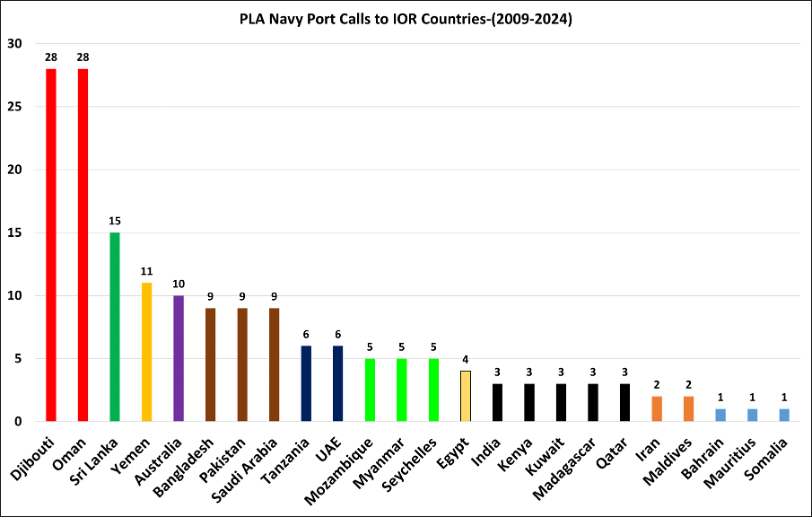
Fig 2
Source: (See Note 38)
Commentary: The fact that 43.3% of PLA Navy’s port calls were to IOR countries appears to be the natural fallout of the continuous unbroken presence of these units in IOR with effect from 2009.
- Bilateral Military Exercises with IOR Countries
From 2009 to 2024, China participated in a total of 270 bilateral military exercises, of these, 100 (37.03%) of the exercises were with IOR countries.[42]
Commentary: The fact that 37.03% of the bilateral military exercises from 2009 to 2024 were with IOR countries, is indicative of China’s deep engagement with this region.
- Multilateral Military Exercises in IOR[43]
China was a participant in the following multilateral exercises under the aegis of multilateral constructs such as IONS or multilateral exercises hosted by various IOR countries: –
- International Fleet Review in India in 2016.
- Under the aegis of IONS, China participated in the International Maritime Search and Rescue exercise held in Bangladesh in 2017.
- Exercise Maritime Security Belt hosted by Iran in 2019,2022,2023 and 2024.
- Pakistan
- Exercise ‘AMAN’ in 2009,2011,2017,2019,2021,2023, 2nd International PACES Competition in 2016 and 2018, Exercise Shared Destiny in 2021 and Exercise Warrior VI in 2019.
- South Africa
- Exercise MOSI in 2019 and similar unnamed exercise in 2023.
- Sri Lanka
- Exercise Cormorant Strike in 2012,2015,2017 and 2018.
- Tanzania
- Exercise Peace Unity-2024.
- Thailand
- Exercise Cobra Gold editions from 2014 to 2021 and again in 2023 and 2024.
Commentary: China’s regular participation in multilateral exercises in IOR is significant because it helps China to get embedded into region’s construct.
- Senior Level Military Interactions with IOR Countries[44]
Out of the total 1567 senior level military interactions that China had worldwide from 2009 to 2024, 371 or 23.67% were with 26 countries of IOR. 310 or 83.5% of these 317 interactions were at the CMC level.
Commentary: China’s senior level military interactions, with 83.5% at CMC level with IOR countries can be seen as a deliberate effort to deeply engage with the countries of the region.
- Supply of Armament to IOR Countries[45]
- China has supplied armaments to a total of 23 IOR countries to date, of these platforms were supplied to 21 countries, weapons to 14 countries and equipment to 16 countries.
- 10 countries in Africa, including Djibouti, Egypt, Eritrea, Ethiopia, Kenya, Mozambique, Seychelles, Somalia, Sudan and Tanzania were recipients of Chinese armaments. 13 countries in Asia, including, Bahrain, Bangladesh, Iran, Kuwait, Malaysia, Myanmar, Oman, Pakistan, Qatar, Saudi Arabia, Sri Lanka, UAE and Yemen also received armaments from China.
Commentary: Supply of armament is one of the most effective ways for China to create dependencies and when viewed in the context of IOR has implications, especially for India.
- Trade and Energy [46]
- As of 2024, 26.7% of China’s merchandise imports and 32.6% of exports transited through IOR. Interestingly, no IOR country except Australia (at number 6) figures amongst the top 10 suppliers of merchandise to China in 2024. Similarly, no IOR country, barring India (at number 6) figures amongst the top 10 export destinations of China.
Commentary: Transit of Chinese merchandise trade through IOR is significant, however, can these figures, solely by themselves, justify China’s attempts to integrate into IOR?
- As far as energy products are concerned, in 2024, following Chinese energy imports transited through IOR: –
- Crude Oil – 55.2% by value and 53.5 by quantity.
- Refined Products – 24.5% by value and 23.4% by quantity.
- LNG -29.9% by value and 29.8% by quantity.
Commentary: Transit of Chinese energy products through IOR is fairly significant and can be viewed as a driver of its need to be present in IOR.
Summary of Chinese Activities in IOR in Chronological Order (2009-2026)
A tabular summary of the 31 events highlighted in this paper is as follows:
| Ser | Timeline | Event | Remarks |
| (a) | 2009 | PLA Navy’s First APEF commences escort duties in the Gulf of Aden | |
| (b) | 2011 | International Seabed Authority (ISA) approves application of China Ocean Mineral Resources Research and Development Association (COMRA) for allocation of Poly Metallic Sulphides area in the Indian Ocean | |
| (c) | 2012 | Vice Admiral Su Zhiqian’s statement at Galle Dialogue 2012 that “the Chinese navy will actively maintain the peace and stability of the Indian Ocean” | |
| (d) | 2013 | Commencement of deploying of PLA Navy submarines to IOR, apparently for anti-piracy duties | |
| (e) | 2013 | Announcement of BRI | |
| (f) | 2014 | University of Ruhuna and South China Sea Institute of Oceanology (SCSIO) of Chinese Academy of Sciences (CAS) established a China-Sri Lanka Joint Cebtre for Research and Education (CSL-CER) | |
| (g) | 2014 | MoU on marine cooperation signed between China and Maldives for establishment of a Joint Observation Station was on Makunudhoo | Not yet executed |
| (h) | 2018 | Shanghai Museum signed a memorandum of understanding (MOU) with the Sri Lanka Central Cultural Fund on a five-year archaeological cooperation program | |
| (j) | 2017 | PLA Djibouti Support Base inaugurated | |
| (k) | 2018 | MoU on Cooperation in the field of Marine Sciences between the China Geological Survey (CGS), Ministry of Natural Resources of China and the Pakistan Institute of Oceanography, Ministry of Science and Technology | |
| (l) | 2019 | China Geological Survey and Geological Survey of Pakistan had signed a Memorandum of Understanding (MOU) in 2019, fostering cooperation in marine sciences and research, particularly in exploring natural mineral and hydrocarbon resources within Pakistan’s territorial waters | |
| (m) | 2020 | PN /China Geological Survey (CGS) scientific research cruise was undertaken from Dec 19 to Feb 20 for systematic seismic and magnetic surveys to understand the geology of Pakistan’s EEZ | |
| (n) | 2022 | China included the high seas within the northern Indian Ocean into the scope of voluntary moratoria on fishing, applicable to Chinese fishing vessels | |
| (p) | 2022 | The inaugural “China-Indian Ocean Region Development Cooperation Forum” held in Kunming, Yunnan | |
| (q) | 2023 | Second “China-Indian Ocean Region Development Cooperation Forum” held in Kunming, Yunnan | Deliverables included establishing of the “China-Indian Ocean Region Disaster Prevention and Mitigation Alliance” |
| (r) | 2023 | Memorandum of Understanding (MoU) was signed online between Dalian Ocean University, the University of Kelaniya, and the Island Research Centre (Ministry of Natural Resources) | |
| (s) | 2023 | Chinese research vessel Shi Yan 6 docked in Colombo for an extended period. The vessel was reportedly engaged in geophysical scientific research in collaboration with Sri Lanka’s National Aquatic Resources Research and Development Agency (NARA) | |
| (t) | 2023 | Bangladesh Maritime University, Bangladesh (BMU) and National Ocean Technology Centre (NOTC), China signed a “Cooperation Agreement on Promoting Marine Spatial Planning (MSP) Advancing Blue Economy Development” | |
| (u) | 2023 | “China-Africa Marine Science and Blue Economy Cooperation Centre” established. | |
| (v) | 2023 | China announced naming of 19 sub-surface features in the Indian Ocean region | |
| (w) | 2024 | As part of a project jointly undertaken by the Chinese tech giant Huawei and the Mauritius non-governmental environmental protection group EcoMode Society, 25,000 coral fragments were successfully raised in nurseries and planted over an area of 1.01 square km | |
| (y) | 2024 | Third “China-Indian Ocean Region Development Cooperation Forum” held in Kunming, Yunnan | The “China-Indian Ocean Region Maritime Cooperation and Training Centre”, was officially inaugurated |
| (z) | 2024 | As of 2024, 26.7% of China’s merchandise imports and 32.6% of exports transited through IOR | |
| (aa) | 2024 | The following Chinese energy imports transited through IOR:
Crude Oil – 55.2% by value and 53.5 by quantity. Refined Products – 24.5% by value and 23.4% by quantity. LNG -29.9% by value and 29.8% by quantity. |
|
| (ab) | 2025 | The South China Sea Institute of Oceanology (SCSIO), the Chinese Academy of Sciences (CAS), and the University of Chittagong (CU), Bangladesh, signed a Memorandum of Understanding (MoU) | |
| (ac) | 2026 | The Pakistan Navy, through its National Hydrographic Office (NHO), actively supported a Pakistan–China Joint Oceanographic Cruise, conducted by the National Institute of Oceanography (NIO) in partnership with China’s Second Institute of Oceanography (SIO). Pakistan Navy’s survey vessel, PNS Behr Masah deployed to assist with this scientific mission | |
| (ad) | 2009-2024 | PLA Navy units made a total of 396 port calls worldwide. Of these, 172 or 43.3% of the port calls were to IOR countries | |
| (ae) | China participated in a total of 270 bilateral military exercises, of these, 100 (37.03%) of the exercises were with IOR countries | ||
| (af) | China participated in 33 multilateral military exercises in IOR | ||
| (ag) | Of the total 1,567 senior-level military interactions that China had worldwide from 2009 to 2024, 371 (23.67%) were with 26 countries of IOR. 310 (83.5%) of these interactions were at the CMC level | ||
| (ah) | Till 2024 | China has supplied armaments to a total of 23 IOR countries to date. Of these, platforms were supplied to 21 countries, weapons to 14 countries, and equipment to 16 countries |
Conclusion
It is not very clear whether the events listed in the table above occurred at different times as standalone events, or whether they are part of a larger strategy for IOR. There is no real evidence to support either supposition. However, irrespective of this, these events have nevertheless had a significant impact on the region.
For instance, far from raising alarm, China’s unbroken deployment of very heavily armed combatants ostensibly for anti-piracy escort duties, has become both, normalised and legitimised. The several diplomatic spin-offs from these deployments include regular port calls in a variety of IOR countries, bilateral and multilateral military exercises, and senior level military interactions. In other words, these activities are no longer seen as something extraordinary or even noteworthy.
The allocation to China (by the ISA) of an exploration area for polymetallic sulphides, within the Indian Ocean is, of course, perfectly legal. This has, however, provided justification for the deployment of Chinese Scientific Research Vessels (CSRVs) to IOR. Hence, as and when these CSRVs enter IOR, they have ceased to raise any alarm, as their activities in this region have once again become legitimised and normalised. In fact, it is the occasional absence of CSRVs is what is being seen as strange! Once again, Chinese presence in the IOR is increasingly being viewed as “normal”.
Surprisingly, Vice Admiral Su Zhiqian’s statement at the 2012 edition of the Galle Dialogue, that “the peace and stability of the Indian Ocean bear upon that of the world. The freedom and safety of the navigation in the Indian Ocean play a very important role in the recovery and development of global economy and the Chinese navy will actively maintain the peace and stability of the Indian Ocean”, did not evoke any public reaction from IOR nations — including India — despite the admiral’s articulation being a clear of statement intent by China to assert a claim of being part of the IOR’s stability-construct.
The deployment of PLA Navy submarines to IOR, commencing 2013, purportedly for anti-piracy duties, ought to have been perceived as being a dead giveaway of by Chinese intentions in the IOR. These deployments should not be viewed through the relatively benign lens of anti-piracy, but as clear statements of intent, on the part of China to prepare for any future combat situations in the region. That the obvious incongruity of deployment of both nuclear and conventional submarines for anti-piracy tasks has not been highlighted by India or by other affected countries of the IOR, is both astonishing and ominous.
The BRI is a major strategic interest of China and a significant portion of it is anchored in the IOR. With 25 countries of this subregion having already signed MoUs with China, this initiative provides China a firm footing in the region and makes it a major stakeholder. Wisely, India has refused to participate in this initiative and has raised concerns over the fact the China Pakistan Economic Corridor (CPEC) is actually a “China Pakistan-Occupied-Kashmir Economic Corridor” and has been formulated and effected without any prior consultation with India and without any regard for India’s territorial integrity. This strong flagging of concern by India, certainly tarnishes the shiny image of the BRI that is being sought to be sustained by Beijing, even though it cannot completely arrest its progress.
The signing of Memorandums of Understanding (MOUs) for marine scientific research with several IOR countries, including Sri Lanka, Maldives, Pakistan, and Bangladesh, and the establishment of the “China-Africa Marine Science and Blue Economy Cooperation Centre” are significant developments and project China as a major stakeholder in the region, provide an acknowledgement of its prowess in marine scientific research, generate a legitimate reason for deployments of CSRVs, and enable China to act as an enabler of peace, stability, and prosperity in the IOR. Obviously, the collection by China of long-term hydrographic and oceanographic data, when taken in aggregate, has clear and disturbing implications for naval surface and sub-surface operations. Yet this has not evoked strong vocal/public protests from affected countries.
That said, it has been adequately demonstrated that expressions of concern, via diplomatic or public means, do have an impact. Examples include Sri Lankas decision to impose restrictions on entry of foreign research vessels to Sri Lankan ports (even though these restrictions were subsequently lifted), and the Maldivian decision to place in abeyance the establishment of a proposed Chinese-Maldivian joint ocean observation station.
The 2022 moratorium imposed by China, for Chinese fishing vessels only, in Indian Ocean, appears to be a clever attempt to generate a perception of China as a responsible stakeholder in the IOR. Of concern is the fact this action by China, too, has not led to any serious analysis and hence, there are few, if any, expressions of concern by any IOR State. Although there are no publicly available inputs on whether China announced similar moratoria after 2022, if activities of this nature go unchallenged, China will soon succeed in establishing itself as a legitimate stakeholder with regard to fishing issues in IOR.
Three editions of the “China-Indian Ocean Region Development Cooperation Forum” have been conducted — in 2022, 2023 and 2024, respectively. Interestingly, India is not a part of this forum. The operationalisation of this forum, without the inclusion of India, is yet another clear statement of intent on the part of China to establish itself as a de facto Indian Ocean nation. Further, the proposal to establish the “China-Indian Ocean Region Disaster Prevention and Mitigation Alliance” seems to be a particularly strong attempt to erase the black mark of China’s tepid response during the 2004 tsunami in the Indian Ocean. It also seems to be aimed at encouraging IOR nations to seek China’s aid first in the event of any disaster, rather than approaching India. The lack of any vocal/public expression of concern by India would have been noted by China with considerable satisfaction if not unabashed glee.
The 2023 action by China of naming of 19 sub-surface features in the IOR is significant because of the geographical displacement of China from IOR. Incidentally, China has proposed naming of features in other oceanic areas, too, besides the Indian Ocean. However, this act in IOR has greater significance as compared to other areas. Once again, this action by China also does not appear to have evoked any concern (at least publicly) by IOR countries and is likely to be seen as an endorsement of Chinese activities of this nature in IOR.
China has supplied armaments to a total of 23 IOR countries to date. Of these, platforms have been supplied to 21 countries, weapons to fourteen, and equipment to sixteen. Supply of armament is one of the most effective ways for China to create dependencies and when viewed in the context of IOR has serious implications, especially for India.
The inauguration, on 01 August 2017, of China’s first overseas facility at Djibouti, officially referred to as ‘PLA Djibouti Support Base’ is a landmark event and has firmly established China as a de facto IOR nation. The apparent complacency that has been generated simply because the Chinese facility co-exists with those of other countries in Djibouti, is dangerous.
Incidentally, as of 2024, 26.7% of China’s merchandise imports and 32.6% of exports transited through IOR. Interestingly, no IOR country except Australia (at number 6) figures amongst the top 10 suppliers of merchandise to China in 2024. Similarly, no IOR country, barring India (at number 6) figures amongst the top 10 export destinations of China. With only one IOR country being in the list of both top 10 suppliers of China and also export destination of China, protection of trade cannot be seen as a prime driver for China to be present in the IOR. As far as energy products are concerned, in 2024, 55.2% by value and 53.5 by quantity of crude oil,
24.5% by value and 23.4% by quantity of refined products and nearly 30% of LNG imports transited through the IOR. These values are significant and can be deemed to be evoking concern in China in the event of any hostilities in the region.
However, if protection of merchandise and energy were the main drivers for China to be present in IOR, then, the series of other activities highlighted in this paper would not have been necessary.
Overall, China appears to have succeeded in entrenching itself into the geography of IOR, and into the psyche of nations of the IOR, most of whom seem to have been lulled into perceiving its activities as normal, legal and justifiable. Hence, by design or by default, China has slowly, drop by drop, seeped into the consciousness of the IOR, despite being geographically displaced by a significant margin. Neither New Delhi’s security establishment, nor the Indian Navy, can afford any further benign neglect of these developments.
*******
About the Author
Captain TSV Ramana is a former Indian Navy Officer and a pioneer of the Indian Navy’s analytical studies vis-à-vis China, with extended tenures in the Directorate of Naval Intelligence at Naval Headquarters, the China Cell at the National Maritime Foundation, at the Maritime Doctrine and Concept Centre (MDCC) as part of the ‘Strategic Maritime Assessment Team (SMAT) – China’ and the Centre for Contemporary China Studies (CCCS). He is a qualified Mandarin interpreter from the School of Foreign Languages at New Delhi. The views expressed are his own. He may be reached at tsvramana68@gmail.com
Endnotes:
[1] Xinhua, “Chinese Navy Sets Sail for Anti-Piracy Mission off Somalia”. https://www.chinadaily.com.cn/china/2008-12/26/content_7344989.htm, 26-12-2008.
[2] Andrew S Erickson and Lt Justin D Mikolay, “Welcome China to the Fight Against Pirates: The Chinese Deployment to the Gulf of Aden is Historic and Significant”, Proceedings, US Naval Institute, Annapolis, Maryland, 2009.
[3] Xinhua, “China Sends New Navy Fleet on Escort Mission in Gulf of Aden, Waters Near Somalia”, 12 October 2025. https://www.globaltimes.cn/page/202510/1345390.shtml.
[4] Embassy of the People’s Republic of China in the Islamic Republic of Iran, Foreign Ministry Spokesperson Ma Zhaoxu’s remarks on the Approval for China’s Application for Seabed Exploration. https://ir.china-embassy.gov.cn/eng/fyrth/201108/t20110804_1898169.htm,02-08-2011.
[5] International Seabed Authority. https://isa.org.jm/exploration-contracts/polymetallic-sulphides/
[6] Xinhua. https://www.chinadaily.com.cn/bizchina/2011-11/19/content_14124852.htm,19-11-2011.
[7] chinamil.com.cn, “Chinese Navy to Actively Maintain Peace and Stability of Indian Ocean”. https://www.globaltimes.cn/content/750602.shtml,17-12-2012.
[8] Vijay Sakhuja, “Chinese Submarines Taste Indian Ocean”, CSS ETH Zurich. https://isnblog.ethz.ch/uncategorized/europe-needs-the-uks-sea-based-nuclear-deterrent,09-10-2014.
[9] Prakash Panneerselvam, The Diplomat, China’s Emerging Subsurface Presence in the Indian Ocean, https://thediplomat.com/2022/12/chinas-emerging-subsurface-presence-in-the-indian-ocean/, 03 December 2022.
[10] Green Finance and Development Centre. https://greenfdc.org/belt-and-road-initiative-about/
[11] Christoph Nedopil, “Countries of the Belt and Road Initiative”, Shanghai, Green Finance & Development Centre, FISF Fudan University. www.greenfdc.org
[12] Belt and Road Portal, Xinhua Silk Road, 26 June 2023. https://eng.yidaiyilu.gov.cn/p/0H647R18.html
[13] China-Sri Lanka Centre for Research and Education (CSL-CER). https://www.ruh.ac.lk/Uni/cslcer/
[14] CGTN, “China and Sri Lanka Unite in Maritime Silk Road Archaeological Research”, 15 Sep 2018. https://news.cgtn.com/news/3d3d674e7a55544d7a457a6333566d54/index.html,
[15] Dalian Ocean University (DLOU) Signs an MoU with The University of Kelaniya, and Island Research Centre, Ministry of Natural Resources, 24 March 2023
[16] Lee Kuan Yew School of Public Policy, “Ripples in the Indian Ocean: Chinese Research Ships and Sri Lanka’s Diplomatic Dilemma”, 30 April 2024. https://lkyspp.nus.edu.sg/cag/publications/cebtre-publications/publication-article/detail/ripples-in-the-indian-ocean-chinese-research-ships-and-sri-lanka-s-diplomatic-dilemma
[17] Ibid.
[18] Shakthi De Silva, “Ripples in the Indian Ocean: Chinese Research Ships and Sri Lanka’s Diplomatic Dilemma”, Column, Lee Kuan Yew School of Public Policy, 02 Jan 2024. https://lkyspp.nus.edu.sg/docs/default-source/cag/cib242-2.pdf?sfvrsn=1a25380a
[19] “Sri Lanka to Lift Ban on the Visit of Foreign Research Ships after India & US Concerns”, Sea and Job Website, 08 July 2024. https://www.seaandjob.com/sri-lanka-to-lift-ban-on-the-visit-of-foreign-research-ships-after-india-us-concerns/
[20] Website of Embassy of the Republic of Maldives in the People’s Republic of China. https://cn.mdvmission.gov.mv/index.php/en/bilateral-relations/maldives-china-relations
[21] “Sino Maldives Relations”, Ministry of Foreign Affairs, 19 August 2009. https://www.chinadaily.com.cn/world/2009-08/19/content_8589136.html
[22] Shalini Singh, “Maldives-China Relations —Multidimensional Cooperation in the Indian Ocean”, Organisation for Research-China and Asia (ORCA) Website, 07 April 2022. https://orcasia.org/article/202/maldives-china-relations.
[23] Li Yan, “Chinese Marine Observatory in Maldives Not for Military: Analysts”, Global Times, 28 February 2018. https://www.ecns.cn/2018/02-28/293839.shtml.
[24] See Note 16.
[25] Ministry of Science and Technology, Government of Pakistan, National Institute of Oceanography, 13 January 2018. https://niopk.gov.pk/pcre.html.
[26] “Prime Minister Imran Khan’s Meeting with Chinese Premier Li Keqiang in Beijing, China”, CPEC Secretariat, 28 April 2019. https://cpec.gov.pk/news/169
[27] “China-Pakistan Joint Marine Geological Survey Data Handover Strengthens Bilateral Scientific Cooperation”, CPEC Portal, 02 August 2023. https://cpecinfo.com/china-pakistan-joint-marine-geological-survey-data-handover-strengthens-bilateral-scientific-cooperation/
[28] National Hydrographic Office, Pakistan, https://hydrography.paknavy.gov.pk/second-pn-china-geological-survey-cgs-scientific-research-cruise/, 23 October 2020
[29] The Express Tribune, https://tribune.com.pk/story/2585866/pn-facilitates-pakistan-china-joint-cruise,07 January 2026.
[30] Bangladesh Maritime University, BMU and NOTC, China signs Cooperation Agreement, https://bmu.edu.bd/news_details/bmu-and-notc-china-signs-cooperation-agreement, 09 August 2023.
[31] Md Abu Kwasar, “China and Bangladesh Strengthen Marine Science Collaboration through MoU between SCSIO and University of Chittagong”, Bangladesh-China Youth Student Association (BCYSA), 01 June 2025. https://www.bcysa.org/news-details/713/China-and-Bangladesh-Strengthen-Marine-Science-Collaboration-through-MoU-between-SCSIO-and-University-of-Chittagong.
[32] “Establishment of China-Africa Marine Science and Blue Economy Cooperation Centre”, Second Institute of Oceanography, MNR, 26-07-2023. https://www.sio.org.cn/en/a/platforms/23082.html.
[33] Xinhua, “China, Mauritius Work Together for Underwater Reforestation”, 25 August 2024. https://en.chinadiplomacy.org.cn/2024-08/25/content_117386311.shtml
[34] State Council of the People’s Republic of China, “China’s Defense White Paper 2019: China’s National Defense in the New Era”, 24 July 2019, https://english.www.gov.cn/archive/whitepaper/201907/24/content_WS5d3941ddc6d08408f502283d.html
[35] Xinhua, China opens its first army support base overseas, http://www.xinhuanet.com//english/2017-08/01/c_136491533.htm, 01-08-2017.
[36] State Council Information Office of PRC, Full text: Development of China’s Distant-Water Fisheries, October 2023, http://www.scio.gov.cn/zfbps/zfbps_2279/202310/t20231024_775875.html
[37] Speech by Mr. Luo Zhaohui at the Opening Ceremony of the China-Indian Ocean Region Development Cooperation Forum, China International Cooperation Development Agency (CIDCA), 22 November 2022. http://en.cidca.gov.cn/2022-11/22/c_833009.htm
[38] Sanjeev Kumar, “Second China-Indian Ocean Region Forum: Agenda and Outcome”, Indian Council of World Affairs. https://icwa.in/show_content.php?lang=1&level=3&ls_id=10303&lid=6571
[39] YY Mao, “Inauguration of the China-Indian Ocean Region Maritime Cooperation and Training Centre”, Second Institute of Oceanography, MNR, 17 December 2024. https://www.sio.org.cn/en/a/platforms/23081.html
[40] Shishir Gupta, “Xi Jinping Projects Dominance in Indian Ocean, Names 19 Seabed Features”, Hindustan Times, 17 April 2023. https://www.hindustantimes.com/world-news/xi-projects-dominance-in-indian-ocean-names-19-sea-bed-features-101681693691689.html
[41] Author’s analysis of from National Defense University Press data, Washington, DC, https://ndupress.ndu.edu/Media/News/News-Article-View/Article/4222744/chinas-military-diplomacy/
[42] Ibid.
[43] Ibid.
[44] Ibid
[45] Author’s analysis of Stockholm International Peace Research Institute (SIPRI) Arms Transfer Database, https://armstransfers.sipri.org/ArmsTransfer/CSVResult
[46] Author’s analysis of International Trade Centre (INTRACEN) data for China, Hong Kong and Macao for the year 2024.


Leave a Reply
Want to join the discussion?Feel free to contribute!