
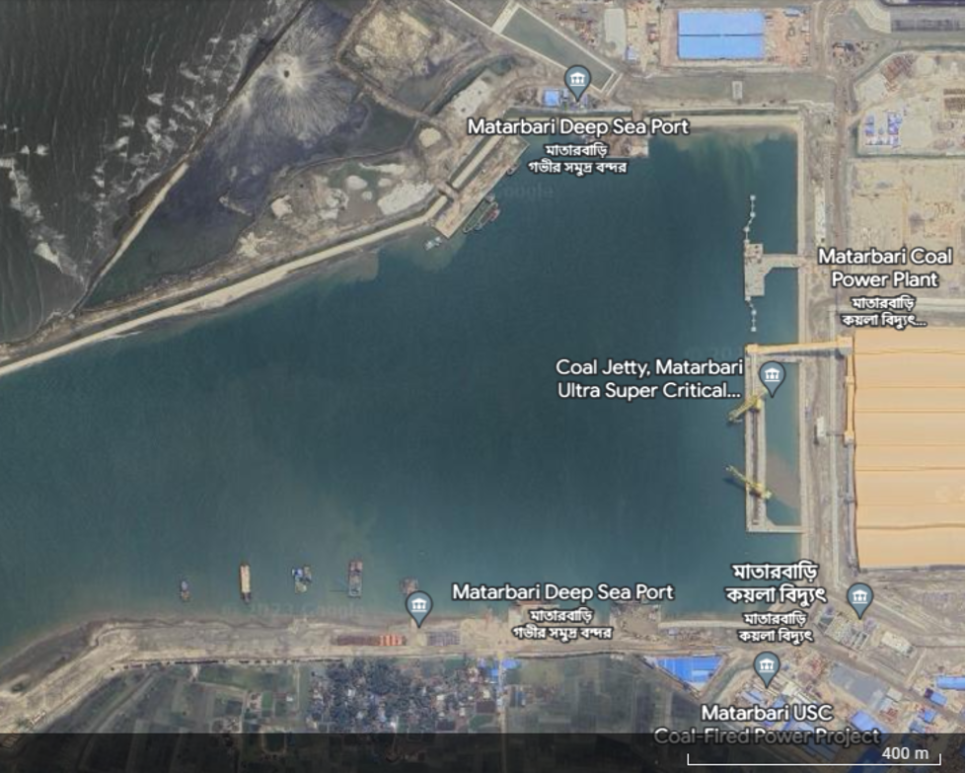
 Google Earth
Overview
Currently under construction as a deep-sea port in the Moheshkhali sub district of Cox Bazar district of Bangladesh, Matarbari port is located on the southeastern coast, situated south of Chattogram Port (formerly known as Chittagong Port). The primary purpose of the construction of Matarbari was to provide maritime connectivity for the Matarbari coal plant that had been proposed in 2011 and has been in the process of construction since then. In 2018, the government of Bangladesh made the decision to transform the Matarbari port into a deep-sea port, with the estimated completion date set for January 2027. Both projects have received substantial funding from the Japan International Cooperation Agency (JICA), which initially provided an Official Development Assistance (ODA) loan of 4 billion dollars specifically for the coal power plant in 2014.[1] While the Chittagong Port Authority is also providing funding for the port, Japan remains the primary investor.[2]
The Matarbari port project serves as a pivotal junction uniting two influential economies within the Indo-Pacific region, namely those of India and Japan. Recognising the influence they exert over the strategic stability of this area, both economies are keen on assuming more prominent roles in the multilateral dynamics of the Indo-Pacific. For Japan, the Matarbari port project presents an opportunity to deepen its economic ties with Bangladesh. Japan’s financial investments and technical expertise demonstrate its commitment to supporting Bangladesh’s development agenda and expanding its presence in the region. It also aligns with Japan’s broader economic and strategic interests in the Indo-Pacific region. India, however, has not provide any direct financial investment into the port, raising questions about its actual role in the project. To properly grasp the contributions of India and Japan, however, it is essential to comprehend the port’s significance for the various stakeholders involved. While India may not have a direct financial stake in the port, its involvement encompasses critical elements such as policy coordination, strategic consultations, and potential collaboration in relevant sectors. India’s engagement should, indeed, be understood within the broader context of Indo-Pacific regional dynamics wherein India’s objectives include promoting regional connectivity, fostering economic cooperation, and countering China’s growing influence.
Matarbari Port: Economic Significance for Bangladesh
As Bangladesh’s first deep-sea port, Matarbari holds immense strategic significance for Bangladesh, as it promises to revolutionise the country’s trade connectivity, stimulate robust economic growth, and generate a multitude of employment opportunities. This ambitious project is well aligned with Bangladesh’s vision of fortifying its infrastructure and attracting foreign investments, thereby contributing significantly to its overall development goals. Presently, Bangladesh relies heavily on neighbouring deep-sea ports like Colombo, Singapore, and Malaysia, resulting in exorbitant transshipment costs for vessels entering or leaving Bangladesh. This heavy dependence imposes a substantial financial burden on the country. Dhaka hopes that once the port is opened large-draught container ships will be able to dock at the Matarbari deep-sea port, obviating the need for transhipment to access larger regional port and significantly enhancing Bangladesh’s maritime trade efficiency and competitiveness. It will also streamline Bangladesh’s supply chains and reduce logistic costs, bolstering Bangladesh’s trade capabilities, enabling faster and more cost-effective movement of goods, and catalysing economic growth across various sectors.
Matarbari is expected to surpass the capabilities of Bangladesh’s current largest port, namely, Chattogram. Dhaka also seeks to develop Matarbari port as a regional transshipment hub. By facilitating the direct docking of larger vessels, Bangladesh’s competitiveness in the global market is expected to soar, ensuring smoother import and export operations, and bolstering its overall standing. Conservative estimates suggest that the port’s development alone will contribute to a notable 2-3 per cent increase in the country’s Gross Domestic Product (GDP), propelling Bangladesh towards middle-income status.[3] The resulting surge in job creation will not only alleviate unemployment but also uplift the lives of countless Bangladeshis, fostering socioeconomic progress and prosperity. At least where Dhaka is concerned, the Matarbari port represents a monumental leap forward for Bangladesh, hopefully ushering in an era of heightened trade connectivity, accelerated economic advancement, and unwavering self-reliance. It certainly serves as a tangible embodiment of the nation’s resolute commitment to modernise its infrastructure, attract investments, and solidify its position as a prominent player in terms of global trade connectivity.
Moreover, the location of the port provides for direct access to the Bay of Bengal, enabling its positioning as a pivotal gateway for trade with neighbouring countries and beyond. This seamless connectivity would not only foster regional integration but also strengthen economic ties and promote cross-border trade, amplifying the positive spillover effects on the nation’s economy.
Matarbari: Regional Benefits
The development of this port in Bangladesh not only brings significant economic advantages to the country itself but also holds significant potential for neighbouring landlocked countries such as Nepal and Bhutan. These countries would experience substantial benefits through the reduction of regional transshipment costs for their goods and Bangladesh hopes to be able to do just that. The establishment of the port is expected to create an efficient maritime trade route, eliminating the need for lengthy detours, and thereby reducing transportation expenses. India, too, is expected to benefit from the improved connectivity facilitated by the Matarbari port, which is expected to provide an economic boost to the country’s northeastern states. Similar benefits are likely to accrue for the broader sub-region as well. Indeed, the advantages extend beyond mere economic gains, as it is anticipated that the establishment of this port would cultivate stronger regional bonds and foster greater cooperation. It opens avenues for collaborative endeavours among nations, encouraging partnerships across multiple sectors including infrastructure, tourism, cultural integration, and of course, logistics, and trade. The establishment of a seamless regional trade network lays the foundation for shared prosperity and sustainable development, ultimately benefiting all participating nations.
Strategic Shift: Matarbari and the Abandoned Sonadia Port
In understanding the strategic significance of Matarbari, it is important to consider the adjacent proposed port at Sonadia, which is located less than 50 km away.[4] In 2006, it was Sonadia that had been identified as the most suitable location for a deep-sea port. China expressed a keen interest in developing the port and even presented a comprehensive project proposal for its construction. However, despite the discussions between Bangladesh and China, the anticipated — and in some quarters, the apprehended — agreement never materialised. Subsequently, in 2018, Dhaka decided to construct the deep-sea port at Matarbari with assistance from Japan, marking a shift in the country’s direction. This move effectively sealed the fate of the Sonadia port and finally, in 2020, Bangladesh officially announced the scrapping of the Sonadia port project, solidifying the Matarbari port’s position as the chosen deep-sea port[5].
This sequence of events highlights the strategic choices made by Bangladesh in collaboration with its international partners. The decision to proceed with the Matarbari port project and the strong supported by Japan, carries substantive significance in terms of regional geopolitics. It represents a strategic alignment with partners who prioritise shared values, economic cooperation, and connectivity, reflecting Bangladesh’s broader interests and objectives. By opting for the Matarbari port over Sonadia, Bangladesh has shaped its strategic environment and balanced its partnerships. Its collaboration with Japan generates not only economic benefits but also underscores broader strategic implications, including the counterbalancing of influence within the region. This decision also reflects Bangladesh’s strategic positioning in pursuit of its economic and geopolitical objectives.
Environmental Concerns and Considerations
While environmental concerns are relevant for both ports, geopolitical considerations, strategic alliances, economic viability, technical feasibility, and alignment with national priorities all appear to have played significant parts. Nevertheless, it is important to note that while environmental damage was a valid consideration for Sonadia, it is also a relevant factor for the Matarbari port. A report by Greenpeace Japan[6] highlighted that the Matarbari coal power plant, which is closely linked to the Matarbari port, would result in increased air pollution and a subsequent rise in premature deaths in Bangladesh. It is crucial that environmental impacts and potential health risks be thoroughly assessed and addressed in major infrastructure projects. The challenges associated with the Matarbari port and coal power plant underline the importance of adopting sustainable practices, implementing effective pollution control measures, and prioritising the wellbeing of local communities and ecosystems.
Sonadia versus Matarbari Port: India’s Role and Strategic Concerns
Several scholars in Bangladesh believe that India exerted significant pressure to influence Dhaka’s decision regarding the Sonadia port project. Whether or not this was actually the case, India had valid reasons to exert its influence, considering the potential implications of a Chinese-developed Sonadia port in the Bay of Bengal, which lies deep within India’s sphere of influence. Geographical proximity would have been a critical factor, as the distance from Sonadia to India’s Eastern Naval Command headquarters in Visakhapatnam is a mere 541 nautical miles (nm). Sonadia is even closer to Kolkata, another vital Indian naval base, the distance between the two being a paltry 173 nm.[7]
Further, a Chinese-controlled port in Sonadia would pose an obvious threat to the Andaman and Nicobar Islands, which India regards as amongst its most crucial strategic assets within the Indian Ocean. While China’s ostensible role in the Sonadia project was as a port developer, with Bangladesh retaining ownership, the example of Hambantota port in Sri Lanka serves as a cautionary tale. It demonstrated how ownership could be lost to Beijing, heightening New Delhi’s wariness of Chinese involvement in the region’s port-development projects.
India’s strategic concerns about China’s expanding presence and influence in the Indian Ocean region drive several of New Delhi’s efforts to safeguard the country’s security interests. By advocating alternatives such as the Matarbari port with Japanese assistance, India aims to mitigate potential threats and maintain its strategic advantage in the region.
Matarbari port also plays a crucial and positive role in addressing India’s strategic concerns over the ‘seven sisters’ that comprise the country’s northeast states. These concerns include the geographical vulnerabilities that attend the Siliguri Corridor (colloquially known as the ‘chicken’s neck’), which constitutes India’s sole land connection with its northeastern states. China’s continual military meddling with the trans-Himalayan border has resulted in a number of disputes and the fact that China shares a longer land border with the Indian state of Arunachal Pradesh than it does with the rest of India is not lost on anyone. The development of Matarbari is expected to enable New Delhi to redress its historical challenges of developing its northeast region and, as such, holds immense strategic importance for India.
Catalysing a Free and Open Indo-Pacific
Matarbari’s significance is evident not only in promoting Bangladesh’s own economic development but also in enhancing Dhaka’s ability to be a key participant in ensuring a free, open, and inclusive Indo-Pacific. Obviously, this resonates favourably in both Tokyo and New Delhi. As members of the Quadrilateral Security Dialogue (Quad) alongside Australia and the United States, Japan and India have common concerns over the increasing Chinese investment and naval presence across the Indo-Pacific.
Japan, in particular, holds a substantial stake in the trade that traverses the Indian Ocean and seeks to prevent the region from mirroring the turbulence that has engulfed the South China Sea. Japan and Bangladesh have recently elevated their relationship to a strategic partnership. Japan serves as Bangladesh’s largest development aid partner, and the number of Japanese companies operating in Bangladesh has significantly increased over the past decade.
For India, Bangladesh holds immense importance not only as a historical ally but also as a core component of its ‘Neighbourhood First’ policy and a crucial partner in its ‘Act East’ policy. New Delhi’s strategic partnership with Bangladesh aligns with India’s broader regional objectives, emphasising its commitment to fostering closer ties and promoting economic integration in the Indo-Pacific.
While New Delhi is visibly uncomfortable with the fact that Bangladesh shares close, albeit financially driven political ties with China, it recognises that India cannot match China’s financial aid and investment in supporting Bangladesh’s economic development. India has accordingly welcomed the involvement of its close partners, most notably Japan, to compensate for its own limitations. It is important to remember that Japan is the only foreign country that India has allowed to invest in its sensitive northeastern region and in the Andaman and Nicobar Islands.[8]
Consequently, Bangladesh finds itself in a position of simultaneously engaging China and India, balancing the need to promote its own economic growth while respecting Indian ‘red lines’. Although it is premature to declare a winner in the ongoing wooing of Bangladesh, the construction of the Matarbari port certainly represents a strategic victory for both India and Japan, as well as for the Quad as a collective entity. That said, the complex dynamics at play suggest that the competition is a long game, requiring sustained efforts and engagement from all parties involved.
Recommendations
From the foregoing analysis, the following five recommendations are submitted for the consideration of policymakers:
- India must continue to strengthen economic cooperation with Bangladesh by leveraging its own strengths in sectors such as infrastructure, energy, and connectivity. This could be achieved through increased investment, trade facilitation, and joint ventures between Indian and Bangladeshi businesses. Towards this end and in order to leverage the capacities and capabilities of India’s major chambers of industry commerce (such as the CII, FICCI, ASSOCHAM, and the PHD, in addition to state-centric chambers such as the Bengal Chamber of Commerce and Industry), it is recommended that a series of not just ‘G-to-B’ briefing sessions but also brainstorming workshops and seminars be held in conjunction with the MEA and incorporating maritime-experts such as the NMF.
- While the Government is already undertaking strenuous efforts in promoting the joint utilisation of the historic trade-enabling network of inland waterways in both India and Bangladesh, there is a clear need to first identify and then address the large variety of logistic challenges, ranging from last mile connectivity issues relevant to multi-modal infrastructure, the greening of the waterways themselves as well as the shipping plying or planned to ply in them, multi-faceted skill-development of Indian and Bangladeshi human resources, and the development and execution of a strong, imaginative, and protracted publicity campaign to sensitise industry to the business opportunities available. Towards these ends, the concerned ministries — particularly the Ministry of Ports, Shipping, and Waterways (MoPSW), the Ministry of Skill Development and Entrepreneurship (MSDE), and the Ministry of External Affairs (MEA) — need to leverage the capabilities of the NMF by commissioning it to undertake, in conjunction with its partner institutions within Bangladesh, not only a process of sustained analyses but also a process of sensitisation.
- India must proactively promote people-to-people exchanges, engage in vibrant cultural diplomacy, and promote educational collaborations, all of which would foster greater understanding and goodwill between the two nations. This can be achieved through student-exchange programs, scholarships, and cultural events that highlight the shared heritage and historical ties between India and Bangladesh.
- India must be more proactive in developing, promoting, and executing capacity-building, capability-enhancing, and technical cooperation initiatives with Bangladesh, particularly in areas such as sustainable port-led development, green ports, green shipping, and climate-change adaptation.
- The NMF must be tasked to continuously and comprehensively monitor and analyse the evolving maritime dynamics of the region, delivering a frequently updated set of assessments of the geopolitical and geoeconomic impact of Matarbari Port that would enable the development by New Delhi and Dhaka of appropriate and mutually beneficial geostrategies.
*****
About the Author
Mrs Sreoshi Sinha is currently an Associate Fellow at the National Maritime Foundation (NMF). Her research focuses upon maritime facets of the Bay of Bengal, the Andaman Sea, and BIMSTEC. She can be reached at indopac4.nmf@gmail.com
[1] Sharier Khan, “Maheshkhali to House Massive Power Plant,” The Daily Star, 07 March, 2015, https://www.thedailystar.net/maheshkhali-to-house-massive-power-plant-10801
[2] India Shipping News, “Bangladesh Matarbari Will Become Regional Hub in South-Asian Economy,” India Shipping News, 13 January 2023.
[3] Sabera Chowdhury, “How Matarbari Deep-Sea Port Could Transform Regional Growth Dynamics”, Daily Observer, 15 May 2023, https://www.observerbd.com/news.php?id=419411
[4] Shahana Thankachan, “Matarbari: A Deep-Sea Port at the Heart of a Deep-Seated Regional and Global Rivalry”, https://lkyspp.nus.edu.sg/cag/publications/center-publications/publication-article/detail/matarbari-a-deep-sea-port-at-the-heart-of-a-deep-seated-regional-and-global-rivalry
[5] Sudha Ramachandran, “Bangladesh Buries the Sonadia Deep-Sea Port Project”, The Diplomat, 12 October 2020, https://thediplomat.com/2020/10/bangladesh-buries-the-sonadia-deep-sea-port-project/
[6] Kate Ford, Karlie Thomas, and Marie Bout, “A Deadly Double Standard: How Japan’s Financing of Highly Polluting Overseas Coal Plants Endangers Public Health”, Greenpeace Southeast Asia and Greenpeace Japan, 19 August 2019.
[7] Shahana Thankachan, “Matarbari: A Deep-Sea Port at the Heart of a Deep-Seated Regional and Global Rivalry,” https://lkyspp.nus.edu.sg/cag/publications/center-publications/publication-article/detail/matarbari-a-deep-sea-port-at-the-heart-of-a-deep-seated-regional-and-global-rivalry
[8] Sohini Bose, “India-Japan Collaborations: Andaman and Nicobar Islands in Focus,” ORF, April 14, 2022, https://www.orfonline.org/expert-speak/india-japan-collaborations/.


Leave a Reply
Want to join the discussion?Feel free to contribute!