
Climate policy is typically constructed on the assumption that decarbonisation can proceed within a stable geopolitical environment. This assumption underpins dominant approaches to climate governance, where emissions reduction is framed as a technocratic process driven by markets, innovation, and institutional coordination. However, this premise is increasingly untenable. The persistence and intensification of geopolitical conflict suggest that stability is no longer a credible baseline for climate action. Instead, conflict must be understood as an enduring feature of the global system with direct implications for emissions trajectories, energy systems, and ecological integrity.
This paper argues that armed conflict is not merely a byproduct of climate stress or a source of localised environmental damage, but a structural driver of emissions, energy system trajectories, and ecological degradation. Drawing on recent conflicts in Indo-Pacific,—including the Russia–Ukraine conflict and escalating State-inflicted violence involving Israel, the United States, and Iran—it is clear that warfare generates immediate and large-scale greenhouse gas emissions, disrupts decarbonisation pathways, and degrades critical carbon sinks, particularly in marine environments.
Existing scholarship on the climate–conflict nexus has developed along three main strands. First, a substantial body of research examines climate change as a risk multiplier for conflict, linking resource scarcity, extreme weather events, and socio-political instability.[1] Second, work on environmental security and political ecology documents the environmental impacts of warfare, including land degradation, pollution, and biodiversity loss.[2] Third, a growing quantum of literature quantifies the carbon footprint of military activity, revealing the scale of emissions embedded in defence operations and global logistics systems.[3]
Yet, even as this literature expands, a critical limitation persists: military activity and armed conflict remain systematically under-accounted within climate governance.[4] In practice, they function as a structural blind spot, with emissions generated through warfare, supply chains, and reconstruction only partially captured—if at all—within national inventories. This underreporting is not incidental but embedded in institutional design, where security exemptions and voluntary disclosure frameworks obscure the full carbon cost of conflict.[5]
Empirical evidence increasingly demonstrates that the exclusion of conflict from climate accounting is analytically untenable. Contemporary wars generate substantial emissions not only through direct fuel consumption but also via infrastructure destruction and reconstruction processes. These impacts are no longer speculative but measurable at scale. Military emissions are also deeply embedded within global fossil fuel systems. Defence institutions constitute some of the largest institutional consumers of energy worldwide: the US Department of Defence alone has been identified as the largest institutional consumer of fossil fuels globally, with annual emissions in some periods exceeding those of entire countries.[6] Moreover, military supply chains embed emissions across extraction, production, transport, and deployment systems, extending the carbon footprint of conflict far beyond the battlefield.
Crucially, these emissions are not confined to discrete battlefields. Military infrastructure, supply chains, and overseas bases, generate what has been described as a diffused “carbon bootprint”—a spatially distributed emissions profile that is both politically shielded and methodologically difficult to capture. This dispersion complicates efforts to integrate conflict-related emissions into existing accounting frameworks, reinforcing their systematic marginalisation within climate policy. Taken together, these dynamics point to a deeper structural problem: conflict is not simply under-measured, but conceptually mislocated within climate governance. It is typically treated either as an outcome of climate stress or as a site of environmental damage, rather than as a systemic force shaping emissions trajectories, energy systems, and ecological processes.
To address this gap, this paper advances a framework identifying four primary pathways through which conflict shapes climate outcomes: direct emissions from warfare, including fuel-intensive operations and infrastructure destruction; reconstruction-driven emissions and carbon lock-in; energy system disruption and fossil fuel reversion; and the degradation of carbon sinks, particularly marine and coastal ecosystems. These pathways operate across multiple temporal scales and interact cumulatively, positioning conflict as a structural component of the global carbon system rather than an external disruption to it.
The Material Cost of Kinetic Conflict
Traditionally, the climate impacts of armed conflict have been viewed through the lens of a slow and cumulative process of environmental degradation. However, emerging evidence reveals that modern warfare is also an immediate and massive source of emissions, making it a direct contributor to the global carbon budget rather than a secondary factor. From the extreme fuel consumption of military operations to the substantial carbon footprint of rebuilding destroyed infrastructure, these “hidden” emissions create a significant atmospheric shock.
By continuing to treat military activity as a voluntary component of climate reporting—a structural blind spot in the United Nations Framework Convention on Climate Change (UNFCCC) framework—a major gap persists in global carbon accounting, undermining the credibility of net-zero targets. This omission is particularly significant given the scale of militarisation. Global military expenditure reached approximately US$ 2.7 trillion in 2024,[7] while military institutions account for an estimated 5–6% of global emissions. Beyond direct fuel use, conflict generates additional emissions through infrastructure destruction, reconstruction, and the erosion of climate-resilient systems. The climate cost of war is therefore systemic, simultaneously increasing emissions while reducing adaptive capacity. Ultimately, conflict is not merely a geopolitical failure; it is a systemic disruption that accelerates the global climate crisis and erodes natural ecosystems.
The Russia–Ukraine conflict and recent hostilities in West Asia provide clear empirical benchmarks for this shift. Estimates from the “Initiative on GHG Accounting of War” suggest that between 2022 and early 2025, the conflict generated approximately 230–237 million tonnes of CO₂ equivalent (MtCO₂e), comparable to the annual emissions of mid-sized economies.[8] Similar dynamics are evident in West Asia, where high-intensity operations involving Israel, the United States, and Iran, demonstrate how even short-duration conflicts can produce concentrated emission spikes.[9] Evidence from the Gaza conflict reinforces this: while direct military activity over fifteen months generated nearly 2 million tonnes of CO₂e, the inclusion of mobilisation and infrastructure destruction raises the total to over 30 million tonnes.[10] Taken together, these cases show that conflict functions as a high-intensity emissions sources, compressing large volumes of greenhouse gases into short timeframes while simultaneously triggering long-term disruptions to global decarbonisation.
Importantly, these emissions are not confined to discrete kinetic events; they accumulate as hostilities persist.[11] Moreover, the emissions profile of warfare extends beyond direct fuel use. A substantial share arises from the systematic targeting and destruction of energy infrastructure, including pipelines, storage facilities, and electricity systems.[12] Such damage leads to large-scale methane leakage and the release of sulphur hexafluoride (SF₆), a greenhouse gas with extremely high global warming potential.[13] In parallel, conflict-induced landscape fires, and the rerouting of aviation and maritime transport, further amplify emissions, demonstrating how warfare generates cascading environmental effects across sectors. [14] These emissions remain only partially captured in national reporting frameworks, reinforcing the persistent accounting gap embedded within current climate governance systems.
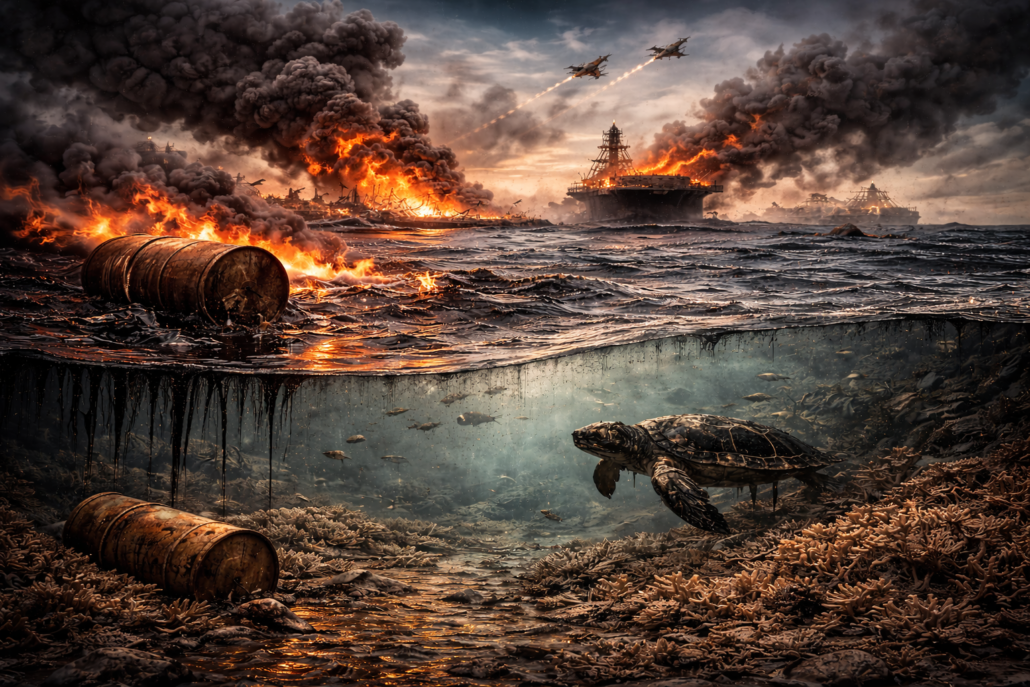
The environmental impacts of the war are equally critical in marine systems, where conflict intersects with oceanic climate processes. In the Black Sea, conflict-related activities have led to significant chemical contamination and oil spills, spread of pollutants from damaged infrastructure, with long-term consequences for marine ecosystems and regional carbon regulation.[15] Recent assessments indicate that such degradation may have already pushed parts of the marine ecosystem toward critical thresholds, such as benthic hypoxia, highlighting how warfare can disrupt the “biological pump” of the ocean.[16] These cases demonstrate that contemporary warfare can, in some cases, approach emissions levels comparable to mid-sized national economies, particularly when hostilities are prolonged and the embedded carbon of reconstruction is taken into account.
Reconstruction and the Architecture of Carbon Lock-in
Post-conflict reconstruction introduces a secondary—and often more persistent—emissions phase, driven by the urgent need to rebuild damaged infrastructure, restore economic functionality, and re-establish basic services. While reconstruction is frequently framed as an opportunity to “build back better,” empirical evidence suggests that these periods typically trigger a significant emissions surge followed by long-term carbon lock-in, where high-emission pathways become embedded within recovery processes.
In the case of the Russia-Ukraine conflict, reconstruction is estimated to account for approximately 27% of total war-related emissions, reflecting the scale of damage to critical infrastructures, transport, energy and housing systems.[17] A substantial share of this footprint is linked to the use of “hard-to-abate” materials such as cement and steel.[18] Importantly, these impacts are not temporally distinct from warfare itself; the emissions associated with rebuilding are structurally embedded from the moment infrastructure is destroyed. This creates a continuous emissions profile in which present destruction shapes future carbon intensity.[19]
Evidence from other post-conflict contexts, including those of Iraq and Syria, reinforces this pattern. Under conditions of institutional fragility and resources constraints, reconstruction efforts tend to prioritise speed, cost-efficiency, and immediate functionality over environmental sustainability.[20] These pressures lead to reliance on conventional construction practices and fossil fuel-dependent energy systems, effectively locking in high-emission development pathways that persist long after conflict has ended.
In maritime and trade-dependent economies — particularly in the Indo-Pacific — these dynamics are even more pronounced. Damage to ports, coastal infrastructure, and logistics networks necessitates rapid restoration to maintain trade flows and economic stability. Under such conditions, sustainability considerations are often subordinated to operational imperatives, limiting the adoption of low-carbon materials and resilient design strategies. This creates a structural “double burden”, for vulnerable coastal states: the need to rebuild quickly while simultaneously facing increasing exposure to climate risks such as sea-level rise, coastal erosion, and extreme weather events.
Overall, reconstruction reshapes emissions trajectories by embedding carbon-intensive systems into recovery processes. Conflict, therefore, not only increases emissions in the short term but also locks in long-term carbon dependence, reinforcing its role as a structural driver of climate outcomes.
Energy Security vs Climate Resilience
In the Indo-Pacific, energy security is inextricably linked to the stability of maritime supply chains and the reliability of transboundary flows. Under these conditions, states frequently adopt securitised energy responses, prioritising short-term supply stability over long-term decarbonisation objectives. Energy systems therefore function as a critical nexus linking climate, economic, and security outcomes, where disruptions in one domain rapidly cascade across others.[21] These vulnerabilities are amplified by the region’s dependence on maritime chokepoints. Strategic routes such as the Strait of Malacca, the Sunda Strait, the Lombok Strait, and the Strait of Bab el-Mandeb, serve as critical arteries for global energy transport. Disruptions in these corridors generate a “chokepoint multiplier” effect, whereby localised instability produces cascading impacts across global supply chains. The 2024–25 disruptions in the Red Sea illustrate this:[22] rerouting vessels around the Cape of Good Hope significantly increased transit distances, fuel consumption, and per-voyage emissions, demonstrating that the climate impacts of conflict are diffused through interconnected logistical systems.
Recent tensions involving the United States, Israel, and Iran illustrate how conflict directly reshapes energy systems. Disruptions to the Strait of Hormuz—through which roughly a quarter of global seaborne oil trade and a significant share of LNG flows transit, with most volumes destined for Asia—have constrained supply and increased price volatility across global markets.[23] Limited alternative pipeline capacity further reinforces the system’s exposure to disruption. In response, States have prioritised energy security under conditions of uncertainty. This has led to a renewed reliance on dispatchable and stockpile-ready fuels such as coal and diesel, which provide reliable baseload power and reduce dependence on vulnerable supply chains. The impacts are particularly visible in Asia, where countries including India, Thailand, and Vietnam have increased coal consumption to offset disruptions in LNG supply.[24] Similar pressures risk reversing recent declines in coal use in China.[25]
At the same time, elevated fossil fuel prices and supply uncertainty have incentivised renewed investment in oil and gas exploration, as well as the expansion of LNG infrastructure. High energy prices generate windfall profits that flow back into exploration and extraction infrastructure. Recent developments, such as Venture Global’s new five-year LNG contracts and TC Energy’s fast-tracked export expansions, demonstrate that conflict-driven disruptions are actively accelerating the deployment of fossil fuel infrastructure.[26] Taken together, these dynamics demonstrate that conflict not only disrupts energy systems but actively reshapes them, pushing states toward short-term resilience strategies that risk entrenching long-term emissions trajectories.
This reflects a structural misalignment between energy resilience and climate mitigation. While low-carbon technologies are central to long-term climate goals, their contribution to resilience remains uneven due to intermittency, storage constraints, and grid-integration challenges.[27]
Moreover, the transition to low-carbon systems does not resolve these tensions; it merely reconfigures them. Renewable technologies depend on critical minerals (lithium, cobalt, and rare earth elements) that are geographically concentrated and often located in politically unstable regions. For example, over 70% of global cobalt supply originates from the Democratic Republic of Congo, creating supply chain vulnerabilities for battery production and renewable energy systems. Strategic control over the processing of these minerals—particularly by China—has introduced new forms of geopolitical leverage into low-carbon supply chains. This emerging “green conflict” dynamic suggests that decarbonization may reproduce old resource dependencies in new material forms, linking climate policy to emerging supply chain vulnerabilities.
These dependencies introduce new forms of geopolitical risk, shifting competition from fossil fuel reserves to mineral supply chains. In the Indo-Pacific—where maritime trade, industrial growth, and strategic rivalry intersect—this raises the likelihood that energy transitions will remain shaped by security imperatives. Rather than resolving existing tensions, decarbonisation pathways may reproduce them in new forms, embedding climate policy within evolving structures of geopolitical competition.
The Blue Frontier: Militarisation of Marine Systems
Military conflict directly disrupts marine ecosystems, transforming critical blue carbon sinks into degrading critical blue carbon ones, reducing their long-term sequestration capacity. This pathway—often underexamined within the climate–security nexus—extends the impacts of conflict beyond terrestrial emissions, weakening the ocean’s capacity to regulate climate and sustain ecological stability. The maritime dimension of conflict is therefore central to understanding climate risk. Oceans and coastal ecosystems not only sequester carbon but also support biodiversity, regulate biogeochemical cycles, and provide essential coastal protection. Disruptions to these systems have cascading consequences, undermining both ecological resilience and long-term climate regulation.
Coastal ecosystems—particularly mangroves, seagrasses, and coral reefs—are especially vulnerable. In the South China Sea, large-scale land reclamation and militarised island-building have caused extensive ecological damage, including the destruction of over 6,200 acres of coral reef, much of it linked to China’s activities.[28] Dredging and sediment plumes associated with these operations smother marine habitats and reduce primary productivity, while artificial structures replace biodiverse ecosystems with low-function substrates. This not only diminishes carbon sequestration capacity but risks converting long-standing carbon sinks into net emission sources.
Conflict also disrupts broader oceanic carbon processes, with empirical cases from the Black Sea and the Persian Gulf underscoring the link between hostilities and marine carbon regulation. In the Black Sea, the Russia–Ukraine war has generated repeated oil spills from damaged tankers and onshore facilities, combined with underwater explosions and intense naval activity.[29] Post 2022 field surveys and remote sensing analyses document elevated hydrocarbon concentrations, seagrass mortality in nearshore zones, and increased strandings of Black Sea dolphins, pointing to a decline in the biological pump’s efficiency and overall ecosystem resilience.[30] Similar dynamics are evident in the Persian Gulf, where missile and drone strikes on oil infrastructure have caused recurrent hydrocarbon leakage and marine pollution.[31]
Furthermore, ongoing hostilities involving the United States, Israel, and Iran have resulted in repeated strikes on oil infrastructure, missile facilities, and maritime assets, generating widespread pollution risks.[32] Evidence indicates hundreds of incidents of environmental harm, including hydrocarbon leakage, air and water contamination, and damage to coastal ecosystems. These impacts are particularly acute in water-stressed environments, where contamination of marine and freshwater systems poses long-term risks to both ecosystems and human health. Such conflict-driven pollution extends beyond immediate ecological damage. Hydrocarbon spills, particulate fallout, and chemical contamination introduce persistent environmental stressors that can alter marine food webs, degrade habitats such as seagrass meadows and mudflats, and disrupt regional carbon fluxes. In this sense, contemporary warfare not only damages marine ecosystems but also generates a “toxic legacy,” where environmental impacts continue to unfold long after active hostilities have ceased.[33]
These ecological impacts are compounded by governance disruptions. In Ukraine, conflict has reduced access-to and management-of ecologically significant coastal and marine areas, including Ramsar sites and marine protected areas (MPAs). Limited coverage, weak enforcement, and restricted access—exacerbated by territorial loss following the annexation of Crimea—have increased pressures such as illegal, unreported, and unregulated fishing, further degrading already stressed ecosystems.[34]
Taken together, these cases demonstrate that conflict reshapes the ocean’s carbon cycle at multiple scales—from the loss of coastal blue-carbon ecosystems to disruptions in offshore ecological processes and environmental governance. By undermining marine carbon sinks and weakening ecosystem resilience, the militarisation of marine systems amplifies climate risk while complicating long-term recovery and sustainability efforts.
Toward a Conflict-Sensitive Climate Framework
Addressing this requires a shift toward a conflict-sensitive climate framework grounded in three core dimensions. First, emissions accounting must be expanded to systematically include military activities, conflict-related infrastructure damage, and reconstruction processes, closing the persistent gap in global carbon inventories. Second, energy transitions must incorporate resilience considerations, reducing dependence on vulnerable supply chains and chokepoints while avoiding default reversion to carbon-intensive fuels under conditions of crisis. Third, blue carbon ecosystems must be recognised as critical climate infrastructure, requiring protection during conflict and prioritisation in post-conflict recovery strategies.
This challenge is compounded by persistent gaps in climate governance. Although the Paris Agreement removed formal exemptions for military emissions, reporting remains voluntary and inconsistent. The result is a continuing “Kyoto Gap,” whereby a significant share of emissions associated with defence activities, active conflict, and reconstruction, remains outside national inventories. This reflects a deeper structural misalignment between climate governance and security realities, where existing frameworks remain ill-equipped to account for emissions generated in conflict-prone systems.
At the same time, the degradation of marine ecosystems underscores the need to integrate ecological loss into climate and economic decision-making. The erosion of blue carbon systems not only reduces sequestration capacity but also weakens coastal resilience, suggesting the need for approaches that recognise ecological degradation as a long-term systemic cost rather than an externality. This will require institutional reform within existing governance frameworks, particularly the UNFCCC, where military emissions and conflict-related impacts remain largely exempt from systematic reporting.
The conventional separation between “security policy” and “climate policy” is no longer tenable. In an era of persistent geopolitical instability, the feasibility of achieving net-zero targets depends on integrating conflict into climate governance. Without such integration, climate policy will remain structurally incomplete—systematically underestimating the scale and persistence of conflict-related emissions and, in doing so, undermining the credibility of long-term decarbonisation pathways.
*******
About the Author:
Dr Chime Youdon is a Research Fellow at the National Maritime Foundation and heads its “Resilience, Sustainability, and Ocean Resources” (RSOR) Cluster. Her research is centred upon climate risk, resilience, and sustainable transitions in the coastal and maritime domain. She works at the intersection of climate science, governance, and policy, with a regional focus on India and the broader Indo-Pacific.
Endnotes:
[1] Tim Krieger, Diana Panke, and Michael Pregernig, eds., Environmental Conflicts, Migration and Governance (Cham: Springer, 2020).
See also: Ruben Dahm, Tobias Ide, Lena Schilling, and Jürgen Scheffran, “What Climate? The Different Meaning of Climate Indicators in Violent Conflict Studies,” Climatic Change 176, No 11 (2023), https://doi.org/10.1007/s10584-023-03617-x
[2] Rob Nixon, “Slow Violence and the Environmentalism of the Poor”, Cambridge, MA, Harvard University Press, 2011), https://southwarknotes.wordpress.com/wp-content/uploads/2018/10/slow-violence-and-the-environmentalism-of-the-poor.pdf
[3] Oliver Belcher, Patrick Bigger, Ben Neimark, and Cara Kennelly, “Hidden Carbon Costs of the ‘Everywhere War’: Logistics, Geopolitical Ecology, and the Carbon Bootprint of the US Military,” Transactions of the Institute of British Geographers 45, No 1 (2020): 65–80, https://doi.org/10.1111/tran.12319.
Also See: Neta C Crawford, “Pentagon Fuel Use, Climate Change, and the Costs of War,” Brown University Watson Institute for International and Public Affairs, 2019 https://watson.brown.edu/costsofwar/papers/ClimateChangeandCostsofWar
[4] Axel Michaelowa, “Climate Change Mitigation and Armed Conflict: Exploring the Linkages,” Climate Policy 23, No 4 (2023): 503–517, https://doi.org/10.1080/14693062.2022.2101255.
[5] Oliver Belcher, Patrick Bigger, Ben Neimark, and Cara Kennelly, “Hidden Carbon Costs of the ‘Everywhere War’: Logistics, Geopolitical Ecology, and the Carbon Bootprint of the US Military,” Transactions of the Institute of British Geographers 45, No 1 (2020): 65–80, https://doi.org/10.1111/tran.12319.
[6] Crawford, Neta C. “Pentagon Fuel Use, Climate Change, and the Costs of War.” Brown University Watson Institute for International and Public Affairs, 2019, https://watson.brown.edu/costsofwar/papers/ClimateChangeandCostsofWar.
[7] Stockholm International Peace Research Institute (SIPRI), “Unprecedented Rise in Global Military Expenditure as European and Middle East Spending Surges,” April 28, 2025, https://www.sipri.org/media/press-release/2025/unprecedented-rise-global-military-expenditure-european-and-middle-east-spending-surges.
[8] Lennard de Klerk et al, “Climate Damage Caused by Russia’s War in Ukraine: Three Year Assessment”, (Initiative on Greenhouse Gas Accounting of War, 2025). https://www.theguardian.com/environment/article/2024/jun/13/russia-war-with-ukraine-accelerating-global-climate-emergency-report-shows
[9] Damian Carrington, “Middle East Iran Conflict Could Trigger Environmental and Climate Crisis,” The Guardian, 21 March 2026, https://www.theguardian.com/world/2026/mar/21/middle-east-iran-conflict-environment-climate.
Also see: Jaspal Mannat, “The US–Israel–Iran Conflict: Energy, Climate, Food, and Water Impacts,” Observer Research Foundation Middle East, 2026, https://orfme.org/expert-speak/the-us-israel-iran-conflict-energy-climate-food-water-impacts/.
“US–Iran War: Environmental Cost and Climate Damage Explained,” India Today, 06 March 2026, https://www.indiatoday.in/science/story/united-states-us-iran-war-middle-east-donald-trump-environemntal-cost-climate-damage-climate-change-iran-nuclear-attacks-middle-east-2878176-2026-03-06.
[10] Berners-Lee, Mike and Duncan Clark. “What’s the Carbon Footprint of … the Iraq War?” The Guardian, 08 July 2010. https://www.theguardian.com/environment/green-living-blog/2010/jul/08/carbon-footprint-iraq-war.
Nikki Reisch and Steve Kretzmann, “A Climate of War: The War in Iraq and Global Warming” Washington, DC: Oil Change International, 2008, https://www.oilchange.org/wp-content/uploads/2008/03/Climate-of-war-2008.pdf.
[11] Damian Carrington, “Forest Fires Push Up Greenhouse Gas Emissions from War in Ukraine,” The Guardian, 24 February 2025, https://www.theguardian.com/world/2025/feb/24/forest-fires-push-up-greenhouse-gas-emissions-from-war-in-ukraine
[12] Damian Carrington, “Russia’s War with Ukraine Accelerating Global Climate Emergency, Report Shows.” The Guardian, 13 June 2024. https://www.theguardian.com/environment/article/2024/jun/13/russia-war-with-ukraine-accelerating-global-climate-emergency-report-shows.
[13] European Commission Joint Research Centre, “Status of Environment and Climate in Ukraine”, Luxembourg: Publications Office of the European Union, 2025, https://data.europa.eu/doi/10.2760/6292177.
[14] United Nations Conference on Trade and Development, “Navigating Troubled Waters: Impact to Global Trade of Disruption of Shipping Routes in the Red Sea, Black Sea and Panama Canal”, Geneva: United Nations, February 2024, https://unctad.org/system/files/official-document/osginf2024d2_en.pdf.
[15] Damian Carrington, “Middle East Iran Conflict Could Trigger Environmental and Climate Crisis”, The Guardian, 21 March 2026. https://www.theguardian.com/world/2026/mar/21/middle-east-iran-conflict-environment-climate.
[16] Caroline Kuzemko et al, “War, Energy, and Sustainability Transitions,” Environment, Development and Sustainability (2025), https://doi.org/10.1007/s10668-025-06763-7
[17] Simmone Shah, “Ukraine to Claim $44 bn in Climate Damages From Russia: Why War is So Bad for Emissions,” Time, 2025, https://time.com/7335449/ukraine-russia-war-climate-impact/.
[18]Ali Akbarnezhad and Jianzhuang Xiao, “Estimation and Minimization of Embodied Carbon of Buildings: A Review,” Buildings 7, No 1 (2017): 5, https://doi.org/10.3390/buildings7010005.
[19] Max Hunder, “Study Details Huge Emissions Resulting from Russia’s Invasion of Ukraine,” Reuters, 12 June 2024, https://www.reuters.com/world/europe/study-details-huge-emissions-resulting-russias-invasion-ukraine-2024-06-12/.
[20] United Nations Development Programme, “Iraq’s Environmental Sustainability Prioritized in New UNEP/UNDP Agreement, 2025”. https://www.undp.org/arab-states/press-releases/iraqs-environmental-sustainability-prioritized-new-unep/undp-agreement#:~:text=From%20his%20side%2C%20the%20Regional,live%20prosperously%20in%20the%20future
[21] Demetrio Panarello, Andrea Gatto, Elkhan Richard Sadik-Zada, and Luigi Aldieri, “Energy Sustainability, Vulnerability and Resilience,” Discover Sustainability 5 (2024): 326, https://doi.org/10.1007/s43621-024-00534-6.
[22] Samim Aktar and Nawaz Sharif, “Maritime Chokepoints and the Politics of Energy Security in the Indo-Pacific,” International Journal of Humanities and Social Science Research 12, No 1 (2026): 363–370, https://www.socialsciencejournal.in/assets/archives/2026/vol12issue1/12088.pdf.
[23] International Energy Agency, “Strait of Hormuz,” Oil Security and Emergency Response Fact Sheet. https://www.iea.org/about/oil-security-and-emergency-response/strait-of-hormuz.
[24] CoinLive, “Morgan Stanley Analysts Highlight Coal as Key LNG Alternative for Asia,” Longbridge, 05 March 2026, https://longbridge.com/en/news/277886313.
[25] Dharna Noor, “What Does the Iran War Mean for Clean Energy Transition? Here’s What to Know About How the Current Crisis Could Shape the Expansion of Renewable Energy,” The Guardian, 26 March 2026 https://www.theguardian.com/environment/2026/mar/26/iran-war-clean-energy-transition.
[26] Shree Mishra, “Venture Global Signs Five-Year LNG Offtake Deal with Vitol”, Offshore Technology Website, 24 March 2026, https://www.offshore-technology.com/news/venture-global-signs-lng-offtake-deal-vitol/
[27] Tyler Bennett Phillips et al, “A Framework for Evaluating the Resilience Contribution of Solar PV and Battery Storage on the Grid”, Idaho National Laboratory, Idaho Falls, October 2020, https://inldigitallibrary.inl.gov/sites/sti/sti/Sort_26275.pdf
[28] CSIS Asia Maritime Transparency Initiative, “Deep Blue Scars: Environmental Threats to the South China Sea,” Center for Strategic and International Studies, 18 December 2023, https://amti.csis.org/deep-blue-scars-environmental-threats-to-the-south-china-sea/.
[29] Eugene Simonov, “Military Oil Spill (2): Scale and Consequences of the Catastrophe for Flora and Fauna and the Region’s Ecosystems,” Voxeurop, 28 February 2025, https://voxeurop.eu/en/war-ukraine-ecosystem-black-sea/.
[30] Théodore Donguy, “The War in Ukraine Is Threatening the Ecosystem of the Black Sea,” Voxeurop, 24 October 2024, https://voxeurop.eu/en/war-ukraine-ecosystem-black-sea/.
[31] Seithikurippu R, Pandi-Perumal, and Konda Mani Saravanan, “Marine Life is a Silent Casualty of Armed Conflicts,” Nature 651, No 8107, 24 March 2026: 1124, https://doi.org/10.1038/d41586-026-00942-w.
[32] Conflict and Environment Observatory (CEOBS), “Iran War: Environmental Risk Overview as of 27th March,” 27 March 2026, https://ceobs.org/iran-war-environmental-risk-overview-as-of-27th-march/
[33] Natalie Muller, “Iran War Risks Long-Term Toxic Legacy for People and Nature That Ripples Beyond Borders,” Deutsche Welle, March 2026, https://www.dw.com/en/iran-war-risks-long-term-toxic-legacy-for-people-and-nature-that-ripples-beyond-borders/a-76335587.
[34] Conflict and Environment Observatory (CEOBS) and Zoï Environment Network, “Ukraine Conflict Environmental Briefing: The Coastal and Marine Environment,” February 2023, https://ceobs.org/ukraine-conflict-environmental-briefing-the-coastal-and-marine-environment/.

Leave a Reply
Want to join the discussion?Feel free to contribute!