
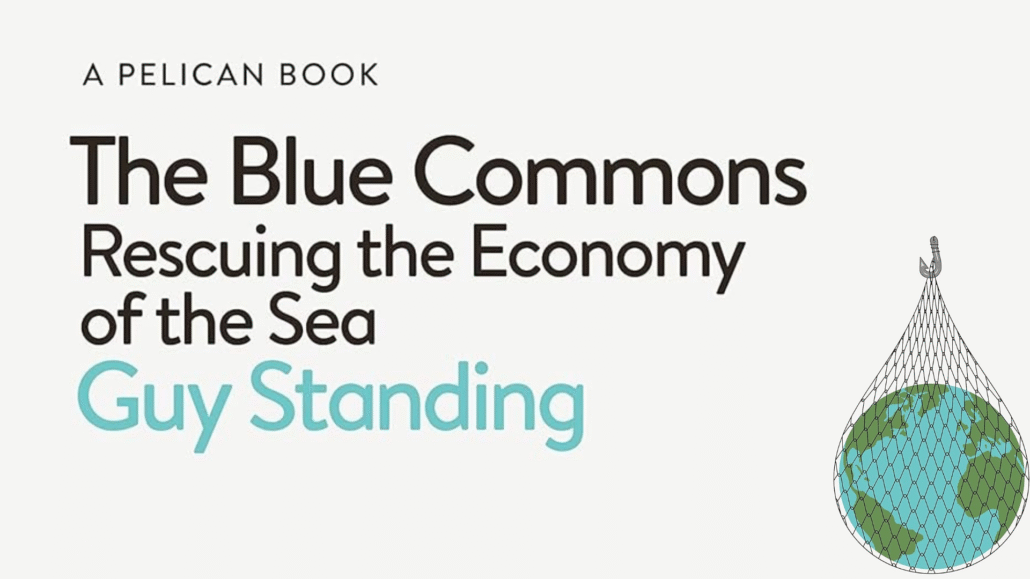
Author: Guy Standing. Penguin Random House UK, 2022. 584 pages, Rs. 965, ISBN: 978-0-241-47587-4 (Hard Bound)
The Blue Commons: Rescuing the Economy of the Sea, written by Guy Standing, draws attention to one of the planet’s most vital yet most endangered environments: the world’s oceans. The author is a British economist and professor at the School of Oriental and African Studies (SOAS), University of London. He is also a co-founder of the Basic Income Earth Network (BIEN), which advocates for universal basic income. Known for his work on inequality, he previously spent over 30 years at the International Labour Organisation. Much of his writing examines how public resources, such as land and the oceans, are increasingly captured by private interests, and he argues for restoring them as commons accessible to all.
In this book, Standing blends history, political economy and environmental analysis to show how the seas, long seen as humanity’s shared inheritance, have been systematically enclosed and commodified by States and corporations. This process, he argues, has led not only to ecological harm but also to the erosion of what he calls the “blue commons”: the collective rights and benefits that rightfully belong to everyone. In this framework, “blue commoners” are ordinary citizens, coastal communities, indigenous groups, and small-scale fishers, all of whom rely on the sea and should share in its benefits. By tracing how these shared resources have been steadily appropriated, Standing makes the case for reclaiming the oceans as a commons that is managed sustainably and governed for the public good.
He also shows how major powers have shaped ocean governance to protect their own interests, highlighting the United States as a key example. Although the UN Convention on the Law of the Sea (UNCLOS, 1982) was designed to create shared rules for managing marine resources, the US refused to ratify it, largely because it opposed the Convention’s provisions on redistributing seabed mining revenues to developing countries. By remaining outside UNCLOS, the US avoided obligations to share benefits from deep-sea resources and resisted the idea that parts of the seabed should be treated as a global commons. For Standing, this illustrates how powerful nations undermine collective frameworks when these threaten strategic or commercial advantage, reinforcing the inequalities the blue commons aims to confront.
Standing’s central thesis is compelling. Just as land and resources onshore have been enclosed over centuries, the oceans are now being privatised through fishing quotas, seabed mining licences, industrial aquaculture and militarised zones of control. He exposes how this process disproportionately enriches a small elite while marginalising coastal communities that have long depended on marine resources. Restoring the blue commons, he argues, requires rethinking ocean governance by placing stewardship, equity and sustainability at its core.
In the preface, Standing invokes Alexander von Humboldt, the pioneering explorer who warned of humanity’s attempts to dominate nature. Standing uses the example of the COVID-19 pandemic to show how the destruction of natural habitats forces pathogens to shift hosts and spill over into human populations. He links this pattern of ecological disruption to broader marine crises: warming seas altering weather patterns, rising sea levels accelerating coastal erosion and contamination threatening food systems and displacing coastal communities. From here, he traces how similar dynamics of degradation and enclosure operate across the ocean.
The book then moves into the chapter “Who Owns the Sea?”, where Standing explains how control over the oceans shifted dramatically in the 20th century. He discusses the creation of Exclusive Economic Zones (EEZs), which extended national authority 200 nautical miles from a nation’s baselines. While this framework clarified ocean jurisdiction, it also reshaped global power dynamics. Countries with long coastlines gained vast new marine territories, while others, such as China, which felt constrained by these boundaries, were left dissatisfied. Standing argues that these tensions continue to influence maritime disputes, geopolitical rivalries and competing claims over ocean resources today.
He also highlights the alarming decline in ocean health driven by IUU fishing, pollution, climate change and unregulated industrial expansion. Throughout the book, he provides examples of how corporations and political actors have carved up ocean spaces through exclusive fishing rights, deep-sea mining concessions or offshore energy projects, often at the expense of small-scale fishers, indigenous groups, and fragile ecosystems.
Standing critiques the wave of “partnerships for sustainable development” that followed the 1992 Rio Summit. Despite lofty promises, he argues, governments and international organisations placed excessive faith in market-based solutions and private finance, even as environmental destruction continued. Mechanisms such as debt-for-nature swaps often ended up benefiting wealthy governments, banks and large conservation NGOs, while doing little to empower poorer countries or address the deeper inequalities driving environmental decline.
He further emphasises the consequences of weak global governance. Although the ocean covers more than two-thirds of the planet, responsibility for its protection is fragmented across international bodies, national governments and private actors. This patchwork system, he argues, enables exploitation rather than preservation, allowing profit to overshadow long-term ecological stability.
Standing also reflects on Brexit, using it to illustrate how political decisions can weaken environmental protections. Leaving the European Union removed several marine safeguards upheld by EU regulations, making the UK more vulnerable to deregulation and corporate capture of ocean resources. The political rhetoric of “taking back control” of British waters, he notes, was largely symbolic: the fishing industry represents only a tiny fraction of the UK economy, yet it was instrumentalised during the referendum. Rather than restoring the commons, Brexit risked placing more control in private hands at the expense of sustainability and long-term public benefit.
Yet, the book is not only a critique; it is also a call for action. Standing proposes a range of reforms, from establishing a “Blue Commons Trust” to eliminating harmful subsidies and strengthening the rights of coastal communities. He argues that ocean resources should be managed democratically and sustainably, with benefits shared broadly rather than captured by a privileged minority.
In the closing chapters, Standing shifts from diagnosis to possibility. He highlights cases such as Korea’s Jangdo Island, where local fishers revived a community-managed system that restored marine health while ensuring every household received a basic income from shared resources. Such examples show how commons-based governance can generate ecological recovery, social equity and economic security at the same time. Standing proposes the creation of Blue Commons Funds, designed around stewardship, redistribution and intergenerational equity, to ensure that the wealth derived from marine resources supports both sustainability and public welfare. He ends with an urgent call for collective action, arguing that protecting the oceans cannot rely solely on international declarations; meaningful progress requires rethinking economic priorities and confronting the inequalities embedded in ocean governance.
While The Blue Commons is compelling and richly researched, it is not without limitations. Standing is strongest when exposing the political economy of ocean enclosure and the failures of global governance. However, his proposals for blue commons funds and income distribution, although imaginative, can seem idealistic and difficult to implement in the current geopolitical landscape. At times, the book paints powerful States and corporations with too broad a brush, simplifying complex maritime disputes and the varied capacities and capabilities of developing nations. Readers seeking detailed policy roadmaps may find the solutions more aspirational than practical. Despite these limitations, the book succeeds in reframing how we think about ocean resources and offers a powerful argument for treating the seas as shared inheritance rather than commodities.
Overall, The Blue Commons challenges readers to rethink their relationship with the sea, not as an inexhaustible frontier to be exploited but as a shared life-support system that demands collective responsibility. Through its combination of sharp analysis and moral urgency, the book offers both a warning and a blueprint for safeguarding the oceans for future generations.
******
About the Author
Ms Kripa Anand is a Research Associate at the National Maritime Foundation (NMF). Her research encompasses maritime security issues, with special focus upon the manner in which India’s own maritime geostrategies are impacted by the maritime geostrategies of the island-States of Oceania in general and Australia and New Zealand in particular. She may be reached at ocn1.nmf@gmail.com.


Leave a Reply
Want to join the discussion?Feel free to contribute!