
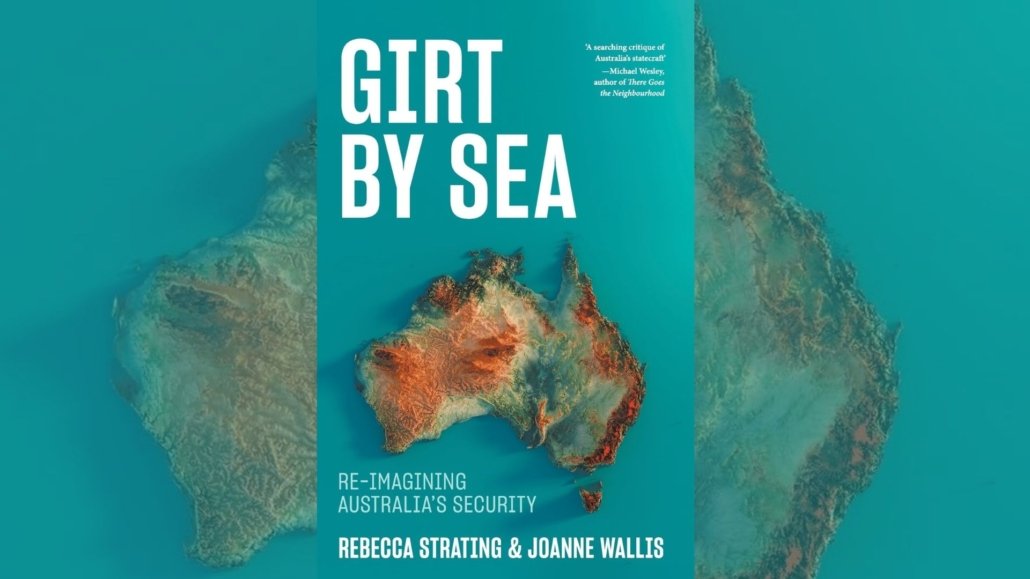
Authors: Rebecca Strating and Joanne Wallis. Collingwood, Australia: La Trobe University Press in conjunction with Black Inc, 2024. 287 pages, Rs. 2,000, ISBN: 9781760644512
Girt by Sea: Re-Imagining Australia’s Security is a thought-provoking exploration of Australia’s maritime identity and strategic outlook. Published in April 2024 by La Trobe University Press, the book is co-authored by Professor Rebecca Strating, Director of La Trobe Asia and a professor of politics and international relations at La Trobe University, and Professor Joanne Wallis, a professor of international security at the University of Adelaide. By reimagining Australia’s place in its surrounding seas, the authors prompt readers to reconsider how the nation engages with its closest neighbours and navigates the shifting dynamics of the Indo-Pacific region. Together, Strating and Wallis bring a wealth of academic and practical experience to Girt by Sea, offering a nuanced analysis of Australia’s maritime security challenges and advocating for a more regionally focused and integrated strategic approach.
The book is structured around six key maritime regions central to Australia’s national interests: the North Seas (including the Timor, Arafura, and Coral Seas, and the Torres Strait), the Western Pacific, the South China Sea, the South Pacific, the Indian Ocean, and the Southern Ocean. This regional division allows the authors to delve into the specific security challenges and strategic considerations unique to each area, providing a comprehensive analysis of Australia’s maritime domain.
The authors highlight that an ‘inescapable’ feature of Australia is that it is girt (that is, ‘surrounded’) by the sea. It holds the world’s third-largest maritime jurisdiction and the largest search-and-rescue zone, spanning 53 million square kilometres, and includes over 8,200 islands. Notably, 65% of Australia’s two-way trade is with Asia, including one-third with China. Despite strong trade ties with neighbouring states and ongoing defence cooperation, Australia has consistently relied on the United States as its security guarantor. The authors delve into the Australian Government’s 2016 Defence White Paper; the 2020 Defence Strategic Update and the 2023 Defence Strategic Review, which describes intensifying China–US rivalry as the central dynamic shaping the Indo-Pacific region. They also highlight that Australia lacks a comprehensive maritime strategy, despite being an island nation heavily reliant on sea trade and critique Australia’s pursuit of nuclear-powered submarines under AUKUS. They argue it reflects an overly militarised approach to security that risks strategic autonomy, strains regional relationships, and diverts resources from non-military challenges like climate change and diplomacy. The authors call for a more balanced strategy that prioritises regional cooperation, sustainability, and a broader understanding of national security.
Strating and Wallis then turn their attention to Australia’s northern seas, highlighting a 2022 case where Torres Strait Elders successfully challenged the Australian government’s inaction on climate change, prompting questions about Australia’s commitment to coastal communities’ human and economic security. They argue that addressing non-traditional threats like climate change and illegal fishing requires rethinking entrenched security approaches and fostering regional cooperation. Northern Australia, they note, is a strategic hub for defence, the US alliance, and ties with Indonesia, Papua New Guinea, and Timor-Leste.
The next section of the book focuses on the Western Pacific, in which, Strating and Wallis argue that while Australia is geographically distant from Taiwan, it is increasingly entangled in the strategic calculations of a potential US–China conflict. They contend that Australia’s military capacity is unlikely to be decisive in such a scenario, but Canberra may still find itself involved— either through securing sea lanes, participating in proxy engagements, or under alliance obligations via ANZUS. The authors highlight the lack of serious domestic discussion about the real costs of war, including economic disruption and potential conscription. They further emphasise that Australia’s strategic discourse often overlooks the divergent interests of regional powers such as Japan, India, and South Korea, who may not align automatically with US objectives. Strating and Wallis underscore the rising risk of miscalculation, particularly in contested maritime zones, and recommend that Australia prioritise regional diplomacy, crisis management frameworks, and legal instruments over narrow militarised strategies.
In Chapter 4, The South China Sea, the authors cite Richard Marles, currently the Deputy Prime Minister of Australia, who described the South China Sea as “the most difficult issue” in the Australia–China relationship. Conflict in the region could have significant ramifications for trade, threatening the supply chains for energy sources on which Australia is heavily dependent. Australia has also expressed concern over China’s militarisation of the South China Sea and the shifting balance of power away from the United States.
The authors critique Australia’s reliance on a US led, rules-based order that Washington itself often undermines. They highlight how environmental threats, such as climate change, overfishing, and artificial island-building are deeply entwined with security concerns, calling for integrated responses. While Australia engages diplomatically and militarily in the region, it is hesitant to participate in US-led Freedom of Navigation Operations (FONOPs), viewing them as risky and potentially provocative. The authors call for a reassessment of Australia’s maritime policy, one that is less tethered to US strategy and more attuned to regional dynamics and environmental realities.
In the South Pacific chapter of Girt by Sea, Strating and Wallis argue that Australia must rethink its approach to the region, especially amid China’s growing influence. The 2022 security pact between the Solomon Islands and China sparked serious concern in Australia, challenging its traditional role as the region’s key security partner and raising fears of a potential Chinese military presence. Australia’s ability to assert influence is further constrained by the region’s vast geography— often referred to as its “backyard”— which spans 15% of the Earth’s surface and 30 million square kilometres. While Australia views China as a strategic threat, many Pacific Island nations welcome Chinese investment due to pressing development needs and dissatisfaction with Western engagement.
The authors stress that Australia should move beyond a narrow security lens and instead address the root causes of insecurity, such as underdevelopment, climate change, and governance challenges. They call for a more empathetic and locally attuned foreign policy— one that acknowledges colonial legacies, supports Pacific autonomy, and invests in development, labour rights, and regional cooperation articulated in the Blue Pacific narrative, which emphasises the importance of “collective actions” within the Pacific Ocean. A more collaborative approach, they argue, is key to both regional stability and Australia’s long-term interests.
In Chapter 6, Strating and Wallis shift focus to the Indian Ocean, pointing out that India remains the leading maritime power here, while Australia, despite having the region’s largest coastline and maritime domain, still lacks a comprehensive Indian Ocean strategy. Its initial “Look West” policy under the Hawke government led to the formation of the “Indian Ocean Rim Association” (IORA) in 1997, but focus diminished under subsequent governments. Strategic attention resumed with the 2013 Defence White Paper under the Gillard government and intensified during Julie Bishop’s tenure as Foreign Minister, particularly in support of India’s SAGAR (Security and Growth for All in the Region) policy-initiative, which has now evolved into a policy encapsulated by the acronym MAHASAGAR (Mutual and Holistic Advancement for Security and Growth Across Regions).
Strating and Wallis outline Australia’s evolving engagement with the Indian Ocean, highlighting its strategic ramifications— nearly half of its Exclusive Economic Zone lies in this region, including vital territories like the Cocos (Keeling) and Christmas Islands. Recent years have seen Australia deepen ties with India, enhance bilateral and multilateral cooperation, and participate in frameworks such as the Indo-Pacific Oceans Initiative (IPOI), where it leads the marine ecology pillar.
The authors emphasise Australia’s increasing role in regional maritime security through mechanisms such as the Quad, the Indian Ocean Naval Symposium (IONS), and IORA. These align with Australia’s goals of promoting a rules-based maritime order and countering coercive behaviour. Strategic interests also include safeguarding undersea cables, shipping routes, and chokepoints like the Strait of Hormuz.
The authors are refreshingly upfront about the unevenness in Australia’s historical engagement, portraying a country still coming to terms with the need to move beyond episodic interest and instead develop a long-term strategic vision, one that balances its Pacific priorities with the complex, and often less familiar, dynamics of the Indian Ocean.
In Chapter 7, the authors review Australia’s strategic role in Antarctica and the Southern Ocean, highlighting its leadership in environmental diplomacy through key treaties such as the 1959 Antarctic Treaty and 1991 Madrid Protocol. They praise Prime Minister Bob Hawke’s rejection of mining in favour of permanent conservation. Despite Australia’s large territorial claims, its recent strategic focus has waned amid rising geopolitical interest from China, Russia, and others. Strating and Wallis call for Australia to renew its Antarctic leadership by boosting science, surveillance, and diplomacy, balancing sovereignty with treaty cooperation, reducing dependence on the US, and strengthening regional partnerships— especially with Asian countries— to safeguard peace, environment, and legal order amid growing challenges.
Girt by Sea presents a persuasive case for reshaping Australia’s strategic outlook by focusing on its maritime surroundings. The authors effectively highlight the limitations of Australia’s reliance on traditional alliances and Indo-Pacific narratives. However, the book would have benefited from more concrete policy recommendations, as the discussion often remains conceptual rather than offering actionable strategies such as diplomatic or military initiatives. Although the authors advocate regional cooperation, the analysis relies more on policy interpretation than on direct engagement with Pacific and Southeast Asian perspectives. Incorporating regional voices through interviews or case studies could have added greater depth and authenticity.
Structured around six key maritime regions, the book offers valuable insights into each area. Yet, this compartmentalisation may lead to a somewhat fragmented narrative. Thematic overlaps, such as environmental concerns or transnational security threats, could have been more cohesively explored to better reflect the interconnectedness of Australia’s maritime security landscape. Additionally, the academic tone, while appropriate for the subject, comes across as being overly cautious. The measured language often understates the urgency of the issues at hand, limiting the book’s impact on a broader audience seeking a more assertive and impassioned argument.
In summary, Girt by Sea is a timely and thoughtful contribution to Australian security discourse. While it could have delivered an even more compelling vision for reimagining Australia’s strategic future with a more integrated structure, clearer policy direction, and stronger regional representation, it is, nevertheless, a must-read book for all those interested in a contemporary Australian perspective of the country’s maritime engagement within the Indo-Pacific.
******
About the Author
Ms Kripa Anand is a Research Associate at the National Maritime Foundation (NMF). Her research encompasses maritime security issues, with special focus upon the manner in which India’s own maritime geostrategies are impacted by the maritime geostrategies of the island-States of Oceania in general and Australia and New Zealand in particular. She may be reached at ocn1.nmf@gmail.com.


Leave a Reply
Want to join the discussion?Feel free to contribute!