
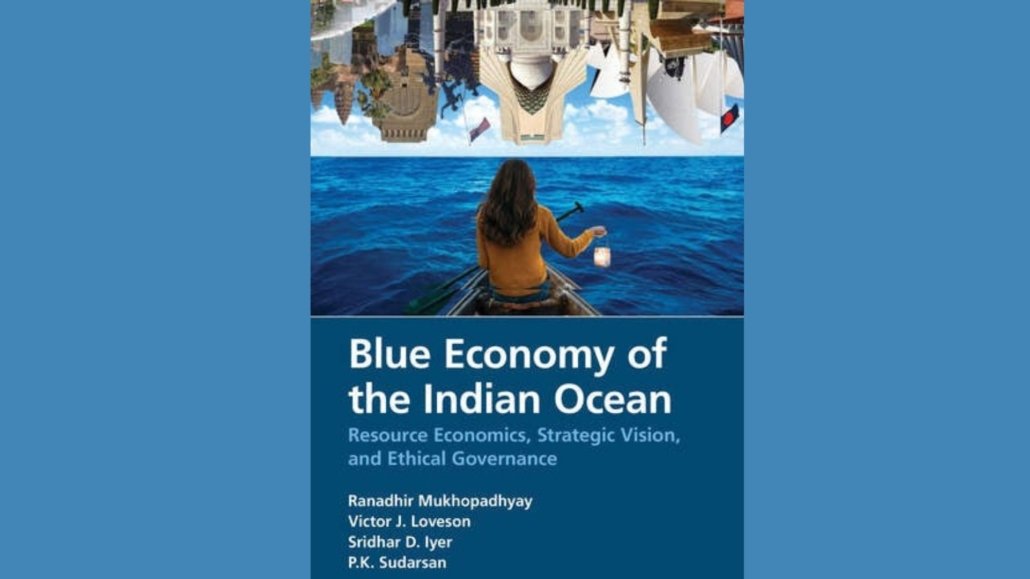
Authors: Ranadhir Mukhopadhyay, Victor J Loveson, Sridhar D Iyer, and PK Sudarsan. CRC Press (Taylor & Francis Group), US & UK 2021. 297 pages, Rs 2963, ISBN: 978-0-367-52382-4 (Paperback)
Against the backdrop of intensifying climate change, growing resource pressures, and widening socio-economic inequalities, conventional economic frameworks are under increasing strain. Blue Economy of the Indian Ocean: Resource Economics, Strategic Vision, and Ethical Governance engages with this contested intellectual space by reframing how ocean-based development is conceptualised and pursued. Authored by Ranadhir Mukhopadhyay, a veteran Earth scientist and former Director of the Mauritius Oceanography Institute, alongside senior oceanographers Victor J Loveson and Sridhar D Iyer from India’s CSIR-National Institute of Oceanography, and economist PK Sudarsan of Goa University, the book melds environmental science, developmental economics, strategic foresight, and ethical discourse into a cohesive narrative that pushes readers to rethink how the world’s most dynamic oceanic region can—and should—navigate its future.
At its core, this book challenges the deeply embedded linear model of “growth at all costs” that has dominated economic thought for decades. The authors argue that this model is fundamentally incompatible with ecological stability and long-term prosperity, especially for regions like the Indian Ocean where the environment and human wellbeing are intrinsically linked. Their central thesis posits that a “blue economy”, one that balances economic development with ecological sustainability and social equity—is not only desirable but essential for the Indian Ocean’s future.
The book opens with a clear and analytically grounded Introduction that combines conceptual clarity with an urgent sense of realism. It presents the blue economy as a transformative development paradigm that moves beyond conventional models of resource extraction, instead advocating economic systems that enhance human well-being while safeguarding the ocean’s life-support functions. The authors note that almost three-fourths of planet Earth is covered by water, of which oceans account for approximately 96.5 per cent, supporting more than 95 per cent of the biosphere. Oceans therefore play a central role in climate regulation, food security, and livelihoods worldwide. Yet they are under unprecedented stress due to overfishing, pollution, and rising ocean temperatures. The authors argue that without a fundamental shift toward sustainability embedded within economic policy and practice, both marine ecosystems and dependent communities face irreversible consequences.
Importantly, the Introduction does not engage with theory in isolation. It also outlines the geographic, biological, and historical dimensions of the Indian Ocean, situating the blue economy within the region’s distinctive context. This integrated framing is especially significant given that the Indian Ocean region is home to some of the world’s most vulnerable coastal populations, communities that are likely to bear the greatest impacts of environmental degradation and climate change.
The second chapter, The Indian Scenario, functions as a detailed case study of India’s blue economy potential. It examines both living resources, such as captured fisheries, mariculture, and bio-products, and non-living resources, including coastal minerals and offshore energy. The book’s emphasis on mariculture and bio-products reflects a broader trend in blue economy thinking: moving beyond extractive industries to sectors that generate value through innovation and ecological harmony. Offshore renewable energy sources—such as wave, tidal, and solar—are also discussed as long-term economic opportunities that can reduce carbon dependence while expanding energy access.
This chapter is striking for its breadth and depth, not shying away from hard data or complex policy implications. It highlights, for example, how traditional fishing practices and related industries, including net making, boat construction, and fish processing, are deeply embedded in local economies. These sectors, when envisioned as part of a blue economy strategy, can uplift coastal livelihoods while preserving ecological balance. Yet the authors do not idealise the reality: overfishing, inadequate infrastructure, and regulatory gaps remain pressing obstacles.
The third chapter expands the lens beyond India, examining the Indian Ocean Region (IOR) as a mosaic of nations with disparate socio-economic realities. From South Africa and Mauritius to Kenya and Bangladesh, each sub-region is profiled through its resources, challenges, and progress toward sustainable ocean-related activities. This regional overview underscores a crucial insight: the blue economy is not a one-size-fits-all model. Each country must tailor strategies in accordance with its ecological characteristics, institutional capacities, and development aspirations.
Importantly, this section highlights success stories as well as cautionary tales. For example, the economic impact of sustainable fisheries and tourism in some island States suggests pathways for growth that remain ecologically respectful. Conversely, shortcomings in infrastructure or governance in other areas reveal the severe costs of neglecting strategic planning. By comparing these diverse cases, the authors illustrate both the promise and the peril inherent in translating blue economy concepts into actionable national strategies.
A defining strength of this book lies in its balanced treatment of threats and opportunities. The chapter on Threats to the Blue Economy catalogues the multidimensional risks facing the Indian Ocean—plastic and acoustic pollution, carbon emissions, invasive species, and geopolitical tensions among them. These are not abstract hazards; they represent real impediments to human well-being and economic stability. Climate change-induced sea-level rise, for instance, endangers millions of coastal residents and could displace entire communities if left unaddressed.
The subsequent chapter on Opportunities Ahead focuses on providing solutions. Drawing from global best practices and emerging trends, the authors outline areas where the IOR could lead in sustainable development—such as marine biotechnology, renewable energy, blue carbon markets, and eco-tourism. What stands out here is their emphasis on entrepreneurship and innovation. Rather than waiting for top-down policy shifts, local businesses and start-ups can catalyse change by adopting sustainable technologies, reducing energy use, and creating value that aligns with ecological preservation.
The chapters on Economic Projections and the Ethical Blue Economy deepen the intellectual rigour of the text. Economic projections provide realistic scenarios for growth, weighing both macroeconomic data and environmental constraints. These projections are not simplistic forecasts; they are nuanced analyses that account for differential development pathways across countries and sectors.
Equally important is the book’s focus on ethics. All too often, economic discussions treat growth and profit as goals in and of themselves. Here, the authors argue for ethical governance at the core of the blue economy—governance that prioritises ecological health, community rights, and intergenerational equity. This ethical perspective is not merely symbolic; it is fundamental, challenging exploitative models that have historically pushed environmental and social costs to the margins.
The epilogue ties together the book’s thematic strands with a call to action. It underscores the urgency of global cooperation, technological innovation, and policy coherence to safeguard the Indian Ocean’s ecosystems while harnessing its developmental potential. The authors rightfully emphasise that the blue economy cannot be an exclusive project of governments or experts alone; it must be a collective endeavour involving civil society, private enterprise, and local communities.
Conclusion
Blue Economy of the Indian Ocean is more than a scholarly volume—it is a strategic blueprint for reimagining growth in one of the world’s most dynamic yet vulnerable regions. Its greatest merit lies in its interdisciplinary integration: it bridges science, economics, policy, and ethics in a way that few books on the subject have managed. While the book offers a comprehensive and theoretically rich account of the blue economy, parts of the discussion may be dense and less accessible to non-specialist readers, particularly practitioners or policymakers seeking concise, actionable guidance. Nevertheless, the depth and breadth of its analysis make it an indispensable resource for researchers, policymakers, business leaders, and students of ocean governance.
In an age defined by ecological disruption and economic uncertainty, this book offers not just critique but a constructive vision—one that insists sustainability and prosperity are not mutually exclusive but deeply interconnected. As nations and communities grapple with how to steward their ocean resources responsibly, this text stands as a compelling and necessary guidepost.


Leave a Reply
Want to join the discussion?Feel free to contribute!