
The ongoing USA-Iran-Israel conflict, escalating sharply in end-February 2026, has thrust the maritime domain into the forefront, with kinetic actions to and from the sea, disruption of global seaborne traffic, and the challenge of projecting naval power in narrow seas. As a preliminary analysis of the maritime dimensions of the ongoing conflict in West Asia, this paper primarily seeks to highlight issues pertaining to maritime actions as on 05 March 2026.
Simultaneously, the National Maritime Foundation is undertaking more in-depth studies into the issues highlighted here, so that commentators and the general public at large are made aware of the actual rule positions, doctrinal aspects and operational philosophies of maritime force-employment, so that they can discern fact from hyperbole and ill-informed reportage.
Casus Belli
Tensions have ignited from combined US and Israeli strikes targeting purported Iranian nuclear sites, IRGC assets, and military infrastructure, whilst the Iranian response has included US and Israeli targets across the region. The core trigger appears to be Iran’s continued direct or proxy threats to Israel and US interests in West Asia, with the tipping point for kinetic action being reached in the lack of consensus in arriving at a nuclear deal. As President Trump stated on 28 February 2026, “…menacing activities directly endanger the United States, our troops, our bases overseas, and our allies throughout the world… they’ve rejected every opportunity to renounce their nuclear ambitions, and we can’t take it anymore.”[1]
Principal Actors and Attributes
Whilst the conflagration has spread to other States by Iran’s strikes, this article limits the term “principal actors” to Iran, Israel, the US, and the wider seafaring community for the purpose of analysis. The response and scale thereof of other States is still unfolding and thus remains subjective.
Having operated at sea in this area, this author is of the opinion that Iran enjoys a certain degree of home ground advantage in the Persian Gulf, wherein it can exercise effective sea denial, and a modicum of sea control.
Iran has demonstrated its reach by targeting Israel earlier. Its recent missile firings leading up to hostilities tend to indicate a level of preparedness, and the ‘closing’ of the Strait of Hormuz demonstrate intent. This closure is unprecedented, since the Strait was not closed even during the “tanker war”[2] that occurred during the eight-year Iran-Iraq war, nor during the Iran-Israel conflict last year.
A central position, interior lines of operations, and combat experience in narrow seas contribute to Iran’s home ground advantage unless its culmination point is brought out about quickly, by way of addressing its command and control, as well as logistics sustenance. Apex level decapitation strikes have served to address the first factor in some measure, with several echelons of its senior leadership being killed. The logistics advantage eventually translates to relative combat power over time and depends upon the the US-Israel combine’s desired end state(s), criteria for success and failure, along with decisive points across various lines of operation of the campaign plan.
Israel, for its part, has over time and by way of strikes on Iran, demonstrated both reach and intent. Its multidomain technological capability provides a useful tool for both rear area security, as also long-range strikes. A lack of blue water reach would have been an important limiting factor, but this has been mitigated by the US Navy.
The US, with CENTCOM’s assets, is a resident power, and its trans-regional deployment capability permits surge to address the operational factors of force, space and time. President Trump’s eight-minute address on 28 February 2026 provides clear “commander’s intent” in an era of grey zone operations, by addressing the basic questions of why, who, what, where, how (in broad strokes), and when, to the extent wherein it provides event, rather than time-based guidance. On 02 March 2026, he amplified that the expected timeline was four to five weeks.[3]
Importantly, the Iranian Revolutionary Guard has been offered immunity if it were to surrender unconditionally—a clear lesson learned from Op IRAQI FREEDOM, wherein the Republican Guard and Police were disbanded, only to subsequently become a potent adversary. Conflict termination thus depends upon the IRGC accepting the offer, but its continuing actions indicate otherwise. The components of the operational factor of “time” (time, timing and tempo) would provide answers, as the campaign plan unfolds.
As these actors interact, it is the global arteries of economic growth and human prosperity beyond the Gulf, too, that are adversely affected. According to a NITI Aayog paper related to the Indian Ocean Region (IOR), approximately 100,000 ships transit through the Indian Ocean annually, plying nearly 30 per cent of global containerised cargo, and 42 per cent of global crude oil.[4] Although these waterways are now denied, the impact on global trade cannot yet be fully ascertained.
Existing non-traditional threats and “blue crime” such as piracy; maritime terrorism; IUU fishing; drug-, people- and narcotics-trafficking; as also climate change impact have now been superimposed with a layer of State-on-State conflict. The immediate future is uncertain, and post-conflict analysis alone will provide the human and materiel cost.
As of now, the effects are already being felt by trade, as exemplified by the advisory issued by the United Kingdom Maritime Trade Operations (UKMTO) indicate significant military activity in the Persian Gulf, Gulf of Oman, North Arabian Sea and the Strait of Hormuz. It also apprises mariners of the potential for elevated electronic interference, including disruption to Automatic Identification Systems (AIS) and other navigational or communications systems. The advisory takes cognisance of vessels (ostensibly IRG ships) broadcasting that the Strait of Hormuz has been closed but also indicates that these are not legally binding.[5] Military ultimatums from the IRG notwithstanding, the real closure of traffic has actually been effected via insurance companies and promulgation of High Risk Areas that encompass the Persian Gulf and the Gulf of Oman (as depicted in Figure 1). Tellingly, insurance agencies have increased war risk premiums from approximately 0.2 per cent of ship value to nearly 1 per cent, adding to a significant jump in costs for every shipment. For example, a tanker worth $100m would now have to pay war‑risk premium of USD 1 million instead of USD 200,000 before the crisis.[6] Consequent upon Iran’s attacks across the region, Qatar has stopped LNG production, and daily freight rates for LNG tankers have increased by 40 per cent.[7]
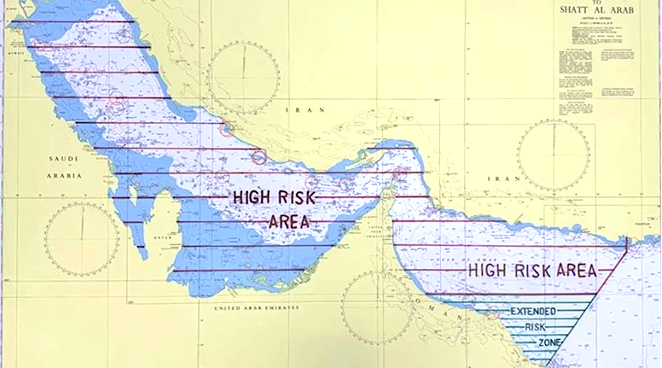 Fig 1: High Risk Area, March 2026.[8]
At this juncture, the pattern appears to follow previous crises, where traffic has been disrupted, insurance rates spiked, and mental health of crews on vessels affected. Nearly 21 million barrels of oil transit the Strait of Hurmuz daily, and closure is likely to result in price rise to USD 120 per barrel.[9]
Deployment
Operation EPIC FURY was launched on 28 February 2026 and, more than 50,000 troops, 200 fighters, two aircraft carriers, at least one submarine, and bombers from the United States are participating in this operation. Within the first 24 hours of the launch of operations, Iran was subjected to multidomain strikes from seabed to space and cyberspace. Given that maritime situational awareness (MSA), pre-positioning, and presence, are all key to naval operations, this has been a well-orchestrated campaign, with US forces surging into the Area of Operations (AO). By 04 March 2026, 2,000 targets had been struck, degrading Iran’s air defences, ballistic missiles/ launchers, and drones.[10] Iran’s ballistic missile attacks are reported to have decreased by 90% since the first day of the conflict; likewise, Iranian drone attacks have decreased by 83% in the same timeframe.[11]
Sea Control and Control of the Air
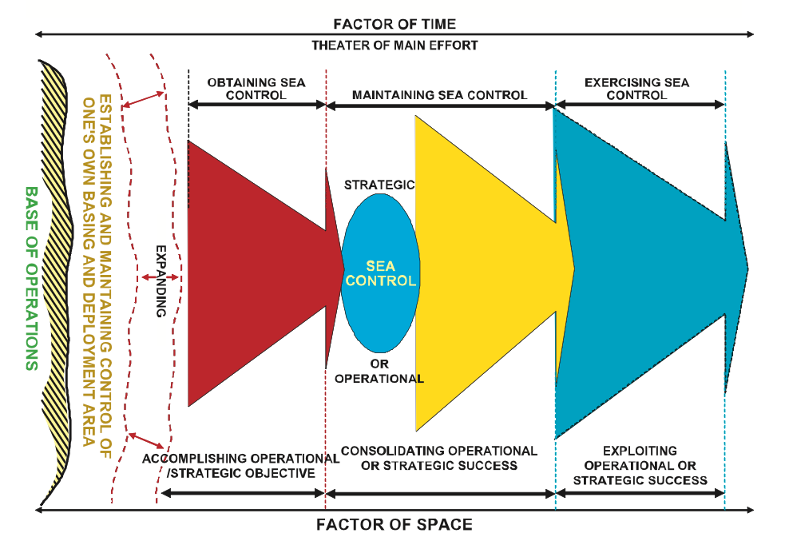 Figure 2[12] offers a schematic of sea control dynamics and depicts the well-known relationship between sea control and the operational factors of “time” and “space”.
As declared by President Trump, the entire Iranian Navy is quite literally being taken off the board, and the sinking of 17 ships in the AO, followed by the sinking of a frigate, the IRSIS Dena, off Sri Lanka, speaks to degree of sea control that the US Navy has achieved quite so rapidly to meet its assigned objectives.
Herein lies a lesson for navies that seek to secure national interests across large areas of operation — the criticality of Carrier Battle/ Strike Groups (CBGs/CSGs). Sea control — the ability, for a specified period of time, to utilise a specified sea-area for one’s own purposes while simultaneously denying the use of that sea-area to one’s adversary — is a critical requirement for achieving naval objectives, and the ability to project power to influence matters on land. Sea control is thus integrated as a mission, within the IN’s strategy of fielding Carrier Task Forces (CTFs) comprising one or more CBGs in battle. Shore-based aircraft can rarely, if ever, meet the here-and-now imperative for air power. This twin-imperative needs integral air power under the fleet commander’s direct command.
The Falklands Conflict of 1982 was the first time missile-armed shore-based air power went to war against aircraft carriers, and although ships were lost, but the carriers won. Since then, the aircraft carriers have rarely been challenged in conflict, and the US Navy, with its long-range vectors and mobility, is proving that much of the hype regarding drone-swarms, etc., is just that — hype. In this context, it is prudent to note that the US CSGs were amongst the very first major combat-elements to be put in place and that military operations began in earnest only once the USN CSGs had been properly deployed. This has been lucidly brought out by US Navy Captain Robert C Rubel in his article “Whatever Happened to Command of the Sea”, published in the January 2026 issue of the US Naval Institute Proceedings.[13]
As Op EPIC FURY progresses, the deployment of US CSGs is very likely to be a future case study, as one group is deployed in the northwestern reaches of the Indian Ocean and enjoys far greater more sea room that the other group that is deployed in the relatively ‘closed’ Mediterranean Sea. Deploying major blue water naval combatants such as a CBG/CSG within the restricted and land-locked waters of the Persian Gulf and the Gulf of Oman goes against the fundamental deployment tenets of naval warfare. The sinking of the Moskva in the Black Sea is an illustrative case in point and serves to underscore the great truths that geography always matters and that adequate sea room for blue water major combatants is an imperative that may be ignored only at great peril.
Contextual to the issue of sea control moving “in to out” as illustrated in Figure 2 above, an issue that needs analysis is the nature of overseas facilities, wherein one must (a) protect one’s own facilities, (b) protect host nation infrastructure and its populace, in order to retain post-conflict confidence, and (c) build capacity and capability of the host nation to an extent where it can defend itself — and one’s own assets as well.
Another interesting dimension is a possible distinction in respect of US objectives relevant to Iranian military maritime forces. The Iranian Navy (the NEDAJA) and IRGC Navy (NEDSA — also known as the Sepah Navy) are two distinct entities. While the US national and op level leadership has, indeed, indicated—quite unequivocally—that the entire Iranian Navy will be sunk, there is no similar specificity about the IRGC Navy. Yet it is the NEDSA and not the NEDAJA that announced the closure of the State of Hormuz. It remains to be seen whether the NEDSA would continue operations (enforcing the closure of the Strait of Hormuz), or surrender and seek US clemency. A third option could very well be a temporary retreat to safety, transforming into a “Fleet in Being”, much like the Italian Regia Marina, after the display of British carrier-borne power projection during the Battle of Taranto, 1940. The last option may require further analysis, since it is non-binary and may possibly involve IRGC ships seeking shelter in foreign ports. The last, whilst possible, seems improbable, given the indiscriminate targeting of other States by Iran.
As regards the air campaign, US-Israeli actions appear to have quickly moved from the attainment of a “favourable air situation” (quite akin to sea control) to “command of the air”, since there is no reported damage to B1, B2 and B-52 bombers conducting strikes on missile facilities deep inside Iran. The ability of Task Force SCORPION STRIKE, using reverse-engineered Iranian drones on one-way missions to strike Iran also speaks to the command of the air achieved by US-Israeli shore-based as well as and sea-based air power.
Further, attacks on mobile missile launchers not only indicate the level of op and tactical level intelligence, surveillance, and reconnaissance (ISR) available to US-Israeli forces, but have also led to reduction of threats to surface forces, military, and civilian targets. Reminiscent of the ‘Scud Busting’ that was witnessed during Op DESERT STORM, all this offers proof that while history might not repeat itself, it certainly rhymes.[14]
Lessons for the Indian Navy
Relationships vs Law. India and the US have signed four foundational agreements, and requests for logistics support may require an even-handed approach towards all sides.
Chokepoint Control. As the resident navy in the IOR, the IN would need to work with the MEA to ensure trade flows resume at the earliest. Indian warships have deployed in harm’s way earlier, and this is an opportunity to reassure the world.
Force Protection. The protection of prospective dual-use facilities abroad may require force allocations for their defence in order to retain the partner nation’s confidence and assure future partnerships as well. In an area of interest as vast as the Indo-pacific, this would be a fairly uphill task, and future acquisitions may require additional offensive and defensive vectors that could be either sold or gifted to India’s partners.
Terminal Air Defence. Deployment of ships for air defence off an enemy coast denudes warships of their critical attribute of mobility and creates predictable defensive patterns that are fraught with danger in today’s combat milieu of supersonic antiship missiles and drone swarms that are capable of being effectively deployed against naval combatants operating in coastal waters. Terminal Air Defence using long range vectors should be provided by the Indian Air Force, thus freeing-up naval assets for offensive tasks.
Strategic Communication. The “battle of the narrative” must be tightly controlled, and not result in ill-informed speculation by media and social media. A case in point is the engagement of the Iranian frigate off Sri Lanka, wherein much of the commentary in the public domain displays an astonishing level of ignorance amongst interlocutors who appear to have “missed the memo” by which the IN transformed itself from a brown water navy to a major blue water one, affording a credible threat to its enemies and adversaries. This capability has come from a change in mindset of a small-to-medium navy that had coastal concerns, to a trans-regional force that has the ‘large navy’ outlook of a major maritime power.
Operational Logistics. Quantity has a quality of its own, and the Indian Navy would need to stockpile enough air defence vectors and ammunition to sustain a prolonged conflict.
Maritime (and Undersea) Situational Awareness. Operating over large AOs in areas contested by multidomain threats from the seabed to space requires timely and accurate actionable intelligence. The submarine engagement of the Iranian frigate, the Dena, is a clear indication of the MSA available to the USN, and such situational awareness would be a pre-requisite for an Indian Navy engaged prosecuting operations in distant waters.
Conclusion
The US-Israel-Iran conflict unfolding presents much food for thought for planners, commentators and particularly the lay public, given that videos of ships being hit and sunk are capturing the imagination. At the outset, it has shown how a clear “Commander’s Intent” permits planners to develop options that are operationally feasible and logistically sustainable.
It has also brought to fore the uncertainty and vulnerability of maritime trade, the importance of access control via chokepoints, sea control, sea denial, and the necessity of having a balanced force structure. All of these are time-tested doctrinal issues that were being given short shrift in an era of low-end conflict.
This ongoing conflict has already served to remind all students of the art and science of war that the lessons of military history still have an important place, and that a well-planned old-fashioned naval offensive delivered with overwhelming force by blue water navies can make short work of brown water coastal defence navies that rely on shore-based air cover and the safety of their coasts. Blue water navies protect their coast by operating off the enemy’s coast, because offence is invariably the best defence.
This analysis has attempted to abjure uninformed conjecture. Nevertheless, it recognises that the conflict is ongoing, and a more objective assessment would need to be undertaken when greater details are available…more anon.
*******
Endnotes
[1] https://www.pbs.org/newshour/world/read-trumps-full-statement-on-iran-attack. Text of President Trump’s video statement, 28 Feb 2026. Accessed on 03 March 2026. In discussing casus belli, the words ‘we can’t take it anymore’ may well provide food for thought in ensuing public international maritime law discourse, even though there is enough precedent for such actions. On one hand, they could be interpreted as an echo of the spirit behind Article 51 of the UN Charter relating to self-defence, and on the other hand, it may be argued that they may not comply with the letter of Article 51.
[2] https://www.strausscenter.org/strait-of-hormuz-tanker-war/. Accessed 06 March 2026.
[3] https://www.npr.org/2026/03/02/nx-s1-5732258/us-iran-hegseth-caine. Accessed on 03 March 2026.
[4] NITI Aayog, Government of India Working Paper Gondwana: Economic Integration of Indian Ocean Region. https://niti.gov.in/sites/default/files/2026-02/Gondwana-Economic-Integration-of-Indian-Ocean-Region.pdf?utm_source accessed on 03 March 2026.
[5] https://www.ukmto.org/ukmto-products/advisories/2026. Issued on 28 Feb 2026. Accessed on 03 March 2026.
[6] https://www.aljazeera.com/economy/2026/3/3/maritime-insurers-cancel-war-risk-cover-in-gulf-will-it-spike-energy-cost. Accessed on 06 March 2026.
[7] https://www.tbsnews.net/worldbiz/middle-east/global-oil-gas-shipping-costs-surge-iran-vows-close-strait-hormuz-1375931. Accessed on 06 March 2026.
[8] https://www.imec.org.uk/the-international-bargaining-forum-ibf/ibf-risk-areas. Accessed on 03 March 2026. In 2008, a set of guidelines was introduced by the IBF for maritime employers and seafarers which intended to define the rights and responsibilities for both parties sailing in the Gulf of Aden where piracy was rife. This is now used to inform shipping companies and seafarers about threatened areas.
[9] https://www.idnfinancials.com/news/61770/usiran-conflict-tanker-traffic-in-strait-of-hormuz-not-fully-halted
[10] https://www.youtube.com/watch?v=0Yw69XKqVcA. Video update by Commander US CENTCOM 04 March 2026. Accessed on 04 March 2026.
[11] https://www.war.gov/News/News-Stories/Article/Article/4424786/hegseth-says-theres-no-shortage-of-american-will-resources-in-operation-epic-fu/. Briefing by Secretary of War and Commander CENTCOM on 05 March 2026. Accessed on 06 March 2026.
[12] Joint Operational Warfare Theory and Practice, Milan Vego. US Naval War College, 2009. Page II-50.
[13] https://www.usni.org/magazines/proceedings/2026/january/what-happened-command-sea. Accessed on 06 March 2026.
[14] Theodore Reik, ““The Unreachables”. (“It has been said that history repeats itself. This is perhaps not quite correct; it merely rhymes”). https://quoteinvestigator.com/2014/01/12/history-rhymes/


Leave a Reply
Want to join the discussion?Feel free to contribute!