
 https://moderndiplomacy.eu/
Keywords: Indonesia, China, DOC, COC, Code of Conduct, Indo-Pacific, MAHASAGAR.
Indonesia’s Geostrategic Centrality in the Indo-Pacific
Indonesia occupies a geostrategic position along some of the world’s most vital international shipping lanes (ISLs), through which over 60% of global maritime trade flows annually.[1] Despite not being a formal party to the South China Sea disputes involving the Spratly or Paracel Islands, Indonesia remains deeply entangled in maritime tensions due to the overlap between its EEZ near the Natuna Islands and China’s expansive “ten-dash line”. Jakarta has long grounded its maritime policy in legal rigour. Its EEZ claims, based on straight archipelagic baselines from the outermost Natuna Islands, are fully consistent with the UNCLOS. Under this framework, Indonesia possesses sovereign rights over natural resource exploitation and the authority to regulate and prohibit foreign fishing in its EEZ. Accordingly, Jakarta’s objections to illegal Chinese fishing activities and its enforcement actions, such as arresting foreign fishing vessels, are not only lawful but essential to preserving its maritime integrity.[2]
Yet, China remains Indonesia’s largest trading partner and a critical investor in multiple sectors of the Indonesian economy, including strategic ones such as infrastructure, energy, and fisheries. These relationships are becoming increasingly important as Indonesia strives to achieve high-income status by 2045.[3] The political calculus within Indonesia further complicates matters. President Prabowo’s economic platform, anchored in an ambitious goal of 8% annual growth, hinges on foreign investments and industrial advancement, especially in emerging sectors like electric vehicles.[4] Domestic pressures — such as a shrinking middle class, stagnant productivity, and economic inequality — have only intensified the appeal of Chinese investment. China’s strategic alignment with these goals has found a receptive audience in Jakarta.
In November 2024, President Prabowo Subianto’s visit to Beijing, where a joint statement was made suggesting a “common understanding on joint development” in disputed waters.[5] The ambiguity of this phrasing sparked domestic and regional concern. Although Jakarta later issued a unilateral clarification affirming that the agreement did not imply recognition of China’s maritime claims, the damage to strategic credibility was already evident. Without a mutual correction of the narrative, Beijing retains room to interpret the agreement in its favour — an outcome that undercuts Indonesia’s long-standing rejection of China’s unlawful claims under UNCLOS. Nonetheless, the diplomatic space for such legal distinctions is narrowing, particularly when strategic language is left deliberately vague.
Indonesia’s recent policy signals appear to blur this legal clarity with its participation implicitly acknowledging overlapping claims has prompted concern among regional observers and legal scholars. While Indonesian officials insist the agreement does not imply recognition of the infamous but misleading ten-dash line, critics argue that the optics undermine Indonesia’s legal and diplomatic consistency. The move also weakens the credibility of Jakarta’s firm rejections of Chinese incursions, such as those into the Tuna Block, a critical gas field where Chinese Coast Guard presence prompted sharp protests in 2021.[6] Indonesia’s relationship with China is marked by a strategic dualism — economic pragmatism on one hand, and geopolitical wariness on the other. This dual-track approach introduces inconsistencies, particularly evident in the contrast between Indonesia’s joint statement with China and the subsequent unilateral clarification by the Ministry of Foreign Affairs.
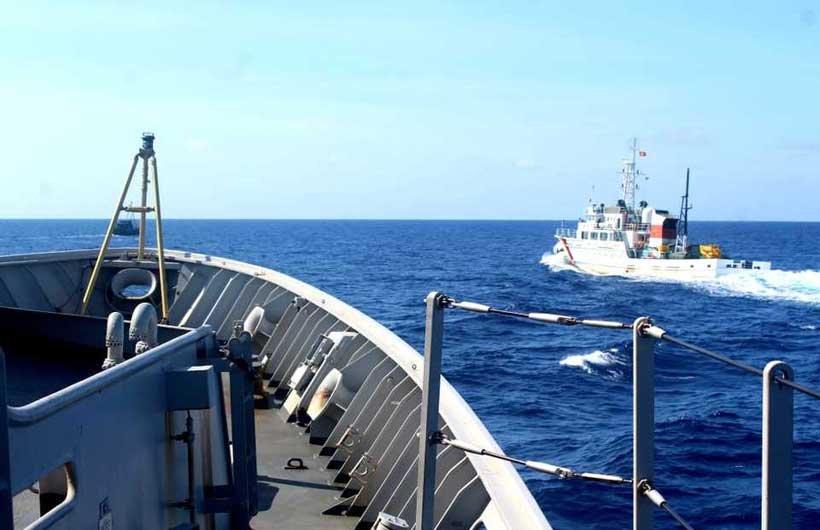
As Southeast Asia’s largest economy, Indonesia has deepened trade and investment ties with Beijing, welcoming billions in Chinese capital for flagship projects such as the Jakarta–Bandung high-speed rail and the Cirata floating solar power plant.[7] However, these gains exist alongside mounting frictions in the maritime domain. During the first week of President Prabowo Subianto’s administration in October 2024, Indonesian naval and coast guard forces confronted and expelled Chinese coast guard ships from the Natuna EEZ on three separate occasions, underscoring the persistent tension between security imperatives and economic interests.[8]
Additionally, amid the intensifying US–China strategic rivalry and rising tensions in the South China Sea, Jakarta finds itself increasingly entangled in maritime friction with Beijing. Despite recent diplomatic overtures, such as the inaugural senior-level “2+2” dialogue between the respective defence and foreign affairs senior officials, Indonesia’s concerns over Chinese encroachment remain acute.[9]
The Perils of Proximity: Indonesia’s China Strategy Under Scrutiny
Chinese Coast Guard vessels continue to escort fishing fleets into Indonesian waters — actions that breach Indonesia’s sovereign rights under UNCLOS. While China retains the right to “innocent passage”, using State vessels to shield illegal fishing operations violates international maritime law and erodes Jakarta’s authority in its own EEZ. Indonesia’s willingness to engage in maritime economic cooperation with China — even in sensitive zones — raises alarms over the enforcement of maritime law, particularly concerning IUU fishing (IUUF). The presence of Chinese fishing fleets, often escorted by the China Coast Guard, has already led to confrontations in Indonesian waters. This, in turn, threatens local livelihoods and fisheries sustainability in an already contested maritime environment. These concerns are compounded by recent geopolitical signals. The docking of China’s advanced Type 075 amphibious assault ship the Hainan (31), with two other frontline PLAN guided-missile frigates — the Liuzhou (FFG 537) and the PLAN Hengyang (FFG 568) — at Indonesia’s Port of Tanjung Priok in late 2024, although couched in the language of a technical turn-around and a goodwill visit, highlights Beijing’s growing maritime reach.[10] Meanwhile, China continues to oppose Indonesia’s lawful oil and gas exploration within its EEZ, further exposing the strategic incongruity of Jakarta’s willingness to cooperate in areas where Chinese objections persist.
Indonesia has responded by escalating patrols and enhancing military installations across its far-flung islands in the Natuna region. While Jakarta sees the maritime agreement as a potential incentive for finalising the long-stalled CoC (Code of Conduct) between ASEAN and China, the reality is far more complex. The lack of cohesion within ASEAN, amplified by Indonesia’s ambiguous stance, may weaken the bloc’s negotiating leverage, making it more difficult to achieve a binding and enforceable CoC grounded in consensually-derived international law.
Between Opportunity and Risk: Indonesia’s Strategic Outlook in a Shifting Indo-Pacific
Indonesia’s consistent position since 2020, articulated in its official rejection of China’s “nine-dash line” at the United Nations, underlines its commitment to UNCLOS and a rules-based maritime order. Unlike other ASEAN claimants, such as Vietnam and the Philippines, who have resisted joint development proposals out of concern for legitimising China’s claims, Indonesia’s openness to such initiatives requires careful recalibration. Indonesia’s 2022 EEZ delimitation agreement with Vietnam, which took over a decade to conclude, could face political backlash or delay in ratification, as Ha Noi may question Jakarta’s commitment to mutual legal consistency. While this may well be presented as economic pragmatism, it risks blurring legal boundaries and diminishing Jakarta’s leadership role within ASEAN on maritime legal norms and the declaration of the Code of Conduct (CoC). Moreover, by leveraging the legal provisions of UNCLOS for an archipelagic State, Indonesia is provided with both, a moral and strategic imperative, to lead regional efforts in resisting Chinese maritime overreach. Softening this stance for short-term investment gains could cost Indonesia far more in long-term strategic influence and sovereignty protection.
Critics argue that by acknowledging overlapping claims in the Natuna waters, Indonesia has signalled a softening of its traditional stance. However, this should not be misinterpreted as a capitulation. Rather, it reflects a strategic shift to manage tensions while securing political and economic dividends. Still, ambiguity in rhetoric and policy leaves Indonesia vulnerable to divergent interpretations, especially by Beijing.
Indonesia’s Security Equation with China in 2025
Indonesia’s evolving security relationship with China reveals a complex balancing act. Key developments in early 2025 reflect both cooperation and latent friction:[11]
- 08 January 2025: Bakamla–China Coast Guard Talks: Emphasis was laid on combating IUUF and ensuring freedom of navigation. Ironically, even while reaffirming mutual interests, these talks occurred against the backdrop of continued illegal fishing activities by Chinese vessels in Indonesia’s EEZ.
- 09–10 January 2025: PLA Chief’s Visit to Jakarta: The visit to Jakarta by General Liu Zhenli resulted in agreements to deepen military exercises and personnel exchanges. While cooperation is expanding, it remains unclear how Indonesia will reconcile this with its persistent maritime disputes.
- 22 January 2025: Indonesian Defence Minister’s Visit to Beijing: Defence Minister Sjafrie Sjamsoeddin’s trip reinforced earlier agreements and explored potential military technology transfers. However, Indonesia reiterated that such cooperation must not compromise its national interests or territorial integrity.
The most significant diplomatic engagement occurred during President Prabowo’s visit to Beijing in November 2024, which yielded over $10 billion in investment agreements spanning infrastructure, trade, and maritime development.[12] Though marketed as economic cooperation devoid of sovereignty implications, such agreements risk legitimising China’s claims, particularly when other ASEAN claimant States, including Vietnam and the Philippines, have deliberately avoided such arrangements for fear of undermining their legal positions.
The ambiguity surrounding Indonesia’s policy is exacerbated by such a statement, framing cooperation on fisheries and resource-development in disputed waters as non-prejudicial to sovereignty, which offers Beijing a rhetorical advantage. Unless managed with extreme diplomatic precision, such language risks being interpreted by China through strategic messaging as implicit acquiescence to its “ten-dash line” claims, weakening Indonesia’s legal standing and credibility among regional and international partners, and the Chinese have done precisely that.
India–Indonesia Strategic Ties: Navigating Convergence in a Shifting Indo-Pacific
In this context, the bid to strengthen the maritime defence partnership between India and Indonesia reflects a shared strategic calculus as a counter to China’s increasing assertiveness in the Indo-Pacific, particularly in the South China Sea. India’s commitment to a consensually derived rules-based regional order has aligned both nations in pursuit of mutual deterrence and defence modernisation. Crucially, this defence cooperation is underpinned by a shared commitment to international law. Both nations reaffirmed the principles of the 1982 UNCLOS and emphasised peaceful dispute resolution, freedom of navigation, and unimpeded maritime trade in their joint statement.[13] These affirmations directly challenge China’s efforts to unilaterally redefine maritime boundaries and signal the emergence of a more coordinated regional response.
While China has vocally criticised India’s defence exports to ASEAN nations, arguing that they contribute to instability, such claims overlook the legitimate security concerns of Southeast Asian States. China’s actions — supporting Pakistan’s naval build-up, expanding military ties with Sri Lanka and Myanmar, and deploying vessels across contested waters — have prompted affected countries to diversify their respective defence partnerships.[14] India’s outreach is a natural response to these dynamics, rather than a provocation.
President Prabowo Subianto has reaffirmed Indonesia’s intent to continue infrastructure collaboration in Sabang and the Andaman Islands, underscoring Jakarta’s recognition of India as a key strategic partner.[15] More recently, India and Indonesia have elevated their coordination mechanisms. In January of 2025, the two countries agreed to deploy an Indonesian International Liaison Officer at India’s Information Fusion Centre – Indian Ocean Region (IFC-IOR), signalling enhanced surveillance cooperation.[16] This move reflects both nations’ prioritisation of Maritime Situational Awareness (MSA) and Maritime Domain Awareness (MDA), as critical in countering IUUF, drugs and arms trafficking, and incursions by third-party actors, particularly in the face of China’s expanding naval footprint.
India’s potential sale of the BrahMos supersonic cruise missile to Indonesia — currently in its final stages — is a pivotal step in this evolving relationship. The deal, valued at $450 million, follows a similar agreement that India had concluded with the Philippines and underscores India’s growing role as a net provider of security.[17] For Indonesia, the procurement is part of a broader effort to bolster maritime defence capabilities in response to grey-zone coercion and assertive manoeuvres by Chinese maritime forces. The visits by Indonesian defence officials to Indian military-industrial facilities, and high-level diplomatic exchanges between President Prabowo Subianto and Prime Minister Narendra Modi, signify not only defence alignment but also a broader strategic convergence, which should be pursued continuously and vigorously.[18]
Moreover, the prospective White Shipping Information Exchange (WSIE) agreement and combined maritime patrols in the Eastern Indian Ocean could bolster refined and efficient interoperability. These initiatives are not just tactical, but part of a broader strategic convergence: India’s maritime policy, which is encapsulated in the acronym MAHASAGAR (Mutual and Holistic Security and Growth Across Regions) aligns well with Indonesia’s maritime policy of being the Global Maritime Fulcrum (GMF) in terms of promoting the freedom of navigation, rules-based maritime governance, and inclusive Indo-Pacific cooperation.
Nonetheless, significant challenges persist. The development of Sabang Port — a key maritime node envisioned to enhance Indo-Indonesian naval cooperation — has seen limited progress, and continues to be hampered by bureaucratic inertia and an absence of sustained strategic investment. Moreover, the lack of a trilateral or minilateral framework involving other Indo-Pacific partners such as Australia, Japan, or the United States restricts the potential for interoperability, coordinated MSA/ MDA, and combined patrols in the eastern Indian Ocean.
India’s potential sale of the BrahMos supersonic cruise missile to regional actors like Indonesia marks a bold strategic leap in defence diplomacy. However, this comes with escalating concerns about technology security. In an increasingly volatile geopolitical environment, the transfer of high-end, dual-use military technology — even to friendly nations — carries inherent risk. There is a growing possibility of these platforms being reverse engineered, diverted, or falling into the orbit of belligerent actors due to regime change, coercive diplomacy, or weak export controls. For India, the imperative must be twofold: to expand its strategic partnerships without compromising on its technological edge, and to ensure that defence exports are nested within a clear framework of end-use verification, security assurances, and long-term strategic alignment.
Navigating Troubled Waters: Indonesia’s Potential Maritime Response to China’s Encroachment
China cannot be contained through strategic ambiguity. In a region defined by maritime tension and legal complexity, clarity, consistency, and credibility are paramount. Jakarta must reaffirm its leadership in upholding international maritime law, not merely in statements, but in action — before short-term diplomatic overtures risk long-term strategic compromise. To preserve its strategic autonomy and legal consistency, Indonesia must:
- Reject Joint Development in Disputed Waters: Any cooperation with China must be confined to uncontested zones. Allowing economic engagement in disputed areas sets a dangerous precedent for the dilution of sovereignty.
- Enhance Deterrence: Continued investment in maritime surveillance and the garrisoning of strategic islands, particularly in Natuna — will strengthen Jakarta’s capacity to monitor and deter unlawful incursions.
- Clarify Policy Messaging: A unified foreign policy apparatus is essential. Discrepancies between political statements and diplomatic clarifications could weaken Indonesia’s credibility and strategic posture.
Indonesia’s future in the Indo-Pacific will depend on its ability to assert its maritime rights without alienating vital economic partners. Striking this balance requires not strategic ambiguity, but principled engagement, rooted in law, regional solidarity, and long-term national interest.
Maritime cooperation must be confined strictly to undisputed waters — anything less risks being interpreted as tacit acceptance of contested claims, undermining Indonesia’s legal and strategic standing. There is no room for complacency. Jakarta must take the lead in fast-tracking a binding, verifiable ASEAN–China Code of Conduct, firmly rooted in the principles of UNCLOS. Delay only serves those who seek to redraw maritime boundaries through coercion and fait accompli tactics. At the same time, Indonesia’s growing defence ties with India, the United States, and Japan are at risk of dilution should Jakarta appear increasingly deferential to Beijing’s maritime assertiveness.
Indonesia’s bebas dan aktif (independent and active) doctrine must not be mistaken for passivity.[19] In today’s strategic environment, ambiguity breeds vulnerability. The window for preserving strategic autonomy is rapidly narrowing—and it cannot be done through hedging alone. It demands a recalibrated foreign policy that is visibly aligned with international law, bolstered by proactive regional coordination, and supported by like-minded maritime democracies. Failure to do so will not only cede initiative to more aggressive actors but will cast doubt on Indonesia’s role as a regional anchor. The time for strategic equivocation is over. What is now needed is bold, lawful, and unambiguous maritime leadership—before the tide turns irrevocably.
Conclusion
India and Indonesia, as pivotal Indo-Pacific middle powers, must move beyond symbolic gestures and not allow themselves to remain stuck at merely institutionalising their maritime partnership, but move it ahead through structured mechanisms. This includes regular joint naval exercises, accelerated technology transfers, and integrated information-sharing systems for Maritime Situational Awareness (MSA) leading to MDA. Such efforts should be embedded within a formal strategic dialogue framework, ensuring consistency and long-term alignment. Financial cooperation, too, deserves prioritisation. The push towards using local currencies in bilateral trade should be seen not merely as economic pragmatism, but as a hedge against external geopolitical pressures and dollar-dominated vulnerabilities.
Critical infrastructure projects, such as the development of Sabang Port near the Strait of Malacca, must be expedited, and the white shipping agreements between the two countries should be the priority at this time. These initiatives are not just about connectivity — they are strategic counterweights to China’s assertive maritime expansionism, particularly in the South China Sea, where Beijing continues to redraw boundaries through coercive means of strategic communications and to extend its influence into the Indian Ocean region.
The India–Indonesia partnership offers an alternative model, grounded in international law, mutual sovereignty, and collective regional stewardship. In an era of great power flux, the India-Indonesia partnership could be a role model that illustrates middle powers as not merely spectators but active architects of maritime order. Their collaboration reflects a shift from reactive diplomacy to proactive, interest-driven engagement, where regional balance is sustained not by hegemonic dictates, but by the deliberate agency of committed stakeholders.
******
About the Author
Mr Chemi Rigzin is a Research Associate at the National Maritime Foundation. He holds an MPhil degree in Geography from Delhi University. His research currently focuses upon critical areas of hard security such as PLA naval modernisation, and Chinese port construction and facilities. He also delves into more generalised threats to shipping and maritime connectivity within the Indo-Pacific. He may be contacted at pcrt4.nmf@gmail.com
Endnotes:
[1] China Power Team, “How Much Trade Transits the South China Sea?”, China Power, 25 January 2021, https://chinapower.csis.org/much-trade-transits-south-china-sea/
[2] Fardah Assegaf, “Fisheries Ministry detains five foreign fishing boats in Natuna”, Antara, 4 March 2020, https://en.antaranews.com/news/142830/fisheries-ministry-detains-five-foreign-fishing-boats-in-natuna?utm
[3] IMF Country Report, Indonesia “Golden Vision 2045: Structural Reforms to Achieve High-Income Status”, IMF Country report, 2 July 2024.
[4] IMF Country Report, “Golden Vision 2045: Structural Reforms to Achieve High-Income Status”
[5] Arie Firdaus, “Jakarta seeks to contain fallout from South China Sea agreement with Beijing”, Radio Free Asia, 13 November 2024, https://www.rfa.org/english/southchinasea/2024/11/13/indonesia-china-maritime-agreement/?utm
[6] Tom Allard, Kate Lamb and Agustinus Beo Da Costa, “China protested Indonesian drilling, military exercises”, Reuters, 01 December 2021, https://www.reuters.com/world/asia-pacific/exclusive-china-protested-indonesian-drilling-military-exercises-2021-12-01/
[7] Fajar Hirawan, “Beijing-Jakarta partnership beyond trade”, China Daily, 13 April 2025, https://www.chinadaily.com.cn/a/202504/13/WS67fb6550a3104d9fd381ef89.html?utm
[8] Indonesian National Police, “Bakamla Expels Chinese Coast Guard Vessel from North Natuna Sea”, INP Website, 27 October 2024, https://inp.polri.go.id/artikel/bakamla-expels-chinese-coast-guard-vessel-from-north-natuna-sea?utm
[9] Christopher Bodeen, “China and Indonesia agree to boost maritime security cooperation in South China Sea despite tensions”, AP News, 21 April 2025, https://apnews.com/article/china-indonesia-south-china-sea-security-building-29c2e091e53703b68c471e0ba9829d2b
[10] Li Jianjun and Qiao Chenxi, “Chinese naval taskforce makes technical stop in Indonesia”, China Military, 26 December 2024, https://eng.chinamil.com.cn/CHINA_209163/TopStories_209189/16361427.html?utm
[11] Muhammad Zulfikar Rakhmat, “Indonesia’s Evolving Maritime and Defense Cooperation with China: Balancing Diplomacy and Sovereignty”, China Global South project, 9 January 2025, https://chinaglobalsouth.com/analysis/indonesias-evolving-maritime-and-defense-cooperation-with-china-balancing-diplomacy-and-sovereignty/?utm
[12] Ruth Dea Juwita, “Indonesia, China ink $10b in deals for high-tech, renewable energy”, The Jakarta Post, 11 November 2024, https://www.thejakartapost.com/business/2024/11/11/indonesia-china-ink-10b-in-deals-for-high-tech-renewable-energy.html?utm
[13] Ubeer Naqushbandi, “India, Indonesia push for peaceful resolution of South China Sea dispute”, The Tribune, 26 January 2025, https://www.tribuneindia.com/news/india/india-indonesia-push-for-peaceful-resolution-of-south-china-sea-dispute/?utm
[14] Dinakar Peri, “Chinese dual use facilities in Myanmar and Sri Lanka raises security concerns in India”, The Hindu, 16 April 2023, https://www.thehindu.com/news/national/chinese-dual-use-facilities-in-myanmar-and-sri-lanka-raises-security-concerns-in-india/article66741343.ece?utm
[15] Rahmad Nasution, “India an important partner for Indonesia, says Prabowo”, Antara, 23 January 2025, https://en.antaranews.com/news/342646/india-an-important-partner-for-indonesia-says-prabowo?utm
[16] Media Center, “India-Indonesia Joint Statement on the State Visit of H.E. Prabowo Subianto, President of Republic of Indonesia”, Ministry of External Affairs, Government of India, , 26 January 2025, https://www.mea.gov.in/bilateral-documents.htm?dtl/38944/IndiaIndonesia+Joint+Statement+on+the+State+Visit+of+HE+Prabowo+Subianto+President+of+Republic+of+Indonesia+2326+January+2025
[17] IDRW, “India’s $450 Million BrahMos deal with Indonesia to include Transfer of Technology (ToT) for local manufacturing” IDRW, 24 January 2025, https://idrw.org/indias-450-million-brahmos-deal-with-indonesia-to-include-transfer-of-technology-for-local-manufacturing/?utm
[18] Media Center, “India-Indonesia Joint Statement on the State Visit of H.E. Prabowo Subianto, President of Republic of Indonesia”
[19] Mangadar Situmorang and Inez Ignatzia, “Papua and ‘independent, active’ foreign policy”, The Jakarta Post, 16 September 2019, https://www.thejakartapost.com/academia/2019/09/16/papua-and-independent-active-foreign-policy.html?utm


Leave a Reply
Want to join the discussion?Feel free to contribute!